

In real projects, two stair treads that look similar in photos can have very different prices once details such as serrated nosing, galvanized coating weight, side plate thickness, and custom cutouts are included. For that reason, factory pricing is usually calculated from the drawing rather than from a simple “one price fits all” list. Still, there are clear pricing patterns in the market, and understanding them helps buyers judge quotations faster and avoid paying for the wrong specification.
The biggest price driver in steel bar grating stair treads is the raw material itself. In the market, the most common options are carbon steel, stainless steel, and galvanized steel products made from carbon steel and then protected by hot-dip galvanizing. Carbon steel is usually the most economical base choice. It is widely used for industrial stairs, platforms, and outdoor access systems when budget matters and corrosion is manageable. Stainless steel is much more expensive, but it performs better in aggressive environments such as chemical plants, coastal sites, food processing facilities, and places where rust contamination is a concern.
Many buyers say “galvanized steel” as if it were a separate steel type, but from a pricing point of view, it usually means carbon steel stair treads plus the cost of galvanizing. This distinction matters because some quotations only show the finished price, while others separate the raw grating fabrication cost and the zinc coating cost. If you compare offers from different factories without checking this point, you may think one quote is lower when it is simply incomplete.
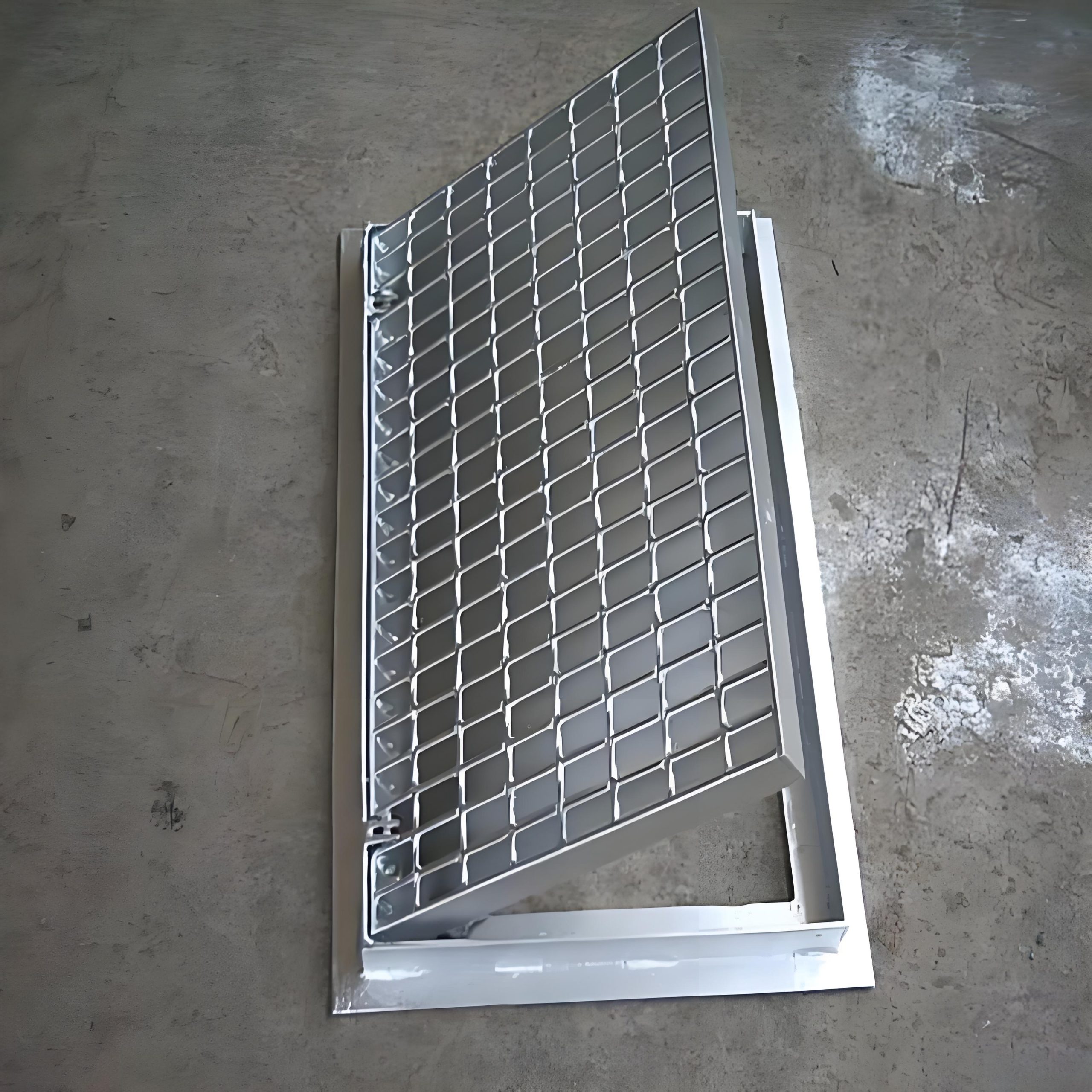
Specification details have an equally strong effect on cost. The bearing bar size is one of the first things a factory checks. A tread made from 25×3 mm bearing bars will cost much less than one made from 40×5 mm or 50×5 mm bars because the steel consumption per square meter rises quickly. Cross bar spacing and bearing bar pitch also matter. A tighter mesh means more steel, more welding points or more press-locking work, and therefore a higher production cost. Common grating pitches such as 30/100 mm, 30/50 mm, or 40/100 mm can vary noticeably in price even when the overall tread dimensions are the same.
Grid opening size affects more than cost. It also affects load performance, drainage, heel safety, and compliance with project standards. If a project requires smaller openings for better foot safety or anti-fall performance, the tread will usually become more expensive because the manufacturing density increases. Buyers often focus on the tread width and length, but the real costing logic goes deeper into the bar arrangement inside that footprint.
Thickness is another hidden price factor. Two stair treads may both be 900 mm long and 270 mm deep, but if one uses heavier flat bars and thicker end plates, it will weigh significantly more and be priced accordingly. The side plate thickness, nosing bar type, and hole preparation for installation all add steel weight and labor time. Factories do not price stair treads only by area; they often calculate by theoretical weight plus processing cost.
Customization also moves the price. Standard treads are easier to batch-produce. Once the order includes non-standard widths, unusual lengths, mixed sizes in one project, or special hole positions, unit cost tends to rise. This is because the production line loses some efficiency. In practical sourcing, stair tread pricing is usually most competitive when the order uses repeatable dimensions and standard grating patterns.
After raw material and specification, the next major pricing factor is how the stair treads are made. In this industry, welded grating and press-locked grating are the two main process routes. Welded grating is very common for industrial stair treads because it offers solid strength and relatively efficient production. For many standard projects, it provides the best cost-performance balance. Press-locked grating can look cleaner and more architectural, but depending on the bar size and finishing requirement, it may cost more due to precision fabrication and a more appearance-sensitive process.
With welded stair treads, the production cost includes steel cutting, bar arrangement, high-pressure welding or manual resistance welding depending on the line, trimming, edge banding, side plate fitting, nosing attachment, hole drilling or punching, and final finishing. If the tread design is simple and repeatable, this process can be done efficiently. If each piece is different, labor cost goes up because positioning, inspection, and finishing all take more time.
Some buyers only ask for the grating panel price and forget that stair treads are not just “small grating pieces.” A finished stair tread usually needs side plates, mounting holes, and a nosing edge. These extra parts add direct material cost and fabrication time. A basic grating panel cut into a tread size may seem cheap at first, but once all stair-specific work is added, the final price changes substantially.
Surface treatment is a separate cost layer and can be significant. Hot-dip galvanizing is one of the most common finishes because it improves corrosion resistance and extends service life in outdoor or humid environments. The galvanizing price depends on zinc market conditions, coating requirement, and the total weight being processed. A heavy zinc coating can be worth the cost in long-term durability, but it should be quoted clearly so the buyer knows what standard is being applied.
Painted finishes are sometimes used for indoor applications or where color coding is required. Paint is usually cheaper upfront than hot-dip galvanizing, but its long-term maintenance can be higher depending on wear and environment. Anti-slip coatings, especially for safety-critical stairs, add another layer of cost. Some projects prefer serrated bearing bars instead of special coatings because mechanical slip resistance can be more durable than a coating that may wear off over time.
From a factory cost perspective, the final tread price is typically a combination of raw steel cost, fabrication labor, process loss, finishing cost, quality inspection, and packing. At Anping County Chuansen Silk Screen Products Co., Ltd., or at most similar manufacturers in the industry, the quote is usually built from this structure rather than from a flat retail-style catalog number. That is why detailed drawings nearly always lead to more accurate pricing than verbal descriptions.
Buyers should clearly distinguish between ex-factory price and end market price. Ex-factory price normally means the cost of the product leaving the factory, without trading markups, destination freight, customs charges, local warehouse overhead, or installer margin. End market price, by contrast, is what the final buyer may see after the product passes through exporters, importers, distributors, and local contractors. The difference can be large, especially in small-volume purchases.
In the current industry, a rough ex-factory reference for standard carbon steel welded stair treads can start from around USD 900 to USD 1,300 per ton for unfinished products, depending on steel market fluctuations and quantity. For hot-dip galvanized standard stair treads, the ex-factory level may often fall in the range of about USD 1,100 to USD 1,600 per ton. When converted by area, many common industrial specifications may roughly land around USD 18 to USD 45 per square meter, but this is only a broad reference. Heavy-duty treads, stainless steel treads, or highly customized treads can exceed that range by a clear margin.
Stainless steel stair treads are in a different pricing class altogether. Depending on grade, bar size, finish, and order complexity, prices can be several times higher than comparable carbon steel products. In real procurement, stainless is usually chosen for environment-driven reasons rather than price efficiency. If corrosion resistance is not critical, galvanized carbon steel remains the mainstream option for many industrial and infrastructure projects.
Batch size has a strong impact on the ex-factory number. A factory can usually offer better rates for larger quantities because material procurement becomes more efficient, machine setup costs are spread over more pieces, and galvanizing or packing can be handled in more economical lots. Small trial orders, mixed-size orders, or sample quantities almost always carry a higher unit price. This is normal in the grating industry and not necessarily a sign that the supplier is overpriced.
Minimum order quantity also matters, although it is not always expressed as a strict fixed number. For some factories, the practical minimum is tied to processing efficiency rather than a hard policy. For example, a very small order of customized stair treads may still be accepted, but the unit cost will rise because production time, tooling preparation, and packaging still have to be covered. Buyers who need the lowest possible price should usually combine sizes, confirm specifications early, and order in batch instead of in many small releases.
Market terminal price includes more than product cost. A local distributor may add inventory risk, financing cost, warehousing, domestic transport, and after-sales handling. This is why a factory-direct quote can look much lower than the local delivered offer. But the buyer should compare on equal terms. A direct factory price is not automatically the cheapest overall if the buyer still needs to handle ocean shipping, customs, and local delivery separately.
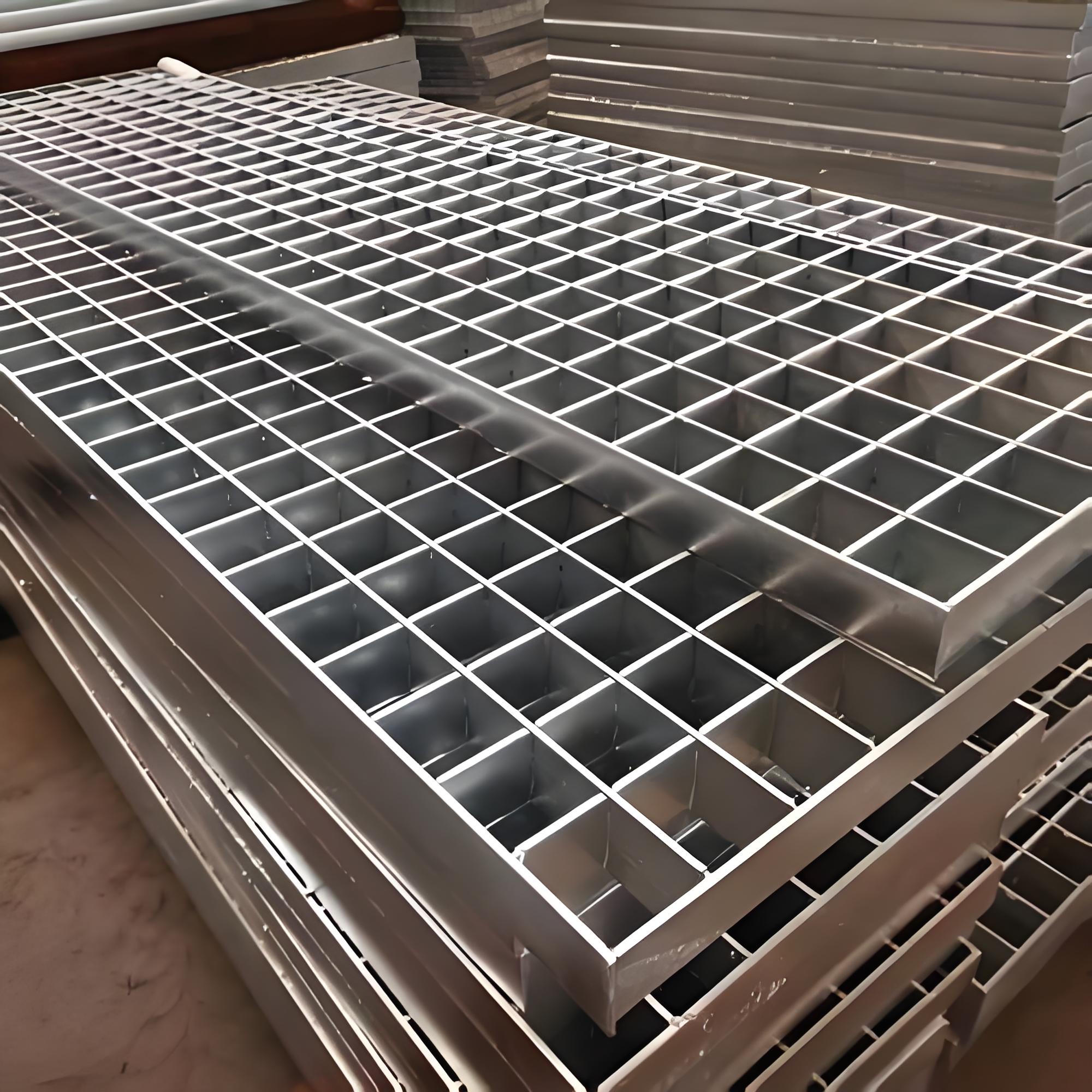
Customized stair treads often involve extra charges beyond the base grating panel. One of the most common add-ons is the anti-slip front edge, also called the nosing. Serrated nosing is widely used because it improves slip resistance in wet, oily, or dusty environments. A flat bar nosing can be cheaper and cleaner in appearance, but it may not provide the same traction level. If the project specification requires a specific nosing profile, that choice should be reflected separately in the quotation.
The reason nosing changes the price is simple: it adds material, fabrication steps, and in some cases more precise finishing. A welded serrated nosing bar needs to be aligned correctly and securely attached. If the tread is galvanized after fabrication, the complete assembly also goes through the zinc bath, which adds cost by weight. On high-volume industrial stair systems, even a small per-piece nosing cost difference can become a visible line item.
Special cutting is another common surcharge area. Standard rectangular treads are straightforward to produce. But once the project includes angled cuts, corner notches, pipe clearances, curved edges, toe-board conflicts, or unusual side plate arrangements, the labor content rises. These details may seem minor on a drawing, yet they can slow production significantly because each piece needs individual attention. Factories typically charge more for irregular shapes because they reduce standardization.
Installation hardware should not be overlooked. Some stair treads are supplied with clips, saddle fasteners, bolts, or custom fixing plates. Others are quoted without hardware, with the assumption that the installer will source locally. If the buyer expects a complete package, the quotation should state exactly what is included. Hardware may not be the most expensive component, but omission can cause confusion later and make price comparisons inaccurate.
Hole preparation can also affect cost. Standard side plate holes are simple, but slotted holes, oversized holes, countersunk requirements, or project-specific hole spacing require more processing and inspection. In some projects, stair treads must match existing structures, which means the hole pattern cannot follow the factory standard. That is a typical reason why replacement treads can cost more than new-build standard treads.
Another possible extra cost is testing or enhanced quality control for custom treads intended for regulated applications. If the project requires specific load verification, coating thickness checks, material traceability, or third-party inspection, these items should be expected in the final price. They are not always included in a basic factory quote unless the buyer asks for them clearly in advance.
Transportation cost can change the final landed price almost as much as fabrication does, especially for heavy steel products. Stair treads are dense, and freight is usually charged by weight, volume, route, and handling method. Buyers often focus heavily on the factory price and then realize later that shipping creates a major cost gap. This is especially true for urgent deliveries, low-volume shipments, or destinations far from major ports.
Packing method matters because it affects protection, handling efficiency, and freight charge. Common packing options include steel strapping in bundles, wooden or steel pallets, and simple loose loading for rugged industrial products. Bundle packing is usually economical and suitable for many grating stair treads. Pallet packing can make loading and unloading easier and may reduce handling damage, but it adds packing material cost and sometimes increases shipping volume.
For sea freight, the buyer should think in terms of container loading efficiency. Stair treads with standard sizes and compact stacking usually ship more efficiently than mixed oversized pieces. Loose irregular treads may waste container space, which raises the freight cost per ton or per square meter. For inland truck transport, the issue is slightly different: local road delivery may depend more on truck type, destination access, unloading equipment, and distance from port or warehouse.
Export packing should also consider surface protection. Hot-dip galvanized treads are generally robust, but if appearance matters, buyers may request separators, edge protection, or more careful stacking to reduce scuffing. Painted or coated treads often need better protection than bare galvanized products. Better packaging reduces risk but adds cost. In a budget-sensitive industrial project, many buyers prefer functional packing rather than cosmetic-level protection.
Import clearance and local delivery are often underestimated. Customs duties, import VAT or GST, broker fees, port handling, terminal storage, inspection charges, and final truck delivery all contribute to the real purchase cost. These items vary by destination country and by local import rules. A buyer asking “How much is the factory price?” should remember that ex-factory and landed cost are very different numbers. In some destinations, local charges can add a meaningful percentage on top of the product value.
As a broad planning reference, domestic delivery in the supplier’s country may be relatively small compared with ocean freight for large export orders, but for small orders the fixed paperwork and handling charges can make transportation disproportionately expensive. That is why combining multiple tread sizes into one shipment and planning procurement ahead of schedule often creates better overall value than placing repeated urgent small orders.
If a buyer wants a fast and accurate quotation, the most important thing is to provide a clear specification package from the beginning. A simple message saying “Please quote steel grating stair treads” is rarely enough. Different factories may assume different bar sizes, pitches, side plates, and finishes, which leads to quotes that are impossible to compare. The better the RFQ detail, the better the pricing accuracy.
The first item a factory wants is the drawing or at least a detailed dimension sheet. This should include tread width, tread depth, bearing bar size, bearing bar spacing, cross bar spacing, side plate dimensions, hole diameter, hole position, and required nosing type. If there are multiple sizes, the quantity of each size should be listed separately. Mixed projects often create quotation errors when buyers send only a total quantity without size breakdown.
Surface treatment requirements should always be stated clearly. If the treads need hot-dip galvanizing, the buyer should mention it directly rather than assuming it is standard. If paint color, anti-slip coating, or stainless steel polishing is needed, that must also be included. In many cases, one supplier may quote black steel while another quotes galvanized steel, and the buyer may wrongly believe one offer is simply cheaper. This confusion is easy to avoid with a precise RFQ.
Quantity is essential not only for total cost but for unit pricing. Factories usually calculate one price for sample quantity, another for small batch, and another for full production quantity. If the project will be phased, it helps to say whether the buyer wants pricing for a single release or for the total annual demand. A supplier can often optimize material use better when the expected total volume is known.
Buyers should also mention whether certifications or inspection documents are required. Common requests include ISO-related quality documentation, material certificates, galvanizing inspection reports, or compliance support for workplace safety expectations such as OSHA-related project needs. Not every project requires this paperwork, but when it is needed, the supplier should know before quoting because document preparation, testing, and third-party review can add cost and lead time.
Another useful item is the application environment. The same tread may be used in a warehouse, wastewater plant, offshore platform, public stairway, or food facility. Environmental context helps the factory recommend whether carbon steel, galvanized steel, or stainless steel makes better sense. It also helps avoid under-specifying the product just to get a lower initial quote.
Lead time expectation should be included as well. If the buyer needs fast production, overtime scheduling, priority galvanizing, or split shipment may raise the price. A normal lead time usually allows the factory to offer a more stable cost. In practical sourcing, some “expensive” quotes are simply urgent-production quotes, while lower quotes may assume a standard schedule.
How much does galvanized steel bar grating stair tread cost per piece?
For standard industrial sizes, a rough market reference can be around USD 8 to USD 35 per piece at ex-factory level, but the real number depends on bearing bar size, tread dimensions, side plates, nosing, galvanizing, and quantity. Light-duty standard pieces in bulk are usually at the lower end, while heavy-duty or customized treads are higher. The most reliable way to estimate per-piece price is to send the drawing and quantity list.
Is it cheaper to buy stair treads directly from a factory or from a local distributor?
Factory-direct purchasing often gives a lower product price, especially for medium and large orders, but it does not automatically mean the lowest landed cost. Buyers still need to consider freight, customs clearance, inland delivery, and coordination time. For large-volume projects, factory-direct sourcing is often more economical. For small urgent jobs, a local distributor may cost more per piece but save time and logistics effort.
What information is needed to get an accurate stair tread quotation from a manufacturer?
The key items are tread drawing, dimensions, bearing bar specification, grating pitch, quantity of each size, surface treatment, nosing type, side plate details, installation hardware requirement, and destination country. If certifications, test reports, or OSHA- or ISO-related documentation are needed, that should be stated at the RFQ stage. Without these details, suppliers may quote different assumptions and the prices will not be directly comparable.