

Welded steel bar grating is a practical choice when a project needs strength, drainage, airflow, and safe footing at the same time. It is widely used in walkways, working platforms, and trench or channel covers because the open-grid structure helps water, dirt, and light pass through while still carrying people or equipment loads. For buyers, the real challenge is not just choosing “steel grating,” but choosing the right grating specification for the actual use. A walkway panel, a maintenance platform, and a drainage cover may all look similar at first glance, but the bar size, spacing, surface treatment, fixing method, and load requirement can be very different.
Welded steel bar grating is made by joining load-bearing flat bars with cross bars to form a rigid grid structure. The flat bars carry the main load, while the cross bars keep the panel square, stable, and evenly spaced. In standard production, the most common manufacturing method is resistance pressure welding. This process uses pressure and electric current to fuse the cross bars to the bearing bars at every intersection, creating a strong and consistent panel.
Manual welding is also used, especially for custom sizes, special shapes, small production runs, or heavy-duty pieces that need extra fabrication work. In practical purchasing, it is important to know whether the supplier is offering resistance-welded grating or hand-welded grating, because the cost structure, production efficiency, and consistency can be different.
The two most common materials are carbon steel and stainless steel. Carbon steel is the mainstream option because it is economical, easy to process, and suitable for most industrial and municipal jobs. Stainless steel is usually selected when corrosion resistance, hygiene, or appearance matters more, such as in food plants, pharmaceutical facilities, coastal projects, or wastewater treatment systems.
Surface finish also matters a lot. Carbon steel grating can be supplied as black steel, electro-galvanized, or hot-dip galvanized. Black steel is the most basic and lowest-cost option, but it needs paint or other protection if rust is a concern. Electro-galvanized grating has a thinner zinc coating and is more suitable for indoor or dry environments. Hot-dip galvanized grating is the most common outdoor choice because it provides better long-term corrosion protection.
The three main application scenarios are walkways, platforms, and drainage. Walkways focus more on safe footing and comfortable walking. Platforms need stronger load capacity because they may carry people, tools, and equipment. Drainage covers need the right opening ratio so water can pass through while debris is blocked as much as possible. Even though these three uses all fall under welded steel bar grating, they should not be specified in the same way.
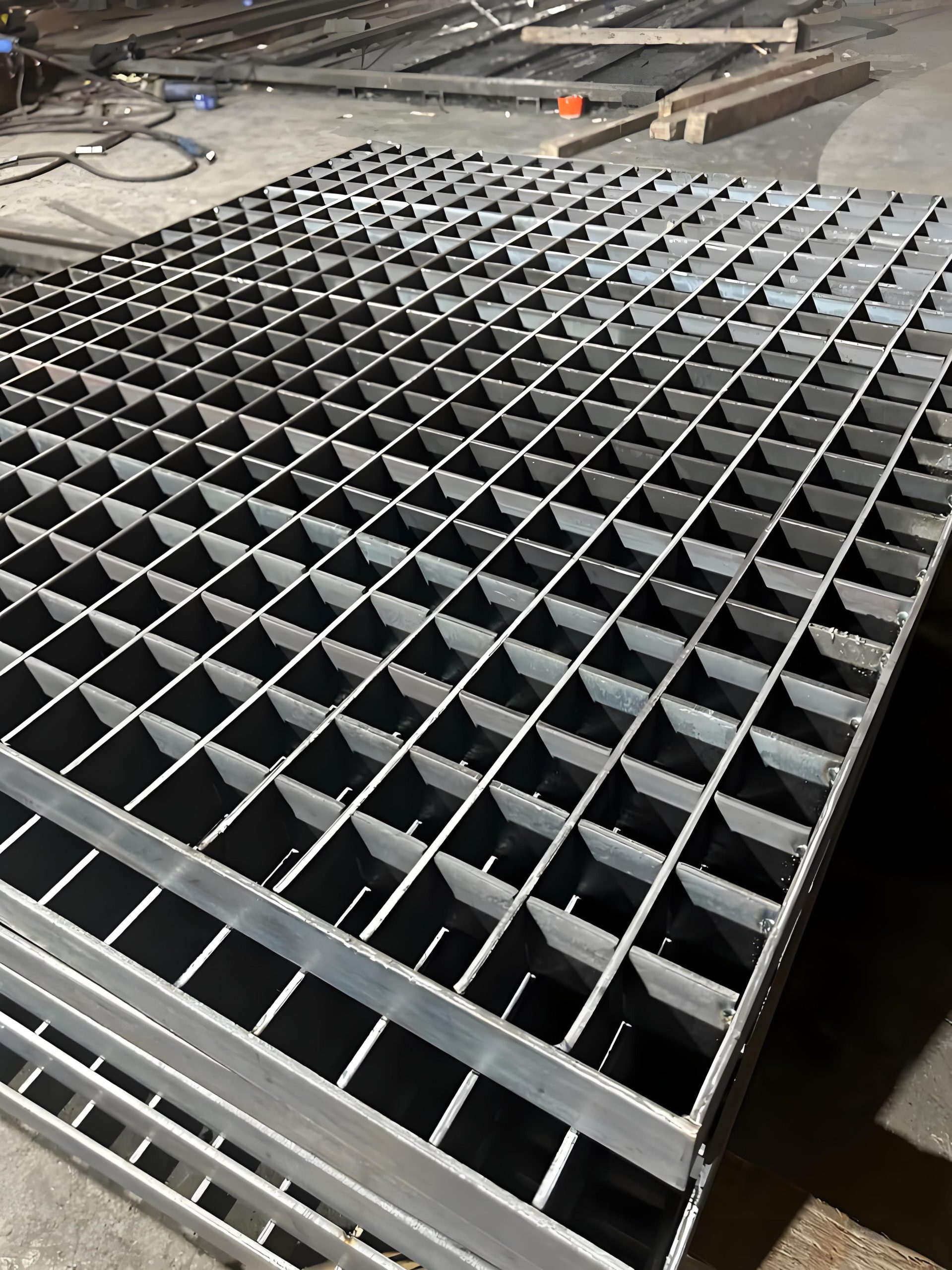
Walkway grating is usually designed around pedestrian safety, moderate loading, and slip resistance. In many projects, a bearing bar height of 25 mm to 32 mm and a thickness of 3 mm to 5 mm is a practical starting range. This range works well for general access paths, service walkways, rooftop routes, and plant maintenance passages where the load is mainly foot traffic with occasional tools or light carts.
Bearing bar spacing is especially important for walkways. In most cases, the center spacing should be 30 mm or less. Tighter spacing gives better foot support and reduces the chance of heels, tools, or small parts catching in the openings. For sites with frequent pedestrian traffic, a 30 mm pitch is often the standard balance between comfort, drainage, and cost. If smaller gaps are required, 20 mm or 15 mm spacing can also be used, though the price will go up.
Slip resistance should never be treated as a minor detail. For outdoor walkways, wet areas, oil-prone industrial environments, or stair access, serrated bearing bars are often preferred because they provide better grip than plain bars. A hot-dip galvanized finish is also commonly chosen for outdoor anti-corrosion performance. In some special cases, a sand-coated or anti-slip painted finish may be added, but this depends on the environment and maintenance expectations.
For cross bar spacing, 100 mm is the standard choice for many walkway panels. It offers enough panel stability for normal pedestrian use and is economical. If the project calls for higher density, a firmer walking feel, or stronger overall rigidity, 50 mm cross bar spacing can be used instead. This denser layout increases steel consumption and usually raises the price, but it can be worth it in busy access areas.
Installation for walkways is usually done in one of two ways. Permanent walkways are often welded directly to steel supports. This is simple and solid, but it makes future removal harder. If access under the grating is needed for maintenance, installation clips are often the better choice. Clips hold the panel securely while allowing easy removal without cutting or re-welding.
Platform grating usually needs to handle more demanding loads than ordinary walkways. In many industrial applications, the recommended bearing bar range is 32 mm to 50 mm in height and 5 mm to 6 mm in thickness. These specifications are commonly used for equipment platforms, operator floors, mezzanine service decks, and maintenance areas where both people and machinery-related loads may be present.
For bearing bar spacing, 30 mm to 40 mm is typical for platforms. A 30 mm pitch is the more conservative option when load and stiffness are important. A 40 mm pitch can reduce weight and cost if the platform is not heavily loaded and open area is preferred. The final choice should depend on span, working load, and how the platform will actually be used.
Load capacity is the main design factor for platforms. Some platforms only support maintenance personnel and hand tools, which falls into medium-duty use. Others support equipment, dense worker traffic, storage loads, or rolling loads, which pushes the grating into heavy-duty selection. This is why platform grating should never be chosen only by appearance or habit. The bar size must be tied to the actual span and expected load.
Cross bar spacing of 50 mm is often recommended for platforms because it improves overall rigidity. A denser cross bar layout helps the panel feel more stable underfoot and can be useful in areas with repeated traffic or vibration. Compared with 100 mm spacing, it adds cost, but on industrial platforms that extra stiffness is often desirable.
Edge treatment is also more important on platforms than many buyers expect. Platform panels are usually fully banded on all four sides to protect the bearing bar ends, improve handling strength, and maintain panel shape during installation. It is also common to leave mounting holes or weld ear plates for easier fixing to support beams or frames. These details should be confirmed before production, not added later on site.
For drainage applications, welded steel bar grating is commonly used as a grating cover for trenches, channels, and surface drainage lines. The basic goal is simple: let water pass quickly while still covering the opening safely. But in practice, drainage cover design depends on whether the area is pedestrian-only, light vehicle traffic, or heavy-duty traffic.
A bearing bar spacing of 30 mm to 40 mm is commonly used for drainage covers because it offers a workable balance between water flow and debris interception. If the spacing is too wide, more debris may fall into the trench. If it is too narrow, drainage efficiency can drop and cleaning may become more frequent. For general factory drains and roadside channels, 30 mm or 40 mm spacing is often the most practical choice.
Cross bar spacing of 100 mm is widely used for drainage grating because it keeps the panel open enough to reduce clogging from leaves, dirt, or solid waste. In many drainage situations, too many cross bars can actually make cleaning more difficult. That is why the standard 100 mm layout is often preferred unless there is a special structural reason to tighten it.
Drainage covers may need an openable design. Common options include hinges, locking latches, or lift-out frame systems. Hinged grating covers are useful where frequent cleaning or trench inspection is needed. Lockable covers help prevent theft, accidental movement, or unauthorized access. Lift-out frames are simple and practical for service trenches that must be opened occasionally.
Typical applications include roadside gutters, factory drainage trenches, parking area drains, and wastewater treatment facilities. In these environments, buyers should pay close attention not only to load rating, but also to frame design, opening method, and corrosion resistance. A drain cover is not just a panel; it often works as part of a frame-and-cover system.
Welded steel bar grating specifications are usually defined by five basic dimensions: bearing bar height, bearing bar thickness, bearing bar center spacing, cross bar spacing, and finished panel size. Without these details, it is difficult to quote accurately or compare suppliers fairly.
The bearing bar height typically ranges from 25 mm to 100 mm, and the thickness usually ranges from 3 mm to 6 mm. Common combinations include 25 x 3 mm, 30 x 3 mm, 32 x 5 mm, 40 x 5 mm, 50 x 5 mm, and 75 x 6 mm. In simple terms, taller and thicker bars mean more strength and more weight.
Bearing bar center spacing options commonly include 12.5 mm, 15 mm, 20 mm, 30 mm, and 40 mm. Tighter spacing gives better support and smaller openings, but it also increases material use and cost. A 30 mm pitch is one of the most common choices across industrial projects. A 40 mm pitch is more economical. Smaller spacings are used where finer openings or better foot comfort are needed.
Cross bar spacing is usually 50 mm or 100 mm in standard production. Custom spacing such as 30 mm or 76 mm can also be made when the project demands it. In general, 50 mm gives better stiffness, while 100 mm is more open and more economical.
Standard production panel sizes often include widths around 1 m or 1.22 m and lengths of 4 m or 6 m, although most finished orders are cut to project size. Customization is very common. Buyers may need rectangular panels, notched pieces, pipe openings, toe plate preparations, or special-shaped covers. These fabrication details affect both price and lead time.
Load capacity must be tied to the actual application. For walkways, a light-duty load range of about 2 to 4 kN/m² is common. In these cases, a recommended support span is often 1000 mm or less, depending on the bearing bar size and deflection requirement. This is suitable for ordinary foot traffic and maintenance access.
For medium-duty platforms, a typical design range is about 4 to 7 kN/m². A practical recommended span is often up to 1200 mm, again depending on the flat bar size and support conditions. This type of loading is common on industrial operating floors, machine access decks, and service platforms with moderate worker density.
For heavy-duty platforms, once the load reaches 7 kN/m² or higher, the grating usually needs a heavy-duty series with a smaller span, often 800 mm or less unless a larger bar size is used. Heavy-duty conditions include equipment platforms, dense loading areas, and projects with concentrated loads that create more stress than uniform pedestrian traffic.
Drainage covers are selected differently because the load depends on whether people only walk across them or whether vehicles pass over them. A pedestrian trench cover may use a relatively light specification. A parking lot or service road drain cover may need a much stronger grating and frame system. Buyers should clearly state whether the cover is for foot traffic, carts, passenger vehicles, or heavier service vehicles.
As a quick reference, 25 x 3 mm bearing bars are usually suitable only for short spans and lighter use. A 32 x 5 mm bearing bar is often a standard industrial option for moderate spans. A 50 x 5 mm or 50 x 6 mm bar is more commonly used for stronger platform and cover requirements. These are not universal rules, but they are useful as a starting point before checking an actual load table.
It is also important to ask how deflection is being controlled. Many calculations are based on a limit such as span/200 or span/100. If two suppliers provide the same load value but use different deflection criteria, the comparison is not equal. For real procurement, requesting a load calculation sheet is the safest approach.
The biggest price driver is the grating specification itself. The higher and thicker the bearing bar, the more steel is used, so the cost rises. Denser spacing also increases price because more bars are required per square meter. This means a 20 mm pitch grating will usually cost more than a 30 mm pitch grating, and a 30 mm pitch grating will usually cost more than a 40 mm pitch grating.
Surface treatment is another major cost factor. Hot-dip galvanized grating is usually more expensive than electro-galvanized grating, and both are more expensive than black steel. That said, the cheapest option up front is not always the cheapest in service. If the grating is installed outdoors or in a wet industrial area, paying more for hot-dip galvanizing is often the smarter long-term choice.
Fabrication work adds cost quickly. Cutting, banding, punching, adding mounting holes, installing hinges, and making a frame for drainage covers all require labor beyond the base panel price. For custom drainage covers, the hinge and frame system can be a noticeable part of the total cost, not just a small accessory.
For budget planning, industry reference prices may look roughly like this: light black steel grating for simple walkways may start around USD 12 to USD 22 per square meter; standard hot-dip galvanized industrial grating often falls around USD 22 to USD 40 per square meter; heavier-duty galvanized panels can move into the USD 38 to USD 70 per square meter range or higher depending on bar size and fabrication. Stainless steel grating is usually much higher.
Cost optimization usually comes from using standard specifications, ordering in batch quantities, and selecting the right galvanizing level instead of over-specifying every detail. It also helps to standardize panel sizes where possible. If every panel is different, fabrication cost goes up. When discussing a project with a manufacturer such as Anping County Chuansen Silk Screen Products Co., Ltd., buyers should ask whether the quote includes banding, galvanizing, cut-outs, and packing to avoid later surprises.
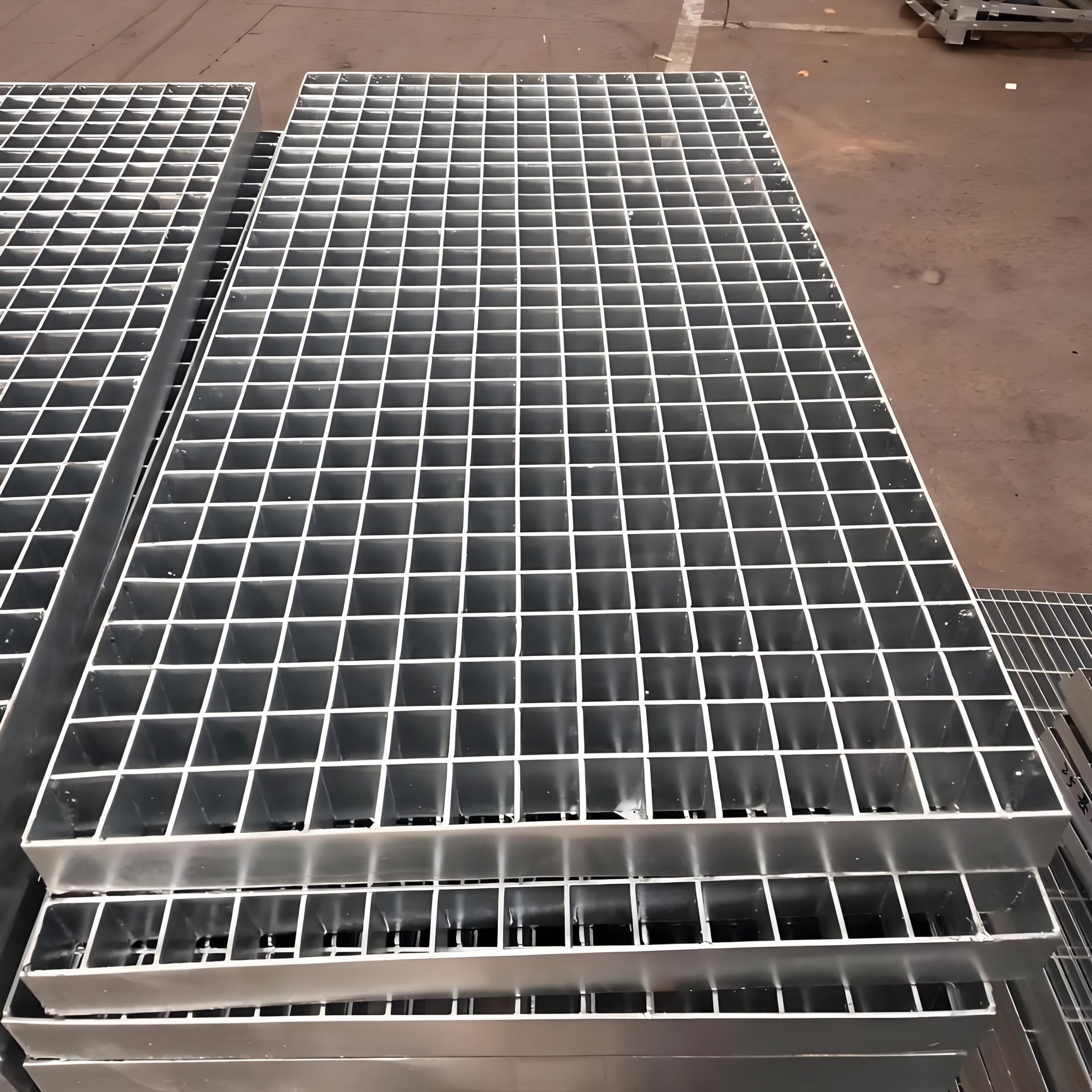
For dry indoor environments, black steel with anti-rust paint or electro-galvanized finishing can be acceptable. This is often used in interior mechanical rooms, sheltered service platforms, or low-corrosion industrial spaces. The main reason buyers choose these finishes is lower cost.
For general outdoor use, hot-dip galvanizing is usually the preferred option. It offers stronger corrosion resistance and a more realistic service life in normal exposed conditions. In many industrial and municipal projects, a service life of around 8 to 12 years is a practical expectation, though actual performance depends on local climate, pollution, and maintenance.
For wet, corrosive, or chemically aggressive environments, a thicker hot-dip galvanized coating or a heavier anti-corrosion coating system may be necessary. This includes coastal areas, wastewater zones, fertilizer plants, chemical sites, and washdown-heavy facilities. In these places, standard indoor-type finishing is usually not enough.
For food processing, pharmaceutical, or hygiene-sensitive projects, stainless steel welded grating is often the better choice. It costs more, but it avoids many coating-related issues and is easier to maintain in clean environments. In these applications, the material decision is usually driven by hygiene and corrosion performance rather than by the lowest initial price.
For permanent walkway and platform installations, welding is the most common fixing method. The grating is welded directly to the support steel at selected points. This provides strong attachment and is widely used in industrial structures where removal is not expected.
For removable walkway or platform panels, installation clips are more practical. Clips are especially useful when there is a need to inspect pipes, cables, channels, or equipment below the grating. They also avoid damage to galvanized coating that can happen with on-site welding if touch-up is not handled properly.
For drainage grating covers, an embedded frame with hinges is a common solution. The frame is fixed into the concrete or steel channel edge, and the grating cover sits or swings within that frame. This makes opening and cleaning easier, especially in maintenance-heavy drainage systems.
For heavy-duty drainage covers, a stronger frame with embedded supports and bolt fixing may be necessary. This is common in traffic areas or industrial yards where the cover must resist movement under repeated load. In these cases, the frame design is just as important as the grating panel itself, because poor support can lead to early failure even if the panel specification looks strong enough.
Welded steel bar grating is generally the more economical and widely used option. It fits a broad range of industrial and municipal applications, especially where function matters more than decorative appearance. For walkways, standard platforms, and many drainage covers, welded grating is often the first choice because it balances strength, availability, and cost well.
Press-locked grating has a flatter and more uniform appearance because the bars are mechanically locked together rather than joined in the same welded pattern. It is often selected for projects where aesthetics matter more, such as commercial buildings, architectural facades, public spaces, or premium interior applications.
In many cases, press-locked grating can also deliver high load performance, but it usually comes at a higher price. Buyers should not assume it is automatically better for every job. If the project is a utility platform or drainage cover in an industrial plant, welded grating is often the more practical choice. If the project is visible, design-sensitive, or requires a refined surface appearance, press-locked grating may be worth the extra cost.
The best way to choose is by scenario. For cost-controlled industrial flooring, welded grating usually makes more sense. For architectural or premium visual applications, press-locked grating may be the better fit. The decision should be based on use, not just on product type names.
Before placing an order, the first thing to confirm is the application: walkway, platform, or drainage. This sounds basic, but it directly affects load class, spacing, edge treatment, and fixing method. A grating panel for walking access is not automatically suitable for a machine platform or vehicle drain cover.
Next, confirm the bearing bar specification, bearing bar spacing, and cross bar spacing. These three details define the structural core of the product. If a quotation only says “steel grating” without these values, it is not complete enough for technical comparison.
Surface treatment must also be stated clearly, including the type of finish and, if relevant, coating thickness. “Galvanized” alone can be too vague. Buyers should know whether the product is hot-dip galvanized or electro-galvanized, especially when corrosion resistance is important.
Dimensions should include the length and width of each panel as well as the total quantity. If the order includes multiple panel sizes, a cutting list is usually needed. For drainage covers, it is also necessary to confirm whether the frame is included and whether the clear opening size or outer frame size is the controlling dimension.
Special fabrication requirements should be listed before production starts. These may include edge banding, holes, cut-outs, hinges, lifting holes, lock devices, or support frames. Many procurement issues happen not because the grating was poorly made, but because the fabrication details were not fully communicated.
Finally, request a load capacity calculation sheet and, where needed, a test report. This is especially important for platforms, public-access walkways, and drainage covers in traffic zones. A proper document helps confirm that the chosen specification matches the real service conditions rather than just a generic catalog assumption.
What is the best welded steel bar grating for outdoor walkways?
For outdoor walkways, a common and practical choice is carbon steel welded grating with hot-dip galvanizing, serrated bearing bars, bearing bar height around 25 mm to 32 mm, thickness 3 mm to 5 mm, and bearing bar spacing at or below 30 mm. This combination gives good corrosion resistance, better slip performance, and comfortable pedestrian use in most industrial or municipal settings.
How do I choose grating load capacity for a platform?
Start with the actual support span and the real working load, including both people and equipment. Then choose a bearing bar size that can safely carry that load at the given span while meeting the required deflection limit. For medium-duty platforms, 32 x 5 mm or larger is often a starting point. For heavier conditions, buyers usually move to 40 x 5 mm, 50 x 5 mm, or stronger sections and reduce the span if needed. A formal load calculation sheet should always be checked before ordering.
Is hot-dip galvanized grating better than electro-galvanized grating for drainage covers?
In most cases, yes. Drainage covers are often exposed to rain, standing water, mud, cleaning chemicals, or wastewater, so hot-dip galvanizing is generally the better option because the zinc coating is thicker and more durable. Electro-galvanized grating may work indoors or in relatively dry areas, but for outdoor drains, factory trenches, and parking areas, hot-dip galvanized grating is usually the safer long-term choice.