

Welded steel bar grating is one of the most widely used metal flooring and drainage products in industrial, municipal, and commercial projects because it offers a practical balance of strength, ventilation, drainage, and cost. Buyers usually compare three things first: price, size, and load capacity. In real purchasing work, however, these three factors are closely linked. A lower price often means a lighter bar size, wider spacing, simpler finish, or lower welding cost, while a higher load requirement usually pushes the specification, galvanizing standard, and fabrication difficulty upward. To choose the right product without overpaying or under-specifying, it is important to understand how welded steel bar grating is made, how its dimensions are defined, how load ratings are calculated, and which options actually affect long-term performance.
Welded steel bar grating is a grid-like panel made by joining load-bearing flat bars with cross bars at regular intervals. The flat bars run in one direction and carry the main load, while the cross bars hold the panel together, maintain spacing, and improve overall stability. This simple structure is what gives welded grating its high strength-to-weight ratio and makes it suitable for platforms, trench covers, walkways, stair treads, mezzanines, catwalks, and equipment access areas.
The most common manufacturing method is resistance pressure welding. In this process, cross bars are pressed into the bearing bars under high pressure and electric current, creating a fused joint at each intersection. This method is efficient, consistent, and widely used for standard industrial grating. It is especially suitable for large production volumes because it provides uniform weld quality and good dimensional repeatability.
Manual welding is also used in the market, especially for small batch production, heavy-duty custom panels, irregular shapes, and repair work. Compared with pressure-welded panels, hand-welded grating may have higher labor cost and more variation from panel to panel, depending on workmanship. That does not automatically make it inferior, but buyers should clearly distinguish between machine pressure welding and hand welding when comparing quotations.
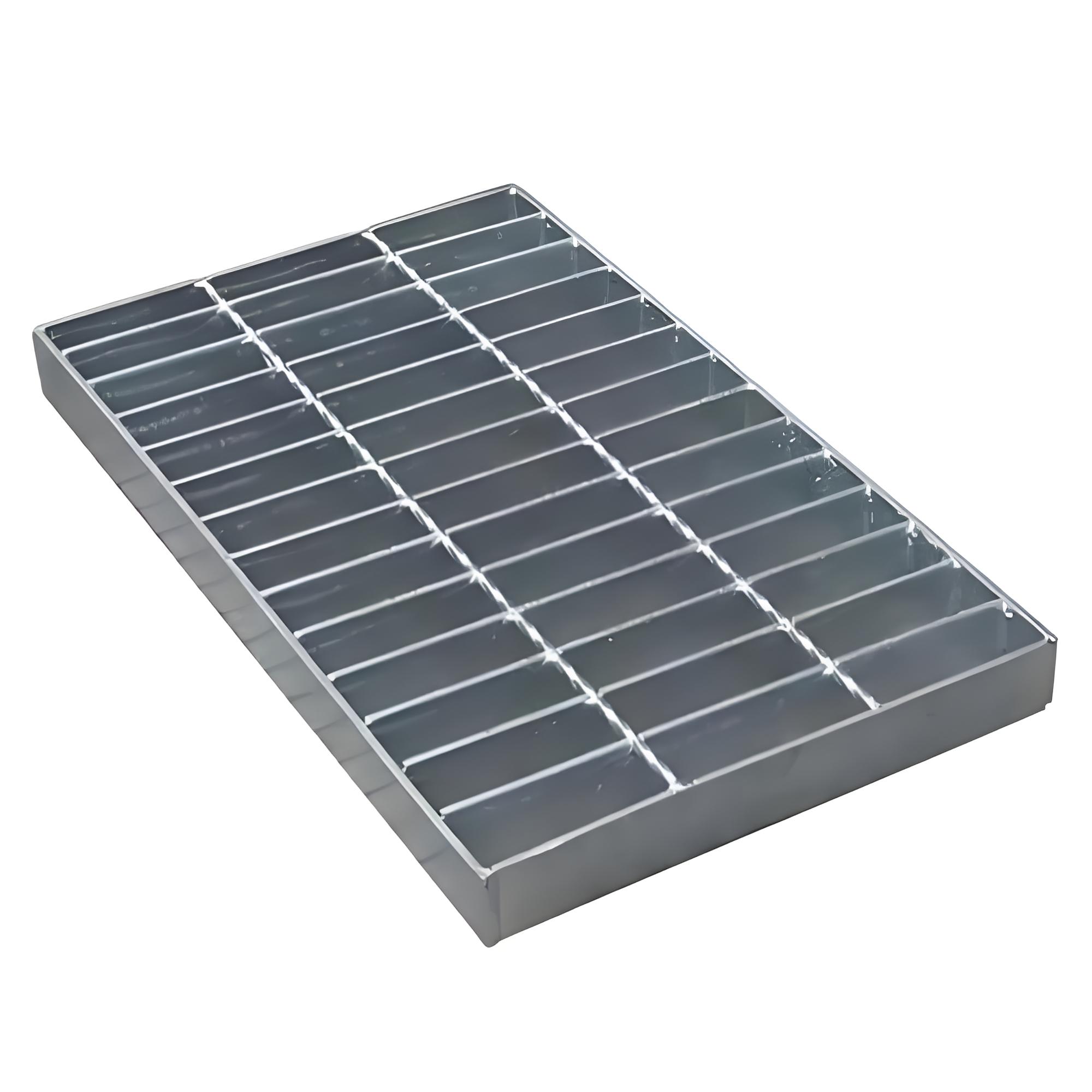
In terms of material, carbon steel is the mainstream choice because it is economical, easy to process, and available in a wide range of flat bar sizes. Stainless steel welded grating is selected when corrosion resistance, hygiene, or appearance is a priority, such as in food plants, chemical facilities, pharmaceutical sites, wastewater treatment, or coastal environments. Stainless grades such as 304 and 316 are common, with 316 usually priced higher because of its better chloride resistance.
Surface treatment also plays a major role in service life and price. Hot-dip galvanized welded grating is the most common option for outdoor or corrosive applications because the zinc layer provides durable anti-rust protection. Electro-galvanized grating is cheaper and has a cleaner appearance, but its coating is thinner and better suited for relatively dry indoor environments. Black steel grating refers to untreated carbon steel and is the lowest-cost option, but it will rust unless it is painted or used in very controlled conditions. Painted grating can improve appearance and offer limited protection, but in many industrial projects it is still less durable than hot-dip galvanizing.
When buyers ask for the “size” of welded steel bar grating, they are usually referring to several dimensions at the same time: bearing bar height, bearing bar thickness, bearing bar spacing, cross bar spacing, and overall panel size. If even one of these is missing from the inquiry, the quotation may not be accurate.
The bearing bar is the core structural element. Common bearing bar heights range from 25 mm to 100 mm, while thickness typically ranges from 3 mm to 6 mm. For example, 25 x 3 mm, 30 x 3 mm, 32 x 5 mm, 40 x 5 mm, 50 x 5 mm, and 75 x 6 mm are all practical industrial sizes. In general, a taller and thicker bearing bar can span farther and carry more load, but it also increases weight and price.
Bearing bar center spacing is another key variable. Common options include 12.5 mm, 15 mm, 20 mm, 30 mm, and 40 mm. Among these, 30 mm is often treated as the standard spacing for general industrial use because it provides a good balance between load performance, open area, drainage, and cost. A 40 mm spacing is often used when economy and higher open area are priorities. Tighter spacings such as 20 mm, 15 mm, or 12.5 mm are selected for small object retention, higher pedestrian comfort, or special safety requirements.
Cross bar spacing is usually 50 mm or 100 mm in standard production. A 100 mm cross bar pitch is common in many standard grating panels, while 50 mm spacing improves panel rigidity and is often preferred in heavier-duty designs. Custom spacings such as 30 mm or 76 mm are also possible for special architectural, mechanical, or platform requirements. When spacing becomes denser, the panel usually becomes more expensive because it requires more steel and more welding points.
Standard panel dimensions often include widths of about 1 m or 1.22 m, and lengths of 4 m or 6 m before cutting. These are practical production sizes because they match common raw material and galvanizing arrangements. However, finished grating panels are frequently custom-cut to suit the project layout. Openings, notches, kick plate areas, edge banding, and non-rectangular shapes are all common in real orders.
From a product series perspective, welded steel bar grating can be grouped into light-duty, standard-duty, and heavy-duty ranges. Light-duty series typically use lower flat bars such as 25 x 3 mm or 30 x 3 mm and are suited for pedestrian walkways or low-load covers. Standard-duty series often include 32 x 5 mm or similar bars for industrial flooring and plant access. Heavy-duty series use larger bars such as 50 x 5 mm, 50 x 6 mm, or even deeper sections where forklifts, wheel loads, or high concentrated loads are expected.
Load capacity is one of the most misunderstood parts of grating selection. A grating panel does not have one universal load number. Its actual performance depends on the bearing bar size, spacing, steel grade, support span, load type, and allowable deflection limit. That is why a panel that works well in one project may fail in another if the span changes.
There are three load types buyers should know. Uniformly distributed load means the load is spread over the panel surface, such as workers walking or materials stored across a platform. Line load means the force is applied along a narrow strip, which can happen in some equipment support conditions. Concentrated load means the force is applied at a small point or limited area, such as a wheel, jack point, or equipment leg. Concentrated load is usually more demanding than uniform load and should never be ignored in equipment zones.
Span and deflection are closely related. Span is the clear support distance in the direction of the bearing bars. Deflection is how much the panel bends under load. In many practical designs, maximum deflection is limited to span/200 or span/100 depending on the application standard and service expectation. A stricter limit such as span/200 gives a stiffer panel and better walking feel, while span/100 may be accepted in less sensitive heavy-duty conditions. Buyers should confirm which deflection criterion is used when comparing load tables.
As a quick practical reference, lighter grating such as 25 x 3 mm at 30 mm bearing bar spacing is often suitable only for short spans around 300 mm to 500 mm under pedestrian-type loading. A standard industrial bar such as 32 x 5 mm at 30 mm spacing may work around 700 mm to 1000 mm depending on the load and deflection limit. Heavier bars like 50 x 5 mm or 50 x 6 mm may support spans around 1000 mm to 1500 mm or more under moderate industrial loads, but exact values must be checked against manufacturer calculations.
Another useful way to think about grating is by broad load class. Light-duty grating is used for foot traffic, ceiling platforms, and low-risk service access. Medium-duty grating is common for industrial walkways, equipment platforms, and trench covers with occasional carts or denser traffic. Heavy-duty grating is used for vehicle areas, high-load process plants, loading zones, and places where concentrated loads matter. The same 30 mm bearing bar spacing can appear in all three classes, but the flat bar height and thickness change significantly.
For procurement purposes, many buyers ask for a span-load quick check. As a rough guide only, G203/30/100 is often considered light and used on short spans; G325/30/100 is one of the most common standard industrial choices; G505/30/50 is a typical heavy-duty configuration where stronger support is needed. These references are useful for discussion, but they are not a substitute for a proper loading sheet or engineering verification.
The price of welded steel bar grating is built from several layers, and raw material cost is the starting point. The main steel cost comes from the bearing flat bars and cross bars. Since the bearing bars account for most of the weight and load performance, they usually have the largest impact on final price. Material grade also matters. Carbon steel is the baseline. Stainless steel adds a large premium because of both material cost and fabrication difficulty.
Specification has a direct and predictable effect on price. The higher and thicker the bearing bar, the heavier the panel becomes, so the steel consumption increases. If spacing becomes denser, more bearing bars and more cross bars are required per square meter, which pushes up both material usage and welding workload. A 20 mm bearing bar pitch will normally cost more than a 30 mm pitch, and 30 mm will usually cost more than 40 mm.
Surface treatment adds another major cost layer. Hot-dip galvanizing is generally more expensive than electro-galvanizing, and both cost more than black steel. The difference is not just the zinc material itself. Galvanizing also involves pretreatment, pickling, fluxing, immersion, drainage, and quality control. For outdoor industrial projects, however, the extra cost of hot-dip galvanizing is often justified because replacing rusted grating later is much more expensive than paying for proper protection at the beginning.
Welding method can also affect price. Resistance pressure-welded grating is usually more economical for standard specifications and larger production runs because it is efficient and repeatable. Hand-welded grating may cost more due to labor intensity, especially for heavy bars, custom-shaped pieces, or small quantities. If two quotations look similar on paper but one is pressure-welded and the other is manual, buyers should not assume the production cost or consistency is the same.
Processing charges are often underestimated. Cutting panels to exact dimensions, adding banding bars, making openings for pipes, notching around columns, drilling, welding kick plates, and producing special-shaped panels all create extra labor. In many projects, these fabrication details matter more than the base grating panel. Freight packaging can also affect cost, especially when buyers require pallet packing, steel-frame packing, or export-grade loading protection.
Because steel prices, zinc prices, order quantity, and regional labor costs change frequently, it is better to treat any quoted amount as a market reference rather than a fixed rule. Still, buyers often need a rough number for budgeting, and that is reasonable.
For a light and economical configuration such as G203/30/100 in black steel, the market reference is often around USD 12 to USD 22 per square meter for standard volume orders. If the quantity is small, if many cut pieces are needed, or if edge banding is heavy, the price can move higher. This type is commonly used in low-load indoor service areas where corrosion is not the main concern.
For a standard industrial configuration such as G325/30/100 with hot-dip galvanizing, a common reference range is about USD 22 to USD 40 per square meter. This is one of the most frequently purchased categories because it works for many plant walkways, trench covers, operating platforms, and access zones. In many cases, this is the point where cost and performance are balanced well enough for general industrial procurement.
For a heavy-duty industrial configuration such as G505/30/50 with hot-dip galvanizing, the price may fall roughly in the range of USD 38 to USD 70 per square meter, sometimes higher if the panel includes heavy edging, custom cuts, or strict galvanizing requirements. This type is often used where span is longer, deflection limits are tighter, or heavier loads need to be carried safely.
Stainless steel welded grating is in a very different price bracket. Depending on grade, size, and fabrication complexity, stainless welded grating may start around USD 80 per square meter and go well above USD 180 per square meter. Grade 316 is usually more expensive than 304. If the grating includes pickling, passivation, or polished finishing requirements, cost rises further. For buyers who truly need corrosion resistance or hygiene performance, stainless steel can still be cost-effective over the long term.
When discussing pricing with a manufacturer such as Anping County Chuansen Silk Screen Products Co., Ltd., buyers should clarify whether the quoted unit is based on square meter, panel, or tonnage, and whether the quote includes banding bars, galvanizing, cutting, and packing. A low unit number can look attractive until all necessary fabrication items are added later.
The first step is to define the application clearly. Is the grating for a pedestrian walkway, drainage trench, equipment platform, stair tread, forklift lane, or offshore plant access area? The answer changes everything. A simple maintenance walkway may only need light to standard grating, while a loading area with wheel traffic may require heavy-duty bars, closer spacing, and strict deflection control.
The second step is to use the support span to choose a starting bearing bar height. A practical trial method is to begin with the expected span, estimate the working load, then select a likely bearing bar size and check whether the load table confirms it. If the result is not enough, move up to a higher or thicker bar. For example, if a short span is involved, 25 mm or 30 mm bars may be enough. If the span increases to around 1 meter or more under industrial load, many buyers start checking 32 x 5 mm, 40 x 5 mm, or 50 x 5 mm options.
The third step is to choose bearing bar spacing. A 30 mm spacing is the standard choice for most industrial applications. It gives a good compromise between strength, drainage, and cost. A 40 mm spacing can reduce weight and price when the load is moderate and object retention is not critical. A 20 mm spacing is denser and often chosen where smaller items must not fall through, where foot comfort matters, or where more compact support is needed.
The fourth step is to determine cross bar spacing. A 100 mm cross bar pitch is standard and adequate for many uses. A 50 mm pitch improves rigidity and often feels more solid underfoot, especially in heavier-duty layouts. Denser cross bar spacing may also be needed for special machine access, small opening requirements, or architectural preferences, though it raises cost.
The fifth step is surface treatment. For outdoor use, hot-dip galvanizing is usually the first choice because it gives the most reliable corrosion protection in typical industrial environments. Electro-galvanizing may work indoors where humidity and chemical exposure are limited. Black steel can only be considered where budget is very tight and rust risk is minimal or temporary use is expected.
The sixth step is to verify the final selection against a proper load table or engineering calculation. This is where many mistakes are avoided. A panel that “looks strong enough” may still fail the deflection requirement or may not handle a concentrated wheel load. The safest procurement method is to request a documented load check based on the actual support condition, not just a generic catalog line.
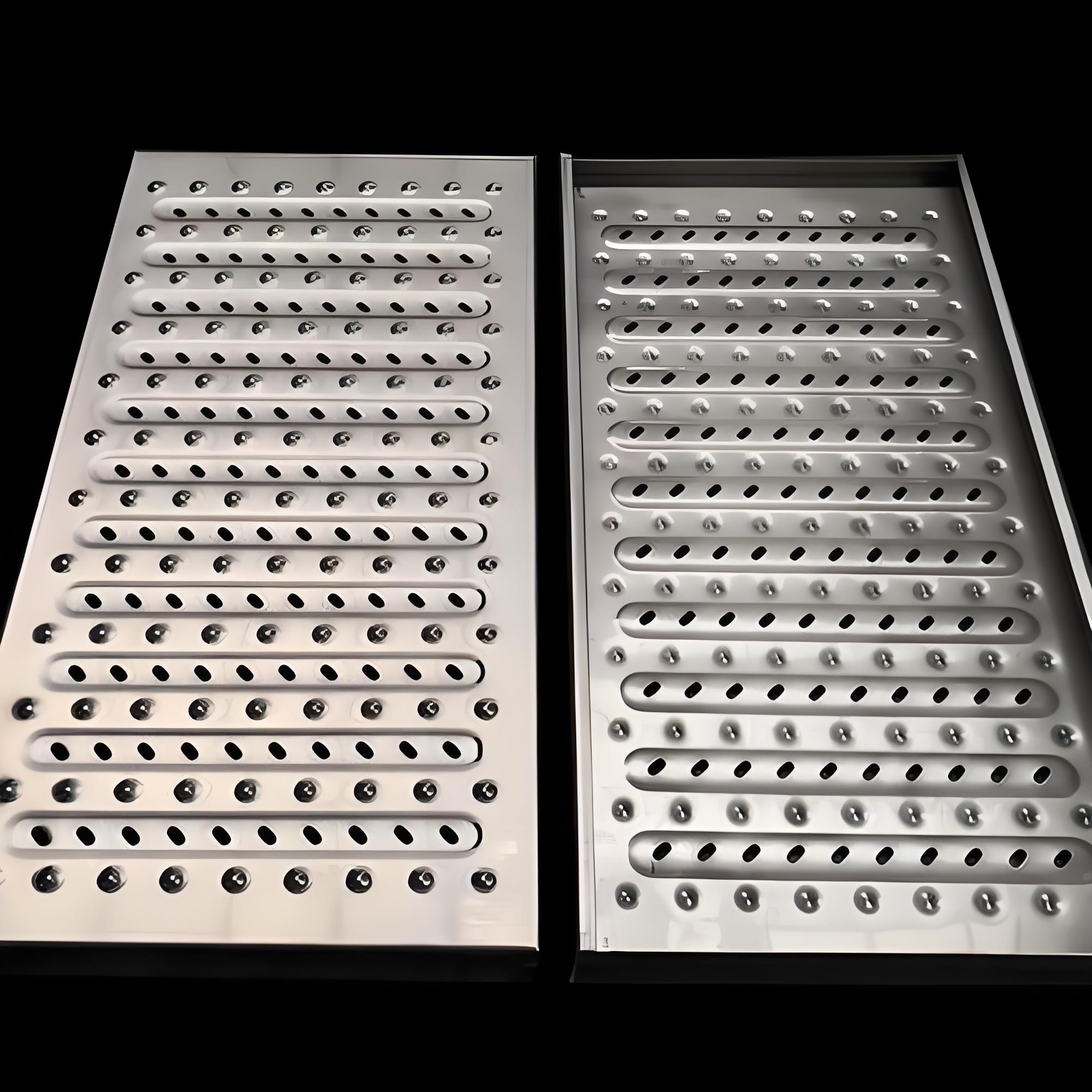
Welded steel bar grating, press-locked grating, and rebar grating are often discussed together, but they serve different needs. Welded steel bar grating is made by welding bearing bars and cross bars into a fixed grid. It is widely used because it provides reliable structural strength and is economical for industrial projects. Press-locked grating is produced by mechanically locking slotted bars together without the same welded intersection pattern. Rebar grating, by contrast, uses reinforcing bars and is more common in heavy civil or concrete-related applications than in standard industrial flooring.
From a strength and process perspective, welded bar grating is usually the mainstream choice for load-bearing platforms and covers because the structure is straightforward and the load data is well established. Press-locked grating is often selected for architectural applications because it can provide a more refined appearance, cleaner top surface, and closer visual tolerance. Rebar grating is rugged but generally less refined in finish and less commonly used where precise industrial grating specifications are expected.
In price terms, welded steel bar grating is often the most cost-efficient for industrial load-bearing use. Press-locked grating can be more expensive, especially when appearance, tighter tolerances, or stainless steel architectural use is involved. Rebar grating may be cost-effective in certain heavy-duty concrete or infrastructure applications, but it is not always the best substitute when standard platform grating performance and installation details are required.
Each type has its pros and cons. Welded steel bar grating offers strong load capacity, broad size availability, and predictable pricing, but it has a more industrial appearance. Press-locked grating offers better aesthetics and can work well in public-facing or design-sensitive spaces, but it may not be the first choice when cost control is critical. Rebar grating can handle rough heavy-duty conditions, but it is less versatile for standard industrial walkways and often does not provide the same open-area and finishing options as bar grating.
One common mistake is focusing only on unit price while ignoring galvanizing quality and dimensional tolerance. Two grating panels may have a similar specification on paper but differ greatly in zinc coating quality, weld consistency, bar straightness, and edge finishing. In long-term use, these details matter. Poor galvanizing can lead to premature rusting, and loose tolerances can create installation problems on site.
Another frequent issue is assuming the stated load capacity applies to every span. It does not. Grating load ratings are always tied to a support span and a deflection criterion. If a supplier gives a load number but does not state the span and deflection limit, the information is incomplete. Buyers should always confirm that the load calculation matches the actual project support condition.
It is also important to distinguish between pressure-welded and hand-welded grating. Both exist in the market, but they should not be compared casually as if they are identical products. For standard industrial orders, pressure welding usually offers better consistency and production efficiency. For custom shapes or special heavy fabrication, hand welding may be necessary. The key is to know what is being quoted.
Professional procurement should include a formal load calculation sheet or test report when the application is safety-critical. This is especially important in industrial plants, public infrastructure, or projects with inspection requirements. A proper document helps confirm whether the panel meets the required span, load type, and deflection limit before installation begins.
Finally, delivery condition should be confirmed early. Some buyers assume grating will arrive palletized, while others expect bundled loose packing or steel-frame packing for export. Packaging affects loading efficiency, site handling, and transportation damage risk. Clarifying whether the goods are supplied loose, on pallets, or in steel frames can prevent disputes and extra costs later.
How do I choose the right welded steel bar grating size for my project?
Start with the application, actual support span, and expected load type. Then choose a bearing bar height and thickness that can carry the load at that span, select the bearing bar spacing based on drainage and object-retention needs, choose the cross bar spacing, and finally confirm the design against a load table or calculation sheet. In many general industrial applications, 30 mm bearing bar spacing and hot-dip galvanized carbon steel are a practical starting point.
Is hot-dip galvanized welded grating worth the extra cost?
In most outdoor and industrial environments, yes. Hot-dip galvanizing costs more than black steel or electro-galvanizing, but it provides much better corrosion resistance and usually lowers lifetime replacement and maintenance cost. If the grating will be exposed to rain, moisture, chemicals, or washdown conditions, hot-dip galvanizing is often the safer and more economical long-term choice.
What information should I send to get an accurate grating quotation?
Provide the bearing bar size, bearing bar spacing, cross bar spacing, panel dimensions, material type, surface treatment, support span, load requirement, quantity, and any fabrication details such as banding, cut-outs, holes, or irregular shapes. Also mention the packing requirement if it matters. The more complete the specification, the more accurate the price and lead time will be.