

Serrated steel bar grating is widely used in places where people need to walk, work, climb, or maintain equipment in less-than-ideal conditions. If the floor can get wet, oily, muddy, icy, or dusty, a smooth surface is usually not enough. That is why many engineers, contractors, and plant buyers choose serrated grating instead of plain flat bar grating. The teeth on the bearing bars are not just a visual detail. They are there to improve grip, help water and oil drain away, and reduce slip risk in real working environments. For walkways, platforms, and stairs, this type of grating is often selected because it offers a practical mix of strength, drainage, and anti-slip performance without making the structure too heavy.
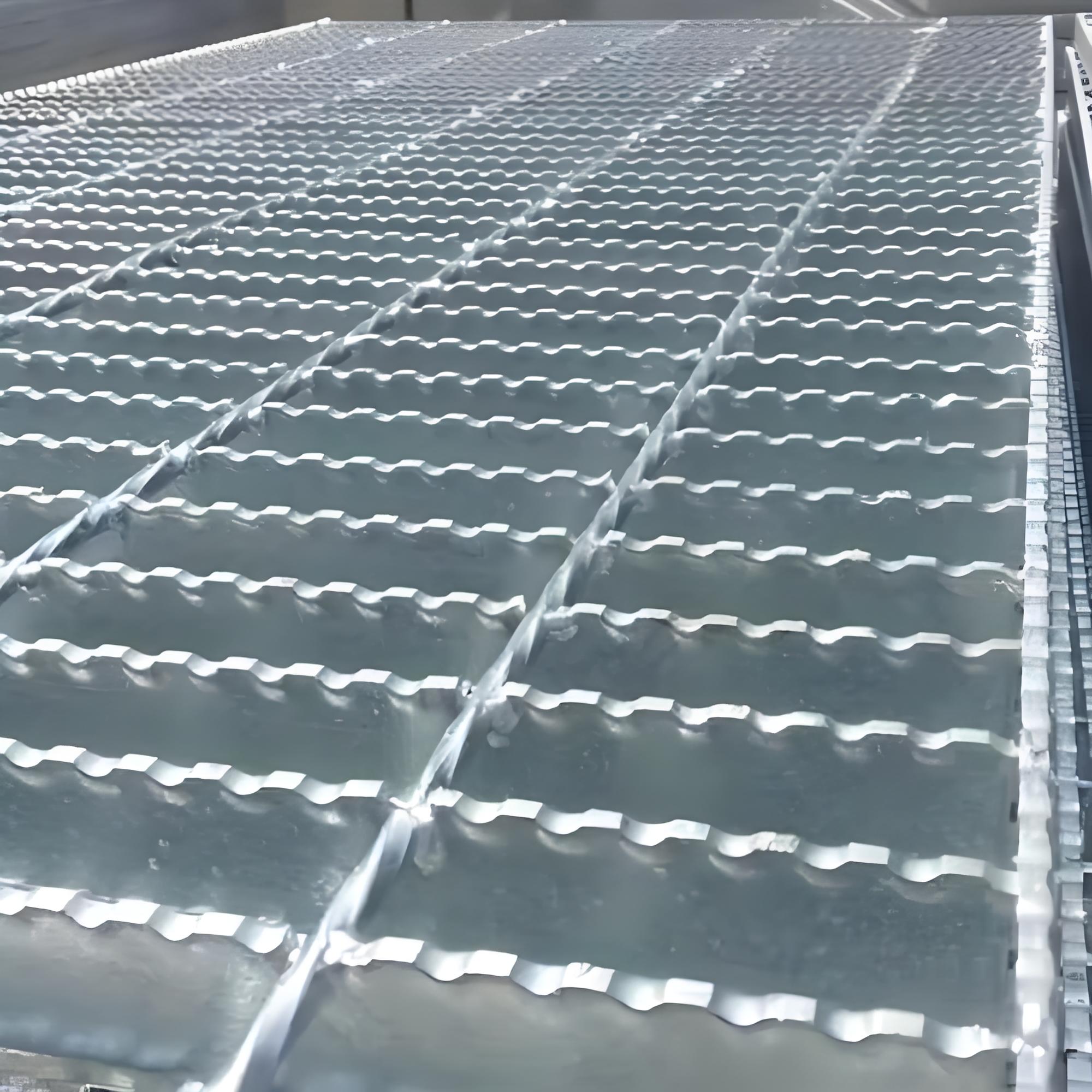
Serrated steel bar grating is a type of open steel flooring panel made with bearing bars and cross bars, but unlike standard plain grating, the top edge of the bearing bar is cut into a toothed or serrated profile. The core structure is still similar to regular steel bar grating: the bearing bars carry the load, while the cross bars hold the panel together and keep spacing consistent. The main difference is the upper edge shape. Instead of a smooth top line, the bearing bars have small teeth or notches that create a rougher contact surface.
This is the biggest structural difference between serrated bearing bars and plain flat bars. Plain flat bars are easier to clean and are often enough for dry indoor areas. Serrated bearing bars are designed for better traction. When a worker’s shoe, boot sole, or equipment wheel touches the toothed edge, the contact becomes less slippery than on a flat metal surface. In industries where slipping can lead to injury, shutdown, or maintenance trouble, this difference matters a lot.
The anti-slip principle is simple but effective. The serrated surface increases friction by breaking the smooth contact area between footwear and steel. It also helps water, oil, and light debris move away from the top contact points instead of staying as a slippery film across the surface. On outdoor stairs, marine walkways, factory passages, and maintenance platforms, this is one of the main reasons serrated grating is preferred over standard plain grating.
The open grid design also supports the anti-slip effect. Because the panel is not a solid plate, rainwater, wash water, oil splash, snow, and dust can pass through the openings more easily. That means the walking surface is less likely to hold standing liquid. In many industrial settings, good slip resistance comes not from one feature alone, but from the combination of teeth on the bars and drainage through the open mesh.
Common materials include low carbon steel, stainless steel 304, and stainless steel 316. Low carbon steel is the most common choice because it gives good strength and competitive cost. When low carbon steel is used outdoors or in industrial environments, hot-dip galvanizing is usually added after fabrication to improve corrosion resistance. Stainless steel 304 is common in areas where corrosion resistance matters but the environment is not extremely aggressive. Stainless steel 316 is often chosen for marine, chemical, and chloride-rich conditions because it offers better corrosion resistance than 304.
In practical buying, the material choice usually comes down to three questions: how corrosive is the environment, how high is the load, and how long does the buyer expect the product to last before major maintenance or replacement. A supplier such as Anping County Chuansen Silk Screen Products Co., Ltd. would normally be expected to explain these differences clearly rather than simply asking the buyer to pick the cheapest option.
For walkways, serrated steel bar grating is one of the most common choices because walkways are exposed to frequent foot traffic and changing surface conditions. In factories, pedestrian walkways often pass through areas with coolant, oil mist, water, dust, or scattered residue. A plain surface may become risky very quickly in these conditions. Serrated grating helps improve foot grip and at the same time allows spilled material to drain or fall through the openings instead of staying on the surface.
In overhead bridges and access walkways, the open design brings another advantage: reduced wind resistance. Compared with solid steel plate, grating allows air to pass through more freely, which can be useful in outdoor plants, elevated passages, and exposed structural walkways. It also allows more light to pass through, which can improve visibility in lower levels of industrial facilities.
Offshore platforms and marine access routes are another common application. In these places, salt spray, moisture, and constant surface contamination make slip resistance especially important. Serrated grating is often selected for personnel walkways because it combines drainage, traction, and structural strength in one product. If the environment is highly corrosive, buyers may move from galvanized carbon steel to stainless steel, especially 316.
For platforms, serrated grating is widely used on maintenance platforms, operating platforms, service decks, and temporary work platforms. On a maintenance platform, workers may carry tools, hoses, spare parts, or small machines while standing in awkward positions. Extra grip underfoot is valuable in this kind of environment. On operating platforms near pumps, valves, tanks, or process lines, water and chemicals may be present, so a serrated surface is often the safer choice.
Temporary work platforms also benefit from serrated grating because they need a strong but relatively lightweight surface that can be lifted, installed, and used without becoming too slippery in outdoor conditions. Since the grating is open, mud, dust, and rain do not collect as heavily as they do on solid sheet flooring. This can reduce cleaning work and improve usability during short-term projects.
For stairs, the advantages become even more obvious. Stair treads are one of the highest-risk slip points in industrial and public structures because foot contact happens at a changing angle. Serrated stair treads are commonly used in factories, warehouses, utility plants, outdoor public stairs, fire escape stairs, and equipment access ladders. The toothed edge helps increase grip during ascent and descent, especially when the tread is wet or dirty.
Some stair applications also use serrated step covers or anti-slip tread plates in combination with grating systems. For industrial stairs, buyers usually focus on tread strength, edge nosing detail, side plate accuracy, and whether the serration pattern remains aggressive enough after galvanizing or long use. For outdoor public stairs, drainage and anti-slip performance are often just as important as appearance.
The first major advantage is very high slip resistance. This is the main reason people choose serrated steel grating in the first place. In dry indoor conditions, plain grating may be acceptable. But in wet plants, food processing areas, marine environments, snow-exposed outdoor access routes, and places with oil or grease contamination, serrated grating gives a much more secure walking surface. The improvement does not come from coating alone; it comes from the geometry of the bearing bar itself.
This feature becomes especially useful in environments where the surface condition changes constantly. A walkway may be dry in the morning and wet by afternoon. A maintenance platform may be clean one day and oily the next. In these cases, buyers often prefer to build in extra slip resistance from the start instead of relying on maintenance or warning signs to control the risk later.
The second major advantage is load capacity. Serrated grating still uses structural bearing bars, so it can be designed for different loads by changing bar depth, thickness, spacing, and span. In other words, the anti-slip feature does not mean the product becomes weak. A properly selected serrated grating panel can handle pedestrian loads, maintenance loads, equipment access traffic, or heavier industrial service depending on its specification.
Buyers should remember that load capacity does not depend on serration alone. It depends mainly on bearing bar dimensions and support span. A 25×3mm serrated bearing bar may work for light pedestrian use over a short span, while a 40×5mm or heavier bar may be required for platforms carrying tools, carts, or concentrated loads. The right supplier should ask about span and service condition before recommending a specification.
The third major advantage is the open design. Open steel grating is often called self-cleaning because dirt, snow, liquid, and loose debris are less likely to stay on the surface than they are on a closed plate. This is not absolute self-cleaning in the strict sense, but in daily use it does reduce surface accumulation. That helps maintain anti-slip performance and reduces cleaning time.
The open structure also reduces wind load, improves airflow, and allows light transmission. In multilevel industrial plants, this can be very useful. Lower levels can receive more natural or artificial light, and ventilation between levels is improved. In outdoor structures such as towers, mezzanines, and exposed platforms, lower wind resistance can also be a design benefit.
Another practical advantage is visibility and inspection access. Because the surface is open, workers can often see leaks, residue buildup, or blockage below the platform more easily than with a solid floor. In process industries, this can help maintenance teams identify issues faster.
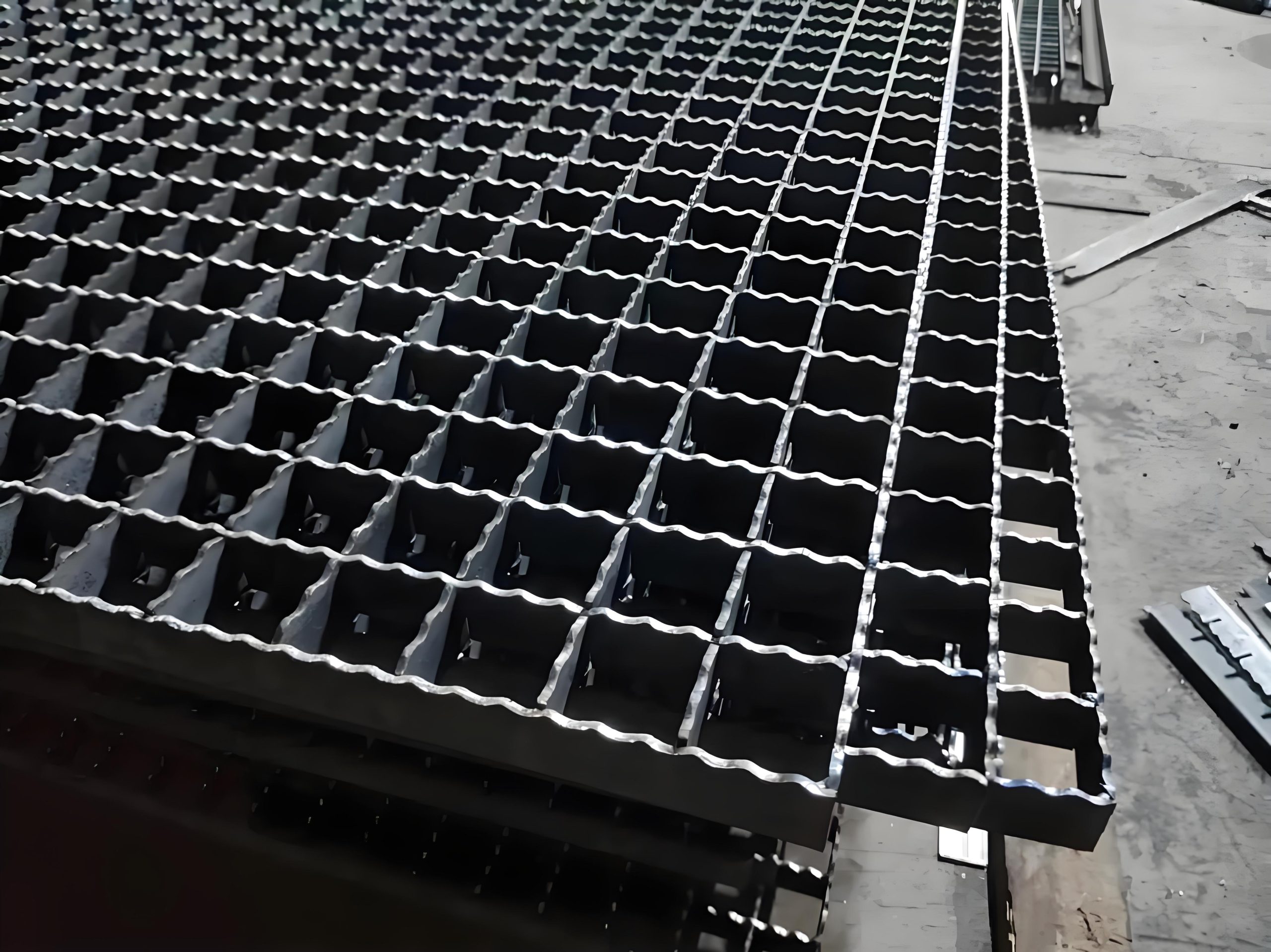
Choosing the right serrated steel bar grating starts with the bearing bar size. Common bearing bar dimensions include 25×3mm, 32×5mm, 40×5mm, and other heavier sections depending on load demand. The smaller sizes are often used for light walkways and access routes with short spans. Mid-range sizes such as 32×5mm are common for industrial walkways and general platforms. Heavier sections such as 40×5mm are more suitable where the span is longer or the load is higher.
It is important not to select size by habit alone. Two projects may both be called “walkways,” but one may be a simple indoor access path while the other may be a long outdoor route over pipe racks with wider support spacing. The same logic applies to stairs and platforms. The bar size should match the actual span, support arrangement, and load requirement, not just the project label.
The serration type also matters. Common options include single-side serration and double-side serration. In many standard grating panels, the serration is formed on the top edge area that makes contact during use. Some buyers ask for a more aggressive tooth profile where higher grip is needed. Double-side serration may be used in some designs, but buyers should confirm whether it is really necessary, since manufacturing complexity and cost can increase.
Mold capability is another point buyers sometimes miss. Not every factory can produce the same minimum tooth height or tooth spacing with consistent quality. If the teeth are too shallow, the anti-slip effect may be weaker than expected. If the teeth are too aggressive, it can affect comfort, cleaning, or even coating uniformity. That is why buyers should ask what serration profile the factory can produce stably, not just what is shown in a catalog drawing.
Grid spacing is one of the most important specification decisions. Common bearing bar center spacing is 30mm or 40mm, while common cross bar spacing is 50mm or 100mm. A 30mm bearing bar pitch usually gives a denser surface and may be preferred where smaller openings are needed, such as frequent foot traffic or where dropped objects are a concern. A 40mm pitch is also widely used and can be more economical in some projects. Cross bar spacing affects panel rigidity, appearance, and opening size.
For stairs and public-facing areas, denser spacing may be chosen for safety and comfort. For heavy industrial service, the correct combination of bar size and spacing matters more than appearance. Buyers should also think about cleaning requirements, heel safety, drainage rate, and possible debris size in the application area.
Surface treatment is another key part of selection. In most industrial and outdoor applications, the practical ranking is usually hot-dip galvanized first, then electro-galvanized, then painted finish. Hot-dip galvanizing generally offers the best corrosion resistance among these common options because the zinc layer is thicker and more durable. Electro-galvanizing gives a thinner coating and is usually more suitable for indoor or less aggressive conditions. Paint can be useful for color coding or lower-cost indoor use, but its corrosion protection is usually the weakest of the three.
For stainless steel grating, hot-dip galvanizing is generally not used, because stainless steel is selected precisely for its own corrosion resistance. If a project document mentions stainless steel together with hot-dip galvanizing, the buyer should double-check the specification, since that combination is not standard practice.
In a chemical plant with corrosive exposure, buyers often compare two realistic routes: stainless steel 316 for the most aggressive zones, or hot-dip galvanized carbon steel for areas where corrosion exposure is moderate and budget control matters more. If the environment includes chlorides, acid splash, or long-term wet chemical contact, 316 stainless steel is usually the stronger choice. If the project note says “316 + hot-dip galvanized,” the specification should be reviewed carefully, because stainless steel grating itself is normally supplied without galvanizing.
For a heavy truck maintenance platform, the selection focus is different. Here the concern is not only slip resistance but also load concentration, impact from tools, and repeated service traffic. In this kind of application, buyers often move toward thicker bearing bars, tighter structural control, and a more aggressive serration pattern. Dense serration and heavier bars help maintain safety when mechanics are working with oil, grease, and heavy equipment.
For outdoor public stairs, drainage and anti-slip performance are usually the priority. Rainwater needs to pass through quickly, and the surface must remain walkable in wet weather. In colder regions, snow and ice can make smooth metal steps extremely risky. A serrated tread with good drainage geometry can help reduce that risk. Some projects also add an anti-slip coating or a contrasting nosing treatment if extra visibility is needed.
In industrial platform retrofits, buyers often choose serrated grating when replacing old checker plate or damaged plain grating in service zones where slipping has become a known issue. This is common around pumps, valves, cooling systems, and washdown areas. The retrofit logic is practical: improve drainage and underfoot traction without rebuilding the entire steel support system.
In offshore and coastal projects, serrated grating is often used for access walkways, platform links, and stair treads because the surface stays more reliable in constant moisture and salt-laden air. In these environments, the material and surface treatment decision has to be made carefully. Hot-dip galvanized carbon steel may work in some zones, but stainless steel 316 is often selected for more severe exposure and longer service life.
As a rough market reference, galvanized serrated steel bar grating may fall somewhere around USD 900 to USD 1,500 per ton in international trade for common industrial specifications, while stainless steel versions can be several times higher depending on grade, bar size, and fabrication complexity. The real price depends on steel cost, load design, surface treatment, and order volume.
Installation method affects both safety and service life. Common fixing methods include welding, saddle clips such as M-clips, and U-bolts in certain support conditions. Welding gives a strong permanent connection and is often used where the panel is not expected to be removed often. However, if the grating needs regular access for inspection, cleaning, or equipment servicing, clip-based fastening may be more practical.
M-clips are widely used because they hold the grating securely while allowing later removal if needed. They are common on industrial walkways, platforms, and trench covers where maintenance access matters. U-bolts may be used in some framed or tubular support setups, especially where direct welding is not ideal. The right fixing choice depends on whether the panel is permanent, removable, exposed to vibration, or subject to repeated maintenance access.
Edge treatment is another detail that should not be ignored. Banding bars, edge plates, and end plates help keep the panel shape stable and improve handling strength. They also reduce the chance of edge distortion during lifting, installation, and use. For stair treads, edge details may include side plates for bolting and front nosing profiles for safer stepping. For trench covers or removable panels, proper edge finishing helps maintain fit and reduces damage during repeated lifting.
In maintenance, one of the first things to check is tooth wear. Over time, heavy foot traffic, dragged tools, carts, or abrasive cleaning can wear down the serrated edge. When the teeth become rounded or flattened, the anti-slip effect can drop noticeably. In high-use areas, this should be checked as part of regular safety inspection.
Coating condition is another major maintenance point. On galvanized carbon steel grating, inspectors should look for zinc layer damage, local rusting, or areas where the coating has been worn away by repeated contact or impact. On painted grating, coating peeling or underfilm rust should be watched closely. Stainless steel should be checked for contamination, staining, or crevice corrosion in harsh environments.
Weld cracks and loosened joints also deserve attention. If the cross bars or bearing bars show signs of separation, panel rigidity can drop and safety may be affected. This is especially important in platforms with vibration, heavy maintenance activity, or repeated loading. If a panel starts rocking, deflecting unusually, or making movement noise, the fixing points and welds should be inspected quickly.
Routine cleaning helps maintain the anti-slip function. Serrated grating resists slipping better than plain grating, but if openings become blocked by compacted debris, hardened grease, or industrial residue, performance will still decline. Good maintenance means keeping the teeth effective and the openings clear.
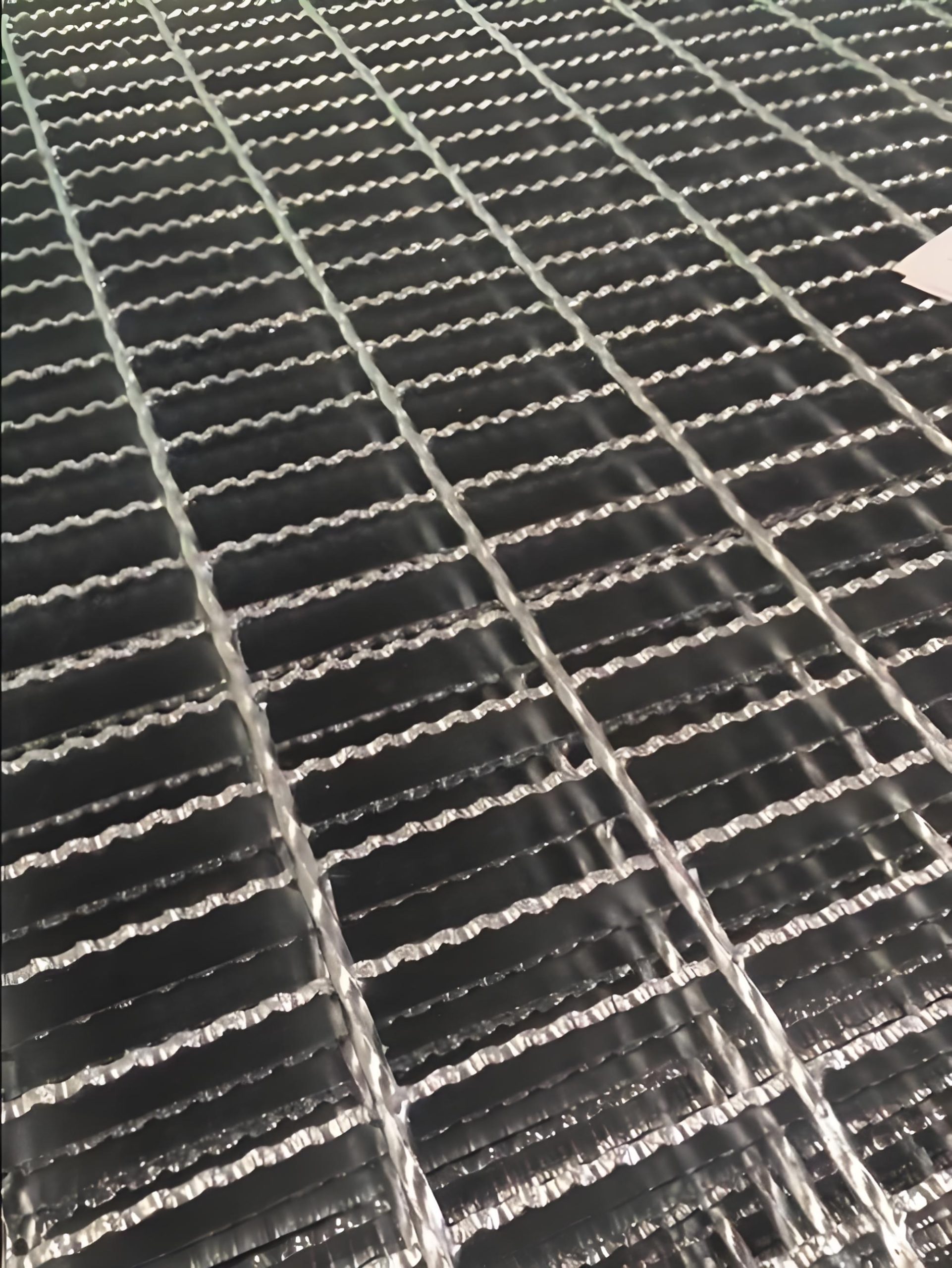
When sourcing serrated steel bar grating, buyers should first ask for a real serration sample, not just a catalog photo. The actual tooth shape, depth, spacing, and finish after galvanizing are all easier to judge in hand. Some serration profiles look sharp in drawings but become less distinct after production or coating. A physical sample helps buyers see whether the anti-slip profile is truly suitable for the application.
It is also smart to ask for anti-slip or friction-related test information where available, especially for safety-sensitive projects. Not every order will require a formal slip test, but if the grating is going into a wet industrial facility, offshore area, or public access stair, test data can help the buyer compare options more objectively. At the very least, the supplier should be able to explain how the serration profile is intended to improve grip and what similar projects it has supplied before.
Another important purchasing question is mold capability. Buyers should confirm the minimum tooth height and tooth pitch that the factory can produce consistently. This matters because anti-slip performance depends heavily on geometry. If the supplier cannot produce the requested serration profile with stable quality, the finished product may not match the intended use. It is better to discuss this before production than to argue about it after delivery.
Hot-dip galvanizing quality should be checked carefully when carbon steel is used. Buyers should ask about zinc coating thickness, adhesion, surface uniformity, and how the factory manages drainage and venting during galvanizing. Poor galvanizing can fill openings, leave rough drips, or create thin spots at critical areas. Since serrated grating is often selected for outdoor and harsh service, coating quality should never be treated as a minor issue.
Buyers should also review fabrication details such as panel flatness, cut-out accuracy, edge banding, and fastening accessories. In many projects, installation problems come from small fabrication errors rather than from the grating type itself. A good supplier should be able to work from clear drawings, confirm dimensions before production, and package panels in a way that protects the serrated edges during shipment.
For export buyers, it is also worth checking whether the supplier understands project labeling, bundle marking, and mixed-size packing. On jobs with many panel sizes, clear identification saves installation time and reduces confusion on site. A company such as Anping County Chuansen Silk Screen Products Co., Ltd. would typically be judged by buyers on these practical points as much as on price.
What is the difference between serrated steel grating and plain steel grating?
The main difference is the top edge of the bearing bar. Serrated grating has a toothed edge designed to improve grip, especially in wet, oily, or outdoor conditions. Plain grating has a smooth top edge and is more commonly used where slip resistance is less critical. If the application includes water, oil, snow, or regular contamination, serrated grating is usually the safer option.
Is hot-dip galvanized serrated grating good enough for outdoor stairs and walkways?
In many industrial and commercial outdoor applications, yes. Hot-dip galvanized carbon steel serrated grating is a common choice for outdoor stairs, access walkways, and platforms because it combines corrosion resistance with anti-slip performance. However, in highly corrosive areas such as marine or chemical environments, buyers should also compare stainless steel options, especially 316 grade.
How long is the delivery time for custom serrated steel bar grating?
For standard custom orders, production often takes around 2 to 5 weeks after drawing confirmation, depending on quantity, bar size, serration type, surface treatment, and packing requirements. Large project orders or stainless steel fabrication may take longer. Buyers should confirm whether the quoted lead time includes galvanizing, inspection, and export packing, not just workshop production.