

For outdoor projects, the best serrated steel bar grating is usually the one that can handle water, dirt, corrosion, temperature swings, and heavy foot traffic at the same time. In real purchasing work, outdoor performance is not decided by the serrated surface alone. Material grade, corrosion protection, bearing bar size, drainage layout, and edge finishing all matter. A grating panel that works well in a dry warehouse may fail much faster on a coastal dock, a chemical plant platform, or a muddy mining walkway. That is why outdoor selection has to focus on total durability, not just initial price.
Outdoor use is much harder on steel bar grating than indoor use. The first reason is constant exposure to rain, humidity, and standing moisture. Even when a site does not look very aggressive, repeated wet-dry cycles slowly attack the surface. Water enters scratches, weld areas, and cut edges, and over time that creates corrosion points. For serrated grating, this matters even more because the teeth are part of the working surface and need to stay sharp enough to maintain slip resistance.
Ultraviolet exposure is another issue, especially when the grating relies on coatings instead of just base metal performance. UV itself does not damage steel directly, but it can shorten the life of some organic topcoats if the wrong coating system is used. In outdoor conditions, a coating that looks fine at delivery can start chalking, fading, or losing adhesion earlier than expected if it is not designed for long-term weathering.
Temperature change is often underestimated. Steel expands and contracts as the weather shifts between hot days and cold nights, or between summer and winter. In regions with wide seasonal changes, repeated thermal movement can stress connections, clip systems, and welded joints. It can also affect the coating over time if the coating flexibility is poor or if the substrate preparation was not done properly.
Outdoor surfaces also face more complicated contamination than indoor floors. A grating panel may be exposed to rainwater one day, ice the next morning, and then mud, grease, leaves, sand, or industrial dust later. This is exactly why serrated grating is so often used outside. The teeth help maintain traction when the surface film is unstable. But not all serrated patterns perform equally well outdoors. Shallow teeth may lose effectiveness faster when exposed to wear and debris.
Corrosion risk changes dramatically by location. A general commercial building walkway is very different from a coastal pier, a fertilizer plant, or a wastewater treatment station. Industrial atmospheres may contain acidic or alkaline agents. Coastal air brings chlorides. Roads and public bridges may be exposed to de-icing salts in winter. So when people ask which serrated grating is best for outdoor use, the honest answer is that the best option depends heavily on the corrosion class of the site.
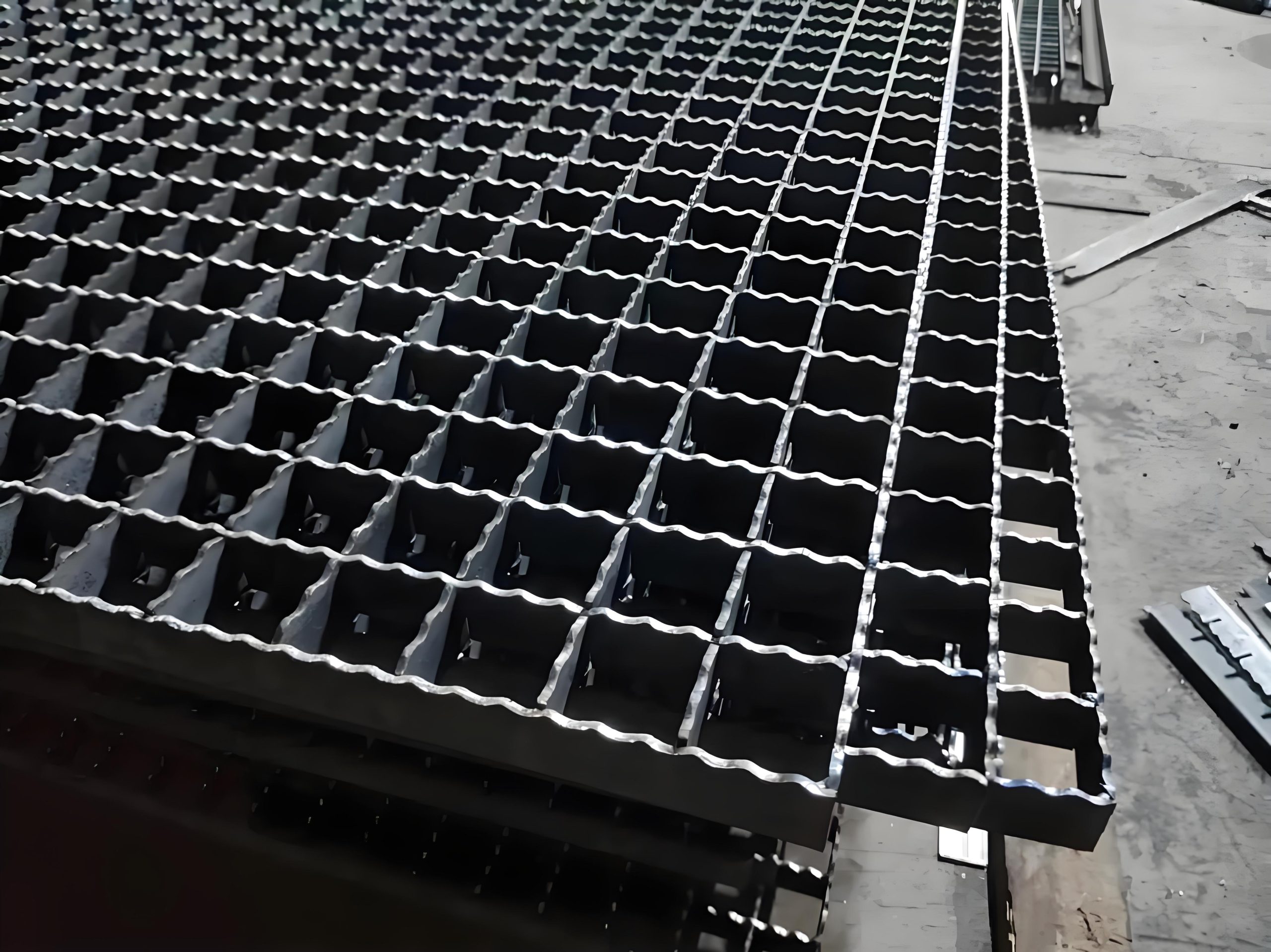
For most outdoor projects, hot-dip galvanized carbon steel is the standard starting point. It offers a strong balance between cost, availability, structural strength, and corrosion protection. In common outdoor environments, a properly galvanized serrated steel grating panel can perform very well for years. As a practical buying point, the zinc coating should not be treated as a vague promise. It is better to confirm a coating thickness of at least 70 microns for general outdoor exposure, and in some specifications buyers may request more depending on the standard and service environment.
Hot-dip galvanized carbon steel is usually the most cost-effective choice when the site is not severely corrosive. It is commonly used for municipal walkways, rooftop service platforms, factory access areas, loading zones, and public overpasses. It gives good protection, and it is much more economical than stainless steel in large quantities. For many standard projects, this is the best value option rather than the absolute highest-grade option.
Stainless steel 304 is the next step up when corrosion resistance needs to be stronger. It performs better than carbon steel in humid and rainy environments, especially where the owner wants lower long-term rust risk without depending entirely on a zinc layer. It is a good fit for areas with frequent moisture, regular wash-down, or moderate corrosive exposure. Buyers often choose 304 for outdoor platforms around food plants, pharmaceutical support areas, and higher-end architectural or infrastructure projects where appearance matters as well as durability.
Stainless steel 316 is generally the best material choice for the most demanding outdoor environments, especially where chlorides are present. Because it contains molybdenum, it has much better resistance to chloride attack than 304. That makes it the preferred option for coastal projects, marine terminals, offshore structures, and areas exposed to de-icing salt. If the project is near seawater or a winter road system with salt spray, 316 is usually the safer long-term decision.
If you compare the three options in plain terms, galvanized carbon steel gives the lowest upfront cost and solid outdoor performance in normal environments. Stainless 304 gives better corrosion resistance and longer service life, but at a higher material cost. Stainless 316 is the strongest choice against salt and aggressive corrosion, but it is also the most expensive. In many markets, plain carbon steel serrated grating with hot-dip galvanizing may be around USD 25 to USD 60 per square meter for common specifications, stainless 304 may range around USD 70 to USD 140 per square meter, and stainless 316 may reach roughly USD 95 to USD 180 per square meter or more depending on bar size, fabrication, and quantity. These are only broad industry reference ranges.
In terms of expected life, galvanized carbon steel often suits standard outdoor service if the coating quality is good and maintenance is not ignored. Stainless 304 is usually chosen when buyers want stronger corrosion stability in wet climates. Stainless 316 is the best answer where the environment is truly harsh and replacement cost would be high. At Anping County Chuansen Silk Screen Products Co., Ltd., this is usually how outdoor material recommendations are separated in practical discussions: start with environment severity, then compare lifecycle cost rather than purchase price alone.
For outdoor grating, the serrated pattern itself deserves more attention than many buyers give it. Not all serrations are equally useful once the panel is exposed to rain, mud, frost, and wear. One of the first things to check is tooth depth and tooth spacing. For outdoor use, deeper serrations generally hold their slip-resistant function longer because they continue to provide mechanical grip even after some surface wear. A practical recommendation is a tooth height of at least 1.5 mm for exterior traffic areas.
Tooth spacing also matters. A denser serration pattern, such as spacing at or below 20 mm, usually provides more consistent traction across the walking surface. When the teeth are too widely spaced, the anti-slip effect may feel uneven underfoot, especially with smaller shoe contact points or when the sole is coated with mud. For public or industrial outdoor walkways, deep and relatively dense serrations are usually the safer choice.
Another design question is single-sided serration versus double-sided serration. Single-sided serrated grating is more common and usually sufficient for many projects. Double-sided serration gives more flexibility because the panel can potentially be reversed in some maintenance situations, extending service life. It may also provide better grip consistency in conditions where both sides might be used during installation or replacement planning. The trade-off is higher cost and slightly more complex manufacturing.
Serration direction is often overlooked, but it has direct influence on walking safety. In general, the serrated bearing bars should be oriented so the traction effect works effectively against the main direction of foot movement. For walkways, the surface profile should support grip as people move forward. For stair treads, this becomes even more important because descending stairs creates a stronger slip force. Buyers should make sure the serrated bar direction and panel layout match the actual traffic path rather than just fitting the support frame conveniently.
If the project includes stair treads, check whether the tread nose detail is designed for outdoor slip prevention. A serrated grating tread with a properly formed nosing edge usually performs better than a plain tread in wet weather. This is one of the simplest places to justify a higher-grip design because stairs are naturally higher-risk than flat platforms.
For carbon steel grating used outdoors, hot-dip galvanizing is the standard protection system. In most general outdoor applications, it should be treated as a baseline requirement rather than an upgrade. The zinc layer needs to be thick enough, uniform enough, and well bonded to the steel. Buyers should not only ask whether the panel is galvanized, but also whether the coating thickness is verified and whether adhesion meets the relevant requirement. A poor galvanizing job can fail early even if the base grating is structurally strong.
Uniformity matters because outdoor corrosion does not attack all points equally. Thin spots around welds, cut ends, and corners often become the first failure locations. If the serrated teeth are not evenly coated, their edges may corrode faster, reducing both durability and slip performance. This is why inspection reports are important, especially for larger procurement projects.
For harsher outdoor environments, heavy-duty anti-corrosion coating systems such as epoxy or polyurethane can be used in addition to or instead of standard galvanizing, depending on the design approach. In chemical plants, wastewater facilities, and highly contaminated industrial areas, a duplex-style protection concept may be considered. The exact coating stack should match the chemical exposure, UV exposure, and maintenance plan. A heavy coating system can significantly increase life if it is specified correctly and applied on a properly prepared surface.
There are also options that buyers should usually avoid for serious outdoor use. Electro-galvanized grating is generally not a good choice because the zinc layer is much thinner than hot-dip galvanizing and tends to provide limited long-term protection in exposed environments. It may be acceptable for indoor or light-duty applications, but outdoors it often becomes a false economy.
Grating that is only painted without a robust corrosion-protection system should also be approached carefully. Paint alone can wear, chip, and peel, especially on the top edges of serrated bars where foot traffic is concentrated. Once that coating breaks, the exposed steel starts rusting quickly. For outdoor service, especially on walk surfaces, relying only on paint is usually not the best specification.
Outdoor grating selection is not only about corrosion and slip resistance. Structural stability matters just as much. For outdoor load-bearing service, a practical recommendation is to use bearing bars with a thickness of at least 5 mm and a width of at least 32 mm for many common applications. This is not a universal rule for every span and load, but it is a useful baseline when the grating is expected to handle regular pedestrian use, maintenance activity, and weather exposure over time.
If the project is in a rough environment such as a mine, port, or heavy industrial site, thicker bars may be the smarter choice. Outdoor panels face not only live loads but also long-term wear, corrosion allowance concerns, and occasional impact from tools or equipment. A heavier section often gives better durability and less deflection under harsh service conditions.
Bearing bar spacing is another important point. For many outdoor applications, spacing at or below 30 mm is a good recommendation. This tighter spacing helps reduce the risk of high heels, small tools, or maintenance parts falling through the opening. It can also improve walking comfort for public-use structures such as pedestrian bridges or observation platforms.
At the same time, the grating must still drain well. Outdoor surfaces should not trap water because standing water becomes an ice hazard in winter and accelerates corrosion in wet zones. Open-area design is one of the reasons bar grating works well outdoors in the first place. To support drainage while keeping the panel stable, a cross bar spacing of 50 mm or less is often a practical design target. This helps maintain a good balance between openness, strength, and underfoot support.
Edge banding is not a cosmetic detail; it is part of durability. All exposed edges should be properly banded. Without edge banding, the open ends of bearing bars can be more vulnerable to localized corrosion and damage. Outdoor projects especially benefit from complete edge finishing because water, debris, and corrosion products often collect at exposed section ends. Proper banding also improves handling safety during installation and maintenance.
For coastal docks and offshore platforms, stainless steel 316 is usually the top material recommendation because chloride resistance is critical. In the harshest cases, buyers may also ask for additional protective strategies depending on the design philosophy, such as combining corrosion-resistant material selection with strong surface finishing and careful fabrication control. Deep serrations are strongly recommended because marine surfaces are regularly wet, salty, and slippery. If the project budget allows it, 316 is usually the safest long-term answer in this category.
For outdoor platforms in chemical plants, carbon steel with a heavy anti-corrosion coating system can be a practical and cost-controlled solution. In these environments, the exact coating chemistry matters as much as the steel itself because airborne chemicals or splash exposure can attack standard galvanized surfaces over time. Dense serrations are preferred because chemical plants often have liquid contamination, wash-down water, and process residue on the walking surface.
For public pedestrian overpasses, hot-dip galvanized carbon steel is commonly the best fit. It gives solid structural value, broad availability, and acceptable corrosion protection for typical urban outdoor service. A standard serrated surface often works well, and in some public projects an extra anti-slip top treatment may be added depending on traffic volume, local climate, and maintenance policy. Public infrastructure usually needs a balance of safety, cost, and easy replacement, and galvanized carbon steel often meets that balance.
For mining sites or muddy outdoor work zones, the priority shifts more toward impact resistance, drainage, and self-cleaning performance. In these conditions, thicker bearing bars of at least 6 mm are often recommended. Double-sided serrations can be useful for extended wear life, and larger drainage gaps may help shed mud and debris more efficiently. These sites are rough on steel, rough on coatings, and rough on slip resistance, so a lighter decorative-grade grating is not enough.
It is worth noting that the “best” outdoor grating is often scenario-specific rather than universal. A public bridge, a sewage plant, and a salt-exposed dock should not all be using exactly the same specification. The smart approach is to match material, serration depth, coating system, and structural size to the site instead of picking the cheapest standard panel and hoping it works everywhere.
Service life outdoors depends on both environment and specification quality. For hot-dip galvanized carbon steel, a realistic outdoor life expectation is often around 8 to 12 years in many normal service conditions. In cleaner inland environments it may last longer, while in coastal or industrially polluted environments it may need earlier maintenance or replacement. The range is broad because zinc loss rate changes a lot from one location to another.
Stainless steel 304 generally offers a longer outdoor service life, often in the range of 15 to 20 years in many applications, especially where the climate is wet but chloride exposure is moderate. It is less dependent on sacrificial coating thickness and usually gives a more stable long-term appearance. However, it is still not ideal for heavy salt exposure if 316 is the more suitable grade.
Stainless steel 316 is commonly expected to deliver 20 to 25 years or more when properly specified for coastal or chloride-rich outdoor service. In many cases, the higher upfront cost is justified because replacement in marine or elevated structures is expensive and disruptive. The more difficult the access and the more severe the environment, the more 316 starts to make economic sense over the full life cycle.
Maintenance should not be ignored even with high-grade materials. Outdoor grating should be inspected regularly for zinc layer damage, corrosion at welds, and wear on the serrated edges. The serrations are part of the safety function, so if they become rounded or heavily corroded, slip resistance may decline long before the panel loses structural capacity. That is an important point in maintenance planning.
Inspectors should also look for rust creep at cut edges, damage caused by dropped tools or moving equipment, loose fastening clips, coating breakdown near supports, and trapped debris that keeps moisture in contact with the steel. In snowy climates, the use of de-icing salts should be considered in the maintenance schedule because salt residue accelerates corrosion if it is allowed to accumulate.
When buying serrated steel bar grating for outdoor use, the first item to verify is the material certificate. The document should confirm the actual steel grade and include chemical composition where relevant. This is especially important when the project specifies stainless steel 304 or 316, because visual inspection alone cannot reliably confirm the grade.
The second key item is the galvanizing test report if carbon steel is used. Buyers should ask for coating thickness data and adhesion-related verification. A verbal promise that the grating is “hot-dip galvanized” is not enough for serious procurement. The report should help you confirm whether the zinc layer is thick enough and whether the coating quality is consistent.
Salt spray test information can also be useful, particularly for stainless products, coated products, and galvanized items intended for harsher outdoor conditions. Salt spray hours do not tell the whole story of real field life, but they still give a comparative indication of corrosion resistance quality. If the project is in a coastal or industrial environment, asking about corrosion testing is reasonable and often necessary.
Another practical item is whether the supplier provides a clear outdoor-use warranty or performance commitment. The exact wording will vary by manufacturer and project type, but the point is to understand what is covered and what is not. Outdoor service always contains variables, so buyers should read warranty terms carefully rather than assuming all corrosion risks are automatically included.
It is also smart to confirm fabrication details in advance: bearing bar size, spacing, cross bar spacing, banding, serration type, panel dimensions, support direction, fastening method, and whether cut edges are properly protected after fabrication. Many outdoor grating failures come from detail mismatch, not from the basic material itself.
For large projects, many buyers also ask whether samples can be checked before mass production. That can be useful for verifying serration sharpness, galvanizing appearance, edge finishing, and basic dimensional quality. In practical supply work, companies such as Anping County Chuansen Silk Screen Products Co., Ltd. are often asked to provide this type of confirmation before full production starts, especially for export or infrastructure projects where replacement is costly.
What is the best serrated steel grating material for coastal outdoor use?
For coastal areas, stainless steel 316 is usually the best choice because it has stronger resistance to chloride corrosion than 304 or galvanized carbon steel. If the location is directly exposed to sea spray, salt fog, or de-icing salt, 316 is generally the safest long-term option.
Is hot-dip galvanized serrated grating good enough for outdoor walkways?
Yes, in many normal outdoor environments it is. Hot-dip galvanized carbon steel is a common and cost-effective choice for outdoor walkways, platforms, and public access structures. The key is to make sure the zinc coating is thick enough, uniform, and properly tested. It is less suitable for highly corrosive coastal or chemical exposure unless the specification is upgraded.
How do I choose the right serrated grating size for outdoor heavy-duty use?
Start with the actual load, support span, traffic type, and environment. For many outdoor heavy-duty applications, buyers look for bearing bars at least 5 mm thick and 32 mm wide, while rougher sites such as mines may require 6 mm or more. Bar spacing, drainage needs, and corrosion allowance should all be checked together instead of choosing size by price alone.