
Home > Products > Step Board > Heavy-Duty Industrial Stairs
Heavy-duty industrial stairs are designed for factories, warehouses, platforms, power plants, machinery access areas, and other demanding workplaces w…
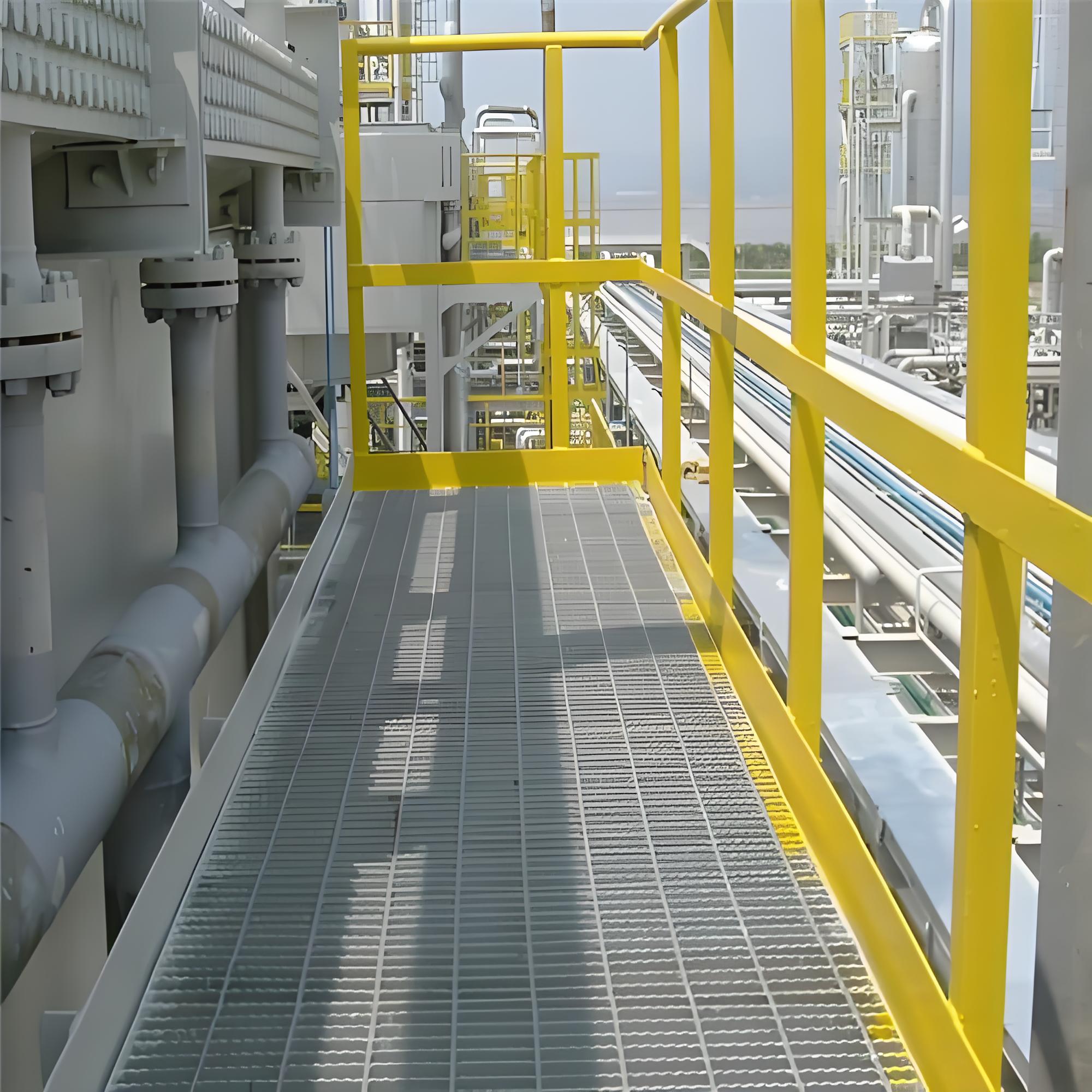
Heavy-duty industrial stairs are designed for factories, warehouses, platforms, power plants, machinery access areas, and other demanding workplaces where ordinary stair systems may not provide enough strength, safety, or durability. A complete industrial stair system usually includes steel stair stringers, grating stair treads, platforms, handrails, guardrails, fasteners, and surface protection. The correct design depends on load capacity, stair width, tread type, anti-slip requirements, corrosion exposure, installation space, and site drawings. For heavy-duty use, buyers should pay attention to structural steel selection, tread thickness, connection method, hot-dip galvanizing quality, fabrication tolerance, and long-term maintenance requirements.
Heavy-duty industrial stairs are metal stair systems used to provide safe access between different working levels. They are commonly installed around steel platforms, production lines, mezzanine floors, tanks, silos, conveyors, boilers, cooling towers, machinery foundations, roof access areas, and maintenance walkways.
Compared with light-duty service stairs or simple access ladders, heavy-duty industrial stairs are designed for more frequent use, higher load capacity, harsher working conditions, and longer service life. Workers may carry tools, spare parts, hoses, inspection devices, or maintenance equipment while using the stairs, so the stair structure must remain stable, non-slip, and comfortable enough for repeated access.
A heavy-duty industrial stair is not only a set of steps. It is a fabricated steel access system. The stair angle, tread size, stair width, stringer strength, handrail height, platform connection, surface treatment, and fixing method all affect safety and usability. If one part is poorly designed, the whole stair system may become difficult to install or unsafe to use.
| Main Item | Common Requirement | Why It Matters |
|---|---|---|
| Stair stringers | Structural steel plate, channel, or beam sections | Carry the main stair load |
| Stair treads | Steel grating, serrated grating, checker plate, or custom tread | Provide walking surface and anti-slip performance |
| Handrails | Pipe, tube, or fabricated steel railing | Improve user safety during climbing and descending |
| Guardrails | Installed on platforms and open edges | Reduce fall risk in elevated areas |
| Surface treatment | Hot-dip galvanized, painted, or stainless finish | Protects against corrosion and wear |
| Connection method | Bolted, welded, or combined connection | Affects installation, removal, and structural stability |
The main structure of heavy-duty industrial stairs usually consists of two side stringers, multiple stair treads, landing platforms, support brackets, handrails, guardrails, and connection plates. Each part must work together to transfer loads safely to the supporting structure.
Stair stringers are the main side members of the stair. They support the stair treads and transfer loads to the upper and lower connection points. In heavy-duty applications, stringers are usually made from steel channel, steel plate, angle steel, or fabricated structural sections.
The stringer size depends on stair length, stair width, stair angle, expected load, connection design, and whether the stair is supported only at both ends or also supported at intermediate points. A long stair without intermediate support usually needs stronger stringers than a short stair connected between two nearby platforms.
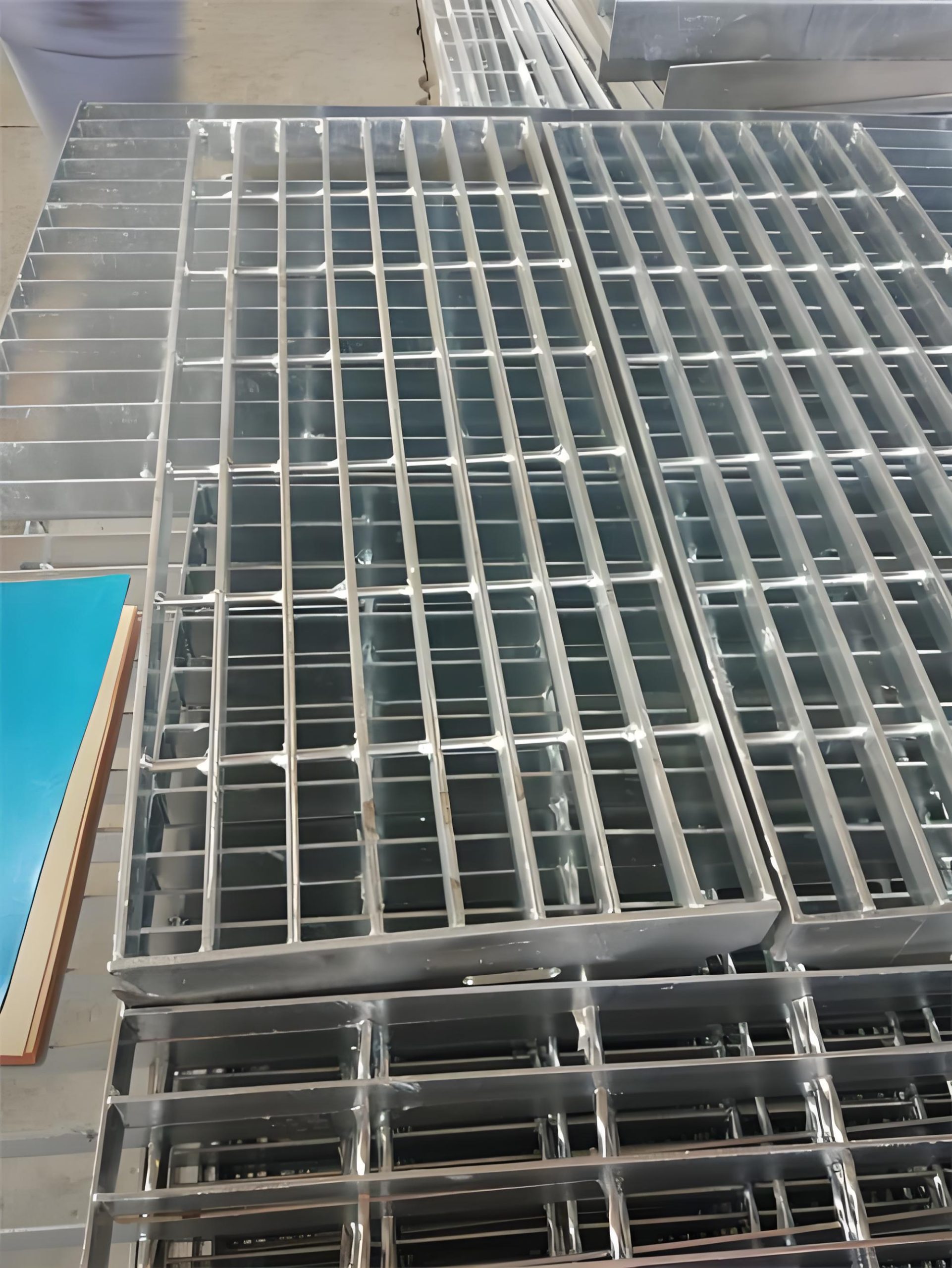
Stair treads are the walking steps. For industrial stairs, steel grating stair treads are very common because they provide drainage, ventilation, light transmission, and good anti-slip performance when serrated bearing bars or anti-slip nosing are used.
Checker plate treads, perforated plate treads, and custom fabricated treads may also be used depending on site conditions. The tread should have enough width, depth, stiffness, and edge protection for safe use.
Landing platforms are used at the top, bottom, or intermediate levels of industrial stairs. They provide a flat area for turning, resting, inspection, or connecting to other walkways. Heavy-duty stairs often connect directly to steel grating platforms or structural mezzanine floors.
Handrails are installed along stair sides to help workers maintain balance. Guardrails are installed along open platform edges to reduce fall risk. In industrial projects, handrails and guardrails are normally fabricated from steel pipe, square tube, flat bar, or structural sections.
Connection plates, base plates, angle brackets, gusset plates, and bolt holes are important for installation. Poor connection design can cause misalignment, site welding problems, vibration, or difficult assembly.
| Structural Component | Function | Common Material |
|---|---|---|
| Side stringers | Main support members for the stair | Carbon steel plate, channel, or beam |
| Grating stair treads | Walking surface | Carbon steel, galvanized steel, stainless steel |
| Landing platform | Connection and access area | Steel grating or steel plate |
| Handrails | Hand support for stair users | Steel pipe or tube |
| Guardrails | Fall protection around open edges | Steel pipe, tube, or fabricated railing |
| Base plates | Connection to floor or support steel | Carbon steel or stainless steel |
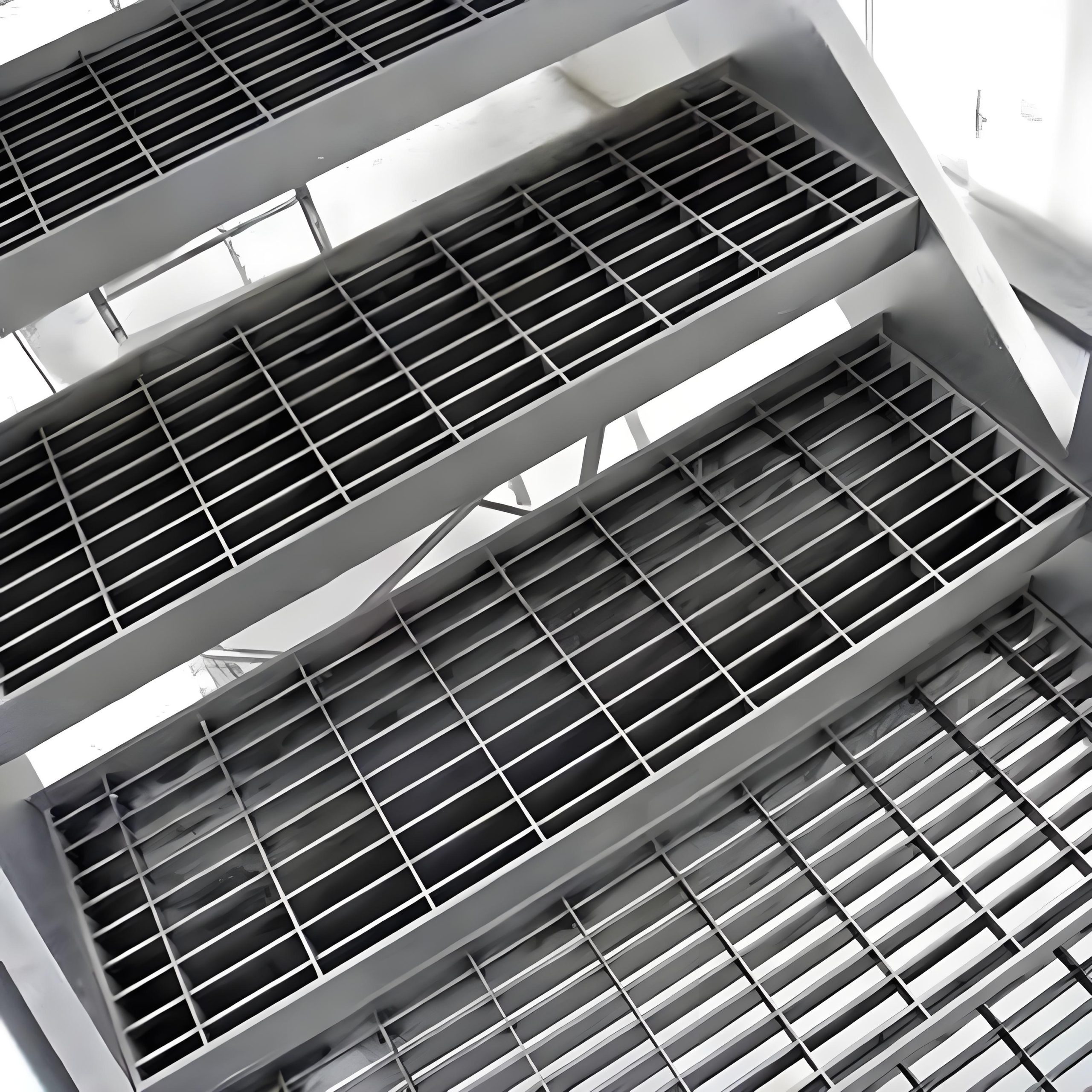
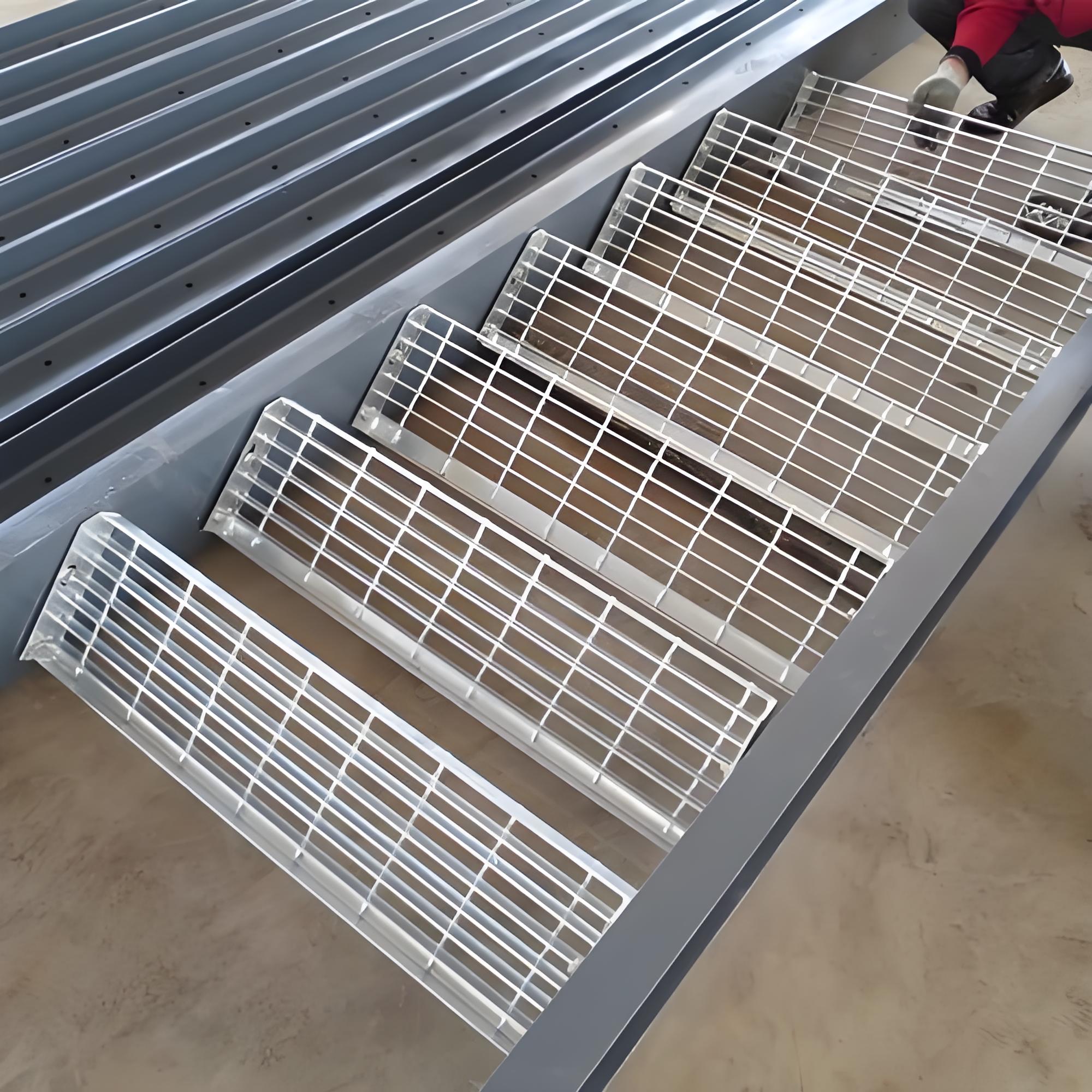
Steel grating stair treads are one of the most widely used tread types for heavy-duty industrial stairs. They are made from bearing bars and cross bars, usually with side plates or end plates for bolted installation. A front nosing may also be added to improve visibility and anti-slip performance.
Steel grating treads are practical for industrial stairs because they allow water, oil, dust, mud, and small debris to pass through the openings. This reduces accumulation on the walking surface compared with solid plate steps. The open-grid design also improves ventilation and allows light to pass through the stair structure.
For outdoor stairs, grating treads are especially useful because rainwater does not remain on the step surface as easily as on solid plate. When serrated bearing bars are used, the tread can provide better traction in wet or oily conditions.
Industrial grating stair treads usually include welded side plates with bolt holes. This allows the treads to be bolted to the stair stringers. Bolted treads are easier to replace during maintenance than permanently welded treads.
The side plate thickness, hole diameter, hole spacing, and plate shape should match the stair stringer design. If the holes are not aligned, installation time increases and site modification may be required.
Stair nosing is the front edge of the tread. It may be made from checker plate, perforated plate, abrasive strip, serrated plate, or other anti-slip profiles. Nosing improves foot contact and makes the step edge more visible.
For heavy-duty industrial stairs, tread nosing is often recommended because the front edge of the step receives repeated impact and wear.
| Grating Tread Feature | Purpose |
|---|---|
| Bearing bars | Carry the main load of the tread |
| Cross bars | Maintain bar spacing and panel stability |
| Side plates | Allow bolted connection to stair stringers |
| Front nosing | Improves anti-slip performance and step visibility |
| Serrated surface | Improves traction in wet, oily, or outdoor conditions |
| Hot-dip galvanizing | Provides corrosion protection for outdoor use |
Material selection affects the strength, corrosion resistance, appearance, price, and service life of heavy-duty industrial stairs. The most common material options are carbon steel, hot-dip galvanized carbon steel, and stainless steel.
Carbon steel is widely used for heavy-duty industrial stairs because it has good strength, stable fabrication performance, and relatively economical cost. It can be cut, welded, drilled, bent, painted, and galvanized easily.
For indoor dry environments, painted carbon steel may be suitable. For outdoor or humid areas, untreated carbon steel is not recommended because it can rust quickly. If the stair is exposed to rain, moisture, or industrial atmosphere, surface protection should be considered.
Hot-dip galvanized industrial stairs are commonly used outdoors, in factories, on platforms, around tanks, and in general industrial environments. After fabrication, the stair components are dipped into molten zinc so that the coating covers the steel surface, welds, edges, holes, and fabricated details.
Galvanizing is especially suitable for carbon steel grating stair treads, stringers, handrails, and guardrails. It provides durable corrosion protection and reduces repainting requirements. For many heavy-duty stair projects, hot-dip galvanized carbon steel offers a good balance of cost and service life.
Stainless steel industrial stairs are selected for corrosive, hygienic, marine, food processing, chemical, or wastewater environments. Common stainless steel grades include 304 and 316. 304 is suitable for many general corrosion conditions, while 316 or 316L is more suitable for chloride, marine, and chemical exposure.
Stainless steel stairs are more expensive than carbon steel stairs, but they may reduce maintenance cost in aggressive environments. Stainless surfaces can also be pickled, passivated, brushed, or polished according to project requirements.
| Material Option | Main Advantage | Typical Use | Price Level |
|---|---|---|---|
| Carbon steel | Strong and economical | Indoor industrial stairs and platforms | Low to medium |
| Painted carbon steel | Basic corrosion protection and color finish | Indoor factories, warehouses, equipment access | Medium |
| Hot-dip galvanized steel | Durable outdoor corrosion protection | Outdoor stairs, platforms, power plants, walkways | Medium |
| 304 stainless steel | Good general corrosion resistance | Food plants, clean areas, water treatment | High |
| 316 stainless steel | Better chloride and chemical resistance | Marine, chemical, wastewater, coastal facilities | Higher |
Heavy-duty industrial stairs must be designed according to the expected load and actual site conditions. The structure should be able to carry users, tools, maintenance parts, temporary loads, and possible impact during service.
Dead load refers to the weight of the stair itself, including stringers, treads, handrails, platforms, bolts, and surface coating. Live load refers to people, tools, maintenance materials, and any temporary loads placed on the stairs.
Heavy-duty stairs need enough reserve capacity to handle repeated use and working conditions. A stair used only for occasional inspection may not need the same design as a stair used daily by many workers in a busy production area.
Industrial stairs may experience concentrated loads when workers carry heavy parts, when tools are placed on a tread, or when equipment is temporarily supported during maintenance. Stair treads and side plates should be strong enough to resist localized loading without excessive deformation.
Wider stairs are often required for frequent traffic, two-way movement, emergency access, or workers carrying materials. Wider stair treads and longer spans between stringers may require stronger tread construction.
Stringers must support the full stair assembly and transfer loads to the supporting structure. The stringer section, thickness, slope, support spacing, and connection plates should be selected carefully.
A heavy-duty stair should feel stable during use. Excessive vibration can make workers feel unsafe even if the structure does not fail. Proper stringer design, bracing, connection stiffness, and platform support can improve stability.
| Design Factor | Effect on Heavy-Duty Stair Performance |
|---|---|
| Stair width | Affects user capacity, tread span, and structural weight |
| Tread depth | Affects walking comfort and foot support |
| Stringer size | Controls main stair strength and stiffness |
| Tread material | Affects anti-slip performance, weight, and service life |
| Connection method | Affects stability, installation, and maintenance |
| Support condition | Determines load transfer and vibration behavior |
| Surface treatment | Affects corrosion resistance and long-term safety |
Anti-slip performance is one of the most important considerations for heavy-duty industrial stairs. Workers may use stairs in areas exposed to rain, oil, mud, dust, chemicals, process water, or cleaning liquids. A smooth metal tread can become slippery when contaminated.
Serrated grating treads use toothed bearing bars to increase traction. The serrations create additional edges that engage with footwear. This design is useful in outdoor stairs, wet areas, oily equipment platforms, wastewater plants, mining facilities, marine structures, and chemical plants.
Serrated grating is not a complete replacement for cleaning and safe work procedures. Heavy oil, grease, or mud can still reduce grip if it fills the surface. However, compared with plain smooth bars, serrated grating usually provides better anti-slip performance under difficult conditions.
Checker plate nosing is often welded to the front edge of grating stair treads. It improves step visibility and provides extra friction at the most important foot contact area. The raised pattern helps reduce slipping at the stair edge.
Some industrial stairs use perforated nosing, punched anti-slip nosing, or abrasive strips. These options may be selected when the project needs stronger anti-slip performance, better visibility, or specific safety requirements.
Open grating treads allow liquid and debris to pass through, reducing surface accumulation. This is one reason grating treads are widely used outdoors and in wet process areas.
| Anti-Slip Option | Benefit | Common Application |
|---|---|---|
| Serrated grating tread | Better traction on wet or oily surfaces | Outdoor stairs, industrial platforms, wastewater areas |
| Checker plate nosing | Improves edge visibility and grip | General industrial stair treads |
| Perforated nosing | Provides additional anti-slip edges | Wet or high-traffic stairs |
| Abrasive strip | Strong friction surface | Special safety areas and retrofit projects |
| Plain grating tread | Comfortable and easy to clean | Dry indoor stairs and clean areas |
Stair tread size must be selected according to stair width, user traffic, load requirement, installation method, and site space. In heavy-duty industrial stairs, tread dimensions should be practical for workers wearing safety boots and carrying tools.
Tread width refers to the distance across the stair from one side stringer to the other. Wider treads provide more walking space and are suitable for frequent use or two-way movement. However, wider treads may require stronger grating, thicker side plates, or additional structural support.
Tread depth is the front-to-back walking surface of each step. Adequate tread depth improves foot support and reduces fatigue. If the tread depth is too small, workers may feel unstable, especially when descending.
For grating stair treads, thickness is mainly related to bearing bar height. Higher and thicker bearing bars increase load capacity but also increase weight and cost. Common grating tread bearing bar sizes may include 25 mm × 3 mm, 30 mm × 3 mm, 30 mm × 5 mm, 40 mm × 5 mm, or custom sizes for heavy-duty use.
Side plates connect the tread to the stair stringers. Their thickness and hole arrangement should match the structural requirement. Heavy-duty stairs may require thicker side plates than light access stairs.
| Tread Parameter | Common Design Consideration |
|---|---|
| Tread width | Based on stair traffic, user access, and site space |
| Tread depth | Should provide comfortable foot support |
| Bearing bar height | Affects tread load capacity and stiffness |
| Bearing bar thickness | Affects durability and heavy-duty performance |
| Side plate thickness | Affects bolted connection strength |
| Bolt hole size | Must match installation bolts and stringer holes |
| Nosing type | Affects anti-slip performance and visibility |
Different tread surface options are available for heavy-duty industrial stairs. The right choice depends on safety requirements, working environment, cleaning method, and project budget.
Serrated grating treads are suitable for outdoor, wet, oily, muddy, dusty, or high-risk areas. They provide better traction than smooth grating and allow water and debris to pass through the openings.
They are commonly used in power plants, chemical plants, wastewater treatment facilities, offshore platforms, mining areas, and general heavy industrial sites.
Plain grating treads have smooth bearing bar surfaces. They are suitable for dry indoor industrial stairs, clean maintenance areas, and locations where anti-slip risk is lower. Plain grating is generally easier to clean and may cost less than serrated grating.
If the stair is located indoors and not exposed to water, oil, or mud, plain grating may be sufficient.
Checker plate treads use solid steel plate with raised patterns. They provide a closed walking surface and prevent small objects from falling through. This can be useful in some workshops, warehouses, and machinery areas.
However, checker plate can retain water, oil, or dust on the surface. In wet or outdoor conditions, drainage and cleaning should be considered carefully.
| Tread Type | Main Advantage | Possible Limitation |
|---|---|---|
| Serrated grating tread | High traction and good drainage | May require more cleaning around serrations |
| Plain grating tread | Comfortable and economical | Less traction in wet or oily conditions |
| Checker plate tread | Closed surface and patterned grip | Can retain water, oil, dust, or debris |
| Perforated plate tread | Anti-slip surface with partial drainage | May be more expensive than standard grating |
A complete heavy-duty industrial stair system includes more than stair treads. Stringers, railings, platforms, bracing, base plates, and connection parts are all important for safe use.
Stringers are normally fabricated from steel plate, channel steel, or structural beams. They must be strong enough to support the stair treads and transfer loads to the floor or platform. The stringer slope and hole layout should match the required stair angle and tread spacing.
Handrails help users maintain balance when climbing or descending. In heavy-duty industrial environments, handrails are often made from steel pipe or tube. They may be welded to posts or bolted to the stair structure depending on installation requirements.
Guardrails are used on platforms, landings, and open stair sides. They usually include top rails, middle rails, posts, and toe boards when required. Guardrails should be strong enough to resist normal industrial use and accidental contact.
Platforms connect stairs to working areas. They may use steel grating flooring, checker plate flooring, or a combination of both. Platform size should allow users to enter and exit the stair safely.
Toe boards may be installed along platform edges to help prevent tools, bolts, and small objects from falling to lower levels. They are common in elevated industrial platforms.
| Component | Function | Common Fabrication Detail |
|---|---|---|
| Stringers | Main stair support | Steel channel, plate, or beam with bolt holes |
| Handrails | User support | Pipe or tube rail with welded posts |
| Guardrails | Fall protection | Top rail, mid rail, posts, and base plates |
| Landing platform | Flat access area | Steel grating or checker plate flooring |
| Toe boards | Object fall protection | Flat bar or plate welded to platform edge |
| Brackets | Support and connection | Angle steel, gusset plates, or custom plates |
Surface treatment protects heavy-duty industrial stairs from corrosion and wear. The correct finish should match the working environment, maintenance plan, and appearance requirement.
Hot-dip galvanizing is one of the most common finishes for industrial stairs used outdoors. The zinc coating protects carbon steel from atmospheric corrosion and covers welded areas, edges, holes, and grating surfaces after fabrication.
For grating stair treads, galvanizing after fabrication is usually preferred because it protects the welded side plates and cut ends. Large stair components should be designed with proper venting and drainage holes so zinc can flow during the galvanizing process.
Painting is used for indoor industrial stairs, color identification, or projects where a specific appearance is required. Painted carbon steel stairs may be more economical than galvanized stairs at the beginning, but paint can wear or chip during service.
In high-traffic stair areas, paint damage may occur at tread edges, handrails, bolt holes, and contact surfaces. Maintenance repainting should be considered.
Some projects use hot-dip galvanizing plus painting. This is often called a duplex coating system. It may be selected for aggressive environments, long service life, or special color requirements.
Stainless steel industrial stairs may be pickled, passivated, brushed, or polished. Pickling and passivation help remove welding discoloration and restore corrosion resistance after fabrication.
| Surface Treatment | Best Use | Cost Level |
|---|---|---|
| Untreated carbon steel | Temporary or dry indoor use only | Lowest |
| Painted carbon steel | Indoor stairs and color-coded areas | Low to medium |
| Hot-dip galvanized steel | Outdoor stairs, platforms, wet industrial areas | Medium |
| Galvanized plus painted | Aggressive environments and color requirements | High |
| Pickled stainless steel | Food, chemical, marine, wastewater areas | High |
| Polished stainless steel | Special clean or appearance requirements | Higher |
Heavy-duty industrial stairs are often custom fabricated because each project has different floor heights, platform positions, stair angles, available space, load requirements, and installation conditions. Standard stair components may not fit every site.
For accurate fabrication, drawings should show total rise, stair run, stair angle, tread quantity, tread spacing, stair width, platform size, connection points, handrail arrangement, guardrail position, and surface treatment. If the stair connects to an existing structure, the support dimensions and bolt positions should be clearly shown.
When replacing old stairs or adding stairs to an existing platform, site measurement is very important. Even small differences in floor height or support position can cause installation problems. Buyers should confirm dimensions before production, especially for bolted stair assemblies.
Treads can be customized by size, bearing bar specification, side plate design, nosing type, hole pattern, surface type, and finish. For heavy-duty stairs, the tread design should match the required load and stair traffic.
Handrails and guardrails may need to follow site layout, platform openings, equipment clearance, pipe routes, or maintenance access requirements. Removable railings may also be required in areas where large equipment must pass through occasionally.
Many industrial stairs can be supplied as prefabricated modules. This reduces site welding, shortens installation time, and improves dimensional control. Large stair systems may be shipped in sections for easier transport and assembly.
Platform connectionControls installation accuracy and load transfer
| Custom Fabrication Detail | Why It Is Important |
|---|---|
| Total stair height | Determines number of steps and stair angle |
| Stair width | Affects traffic capacity and tread strength |
| Tread spacing | Affects walking comfort and safety |
| Handrail layout | Improves safety and site fit |
| Guardrail position | Protects open edges and platform areas |
| Surface treatment | Matches corrosion exposure and project requirements |
| Transport section size | Affects packing, container loading, and installation |
Heavy-duty industrial stairs are used wherever safe and durable access is required. Different applications need different materials, tread surfaces, load capacity, and surface treatments.
Factories use heavy-duty stairs to access production lines, mezzanines, machinery platforms, inspection areas, and storage levels. Stairs in factories may be exposed to oil, dust, water, chemicals, or frequent worker traffic. Serrated grating treads and galvanized finishes are often suitable for these conditions.
Warehouses use industrial stairs for mezzanine access, storage platforms, loading areas, and maintenance zones. Walking comfort, load safety, and installation efficiency are important. Painted or galvanized carbon steel stairs are commonly used.
Platforms around tanks, silos, conveyors, and processing equipment require stairs for safe access. These stairs may connect multiple levels and require landings, guardrails, toe boards, and grating platforms.
Power plants require stairs around boilers, turbines, cooling systems, maintenance decks, pipe racks, and equipment platforms. Heavy-duty galvanized steel stairs are common because they offer strength, durability, and corrosion protection.
Water treatment and wastewater plants have wet and corrosive environments. Galvanized steel, stainless steel, or aluminum stairs may be selected depending on exposure. Serrated grating treads are useful because water and sludge may create slippery surfaces.
Mining facilities, cement plants, quarrying sites, and bulk material handling systems may expose stairs to dust, impact, mud, and heavy maintenance traffic. Strong stringers, serrated treads, and durable surface treatment are important.
| Application Area | Recommended Stair Feature | Common Material Choice |
|---|---|---|
| Factories | Durable treads, handrails, custom platforms | Painted or galvanized carbon steel |
| Warehouses | Comfortable access and modular installation | Painted or galvanized steel |
| Outdoor platforms | Corrosion resistance and anti-slip surface | Hot-dip galvanized steel |
| Power plants | Heavy-duty structure and reliable access | Hot-dip galvanized carbon steel |
| Water treatment | Wet-area traction and corrosion protection | Galvanized or stainless steel |
| Marine and coastal areas | Higher corrosion resistance | Stainless steel or aluminum |
| Mining facilities | Strong structure and serrated treads | Galvanized heavy-duty steel |
Installation method affects construction speed, maintenance, alignment, and future replacement. Heavy-duty industrial stairs can be installed by bolting, welding, or a combination of both.
Bolted installation is common for prefabricated industrial stairs. Stringers, treads, handrails, and platforms can be supplied with pre-drilled holes and assembled at site. This method reduces site welding and allows easier replacement in the future.
Bolted grating stair treads are especially practical because damaged treads can be removed and replaced without cutting the whole stair structure.
Welded installation provides a permanent connection and may be used where the stair is fixed to structural steel or where bolting is not practical. Welding can provide strong connections, but it requires skilled workers, surface repair after welding, and careful alignment.
If galvanized components are welded at site, the damaged zinc coating should be repaired properly to reduce corrosion risk.
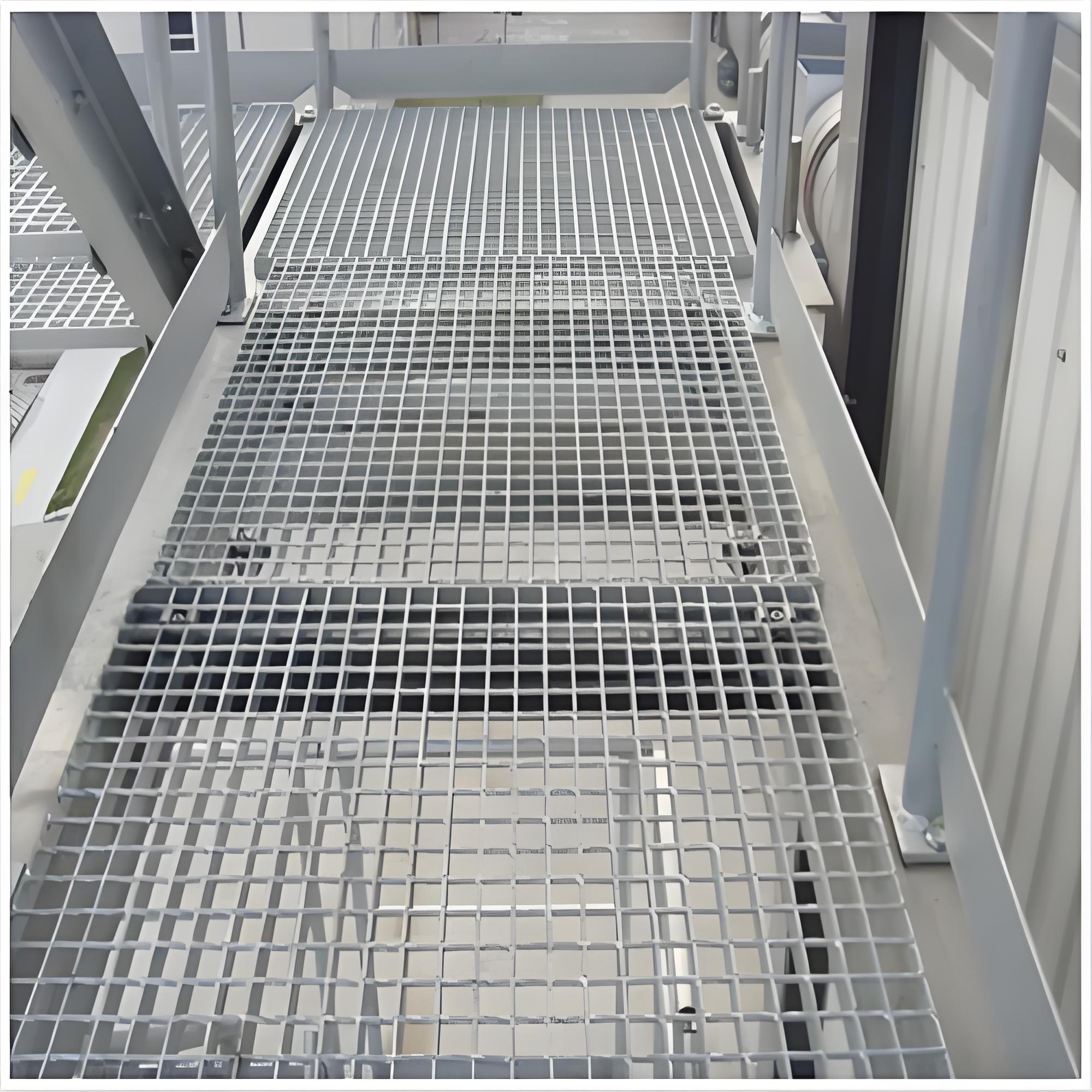
Some industrial stairs use welded main frames with bolted treads and railings. This provides structural rigidity while allowing easier replacement of wearing parts.
Base plates, anchor bolts, support brackets, and platform connection plates should be prepared according to site conditions. The supporting structure must be strong enough to receive the stair loads.
| Installation Method | Advantage | Consideration |
|---|---|---|
| Bolted connection | Fast installation and easier replacement | Requires accurate hole alignment |
| Welded connection | Strong and permanent | Requires skilled welding and coating repair |
| Bolted treads with welded frame | Good balance of strength and maintenance | Needs proper fabrication planning |
| Anchor bolt base connection | Useful for floor-mounted stairs | Requires correct base plate and anchor layout |
| Platform bracket connection | Useful for elevated access | Support steel must be checked |
Quality control is essential for heavy-duty industrial stairs because defects can affect installation and safety. A reliable supplier should inspect the stair structure, stair treads, welds, dimensions, coating, accessories, and packaging before shipment.
The supplier should confirm material grade, thickness, section size, and surface condition before fabrication. For projects requiring traceability, material certificates can be provided.
Important dimensions include stair height, stair width, stringer length, tread spacing, bolt hole position, platform size, railing height, base plate position, and connection plate layout.
Welds should be checked for continuity, appearance, penetration suitability, and absence of obvious defects. Critical joints, side plates, stringer connections, railing posts, and platform frames need careful inspection.
Grating stair treads should be checked for bar spacing, side plate alignment, nosing attachment, tread flatness, bolt hole accuracy, burrs, and surface condition. Serrated treads should have consistent tooth profiles.
For hot-dip galvanized stairs, inspection should cover coating coverage, zinc buildup, drainage marks, bare spots, sharp zinc residues, and distortion. Painted stairs should be checked for coating thickness, color consistency, adhesion, and damaged areas.
For complex custom stairs, trial assembly or partial assembly checking can reduce site installation problems. This is useful when the stair includes multiple platforms, special railings, or unusual connection angles.
Heavy-duty industrial stair components are usually packed in bundles, pallets, steel frames, or customized export packages. Large stair systems may be separated into stringers, treads, railings, platforms, and accessories for easier loading.
Export orders may require commercial invoice, packing list, material certificate, inspection report, galvanizing certificate, certificate of origin, loading photos, and shipping marks. Proper packaging helps reduce coating damage, deformation, and missing accessories during transport.
| Inspection Item | Inspection Focus |
|---|---|
| Raw material | Grade, size, thickness, straightness, surface condition |
| Stringers | Length, hole position, angle, welds, straightness |
| Stair treads | Size, side plates, nosing, bar spacing, surface quality |
| Handrails | Height, post spacing, weld quality, connection plates |
| Platforms | Frame size, grating fit, guardrails, toe boards |
| Coating | Galvanizing coverage, paint quality, stainless finish |
| Accessories | Bolts, clips, base plates, connection parts, labels |
| Packaging | Bundle strength, protection, marks, loading arrangement |
Choosing a supplier for heavy-duty industrial stairs should not be based only on the lowest price. The supplier must understand steel fabrication, grating stair treads, load requirements, anti-slip design, surface treatment, site drawings, and export packing.
A suitable supplier should be able to fabricate stringers, grating treads, platforms, handrails, guardrails, toe boards, brackets, and custom connection plates. If the stair is only partly supplied, buyers may need to coordinate several suppliers, which can increase project risk.
Industrial stair projects often require drawing review and technical confirmation. The supplier should check whether dimensions, stair angle, tread spacing, bearing direction, bolt holes, and connection details are complete before production.
A reliable supplier should offer carbon steel, galvanized steel, and stainless steel options according to environment and budget. For outdoor industrial stairs, hot-dip galvanizing quality should be carefully confirmed.
Two stair quotations can only be compared fairly when the material, stringer size, tread type, stair width, railing design, surface treatment, connection method, and packing scope are the same. A low quotation may exclude handrails, guardrails, platforms, bolts, surface treatment, or export packing.
For international buyers, the supplier should provide inspection support, packing details, shipping marks, document preparation, and loading photos when required. This reduces communication problems after shipment.
| Supplier Evaluation Point | What Buyers Should Confirm |
|---|---|
| Structural fabrication | Stringers, platforms, railings, brackets, base plates |
| Grating tread production | Plain, serrated, galvanized, stainless steel options |
| Drawing review | Stair height, angle, width, tread spacing, connection details |
| Surface treatment | Hot-dip galvanizing, painting, stainless finishing |
| Quality inspection | Dimensions, welds, coating, assembly, packaging |
| Custom supply | Site-specific stair systems and platform components |
| Export support | Documents, packing, shipping marks, loading photos |
| Quotation clarity | Included components, accessories, trade terms, validity |
To receive an accurate quotation, buyers should provide complete information about the stair system. A simple inquiry such as “heavy-duty industrial stairs price” is not enough for accurate fabrication cost because every stair project has different height, width, load, tread type, surface treatment, and connection details.
| Required Information | Example Detail |
|---|---|
| Application | Factory platform, warehouse mezzanine, power plant access, equipment stair |
| Total rise | Vertical height from lower floor to upper platform |
| Stair width | Clear walking width or overall stair width |
| Stair angle | Required slope or available horizontal space |
| Tread type | Serrated grating, plain grating, checker plate, perforated tread |
| Tread size | Width, depth, bearing bar size, side plate details |
| Material | Carbon steel, hot-dip galvanized steel, stainless steel |
| Surface treatment | Painted, hot-dip galvanized, galvanized plus painted, pickled stainless |
| Handrail requirement | One side, two sides, platform guardrails, removable railings |
| Platform requirement | Landing platform size, grating floor, guardrails, toe boards |
| Connection method | Bolted, welded, anchor bolts, platform brackets |
| Drawings | CAD drawings, sketches, site photos, existing structure dimensions |
| Export requirement | Packing, documents, shipping marks, container loading support |
When drawings are available, the supplier can check fabrication feasibility, optimize transport sections, prepare panel marks, and reduce installation risk. For replacement stairs, site photos and existing stair measurements are also useful.
What are heavy-duty industrial stairs used for?
Heavy-duty industrial stairs are used for safe access to factories, warehouses, steel platforms, power plants, machinery areas, tanks, silos, mezzanine floors, and maintenance walkways. They are designed for stronger load capacity, more frequent use, and harsher working environments than ordinary light access stairs.
Are grating stair treads good for industrial stairs?
Yes, steel grating stair treads are very suitable for industrial stairs because they provide drainage, ventilation, light transmission, and good walking safety. Serrated grating treads are especially useful in wet, oily, outdoor, or dusty environments. For heavy-duty use, the tread bearing bar size, side plate thickness, nosing type, and connection holes should match the stair design.
Should industrial stairs be galvanized or painted?
For outdoor or humid industrial environments, hot-dip galvanized stairs are usually preferred because the zinc coating provides durable corrosion protection. Painted stairs may be suitable for dry indoor areas or color-coded projects, but paint can wear under heavy traffic and may need maintenance. In corrosive, marine, food processing, or chemical environments, stainless steel may be a better material option.
Please Feel free to give your inquiry in the form below.we will reply you in 24 hours.