

Aluminum stair treads are widely used where a walking surface needs to be lightweight, corrosion resistant, easy to install, and safe for daily foot traffic. For buyers sourcing from a manufacturer, the main concerns are usually clear: what type of aluminum stair tread is suitable, how much it costs, what sizes can be produced, which surface treatment should be selected, and how the factory controls load capacity, anti-slip performance, packaging, and export delivery. As an aluminum stair treads manufacturer, Anping County Chuansen Silk Screen Products Co., Ltd. supplies standard and custom fabricated aluminum grating stair treads for platforms, walkways, industrial stairs, marine structures, commercial access systems, and maintenance areas.
Aluminum stair treads are commonly made from aluminum grating panels or extruded aluminum profiles, then cut, welded, punched, fitted with nosing plates or side plates, and finished according to the application environment. Compared with carbon steel stair treads, aluminum stair treads are much lighter and naturally more corrosion resistant. Compared with stainless steel stair treads, aluminum is usually easier to handle during installation and often provides a more economical option for many architectural, commercial, marine, and industrial access projects.
Aluminum stair treads price is not a fixed number for every project. It depends on alloy grade, bearing bar size, tread width, tread length, grating spacing, side plate design, nosing type, surface treatment, order quantity, packaging method, and shipping destination. A reliable manufacturer should not only provide a unit price, but also help the buyer confirm whether the stair tread structure is suitable for load, installation, safety, and long-term use.
| Item | Main Buyer Concern | Factory Supply Focus |
|---|---|---|
| Material | Corrosion resistance, strength, weight | 6061, 6063, 5052 and other aluminum alloy options |
| Structure | Load capacity and safe walking | Serrated grating, plain grating, anti-slip nosing, side plates |
| Size | Matching stair width and installation holes | Standard sizes and custom fabricated dimensions |
| Surface | Outdoor corrosion resistance and appearance | Mill finish, anodized, powder coated, brushed or anti-slip finish |
| Price | Project budget and quantity discount | Quoted by size, material, finish, fabrication and order quantity |
Aluminum stair treads are normally priced by piece, by square meter, or according to drawings. For standard aluminum grating stair treads, the factory price is usually lower when the size, bar spacing, nosing, side plate, and hole position follow common production patterns. For custom aluminum stair treads, the cost increases when the buyer requires special alloy, thicker bearing bars, heavy-duty load design, anodized finish, powder coating, special anti-slip nosing, curved shape, irregular cutting, or strict tolerance control.
As a practical purchasing reference, small standard aluminum stair treads used for light-duty access stairs usually cost less than large heavy-duty custom stair treads used for industrial platforms or marine structures. The final quotation should be confirmed from drawings or a clear size list because two stair treads with the same length and width can still have different costs if the bearing bar size, surface finish, side plate thickness, and fixing design are different.
| Aluminum Stair Tread Type | Common Price Level | Main Cost Drivers |
|---|---|---|
| Standard plain aluminum grating stair tread | Lower to medium | Common alloy, regular size, simple side plate and mill finish |
| Serrated aluminum grating stair tread | Medium | Serrated bearing bars, anti-slip processing and fabrication work |
| Aluminum stair tread with nosing plate | Medium to higher | Nosing material, welding, drilling and edge finishing |
| Anodized aluminum stair tread | Higher than mill finish | Surface treatment cost, color requirement and batch control |
| Custom heavy-duty aluminum stair tread | Higher | Thicker bars, wider tread, special hole position and load requirement |
For quotation, buyers should provide the required tread length, width, bearing bar specification, cross bar spacing, alloy grade, surface treatment, nosing requirement, side plate drawing, bolt hole size, quantity, and destination port or delivery address. With these details, the factory can calculate a more accurate aluminum stair tread price instead of giving a rough number that may not match the real project.
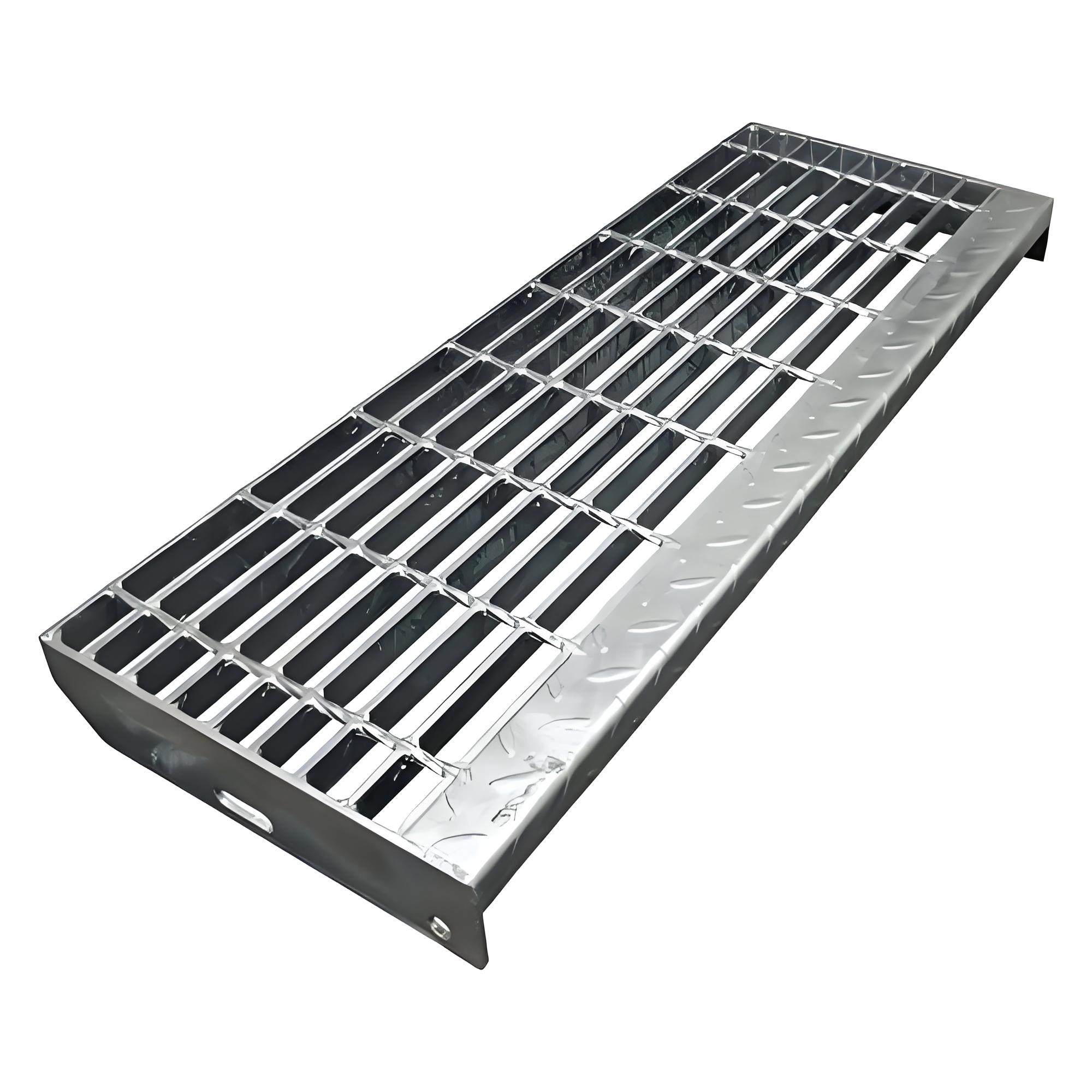
A stair tread is a small component compared with a full platform grating system, but it must be manufactured carefully. Poor welding, incorrect hole position, weak side plates, sharp edges, wrong tread depth, or insufficient anti-slip design can create installation problems and safety risks. A manufacturer with complete fabrication capability can control these details from raw material selection to final packing.
Anping County Chuansen Silk Screen Products Co., Ltd. can supply aluminum stair treads based on standard sizes or custom drawings. Standard production is suitable for common platform stairs, maintenance stairs, commercial stairs, and replacement projects. Custom fabrication is more suitable when the buyer has fixed stair stringer spacing, special bolt hole layout, project drawings, load requirements, or architectural appearance requirements.
The production process may include aluminum grating manufacturing, cutting, edge trimming, side plate welding, nosing fitting, drilling, punching, deburring, surface treatment, inspection, packing, and export documentation. For project orders, the factory can arrange batch production according to size lists to help the buyer reduce installation confusion on site.
| Manufacturing Step | Purpose | Quality Control Point |
|---|---|---|
| Material preparation | Select aluminum alloy and bar size | Confirm alloy grade, thickness and surface condition |
| Grating fabrication | Create walking surface structure | Check bar spacing, flatness and connection strength |
| Cutting | Make tread length and width | Control size tolerance and edge neatness |
| Side plate and nosing | Support installation and improve safety | Check welding, drilling and alignment |
| Surface treatment | Improve corrosion resistance or appearance | Inspect coating, anodizing color, surface defects |
| Packing | Protect goods during transport | Use suitable pallet, wrapping and marking |
Different aluminum alloys have different strength, corrosion resistance, forming performance, surface finish effect, and cost. For most stair tread applications, the buyer should not only ask for “aluminum” in general. The alloy grade should be confirmed based on service environment, load requirement, surface treatment, and budget.
6061 aluminum is one of the most widely used alloys for structural parts. It offers good strength, good corrosion resistance, and good machinability. For aluminum stair treads that require stronger structural performance, 6061 is often selected, especially when the tread is used in industrial access stairs, platforms, maintenance structures, and outdoor walkways.
6063 aluminum is commonly used for profiles and architectural products because it offers good surface finish and good anodizing performance. It is suitable for commercial stairs, architectural platforms, decorative access systems, and applications where appearance is important. When the stair tread requires a clean anodized surface, 6063 may be considered depending on the structural design.
5052 aluminum has good corrosion resistance, especially in humid and marine-related environments. It is commonly used where corrosion resistance is more important than very high structural strength. For coastal areas, marine walkways, light-duty platforms, or equipment access stairs, 5052 can be an option when the design is suitable.
| Alloy Grade | Main Advantage | Typical Stair Tread Use |
|---|---|---|
| 6061 | Good strength and structural performance | Industrial platforms, maintenance stairs, outdoor access stairs |
| 6063 | Good surface finish and anodizing performance | Commercial stairs, architectural access areas, decorative platforms |
| 5052 | Good corrosion resistance in humid environments | Marine areas, coastal walkways, light-duty corrosion-resistant stairs |
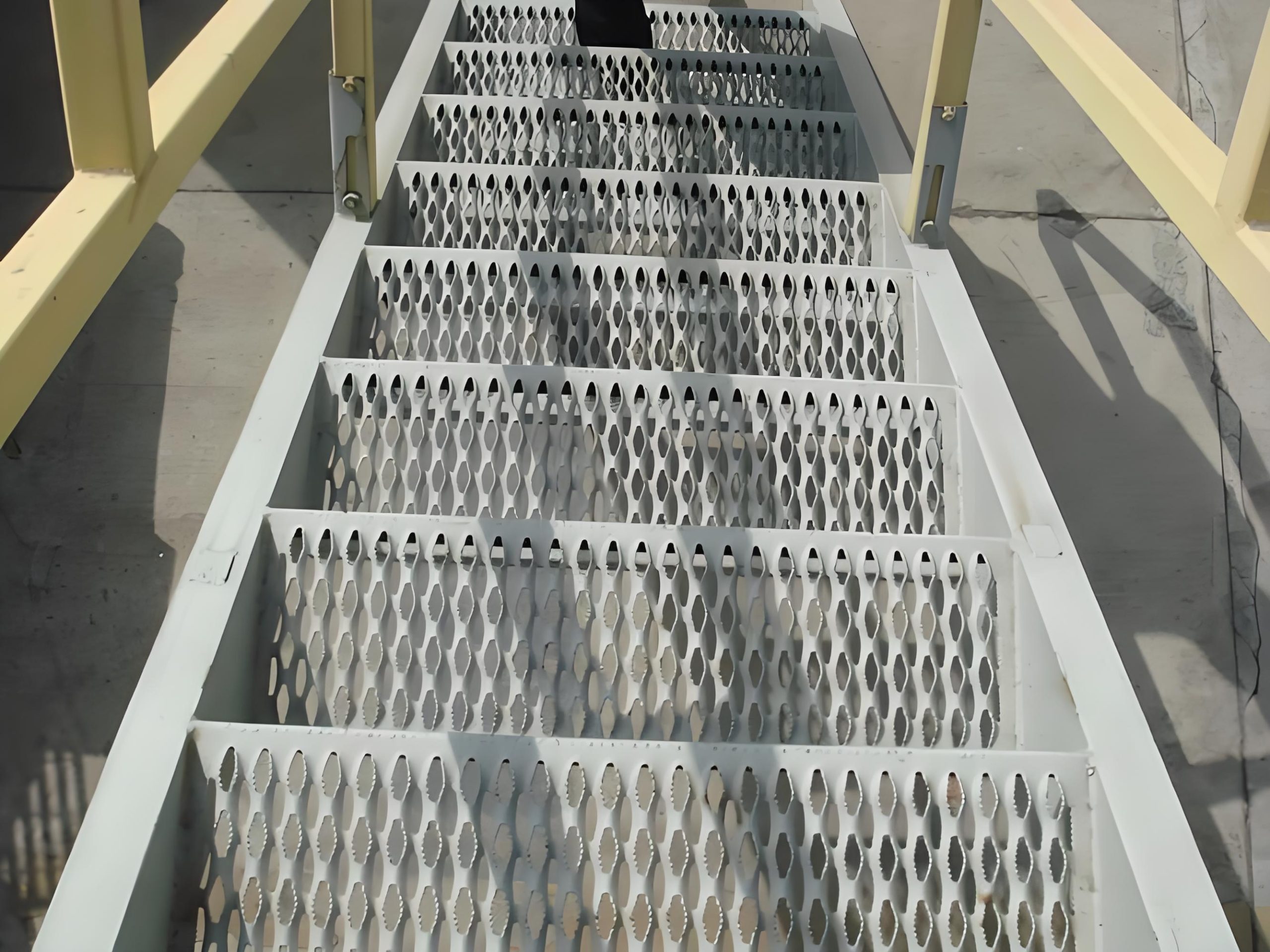
Serrated aluminum grating stair treads are designed to improve slip resistance. The serrated surface helps increase friction between the shoe sole and the tread, especially in areas where the stair may be exposed to water, oil mist, dust, mud, or outdoor weather. For industrial and marine projects, serrated aluminum stair treads are often preferred because safety is usually more important than a smooth appearance.
Serrated aluminum stair treads are suitable for factory platforms, outdoor stairs, wastewater treatment plants, marine access walkways, loading platforms, rooftop maintenance stairs, chemical plants, and equipment service areas. In these locations, the stair surface may become wet or dirty during operation. A serrated tread can provide better walking confidence for workers and maintenance personnel.
The serrated surface improves grip, but it may hold more dirt than a plain surface. For applications requiring frequent washing or clean appearance, buyers should balance anti-slip needs with maintenance requirements. In food processing areas, cleanability and hygiene requirements should be checked before selecting a serrated design. In outdoor industrial projects, serrated aluminum grating stair treads are usually a practical choice.
Plain aluminum grating stair treads have a smooth bearing bar surface. They are suitable for dry areas, indoor platforms, commercial access stairs, light-duty maintenance stairs, and applications where walking comfort and easy cleaning are important. A plain surface is easier to clean and often has a cleaner appearance than a serrated surface.
However, plain does not always mean unsafe. The full stair tread design can still include anti-slip nosing, punched nosing, checkered nosing, abrasive strip, special coating, or raised edge detail. In many projects, the walking area may use plain grating while the front edge uses an anti-slip nosing plate. This design provides a balance between comfortable walking, visual neatness, and safety at the stair edge.
| Surface Option | Anti-Slip Level | Cleaning | Suitable Use |
|---|---|---|---|
| Plain aluminum grating | Basic | Easy | Dry indoor stairs, commercial platforms, light maintenance access |
| Serrated aluminum grating | Higher | Moderate | Outdoor stairs, industrial platforms, wet or dusty areas |
| Plain grating with anti-slip nosing | Medium to high | Easy to moderate | Commercial stairs, public access, equipment stairs |
| Coated anti-slip surface | Project-dependent | Depends on coating | Special safety or appearance projects |
Aluminum stair tread size should match the stair structure, walking comfort, and load requirement. The most important dimensions are tread length, tread width, grating height, bearing bar thickness, side plate thickness, nosing size, and bolt hole layout. If one of these details is wrong, the tread may not fit the stair stringer during installation.
The tread length is normally the distance between stair stringers or the required clear span. Longer aluminum stair treads may need stronger bearing bars or closer spacing to maintain safe load capacity. When the stair width is large, the buyer should provide the loading requirement instead of only providing length and width.
The tread width affects walking comfort and stair safety. A narrow tread may be suitable for maintenance access, while wider treads are preferred for frequent walking areas, public access, or commercial stairs. The tread width should also match the stair angle and local project design requirements.
The bearing bar height and thickness directly affect load capacity and deflection. A thicker or higher bearing bar usually increases strength, but it also increases material cost. For aluminum stair treads, the correct choice should consider span, load, walking frequency, and installation method.
| Size Item | Common Requirement | Impact on Price |
|---|---|---|
| Tread length | Matched to stair stringer spacing | Longer length usually increases material and strength requirement |
| Tread width | Selected according to walking comfort and stair design | Wider tread uses more material |
| Bearing bar height | Selected according to span and load | Higher bars increase aluminum weight |
| Bearing bar thickness | Selected according to load and durability | Thicker bars increase cost but improve strength |
| Side plate thickness | Designed for fixing and edge strength | Special side plates increase fabrication cost |
One of the main reasons buyers choose aluminum stair treads is weight reduction. Aluminum is much lighter than steel, which helps reduce handling labor, transportation weight, and structural load. This is useful for rooftop access, offshore structures, marine platforms, temporary walkways, modular platforms, and projects where installation needs to be fast.
However, lightweight design does not mean weak design. Aluminum stair treads must still meet the required load capacity. The factory should choose the correct bearing bar size, spacing, side plate structure, and fixing method according to the span and load. For frequently used industrial stairs, the buyer should confirm whether the stair tread must support worker traffic only, tool carrying, maintenance equipment, or occasional heavy load.
The load capacity of aluminum stair treads is mainly affected by bearing bar height, bearing bar thickness, clear span, bar spacing, alloy grade, tread width, side plate design, and support condition. A stair tread supported at both ends behaves differently from a tread with additional support. For safety, buyers should provide drawings or load requirements when the stair tread is used in industrial or public access areas.
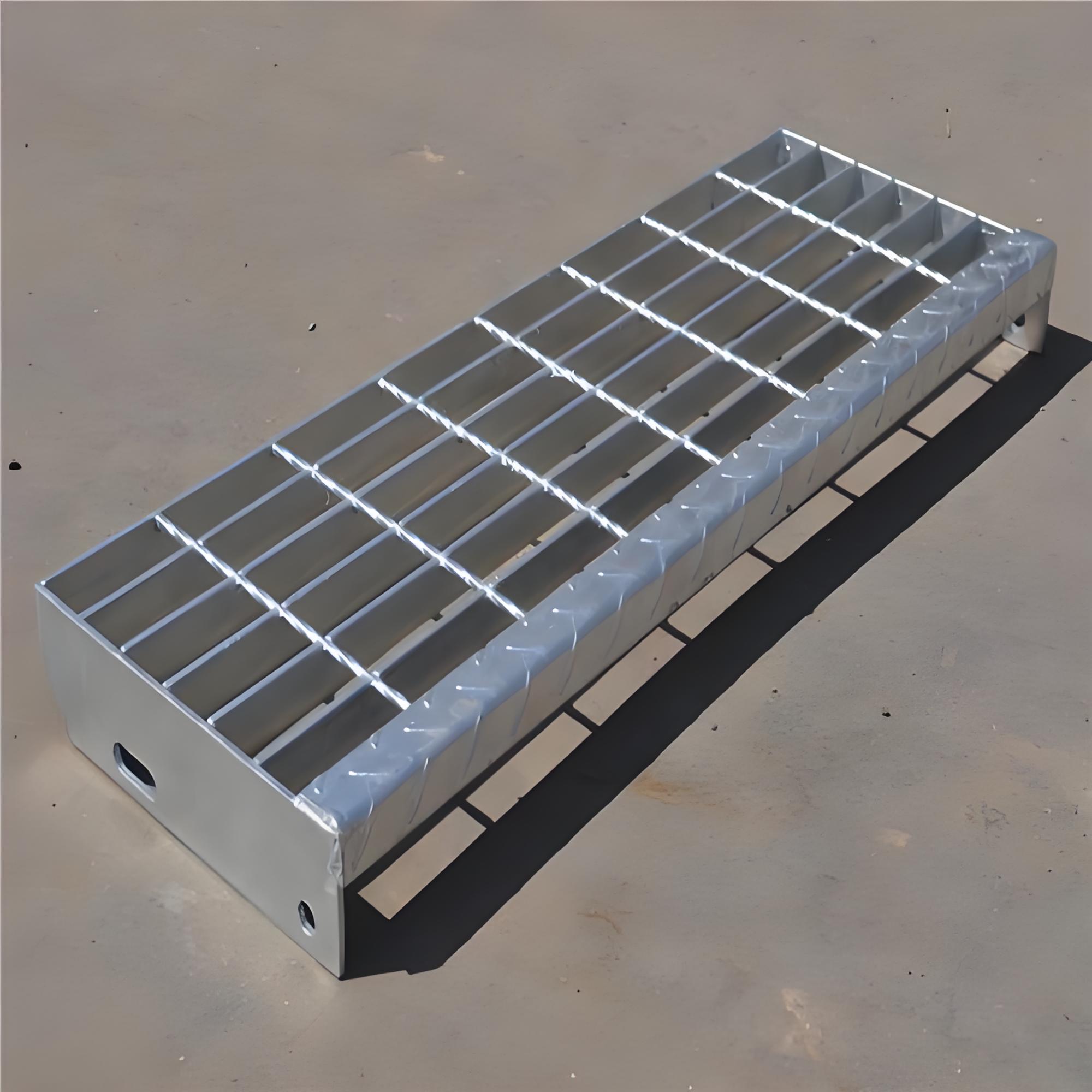
Load capacity is not only about whether the tread breaks. Deflection also matters. If a stair tread feels too flexible under foot traffic, workers may feel unsafe even if the tread has not failed. A good factory design should consider both load strength and comfortable walking performance.
Aluminum stair treads are usually not supplied as simple rectangular grating pieces. Most stair treads require side plates and front nosing. These accessories help with installation, edge protection, anti-slip performance, and visual identification of the stair edge.
The nosing plate is installed at the front edge of the stair tread. It improves walking safety by making the stair edge stronger and more visible. Nosing can be plain, checkered, perforated, abrasive, serrated, or designed according to project requirements. For industrial stairs, anti-slip nosing is often recommended because the front edge is the most important part of each step.
Side plates are installed on both ends of the stair tread. They allow the tread to be bolted to the stair stringers. The side plate thickness, height, hole diameter, hole spacing, and hole position should match the stair frame. For replacement projects, it is especially important to check existing hole positions before production.
Bolt holes can be round, slotted, or customized. Slotted holes allow more installation adjustment, while round holes provide a cleaner fixed position. The factory can punch or drill holes according to drawings. Buyers should confirm bolt size, hole diameter, center-to-center distance, edge distance, and whether the stair tread needs left-hand and right-hand installation direction.
| Component | Function | Quotation Detail Needed |
|---|---|---|
| Nosing plate | Improves front edge safety and visibility | Type, size, surface, material and installation direction |
| Side plate | Connects stair tread to stringer | Thickness, height, hole position and plate shape |
| Bolt hole | Allows installation with bolts | Hole diameter, spacing, edge distance and slot requirement |
| Fixing accessories | Support installation on site | Bolt, washer, clip or project-specific fixing method |
Surface treatment has a direct effect on appearance, corrosion resistance, maintenance, and price. Aluminum has natural corrosion resistance, but different environments may still require different surface options. Indoor dry areas may only need mill finish. Outdoor, coastal, commercial, or decorative projects may require anodizing or powder coating.
Mill finish is the basic aluminum surface after production. It is usually suitable for industrial areas where appearance is not the main concern. Mill finish aluminum stair treads are economical, practical, and widely used for maintenance stairs, platforms, and equipment access areas.
Anodizing improves surface hardness, corrosion resistance, and appearance. It can also provide a more uniform decorative surface. Anodized aluminum stair treads are often selected for commercial projects, public access stairs, architectural platforms, and coastal applications where both appearance and durability are important.
Powder coating provides color options and additional surface protection. It is suitable when the stair treads need to match a building color scheme or safety color requirement. Powder coating cost depends on color, coating thickness, pretreatment, batch quantity, and finish requirement.
For marine or coastal use, the buyer should describe the service environment clearly. Salt spray, humidity, chemical vapor, and outdoor exposure can affect the surface treatment choice. Aluminum is corrosion resistant, but wrong alloy selection or poor surface preparation may reduce service life in harsh environments.
| Surface Option | Appearance | Corrosion Resistance | Cost Level |
|---|---|---|---|
| Mill finish | Natural aluminum surface | Basic to good | Lower |
| Anodized | Clean and uniform | Good to high | Medium to higher |
| Powder coated | Color controlled | Good when properly treated | Medium to higher |
| Special anti-slip coating | Functional surface | Depends on coating system | Project-dependent |
Standard aluminum stair treads are suitable when the project can accept common sizes, regular grating spacing, normal nosing, and standard side plate hole positions. They are easier to produce, easier to quote, and usually have a shorter lead time. For buyers who need replacement treads or small batches, standard dimensions may reduce cost.
Custom fabricated aluminum stair treads are required when the stair structure is already designed, when the installation holes must match existing stringers, when the tread needs special shape, when the load requirement is higher, or when the project requires special surface treatment. Custom fabrication gives better project matching, but the price and lead time are usually higher than standard production.
| Item | Standard Aluminum Stair Treads | Custom Aluminum Stair Treads |
|---|---|---|
| Size | Common factory size | Made according to drawings or size list |
| Lead time | Usually shorter | Depends on drawing, material and quantity |
| Price | Usually more economical | Higher when special fabrication is required |
| Installation matching | Suitable for common stair frames | Better for fixed project dimensions |
| Surface treatment | Common finish options | Can be customized for project appearance or environment |
The price of aluminum stair treads is mainly built from material cost and fabrication cost. Aluminum alloy price can change with market conditions, while fabrication cost changes with cutting, welding, drilling, nosing, surface treatment, inspection, packing, and labor. For export orders, packaging and shipping also affect the final landed cost.
Different aluminum alloys have different base costs. Stronger or corrosion-resistant grades may cost more. If the buyer requires a specific temper or standard, the factory needs to confirm raw material availability before quotation.
Larger stair treads use more aluminum. Higher bearing bars and thicker side plates also increase weight. In many cases, aluminum stair tread price is closely related to the finished product weight, but fabrication complexity can also make two similar weights have different prices.
Higher load requirements may require stronger grating, closer spacing, thicker bars, reinforced side plates, or special design checks. This increases material use and processing cost.
Mill finish is usually the most economical. Anodizing, powder coating, brushing, polishing, anti-slip coating, or special color treatment will increase price. Surface treatment also requires minimum batch consideration in some cases.
Larger quantities usually reduce unit fabrication cost because cutting, drilling, welding setup, surface treatment preparation, packing, and production planning can be spread across more pieces. Small trial orders are possible, but unit cost is often higher.
| Price Factor | Why It Matters | Buyer Suggestion |
|---|---|---|
| Alloy grade | Affects strength, corrosion resistance and raw material cost | Confirm alloy based on application, not only price |
| Tread size | Determines material weight and cutting layout | Provide exact length and width |
| Bearing bar size | Controls load capacity and deflection | Confirm span and load requirement |
| Nosing and side plates | Adds fabrication work and installation function | Provide drawing or hole layout |
| Surface finish | Changes appearance, corrosion resistance and processing cost | Select based on environment and budget |
| Quantity | Affects production efficiency and unit price | Send total quantity and size list for better pricing |
Aluminum stair treads are used in many places where lightweight access, corrosion resistance, and safe walking are required. They are especially useful in projects where workers need to install or remove stair components manually, where the structure should not carry unnecessary weight, or where corrosion from moisture is a concern.
In industrial plants, aluminum stair treads are used for equipment access, maintenance platforms, inspection stairs, mezzanine systems, and production line walkways. Serrated aluminum grating stair treads are often selected when the area may contain oil, water, dust, or processing residue.
For walkway systems, aluminum stair treads can be used together with aluminum grating panels, handrails, and support structures. Their light weight makes them suitable for modular platforms and quick installation projects.
Aluminum stair treads are often used in marine-related structures because aluminum offers good resistance to moisture and weather exposure. For coastal areas, the alloy grade and surface treatment should be confirmed carefully. Anodized or properly finished aluminum can improve durability and appearance in outdoor use.
Commercial buildings, public access areas, rooftop stairs, service stairs, and architectural walkways may use aluminum stair treads because they are light, neat, and available with different surface finishes. For these projects, appearance, safety, edge detail, and color matching may be more important than in general industrial use.
| Application Area | Recommended Design Focus | Common Option |
|---|---|---|
| Industrial platform stairs | Load capacity and anti-slip performance | Serrated grating with strong side plates |
| Outdoor maintenance stairs | Weather resistance and safe walking | Serrated aluminum tread with anti-slip nosing |
| Marine access stairs | Corrosion resistance and lightweight design | Suitable aluminum alloy with anodized or protective finish |
| Commercial stairs | Appearance, comfort and edge safety | Plain or anti-slip nosing design with decorative finish |
| Rooftop access | Low weight and easy installation | Lightweight aluminum stair tread with bolted fixing |
For export orders, aluminum stair treads must be packed carefully to avoid surface scratches, deformation, edge damage, and coating damage during shipping. Although aluminum stair treads are lighter than steel stair treads, they still need firm packing because long-distance transport may include forklift handling, container loading, sea freight, customs inspection, and site transfer.
Common packing methods include pallet packing, wooden case packing, plastic film wrapping, foam protection, corner protection, steel or plastic strapping, and waterproof covering. For anodized or powder coated aluminum stair treads, surface protection is more important because scratches may affect appearance.
Aluminum stair treads can be shipped by sea, by air, or by express for small urgent orders. For large project quantities, sea freight is usually more economical. The buyer should confirm whether the quotation needs EXW, FOB, CFR, CIF, DAP, or DDP terms. Different trade terms include different cost responsibilities, so they should be clearly stated before price comparison.
Export documents may include commercial invoice, packing list, bill of lading, certificate of origin, material certificate, inspection report, and other project-required documents. If the buyer needs a special certificate or third-party inspection, this should be confirmed before production.
To receive an accurate aluminum stair tread price, the buyer should provide clear technical and commercial information. A simple message such as “send aluminum stair tread price” is usually not enough because the factory cannot confirm material, size, load, surface, holes, and quantity from that request.
| Quotation Information | Example Details | Why It Is Needed |
|---|---|---|
| Product size | Length, width, height, side plate thickness | To calculate material and fabrication cost |
| Material | 6061, 6063, 5052 or project-specified alloy | To confirm raw material cost and performance |
| Surface type | Plain, serrated, nosing, anti-slip coating | To confirm safety design and processing cost |
| Installation details | Bolt hole diameter, spacing, side plate drawing | To make sure the tread fits the stair stringers |
| Surface treatment | Mill finish, anodized, powder coated | To calculate finishing cost and lead time |
| Quantity | Total pieces and size list | To calculate unit price and production schedule |
| Delivery requirement | Destination port, address, trade term | To calculate freight, packing and export cost |
A reliable manufacturer should understand both product fabrication and project installation needs. Aluminum stair treads are not only sold by weight. The buyer should check whether the supplier can read drawings, confirm hole positions, recommend suitable materials, provide surface options, control tolerances, protect finished surfaces, and arrange export packing.
For project purchasing, it is better to communicate with the factory before finalizing the drawing. Some size designs may increase cost unnecessarily, while a small adjustment in tread width, side plate design, or hole layout may reduce waste and improve production efficiency. A manufacturer with practical fabrication experience can help buyers avoid repeated revisions and installation delays.
| Supplier Check Point | What Buyers Should Ask | Why It Matters |
|---|---|---|
| Material control | Can the factory confirm alloy grade and material certificate? | Wrong alloy may affect strength and corrosion resistance |
| Drawing support | Can the factory produce according to drawings or size lists? | Custom stair treads must match site installation |
| Fabrication quality | How are side plates, nosing and holes controlled? | Poor fabrication causes installation problems |
| Surface options | Can the factory supply mill finish, anodized or coated treads? | Different environments need different finishes |
| Export packing | How will the stair treads be packed for sea freight? | Good packing reduces damage during transport |
How much are aluminum stair treads?
Aluminum stair tread prices depend on alloy grade, tread size, bearing bar specification, nosing design, side plate thickness, surface treatment, and quantity. Standard mill finish aluminum grating stair treads are usually more economical, while serrated, anodized, powder coated, heavy-duty, or custom drilled stair treads cost more. For an accurate factory price, buyers should send drawings or a detailed size list.
Are aluminum stair treads good for outdoor stairs?
Yes, aluminum stair treads are a good choice for many outdoor stairs because they are lightweight and corrosion resistant. For wet, marine, coastal, or industrial outdoor areas, serrated aluminum grating stair treads or anti-slip nosing designs are often recommended. The alloy grade and surface treatment should be selected according to the real service environment.
Can aluminum stair treads be custom made?
Yes, aluminum stair treads can be custom made according to project drawings. Custom options include tread length, width, bearing bar size, grating spacing, serrated or plain surface, nosing plate, side plate, bolt hole layout, alloy grade, anodized finish, powder coating, and packaging requirements. Custom fabrication is especially useful when the stair treads must match existing stair stringers or special platform structures.