
Walkway gratings do not have one fixed factory price because two panels with the same length and width may contain very different amounts of steel, use different manufacturing methods, carry different loads, and require different corrosion protection. For a standard industrial order, carbon steel walkway grating may start at approximately US$15–45 per square meter, while standard hot-dip galvanized grating commonly falls within about US$22–65 per square meter. Heavy-duty, close-mesh, serrated, press-locked, stainless steel, or extensively fabricated panels can cost considerably more. A useful factory quotation must therefore identify the material, bearing bar size, spacing, span, surface treatment, panel layout, processing requirements, quantity, packing method, and delivery term rather than relying on panel area alone.
The factory price of walkway grating is mainly a combination of material weight and processing cost. Material usually represents the largest portion of the quotation, particularly for thick carbon steel bars and stainless steel panels. Fabrication, surface treatment, custom cutting, banding, inspection, packing, and export preparation are then added according to the project requirements.
A practical factory pricing model can be expressed as follows:
Walkway grating price = material weight × material unit cost + manufacturing cost + surface treatment + custom fabrication + inspection and documentation + packing
Freight, insurance, import duty, local tax, installation, support steel, handrails, and site labor are normally separate unless the quotation specifically includes them. This is why buyers should confirm whether a published price is EXW, FOB, CIF, DAP, or another delivery basis.
| Price Component | What It Includes | Typical Influence |
|---|---|---|
| Raw material | Bearing bars, cross bars, banding bars, toe plates, and accessories | Usually the largest part of the factory price |
| Manufacturing | Welding, press locking, swage locking, straightening, and dimensional control | Depends on grating type and production volume |
| Surface treatment | Hot-dip galvanizing, painting, powder coating, pickling, or passivation | Can add a significant premium, especially on small orders |
| Custom fabrication | Cutting, banding, openings, notches, toe plates, and fixing components | Low for standard panels and high for irregular layouts |
| Quality requirements | Material certificates, load documentation, coating inspection, and third-party inspection | Varies according to project specifications |
| Export preparation | Pallets, wrapping, labels, packing lists, and shipping documents | More noticeable on small shipments |
The lowest published online price often refers to a light specification, untreated surface, large minimum order, standard rectangular panels, and basic packing. It may not represent the cost of a finished industrial walkway system. When comparing quotations, the most reliable approach is to compare the finished panel weight, steel grade, bar dimensions, mesh, coating, fabrication scope, and delivery term on the same basis.
As a direct reference, standard carbon steel walkway gratings generally cost about US$15–45 per square meter at factory level. Standard hot-dip galvanized carbon steel gratings are commonly around US$22–65 per square meter. Heavy-duty or close-mesh galvanized walkway panels may range from approximately US$45–110 per square meter. Stainless steel walkway grating is substantially more expensive, with 304 grades commonly around US$55–150 per square meter and 316 or 316L grades often around US$80–260 per square meter.
These figures are general procurement references rather than fixed offers. The lower end normally applies to lighter standard panels, larger quantities, simple rectangular shapes, and ordinary packing. The higher end applies to thicker bearing bars, short production runs, close spacing, serrated surfaces, irregular cutting, extensive banding, stainless steel, special inspection, or demanding export packing.
| Walkway Grating Type | Indicative Factory Price | Common Conditions Behind the Range |
|---|---|---|
| Untreated carbon steel grating | US$15–45/m² | Standard welded construction, plain surface, regular panels |
| Painted carbon steel grating | US$18–50/m² | Primer, bituminous coating, or industrial paint system |
| Hot-dip galvanized steel grating | US$22–65/m² | Standard industrial walkway specifications |
| Heavy-duty galvanized grating | US$45–110/m² | Thicker bars, deeper bars, close mesh, or short spans with high loads |
| 304 stainless steel grating | US$55–150/m² | Standard welded or press-locked panels |
| 316 or 316L stainless steel grating | US$80–260/m² | Corrosive service, custom fabrication, pickling, or passivation |
A quotation per square meter is convenient, but it can hide major specification differences. A 30 × 3 mm bearing bar panel and a 50 × 5 mm bearing bar panel may cover the same area, yet the heavier panel can contain more than twice as much steel. For this reason, factory prices should be checked against theoretical or actual weight whenever possible.
Untreated carbon steel is normally the lowest-cost option. It is frequently selected for indoor platforms, temporary structures, dry production areas, or projects where the purchaser will apply paint after fabrication. Common material specifications may include structural carbon steel grades such as ASTM A36, ASTM A1011, EN 10025 grades, or equivalent regional standards.
The initial purchase price is low, but untreated steel can require additional painting and maintenance in humid, outdoor, chemical, coastal, or wash-down environments. A low factory price should therefore be evaluated together with the expected corrosion exposure and maintenance plan.
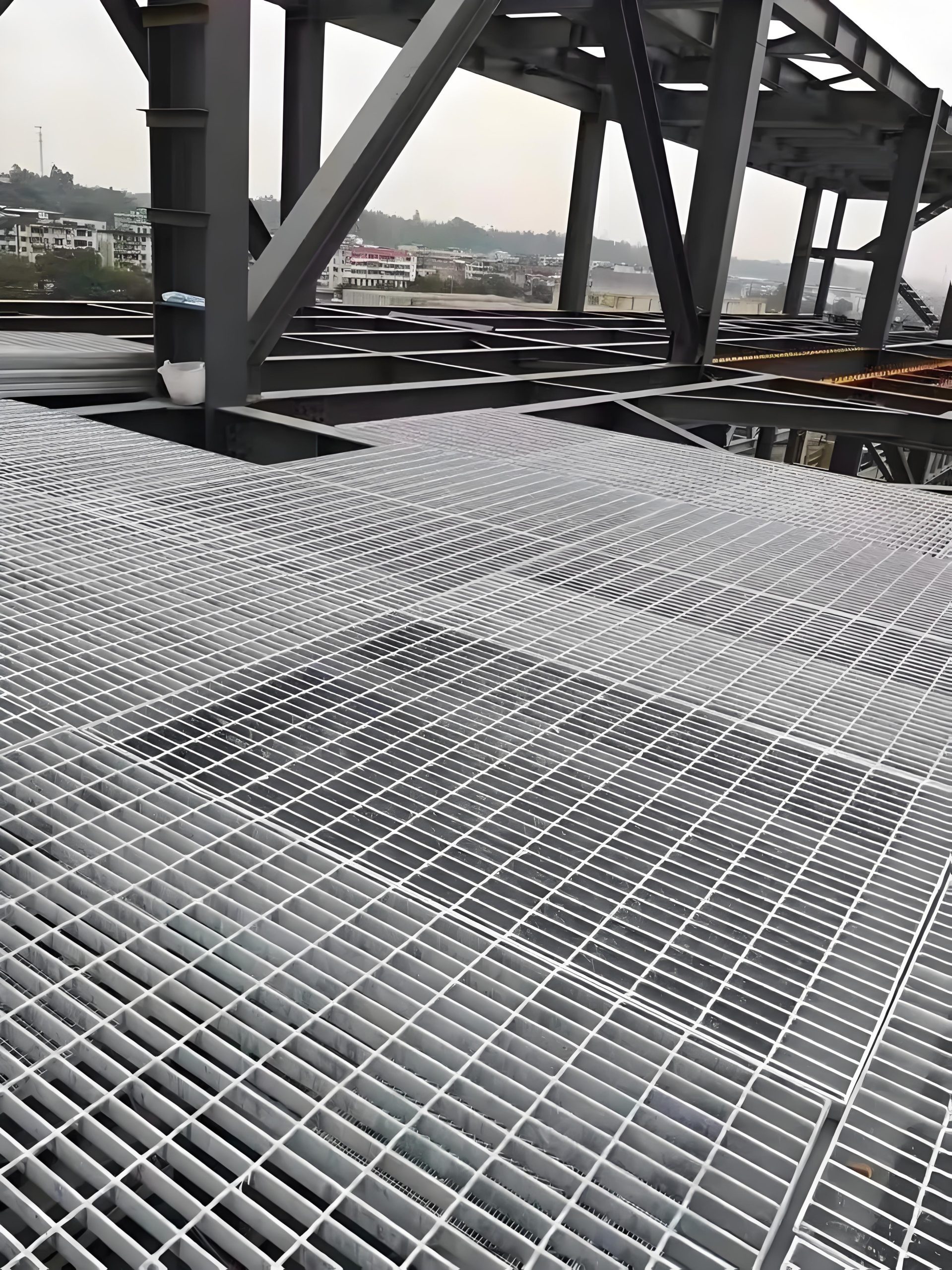
Hot-dip galvanized carbon steel is one of the most widely purchased choices for outdoor industrial walkways. The fabricated grating is immersed in molten zinc after welding and custom processing, allowing the zinc coating to cover bearing bars, cross bars, banding, weld areas, and cut edges.
The galvanized price includes the carbon steel panel plus cleaning, pickling, galvanizing, handling, inspection, and possible straightening after coating. ASTM A123/A123M, ISO 1461, or another specified galvanizing standard may be used depending on the destination and project requirements.
Galvanizing costs do not always increase in direct proportion to panel area. Galvanizers may charge according to weight, minimum batch size, handling difficulty, or total surface condition. Small orders and unusually large panels can therefore carry a higher galvanizing cost per square meter.
Stainless steel grating has a much higher raw material cost than carbon steel, but it may be the more economical long-term choice in food processing, chemical plants, wastewater facilities, marine environments, pharmaceutical production, and other locations where corrosion or hygiene is critical.
Grade 304 is commonly selected for general atmospheric corrosion resistance and many indoor processing environments. Grade 316 or 316L is usually considered where chloride exposure, salt water, aggressive cleaning agents, or stronger chemical conditions are present. The use of 316L does not eliminate the need to evaluate the actual chemical concentration, temperature, crevice conditions, and cleaning process.
| Material | Initial Price Level | Corrosion Protection | Typical Application |
|---|---|---|---|
| Untreated carbon steel | Lowest | Limited without a coating | Dry indoor areas and painted systems |
| Painted carbon steel | Low to medium | Depends on coating system and maintenance | Indoor plants and moderate environments |
| Hot-dip galvanized steel | Medium | Good general outdoor protection | Platforms, catwalks, access ways, and utility plants |
| 304 stainless steel | High | Good in many industrial environments | Food processing, architectural areas, and clean facilities |
| 316 or 316L stainless steel | Highest among common options | Improved resistance in many chloride environments | Marine, chemical, wastewater, and coastal projects |
Material selection should be based on the service environment rather than the lowest purchase price. Replacing corroded walkway panels in an operating plant can cost far more than the original material difference once shutdowns, lifting equipment, access control, labor, and safety management are included.
The bearing bars are the principal load-carrying members of metal walkway grating. Their depth, thickness, spacing, material grade, and unsupported span have a direct effect on panel weight, load capacity, deflection, and factory price.
A deeper bearing bar generally improves bending resistance more efficiently than merely increasing thickness, although the final selection must be checked against the required load table and span. Increasing thickness adds steel weight directly and may be necessary for concentrated loads, heavy-duty use, durability, fabrication requirements, or project specifications.
Common metric bearing bar depths include 20, 25, 30, 32, 35, 40, 45, 50, 60, and 65 mm. Common imperial depths include 3/4, 1, 1-1/4, 1-1/2, 1-3/4, 2, and 2-1/2 inches. A deeper bar normally raises the price because it increases material weight, but the price difference should always be considered together with the permitted span.
Typical thicknesses include 3, 4, 4.5, 5, 6, and 8 mm, as well as 1/8, 3/16, and 1/4 inch. Changing a 30 × 3 mm bar to a 30 × 5 mm bar increases the bearing bar cross-sectional area by about 67 percent. Unless spacing or another parameter changes, the material portion of the panel price rises accordingly.
The approximate weight of the bearing bars in one square meter can be estimated from the bar dimensions, bearing bar spacing, and steel density. Cross bars, banding, weld metal, toe plates, and other accessories must then be added to obtain the complete panel weight.
| Bearing Bar | Bearing Bar Spacing | Approximate Bearing Bar Weight Only | Relative Price Effect |
|---|---|---|---|
| 25 × 3 mm | 30 mm | About 19.6 kg/m² | Economical light-duty configuration |
| 30 × 3 mm | 30 mm | About 23.6 kg/m² | Common walkway range |
| 30 × 5 mm | 30 mm | About 39.3 kg/m² | Substantially higher material cost |
| 40 × 5 mm | 30 mm | About 52.3 kg/m² | Higher-load and longer-span range |
| 50 × 5 mm | 30 mm | About 65.4 kg/m² | Heavy and relatively expensive |
| 30 × 3 mm | 40 mm | About 17.7 kg/m² | Lower weight than 30 mm spacing |
The weights above represent the bearing bars only. Finished weight will be higher after adding cross bars and banding. They nevertheless demonstrate why quotations based solely on panel dimensions can be misleading.
Load capacity must not be judged from price or panel weight alone. The supported span, load type, allowable deflection, bar orientation, material properties, fixing method, and local design requirements all matter. Pedestrian uniform loads, maintenance carts, pallet trucks, pipe supports, falling objects, and equipment wheels create different design conditions. The final grating selection should be verified against an applicable load table or project engineering calculation.
Walkway grating mesh is generally described by the center-to-center spacing of the bearing bars and the spacing of the cross bars. Common metric arrangements include 30 × 100 mm, 30 × 50 mm, 34 × 101 mm, 40 × 100 mm, and several close-mesh configurations. Imperial designations such as 19-W-4 and 19-W-2 are also widely used.
In a designation such as 19-W-4, the first number indicates bearing bar spacing in sixteenths of an inch and the final number indicates cross bar spacing in inches. A 19-W-4 welded grating therefore has bearing bars at approximately 1-3/16 inches on center and cross bars at 4 inches on center.
Closer bearing bar spacing places more load-carrying bars in each square meter. This increases steel weight, welding points, production time, and factory cost. Close mesh may be required for narrow wheel contact, small objects, walking comfort, project opening limits, or accessibility-related design requirements.
Reducing cross bar spacing from 100 mm to 50 mm generally increases the number of cross bars and manufacturing connections. The price increase is usually smaller than a comparable reduction in bearing bar spacing because bearing bars contain a larger share of the total steel weight. Even so, closer cross bars can noticeably affect the quotation on large orders.
| Mesh Arrangement | Material Usage | Typical Price Position | Common Reason for Selection |
|---|---|---|---|
| 40 × 100 mm | Relatively low | Lower | General access where wider openings are acceptable |
| 30 × 100 mm | Medium | Standard | Industrial platforms and walkways |
| 30 × 50 mm | Medium to high | Moderately higher | More cross bars and smaller rectangular openings |
| Close mesh | High | Higher | Small wheels, restricted openings, or project-specific requirements |
| 19-W-4 | Standard imperial arrangement | Competitive where regularly produced | Industrial flooring and catwalks |
| 19-W-2 | More cross bars than 19-W-4 | Usually higher than 19-W-4 | Closer cross bar spacing |
A smaller opening does not automatically mean that the grating is suitable for every wheel load. The wheel diameter, contact area, load position, bar direction, and deflection criteria still need to be checked.
Plain grating uses flat upper bearing bar surfaces and is normally the most economical option. It is commonly used in dry industrial areas, utility platforms, mezzanines, and locations where a serrated profile is not required.
Plain grating is also easier to clean in certain applications because the upper surface does not contain serration notches. The appropriate surface depends on the actual contamination, drainage, housekeeping, footwear, and safety requirements.
Serrated grating has notches or teeth formed along the upper edge of the bearing bars. The additional forming process, material handling, and production control generally make it more expensive than an otherwise identical plain panel.
The premium is often moderate for a regular production run but can become more noticeable on special bearing bar dimensions or small quantities. Serration should be specified clearly because different factories may use different tooth depths, pitches, and production methods.
Serrated surfaces are commonly considered for wet, oily, muddy, snowy, or sloped access areas. They do not remove the need for proper drainage, cleaning, lighting, footwear, guarding, or safe walkway design. Serration also does not automatically increase the structural load capacity of the panel.
I-bar grating uses bearing bars with an I-shaped section instead of a solid rectangular flat bar. The profile can reduce panel weight while maintaining useful section depth. It is commonly associated with aluminum grating but may also be available in other materials and systems.
An I-bar panel may use less material than a rectangular bar panel of the same nominal depth, but it is not always the lowest-priced option. Extrusion, tooling, alloy selection, production volume, and supplier availability can offset some of the weight saving. Load tables must be compared rather than assuming equal performance from equal nominal depth.
| Surface or Profile | Relative Factory Cost | Main Advantage | Important Limitation |
|---|---|---|---|
| Plain flat bar | Lowest baseline | Simple, economical, and widely available | May provide less traction under some contaminated conditions |
| Serrated flat bar | Slightly to moderately higher | Improved surface engagement in many slippery environments | More difficult to clean in some applications |
| I-bar | Depends on material and production method | Lower weight for some designs | Must be checked against a specific load table |
Welded grating is commonly produced by joining twisted or round cross bars to the bearing bars under pressure and electrical resistance welding. It is widely used for carbon steel industrial walkways because production can be efficient, repetitive, and suitable for standard panel sizes.
For regular carbon steel specifications and sufficient volume, welded grating is often the most economical manufacturing method. The total price still depends on bar dimensions, mesh, serration, panel size, banding, galvanizing, and production tolerances.
Press-locked grating is produced by pressing cross bars into pre-punched or slotted bearing bars. It creates a clean geometric appearance and can be manufactured from carbon steel, stainless steel, or aluminum.
Press-locked production involves accurate slotting, alignment, and pressing. Tool setup and tighter visual requirements can make it more expensive than standard welded carbon steel grating, especially for small batches or unusual mesh patterns. It is often selected for architectural walkways, screening, façades, public areas, and projects requiring a uniform appearance.
Swage-locked grating uses cross bars or tubes that are mechanically locked into the bearing bars by pressure or swaging. It is frequently used for aluminum products and may also be specified for stainless steel or other non-welded systems.
The manufacturing cost depends heavily on the profile, alloy, tooling, panel dimensions, and production quantity. Swage-locked panels can carry a higher fabrication cost than conventional welded carbon steel panels, but they may offer advantages where low weight, non-welded construction, or a particular appearance is required.
| Manufacturing Type | Typical Cost Position | Suitable Materials | Common Use |
|---|---|---|---|
| Welded | Usually the lowest for standard carbon steel | Carbon steel and stainless steel | Industrial platforms, catwalks, and access walkways |
| Press-locked | Usually above standard welded grating | Carbon steel, stainless steel, and aluminum | Architectural and industrial applications |
| Swage-locked | Varies; often above standard welded carbon steel | Especially aluminum, with other options available | Lightweight walkways and specialized systems |
Manufacturing types should not be compared by price alone. The quotation should state the exact construction, bar orientation, connection method, material, permissible tolerances, and load data.
Surface treatment affects both the initial factory price and the expected maintenance cost. The correct treatment depends on the material, service environment, required appearance, corrosion exposure, and project specification.
Mill-finish carbon steel has the lowest immediate price. It may contain mill scale and can develop surface rust during storage or transport. It is usually selected when the customer will blast and paint the grating after delivery or when the product is intended for temporary or controlled indoor use.
Paint systems range from a simple shop primer to multi-layer industrial coatings. The quotation should identify surface preparation, primer type, coating system, dry film thickness, color, and repair procedure. A low-cost dip coating should not be treated as equivalent to a specified blasted and multi-coat system.
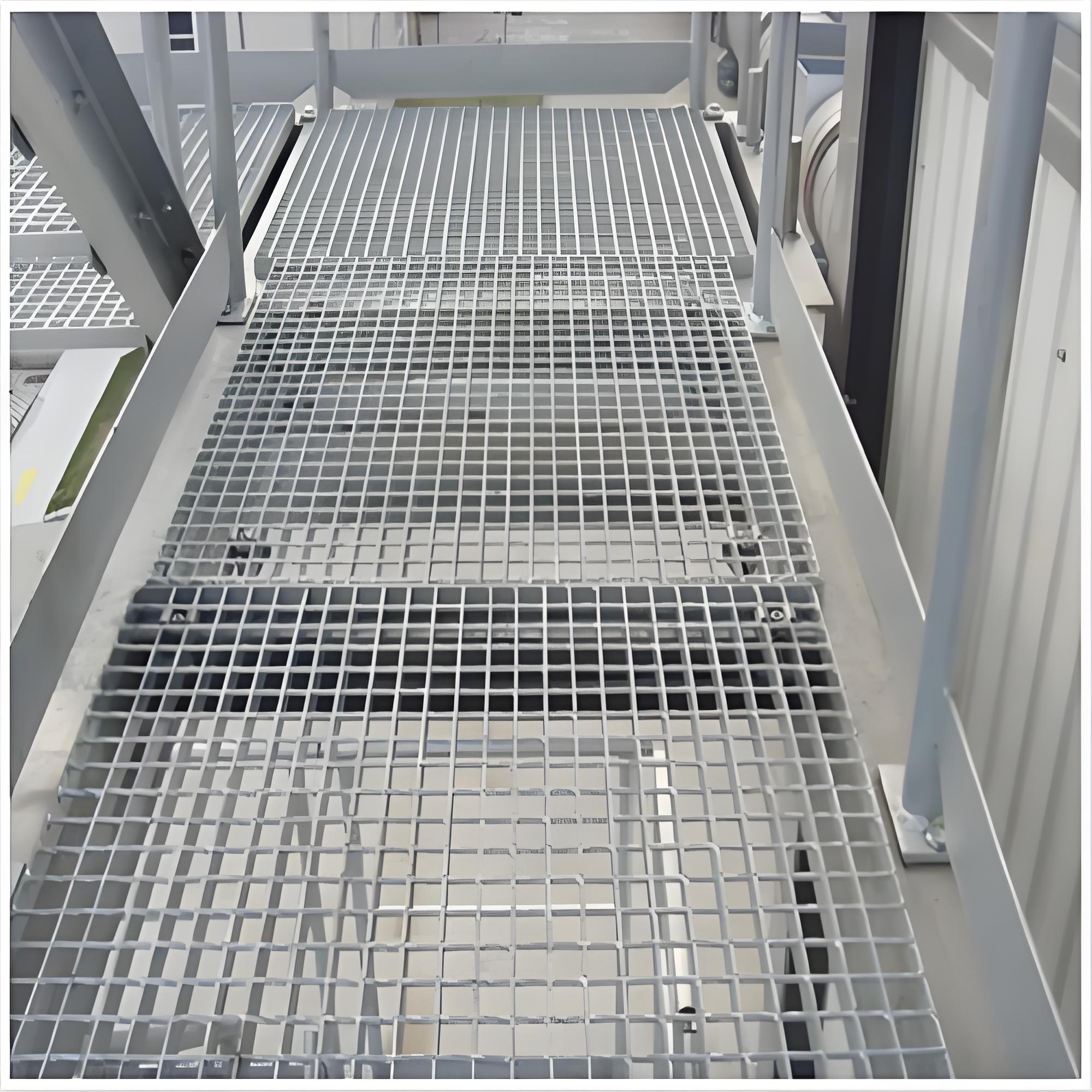
Hot-dip galvanizing is commonly specified after welding and fabrication. Its price is affected by panel weight, minimum galvanizing batch charges, zinc price, steel chemistry, surface condition, panel dimensions, venting and drainage design, coating inspection, and transport between the grating factory and galvanizing plant.
Fabrication should normally be completed before galvanizing. Cutting or welding a galvanized panel afterward damages the zinc coating at the modified area and requires an approved repair method. Extensive site modification can reduce the practical value of ordering a fully galvanized product.
Powder coating can provide a colored and visually uniform finish. It may be applied to properly prepared steel or, under an appropriate duplex system, over hot-dip galvanizing. The cost depends on pretreatment, coating material, color, film thickness, curing, panel size, and masking requirements.
Stainless steel grating may require pickling, passivation, bead blasting, electropolishing, or another finish depending on contamination control and appearance requirements. Welding heat tint and embedded carbon steel contamination should be considered in demanding corrosion environments.
| Surface Treatment | Price Effect | Common Reason for Use |
|---|---|---|
| Untreated | Lowest | Customer-applied coating or dry indoor use |
| Basic paint or primer | Low to moderate | Temporary protection or specified paint system |
| Hot-dip galvanizing | Moderate | Outdoor corrosion protection |
| Powder coating | Moderate to high | Color and architectural appearance |
| Duplex galvanized and painted system | High | Enhanced corrosion protection and appearance |
| Stainless pickling and passivation | Moderate additional cost | Removal of heat tint and surface contamination |
| Electropolishing | High | Special hygiene, finish, or corrosion requirements |
Factories normally obtain the best production efficiency from standard mesh arrangements, regular bearing bar sizes, and full production panels. Common metric production panels may be approximately 1,000 mm wide and 5,800 or 6,000 mm long. Imperial stock panels may be supplied in widths such as 2 or 3 feet and lengths such as 20 or 24 feet. Actual standard dimensions vary by factory, production line, destination market, and manufacturing type.
Project panels are often cut from larger production panels according to an approved layout drawing. Good nesting can reduce scrap and lower the finished price. Poor nesting, narrow residual strips, many irregular shapes, or inconsistent panel dimensions increase waste and processing time.
| Example Specification | Typical Use | Indicative Factory Price |
|---|---|---|
| 25 × 3 or 30 × 3 mm bearing bars, standard mesh, plain carbon steel | Light to general pedestrian access | Approximately US$15–35/m² |
| 30 × 3 mm bearing bars, standard mesh, hot-dip galvanized | General outdoor industrial walkway | Approximately US$22–50/m² |
| 30 × 5 mm bearing bars, standard mesh, galvanized | Higher load or longer span than light grating | Approximately US$35–75/m² |
| 40 × 5 or 50 × 5 mm bearing bars, galvanized | Heavy-duty access or demanding span | Approximately US$55–110/m² |
| 304 stainless steel, regular mesh and rectangular panels | Corrosion-resistant industrial walkway | Approximately US$55–150/m² |
| 316 or 316L stainless steel, custom fabricated | Marine, chemical, or chloride exposure | Approximately US$80–260/m² |
The table is a budgeting guide. It does not replace a load review or detailed factory quotation. Prices can fall outside these ranges when the panel is exceptionally light, unusually heavy, close mesh, press locked, extensively fabricated, made in a small quantity, or subject to special inspection.
Standard rectangular panels are less expensive to manufacture than panels requiring numerous cuts and welded attachments. Custom work affects not only labor but also scrap rate, drawing preparation, handling, welding, grinding, dimensional inspection, marking, and galvanizing.
Straight cutting to regular rectangular dimensions has a relatively small cost impact when panels can be nested efficiently. The cost rises when every panel has a different dimension or when narrow shapes create substantial offcut waste.
Banding closes exposed bearing bar ends and may be supplied as trim banding or load-carrying banding. Load-carrying banding requires stronger connections and should be identified on the drawing. A quotation that only states “banded” may be insufficient for a structural opening or unsupported edge.
Notches may be required around beams, columns, pipes, equipment bases, handrail posts, or structural brackets. Each notch requires measurement, cutting, edge finishing, possible banding, identification, and inspection. A large number of small notches can have a greater cost impact than one large rectangular opening.
Openings should be dimensioned from clear reference points and show the bearing bar direction. Interrupted load-carrying bars may require reinforced or load-carrying banding. The structural effect should be reviewed before fabrication rather than resolved by uncontrolled cutting on site.
Toe plates add material, welding, straightening, coating area, and handling. Their height, thickness, position, weld pattern, and clearances should be included in the inquiry.
| Fabrication Item | Typical Quotation Impact | Main Cost Driver |
|---|---|---|
| Regular rectangular cutting | Low | Cutting time and nesting efficiency |
| Trim banding | Low to moderate | Edge length and number of panels |
| Load-carrying banding | Moderate | More welding and structural connection requirements |
| Simple rectangular opening | Moderate | Cutting, scrap, and edge banding |
| Multiple pipe openings | Moderate to high | Individual layout, cutting, and inspection |
| Irregular curved or angled panels | High | Manual layout and low nesting efficiency |
| Toe plates | Moderate to high | Additional steel, welding, and coating |
| Welded lugs or special fasteners | Moderate | Accessory material and positioning accuracy |
For fabricated walkway projects, the lowest total cost often comes from submitting the complete layout at the inquiry stage. Quoting basic rectangular panels first and adding dozens of openings later usually creates price revisions, production delays, and drawing conflicts.
Order quantity affects the cost per square meter because several factory expenses are fixed or semi-fixed. These include production setup, programming, drawing review, tooling preparation, material procurement, galvanizing batch charges, inspection, packing design, and export documentation.
A small order may carry a relatively high unit price even when the total value is low. The factory still has to purchase material, arrange production, cut panels, prepare documents, and build a safe package. Stainless steel, press-locked grating, special mesh, and custom galvanizing can be particularly sensitive to minimum batch costs.
Medium-volume orders often provide a better balance between production efficiency and manageable logistics. Repeated panel sizes, common mesh, and clear drawings allow the factory to reduce setup time and use raw materials more efficiently.
Large orders may receive a lower unit price when they use consistent specifications and provide a stable production schedule. Bulk purchasing can improve raw material procurement, production line utilization, panel nesting, galvanizing batch efficiency, and container loading.
Quantity discounts are not based on area alone. An order for 1,000 identical panels is usually easier to manufacture than an order for 1,000 panels with hundreds of different sizes and openings. The second project may contain the same total area but require much more engineering and fabrication labor.
| Order Characteristic | Likely Unit Price Effect |
|---|---|
| One standard specification with repeated panels | Lower |
| Several regular panel dimensions | Low to moderate |
| Many unique panel marks | Higher |
| Small quantity with special material | Higher |
| Full production panels without cutting | Lower processing cost |
| Large quantity with efficient container loading | Lower packing and logistics cost per unit |
Walkway grating prices move with the cost of carbon steel strip, flat bar, stainless steel, aluminum, zinc, energy, labor, and transportation. Stainless steel quotations can be especially sensitive to alloy-related input costs, while galvanized steel prices are influenced by both carbon steel and zinc-related processing costs.
A factory may hold common carbon steel in stock, but unusual bearing bar dimensions, stainless grades, or special profiles may need to be purchased specifically for the order. The price and lead time can therefore change according to mill availability and minimum purchase quantity.
When raw material markets are unstable, quotations may have a short validity period. Buyers should check the following points:
Price validity: Confirm the date until which the quoted material price remains valid.
Material basis: Check whether the offer is based on material currently in stock or on new mill purchasing.
Quantity tolerance: Clarify whether the final invoiced quantity is based on ordered area, theoretical weight, actual weight, or completed panel count.
Specification changes: Understand that changing the bar thickness, mesh, panel size, or coating after quotation can require complete repricing.
Currency: International quotations may also change when the factory purchases material in one currency and sells in another.
For long-term projects, it may be useful to separate material price, fabrication price, coating price, and freight. This makes later adjustments easier to understand and prevents an entire quotation from appearing arbitrary when only one input has changed.
The factory price and the delivered price are not the same. A low EXW price may become less competitive after inland transport, export handling, ocean freight, destination charges, duty, local tax, and delivery to the jobsite are added.
Basic packing may consist of steel straps and simple supports suitable for domestic collection. This may not be adequate for container transport, repeated forklift handling, long-term outdoor storage, or stainless steel products that require contamination control.
Export shipments may require steel pallets, wooden supports, protective sheets, corner protection, waterproof wrapping, panel labels, lifting points, and packing lists. Heavy panels must be packed so that bundles remain stable during lifting and sea transport.
Stainless steel should be separated from carbon steel where contamination is a concern. Finished galvanized surfaces may also need spacing and drainage to reduce the risk of trapped moisture during storage.
Long panels can use container space inefficiently or require special handling. The relationship between panel width, length, bundle height, container door dimensions, forklift access, and gross weight affects the logistics cost. In some projects, dividing very large panels into smaller installation modules can reduce transport and handling difficulty, although it may increase the number of clips and support points.
Standard commercial documents may include the quotation, commercial invoice, packing list, and transport document. Project requirements may add material certificates, coating reports, dimensional inspection records, welding documentation, certificate of origin, product photographs, loading photographs, or third-party inspection reports.
| Delivery Basis | Normally Included | Normally Excluded Unless Stated |
|---|---|---|
| EXW | Finished goods at the factory | Collection, export clearance, main freight, and destination costs |
| FOB | Factory goods, inland delivery, export clearance, and loading at the named port | Ocean freight, insurance, and destination costs |
| CIF | FOB scope plus main freight and specified insurance to the named port | Most destination handling, import duty, tax, and inland delivery |
| DAP | Transport to the named destination | Import duty and taxes unless otherwise agreed |
Trade terms must be accompanied by a named place or port. “FOB price” without a port and “delivered price” without an address are incomplete descriptions.
Two quotations should only be compared after confirming that they cover the same technical and commercial scope. A difference of several dollars per square meter may disappear once missing galvanizing, banding, clips, packing, or freight is added.
| Comparison Item | What to Check |
|---|---|
| Material | Grade, standard, and whether certificates are included |
| Bearing bars | Depth, thickness, profile, spacing, and span direction |
| Cross bars | Type, size, and spacing |
| Construction | Welded, press-locked, swage-locked, or another type |
| Surface | Plain, serrated, or special anti-slip profile |
| Finish | Untreated, painted, galvanized, pickled, or passivated |
| Panel dimensions | Finished dimensions rather than raw production panel dimensions |
| Fabrication | Banding, openings, notches, toe plates, and welded accessories |
| Accessories | Clips, bolts, lugs, frames, or support components |
| Inspection | Dimensional, welding, coating, material, and third-party requirements |
| Packing | Domestic bundle, export pallet, crate, labels, and protection |
| Price unit | Per square meter, per panel, per kilogram, or per metric tonne |
| Trade term | EXW, FOB, CIF, DAP, or another named term |
| Lead time | Production time, coating time, inspection, and shipping readiness |
A price per tonne can favor a lightweight specification when the buyer actually needs a particular load capacity. A price per square meter can hide the use of thinner or more widely spaced bars. A price per panel can be misleading when panel sizes differ. The best comparison therefore includes both the finished unit price and the complete technical description.
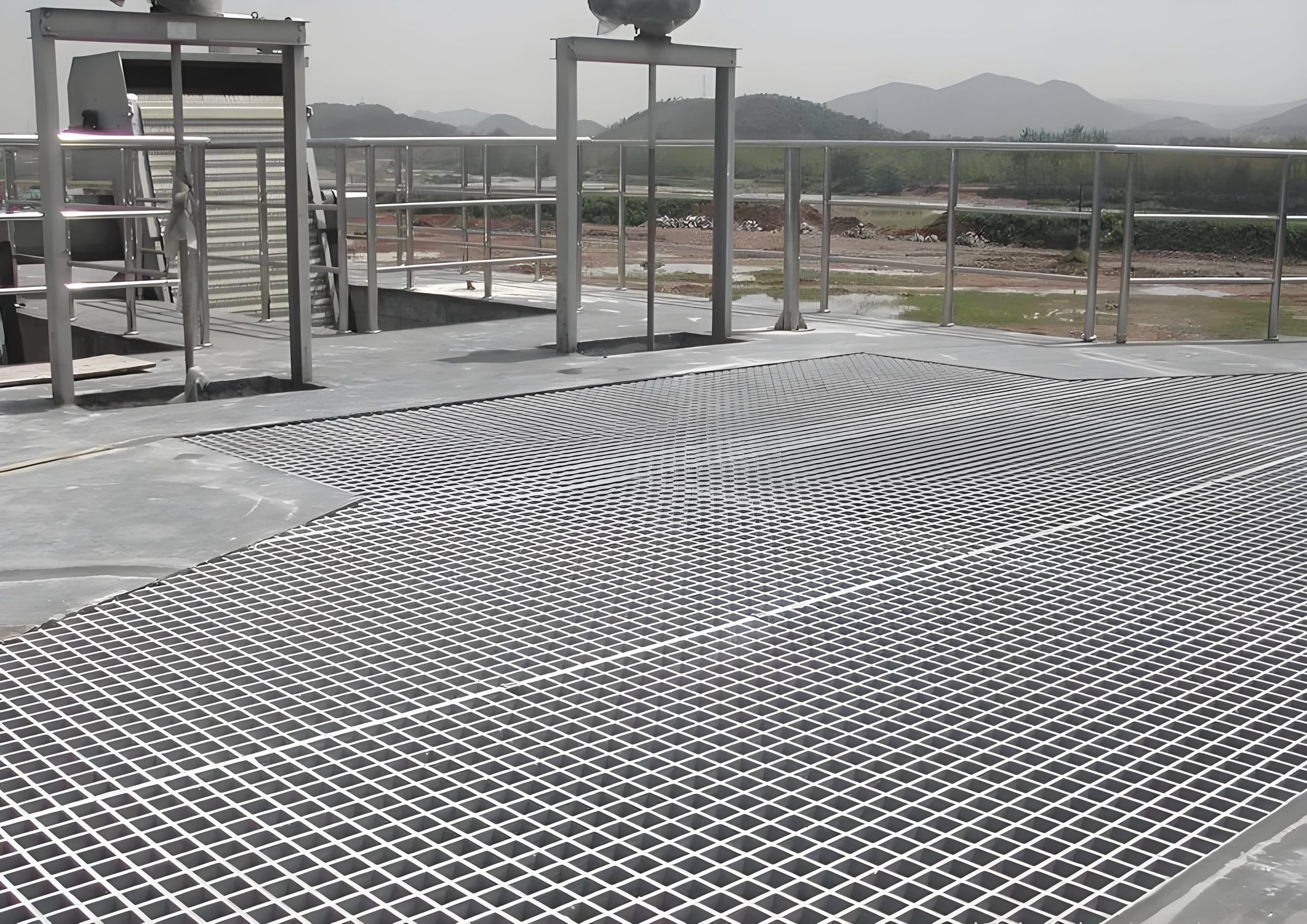
A factory can usually prepare a preliminary budget from several basic parameters, but an executable project quotation requires more complete information. Providing the following details at the beginning reduces assumptions and later revisions.
| Required Information | Example |
|---|---|
| Product application | Outdoor maintenance walkway at a wastewater plant |
| Material and grade | Carbon steel, ASTM A36 equivalent |
| Surface treatment | Hot-dip galvanized after fabrication |
| Bearing bar size | 30 × 5 mm |
| Bearing bar spacing | 30 mm center to center |
| Cross bar type and spacing | Twisted square bar at 100 mm centers |
| Surface | Serrated |
| Manufacturing type | Welded steel grating |
| Panel dimensions | 1,000 × 3,000 mm finished panels |
| Unsupported span | 900 mm |
| Design load | Specified uniform and concentrated pedestrian loads |
| Bearing bar direction | Across the 900 mm support span |
| Edge treatment | Full banding on all panels |
| Openings and notches | According to marked layout drawing |
| Accessories | Four galvanized saddle clips per panel |
| Total quantity | 850 m² |
| Inspection documents | Material certificate and galvanizing inspection report |
| Packing | Export steel pallets with panel mark labels |
| Delivery term | FOB named port or CIF named destination port |
When the load requirement is unknown, the buyer should at least provide the unsupported span, application, expected traffic, concentrated loads, wheel loads, and applicable design standard. The cheapest bar size should not be selected before these conditions are understood.
Drawings should identify every panel, show the bearing bar direction, locate supports, dimension openings from fixed reference lines, and distinguish trim banding from load-carrying banding. For a large project, a panel schedule can be more useful than a single total area because it allows the factory to calculate material nesting, processing time, packing sequence, and installation marks.
How much does galvanized walkway grating cost per square meter?
Standard hot-dip galvanized walkway grating commonly costs approximately US$22–65 per square meter at factory level. Light standard panels may be near the lower end, while thicker bearing bars, serrated surfaces, close mesh, small quantities, custom banding, and irregular openings move the price upward. Heavy-duty galvanized panels may reach approximately US$45–110 per square meter or more. Freight, duty, tax, and installation are normally not included in an EXW factory price.
Is serrated walkway grating more expensive?
Yes. Serrated walkway grating is normally more expensive than an otherwise identical plain panel because the bearing bars require an additional serration process and more production control. The premium is usually smaller than the price difference caused by changing the material, bar thickness, or mesh, but it becomes more noticeable on special sizes and small orders. Serration should be selected according to the actual walking environment rather than price alone.
What details are needed to get a walkway grating quote?
The factory needs the material grade, bearing bar depth and thickness, bearing bar spacing, cross bar spacing, plain or serrated surface, welded or press-locked construction, finished panel dimensions, span direction, design load, surface treatment, custom openings, banding, accessories, total quantity, packing method, destination, and required trade term. A drawing or panel schedule is strongly recommended for projects containing different sizes, notches, pipe openings, toe plates, or installation marks.
