
Hot-dip galvanized grating generally costs approximately US$20 to US$70 per square meter for common standard-duty factory panels. Cut-to-size galvanized grating with edge banding and normal project fabrication may cost approximately US$35 to US$120 per square meter, while close-mesh, thick-bearing-bar, framed, or heavy-duty grating can range from US$80 to US$250 per square meter or more. Vehicle-rated and specially engineered galvanized grating may exceed US$150 to US$400 per square meter when reinforced frames, load calculations, testing, and complex fabrication are required. The final price depends on the carbon steel cost, bearing bar height and thickness, bar spacing, theoretical weight, zinc price, coating requirement, smooth or serrated surface, manufacturing method, panel dimensions, load capacity, custom fabrication, order quantity, packaging, and delivery terms.
Hot-dip galvanized grating is carbon steel grating that is fabricated first and then immersed in molten zinc to form a corrosion-resistant coating over the bearing bars, cross bars, welded intersections, cut edges, and banding bars. It is widely used for industrial platforms, outdoor walkways, stair treads, drainage covers, trench covers, mezzanine floors, catwalks, power plants, wastewater facilities, factories, ports, and municipal projects.
The hot-dip galvanized grating price is not determined only by the size of the finished panel. Two panels with the same length and width can have very different prices if they use different bearing bar sizes, spacing, surface types, frames, coating requirements, or load capacities.
A light pedestrian panel made with relatively small bearing bars may contain less than half the steel weight of a heavy-duty panel designed for forklifts or vehicles. Because both the raw steel cost and galvanizing charge are closely related to product weight, heavier grating normally costs significantly more per square meter.
Suppliers may quote galvanized grating by square meter, kilogram, ton, panel, stair tread, linear meter, or complete project. A price per square meter is useful only when the bearing bar dimensions, spacing, steel grade, surface type, and fabrication scope are clearly stated.
| Quotation Unit | Common Use | Important Limitation |
| Price per square meter | Comparing panels with the same grating specification | Does not show differences in weight unless bar sizes are included |
| Price per kilogram | Factory calculations based on material and galvanized weight | Complex fabrication may not be reflected fully |
| Price per ton | Large bulk orders and standard panels | Cutting, banding, frames, and packaging may be charged separately |
| Price per panel | Standard stock sizes and custom fabricated covers | Panel dimensions and bearing direction must be confirmed |
| Price per stair tread | Finished treads with side plates and nosing | Tread width, depth, holes, and nosing affect the unit price |
| Project price | Platforms, walkways, trench covers, and panel schedules | Scope must identify frames, clips, documentation, packing, and freight |
A low advertised price often applies to a basic standard panel with common spacing, small bearing bars, a large minimum order, and limited secondary fabrication. It may not include cut-to-size production, edge banding, zinc coating verification, installation clips, support frames, drawings, export packaging, or shipping.
For preliminary budgeting, hot-dip galvanized grating can be divided into several general price levels. These ranges are purchasing references rather than fixed factory offers. Raw steel prices, zinc prices, exchange rates, energy costs, production region, material availability, and project quantity can change the final quotation.
| Galvanized Grating Type | Typical Factory Reference Price | General Description |
| Basic light-duty galvanized panel | US$15–40 per m² | Small bearing bars, standard spacing, repeated panels, and limited fabrication |
| Standard-duty galvanized grating | US$25–70 per m² | Common industrial platforms, walkways, stair treads, and drainage covers |
| Fabricated galvanized panels | US$35–120 per m² | Cut-to-size panels with edge banding, notches, and project identification |
| Close-mesh galvanized grating | US$45–140 per m² | Closer bearing bar spacing, more steel weight, and additional welded intersections |
| Serrated galvanized grating | US$30–90 per m² | Anti-slip bearing bars for wet, oily, muddy, or outdoor conditions |
| Medium-duty industrial grating | US$55–150 per m² | Thicker or deeper bars for carts, equipment access, and frequent traffic |
| Heavy-duty galvanized grating | US$80–250 per m² | Deep and thick bearing bars for forklifts, vehicles, and high concentrated loads |
| Framed trench cover assembly | US$100–300+ per m² | Grating, reinforced frame, banding, handles, locks, and fitting work |
| Engineered traffic-rated grating | US$150–400+ per m² | Vehicle loading, structural calculations, reinforced supports, and testing |
A commonly purchased standard-duty hot-dip galvanized grating for industrial walkways may be budgeted at approximately US$25 to US$70 per square meter before extensive customization. When panels are cut according to drawings, banded, notched, galvanized after fabrication, inspected, marked, and export packed, a more realistic project-ready price may be US$35 to US$120 per square meter.
A heavy-duty panel should not be priced by simply adding a small percentage to a standard panel. Heavy-duty grating may contain two or three times as much steel per square meter. It may also require heavier cross bars, stronger welding, thicker edge banding, reinforced support frames, and special lifting equipment.
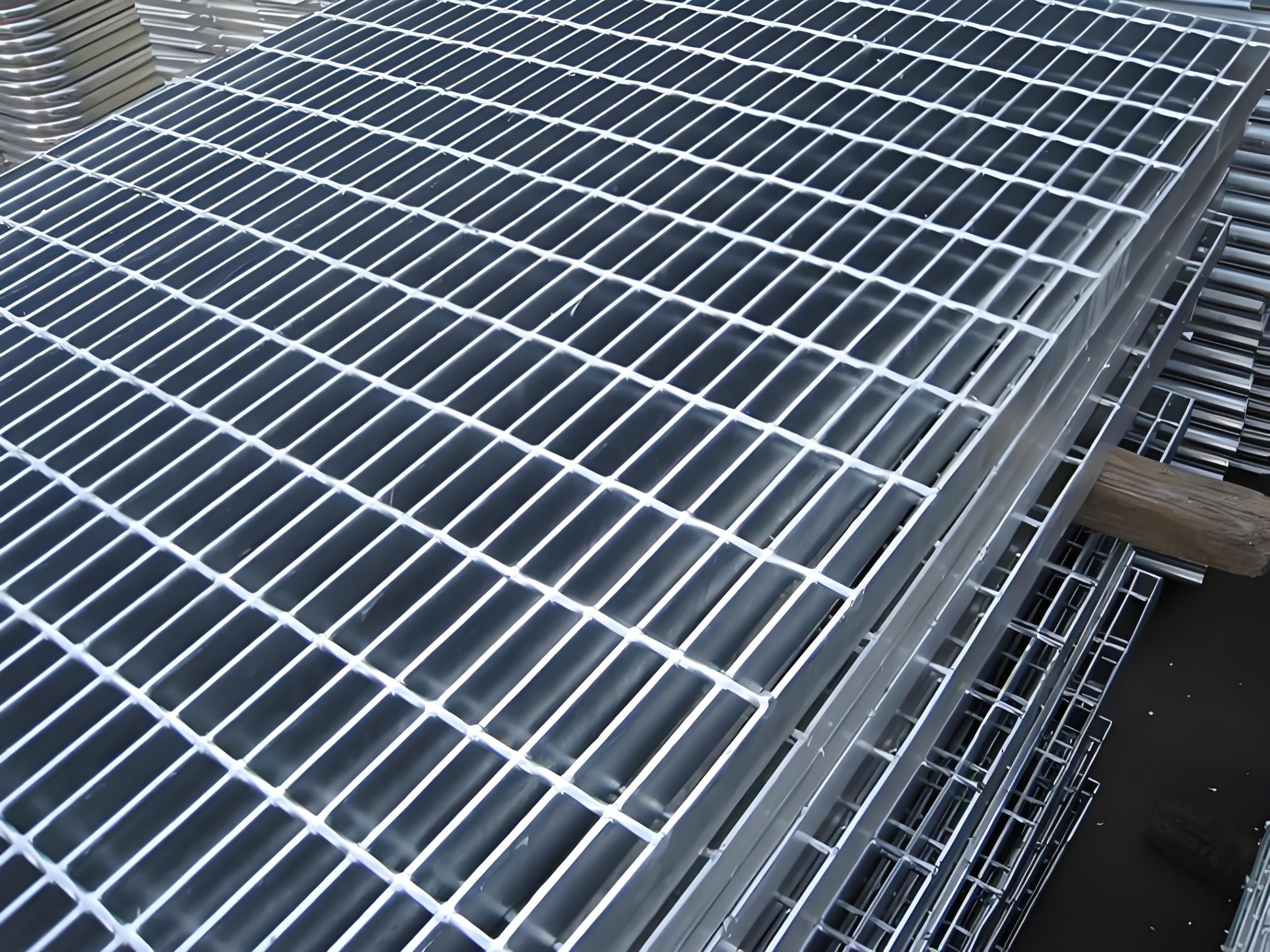
A raw panel price normally refers to a full factory panel produced in a standard width and length. It may be galvanized but not cut into individual installation panels. Open bearing bar ends, standard tolerances, and basic bundling may be included.
A fabricated panel is cut according to the project layout and may include four-sided banding, pipe cutouts, column notches, toe plates, lifting handles, stair tread plates, support frames, and identification marks. These operations increase the price even when the final panel area is smaller than the original stock sheet.
Factory pricing usually assumes a minimum quantity, repeated specifications, longer lead time, and delivery from the production location. Retail suppliers may charge more but provide immediate stock, single-panel quantities, local cutting, and domestic delivery.
Carbon steel is the main cost component of hot-dip galvanized grating. The finished product is manufactured from flat bearing bars and cross bars, so changes in carbon steel coil, strip, plate, flat bar, and billet prices can directly affect factory quotations.
Common structural carbon steel grades are selected according to the project standard and manufacturing region. Different grades can have different yield strength, chemical composition, availability, certification requirements, and purchase costs.
A readily available commercial steel grade is usually more economical than a special high-strength, low-temperature, or project-certified grade. If a buyer requires a specific regional standard, the factory may need to purchase dedicated material rather than use normal stock.
Bearing bars may be produced from slit steel strip, rolled flat bar, or another controlled process. Slit strip can provide economical production for common dimensions, while special rolled flat bars may be selected for heavy-duty or tightly controlled specifications.
The manufacturing route can affect dimensional tolerance, edge condition, material utilization, and cost.
Steel prices can change with iron ore, coking coal, scrap, energy, freight, currency, mill output, construction demand, and regional trade conditions. Manufacturers may limit the validity of a quotation when steel markets are changing quickly.
Buyers should check whether the quoted price is based on material already in stock or on steel that will be purchased after the order is confirmed.
Standard panels use steel efficiently. Custom widths, unusual bearing bar dimensions, curved shapes, and many cutouts can create more scrap. Although some scrap may be recycled, the original material still has to be purchased and processed.
| Raw Material Factor | Effect on Grating Price |
| Higher carbon steel market price | Raises the basic cost per kilogram and per square meter |
| Special steel grade | May increase material price and minimum purchase quantity |
| Non-standard flat bar dimension | Can require dedicated rolling, slitting, or material purchasing |
| Strict material certification | Adds traceability, documentation, and possible testing cost |
| High fabrication scrap | Increases effective material consumption |
| Small order quantity | Reduces purchasing efficiency and increases unit price |
Panel area does not show how much carbon steel is used. A one-square-meter panel made with 25 × 3 mm bearing bars at wide spacing may be much lighter than a one-square-meter panel made with 50 × 5 mm bearing bars at close spacing.
For reliable price comparison, buyers should request the theoretical weight per square meter and total order weight.
The bearing bars carry the main structural load of the grating. Their height, thickness, spacing, and shape have a direct effect on load capacity, product weight, welding requirements, galvanizing cost, and final price.
Bearing bar height is measured vertically. Increasing the height usually provides a substantial increase in bending stiffness and allows the panel to span a greater distance or carry a higher load.
Common bearing bar heights include 20 mm, 25 mm, 30 mm, 32 mm, 35 mm, 40 mm, 45 mm, 50 mm, 60 mm, 65 mm, 75 mm, 100 mm, and other custom sizes for heavy-duty grating.
A deeper bearing bar uses more steel across every bar in the panel. It also creates more surface area for zinc coating. Both the steel and galvanizing costs therefore increase.
Common bearing bar thicknesses include 2 mm, 3 mm, 4 mm, 5 mm, 6 mm, 8 mm, 10 mm, and heavier dimensions. Increasing thickness improves strength, impact resistance, local load distribution, and durability.
Changing from a 30 × 3 mm bar to a 30 × 5 mm bar increases the bearing bar cross-sectional area substantially. If the spacing remains unchanged, the product weight and raw material cost increase accordingly.
Bearing bar spacing is generally measured from the center of one bar to the center of the next. Common metric spacings include approximately 15 mm, 20 mm, 25 mm, 30 mm, 30.2 mm, 32 mm, 34 mm, 35 mm, and 40 mm.
Closer spacing places more bars across the panel width. This improves walking support, small-wheel performance, load distribution, and object retention, but it also increases steel consumption and welding time.
Cross bars keep the bearing bars aligned and stabilize the grating panel. Common spacing includes approximately 50 mm, 76 mm, and 100 mm.
Reducing cross bar spacing increases the number of cross bars and welded intersections. The price increase is usually smaller than the increase caused by thicker bearing bars, but it becomes important on large projects.
| Specification Change | Effect on Product | Typical Price Effect |
| Increase bearing bar height | Improves stiffness and span capacity | Moderate to significant increase |
| Increase bearing bar thickness | Improves strength, impact resistance, and weight | Significant increase |
| Reduce bearing bar spacing | Adds more bearing bars per panel | Significant increase |
| Reduce cross bar spacing | Adds more cross bars and welds | Small to moderate increase |
| Add serrations | Improves anti-slip performance | Small to moderate increase |
| Add heavy banding | Improves edge strength and load transfer | Moderate increase |
Theoretical weight per square meter is one of the most useful values for checking a galvanized grating quotation. It links the bearing bar dimensions and spacing to the approximate quantity of steel in the panel.
| General Grating Construction | Weight Direction | Price Direction |
| Shallow, thin, wide-spaced bars | Low kg/m² | Lowest price |
| Standard pedestrian grating | Moderate kg/m² | Moderate price |
| Close-mesh or thick-bar grating | High kg/m² | High price |
| Heavy-duty industrial grating | Very high kg/m² | Very high price |
| Heavy grating with frame | Extremely high system weight | Highest material and freight cost |
If one supplier offers a substantially lower price, buyers should compare the quoted weight, bearing bar tolerance, spacing, cross bar size, banding, and frame weight. A cheaper quotation may simply contain less steel.
The galvanizing cost is influenced by zinc price, product weight, steel chemistry, surface condition, fabrication design, coating standard, batch size, and galvanizing plant charges.
Zinc is an internationally traded metal, and its market price can change over time. A higher zinc price can increase galvanizing charges, particularly for heavy products and projects requiring substantial coating mass.
The factory quotation may separate the black steel grating price from the galvanizing charge, or it may provide one combined price for the finished hot-dip galvanized product.
Galvanizing plants commonly calculate charges using product weight, minimum batch fees, handling difficulty, dimensions, or a combination of these factors. Heavy grating uses more zinc in total and also requires more lifting and processing capacity.
The required galvanized coating thickness normally depends on the applicable standard, steel material category, steel thickness, and project specification. A thicker coating generally uses more zinc, but coating development is also influenced by steel chemistry and immersion conditions.
Buyers should avoid specifying an arbitrary zinc thickness without checking whether it is practical for the steel grade and bar thickness. Excessively thick or uneven zinc can create roughness, runs, lumps, drainage problems, or interference with closely fitted frames and fasteners.
Project specifications may refer to standards such as ASTM A123/A123M, EN ISO 1461, or another national requirement. The quotation should identify the applicable standard and whether coating thickness inspection and reports are included.
Different regions and projects may use different sampling methods, minimum coating requirements, repair rules, appearance criteria, and documentation. A supplier should not assume that one standard is automatically interchangeable with another.
Silicon, phosphorus, and other elements in the steel can affect the reaction between iron and molten zinc. Some steel compositions develop thicker, darker, or rougher coatings than others.
A thicker-looking coating is not always evidence of better controlled quality. Excessive alloy-layer growth can create brittleness or surface roughness. Material selection and galvanizing process control are therefore important.
Galvanizing plants may apply a minimum charge even when the total grating weight is low. This makes a one-panel or sample order more expensive per kilogram than a full production batch.
| Galvanizing Cost Factor | Effect on Price |
| Higher zinc market price | Raises the coating component of the final price |
| Heavier grating | Increases steel handling and total zinc consumption |
| Higher coating requirement | Can increase zinc use and inspection requirements |
| Small galvanizing batch | Creates a high unit cost because of minimum charges |
| Complex frame or hollow assembly | Requires additional venting, drainage, handling, and process control |
| Coating thickness report | Adds inspection and documentation cost |
| Repair or touch-up requirement | Adds labor after galvanizing |
| Strict appearance standard | May require additional finishing and rejection control |
Steel grating is normally cut, welded, banded, and fabricated before hot-dip galvanizing. This allows the zinc coating to protect cut edges and welded connections.
Cutting or welding after galvanizing removes the coating from the affected area. The damaged location then requires an approved repair method. Extensive post-galvanizing fabrication can reduce corrosion protection and increase labor.
Plain galvanized grating uses smooth bearing bars, while serrated grating has teeth or notches formed along the top of the bearing bars to improve traction.
| Surface Type | Typical Price Relationship | Common Application |
| Plain galvanized grating | Base price | Dry platforms, indoor walkways, mezzanines, and controlled industrial floors |
| Serrated galvanized grating | Often approximately 5–15% above comparable plain grating | Wet, oily, muddy, outdoor, marine-adjacent, and anti-slip applications |
Plain grating has a smooth upper bearing bar edge. It is normally the more economical option because the flat bars require no serration-forming process.
The smooth surface is easier to clean and is suitable for dry or controlled areas. It is commonly used for indoor platforms, equipment access, mezzanine floors, ventilation panels, and walkways where aggressive anti-slip performance is not required.
Serrated grating provides additional grip under footwear. It is commonly selected for outdoor platforms, drainage areas, stair treads, wastewater plants, oily factories, loading zones, and locations exposed to rain or mud.
The price premium results from serration forming, additional material handling, lower production speed, and possible increased scrap.
The galvanizing process coats the serrated edges as well as the rest of the bearing bars. Excess zinc accumulation around teeth should be controlled because heavy lumps can reduce the sharpness and consistency of the anti-slip profile.
Galvanized serrated grating should be inspected for blocked openings, sharp zinc projections, uneven teeth, and areas where the coating may interfere with panel fit.
Serrations improve grip but do not make a surface completely slip-proof. Oil, grease, ice, mud, algae, and chemical residue can still create hazardous conditions. Drainage, cleaning, lighting, footwear, and handrails remain important.
Hot-dip galvanized grating is commonly produced in welded or press-locked construction. The manufacturing method affects production cost, appearance, spacing options, load behavior, and application.
Welded grating is produced by joining cross bars to bearing bars using pressure and electrical resistance or another controlled welding process. It is widely used for industrial platforms, trench covers, stair treads, and walkways.
For standard specifications and commercial quantities, welded grating is generally the more economical option. Production can be automated, and standard panel sizes can be manufactured efficiently.
Press-locked grating is made by pressing cross bars into slots formed in the bearing bars. It creates a clean rectangular grid with accurate alignment and can be produced in close spacing or architectural configurations.
Slotting, positioning, and pressing require greater dimensional precision than ordinary welded production. Press-locked grating can therefore cost more than a comparable standard welded panel.
Press-locked panels can be hot-dip galvanized after fabrication. Close intersections and tight bar contact areas require suitable cleaning, venting, and drainage so that process liquids and zinc do not remain trapped.
| Construction Type | Relative Price | Main Advantages | Typical Applications |
| Welded galvanized grating | Low to moderate | Strong, widely available, and efficient for industrial production | Platforms, walkways, stair treads, and drainage covers |
| Press-locked galvanized grating | Moderate to high | Accurate grid, clean appearance, and close-spacing capability | Architectural floors, facades, entrances, and public walkways |
| Custom hand-fabricated grating | High | Supports unusual dimensions and special bar arrangements | Replacement panels, curved shapes, and specialized machinery |
A press-locked panel is not automatically more expensive than every welded panel. A lightweight press-locked panel can cost less than a heavy-duty welded panel because the material weight remains the largest cost factor.
The comparison should use the same material, bearing bar size, spacing, panel dimensions, surface type, coating requirement, and quantity.
Duty classification provides a general description of expected use, but it is not a complete structural specification. Manufacturers still need the clear span, uniform load, concentrated load, wheel load, contact area, and allowable deflection.
Light-duty grating is used for pedestrians, ventilation grilles, short-span drainage covers, maintenance access, and restricted industrial areas. It normally uses relatively shallow or thin bearing bars.
Basic light-duty panels may cost approximately US$15 to US$45 per square meter for factory quantities, depending on weight and galvanizing.
Standard-duty grating is commonly used for industrial platforms, walkways, stair treads, mezzanine floors, and drainage covers. It provides a practical balance between strength, weight, availability, and cost.
Standard-duty factory pricing is commonly approximately US$25 to US$90 per square meter, depending on bearing bar dimensions, fabrication, and coating requirements.
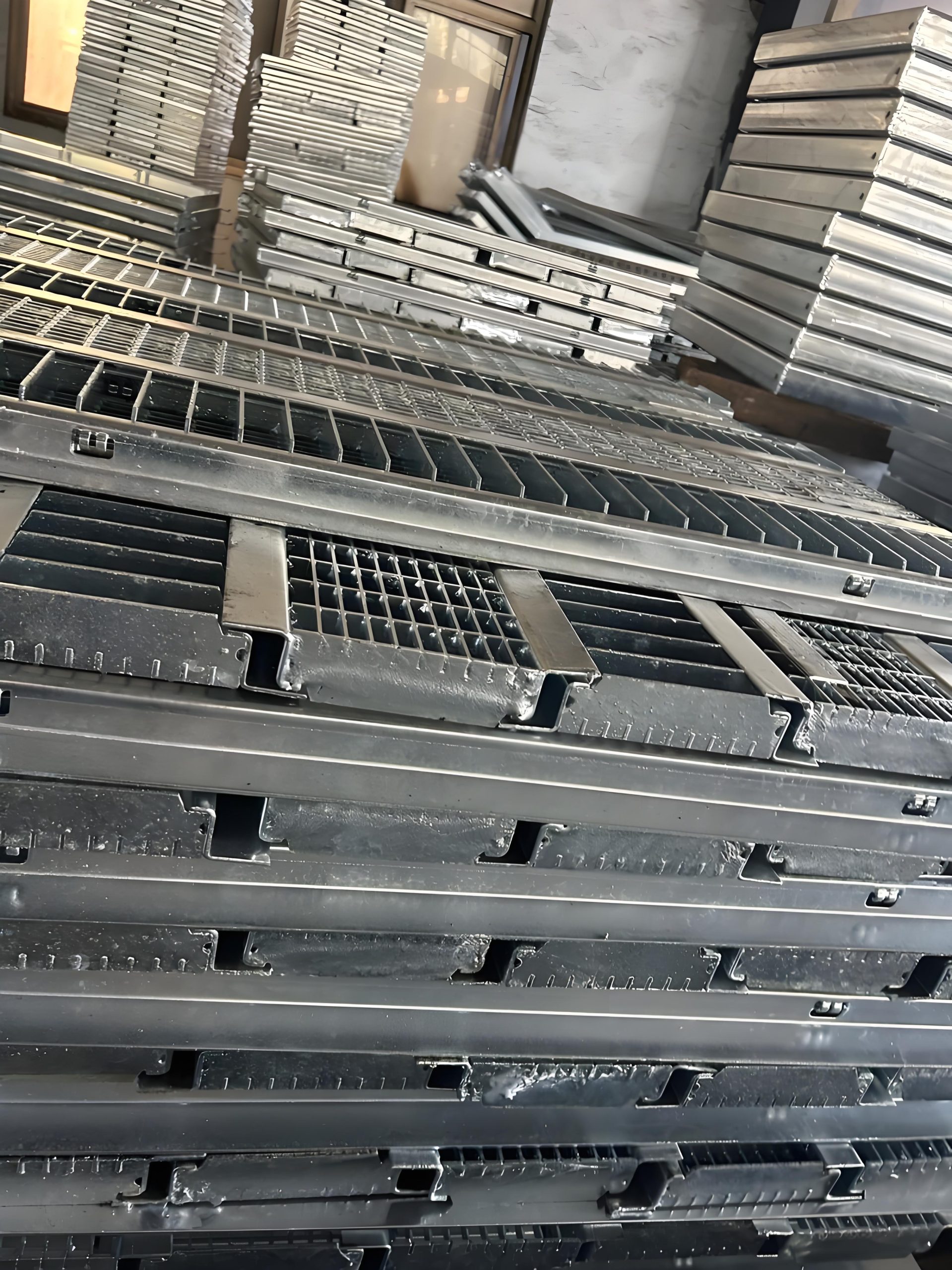
Medium-duty products may carry frequent personnel traffic, loaded carts, maintenance equipment, or light industrial wheels. Deeper or thicker bearing bars and stronger frames are normally required.
Heavy-duty grating is used for forklifts, cars, trucks, industrial vehicles, loading areas, ports, bridge decks, and high concentrated loads. It uses deep and thick bearing bars that may be welded with large cross bars or connecting members.
The high steel weight, welding requirements, galvanizing cost, frame design, and freight can push the price to US$80 to US$250 per square meter or more.
| Duty Level | Typical Application | General Factory Price Reference |
| Light duty | Pedestrians, ventilation, and narrow drainage channels | US$15–45 per m² |
| Standard duty | Walkways, platforms, stair treads, and industrial drainage | US$25–90 per m² |
| Medium duty | Carts, maintenance equipment, and repeated industrial traffic | US$50–150 per m² |
| Heavy duty | Forklifts, cars, loading zones, and high concentrated loads | US$80–250 per m² |
| Engineered traffic duty | Trucks, roads, ports, and specialized industrial vehicles | US$150–400+ per m² |
A grating panel spanning 500 mm does not require the same bearing bar as a panel spanning 1,200 mm. Longer spans increase stress and deflection, often requiring deeper bars and a higher price.
A forklift or pallet truck wheel applies load over a smaller area than pedestrian traffic. Narrow hard wheels can create high local stress and may require close bearing bar spacing.
The manufacturer should receive the maximum wheel load, wheel dimensions, wheel spacing, direction of travel, clear span, and expected impact.
A grating can remain below its failure strength and still deflect too much for comfortable use. Strict deflection limits may require a heavier bar than strength calculations alone would suggest.
Standard factory panels generally have the lowest unit price because they use established widths, lengths, bar spacings, welding programs, and packaging methods.
Full panels require limited secondary fabrication. They are suitable for distributors, local fabricators, and projects that can complete cutting and banding near the installation site.
Cut-to-length service adds cutting, handling, deburring, banding, identification, and packaging. The unit price increases, but site labor and material waste may be reduced.
Custom widths may create unusable remainder strips when cut from standard panels. The final bar layout may also need adjustment to avoid an unusually large opening at the panel edge.
Small panels have more perimeter per square meter. Each panel may require four-sided banding, welding, cleaning, galvanizing inspection, marking, and separate handling.
Ten square meters divided into ten panels normally costs less to fabricate than ten square meters divided into one hundred small trench covers.
Triangular, curved, circular, tapered, trapezoidal, and multi-cutout panels require more drawing review, cutting, fitting, and welding. Their square meter price is normally higher than standard rectangular panels.
| Panel Type | Relative Price | Main Cost Reason |
| Standard full panel | Lowest | Efficient production and minimal secondary work |
| Standard rectangular cut panel | Low to moderate | Cutting, banding, marking, and packaging |
| Custom-width panel | Moderate | Special layout and possible material waste |
| Small removable panel | High per square meter | High perimeter and fabrication effort relative to area |
| Irregular panel | High | Complex drawings, cutting, fitting, and welding |
| Complete framed assembly | High to very high | Grating, frame, trial fitting, accessories, and coating |
Repeated panel sizes reduce drawing work, cutting setup, welding changes, identification errors, packaging complexity, and installation confusion.
Platform and trench layouts can often be adjusted to use more repeated rectangular panels and fewer irregular infill pieces.
Secondary fabrication converts standard grating sheets into project-ready panels. These costs depend on the number of panels, cut length, welding length, geometry, tolerance, and inspection requirements.
Simple straight cutting is normally the least expensive fabrication operation. The cost still depends on material thickness, panel dimensions, cutting method, and quantity.
Banding bars close the exposed ends of the bearing bars. Banding improves handling, appearance, safety, edge stiffness, and panel fit.
Trim banding is mainly used to close the edge. Load banding uses a heavier bar and stronger welds so that the edge can receive concentrated contact or transfer load.
Notches allow panels to fit around beams, columns, walls, pipes, handrails, equipment legs, and structural braces. Each notch requires measurement, cutting, fitting, and possible banding.
Round, square, rectangular, and irregular openings may be required around process equipment and piping. The cut edges often require banding to maintain stability and safety.
Toe plates can be welded along platform edges to reduce the risk of tools and materials falling. Their price depends on plate height, thickness, total length, corners, welding, and galvanizing.
Galvanized angle frames and flat bar frames are commonly supplied with trench covers and removable panels. A frame adds material, welding, anchors, straightening, trial fitting, and galvanizing cost.
Hinges keep covers attached to their frames during opening. Lifting handles, recessed slots, and keyholes simplify maintenance access. These features increase the per-panel fabrication cost.
Roadside, public, vibrating, and vehicle-loaded covers may require bolts, security fasteners, locking bars, or anti-theft systems.
| Fabrication Feature | Typical Cost Effect |
| Simple rectangular cutting | Small increase |
| Two-sided edge banding | Small increase |
| Four-sided edge banding | Small to moderate increase |
| Heavy load banding | Moderate increase |
| Simple notch | Small increase per notch |
| Multiple complex cutouts | Moderate to significant increase |
| Toe plates | Moderate increase according to total length |
| Matching support frame | Moderate to significant increase |
| Hinge or lifting handle | Moderate increase per panel |
| Locking system | Moderate to high increase |
| Curved or irregular shape | Significant increase |
Cutting, banding, framing, drilling, and welding should normally be completed before hot-dip galvanizing. This allows zinc to protect the fabricated surfaces.
When installation holes or final adjustments must be made after galvanizing, the damaged coating should be repaired using an approved method.
The intended application influences the bar size, spacing, surface, frame, corrosion protection, fabrication, and final price.
Industrial walkways commonly use standard-duty welded galvanized grating. Smooth bars are suitable for dry controlled areas, while serrated bars are selected for wet or oily conditions.
Typical project-ready prices may fall between US$35 and US$100 per square meter, depending on span and fabrication.
Platforms require panel layouts, bearing bar direction, support coordination, toe plates, clips, stair treads, and access openings. The basic grating price may be moderate, but platform fabrication can increase the complete project cost.
Drainage covers are often divided into short removable panels with four-sided banding. They may include angle frames, handles, locking systems, and close spacing.
The high number of panel edges can make trench cover grating more expensive per square meter than large platform panels.
Galvanized stair treads normally include end carrier plates, fixing holes, banding, and front nosing. Serrated bearing bars are often selected for outdoor stairs.
The unit price depends on tread width, depth, bearing bar size, nosing type, hole arrangement, quantity, and galvanizing.
Wastewater facilities use galvanized grating around tanks, channels, pumps, screens, and maintenance walkways. Standard galvanized steel is economical for many locations, but aggressive chemical or continuously wet areas may require a more corrosion-resistant material.
These projects may require strict material traceability, panel drawings, toe plates, clips, coating reports, welding inspection, and detailed packaging schedules. Documentation can add to the base product price.
Vehicle grating requires heavy bearing bars, close spacing, reinforced frames, and engineering verification. Wheel loads and impact usually control the structure.
| Application | Typical Price Direction | Main Cost Drivers |
| Pedestrian walkway | Low to moderate | Standard bars, span, smooth or serrated surface, and clips |
| Industrial platform | Moderate | Panel layout, cutouts, toe plates, and stair access |
| Drainage trench cover | Moderate to high | Short panels, banding, frames, handles, and load requirement |
| Stair tread | High per square meter | Carrier plates, holes, nosing, serrations, and individual handling |
| Wastewater facility | Moderate | Corrosion exposure, serrations, frames, and maintenance access |
| Forklift area | High | Wheel load, thick bars, close spacing, and reinforced supports |
| Road or truck traffic | Very high | Heavy-duty structure, frames, locks, calculations, and testing |
Hot-dip galvanized grating generally costs more than bare or simply painted carbon steel grating but less than stainless steel grating of comparable weight and configuration.
| Material or Finish | Relative Initial Cost | Corrosion Protection | Typical Use |
| Bare carbon steel | Lowest | No permanent protection | Dry indoor, temporary, or site-coated applications |
| Painted carbon steel | Low | Paint coating | Indoor factories and controlled environments |
| Hot-dip galvanized steel | Low to moderate | Zinc coating over fabricated steel | Outdoor walkways, platforms, drainage, and industrial structures |
| Duplex galvanized and painted steel | Moderate to high | Zinc coating plus paint system | Severe outdoor, coastal, or color-controlled projects |
| 304 stainless steel | High | Corrosion-resistant stainless alloy | Food processing, clean areas, kitchens, and general wet service |
| 316 or 316L stainless steel | Highest | Improved chloride and chemical resistance | Marine, coastal, chemical, and salt-containing environments |
Painted grating normally has a lower initial price. It may be suitable for dry indoor facilities where coatings can be inspected and repaired.
Hot-dip galvanizing generally provides more complete protection around edges and welded intersections because the fabricated grating is immersed after production. It often requires less maintenance in outdoor and wet environments.
Galvanized carbon steel is usually much less expensive than 304, 316, or 316L stainless steel. It provides strong structural performance and practical corrosion protection for general industrial use.
Stainless steel may provide better long-term value where the grating is exposed to food products, repeated chemical cleaning, chloride, marine conditions, contamination-sensitive processes, or locations where coating repair is difficult.
The corrosion protection of galvanized grating depends on the zinc coating. Severe mechanical damage, site welding, and cutting can expose carbon steel and require repair.
Stainless steel does not depend on an external zinc layer, although its surface can still be contaminated or corroded under unsuitable conditions.
The correct comparison should include initial price, coating maintenance, cleaning, shutdown cost, replacement access, environmental exposure, expected service life, and process contamination risk.
Order quantity affects steel purchasing, panel production, galvanizing batch efficiency, fabrication setup, inspection, packaging, and freight.
A one-panel sample normally has a high unit price because raw material preparation, welding setup, cutting, galvanizing, inspection, and packaging cannot be distributed across a larger order.
Small orders may be subject to minimum steel purchasing, production, galvanizing, coating inspection, and packing charges.
Repeated panel dimensions improve material utilization and production efficiency. Setup and drawing costs are spread over more pieces.
Large standardized orders may receive lower steel purchasing rates, improved welding productivity, more efficient galvanizing batches, and better packaging utilization.
| Order Size | General Unit Price Effect |
| Prototype or one panel | Highest unit price |
| Below 20 m² | Small-order pricing and minimum charges |
| 20–100 m² | Improved production efficiency |
| 101–500 m² | Competitive project pricing |
| 501–2,000 m² | Potential volume discount |
| More than 2,000 m² | Strong factory efficiency when specifications are standardized |
Galvanized panels are commonly stacked into bundles and secured with steel straps. Fabricated panels may require pallets, timber supports, separators, edge protection, labels, and packing lists.
Packaging should prevent panel movement, bending, loss of clips, and mixing of identification marks. Newly galvanized products should not be packed in a way that traps moisture for long periods.
Large platform projects require panel marks that match installation drawings. Marking, bundle organization, and packing schedules add production control cost but reduce site installation errors.
The total freight cost depends heavily on product weight. A project containing 500 square meters of grating at 40 kg per square meter has a net grating weight of approximately 20 tonnes before frames and packaging are added.
Long panels may require special transport arrangements even when their weight is acceptable. Shorter panels are easier to ship but require more cutting and banding.
Sea freight is generally economical for large export orders. The manufacturer should provide package dimensions, gross weight, container loading quantity, and a loading plan.
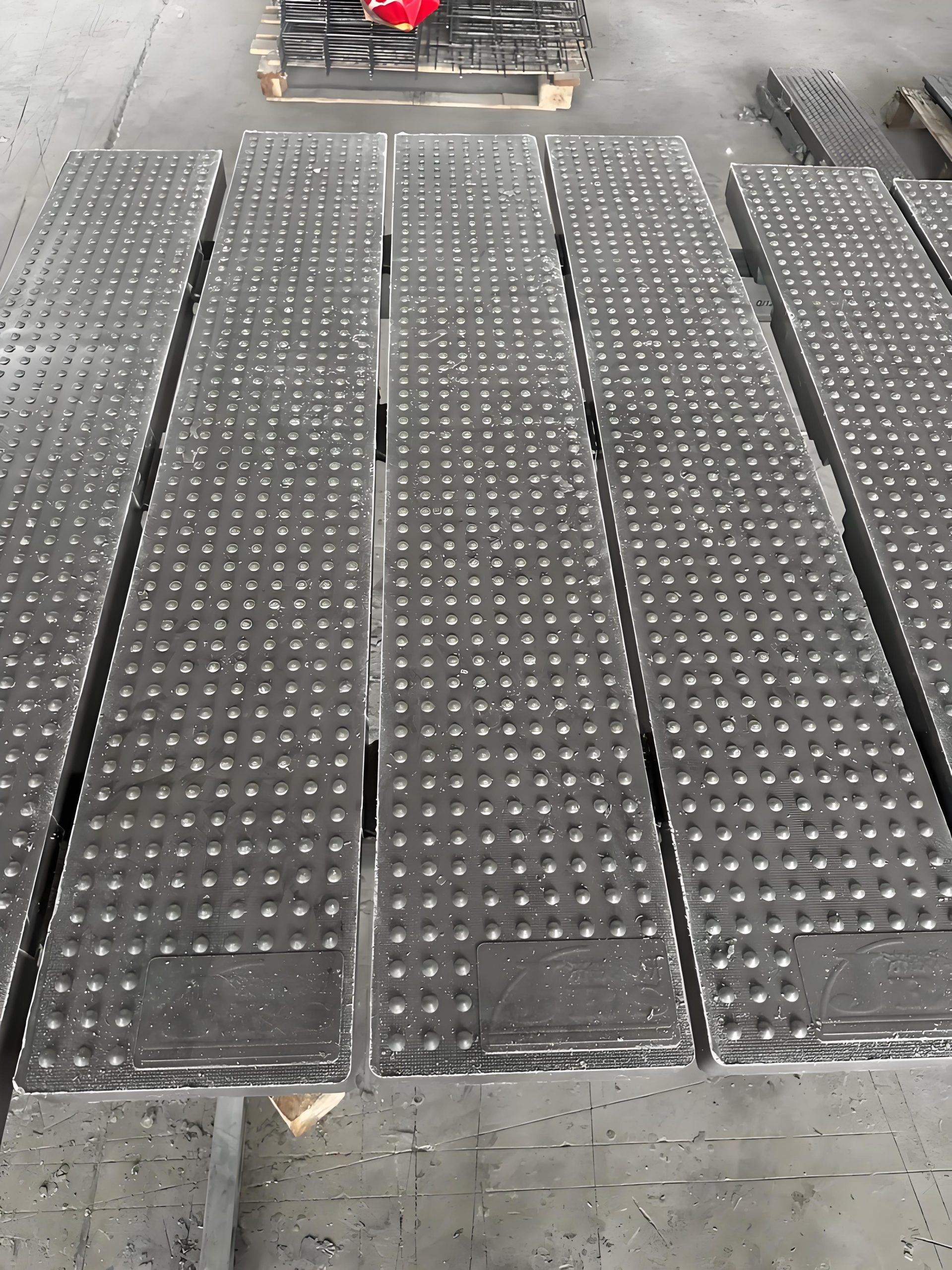
Air freight is normally limited to urgent samples, replacement panels, clips, or small stair tread orders because the product is heavy.
| Trade Term | General Price Scope |
| EXW | Product available at the factory; most transport costs are excluded |
| FOB | Product and export delivery to the named port are generally included |
| CIF | FOB scope plus ocean freight and insurance to the destination port |
| DAP | Delivery to the named destination, normally excluding import duty and tax |
| DDP | Delivery including the agreed import clearance, duty, and taxes |
An EXW price should not be compared directly with a DDP price. Buyers should calculate the complete delivered cost, including packaging, inland transport, export charges, ocean freight, destination fees, import duty, tax, and final delivery.
A preliminary budget can be calculated from the total grating area, estimated unit price, fabrication, frames, accessories, packaging, and freight.
Basic grating cost = total area × estimated price per square meter
Estimated project cost = basic grating cost + cutting + banding + frames + accessories + inspection + packaging + freight
| Item | Example Value |
| Total grating area | 100 m² |
| Estimated standard-duty rate | US$48 per m² |
| Basic grating cost | 100 × US$48 = US$4,800 |
| Cutting, banding, and panel marking | Approximately US$900–1,500 |
| Clips and packaging | Approximately US$400–800 |
| Preliminary product total | Approximately US$6,100–7,100 before freight |
| Item | Example Value |
| Total grating area | 80 m² |
| Estimated serrated fabricated rate | US$75 per m² |
| Basic grating cost | 80 × US$75 = US$6,000 |
| Toe plates, cutouts, and special banding | Approximately US$1,500–2,500 |
| Inspection and export packaging | Approximately US$500–900 |
| Preliminary product total | Approximately US$8,000–9,400 before freight |
| Item | Example Value |
| Total grating area | 25 m² |
| Estimated heavy-duty grating rate | US$180 per m² |
| Basic grating cost | 25 × US$180 = US$4,500 |
| Reinforced galvanized frames | Approximately US$2,000–3,500 |
| Handles, locks, inspection, and packaging | Approximately US$700–1,300 |
| Preliminary product total | Approximately US$7,200–9,300 before freight |
These calculations are preliminary examples. The bearing bar size and frame must be confirmed from the actual span and load before the final price is issued.
Two suppliers may offer very different prices because their quoted products have different weights, fabrication scopes, coating requirements, or delivery terms.
| Possible Difference | Effect on Quotation |
| Smaller bearing bars | Lower weight, lower price, and lower load capacity |
| Wider bearing bar spacing | Fewer bars and lower material consumption |
| Thinner edge banding | Lower cost but different edge strength |
| Raw panels instead of fabricated panels | Cutting, notching, and banding are excluded |
| Galvanizing before final fabrication | May leave cut or welded areas requiring repair |
| Different coating standards | Changes coating requirements, inspection, and documentation |
| Frame excluded | Trench cover quotation appears substantially lower |
| No load calculation | Engineering and verification costs are excluded |
| Different panel quantities | Small panels require more fabrication per square meter |
| Different trade terms | Freight, import duty, tax, and local delivery vary |
A useful comparison should include the steel grade, bearing bar height and thickness, bearing bar spacing, cross bar spacing, unit weight, panel dimensions, fabrication, galvanizing standard, coating report, accessories, packaging, and delivery term.
A reliable factory quotation requires enough information to calculate steel weight, structural performance, welding, custom fabrication, galvanizing, inspection, packaging, and delivery.
| Required Information | Example |
| Application | Walkway, platform, trench cover, stair tread, mezzanine, or vehicle floor |
| Steel grade | Required carbon steel grade and material standard |
| Grating construction | Welded or press-locked |
| Bearing bar size | For example, 30 × 3 mm or 40 × 5 mm |
| Bearing bar spacing | For example, 30 mm on center |
| Cross bar type | Twisted square bar, round bar, or flat bar |
| Cross bar spacing | For example, 50 mm or 100 mm on center |
| Surface type | Plain or serrated |
| Panel dimensions | Length and width of each individual panel |
| Bearing bar direction | Clearly identified on drawings |
| Clear support span | Unsupported distance between structural supports |
| Uniform load | Required distributed loading |
| Concentrated or wheel load | Maximum load and contact dimensions |
| Allowable deflection | Project or standard limit |
| Edge treatment | Open edge, trim banding, or load banding |
| Special fabrication | Notches, cutouts, toe plates, frames, handles, or locks |
| Galvanizing requirement | Applicable standard, coating requirement, and inspection documentation |
| Panel quantity | Total number of panels and total square meters |
| Installation accessories | Clips, bolts, anchors, stair tread fasteners, or lifting tools |
| Documentation | Material certificate, coating report, load calculation, or test report |
| Packaging | Standard bundle, pallet, or seaworthy export packing |
| Delivery destination | City, port, and country |
| Trade term | EXW, FOB, CIF, DAP, or DDP |
Total square meters alone do not show how much cutting and banding are required. The supplier should receive the dimensions and quantity of every panel type.
A layout drawing should show support beams, trench edges, panel divisions, columns, pipes, stairs, openings, frames, and bearing bar direction.
Descriptions such as pedestrian, industrial, or heavy duty are useful but not sufficient for final design. The supplier may need the uniform load, concentrated load, wheel load, contact area, span, and allowable deflection.
The inquiry should identify the required hot-dip galvanizing standard and whether coating thickness measurements, repair records, or inspection reports are required.
The buyer should confirm whether the price includes raw material, fabrication, galvanizing, frames, clips, load calculations, material certificates, coating inspection, packaging, freight, duty, and tax.
How much does hot-dip galvanized grating cost per square meter?
Common standard-duty hot-dip galvanized grating generally costs approximately US$20 to US$70 per square meter for factory quantities. Cut-to-size fabricated panels commonly cost approximately US$35 to US$120 per square meter. Close-mesh, framed, serrated, or heavy-duty galvanized grating may cost US$80 to US$250 per square meter or more. The actual price depends on the bearing bar size, spacing, unit weight, coating requirement, fabrication, quantity, and delivery terms.
Is serrated galvanized grating more expensive than plain grating?
Yes. Serrated galvanized grating is commonly around 5 to 15 percent more expensive than an otherwise comparable plain panel because the bearing bars require an additional serration-forming process. The exact difference depends on the bearing bar size, order quantity, manufacturing method, and whether the serrated material is available from stock.
What information is needed to quote galvanized steel grating?
An accurate quotation normally requires the steel grade, bearing bar height and thickness, bearing bar spacing, cross bar type and spacing, smooth or serrated surface, panel dimensions, bearing bar direction, support span, design load, edge banding, cutouts, frames, galvanizing standard, coating inspection requirements, total quantity, packaging, delivery destination, and trade term. A panel layout and load information provide the most reliable basis for factory pricing.
 English English
  Arabic
 Vietnamese
 German
 French
