
Bar grating steel treads are prefabricated stair and access components made from grating panels with side plates, front nosing, and fixing holes for installation on steel or concrete stair structures. They are widely used on industrial staircases, platform access systems, maintenance routes, mezzanines, tank ladders, and outdoor walkways where drainage, slip resistance, and structural strength are more important than closed-floor appearance. As a manufacturer, Anping County Chuansen Silk Screen Products Co., Ltd. supplies steel grating treads in standard and custom forms for heavy industrial, municipal, chemical, marine, and building access applications, with material and surface treatment selected according to load, corrosion exposure, and installation method.
A bar grating steel tread is a grating panel fabricated specifically for stair use. Compared with a flat grating panel for platforms or trench covers, a tread includes additional structural and installation features. These usually include side mounting plates, bolt holes, and a front edge treatment that improves visibility and footing. The open-grid structure allows water, dust, oil, snow, and process residue to pass through the walking surface, which makes steel treads practical in workshops, process plants, and outdoor access systems where solid plate stairs would hold contaminants.
In industrial construction, these treads are commonly installed on stair flights connecting production floors, access platforms, equipment decks, roof maintenance paths, and elevated structures. They are also used as short transition steps on machine frames, loading systems, and tank access assemblies. The grating format keeps the tread lighter than a solid steel plate of similar width while maintaining load-bearing capacity through the bearing bar arrangement.
Several common structural forms are used in production. Welded treads are the most widely used. In this design, the cross bars are permanently welded to the bearing bars, creating a rigid panel with stable load distribution. Welded treads are suitable for factory platforms, utility stairs, municipal structures, and most fixed industrial installations where long-term structural stability is required.
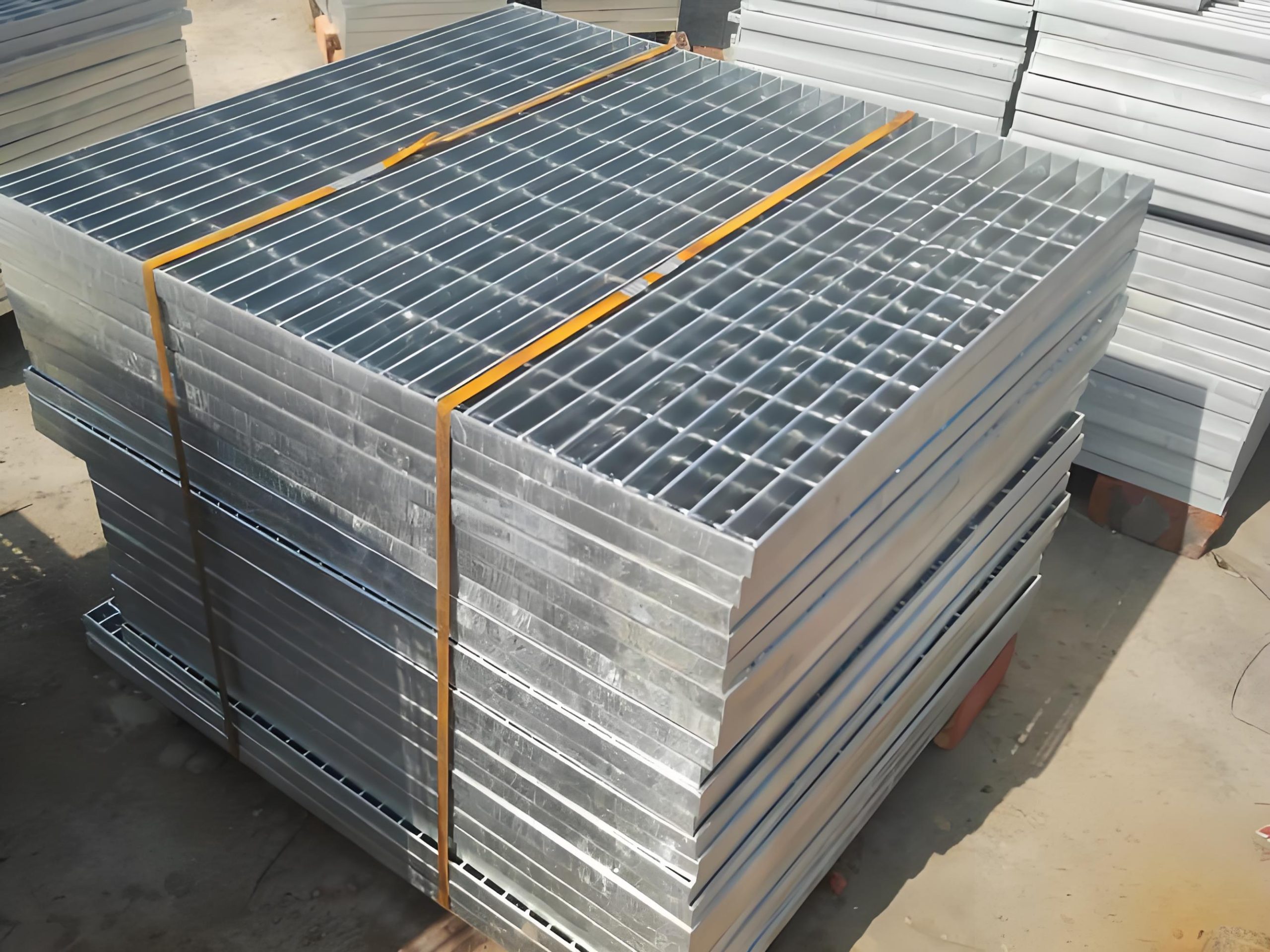
Bolt-fixed treads are designed for easier replacement or site assembly. They are supplied with side plates and hole positions matched to the stair stringer or support frame. This type is useful where maintenance access systems need periodic disassembly or where installation is carried out in modules. Bolt-fixed structures are common in export projects because they simplify packing and reduce on-site welding.
Inserted or press-locked treads are another option. Instead of relying only on welded intersections, these use a mechanically interlocked grid structure formed by inserting cross bars into notched bearing bars. Press-locked treads are often selected where a more uniform surface appearance is preferred, including some architectural or public utility environments. In heavy-duty industrial service, welded grating treads remain more common because they offer robust connection performance under repetitive loading.
Surface treatment is selected according to corrosion exposure and service duration. Hot-dip galvanized treads are standard for outdoor steel structures, industrial stairs, substations, wastewater facilities, and plant platforms. The zinc layer provides long-term corrosion protection over the full surface, including edges and welded joints, when galvanizing is properly controlled. Electro-galvanized treads are used where appearance is smoother and the corrosion environment is lighter, but the coating is thinner and not intended for the same durability level as hot-dip galvanizing.
Painted treads are used when color coding, temporary corrosion protection, or project-specific coating systems are required. Bare steel is generally limited to indoor dry environments or to components that will receive further coating after site installation. For corrosion-sensitive projects, bare carbon steel is rarely the final service condition. In stainless and aluminum treads, the term surface treatment may refer more to finishing method than to a protective coating.
Material selection determines not only corrosion resistance but also fabrication route, weight, long-term maintenance, and total installed cost. The three main material categories for bar grating steel treads are carbon steel, stainless steel, and aluminum alloy. Each serves a different operating environment.
Carbon steel, typically Q235B, is the standard material for general industrial stair treads. It offers a good balance of strength, processability, and cost. For factory buildings, outdoor platforms, utility stairs, equipment support structures, and municipal service walkways, Q235B treads with hot-dip galvanizing are widely used. The steel has reliable weldability, making it suitable for automated pressure welding and side-plate assembly. In most industrial applications, the combination of Q235B substrate and galvanizing is sufficient for structural stairs exposed to weather, rainwater, and moderate industrial atmosphere.
Q235B is especially practical when the project includes a large number of repeated tread sizes such as plant stair towers, warehouse access stairs, conveyor platforms, and power facility maintenance routes. In these situations, structural efficiency and batch manufacturing matter more than decorative finish. Thickness and bearing bar height can be adjusted to match load and span requirements without moving to more expensive alloys.
Stainless steel treads, usually 304 or 316L, are selected where corrosion exposure is beyond the comfort range of galvanized carbon steel or where hygiene standards are stricter. Grade 304 is common in food processing plants, pharmaceutical workshops, indoor chemical handling zones, and washdown areas. Grade 316L is used where chloride exposure is higher, such as marine structures, coastal plants, brine handling facilities, and some aggressive chemical environments. Stainless treads are also useful where coating damage is unacceptable or where regular cleaning with water and chemical agents is part of normal operation.
For chemical plants and food facilities, stainless steel provides a more stable surface condition than painted or zinc-coated carbon steel. It also reduces the risk of coating peel, rust staining, and contamination in clean process areas. In marine service, 316L is generally preferred over 304 because of improved resistance to pitting in chloride-rich air or splash conditions. The correct grade should be linked to the actual exposure level rather than selected by appearance alone.
Aluminum alloy treads are used where lightweight structure and corrosion resistance are both important. They are common in offshore access systems, transportation equipment, rooftop service paths, removable maintenance stairs, and structures where dead load reduction affects the support design. Aluminum treads are easier to handle manually and may simplify installation on prefabricated assemblies. They also resist atmospheric corrosion well, though their load behavior and section design differ from steel and should be calculated accordingly.
Compared with carbon steel, aluminum usually has a higher material price and lower elastic modulus, so deflection control becomes more significant. For that reason, the section layout and support spacing often require adjustment when converting a design from steel to aluminum. Its advantage lies in low weight and stable corrosion behavior, not in direct equivalence to carbon steel sizing.
The structural performance of a bar grating tread depends heavily on bearing bar size, tread width, mesh spacing, and edge treatment. Standardization is helpful for production efficiency, but many industrial stairs still require non-standard dimensions to fit stringer spacing, equipment layout, or retrofit structures. Anping County Chuansen Silk Screen Products Co., Ltd. manufactures both stock-size and drawing-based treads with custom side plates, hole locations, and anti-slip details.
Common bearing bar sizes include 25×3 mm, 25×5 mm, 32×5 mm, and 40×5 mm. These dimensions refer to the height and thickness of the bearing bar, which is the main load-carrying element of the tread. A 25×3 mm section is used in lighter-duty stairs and short spans, while 25×5 mm provides greater stiffness and is common in industrial access treads. For wider stairs, higher loads, or longer unsupported spans, 32×5 mm and 40×5 mm are more suitable. The proper section is selected according to span, expected live load, and deflection limit rather than by visual preference.
Tread width is usually matched to stair design standards and the available support frame. Common widths include 600 mm, 800 mm, and 1000 mm. A 600 mm tread is often used in compact maintenance access systems and equipment stairs. An 800 mm width is common in industrial plant stairs where single-person traffic is expected. A 1000 mm tread is more suitable for wider access stairs, public utility structures, and routes requiring easier movement of personnel or tools.
Mesh spacing affects both structural openness and walking comfort. Typical grid layouts include 30×100 mm, 40×100 mm, and 60×100 mm. The 30×100 mm pattern is one of the most common for stair treads because it offers a balanced surface with adequate support and drainage. A 40×100 mm spacing reduces steel consumption and panel weight but creates a more open walking surface. A 60×100 mm grid is used where maximum openness is preferred, though it is less common for stairs that require tighter foot support.
| Parameter | Common options |
| Bearing bar | 25×3 mm, 25×5 mm, 32×5 mm, 40×5 mm |
| Tread width / Mesh spacing | 600 mm, 800 mm, 1000 mm / 30×100 mm, 40×100 mm, 60×100 mm |
Anti-slip design is critical for bar grating treads because stairs carry concentrated foot traffic and often operate under wet, oily, muddy, or icy conditions. Serrated bearing bars are the most common anti-slip solution. The serrations increase friction under the sole and reduce sliding risk compared with plain flat bars. Additional anti-slip strips can also be added to the tread surface or front nosing where code requirements or site conditions demand stronger slip resistance.
Non-standard customization includes tread depth adjustment, side plate thickness changes, special bolt hole positions, left-right mirrored parts, curved stair sections, and mixed-size production for complete stair flights. Tank access stairs often require wedge-shaped or radial treads to match circular geometry. Retrofit projects may require irregular lengths, notches, or offset fixing points to fit existing steelwork. These variations are difficult to solve with stock panels alone, so CAD-based drawing confirmation becomes part of the manufacturing process rather than an optional service.
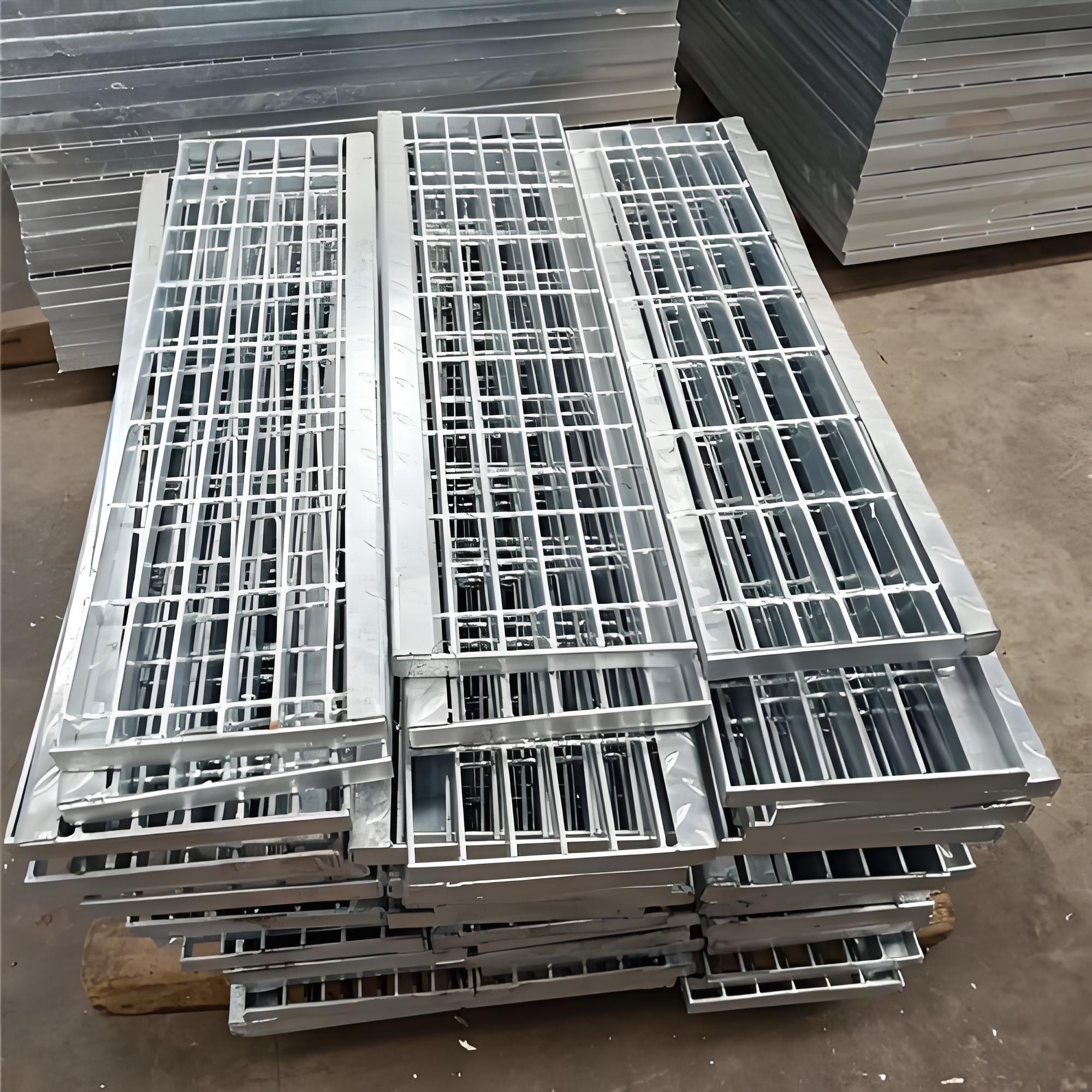
The manufacturing route for bar grating steel treads begins with bearing bar preparation, cross bar arrangement, panel welding or locking, cutting, side plate assembly, surface treatment, and final inspection. For welded grating treads, automatic pressure welding or resistance welding is the standard process for achieving stable intersection quality across repeated production runs. The welding parameters must be controlled so that every joint has adequate fusion strength without excessive deformation or burn-through.
Good welding quality is visible in the consistency of the joints, but visual inspection alone is not enough. Weld point firmness, cross bar positioning, and panel flatness all affect the final tread performance. Weak welds can result in local looseness under repeated foot traffic, while burrs or incomplete finishing can create handling hazards during installation. Proper trimming and finishing remove sharp projections and keep the side plate and nosing assembly aligned.
When hot-dip galvanizing is specified, the grating treads go through degreasing, acid cleaning, fluxing, immersion in molten zinc, and controlled cooling. A well-executed galvanizing process produces a uniform zinc coating over the full surface, including welds, corners, and cut edges. The coating should be continuous, without obvious bare spots, major ash inclusions, or uncoated recesses. For many export and engineering projects, galvanizing is produced to ASTM A123 or equivalent requirements, particularly when durability and coating thickness consistency are part of the technical file.
Electro-galvanizing is thinner and more appearance-oriented, so it is used in lighter-duty indoor conditions rather than in severe outdoor service. Painted finishes, when required, usually depend on surface preparation quality. If the tread is intended for duplex protection systems, galvanizing and coating compatibility must be reviewed before production.
Factory inspection typically covers flatness, overall dimensions, bearing bar spacing, tread depth, side plate position, hole accuracy, weld integrity, and coating condition. Flatness matters because a twisted tread does not seat correctly on the stringers and creates uneven support. Dimensional tolerance matters because even a small side plate misalignment can slow installation across a full stair flight. Weld strength is checked through process control and sampling inspection, while coating quality is reviewed for continuity and visible defects.
For projects requiring traceable documentation, material reports, galvanizing inspection records, and dimensional check sheets can be organized against the production batch. This is especially relevant for chemical facilities, utility projects, marine installations, and export jobs where the technical file is reviewed before shipment.
As a supplier operating from the manufacturing side, Anping County Chuansen Silk Screen Products Co., Ltd. provides bar grating steel treads with direct production control over material preparation, panel welding, side plate fabrication, surface treatment coordination, and packing. The practical advantage of factory-direct supply is not only price reduction but also tighter coordination between drawings, production sequence, and delivery schedule.
Batch pricing is more competitive when the order moves directly from drawing review to fabrication without multiple transfer points. In grating tread projects, repeated sizes, mirrored left-right units, and standardized width groups can be arranged more efficiently at the factory level. This reduces unnecessary handling cost and lowers the chance of dimension errors introduced by secondary reselling channels.
Common specifications are often kept in semi-finished or finished inventory, which supports quick dispatch for urgent stair replacement or fast-track site construction. Regular sizes can often be prepared for shipment within 48 hours when stock and production load permit. This is particularly useful for maintenance shutdown projects, temporary access installations, and replacement of damaged treads in operating plants where downtime is expensive.
CAD drawing refinement is part of supply support for custom treads. In practical production, stair tread orders frequently include mixed dimensions, hole patterns, and orientation marks. Drawing optimization helps distinguish tread numbers, support direction, side plate type, and anti-slip edge requirements before fabrication begins. This reduces on-site mismatch and simplifies installation sequencing.
Installation guidance usually addresses tread orientation, bolt fixing position, support spacing, and side plate alignment. For export projects, packing method is also part of the supply chain quality. Treads may be packed in wooden cases or on steel or timber pallets depending on weight, finish, and shipment mode. Proper export packing prevents edge impact, side plate bending, and coating damage during loading and unloading.
Documentation support can include material reports, inspection certificates, and certificate of origin according to project requirements and available testing scope. For stainless and aluminum treads, composition traceability is often requested. For galvanized carbon steel, coating and dimensional inspection documents are more commonly reviewed. The value of this support lies in keeping the product file consistent with the actual production batch.
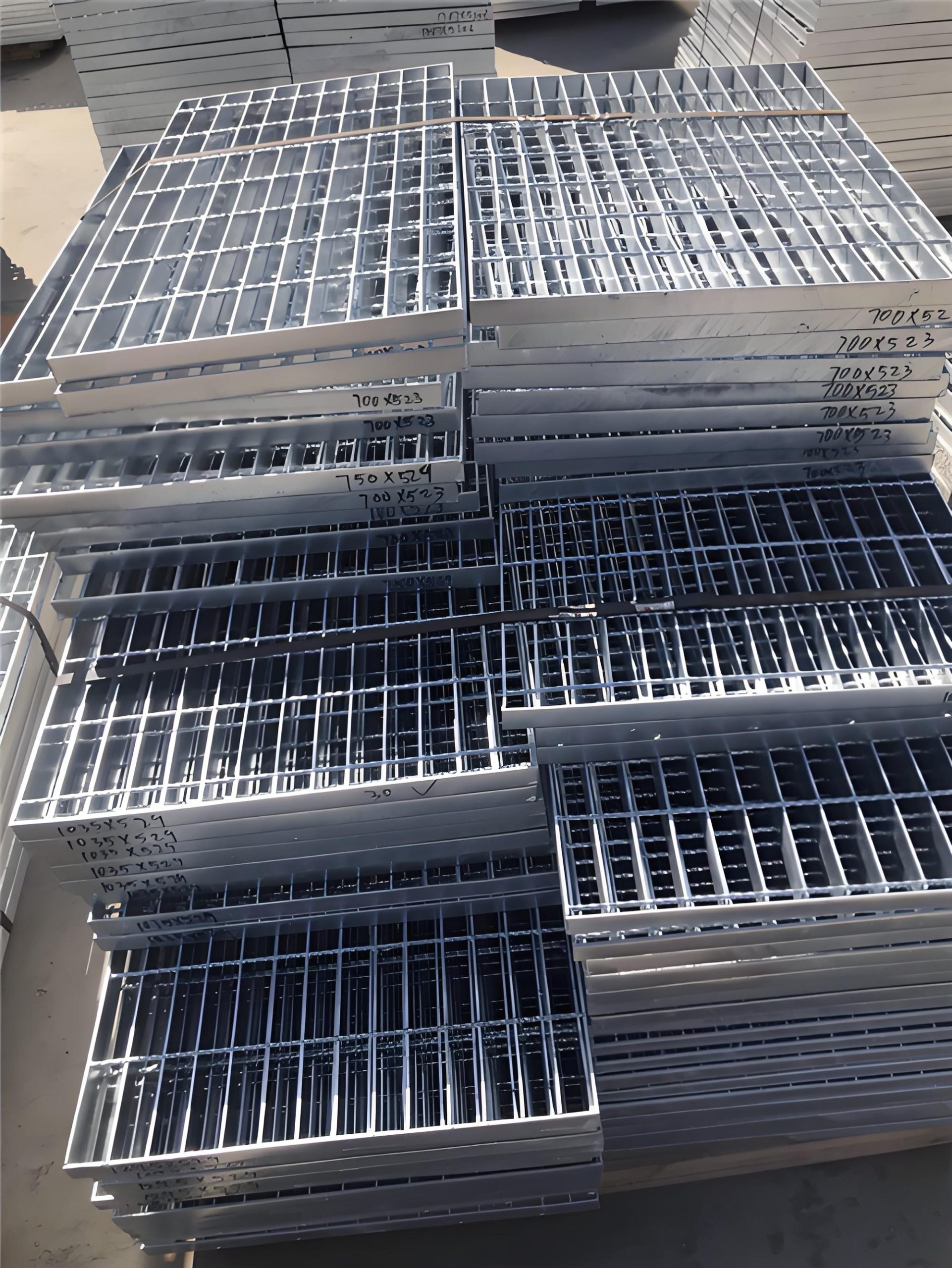
Factory equipment operating platforms are one of the most common application areas for bar grating steel treads. In these installations, treads connect production levels, machine platforms, and service access frames. The open grating structure helps prevent oil, dust, and metal scrap from accumulating on the stair surface, which is useful in fabrication shops, power plants, and heavy equipment workshops. Galvanized Q235B treads are often used here due to their structural economy and resistance to normal industrial exposure.
Tank and storage vessel circular access systems frequently use ring-shaped or segmented grating treads. These are installed around tank walls or on spiral access stairs where geometry is not rectangular. In these cases, non-standard side plates, tapered tread forms, and accurate bolt hole positioning are required. Stainless or galvanized carbon steel can both be used depending on the process medium and atmospheric conditions around the tank.
Wastewater treatment plant maintenance walkways and stairs often operate in humid, chemically active conditions. The environment may include splashing water, sludge residue, cleaning agents, and corrosive gases. Hot-dip galvanized treads are widely used for general access structures, while stainless steel is used in more aggressive zones or in facilities where longer corrosion resistance is necessary. Slip resistance is especially important in these plants, so serrated treads are common.
Marine and offshore engineering stairs place greater emphasis on corrosion resistance and secure footing. Salt exposure, wet surface conditions, and vibration all place higher demands on the tread structure. In these applications, 316L stainless or marine-grade aluminum may be used depending on the platform design and life-cycle requirements. Side plate strength, fixation method, and anti-slip profile all become more critical than in standard inland industrial stairs.
What is the most common material for bar grating steel treads?
Q235B carbon steel with hot-dip galvanizing is the most common configuration for industrial and outdoor stair applications because it provides a practical balance of strength, corrosion protection, and manufacturing cost.
Are serrated treads better than plain grating treads?
Serrated treads provide better slip resistance, especially in wet, oily, muddy, or outdoor conditions. Plain surface treads are still used, but serrated bearing bars are preferred for stairs in most industrial environments.
Can bar grating treads be made to custom width and hole position?
Yes. Width, depth, side plate shape, bolt hole spacing, nosing form, and special cutouts can all be customized according to drawings or measured dimensions from the existing stair structure.
What surface treatment lasts longer outdoors?
Hot-dip galvanizing generally provides longer outdoor corrosion protection than electro-galvanizing or standard paint on carbon steel treads. In highly corrosive conditions, stainless steel may be more suitable than any coated carbon steel option.
Are stainless steel treads necessary for food or chemical plants?
In many food, pharmaceutical, and chemical processing environments, stainless steel treads are used because they handle cleaning exposure and corrosion risk better than coated carbon steel. Grade selection depends on the severity of the environment, with 304 for general corrosive washdown areas and 316L for stronger chloride exposure.
