
Custom stainless steel bar grating is used where standard panels cannot match the platform outline, load requirement, drainage opening, or installation condition. In stainless applications, the value of customization is not only dimensional flexibility but also corrosion resistance matching, fabrication accuracy, and surface finishing after welding. At Anping County Chuansen Silk Screen Products Co., Ltd., custom work typically covers non-standard panel sizes, curved or segmented shapes, stair tread fabrication, trench cover assemblies, and maintenance platform components produced from 304, 304L, 316, or 316L stainless steel.
The first level of customization is material selection. Stainless steel bar grating is not a single product category with one universal grade. The environment determines the suitable alloy. Grade 304 is commonly used for indoor industrial flooring, equipment access platforms, food processing support structures, and drainage covers exposed to water but not aggressive chloride media. 304L is preferred when welding is extensive and lower carbon content is desirable to reduce sensitization risk in the heat-affected zone.
For marine exposure, coastal projects, chemical areas, salt-bearing washdown lines, and chloride-rich environments, 316 or 316L is more appropriate. The molybdenum content improves pitting resistance compared with 304 series material. Where post-weld corrosion stability is critical, 316L is frequently selected for the same reason as 304L: lower carbon content gives better performance after fabrication and passivation.
Surface finishing is another major custom variable. Pickling and passivation is the standard functional treatment for many industrial stainless gratings. It removes welding discoloration, surface contamination, and oxide scale, while restoring the chromium-rich passive layer required for corrosion resistance. In projects with visual exposure or sanitary requirements, polished finishes may be specified. Mirror polish is less common for floor grating because it can become visually reflective and does not improve slip safety, but it is used in architectural or decorative stainless applications. Brushed polish provides a cleaner directional surface appearance and is more practical. Sandblasting gives a uniform matte texture and is selected when glare reduction or a more consistent industrial finish is needed.
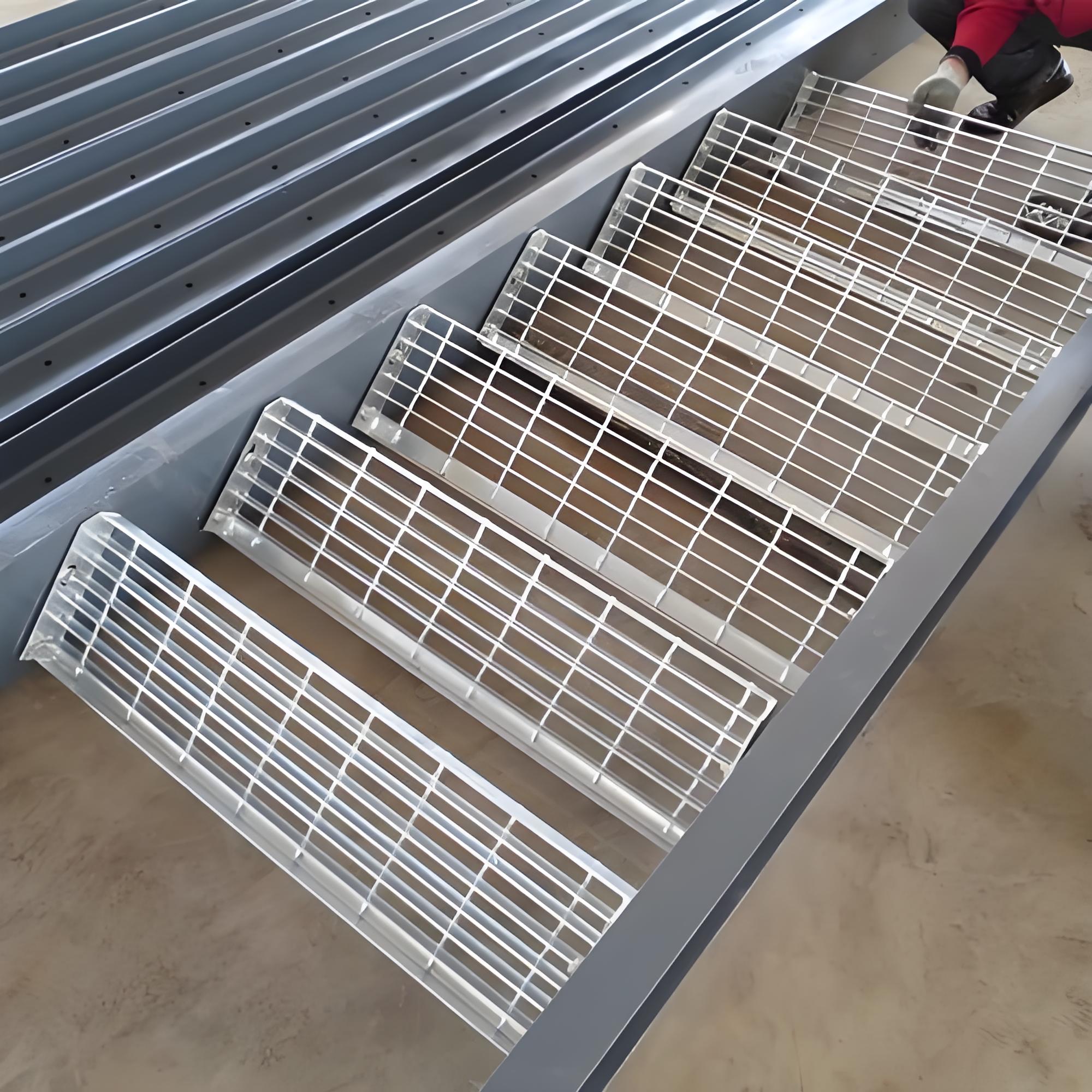
Structural form also varies according to load, appearance, and application. Press-welded stainless steel bar grating is widely used for platforms, walkways, trench covers, and access flooring. It provides stable panel geometry and efficient production for repeated modules. Interlocking grating, including I-bar types and close-mesh configurations, is often chosen where lighter self-weight, different visual profile, or tighter opening control is required. Serrated anti-slip grating is important for stair treads, oily work areas, outdoor ramps, and process zones with frequent moisture. In stainless material, serration improves underfoot traction without adding a separate surface treatment layer.
When a project includes several exposure zones, it is common to combine types. For example, a plant may use plain press-welded 304 grating indoors, serrated 316L grating at outdoor washdown stairs, and close-mesh interlocking grating over channels where smaller open area is necessary. Custom production allows these variations to remain consistent in border treatment, installation method, and drawing control.
The bearing bar specification defines the panel’s strength, stiffness, and overall mass. Custom stainless bar grating is commonly produced with flat bars from 25 mm to 100 mm in height and 3 mm to 6 mm in thickness. A 25×3 mm or 30×3 mm bar is suitable for light-duty covers and small access panels. Medium-duty walking platforms often use 30×5 mm, 40×5 mm, or 50×5 mm. Heavier equipment platforms, longer spans, and concentrated load positions may require 60×5 mm, 65×5 mm, or larger bearing bars. In stainless fabrication, bearing bar selection should be based on clear span, support spacing, and service load rather than copying carbon steel dimensions directly, because project expectations for deformation and finish quality are often stricter.
Grid spacing affects open area, drainage rate, heel safety, debris passage, and weight. Net openings from 20 mm to 60 mm are common in custom production. Standard combinations such as 30×100 mm and 40×100 mm are widely used because they balance drainage, fabrication efficiency, and load distribution. Closer spacing is preferred where smaller objects must not fall through, where footwear safety matters, or where platform traffic includes narrow wheels or tools. Wider openings are acceptable where drainage and reduced material use are the main concern.
Non-standard shape fabrication is often the main reason a custom order is required. Stainless grating can be produced as curved panels, fan-shaped segments, corner-cut rectangles, notched plates, opening-cut panels for pipe penetrations, and bent assemblies for edge transitions or integrated structural details. Curved and fan-shaped units are common around storage tank roofs, circular towers, and turning walkways. Corner cut-outs and localized openings are typical in retrofit projects where existing columns, valves, handrail posts, or cable penetrations must pass through the grating panel without field rework.
Accessory configuration should be confirmed at the same time as the main panel geometry. Edge banding is often required to close the open ends of bearing bars, improve rigidity, and create a cleaner installation line. Installation clips vary by support beam detail and removal requirement. Stair tread anti-slip nosing is frequently welded or fixed to the leading edge. In fabricated assemblies, side plates, toe plates, hinge lugs, lock tabs, and support seat plates may all be part of the same delivered unit rather than separate field-added pieces.
| Parameter | Custom Range | Typical Use |
| Bearing bar | 25-100 mm height, 3-6 mm thickness | Walkways, trench covers, platforms, treads |
| Opening / pitch | 20-60 mm net opening, common 30×100 / 40×100 mm | Drainage, heel safety, debris control |
Stair treads are one of the most common custom stainless grating products. A tread usually requires more than a cut panel. The front edge may include a serrated anti-slip nosing, and the two sides may be closed with end plates drilled for bolted installation. Tread depth, width, hole center spacing, and side plate thickness must match the stair stringer detail. In wet processing plants, offshore access ladders, and outdoor service stairs, stainless serrated treads offer long service life with lower maintenance than painted steel alternatives.
Fan-shaped platforms are typical around tank tops, towers, circular vessels, and curved route transitions. These panels cannot be produced accurately from standard stock without detailed layout. The inner radius, outer radius, included angle, support line orientation, and joint clearance between adjacent segments all affect fabrication. In this type of work, expanded drawings are usually prepared to make sure the bearing bar direction and support locations remain correct after the radial geometry is developed. Stainless fan-shaped grating is also used on architectural service decks where both visual alignment and dimensional fit matter.
Drainage trench covers often require reinforced custom features. Hinges may be added where regular opening is needed for inspection. Locking devices may be required in municipal, processing, or public access areas to prevent unintended removal. For channels with flow requirements, open area must be balanced against wheel load or pedestrian safety. Some covers need frame coordination so the grating and support angle are fabricated as a matched system. In stainless drainage applications, attention is usually given to edge smoothness, weld cleaning, and underside reinforcement because these directly affect service life and installation stability.
Equipment fencing and maintenance platforms frequently combine grating with structural accessories. A platform panel may require an integrated kick plate, post base connection points, handrail interface cut-outs, and removable inspection sections. In machine areas, the grating may form both the floor and the protective perimeter infill depending on design intent. For service platforms built around pumps, filtration systems, conveyors, or thermal equipment, custom stainless grating allows access space to be fitted around irregular machine footprints while preserving drainage and ventilation.
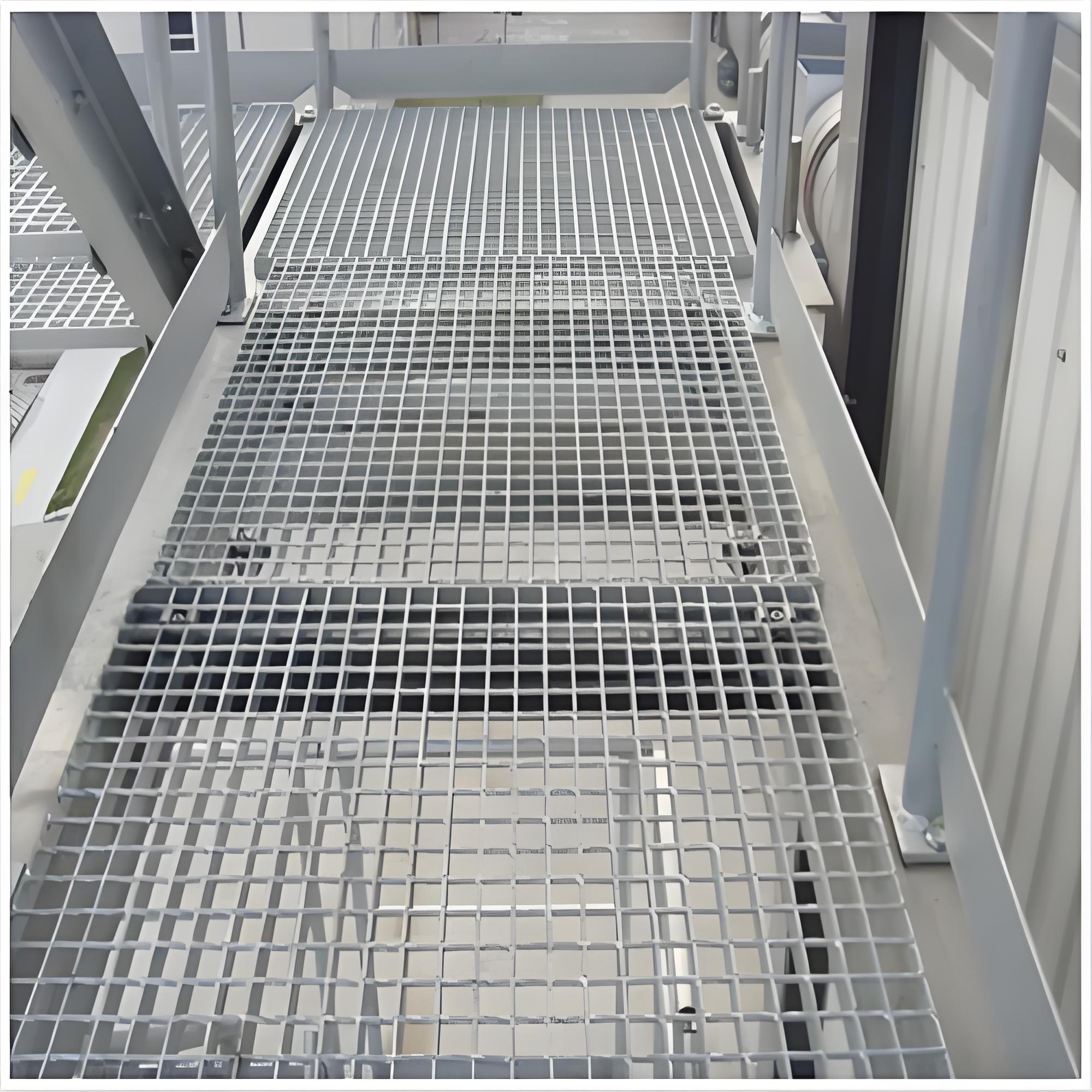
For custom stainless steel bar grating, production accuracy starts with cutting. Laser or plasma cutting is selected according to thickness, geometry complexity, and finish requirement. In standard industrial tolerance control, dimensional precision of approximately ±1 mm is achievable for most custom components when drawings are complete and support references are clear. Laser cutting is advantageous for finer openings, detailed corner cuts, and cleaner edge definition. Plasma cutting is more practical on thicker stainless sections and larger panels where speed is a greater factor.
Automatic resistance welding is used for the main grating structure in many panel types. Stable welding parameters are essential because stainless material shows surface discoloration quickly if heat input is not controlled properly. Good weld formation is not only an appearance issue. In bar grating, each welded intersection contributes to panel stiffness, load distribution, and long-term service reliability. A sound production line focuses on consistent weld penetration, uniform alignment of cross bars, and elimination of missed or weak joints.
After welding and fabrication, pickling and passivation is an important processing stage rather than a cosmetic option. Welding leaves heat tint, oxide scale, and possible iron contamination from handling or tooling contact. If these residues remain on the surface, corrosion resistance is reduced, especially in chloride-bearing conditions. Pickling removes the affected surface layer, and passivation supports the regeneration of the protective oxide film. On stainless grating used in chemical plants, food facilities, marine structures, and wastewater systems, this stage has direct influence on field durability.
Factory inspection should cover flatness, welding strength, dimensional verification, and detail confirmation against drawings. Flatness matters because warped grating creates installation stress and unsafe walking surfaces. Weld strength checks help identify missed joints or local instability, especially around cut-out regions and accessory weld zones. Dimension rechecking is necessary on custom work because one incorrect notch, bolt hole, or radius can prevent installation even if the base panel is structurally acceptable. At Anping County Chuansen Silk Screen Products Co., Ltd., custom grating production normally follows drawing-based review before fabrication and final piece-by-piece verification before packing.
| Process Stage | Control Point | Purpose |
| Cutting and welding | ±1 mm dimensional control, full joint formation | Installation fit and structural integrity |
| Post-treatment and inspection | Pickling passivation, flatness and size check | Corrosion resistance and drawing compliance |
Custom stainless steel bar grating often involves small batches, one-off replacement parts, or project-specific assemblies that do not fit standard production quantities. A practical factory setup should be able to handle single-piece fabrication as well as repeated project lots. At Anping County Chuansen Silk Screen Products Co., Ltd., there is no fixed minimum order quantity for this category. A single panel, one stair tread, or one curved cover can be produced when the drawing and technical details are complete. This matters in maintenance replacement work where only a damaged section needs to be remade to match an existing installation.
Drawing support is often part of custom production rather than a separate engineering process. CAD deepening, detail adjustment, and unfolding drawings are useful when site measurements exist but fabrication-ready dimensions are incomplete. For fan-shaped panels, irregular cut-outs, fold details, and accessory positioning, clear workshop drawings reduce error risk far more effectively than written descriptions. In stainless grating work, dimensional confirmation before production is especially important because post-fabrication site trimming is more difficult and can damage the finished corrosion-resistant surface.
Lead time for custom stainless bar grating is usually in the range of 7 to 15 days, depending on geometry complexity, accessory quantity, material grade, and finishing requirement. Simple rectangular panels with common bearing bar sizes move faster than curved units with hinges, locks, folded edge details, and multiple opening cuts. Production scheduling also changes when the order includes polishing or full passivation after extensive weld cleaning. A realistic lead time must account for material preparation, fabrication, post-treatment, inspection, and export packing.
Supporting documents and packaging can also be arranged along with the product. Stainless material certificates are often required for traceability on industrial projects. Inspection reports may cover dimensions, quantity, and visible weld condition. For export shipments, fumigation-free wooden cases are commonly used to protect passivated stainless surfaces from impact, contamination, and deformation during transport. Proper separation between panels is important, because stainless surfaces can be scratched or stained if packed directly against rough metal or contaminated wood.
The most efficient quotation starts with the overall size or a drawing. Length and width are enough for simple rectangular panels, but non-standard products should preferably be quoted from CAD, PDF, or clearly dimensioned sketches. For curved or fan-shaped units, the quotation should show radius, angle, support orientation, and any split-line arrangement between segments. When replacement grating is required for an existing installation, photos with marked dimensions are useful but should not replace critical measurements.
The bearing bar specification and grid spacing should be stated directly. This includes flat bar height and thickness, cross bar arrangement if relevant, and the mesh spacing such as 30×100 mm or 40×100 mm. If the original specification is unknown, load condition and clear span should be provided so a workable section can be recommended. For stair treads, tread width, depth, side plate requirement, and hole spacing are necessary. For trench covers, frame detail and support seat width should also be included when available.
Material grade and surface requirement should be confirmed at the start of the quotation process. A clear statement such as 304 with pickling passivation, or 316L with sandblasted finish, avoids later changes that affect both processing route and cost. If the grating will be installed in chloride exposure, washdown service, or chemical contact areas, that environmental information is useful because it affects alloy recommendation even when the drawing is complete.
Quantity and accessory requirements should be listed together. The same panel can have different pricing depending on whether it needs edge banding only, or includes clips, toe plates, hinges, locks, anti-slip nosing, support frames, and base plates. Packaging method also matters when the order is for export or mixed-size project lots. A quote can be prepared much faster when the request includes shape dimensions, bar specification, spacing, stainless grade, finish, quantity, and accessory list in one set of information.
What stainless steel grade is usually used for outdoor bar grating?
304 is used for many outdoor installations where exposure is moderate and chloride concentration is low. In coastal, marine, salt-processing, and aggressive washdown environments, 316 or 316L is generally more suitable because it has better resistance to pitting and crevice corrosion.
Can custom stainless grating be made in a curved or fan shape?
Yes. Curved, radial, and fan-shaped panels are standard custom fabrication types for tank roofs, circular walkways, and turning platforms. Accurate production depends on complete radius and angle data, plus support line details.
Is serrated stainless steel grating available for stairs and wet platforms?
Yes. Serrated bearing bars are commonly used on stair treads, outdoor walkways, process areas, and zones where water or oil reduces traction. The serrated profile improves slip resistance without applying an added coating.
What is the usual tolerance for custom stainless grating fabrication?
For most custom cutting and assembly work, dimensional accuracy around ±1 mm is achievable when drawings are complete and the panel geometry is suitable for controlled fabrication. Complex formed parts and large segmented shapes should always be reviewed against actual support conditions.
Can one piece be ordered, or is batch production required?
Single-piece fabrication is possible for replacement panels, sample units, one-off access covers, and custom stair components. This is common in maintenance work where the requirement is not a full batch but an exact match to an existing installation.
