
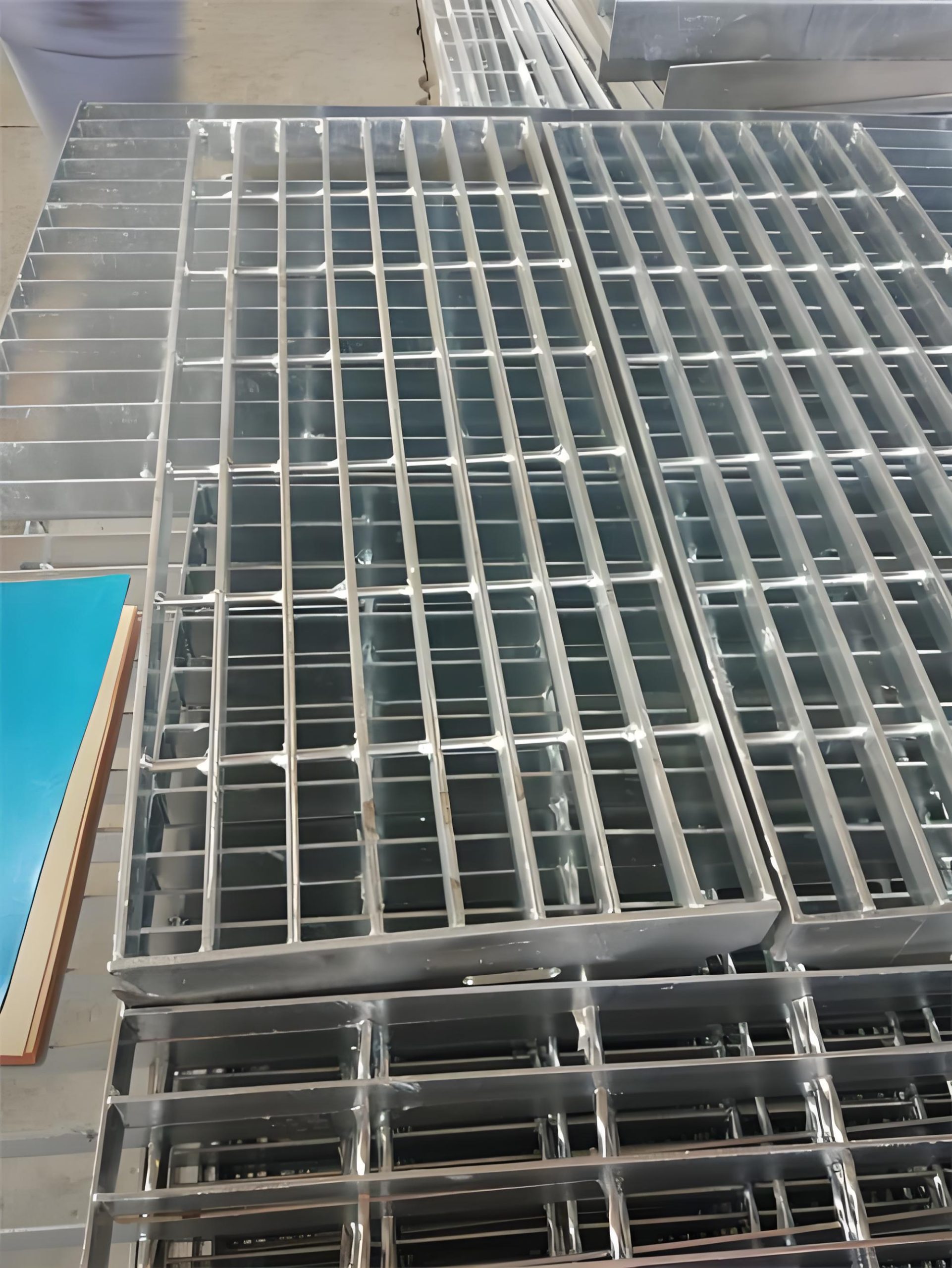
Steel bar grating weight per square foot is normally expressed as the combined weight of the bearing bars and cross bars within one square foot of panel area. In factory production, this value is used for structural load calculations, galvanizing batch control, packaging, transport planning, and installation handling. For standard welded steel bar grating, the weight difference between two panels that look similar can be substantial once bearing bar thickness, spacing, and cross bar layout change. At Anping County Chuansen Silk Screen Products Co., Ltd., weight calculations are generally checked first by theoretical section data and then compared with finished panel output, because grating is not a flat sheet product; its mass distribution depends directly on bar geometry and pitch.
The basic formula for steel bar grating unit weight in imperial measure is:
Unit weight (lbs/ft²) = bearing bar weight + cross bar weight
The bearing bar portion makes up the largest share of total weight in almost all standard grating types. Cross bars contribute less, but they still matter, especially when cross bar spacing is reduced or when twisted square bars are replaced by heavier round or flat cross members. In practical production calculations, the unit weight is first determined in kg/m² from bar dimensions and spacing, then converted into lbs/ft² when required for North American drawings or freight documentation.
The metric-to-imperial conversion used for grating weight is:
1 kg/m² × 0.2048 = lbs/ft²
This factor is convenient for checking workshop data sheets. For example, if a standard grating panel has a calculated theoretical weight of 25 kg/m², the corresponding imperial value is about 5.12 lbs/ft². This conversion is especially useful when the manufacturing drawing is in millimeters but the construction project schedule is based on square feet and pounds.
For more detailed calculation, the bearing bar weight can be estimated from bar cross-sectional area, steel density, and the number of bearing bars per meter or per foot. Cross bar weight is then added according to diameter or section size and spacing. In standard pressure-welded carbon steel grating, bearing bars usually account for roughly 80% to 90% of the total panel weight, so small changes in bearing bar thickness have a stronger effect than similar changes in cross bar dimensions.
The most important factor is the bearing bar size, typically expressed as height × thickness. A 25×3 mm bearing bar contains much less steel than a 40×5 mm or 50×6 mm bar, even if panel spacing remains unchanged. Height increases the section depth, while thickness increases solid metal volume directly. When both dimensions rise together, weight climbs quickly.
The second major factor is bearing bar center spacing. The closer the bearing bars are to each other, the more bars are present in the same square foot, and the heavier the panel becomes. A grating made with 32×5 mm bearing bars at 30 mm centers is noticeably heavier than the same bar size at 40 mm centers. This change happens without altering panel length or width, purely because more steel is packed into the same open area.
The third factor is cross bar specification and spacing. Standard welded bar grating often uses twisted square cross bars at 100 mm spacing, but heavier cross bars or tighter pitch will add weight. Cross bars usually do not dominate the total mass, yet they can shift the weight enough to affect quoted shipping tonnage or support design. This is particularly relevant in serrated grating, heavy-duty grating, or close-mesh products where the secondary bars are more substantial.
The fourth factor is material density. Carbon steel and stainless steel are very close in density, so their unit weights for identical dimensions are nearly the same. Typical density references are:
| Material | Density | Relative Weight Level |
| Carbon steel | 7.85 g/cm³ | Baseline |
| Stainless steel | 7.93 g/cm³ | Slightly heavier |
| Aluminum-magnesium alloy | About 2.67 g/cm³ | Much lighter |
Because the density difference between carbon steel and stainless steel is small, identical grating layouts in 304 or 316 stainless remain very close to carbon steel in unit weight. Aluminum grating is a different case; it delivers a much lower dead load and is often selected where manual handling, rooftop access systems, or corrosion-sensitive structures require a lighter panel.
The following values are commonly used as quick references for standard carbon steel hot-dip galvanized bar grating. These figures are expressed in pounds per square foot and fit standard industrial welded grating layouts.
| Bearing Bar Size | Center Spacing | Cross Bar Spacing | Weight (lbs/ft²) |
| 25×3 mm / 25×5 mm / 32×5 mm / 32×5 mm | 30 mm / 30 mm / 30 mm / 40 mm | 100 mm / 100 mm / 100 mm / 100 mm | 3.1 / 5.1 / 6.6 / 5.0 |
| 40×5 mm / 40×5 mm / 50×6 mm | 30 mm / 40 mm / 30 mm | 100 mm / 100 mm / 100 mm | 8.2 / 6.2 / 12.3 |
These weight levels show the effect of section growth very clearly. A 25×3 mm grating at 30 mm centers is relatively light at 3.1 lbs/ft². Changing only the thickness to 5 mm raises it to 5.1 lbs/ft². Moving from 32×5 mm at 30 mm centers to the same bar at 40 mm centers reduces the weight from 6.6 to 5.0 lbs/ft², which shows how spacing can shift panel mass almost as much as bar size in some layouts.
The 50×6 mm specification belongs to the heavier end of standard industrial grating and is often used where spans, wheel loads, or concentrated service loads are higher. At 12.3 lbs/ft², it carries nearly four times the steel mass of the 25×3 mm entry specification. This difference matters not only for structural design but also for handling methods, galvanizing kettle loading, and bundle weight calculation.
When the grating geometry stays the same and only the material changes, a simple conversion factor can be used for fast comparison. For most standard layouts, the following ratios are accurate enough for preliminary engineering and quotation sheets:
| Material | Conversion Factor | Comment |
| Carbon steel Q235B | 1.00 | Reference value |
| Stainless steel 304/316 | ×1.01 | Nearly the same as carbon steel |
| Aluminum-magnesium alloy | ×0.34 | About one-third of steel weight |
If a carbon steel grating layout weighs 6.2 lbs/ft², the stainless version in the same dimensions will be about 6.26 lbs/ft². In real fabrication, this difference is so small that dead-load assumptions are often treated as equivalent unless the project specification requires strict material-by-material calculation.
For aluminum-magnesium alloy grating, the same 6.2 lbs/ft² steel layout would drop to approximately 2.1 lbs/ft² after applying the 0.34 factor. This lower weight changes transport efficiency and installation labor significantly. It also affects support frame design because the permanent load contribution of the grating becomes much smaller.
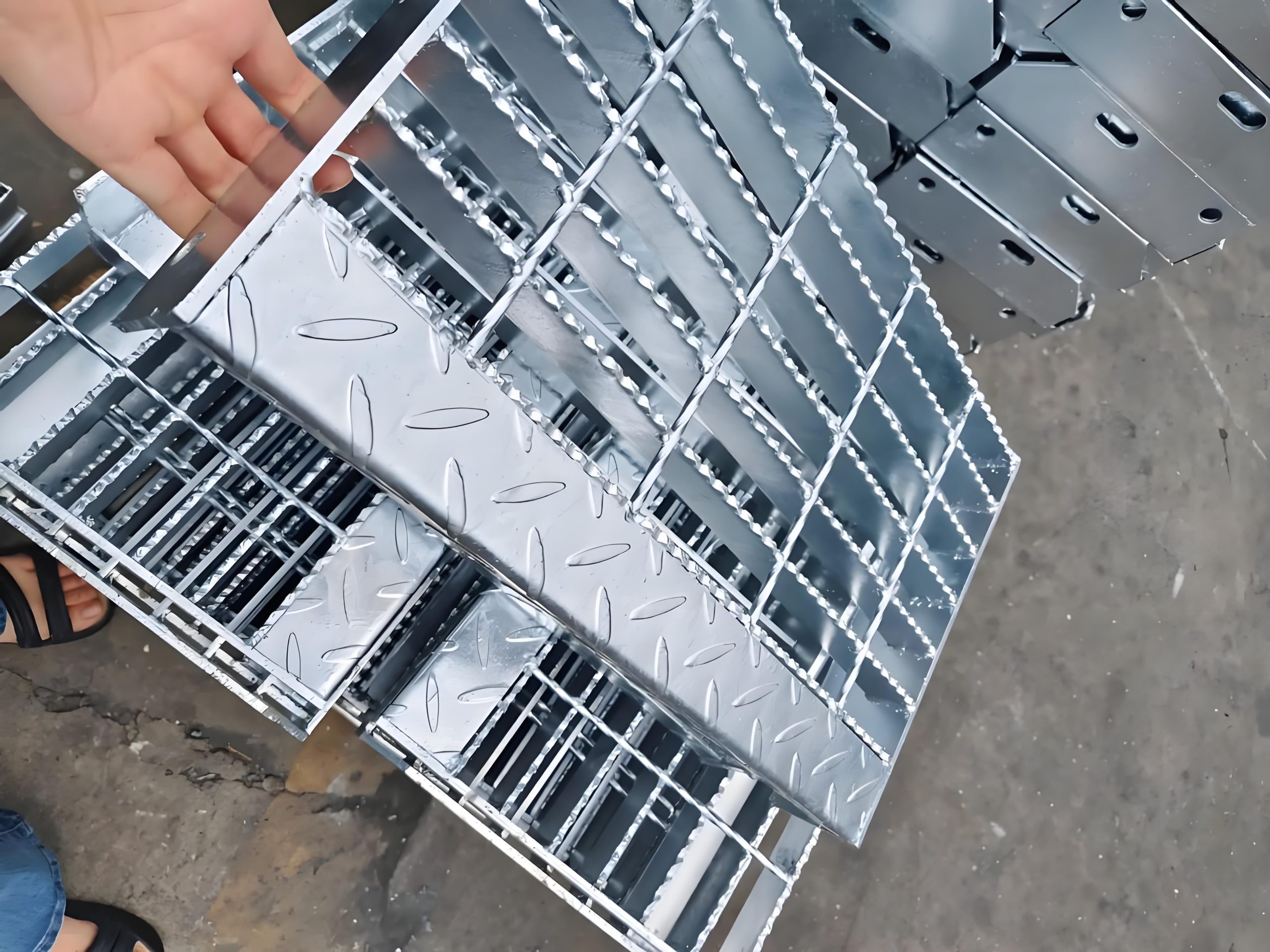
Surface treatment can add measurable weight, especially with hot-dip galvanizing. For carbon steel grating, the zinc coating typically increases total weight by about 3% to 6%, depending on coating thickness, steel chemistry, immersion time, and drainage condition after withdrawal from the zinc bath.
As an example, a bare carbon steel grating panel calculated at 5.0 lbs/ft² may finish around 5.15 to 5.30 lbs/ft² after galvanizing. In light grating, the percentage effect of zinc can look more obvious because the base steel mass is lower. In heavy-duty grating, the absolute zinc addition is larger, but the percentage increase may remain in the same general range.
Painted or powder-coated grating usually shows a weight increase small enough to ignore for ordinary square-foot calculations. The coating film is thin relative to the mass of the steel bars, so for transport tonnage or platform dead-load checks, it is normally treated as negligible.
In production control, galvanizing weight matters for two reasons. First, it changes the final shipment mass. Second, some projects specify zinc coating by area and thickness, so the finished panel may not match the bare theoretical steel weight listed in fabrication drawings. That is why factory records often distinguish between black steel theoretical weight and galvanized delivery weight.
For rapid approximation, a simple rule of thumb can be used:
Approximate weight (lbs/ft²) = bearing bar height (inches) × bearing bar thickness (inches) × 18
This formula is intended as a shortcut rather than a precise engineering calculation. It works best for common welded grating layouts with standard spacing and typical cross bar proportions. Because it focuses mainly on the bearing bar section, it gives a practical approximation for standard products where cross bar contribution stays within the usual range.
Example:
1″ × 3/16″ → 1 × 0.1875 × 18 ≈ 3.38 lbs/ft²
This result is close to the weight level expected for a light-duty grating configuration in that section range. If the spacing becomes tighter than normal, or if the cross bar system is heavier than standard, the real panel weight will exceed this estimate. If the spacing is wider, the actual weight may come in lower.
In workshop use, this approximation is helpful when reviewing many grating schedules quickly. It allows a rough dead-load check before detailed panel-by-panel calculation is completed. It is also useful when converting between inch-based and millimeter-based bearing bar specifications during export order preparation.
Bearing bar height and thickness do not affect weight in the same way from a structural standpoint, even though both add mass. Height increases stiffness more effectively, while thickness adds direct metal volume and improves local section robustness. From a pure weight perspective, increasing thickness often produces a faster rise in lbs/ft² than a small increase in bar height, especially when the center spacing remains fixed.
For example, moving from 25×3 mm to 25×5 mm at the same 30 mm center spacing increases weight from 3.1 to 5.1 lbs/ft². The bar height stays the same, but the thickness change alone adds about 64% more weight. By comparison, moving from 25×5 mm to 32×5 mm increases weight from 5.1 to 6.6 lbs/ft². Here the thickness stays constant and the added height raises the mass by a smaller proportion.
This distinction matters because some projects specify deeper bars for span reasons and thicker bars for wear resistance or loading reasons. Two gratings may have similar load ratings yet differ in dead load because one relies on depth while the other relies on section thickness. That is why weight should not be inferred from bar height alone.
Spacing controls how many bearing bars and cross bars exist in a given area. Reducing bearing bar center spacing from 40 mm to 30 mm increases the number of primary bars by roughly one-third across the panel width. Since bearing bars are the main source of mass, this change can add a large amount of weight without changing the panel outline at all.
The reference values for 32×5 mm and 40×5 mm show this effect clearly. At 32×5 mm, changing from 40 mm spacing to 30 mm spacing raises the weight from 5.0 to 6.6 lbs/ft². At 40×5 mm, the same spacing change raises the weight from 6.2 to 8.2 lbs/ft². The structural open area becomes smaller, the metal volume rises, and the panel dead load increases immediately.
Cross bar spacing has a similar but smaller effect. Moving from 100 mm cross bar centers to a closer pitch increases total steel content, panel rigidity in the transverse direction, and weld count. This is why close-mesh gratings generally weigh more than standard open gratings even when the bearing bar section is unchanged.
Theoretical weight is based on nominal bar dimensions, nominal spacing, and standard density values. Actual shipping weight includes dimensional tolerance, welding accumulation, edging bars, trimming loss patterns, galvanizing pickup, and bundle packing differences. For standard grating panels, a finished weight deviation within ±3% of theoretical value is generally regarded as normal.
This tolerance range is practical because grating is assembled from multiple bars, and each bar has its own rolling tolerance. Edging bars can also influence the total mass more noticeably on small panels than on large ones. A narrow cut panel with a heavy banding bar may have a unit weight slightly above the table value because the perimeter steel occupies a larger proportion of the total area.
Factory weighing often shows that panels with identical nominal specifications can differ slightly from each other after galvanizing, especially when the drain pattern causes some zinc retention at the intersections. That difference usually remains small, but it is enough to explain why exact shipment tonnage should be based on production records rather than table values alone.
Non-standard or irregular grating panels should not be estimated only from the weight of the parent rectangular panel. Openings, chamfered corners, toe plates, kick plates, cut-outs for columns, and curved edges all change the real steel content. In these cases, weight should be calculated according to the developed panel area and then adjusted for additional border bars and attachments.
A panel with a large pipe cut-out may have less net grating area but still require reinforcement around the opening, so its unit weight per installed square foot may actually increase. Likewise, narrow trench covers or stair tread blanks often carry a higher effective weight per square foot than wide standard floor panels because the edging and end plate proportion is much greater.
For workshop accuracy, non-standard panels are usually calculated from a nesting drawing or fabrication schedule rather than from a generic weight chart. This is the only reliable way to capture the effect of special banding, opening reinforcement, and unusual support geometry.
Stainless steel grating in 304 or 316 grade is nearly equal to carbon steel in theoretical density, so section-for-section weight change is minimal. However, for purchasing and logistics purposes, it is often practical to allow a small upward margin. A common internal method is to calculate by theoretical weight and then add about 5% as procurement weight.
This extra allowance does not come from density alone. It reflects fabrication realities such as heavier edge finishing in some stainless designs, stricter flatness control, and the fact that stainless grating orders are often more customized and less likely to follow the most weight-efficient standard patterns. In addition, stainless projects may involve flat cross bars rather than twisted bars, depending on hygiene or architectural requirements.
So while the density correction from carbon steel to stainless is only about 1%, the handling and order-planning allowance can reasonably be higher when preparing project tonnage. This is particularly useful when stainless grating is supplied in small batches with many cut panels instead of full standard modules.
How do I convert steel bar grating weight from kg/m² to lbs/ft²?
Multiply the metric value by 0.2048. For example, 30 kg/m² equals about 6.14 lbs/ft².
Does hot-dip galvanizing significantly increase grating weight?
Yes, but within a moderate range. Standard hot-dip galvanizing usually adds about 3% to 6% to the bare steel weight.
Is stainless steel grating much heavier than carbon steel grating?
No. For the same dimensions, stainless steel grating is only about 1% heavier in theoretical unit weight.
Why can the actual panel weight differ from the chart value?
Chart values are theoretical references. Actual weight is affected by dimensional tolerance, edging bars, panel size, galvanizing pickup, and any special cutting or reinforcement.
What is the fastest way to estimate grating weight per square foot?
A quick approximation is bearing bar height in inches multiplied by thickness in inches, then multiplied by 18. It is useful for rough checks, not for final fabrication weight.
