

Heavy duty steel bar grating is designed for areas where ordinary grating is no longer enough to safely carry concentrated loads, repeated wheel traffic, equipment weight, or harsh industrial service conditions. In practical projects, this includes forklift lanes, truck access zones, machinery platforms, loading bays, port working areas, trench covers for heavy vehicles, and structural walkways with high live loads. The key to proper selection is not simply choosing a thicker grating panel. It requires matching bearing bar size, spacing, span, fixing method, material grade, and reinforcement details to the actual load condition. A heavy duty grating that is undersized may deflect excessively or fail prematurely, while an oversized specification can increase cost far beyond what the project actually needs. For buyers, engineers, and contractors, understanding the basic selection logic is essential before requesting a quotation.
The first and most important selection factor in heavy duty steel bar grating is the bearing bar dimension. In high-load applications, the bearing bar height is usually not less than 50mm, and the thickness is generally not less than 5mm. These two dimensions must be considered together rather than separately. A taller bar improves section modulus and bending resistance, while a thicker bar increases sectional strength and stability. If one parameter is increased without the other being reasonably matched, the performance gain may not be as efficient as expected.
For example, a 50mm high bearing bar with only light thickness may not be adequate for repeated rolling wheel loads, especially when the span is wide. On the other hand, increasing thickness too much while keeping bar height too low may add weight and cost without delivering the best bending performance. In most heavy-duty applications, practical combinations often start from 50x5mm, then move upward to 60x5mm, 65x6mm, 75x6mm, 80x8mm, or higher according to loading and span.
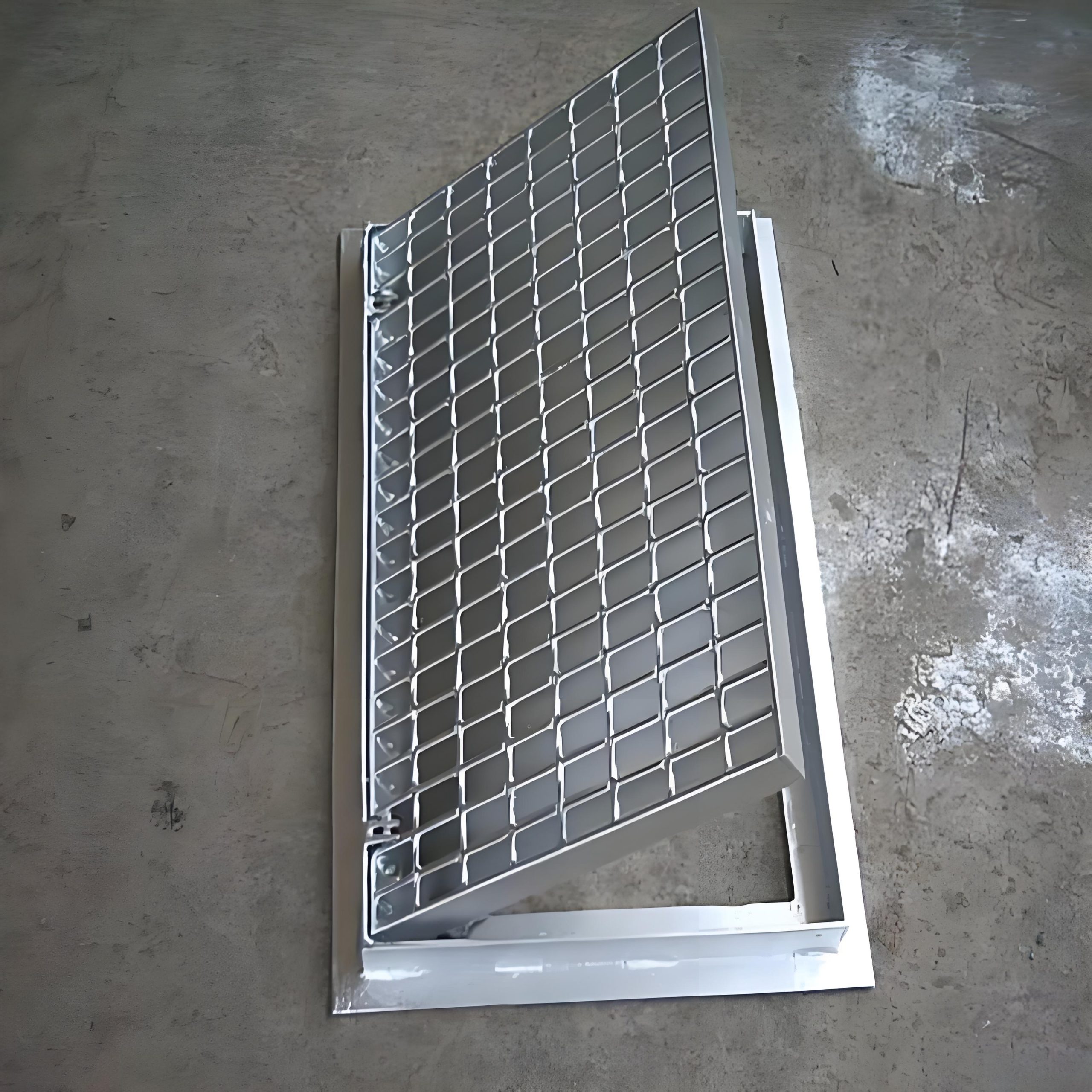
Grid spacing also has a direct effect on load capacity. A denser spacing means more bearing bars per unit width, which improves load distribution and increases the panel’s overall carrying ability. For high-load conditions, the compact 30x30mm spacing is often preferred because it offers stronger structural performance and better support for concentrated loads. Wider spacing such as 40x100mm or 30x100mm may be acceptable in lighter duty industrial areas, but for repeated vehicle traffic or point load conditions, tighter spacing is normally the safer choice.
Another point often overlooked is the difference between static and dynamic load. A grating carrying a stationary machine base behaves differently from a grating supporting a moving forklift. Wheel impact, braking force, vibration, and repeated fatigue cycles all place higher demand on the panel. This is why heavy duty steel bar grating should always be selected according to real operating conditions rather than nominal load values alone.
Anping County Chuansen Silk Screen Products Co., Ltd. generally reviews bearing bar height, thickness, spacing, support span, and traffic type together when recommending heavy duty grating specifications. In high-load projects, even a small change in span or wheel path can alter the required section size significantly.
Heavy duty steel bar grating is usually selected by matching the load class to a suitable bearing bar range. While final engineering verification depends on actual span and support conditions, there are practical reference levels commonly used in industrial procurement to narrow down the correct specification range before detailed calculation.
For forklift or truck traffic, a common recommended bearing bar height range is 50mm to 65mm. In many warehouse yards, industrial maintenance areas, loading channels, and service roads, grating must resist repeated wheel loads instead of only pedestrian traffic. A 50mm or 60mm height is often the starting point for moderate wheel traffic, especially when paired with 5mm or 6mm thickness and dense bar spacing. If axle load is higher or span is longer, the section normally needs to move closer to the upper end of this range.
For heavy machinery platforms, the recommended bearing bar height commonly falls between 65mm and 80mm. These applications involve equipment weight, maintenance crews, tools, vibration, and in some cases local concentrated loads from machine supports. In such conditions, the grating must not only carry static mass but also control deflection. Specifications in this range are widely used for turbine areas, process equipment service decks, heavy industrial mezzanines, and utility platforms requiring greater structural reserve.
For port container operation zones or very high-duty industrial areas, the bearing bar height often needs to be 100mm or more. Such locations may involve container handling equipment, heavy transport loads, larger wheel pressure, and strong impact demand. In these cases, ordinary industrial grating is not suitable. The grating is usually custom-engineered with very high bearing bars, substantial thickness, tighter support spacing, and reinforced edge construction.
The following table provides a simple reference for preliminary specification matching.
| Application Type | Typical Bearing Bar Height | Typical Thickness | Recommended Spacing |
| Forklift or light truck traffic | 50-65mm | 5-6mm | 30x30mm preferred |
| Heavy machinery platform | 65-80mm | 6-8mm | 30x30mm or dense custom spacing |
| Port container working area | 100mm or above | 8-10mm or above | Customized heavy-duty pattern |
These values should be treated as practical selection guidance rather than a universal design code. The final choice must still consider wheel size, axle load, support span, impact factor, and fixing method. In heavy duty service, two gratings with the same bearing bar height can perform very differently if their support conditions are different.
Material selection does not only affect corrosion resistance and service life. It also has an indirect but important effect on load-bearing performance. In heavy duty steel bar grating, carbon steel such as Q235 is often structurally stronger in practical cost-performance terms than 304 or 316 stainless steel. This does not mean stainless steel is weak, but rather that carbon steel generally offers higher structural economy for heavy loading under the same budget.
When the application is mainly focused on load capacity and the environment is not strongly corrosive, Q235 carbon steel is frequently the preferred option. It provides good strength, easier access to large-section bars, and a lower material cost, which makes it more suitable for heavy grating designs with large bearing bars. In many industrial yards, maintenance roads, equipment support areas, and utility trenches, hot-dip galvanized carbon steel is a common heavy-duty solution.
By comparison, 304 and 316 stainless steel are selected mainly for corrosion resistance, hygiene, or marine exposure. Their use in heavy-duty grating is possible, but when the same load must be carried, the stainless version may require a larger section or a shorter support span to achieve comparable structural performance. This increases material consumption and cost. Therefore, in high-corrosion areas, engineers often need to balance two approaches: either choose stainless steel with a heavier specification, or use galvanized carbon steel and accept a different corrosion life profile.
This trade-off is common in coastal plants, chemical drainage systems, food processing facilities, and wastewater treatment areas. If corrosion is severe and maintenance access is limited, a heavier stainless steel grating may be justified even at a much higher initial price. If the environment is only moderately corrosive and regular replacement is acceptable, galvanized carbon steel can still be the more economical heavy-load option.
Anping County Chuansen Silk Screen Products Co., Ltd. normally evaluates both structural demand and corrosion environment before recommending material. For many buyers, the best selection is not the strongest material alone, but the material and section combination that delivers the required load performance at a reasonable lifecycle cost.
In heavy duty steel bar grating, section size alone is sometimes not enough. Reinforcement details can significantly improve rigidity, stability, and long-term performance. This is especially true when the grating must carry wheel traffic, repeated impact, or concentrated machine loads over moderate to long spans.
One important reinforcement method is end plate welding. By welding closing plates at the panel ends, the grating gains better overall integrity and improved resistance to local deformation. End plates help tie the bearing bars together and reduce edge instability, which is valuable when wheels pass close to the panel boundary or when the grating is removed and reinstalled during maintenance.
Another effective method is adding intermediate stiffeners or reducing support beam spacing. Intermediate stiffeners can be welded below the panel in selected zones to improve sectional rigidity. In larger layouts, optimizing the support beam spacing is often even more important than increasing the bar size. A shorter span can sharply reduce bending stress and deflection, sometimes allowing a more economical grating section than simply upgrading to a much heavier bar.
Load direction is also critical. The bearing bars must be positioned perpendicular to the direction of vehicle travel so that the wheel load is carried by the full strength of the bearing bars. If the traffic direction is not coordinated with the bearing bar orientation, the panel may perform far below its expected rating. This is one of the most common mistakes in field installation and one of the easiest ways to compromise load capacity even when the selected grating itself is structurally adequate.
For high-load lanes and equipment service zones, reinforcement design should be reviewed together with the civil or steel support structure. Grating performance depends on the whole system, not just the panel in isolation.
Heavy duty steel bar grating selection becomes much more reliable when based on actual factory test data. In practice, suppliers often refer to destructive load testing to determine the ultimate load capacity of a grating specification, then derive the safe working load using a 4:1 safety factor. This means the tested failure load is divided by four to establish a conservative allowable working value for practical use.
For example, if a given heavy-duty panel fails under a destructive test load of 40 kN over a specified span, the corresponding safe load may be rated at 10 kN. This approach provides a useful engineering margin for real-world conditions such as impact, uneven loading, repeated traffic, and installation tolerance variation.
The following table gives simplified reference-style values for discussion purposes. Actual figures vary by span, support condition, spacing, and manufacturing method.
| Bearing Bar Specification | Reference Span | Approx. Failure Load | Approx. Safe Load at 4:1 |
| 50x5mm | 1000mm | 24-30 kN | 6-7.5 kN |
| 65x6mm | 1000mm | 36-44 kN | 9-11 kN |
| 80x8mm | 1000mm | 52-64 kN | 13-16 kN |
| 100x10mm | 1000mm | 80-96 kN | 20-24 kN |
Deflection control is equally important. Even if a grating does not fail structurally, excessive bending can create service problems, discomfort, vibration, and local damage. A common deflection limit is L/200, where L is the support span. This means that for a span of 1000mm, the allowable deflection is generally limited to 5mm. The simplified deflection concept can be expressed by standard beam behavior principles, where deflection increases rapidly with span and decreases with stronger section properties.
Buyers should not select grating only by failure load. In many industrial uses, deflection limit governs the design earlier than ultimate strength. Anping County Chuansen Silk Screen Products Co., Ltd. typically reviews both safe load and deflection control when discussing heavy duty grating for equipment or vehicle service areas.
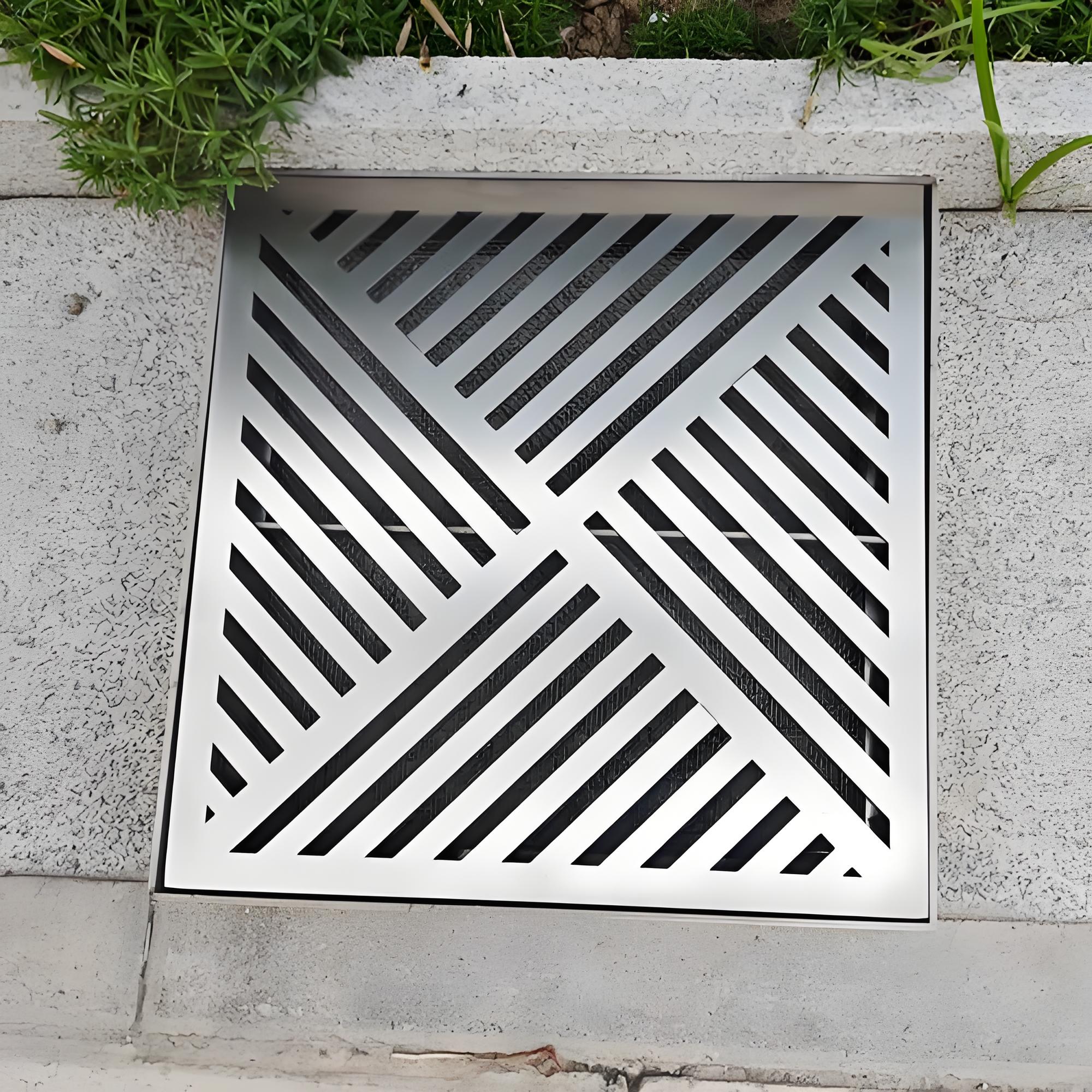
Installation details can change the real load-bearing performance of heavy duty steel bar grating more than many buyers expect. A strong panel can underperform if it is poorly fixed, insufficiently supported, or installed with the wrong orientation. This is why installation should always be treated as part of the structural selection process rather than as a separate afterthought.
Welded fixing generally provides higher load transfer capacity than grating clip fixing. When the panel is welded securely to its support, movement is minimized and the load path is more stable. This is especially useful in high-traffic lanes, machinery platforms, or impact-prone zones. By contrast, grating clips are easier for removal and maintenance, but their load restraint is usually lower and more dependent on correct installation torque and support condition.
Support spacing must also match the grating length. A common mistake is to specify a heavy-duty panel but allow support beams to be spaced too far apart. As the span increases, stress and deflection rise sharply. In many cases, reducing the span slightly can improve performance more economically than upgrading the grating to a much heavier section. Therefore, support layout and panel design must be checked together.
It is also good practice to ensure that support width is adequate and bearing contact is stable across the panel end. Uneven support or insufficient seat length can create local stress concentrations and reduce the effective performance of the grating. For removable panels, the support edge should also control uplift and lateral movement if the area is exposed to vibration or repeated wheel action.
For vehicle areas, site installation teams should always verify that the bearing bars run perpendicular to travel direction and that all supports are level before fixing. Structural selection is only fully effective when the installation follows the intended design condition.
Heavy duty steel bar grating is more expensive than ordinary industrial grating, but the price increase is not random. It mainly comes from larger bearing bars, higher steel consumption, denser spacing, more welding work, and in some cases reinforced edge or custom structural treatment. As a broad market reference, heavy-duty specifications are often about 1.5 to 3 times the price of ordinary grating used for pedestrian platforms.
For galvanized carbon steel heavy duty grating, reference factory prices may roughly range from USD 35 to USD 120 per square meter depending on bar size, spacing, coating requirement, and fabrication complexity. Very heavy custom sections for vehicle traffic or port work can go higher. For stainless steel heavy duty grating, especially 304 or 316 grades, the price can increase substantially beyond that range because of both material cost and fabrication difficulty.
An interesting cost pattern is that when bearing bar height increases, the unit weight cost does not always rise proportionally. In some cases, a taller section can improve material utilization efficiency, meaning the cost per unit load capacity may actually become more economical even though the panel looks larger. This is why experienced buyers do not compare price only by weight or only by square meter. They compare the structural efficiency delivered by each section.
Other cost factors include custom cut-outs, end plates, reinforcement ribs, tight tolerance welding, anti-slip serration, painting or galvanizing thickness, and third-party inspection requirements. If the project involves non-standard spans or special vehicle loads, the engineering review itself can also influence the quotation because more technical verification is required.
When requesting prices from Anping County Chuansen Silk Screen Products Co., Ltd., buyers usually get more useful offers if they provide the application type, required span, traffic condition, support method, environment, and any relevant load data at the beginning. This helps the factory recommend a specification that balances safety, fabrication practicality, and cost control.
What bearing bar size is recommended for forklift traffic on steel grating?
For forklift traffic, a practical starting range is usually 50mm to 65mm bearing bar height with thickness of 5mm to 6mm, often combined with 30x30mm dense spacing. The exact size depends on wheel load, axle load, support span, and fixing method. If the forklift is heavy or the span is long, a larger section may be required.
Is galvanized carbon steel stronger than stainless steel for heavy duty grating?
In many heavy-load applications, galvanized carbon steel such as Q235 offers better structural economy than 304 or 316 stainless steel. It is usually the more cost-effective choice when corrosion is moderate and high load capacity is the main target. Stainless steel may still be preferred in marine, chemical, or hygienic environments, but it often needs a larger specification to carry the same load efficiently.
How much more expensive is heavy duty bar grating than standard grating?
As a general reference, heavy duty steel bar grating is often around 1.5 to 3 times the price of ordinary pedestrian-grade grating. The difference depends on bearing bar height, thickness, spacing, galvanizing or stainless material, reinforcement details, and custom fabrication requirements. Accurate pricing should always be based on load condition and support span rather than size alone.