
Galvanized steel grating standard sizes help buyers, engineers, contractors, and distributors choose suitable grating panels for platforms, walkways, trench covers, stair treads, drainage systems, and industrial flooring. A standard size does not only mean the outside length and width of the panel. It also includes bearing bar height, bearing bar thickness, bearing bar spacing, cross bar spacing, open area, load capacity, surface type, and hot-dip galvanized finish. Understanding these size details makes it easier to compare quotations, read project drawings, reduce installation mistakes, and choose a galvanized steel grating specification that matches the actual working environment.
Galvanized steel grating standard sizes refer to commonly used dimensions and specifications for steel grating panels after hot-dip galvanizing. These sizes usually include panel width, panel length, bearing bar size, bearing bar spacing, cross bar spacing, and sometimes edge banding or surface type. In many projects, buyers ask for “standard size galvanized steel grating,” but the term can mean different things depending on the country, supplier, application, and engineering standard.
For example, one buyer may use “standard size” to describe a common stock panel size such as 1000 mm x 6000 mm. Another buyer may use it to describe a common grating specification such as 30 mm x 3 mm bearing bars with 30 mm bearing bar spacing and 100 mm cross bar spacing. A professional supplier should confirm both the panel size and the bar specification before offering a quotation.
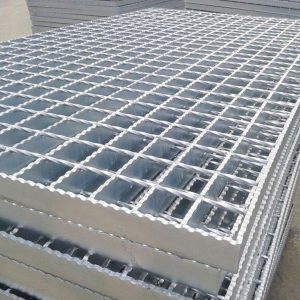
When selecting galvanized steel grating, the outside panel dimension is only one part of the specification. The real performance of the grating depends on the load-carrying bearing bars, bar spacing, span direction, cross bar arrangement, and support condition. Two panels with the same outside size can have very different load capacities if the bearing bar size or spacing is different.
| Size Item | What It Means | Why It Matters |
|---|---|---|
| Panel width | The overall width of the grating panel | Affects installation layout, handling, and support arrangement |
| Panel length | The overall length of the grating panel | Affects cutting plan, span direction, transportation, and installation |
| Bearing bar height | The vertical depth of the load-carrying flat bar | Higher bars usually provide stronger load capacity |
| Bearing bar thickness | The thickness of the flat bearing bar | Thicker bars improve strength and durability |
| Bearing bar spacing | The center-to-center distance between bearing bars | Affects load capacity, open area, walking comfort, and cost |
| Cross bar spacing | The center-to-center distance between cross bars | Affects panel stability, appearance, and structural consistency |
Galvanized steel grating can be produced in many sizes, but factories usually have commonly used stock sizes and production-friendly dimensions. These standard sizes help reduce production time, cutting waste, and cost. However, the most suitable size should still be selected according to the project drawing, support span, load requirement, and installation environment.
Many galvanized steel grating suppliers keep standard panels in stock or manufacture them regularly. Common stock panels are often produced in long rectangular sheets that can be cut into smaller panels for platforms, walkways, trench covers, and maintenance flooring.
| Common Panel Width | Common Panel Length | Typical Use |
|---|---|---|
| 500 mm | 1000 mm to 6000 mm | Narrow walkways, trench covers, small access platforms |
| 600 mm | 1000 mm to 6000 mm | Drainage covers, maintenance access, standard floor panels |
| 750 mm | 1000 mm to 6000 mm | Industrial platforms, service walkways, equipment areas |
| 900 mm | 1000 mm to 6000 mm | Platform flooring, catwalks, general grating panels |
| 1000 mm | 1000 mm to 6000 mm | Common stock panels and large-area platform flooring |
| 1200 mm | 1000 mm to 6000 mm | Large panels, warehouse stock, cutting into smaller pieces |
The sizes above are common references, but actual availability depends on each factory’s production equipment, galvanizing tank size, raw material supply, and shipping method. For export orders, container loading size and safe handling should also be considered.
For platforms and walkways, panels are often larger and arranged according to steel structure supports. For drainage trench covers, panels are usually narrower and shorter for easy removal. For stair treads, the width and length are designed according to stair structure and walking comfort.
| Application | Common Width Range | Common Length Range | Main Design Focus |
|---|---|---|---|
| Industrial platform | 600 mm to 1200 mm | 1000 mm to 6000 mm | Load capacity, span direction, installation layout |
| Walkway grating | 500 mm to 1000 mm | 1000 mm to 4000 mm | Walking safety, drainage, anti-slip surface |
| Drainage trench cover | 200 mm to 1000 mm | 500 mm to 1500 mm | Drainage opening, removable design, support ledge |
| Stair tread | 240 mm to 350 mm | 600 mm to 1200 mm | Step width, nosing, bolt holes, side plates |
| Bridge access walkway | 600 mm to 1200 mm | 1000 mm to 3000 mm | Corrosion resistance, drainage, wind and weather exposure |
The bearing bar is the main load-carrying component of galvanized steel grating. It is usually a flat steel bar placed vertically in the direction of span. The bearing bar height and thickness determine how much load the panel can carry and how far it can span between supports.
Bearing bar height is the vertical depth of the flat bar. A higher bearing bar provides better load capacity and lower deflection under the same span condition. For light pedestrian use, smaller bearing bars may be enough. For industrial platforms, heavy maintenance areas, or longer spans, deeper bearing bars are usually required.
Bearing bar thickness affects strength, durability, welding quality, and long-term service performance. Thicker bars are heavier and more expensive, but they can provide stronger load capacity and better resistance to impact or deformation. The right thickness should be selected according to load, span, traffic, and expected service life.
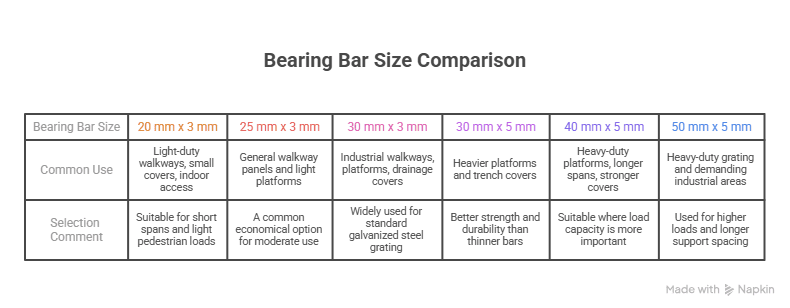
| Bearing Bar Size | Common Use | Selection Comment |
|---|---|---|
| 20 mm x 3 mm | Light-duty walkways, small covers, indoor access | Suitable for short spans and light pedestrian loads |
| 25 mm x 3 mm | General walkway panels and light platforms | A common economical option for moderate use |
| 30 mm x 3 mm | Industrial walkways, platforms, drainage covers | Widely used for standard galvanized steel grating |
| 30 mm x 5 mm | Heavier platforms and trench covers | Better strength and durability than thinner bars |
| 40 mm x 5 mm | Heavy-duty platforms, longer spans, stronger covers | Suitable where load capacity is more important |
| 50 mm x 5 mm | Heavy-duty grating and demanding industrial areas | Used for higher loads and longer support spacing |
When choosing bearing bar specifications, buyers should avoid selecting only by the lowest price. A smaller bar size may reduce cost, but it may also reduce safety and service life. On the other hand, an oversized bar may increase weight and cost unnecessarily. The best choice is the specification that meets the required load and span without excessive material use.
Cross bars connect the bearing bars and help maintain the grid structure. They are usually twisted square bars, round bars, or flat bars, depending on the grating type and factory production method. Cross bar spacing is measured from center to center between cross bars.
Common cross bar spacing includes 50 mm, 76 mm, and 100 mm. Some factories may also provide customized spacing according to project requirements. Closer cross bar spacing can improve the visual density and structural stability of the panel, but it can also increase production cost and weight.
| Cross Bar Spacing | Typical Feature | Common Application |
|---|---|---|
| 50 mm | Closer spacing and stronger grid appearance | Walkways, stair treads, areas needing tighter structure |
| 76 mm | Balanced spacing for many industrial applications | Platforms, maintenance walkways, general floor grating |
| 100 mm | Common economical spacing | Standard industrial grating, drainage covers, outdoor platforms |
| Customized spacing | Made according to drawing or special requirement | Special projects, architectural grating, heavy-duty panels |
Both bearing bar spacing and cross bar spacing are usually measured from center to center. This is important when comparing specifications from different suppliers. If one quotation uses center spacing and another uses clear opening, the two offers may not be directly comparable.
Bearing bar spacing is one of the most important factors in galvanized steel grating size selection. It affects load capacity, open area, safety, weight, appearance, and cost. The same panel size can perform very differently when bearing bar spacing changes.
Closer bearing bar spacing means more bearing bars in the same panel width. This usually increases load capacity, improves walking comfort, and reduces the risk of small objects falling through the grating. However, it also increases steel weight and price.
Wider bearing bar spacing reduces material use and increases open area. This can improve drainage, ventilation, light transmission, and cost efficiency. However, wider spacing may not be suitable for all walking areas, especially where small wheels, narrow footwear, or public access are involved.
| Bearing Bar Spacing | Open Area | Load Performance | Typical Use |
|---|---|---|---|
| 25 mm | Smaller openings | Higher load distribution and better walking comfort | Special walkways, public access, close-mesh requirements |
| 30 mm | Moderate openings | Strong and widely used | Industrial platforms, walkways, trench covers |
| 34 mm | Moderate to large openings | Common industrial performance | General galvanized steel grating panels |
| 40 mm | Larger openings | Lower material weight under same bar size | Drainage areas, light-duty platforms, economical panels |
If the project requires higher load capacity, better walking comfort, or smaller openings, closer bearing bar spacing is usually preferred. If the project mainly needs drainage, ventilation, and lower cost, wider spacing may be acceptable as long as the load requirement is met.
Cross bar spacing influences the stability and rigidity of galvanized steel grating. Although the cross bars are not usually the main load-carrying members, they keep bearing bars aligned and help maintain the panel shape during handling, installation, and service.
Closer cross bar spacing can make the grating feel more stable and reduce movement between bearing bars. This is useful for stair treads, frequent pedestrian areas, platforms where tools may be moved, and grating panels that need a more compact grid appearance.
Cross bar spacing also affects the appearance of the grating. A closer cross bar spacing creates a denser grid pattern, while wider spacing creates a more open look. For purely industrial areas, function is usually more important than appearance. For architectural or commercial areas, visual effect may also matter.
Using more cross bars increases material and welding work. Although the price impact is usually less than changing bearing bar size, it still affects total cost for large orders. Therefore, cross bar spacing should be selected based on structural need, project standard, and budget.
| Cross Bar Spacing Choice | Advantage | Possible Limitation |
|---|---|---|
| Closer spacing | Better panel stability and denser grid structure | Higher cost and more material use |
| Standard spacing | Good balance of stability, cost, and production efficiency | May not meet special close-grid requirements |
| Wider spacing | More open area and lower material use | Less dense grid and weaker lateral stability feel |
Galvanized steel grating panels are usually produced in rectangular shapes. The width and length should match the steel support structure and installation layout. In many cases, the bearing bars run along the length of the panel, but this must be confirmed because the bearing bar direction determines the main load span.
Common panel widths include 500 mm, 600 mm, 750 mm, 900 mm, 1000 mm, and 1200 mm. The best width depends on the walkway width, platform layout, support beam spacing, handling conditions, and whether the panel needs to be removable.
Common panel lengths may range from 1000 mm to 6000 mm. Longer panels can cover larger areas with fewer joints, but they are heavier and harder to handle. Shorter panels are easier to install, remove, and replace, especially for trench covers and maintenance areas.
Large galvanized steel grating panels may reduce installation joints, but they can create handling and shipping challenges. For export orders, container size, forklift access, bundle weight, galvanizing tank length, and site lifting conditions should be considered before confirming oversized panels.
| Panel Size Choice | Advantage | Best Use |
|---|---|---|
| Small panels | Easy to lift, install, remove, and replace | Trench covers, drainage channels, maintenance openings |
| Medium panels | Good balance between coverage and handling | Industrial platforms, walkways, equipment access |
| Large panels | Fewer joints and faster area coverage | Large platform floors and stock cutting |
Standard size galvanized steel grating is usually based on common production dimensions and regular specifications. Custom size galvanized steel grating is manufactured according to project drawings, special spans, irregular openings, or unique installation requirements. Both options are useful, but they are suitable for different situations.
Standard sizes are suitable when the project has simple rectangular areas or when the buyer plans to cut panels on site. They are often easier to quote, faster to produce, and more economical. Distributors may also prefer standard panels because they can keep stock and sell to different customers.
Custom sizes are better for engineering projects where panels must fit around pipes, columns, machines, handrails, tanks, drains, stair frames, or steel beams. Custom fabrication can include banding, cut-outs, notches, bolt holes, lifting holes, stair tread side plates, toe plates, and panel numbering.
| Item | Standard Size Grating | Custom Size Grating |
|---|---|---|
| Production speed | Usually faster | Needs drawing confirmation and fabrication time |
| Cost | Often more economical | May cost more because of labor and special processing |
| Fit on site | May need cutting or adjustment | Designed to match project layout |
| Best for | Stock, resale, simple platforms, general use | Industrial projects, irregular platforms, stair treads, trench covers |
| Installation efficiency | Depends on site cutting and layout | Usually faster when panel drawings are accurate |
For projects with many cut-outs or strict layout requirements, custom grating often saves time during installation. For simple areas, standard panels may provide better cost efficiency.
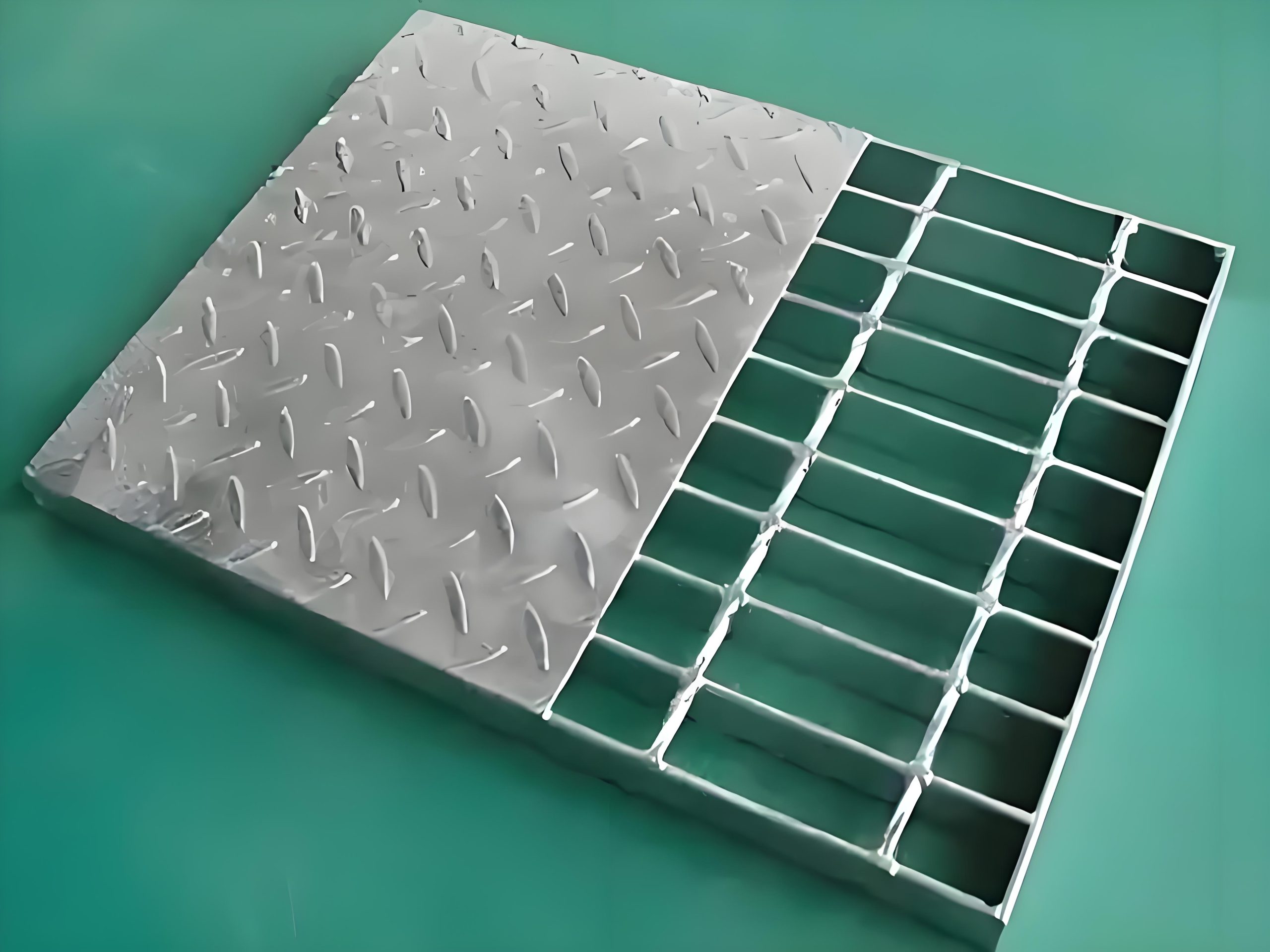
Different load ratings require different grating specifications. Light-duty grating may be suitable for pedestrian walkways, while heavy-duty grating is needed for maintenance vehicles, carts, equipment loads, or longer spans. The required size should be based on actual load conditions rather than appearance.
Light-duty grating is often used for pedestrian walkways, indoor access platforms, small drainage covers, and maintenance areas with limited loads. Smaller bearing bars and wider spacing may be acceptable if the span is short and the load is light.
Medium-duty grating is common for industrial platforms, outdoor walkways, trench covers, catwalks, and general plant flooring. It usually uses stronger bearing bars and practical spacing to balance load capacity and cost.
Heavy-duty grating uses deeper and thicker bearing bars. It is selected for areas where loads are higher, spans are longer, or maintenance equipment may pass over the grating. Heavy-duty grating may be used in loading zones, industrial floors, bridge maintenance areas, and heavy trench covers.
| Load Level | Common Bearing Bar Reference | Typical Application | Selection Focus |
|---|---|---|---|
| Light-duty | 20 x 3 mm, 25 x 3 mm | Pedestrian access, small covers, light walkways | Cost, drainage, easy handling |
| Medium-duty | 30 x 3 mm, 30 x 5 mm | Platforms, walkways, trench covers, industrial flooring | Load capacity, span, walking comfort |
| Heavy-duty | 40 x 5 mm, 50 x 5 mm or heavier | Heavy platforms, vehicle areas, equipment access | Strength, deflection control, long service life |
The table above is only a general reference. The final grating size should be checked according to actual span, support condition, load type, safety factor, and project standard.
Galvanized steel grating needs reasonable dimensional tolerance because steel can deform slightly during cutting, welding, banding, and hot-dip galvanizing. A professional factory should control panel dimensions, diagonal difference, bar spacing, flatness, and opening accuracy according to agreed requirements.
If the grating panel is too large, it may not fit into the frame or platform opening. If it is too small, it may have insufficient bearing length or create unsafe gaps. For trench covers and stair treads, tolerance control is especially important because panels need to match frames, bolts, and support ledges.
| Tolerance Item | Why It Is Important | Possible Problem If Poorly Controlled |
|---|---|---|
| Length and width | Ensures panel fits the installation opening | Difficult installation, excessive gaps, site cutting |
| Diagonal difference | Controls panel squareness | Panel may not align with frame or adjacent panels |
| Bearing bar spacing | Maintains open area and load consistency | Uneven appearance and inconsistent performance |
| Flatness | Improves walking comfort and installation stability | Rocking panels, trip risk, poor appearance |
| Cut-out accuracy | Allows panels to fit around pipes, columns, and machines | Site modification, coating damage, installation delay |
Hot-dip galvanizing can cause slight warping or zinc buildup, especially on complex panels, thin bars, or large welded structures. Good production planning helps reduce these issues. The factory should consider venting, draining, hanging points, panel size, and welding sequence before galvanizing.
Platforms and walkways are among the most common applications for galvanized steel grating. These areas need safe walking surfaces, sufficient load capacity, drainage, ventilation, and corrosion resistance. The grating size should be selected according to the platform support structure and expected load.
Industrial platforms often use medium-duty galvanized steel grating with bearing bars such as 25 x 3 mm, 30 x 3 mm, 30 x 5 mm, or 40 x 5 mm. The exact choice depends on span and load. Panel widths are commonly selected to fit between steel beams and allow convenient installation.
Walkway grating is commonly supplied in widths such as 500 mm, 600 mm, 750 mm, 900 mm, or 1000 mm. For narrow service walkways, smaller widths may be used. For main access paths, wider panels may provide better walking comfort.
For outdoor platforms, wet areas, oily environments, and inclined walkways, serrated galvanized steel grating may be selected. Serrated bearing bars improve traction and help reduce slipping risk.
| Application | Common Panel Width | Common Bearing Bar | Recommended Surface |
|---|---|---|---|
| Indoor maintenance platform | 600 mm to 1000 mm | 25 x 3 mm or 30 x 3 mm | Plain or serrated |
| Outdoor walkway | 600 mm to 1000 mm | 30 x 3 mm or 30 x 5 mm | Serrated recommended |
| Industrial catwalk | 500 mm to 900 mm | 30 x 3 mm or 30 x 5 mm | Plain or serrated according to site condition |
| Heavy maintenance platform | 750 mm to 1200 mm | 40 x 5 mm or stronger | Serrated if wet or oily |
Drainage trench covers are another major application for galvanized steel grating. They require enough open area for water flow and enough strength to support pedestrian or vehicle loads. Because trench width and support ledge design vary from project to project, custom sizes are very common.
Drainage cover width depends on the clear trench opening and support ledge. Common widths may range from 200 mm to 1000 mm. The grating must have enough bearing length on both sides of the trench to transfer load safely.
Drainage covers are often supplied in shorter panel lengths, such as 500 mm, 600 mm, 800 mm, 1000 mm, or 1200 mm. Shorter covers are easier to lift for cleaning and maintenance. Long covers may reduce the number of joints but can be heavier and harder to remove.
Pedestrian trench covers and vehicle trench covers require different grating sizes. If forklifts, carts, cars, or trucks may pass over the cover, heavier bearing bars and closer spacing may be required. The supplier should confirm actual load conditions before recommending a specification.
| Drainage Cover Type | Common Width | Common Length | Design Focus |
|---|---|---|---|
| Pedestrian drainage cover | 200 mm to 600 mm | 500 mm to 1000 mm | Easy removal, walking safety, drainage opening |
| Factory trench cover | 300 mm to 1000 mm | 600 mm to 1200 mm | Load capacity, corrosion resistance, maintenance access |
| Vehicle-access trench cover | Customized | Customized | Heavy-duty bearing bars and strong support frame |
| Municipal drainage cover | Customized | Customized | Public safety, anti-slip surface, anti-theft fixing if required |
Galvanized steel grating stair treads are used in industrial stairs, outdoor access stairs, towers, platforms, fire escape routes, and maintenance structures. Stair tread size is usually determined by stair width, step depth, nosing type, side plate design, and bolt hole position.
The walking depth of a stair tread is often in the range of 240 mm to 350 mm. The correct width should match stair design and local project requirements. Wider treads may improve walking comfort, while narrower treads may be used where space is limited.
Stair tread length often ranges from 600 mm to 1200 mm. Longer treads may need stronger bearing bars or additional support depending on stair structure. The bearing bars usually run in the direction that provides proper load support between stair stringers.
Grating stair treads usually include side plates with bolt holes for easy installation. Hole size and position should match the stair stringer design. If the bolt hole position is wrong, installation can be delayed and site drilling may damage the galvanized coating.
Stair treads often include front nosing to improve visibility and slip resistance. Serrated grating with checker plate nosing or perforated nosing is common in industrial stairs and outdoor access areas.
| Stair Tread Item | Common Size or Option | Selection Advice |
|---|---|---|
| Tread width | 240 mm, 255 mm, 275 mm, 305 mm, 325 mm or customized | Choose according to stair design and walking comfort |
| Tread length | 600 mm to 1200 mm or customized | Match the distance between stair stringers |
| Bearing bar | 25 x 3 mm, 30 x 3 mm, 30 x 5 mm or customized | Select based on tread span and load |
| Nosing | Checker plate, perforated plate, serrated nosing | Recommended for anti-slip and step edge visibility |
| Side plate | Flat side plate with bolt holes | Hole position should match stair stringers |
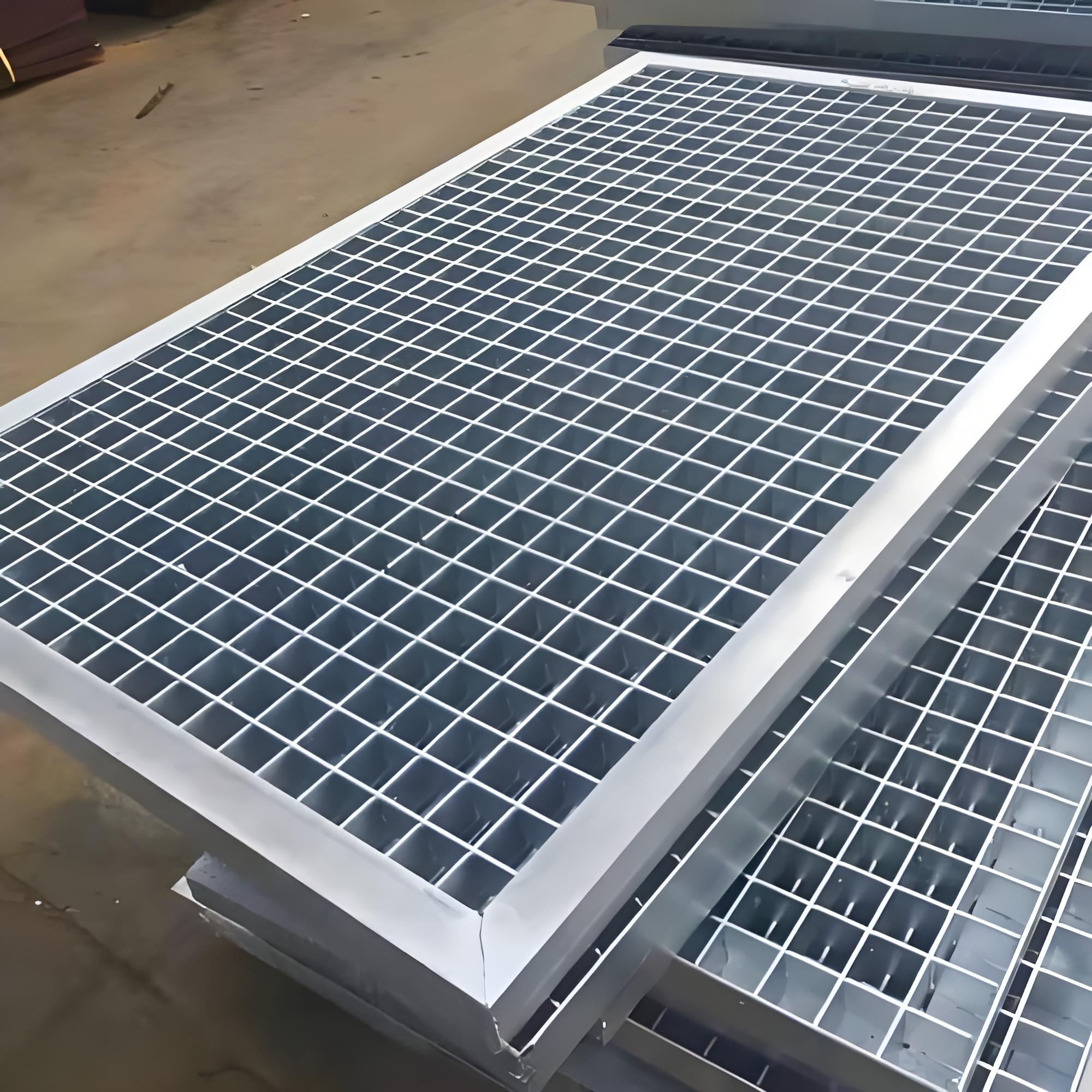
Project drawings are the best reference for selecting galvanized steel grating sizes. A proper drawing should show platform layout, support beam position, panel size, bearing bar direction, cut-outs, stair tread details, trench width, and fixing method. If the drawing is incomplete, the buyer and supplier should confirm all key details before production.
The bearing bar direction must be clearly confirmed because it determines how the load is carried. Bearing bars should span between supports. If the direction is wrong, the panel may not meet the required load capacity even if the outside size is correct.
The clear span between supports directly affects bearing bar selection. A longer span requires a stronger bearing bar. When sending an inquiry, buyers should provide the clear span, not only the panel size.
Large platform areas are usually divided into many grating panels. The layout should consider support beams, installation sequence, removable areas, expansion joints, and handling weight. Panel numbering can help installers place each panel correctly.
Industrial platforms often need openings around pipes, columns, tanks, valves, machines, and handrail posts. These cut-outs should be shown clearly on the drawing. Factory-made cut-outs are usually cleaner and better protected after galvanizing than cutting on site.
Accessories may include fixing clips, saddle clips, bolts, toe plates, kick plates, stair tread side plates, lifting holes, or frame angles. These details affect both production and installation.
| Drawing Detail | What to Confirm | Reason |
|---|---|---|
| Panel number | Each panel should have a clear mark | Helps installation and prevents confusion |
| Panel size | Length, width, and thickness direction | Ensures correct fabrication |
| Bearing bar direction | Direction of main load-carrying bars | Critical for load capacity |
| Support span | Clear distance between supporting beams | Determines bearing bar size |
| Cut-outs | Shape, size, and position of openings | Allows panels to fit around site obstacles |
| Surface treatment | Hot-dip galvanizing, painting, or stainless steel | Affects corrosion resistance and price |
The size and price of galvanized steel grating are closely connected. Larger panels, thicker bearing bars, closer spacing, heavier load requirements, custom fabrication, and hot-dip galvanizing quality all affect the final cost. Buyers should compare quotations based on complete specifications instead of only price per square meter.
Larger panels cover more area but may be heavier, harder to galvanize, harder to transport, and more difficult to install. Smaller panels are easier to handle and remove, but they may need more fixing clips and more installation time.
Bearing bar height and thickness have a major effect on weight and price. Heavier bearing bars increase load capacity but also increase steel consumption and galvanizing cost.
Closer spacing means more bars in each panel. This increases strength, walking comfort, and material cost. Wider spacing reduces weight and cost but may not be suitable for every project.
Plain galvanized grating is usually more economical than serrated galvanized grating. Serrated grating requires additional processing but provides better slip resistance in wet, oily, or outdoor areas.
Custom sizes, cut-outs, edge banding, stair tread side plates, nosing, lifting holes, and special markings increase labor cost. However, custom fabrication can reduce site cutting and improve installation efficiency.
Galvanizing cost is influenced by panel weight, surface area, zinc consumption, coating requirement, and local galvanizing conditions. Good galvanizing improves service life, especially for outdoor and humid environments.
| Price Factor | How It Affects Cost | Buyer Advice |
|---|---|---|
| Panel dimensions | Larger panels use more material and may increase handling cost | Choose sizes that balance coverage and installation convenience |
| Bearing bar size | Deeper and thicker bars increase weight and price | Select according to span and load, not only budget |
| Bar spacing | Closer spacing increases steel quantity | Use closer spacing where load or walking comfort requires it |
| Surface type | Serrated surface costs more than plain surface | Use serrated grating for wet, oily, or outdoor areas |
| Custom processing | Cut-outs, holes, and special shapes increase labor | Provide accurate drawings to reduce rework |
| Galvanizing | Coating cost depends on weight and surface area | Do not reduce coating quality for outdoor projects |
For buyers, the most practical way to control cost is to provide complete project information at the beginning. This includes panel quantity, panel size, bearing bar direction, clear span, load requirement, material, surface treatment, cut-out details, and installation method. With these details, the supplier can recommend a suitable galvanized steel grating size instead of over-designing or under-designing the product.
What is the standard size of galvanized steel grating?
The standard size of galvanized steel grating depends on the supplier and application. Common panel widths include 600 mm, 900 mm, 1000 mm, and 1200 mm, while common lengths can range from 1000 mm to 6000 mm. Standard specifications also include bearing bar size, bearing bar spacing, and cross bar spacing, not only panel length and width.
What is the common bearing bar spacing for steel grating?
Common bearing bar spacing for steel grating includes 30 mm, 34 mm, and 40 mm center to center. Closer spacing usually provides better load distribution and walking comfort, while wider spacing offers larger open area and lower material cost. The best spacing should be selected according to load, span, safety requirement, and application.
Can galvanized steel grating be made to custom sizes?
Yes, galvanized steel grating can be made to custom sizes. Factories can produce panels according to project drawings, including special lengths, widths, cut-outs, notches, stair treads, trench covers, bolt holes, edge banding, and panel numbers. Custom sizes are especially useful for industrial platforms, drainage channels, stairs, and areas with pipes or columns.
