
Painted steel bar grating is a practical grating solution for indoor platforms, equipment access areas, stair treads, safety-marked zones, and projects where color identification is part of the engineering requirement. As a painted steel bar grating supplier, Anping County Chuansen Silk Screen Products Co., Ltd. produces carbon steel and high-strength steel grating panels with controlled welding, surface preparation, primer application, finish coating, drying, inspection, and protective packing. Compared with hot-dip galvanized grating, painted steel bar grating offers lower surface treatment cost, faster finishing speed, easier color customization, and convenient field repair, while its corrosion resistance must be matched correctly with the working environment.
Painted steel bar grating is widely used in indoor industrial platforms where moisture, chemical exposure, and outdoor weathering are limited. Typical areas include maintenance platforms, mezzanine floors, machine access walkways, equipment guards, service corridors, and interior stair tread systems. In these spaces, painted carbon steel grating provides sufficient surface protection while keeping the structure economical and visually organized.
Equipment enclosures and machinery protection areas also use painted grating because color can support functional zoning. Black, grey, yellow, red, blue, and green finishes can separate access routes, inspection zones, safety barriers, and restricted areas. Color-coded grating is especially useful in factories where walking surfaces, machine platforms, and access covers need to be identified quickly.
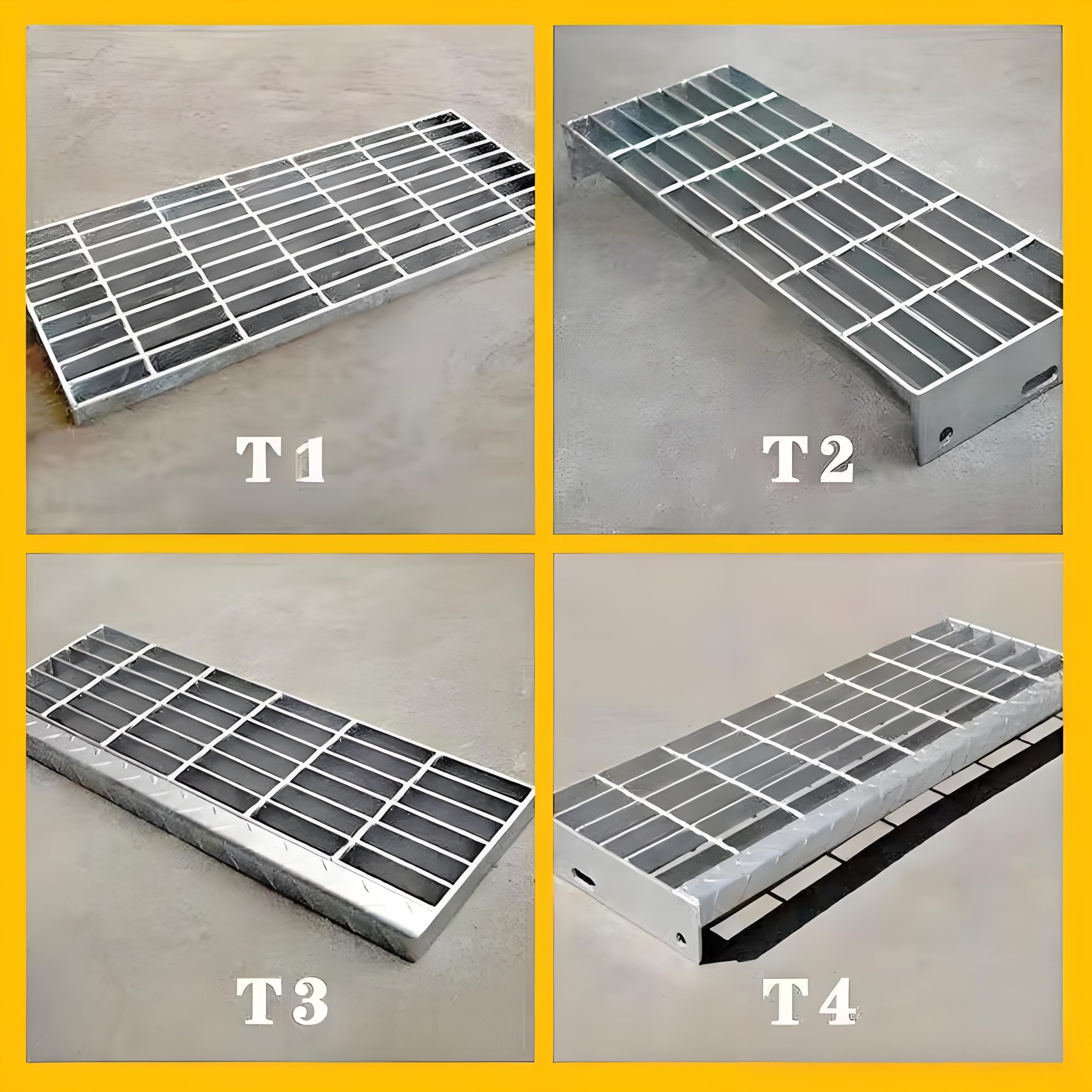
Painted steel stair treads are used in workshops, warehouses, process buildings, and equipment rooms. Serrated painted stair treads can improve foot traction, while bright front nosing colors can increase step visibility. In some projects, yellow or red painted nosing is applied to highlight stair edges, platform openings, or transition areas.
Painted grating is also suitable for projects sensitive to hot-dip galvanizing cost. The painting process generally requires lower surface treatment cost than galvanizing, especially for indoor or short-to-medium service life structures. When the project schedule is tight, painting can also shorten finishing time because grating panels do not need to wait for galvanizing bath scheduling.
Another practical application is temporary industrial flooring. Construction platforms, maintenance access panels, removable walkways, and temporary trench covers may not require the long corrosion life of hot-dip galvanizing. Painted grating offers an economical finish where the service period is controlled and repainting is acceptable.
The paint system used on steel bar grating should match the exposure environment, required service life, surface preparation level, and visual requirement. Different paint systems provide different combinations of cost, adhesion, corrosion protection, weather resistance, and color stability.
Alkyd anti-rust paint is a common option for dry indoor conditions. It has simple application requirements, acceptable rust prevention performance, and relatively low cost. Alkyd coatings are suitable for general indoor platforms, warehouse walkways, equipment maintenance flooring, and non-corrosive workshop areas. Its limitation is weaker chemical resistance and lower long-term performance in wet or outdoor environments.
Epoxy zinc-rich primer combined with a finish coat provides stronger adhesion and improved corrosion resistance. The zinc-rich primer creates a protective base layer, while the finish coat improves appearance and environmental resistance. This coating system is more suitable for humid industrial buildings, equipment platforms, utility rooms, and steel grating that may experience occasional moisture or cleaning.
Acrylic and polyurethane finish coats are used where color retention, weather resistance, and surface appearance are more important. Polyurethane topcoats are stronger in outdoor exposure than ordinary alkyd paint and can provide better resistance to ultraviolet light and atmospheric aging. Acrylic finishes also support color customization and relatively stable appearance for light-duty exterior or semi-outdoor use.
| Paint System | Main Property | Suitable Area |
| Alkyd anti-rust paint | Economical and easy to apply | Dry indoor platforms and equipment areas |
| Epoxy zinc-rich primer with acrylic or polyurethane topcoat | Better adhesion, corrosion resistance, and color durability | Humid indoor, semi-outdoor, and color-coded industrial zones |
For dry indoor areas, one anti-rust primer plus one finish coat can meet many ordinary requirements. For humid indoor or semi-outdoor areas, epoxy primer with acrylic or polyurethane finish is more stable. For outdoor industrial environments with long-term rain, salt, or chemical exposure, painted grating should be evaluated carefully because hot-dip galvanized or duplex-coated grating may provide longer corrosion life.
The performance of painted steel bar grating depends heavily on surface preparation. Steel grating has many welded intersections, bearing bar edges, cross bar contact points, and cut surfaces. These areas must be cleaned correctly before coating, otherwise paint adhesion may become weak and corrosion may start from welds or edges.
For projects following American coating practice, abrasive blasting is commonly specified according to SSPC-SP10 or NACE No. 2 near-white metal blast cleaning. In international project documents, this preparation level is often aligned with Sa 2.5 blasting cleanliness. The purpose is to remove mill scale, rust, oil contamination, welding residue, and loose surface material before primer application.
Shot blasting or sand blasting creates a clean and roughened steel surface. The surface profile helps the primer form mechanical adhesion with the steel substrate. For painted steel bar grating, blasting must cover the upper surface, lower surface, side edges, and welded cross points as completely as possible. Poor cleaning inside bar intersections can reduce coating life.
After surface preparation, primer spraying is carried out according to the selected coating system. The dry film thickness must meet the specified requirement after curing, not only the wet application thickness during spraying. Primer coverage should be continuous across bearing bars, cross bars, welded joints, cut ends, and edge banding areas.
Finish coat spraying follows primer drying. The finish coat provides final color, appearance uniformity, and additional protection. Good coating quality means the color is even, the surface has no obvious sagging, no missed areas, no heavy paint accumulation at corners, and no exposed substrate. Grating panels require careful spraying angles because the open grid structure can hide uncoated inner surfaces.
Drying and curing can be completed by natural air drying or drying-room treatment depending on paint type, workshop conditions, and delivery schedule. Forced drying helps stabilize coating before packing, but temperature must match the coating manufacturer’s technical requirement. Packing painted grating too early may leave pressure marks, sticking points, or surface damage.
Painted steel bar grating provides wider color flexibility than hot-dip galvanized grating. Color customization is one of the main reasons industrial projects select painted grating for indoor and safety-related areas. Colors can be selected according to RAL codes, industrial color standards, project drawings, or supplied color samples.
Common RAL colors include RAL 1007 yellow, RAL 3000 red, RAL 5010 blue, and RAL 9005 black. Yellow is frequently used for warning zones, stair edges, safe passage marking, and equipment access areas. Red may be used for restricted zones or emergency-related identification. Blue can be used for equipment platforms or production line classification. Black is widely used where a neutral industrial appearance is required.
Industrial standard colors such as B03 medium grey, G03 bright green, and silver grey are also used in workshops, manufacturing plants, and machinery areas. Medium grey is practical for general industrial flooring because it hides dust better than light colors while still maintaining a clean appearance. Bright green can be used for pedestrian passages or designated safe zones. Silver grey is used where a metallic or lighter industrial finish is required.
| Color Option | Common Code | Typical Use |
| Yellow, red, blue, black | RAL 1007, RAL 3000, RAL 5010, RAL 9005 | Safety marking, equipment zones, stair treads, platforms |
| Medium grey, bright green, silver grey | B03, G03, industrial silver grey | Workshop flooring, passage areas, machinery platforms |
Color samples can be matched before production when a project requires strict visual consistency. RAL codes are more efficient for production confirmation because they reduce color interpretation differences. For replacement grating panels used in existing facilities, a physical sample may provide better matching when the original paint has aged or faded.
The base structure of painted steel bar grating is usually the same as standard welded steel grating. The difference lies in surface finishing rather than the basic grid configuration. Bearing bar size, cross bar spacing, panel length, panel width, edge banding, serrated surface, and load span must still be designed according to the intended use.
Common bearing flat bar sizes range from 25×3 mm to 75×6 mm. Smaller bearing bars are suitable for light-duty platforms, indoor walkways, and trench covers with shorter spans. Larger bearing bars are used for wider spans, higher loading requirements, or heavy-duty industrial structures. The bearing bar direction must align with the main support span because the bearing bar carries the primary load.
Common mesh spacing includes 30×100 mm, 40×100 mm, and 60×100 mm. A 30×100 mm grid provides denser bearing bar arrangement and stronger walking comfort. A 40×100 mm grid is widely used in general industrial structures. A 60×100 mm grid may be used where reduced weight, larger open area, or lower loading demand is acceptable.
Base materials include Q235B carbon steel and Q355B high-strength steel. Q235B is suitable for most ordinary industrial grating applications. Q355B provides higher yield strength and can be selected for heavier loads, longer spans, or structural designs requiring improved mechanical performance.
| Item | Common Range | Application Meaning |
| Bearing flat bar | 25×3 mm to 75×6 mm | Controls load capacity and span suitability |
| Grid spacing and base material | 30×100, 40×100, 60×100 mm; Q235B or Q355B | Controls open area, weight, strength, and project compatibility |
Surface forms include plain type and serrated anti-slip type. Plain painted grating is suitable for ordinary walking surfaces and equipment platforms. Serrated painted grating is used in wet, oily, dusty, or sloped areas where additional grip is required. The serrated profile should be formed before coating to avoid damaging the paint after finishing.
Painted steel bar grating and hot-dip galvanized steel bar grating serve different engineering priorities. Painted grating provides lower initial surface treatment cost, flexible color selection, and easier on-site repair. Hot-dip galvanized grating provides much longer corrosion protection in outdoor and harsh environments but has limited color appearance unless additional coating is applied after galvanizing.
From a cost perspective, painting is usually lower than hot-dip galvanizing. The process is simpler, coating material consumption is easier to control, and finishing can be completed quickly inside the painting workshop. This makes painted grating suitable for indoor and low-corrosion applications where long zinc protection is not necessary.
From a corrosion life perspective, painted steel grating generally provides about 3 to 8 years of protection depending on environment, coating system, film thickness, surface preparation, and maintenance. Hot-dip galvanized grating may reach about 20 to 50 years in suitable environments, especially where zinc thickness is sufficient and atmospheric corrosion is moderate. In aggressive coastal or chemical areas, actual service life should be reviewed according to exposure severity.
Maintenance is one practical advantage of painted grating. Scratches, installation damage, and cut edges can be repaired on site by cleaning the affected area and applying compatible primer and topcoat. Galvanized grating can also be repaired with zinc-rich paint, but the color and coating structure are not the same as the original galvanized layer.
Appearance flexibility is stronger with painted grating. Any RAL color or industrial standard color can be used, making it practical for safety identification, production line classification, equipment marking, and architectural coordination. Hot-dip galvanizing normally has a silver-grey metallic appearance, with color variation caused by steel chemistry, cooling rate, and zinc layer formation.
| Comparison Item | Painted Steel Bar Grating | Hot-dip Galvanized Steel Bar Grating |
| Cost, color, and repair | Lower cost, flexible color, easy repainting | Higher initial treatment cost, silver-grey appearance, zinc repair required |
| Corrosion life | About 3 to 8 years depending on environment | About 20 to 50 years depending on environment |
Painted steel bar grating quality control begins before coating. Rust, mill scale, oil, welding spatter, dust, and moisture must be removed because coatings cannot compensate for poor substrate preparation. Surface preparation should be no lower than Sa 2.5 for projects requiring strong adhesion and corrosion protection.
Dry film thickness is a measurable quality index. For indoor painted grating, the total dry film thickness of primer and finish coat should generally be no less than 80 μm. For outdoor or semi-outdoor painted grating, the total dry film thickness should generally be no less than 120 μm. Thicker coating may be specified for stronger corrosion resistance, but excessive coating can also create runs, blocked openings, and uneven finish around intersections.
Adhesion testing can be performed by cross-cut method according to common coating inspection practice. The test checks whether the coating film adheres firmly to the blasted steel surface after curing. Poor adhesion may result from insufficient blasting, contaminated surface, incorrect drying interval, incompatible coating layers, or excessive moisture during application.
Final inspection before shipment covers appearance and coating integrity. The paint surface should have no obvious peeling, blistering, exposed base metal, missed spraying, heavy sagging, or mechanical damage. Edges, welded joints, cross bar intersections, and cut openings require extra attention because these areas are more difficult to coat evenly.
Packing inspection is also part of paint quality control. Painted grating panels should not rub directly against each other during transportation. Separating materials, bubble film, felt blanket, or protective wrapping can reduce friction marks and impact damage. Heavy bundles must be stacked in a way that avoids concentrated pressure on freshly painted surfaces.
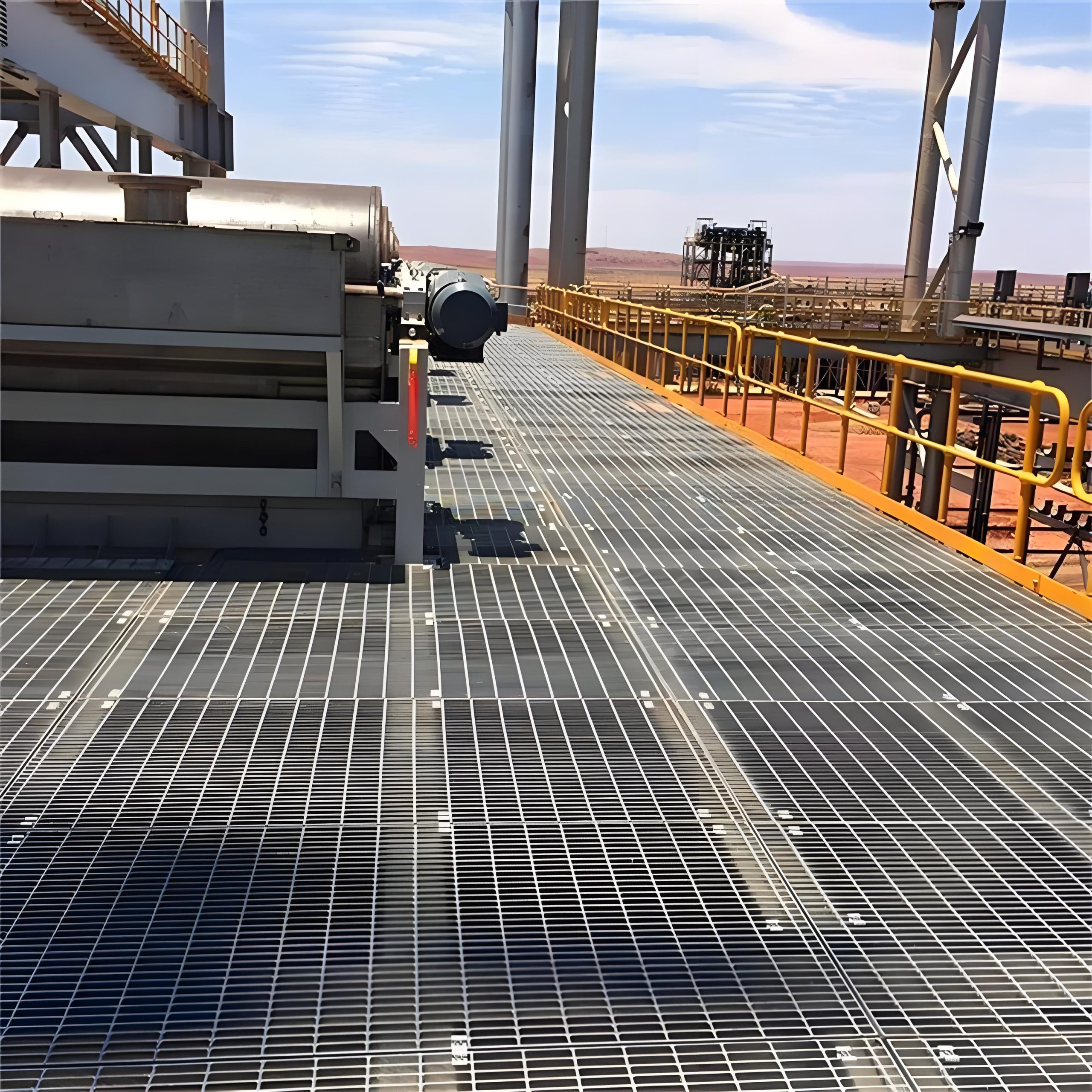
Anping County Chuansen Silk Screen Products Co., Ltd. supplies painted steel bar grating directly from production, including welding, cutting, edge banding, surface preparation, coating, inspection, and packaging coordination. Direct production control allows coating requirements and grating specifications to be handled within one workflow instead of separating structural fabrication from surface finishing decisions.
Small-batch customization is accepted for painted grating because many color-coded projects require limited quantities for specific areas. Replacement panels, stair tread batches, machine platform sections, and safety-marked trench covers may not require full-container production volume. Flexible production arrangement allows standard and custom painted panels to be processed according to actual project scope.
Regular colors such as medium grey and black are easier to arrange because these colors are frequently used for industrial platforms, equipment floors, and workshop areas. When stock paint and regular raw materials are available, production can move faster through fabrication and coating stages. Special RAL colors require color confirmation before coating to avoid mismatch after production.
The typical production time for painted steel bar grating is about 5 to 10 days including the coating process. Standard specifications can be completed faster than complex custom panels. Non-standard openings, serrated bars, edge banding, special color matching, and strict coating thickness requirements may extend the process because additional fabrication and inspection steps are required.
Packaging protection is more demanding for painted grating than for galvanized grating because the coating surface can be scratched during handling. Bubble film, felt blanket wrapping, corner protection, pallet fixing, and careful bundle separation are used to reduce damage before delivery. Painted surfaces should be fully dry before packing to prevent sticking between panels.
Accurate quotation for painted steel bar grating requires both structural information and coating information. The basic panel size should include length and width, or a drawing showing platform layout, trench dimensions, stair tread dimensions, openings, and edge requirements. Drawings are more reliable than text dimensions when panels include irregular shapes or installation holes.
The bearing flat bar size and mesh spacing should be specified clearly. A description such as 30×3 mm flat bar with 30×100 mm spacing gives the factory enough information to calculate weight, material consumption, welding layout, and coating area. For load-bearing structures, span direction and support distance should also be provided.
Color information should include RAL color code, industrial color name, or a physical color sample. Application environment should be identified as indoor, outdoor, humid indoor, semi-outdoor, chemical exposure, or general dry workshop use. This information helps match alkyd paint, epoxy primer, acrylic finish, polyurethane finish, or other coating combinations.
Quantity and edge banding requirements also affect production. Edge-banded panels require additional flat bar welding around the panel perimeter. Stair treads may require side plates, bolt holes, front nosing, and serrated bearing bars. Mounting clips, fasteners, kick plates, and protective packing should be listed together when they are part of the project delivery.
A complete requirement list should include panel dimensions, material grade, bearing bar size, grid spacing, surface type, color code, paint system if specified, application environment, quantity, edge banding, accessories, drawings, packing method, and delivery schedule. With these details, the painted steel bar grating can be quoted and scheduled with fewer production revisions.
Is painted steel bar grating suitable for outdoor use?
Painted steel bar grating can be used outdoors when the coating system is designed for outdoor exposure, such as epoxy primer with polyurethane finish. For long-term outdoor corrosion resistance, hot-dip galvanized grating usually provides longer protection.
What is the normal coating thickness for painted steel grating?
Indoor painted grating generally uses a total dry film thickness of at least 80 μm. Outdoor or semi-outdoor painted grating generally uses at least 120 μm, depending on the required protection level.
Can painted steel bar grating be repaired after installation?
Yes. Damaged areas can be cleaned and repainted with compatible primer and finish coat. This makes painted grating convenient for maintenance areas where surface scratches may occur during installation or equipment movement.
Which colors are commonly used for painted steel bar grating?
Common colors include RAL 1007 yellow, RAL 3000 red, RAL 5010 blue, RAL 9005 black, B03 medium grey, G03 bright green, and silver grey. Custom colors can be produced according to RAL code or supplied color sample.
What base materials are used for painted steel bar grating?
Q235B carbon steel is commonly used for general platforms and walkways. Q355B high-strength steel is used when higher load capacity or improved structural strength is required.
What surface preparation is required before painting?
Shot blasting or sand blasting to Sa 2.5 cleanliness is recommended for stronger coating adhesion. The surface should be free from rust, mill scale, oil, dust, and loose contamination before primer spraying.
