
Walkway steel grating factories manufacture metal grating panels used for safe pedestrian access, industrial maintenance platforms, equipment walkways, stair treads, trench covers, drainage areas, and bridge service zones. A reliable factory does more than cut steel to size. It needs to understand load requirements, span direction, bearing bar selection, surface treatment, anti-slip performance, installation conditions, and export packaging. For buyers, contractors, engineering companies, and distributors, choosing the right walkway steel grating factory helps reduce installation problems, improve site safety, and control long-term maintenance costs.
Walkway steel grating factories mainly focus on producing grating panels that combine strength, drainage, ventilation, slip resistance, and easy installation. Unlike decorative mesh or ordinary welded wire panels, walkway steel grating is designed to carry pedestrian loads, maintenance traffic, carts, small equipment, and in some cases heavier industrial loads. The product is widely used in factories, power plants, chemical plants, oil and gas facilities, water treatment plants, municipal projects, bridge walkways, shipyards, and drainage systems.
A professional walkway steel grating factory usually serves several types of customers. Some buyers need standard panels for stock and resale. Some need customized grating according to project drawings. Some need large-volume supply for platforms, stairs, trench covers, and maintenance walkways. Therefore, a factory must be able to handle both regular specifications and engineering-based customization.
In most industrial projects, walkway grating is not selected only by appearance. The factory must consider the required load, clear span, support method, surface condition, corrosion environment, opening size, installation direction, and whether the grating needs toe plates, kick plates, stair nosing, clamps, or cut-outs around pipes and equipment.
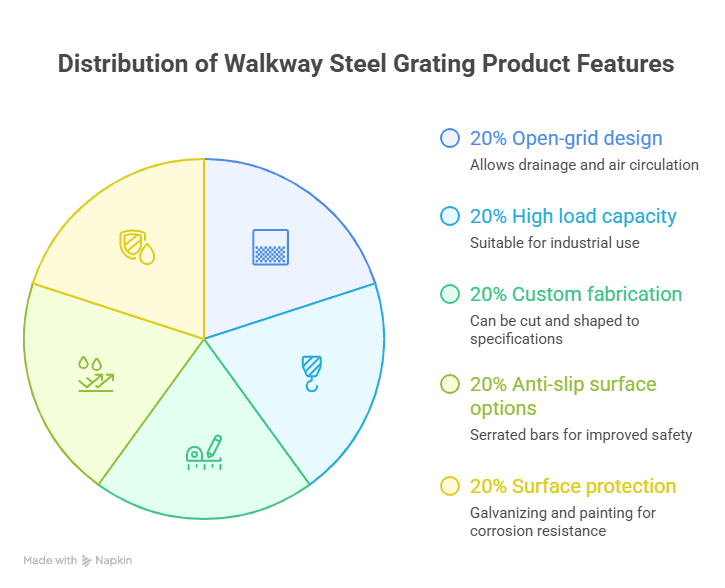
Walkway steel grating has several practical features that make it suitable for demanding working environments. The open-grid structure allows water, dust, snow, oil, and debris to pass through the panel, helping reduce accumulation on walking surfaces. The steel bearing bars provide strength in the load direction, while cross bars keep the panel stable and maintain spacing. When serrated bearing bars are used, the grating offers better slip resistance in wet, oily, or outdoor areas.
| Product Feature | Practical Value for Walkway Projects |
|---|---|
| Open-grid design | Allows drainage, air circulation, light passage, and debris fall-through |
| High load capacity | Suitable for industrial platforms, walkways, stairs, and maintenance areas |
| Custom fabrication | Can be cut, framed, notched, and shaped according to drawings |
| Anti-slip surface options | Serrated bars and special surfaces improve walking safety |
| Surface protection | Hot-dip galvanizing, painting, or stainless steel material improves corrosion resistance |
| Easy installation | Panels can be installed with clips, welding, bolts, or frame systems |
Walkway steel grating can be manufactured in several structural forms. Different types are selected according to load requirement, project budget, installation method, appearance preference, and service environment. A factory should clearly explain the difference between each type, because the wrong structure may cause unnecessary cost or insufficient performance.
Welded steel bar grating is one of the most common types used for industrial walkways. It is made by welding cross bars to bearing bars under pressure or through resistance welding. The structure is strong, stable, and suitable for platforms, stair treads, trench covers, catwalks, and factory floors.
This type is often chosen because it offers a good balance between strength, cost, production efficiency, and availability. For many walkway projects, welded steel grating is the standard solution, especially when carbon steel with hot-dip galvanizing is required.
Press-locked steel grating is produced by pressing cross bars into bearing bars through slots or high-pressure locking. It has a neat appearance and tighter dimensional control. Because of its cleaner surface and uniform look, press-locked grating is often used in areas where both function and appearance matter, such as public walkways, architectural platforms, commercial access areas, and certain municipal projects.
Serrated steel grating uses bearing bars with notched or toothed edges. The serrations improve traction and reduce slipping risks. This structure is commonly used in outdoor walkways, wet areas, oily platforms, drainage zones, shipyards, chemical plants, and wastewater treatment facilities.
Heavy-duty grating uses thicker and deeper bearing bars. It is suitable for areas with higher loads, longer spans, vehicle access, heavy carts, or equipment maintenance traffic. Although many walkway areas only carry pedestrian loads, some industrial sites require stronger panels because workers may move tools, spare parts, pumps, valves, or small machinery across the platform.
Walkway steel grating factories often produce stair treads together with platform panels. Stair treads can include side plates, bolt holes, and anti-slip nosing. They are widely used in industrial stairs, outdoor access stairs, steel structure platforms, and equipment maintenance systems.
| Grating Type | Main Advantage | Common Use |
|---|---|---|
| Welded steel grating | Strong, economical, widely available | Industrial platforms, walkways, trench covers |
| Press-locked grating | Clean appearance and tight structure | Architectural walkways, public platforms, commercial areas |
| Serrated grating | Better slip resistance | Wet, oily, outdoor, and high-risk walking areas |
| Heavy-duty grating | Higher load capacity | Maintenance platforms, vehicle areas, heavy industrial sites |
| Stair tread grating | Safe access for stairs | Steel stairs, tower stairs, equipment access |
The raw material has a direct influence on the strength, corrosion resistance, service life, and price of walkway steel grating. Professional walkway steel grating factories usually offer carbon steel, galvanized steel, stainless steel, and sometimes aluminum grating depending on project conditions. For industrial and construction use, carbon steel with hot-dip galvanizing remains one of the most widely used options because it provides good strength and cost performance.
Carbon steel is commonly used for welded walkway grating. It is strong, cost-effective, easy to fabricate, and suitable for hot-dip galvanizing. For most industrial platforms, drainage covers, factory walkways, and maintenance areas, carbon steel is the first option when the environment is not extremely corrosive or when galvanizing can provide enough protection.
Stainless steel walkway grating is often used in corrosive, hygienic, marine, food processing, chemical, and pharmaceutical environments. Common grades include 304 and 316. Stainless steel 304 provides good general corrosion resistance, while 316 offers better resistance in chloride, marine, and chemical environments. Although stainless steel costs more than carbon steel, it may reduce maintenance and replacement costs in harsh environments.
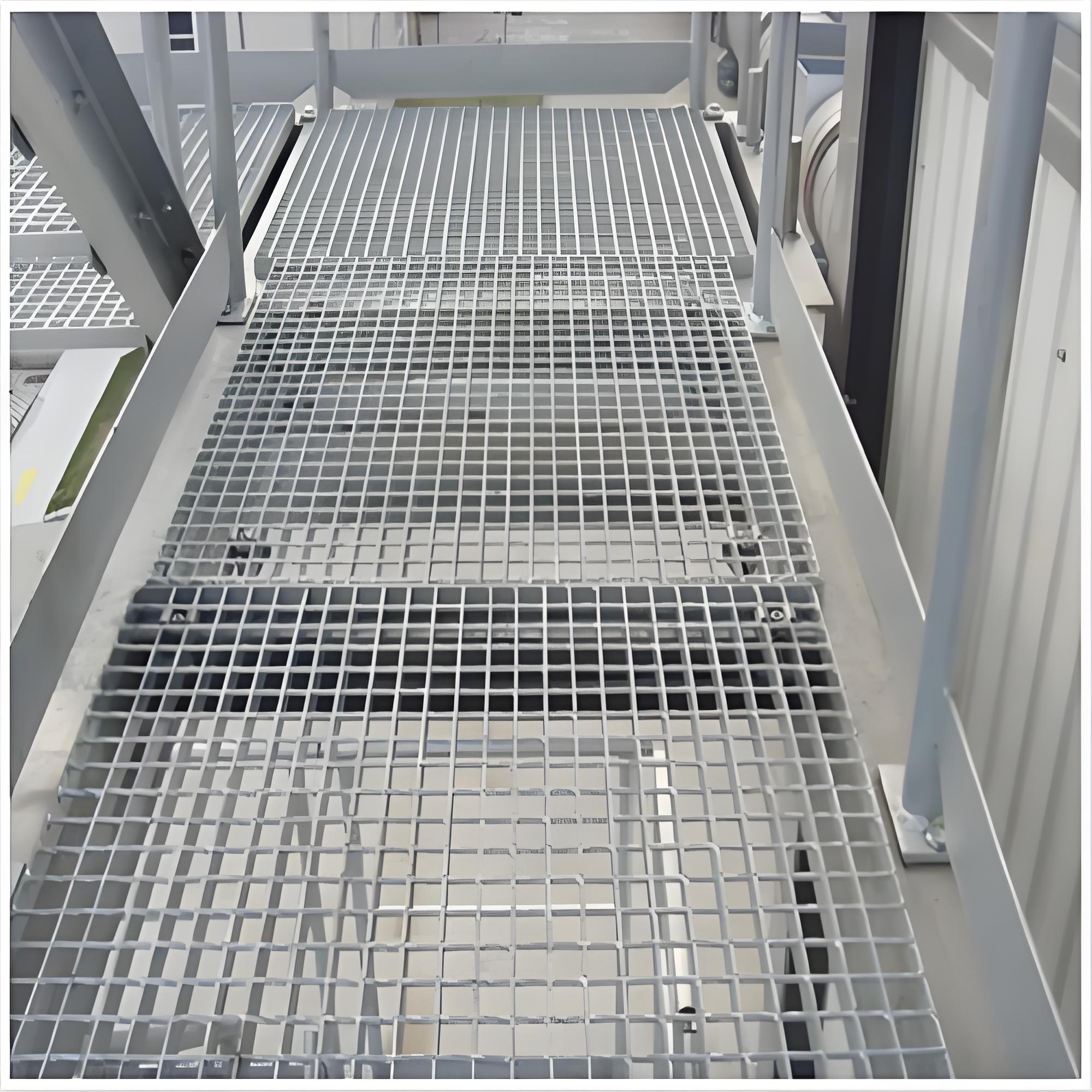
Galvanized steel grating usually refers to carbon steel grating that has been hot-dip galvanized after fabrication. The zinc coating protects the steel from corrosion and is suitable for outdoor walkways, municipal drainage areas, bridge access, industrial plants, and humid environments. For many buyers, hot-dip galvanized walkway grating provides a practical balance between price and durability.
Some factories may also supply aluminum walkway grating for projects requiring lightweight panels and good corrosion resistance. Aluminum is easier to handle and suitable for certain marine, rooftop, architectural, and wastewater projects. However, its load capacity and cost must be evaluated carefully against project requirements.
| Material | Typical Advantage | Suitable Environment | Cost Level |
|---|---|---|---|
| Carbon steel | High strength and economical price | Indoor industrial platforms and general walkway areas | Low to medium |
| Hot-dip galvanized steel | Good corrosion protection with strong base material | Outdoor walkways, drainage covers, municipal and industrial projects | Medium |
| Stainless steel 304 | Good corrosion resistance and clean surface | Food processing, clean areas, light chemical environments | High |
| Stainless steel 316 | Better chloride and marine corrosion resistance | Marine, coastal, chemical, and high-corrosion areas | Higher |
| Aluminum | Lightweight and corrosion resistant | Rooftop access, marine walkways, lightweight structures | Medium to high |
Load capacity is one of the most important factors when selecting walkway steel grating. A grating panel may look strong, but its actual performance depends on bearing bar height, bearing bar thickness, bearing bar spacing, cross bar spacing, clear span, steel grade, support direction, and installation method. Walkway steel grating factories must help buyers match the correct specification to the project load instead of only quoting the cheapest panel.
The bearing bars are the main load-carrying members of steel grating. During installation, the bearing bars must span between supports. If the panel is installed in the wrong direction, the load capacity can be greatly reduced. A responsible factory will mark the bearing bar direction on drawings, packing lists, or panel tags when required.
Clear span means the unsupported distance between structural supports. The longer the span, the stronger the bearing bars must be. A grating panel suitable for a short trench cover may not be suitable for a long platform span. For walkway use, factories normally evaluate pedestrian load, maintenance load, deflection requirements, and safety margin before recommending a specification.
For ordinary pedestrian walkways, engineers usually focus on comfortable walking performance, limited deflection, and safe load capacity. For industrial walkways, additional consideration may be needed for tool carts, equipment parts, temporary loads, and workers carrying heavy components. In maintenance platforms, the grating may need to support concentrated loads instead of only uniform loads.
| Design Factor | Why It Matters | Factory Recommendation |
|---|---|---|
| Bearing bar size | Controls the main strength of the panel | Select height and thickness according to span and load |
| Bearing bar spacing | Affects load capacity, opening size, and walking comfort | Use closer spacing for higher loads or better walking feel |
| Cross bar spacing | Maintains panel stability and grid shape | Choose according to standard specification or project drawing |
| Support condition | Impacts real load transfer during use | Ensure adequate bearing length on each support |
| Deflection limit | Affects walking comfort and long-term safety | Confirm acceptable deflection before production |
Walkway grating is often installed in areas where water, rain, oil, mud, dust, snow, or industrial residue may appear. Anti-slip performance is therefore an important part of walkway steel grating design. Factories can improve walking safety through material selection, bar profile, surface pattern, serrated edges, stair nosing, and correct installation.
Plain surface grating uses smooth bearing bars. It is suitable for dry indoor platforms, general factory walkways, equipment access areas, and locations where slip risk is relatively low. Plain grating is also easier to clean and may be preferred when heavy anti-slip serrations are not necessary.
Serrated walkway grating has toothed bearing bars that improve friction between footwear and the walking surface. It is often recommended for outdoor platforms, wet areas, chemical plants, water treatment plants, drainage areas, shipyards, and industrial facilities where liquids may be present.
For grating stair treads, anti-slip nosing can be added to the front edge. Nosing helps define the step edge and improves traction when workers go up or down stairs. It can be made from checker plate, perforated plate, abrasive nosing, or other anti-slip materials depending on project requirements.
The spacing of bearing bars also affects walking comfort. Wider openings allow better drainage and lower weight, but they may not be comfortable for small wheels, narrow footwear, or certain public access areas. In some projects, close-mesh grating is preferred to reduce the risk of objects falling through the walkway.
Surface treatment protects walkway steel grating from corrosion and improves its service life. The correct surface treatment depends on the installation environment, expected lifespan, budget, and appearance requirement. Walkway steel grating factories should provide practical recommendations instead of using the same treatment for every project.
Hot-dip galvanizing is one of the most common surface treatments for carbon steel walkway grating. After fabrication, the grating panel is dipped into molten zinc to form a protective coating. This coating protects the steel from rust and is suitable for outdoor, humid, municipal, and industrial environments.
Hot-dip galvanized walkway grating is widely used because it combines strong mechanical performance with good corrosion resistance. It is especially common for platforms, drainage covers, bridges, stairs, catwalks, and plant walkways.
Painting is often used when a specific color is required or when the grating is installed indoors. It can improve appearance and provide basic corrosion protection. However, painted surfaces may be easier to scratch during handling, installation, or long-term use. For outdoor or highly corrosive environments, painting alone may not provide the same durability as hot-dip galvanizing or stainless steel.
Powder coating offers a more uniform surface than ordinary painting and is often used for architectural or commercial projects where appearance matters. It can be applied in different colors. For heavy industrial use, the coating system should be selected carefully according to exposure conditions.
Stainless steel grating may be supplied with a natural mill finish, pickled surface, or polished finish depending on the application. Stainless steel is suitable for environments where zinc coating is not preferred or where hygiene, chemical resistance, or long-term corrosion resistance is more important.
| Surface Treatment | Best For | Main Advantage | Important Note |
|---|---|---|---|
| Hot-dip galvanizing | Outdoor industrial and municipal use | Strong corrosion protection and long service life | Most common option for carbon steel grating |
| Painting | Indoor or low-corrosion areas | Flexible color and lower cost | Coating may need maintenance |
| Powder coating | Commercial or architectural projects | Clean appearance and color consistency | Surface preparation is important |
| Stainless steel finish | Food, chemical, marine, and hygienic areas | Excellent corrosion resistance | Higher initial material cost |
The manufacturing process determines the dimensional accuracy, welding strength, surface quality, and installation reliability of walkway steel grating. A professional factory follows a controlled production process from raw material inspection to final packing. The process may vary depending on grating type, but the main steps are generally similar.
The factory first prepares bearing bars, cross bars, flat bars, twisted square bars, round bars, or other required materials. Material thickness, width, straightness, steel grade, and surface condition should be checked before production. If the raw material is not straight or has inconsistent dimensions, the finished grating may have poor appearance or installation problems.
Steel bars are cut according to panel dimensions. For customized projects, the factory follows drawings and panel lists. Correct cutting is especially important for panels with cut-outs, notches, angles, openings around pipes, or special edge shapes.
For welded steel grating, cross bars are welded to bearing bars to create a stable grid. For press-locked grating, bars are mechanically locked into position. Welding quality must be controlled to ensure the cross bars do not loosen during transportation, installation, or long-term service.
After the main grating structure is formed, the factory may add banding bars around the panel edges. Banding improves appearance, protects open bar ends, and provides a more finished edge. For stair treads, side plates and nosing are also added during this stage.
Many walkway grating panels need openings for columns, pipes, valves, equipment bases, handrail posts, or drainage structures. A capable factory can process special shapes according to CAD drawings. Accurate cut-outs reduce site modification and help contractors install panels faster.
After fabrication, carbon steel grating may be hot-dip galvanized, painted, or powder coated. Stainless steel grating may be pickled, cleaned, or polished. The surface treatment should be applied after cutting and welding so that exposed edges and welded areas are protected.
Before shipment, the factory checks dimensions, welding condition, surface coating, panel quantity, labels, and packing requirements. Export orders usually need stronger packing, clear marks, and loading plans to reduce damage during long-distance transportation.
Custom fabrication is one of the most important reasons buyers work directly with walkway steel grating factories. Many projects cannot use only standard panels because the site may include different platform sizes, pipe penetrations, stair openings, equipment foundations, trenches, or irregular steel structures. A factory with drawing processing capability can produce panels that fit the project more accurately.
Walkway steel grating can be manufactured in different lengths and widths. The factory should confirm bearing bar direction, support span, panel size limit, galvanizing tank size, container loading limit, and installation convenience. Oversized panels may reduce the number of joints but can be difficult to galvanize, transport, lift, and install. Smaller panels are easier to handle but may require more supports and fixing clips.
For engineering projects, buyers often provide CAD drawings, layout plans, or panel schedules. The factory should read drawings carefully and confirm all key details before production. These details include panel number, size, material, bar spacing, surface treatment, cut-out position, banding requirement, stair tread dimensions, and installation accessories.
Walkway grating often needs to fit around columns, pipes, cable trays, tanks, and machines. Factory-made cut-outs are usually cleaner and more accurate than site cutting. They also allow the surface treatment to cover the processed areas properly when galvanizing is done after fabrication.
For large projects, panel marking is very useful. Factories can mark panel numbers according to layout drawings so that installers can quickly find the correct panel on site. This reduces confusion, saves installation time, and helps prevent panels from being placed in the wrong position.
| Customization Item | What the Factory Should Confirm |
|---|---|
| Panel dimensions | Length, width, bearing bar direction, and tolerance |
| Opening and cut-out | Pipe holes, column notches, corner cuts, and irregular shapes |
| Edge treatment | Banding bars, kick plates, toe plates, and reinforced edges |
| Stair tread details | Side plates, bolt holes, nosing type, tread width, and length |
| Accessories | Clips, bolts, saddle clamps, fixing plates, and fasteners |
| Marking system | Panel numbers, layout reference, packing marks, and installation sequence |
Walkway steel grating specifications are usually described by bearing bar size, bearing bar spacing, cross bar spacing, panel size, material, surface treatment, and grating type. Different markets may use different naming methods, so buyers should provide complete specification details when requesting a quotation.
The bearing bar is the main load-carrying part of the grating. Common sizes may include flat bars with different heights and thicknesses. A deeper bearing bar usually offers higher load capacity, while a thicker bar improves strength and durability. The correct size depends on span and load.
Bearing bar spacing affects the opening size, weight, load capacity, and walking comfort. Closer spacing generally increases weight and cost but improves strength and reduces open area. Wider spacing reduces material use and allows better drainage, but it may not be suitable for all walkway conditions.
Cross bars keep the bearing bars in position and improve the overall stability of the panel. Common cross bar spacing is selected according to standard factory production, customer drawings, and project requirements. Smaller spacing may improve rigidity and appearance but can increase cost.
| Specification Item | Common Options | Selection Advice |
|---|---|---|
| Bearing bar height | 20 mm, 25 mm, 30 mm, 32 mm, 40 mm, 50 mm or customized | Choose according to span and required load capacity |
| Bearing bar thickness | 3 mm, 4 mm, 5 mm or customized | Thicker bars are suitable for heavier use and longer service life |
| Bearing bar spacing | 30 mm, 34 mm, 40 mm or customized | Closer spacing improves walking comfort and load performance |
| Cross bar spacing | 50 mm, 76 mm, 100 mm or customized | Select according to standard, appearance, and stability requirement |
| Panel size | Standard stock size or project-based size | Confirm installation layout before production |
| Surface | Plain or serrated | Use serrated surface for wet, oily, or outdoor walkways |
When choosing specifications, buyers should not only compare unit price. A lighter grating may be cheaper but may not meet the load requirement. A heavier grating may be unnecessary for a short-span pedestrian walkway. The most economical choice is usually the specification that meets safety requirements without excessive material use.
Quality inspection is essential for walkway steel grating because the product is used for walking, working, maintenance, and access safety. A reliable factory should inspect raw materials, production dimensions, welding strength, surface treatment, panel flatness, and packing condition before delivery.
Before production, the factory checks steel grade, bar size, surface condition, straightness, and material certificates when required. Inconsistent raw materials may cause welding defects, panel distortion, or unexpected load performance.
Panel length, width, diagonal difference, bar spacing, cut-out position, and banding accuracy should be checked according to drawings or agreed tolerance. Accurate dimensions help reduce installation problems on site.
For welded grating, the connection between bearing bars and cross bars must be firm. Poor welding may lead to loose cross bars, deformation, noise, or reduced stability. Factories usually check weld appearance, weld distribution, and structural integrity.
Walkway grating should be reasonably flat so that panels do not rock, create trip points, or cause difficulty during installation. Some deformation may occur during welding or galvanizing, so the factory should control production and correction procedures carefully.
For hot-dip galvanized grating, the factory checks coating coverage, surface appearance, zinc buildup, sharp points, blocked openings, and untreated areas. For painted or powder-coated grating, coating adhesion, color consistency, and surface cleanliness should be inspected.
Before shipment, panels should be counted, labeled, bundled, and protected. For export orders, the factory should consider forklift handling, container loading, seaworthy packing, and easy identification at the destination.
| Inspection Stage | Main Checking Points | Purpose |
|---|---|---|
| Raw material | Steel grade, bar size, straightness, surface condition | Ensure stable production quality |
| Fabrication | Welding, spacing, banding, cut-outs, panel shape | Ensure structural accuracy |
| Dimension | Length, width, diagonal, opening size, drawing match | Reduce installation problems |
| Surface treatment | Galvanizing coverage, coating quality, burrs, sharp edges | Improve durability and safe handling |
| Packing | Quantity, labels, bundling, protection, loading plan | Prevent transport damage and site confusion |
Industrial platforms are one of the most common application areas for walkway steel grating. In factories and processing plants, workers need safe access to machines, tanks, pipelines, valves, conveyors, boilers, towers, and maintenance points. Steel grating provides a strong and open walking surface that is suitable for complex industrial environments.
Walkway steel grating is frequently used around large equipment because it allows workers to inspect, operate, and maintain machinery safely. The open-grid structure reduces dust and liquid buildup, which is important in power plants, chemical plants, mining facilities, cement plants, and manufacturing workshops.
Catwalks connect different working areas at height. They require stable panels, proper support, anti-slip performance, and secure fixing. Steel grating is suitable because it provides strength while keeping the structure lighter than solid plate flooring.
In oil, gas, petrochemical, and water treatment projects, walkway grating is often installed along pipe racks or around service equipment. Customized cut-outs may be needed for pipes, valves, and structural columns. Hot-dip galvanized or stainless steel grating is commonly selected according to corrosion conditions.
Industrial platforms often require stair treads made from steel grating. Grating stair treads are strong, drain quickly, and can be supplied with serrated surfaces and nosing. They are suitable for outdoor stairs, emergency access, tower stairs, and maintenance ladders.
Besides industrial platforms, walkway steel grating is also widely used in municipal engineering, bridge maintenance areas, public works, drainage systems, trench covers, and outdoor access routes. These applications usually require corrosion resistance, stable load capacity, safe walking surface, and long-term durability.
Municipal projects may use steel grating for pedestrian access, service covers, drainage channels, tree grates, utility areas, and maintenance paths. In public areas, the opening size, anti-slip surface, heel safety, appearance, and coating quality should be carefully considered.
Bridge maintenance walkways and service platforms often require grating with good drainage and corrosion protection. The open surface reduces wind load and water accumulation, while hot-dip galvanizing helps extend service life in outdoor environments. For coastal bridges, stainless steel or higher-grade coating systems may be required.
Walkway steel grating is commonly used as trench covers because it allows water to drain while supporting pedestrian or light vehicle traffic. The factory must confirm the trench width, support ledge, load type, bearing bar direction, and lifting requirements. Removable trench grating may need handles, locking systems, or panel numbering.
Water treatment plants require walkways around tanks, channels, pumps, and treatment equipment. Because the environment is humid and sometimes corrosive, galvanized steel, stainless steel, or other corrosion-resistant options are commonly used. Serrated grating can improve safety in wet working areas.
The price of walkway steel grating is affected by material, specification, surface treatment, panel size, fabrication complexity, order quantity, packaging, and shipping method. Buyers often compare price per square meter, but this number can be misleading if the specification is not the same. A heavier grating, smaller spacing, stainless steel material, or complex fabrication will naturally increase cost.
Carbon steel is usually the most economical option. Hot-dip galvanized carbon steel costs more than untreated steel because of the galvanizing process. Stainless steel costs significantly more because of raw material price, processing requirements, and corrosion performance. Aluminum may also cost more than carbon steel depending on market conditions.
The larger the bearing bar size and the closer the spacing, the more steel is used. This increases weight and cost. However, it may be necessary for higher load capacity, longer span, or better walking comfort. A factory quotation should clearly state bearing bar size, spacing, and weight reference.
Hot-dip galvanizing, painting, powder coating, pickling, and polishing all affect price. Hot-dip galvanizing is often worth the added cost for outdoor use because it improves corrosion resistance. Stainless steel surface finishing may add cost depending on the required appearance and cleaning process.
Standard rectangular panels are easier and faster to produce. Panels with irregular shapes, multiple cut-outs, toe plates, hinges, lifting holes, special frames, or detailed markings require more labor and processing time. For project-based orders, drawing work and panel numbering may also influence total cost.
Large orders usually have better unit prices because raw material purchasing, production setup, galvanizing arrangement, and packing can be planned more efficiently. Small custom orders may have higher unit costs because setup time and handling cost are spread over fewer panels.
Export orders may require steel pallets, wooden packing, waterproof protection, labels, container loading plans, or special documentation. These requirements can affect final price but help reduce damage and confusion during long-distance shipping.
| Price Factor | How It Affects Cost | Buyer Advice |
|---|---|---|
| Material | Stainless steel and aluminum cost more than carbon steel | Select based on corrosion environment and service life |
| Bar size | Larger bars increase weight and strength | Match bar size to load and span, not only price |
| Bar spacing | Closer spacing uses more material | Use closer spacing where walking comfort or load capacity is important |
| Surface treatment | Galvanizing, coating, or polishing adds processing cost | Choose treatment according to exposure conditions |
| Custom fabrication | Cut-outs and special shapes increase labor | Provide clear drawings to reduce mistakes and rework |
| Quantity | Larger quantity often reduces unit production cost | Combine project demand when possible |
Choosing reliable walkway steel grating factories is important because the product is connected with safety, installation accuracy, and long-term project performance. A low price can be attractive, but if the factory lacks engineering understanding, quality control, or export experience, the buyer may face installation delays, poor coating quality, wrong dimensions, or insufficient load performance.
A reliable factory should have experience producing walkway grating for industrial platforms, stairs, trench covers, municipal projects, and custom steel structures. Experience helps the factory understand common project details, such as bearing bar direction, cut-out tolerance, panel marking, galvanizing deformation control, and packing requirements.
The factory should be able to read your specifications and identify missing information. If a buyer only sends panel size but does not mention bearing bar size, spacing, material, surface treatment, or load requirement, the factory should ask for clarification instead of quoting randomly.
For projects with drawings, the factory should be able to process irregular shapes, notches, stair treads, framed panels, toe plates, and accessories. CAD capability is important for reducing mistakes and improving installation efficiency.
Ask about inspection steps, tolerance control, welding checks, galvanizing inspection, and packing procedures. A factory that can explain its inspection process clearly is usually easier to work with than one that only offers a low price without technical details.
When comparing quotations from different walkway steel grating factories, make sure the material, bar size, spacing, surface treatment, panel quantity, accessories, packing, and delivery terms are the same. Otherwise, the cheapest quotation may simply be based on a lighter specification or incomplete scope.
Good communication reduces project risk. A reliable factory should provide clear quotations, drawings when required, production updates, packing lists, photos, and shipping documents. For export buyers, this is especially important because any mistake may be costly to fix after shipment.
| Factory Selection Point | What to Look For |
|---|---|
| Production capability | Welding, cutting, banding, serrating, galvanizing coordination, and custom processing |
| Technical support | Ability to recommend specifications based on span, load, and application |
| Drawing ability | CAD processing, panel numbering, cut-out confirmation, and layout support |
| Quality control | Material inspection, welding inspection, dimensional checks, and coating inspection |
| Export experience | Strong packing, container loading, documentation, and international project communication |
| Quotation transparency | Clear material, specification, surface treatment, quantity, and delivery terms |
A good walkway steel grating factory should not only provide a product price. It should help buyers select the right specification, avoid unsuitable materials, reduce installation problems, and deliver panels that match project drawings. For long-term buyers, stable production quality and clear communication are often more valuable than a small difference in unit price.
What is walkway steel grating used for?
Walkway steel grating is used for industrial platforms, pedestrian walkways, stair treads, trench covers, drainage areas, bridge maintenance paths, equipment access platforms, and municipal service areas. Its open-grid structure provides strength, drainage, ventilation, and slip resistance, making it suitable for both indoor and outdoor access systems.
Is galvanized steel grating good for outdoor walkways?
Yes, hot-dip galvanized steel grating is a common choice for outdoor walkways because the zinc coating helps protect carbon steel from corrosion. It is widely used in industrial plants, bridges, drainage channels, municipal projects, and outdoor platforms. For coastal, chemical, or highly corrosive environments, stainless steel or special coating systems may be considered.
How do I choose the right walkway steel grating size?
To choose the right walkway steel grating size, you should confirm the load requirement, clear span, bearing bar direction, support condition, bar spacing, surface type, and corrosion environment. For ordinary pedestrian walkways, standard galvanized welded grating may be enough, while longer spans, heavy maintenance loads, or wet areas may require deeper bearing bars, closer spacing, or serrated surfaces.
