

Heavy duty steel grating is an engineered bar grating system designed for high industrial loads, concentrated equipment loads, forklifts, service vehicles, trucks, heavy trench covers, ramps, and demanding platform applications. It normally uses deeper and thicker bearing bars than ordinary walkway grating, along with a mesh pattern, cross bar design, support arrangement, and fabrication method suited to the actual service condition. Heavy duty steel grating factory prices commonly begin around US$45–85/m² for large-order mill-finish carbon steel panels and US$60–115/m² for standard hot-dip galvanized heavy-duty grating. Heavier vehicle-rated panels, framed trench covers, serrated surfaces, stainless steel, riveted construction, custom cutouts, and project testing can increase the price to US$120–350/m² or more. The final specification must be based on wheel loads, clear span, support width, deflection limits, material, corrosion exposure, and the full structural system—not on bearing bar depth alone.
Steel grating becomes heavy duty when it is designed to carry loads beyond typical pedestrian and light industrial walkway service. The term does not refer to one fixed bearing bar size or one universal mesh pattern. A grating panel qualifies as heavy duty when its bearing bars, cross bars, fabrication method, supports, and load capacity are suitable for the required concentrated, rolling, or high uniform loads.
Ordinary industrial grating may be suitable for personnel, maintenance access, and distributed platform loads. Heavy-duty grating is selected when the service involves higher stress, larger spans, repeated wheel loads, equipment movement, impact, or a need for lower deflection.
| Grating Category | Typical Characteristics | Common Applications |
|---|---|---|
| Light-duty grating | Smaller bearing bars, short spans, pedestrian loads | Indoor walkways, light access routes, small drainage covers |
| Standard industrial grating | Medium bearing bars, common mesh patterns, general platform loads | Catwalks, process platforms, stairs, service walkways |
| Heavy duty steel grating | Deeper or thicker bearing bars, stronger cross-bar connections, engineered spans | Forklift routes, heavy platforms, vehicle covers, ramps, loading areas |
| Vehicle-rated grating system | Heavy-duty grating plus designed frame, support structure, and load verification | Truck crossings, road trenches, industrial traffic lanes, ports, yards |
Heavy duty grating is often manufactured with bearing bars such as 40×5 mm, 50×5 mm, 50×6 mm, 60×5 mm, 60×6 mm, 75×6 mm, 75×8 mm, or larger. However, a 40×5 mm panel is not automatically suitable for all vehicle traffic, and a 50×5 mm panel is not automatically stronger than every 40×6 mm configuration. Bar spacing, support span, wheel load, cross-bar construction, and material grade all affect the result.
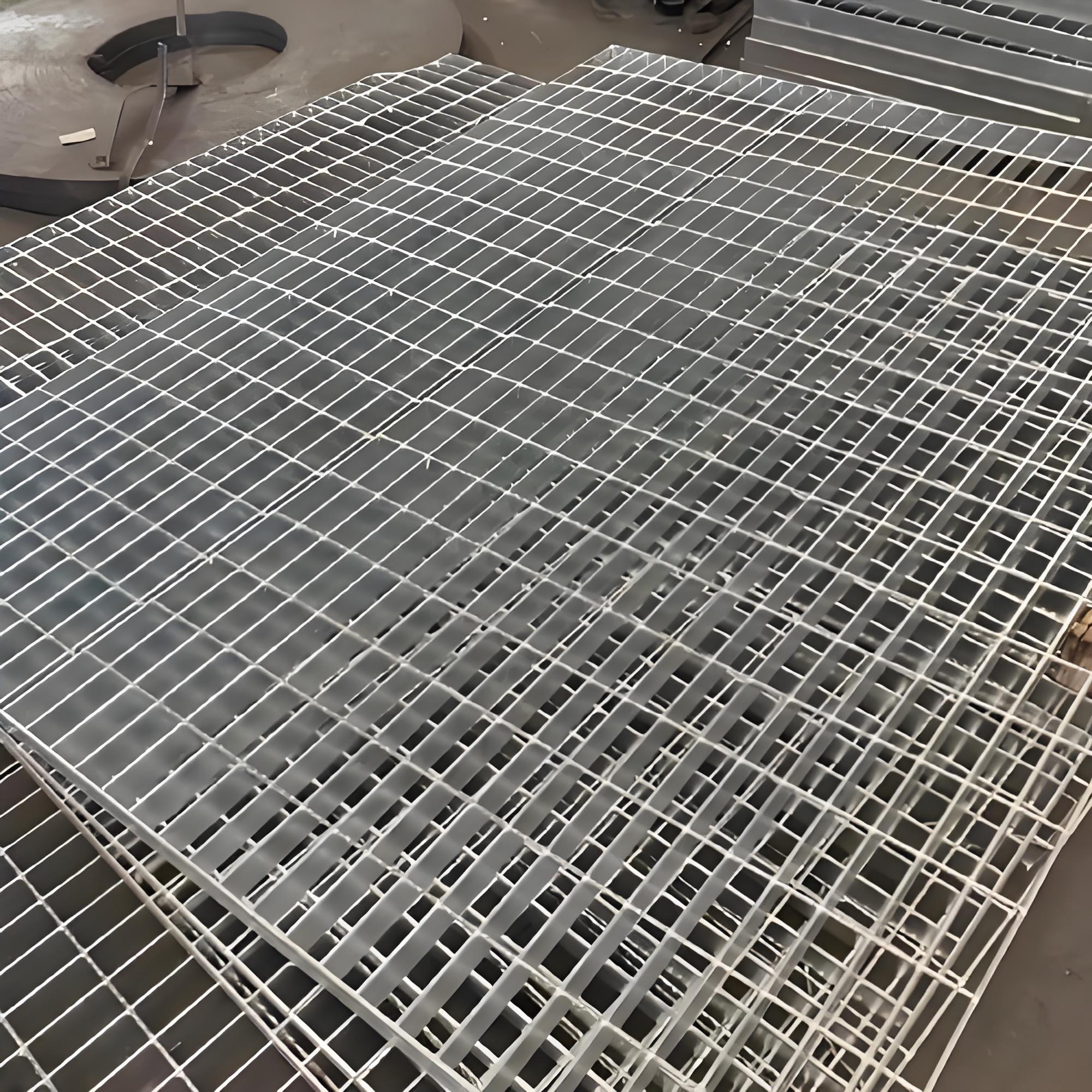
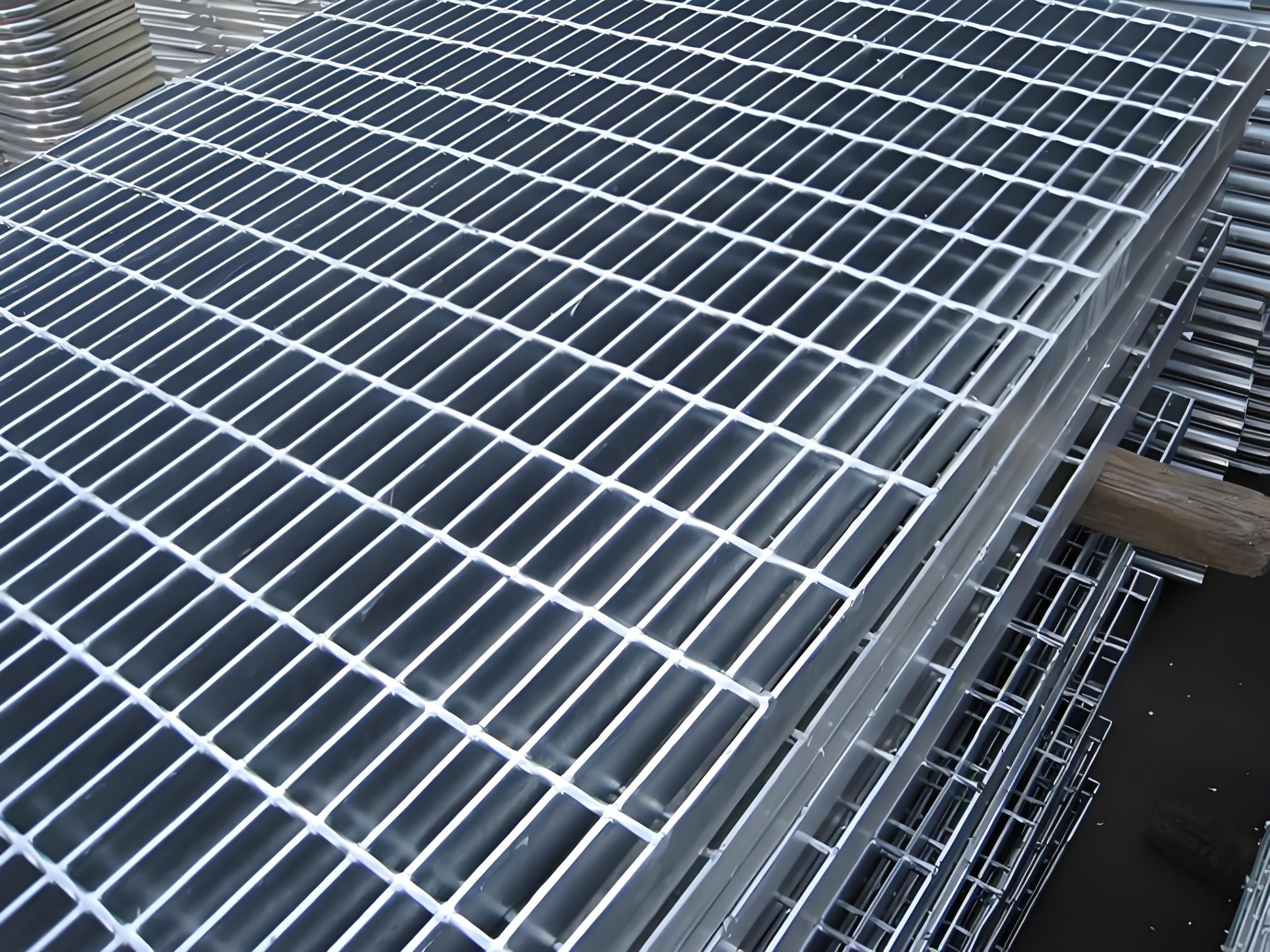
The bearing bars are the vertical flat bars that span from one support to another. They function as a series of closely spaced beams. Their depth, thickness, spacing, and orientation determine most of the grating’s strength and stiffness.
Cross bars lock the bearing bars into the required grid pattern, help distribute local loads to adjacent bearing bars, and maintain panel stability. They are important, but they do not replace the structural role of the bearing bars.
Forklifts, trucks, service vehicles, and mobile equipment create different demands than personnel walking on a platform. A vehicle does not apply its total weight evenly across the entire grating surface. The load is transferred through axles, wheels, tires, and contact patches. A small wheel can create a high local stress even when the vehicle’s overall weight appears moderate.
For vehicle traffic, a heavy duty grating system must be reviewed as a complete assembly:
Forklift grating should be selected from the loaded forklift condition, not only from the forklift’s rated lifting capacity. The actual loaded machine weight, axle distribution, tire type, wheel contact area, wheel spacing, and travel direction are all relevant.
A forklift can impose very high loads on one axle, especially when carrying a load. Solid tires may create a smaller contact area than pneumatic tires, increasing local pressure. Repeated travel can also create fatigue concerns that do not appear in a simple static load calculation.
For a forklift route, the supplier should receive the forklift data sheet or at least the maximum loaded axle load, maximum wheel load, wheel dimensions, tire type, wheelbase, track width, and expected travel pattern. “Three-ton forklift” is not enough information for a final heavy-duty grating selection.
Truck traffic requires a more conservative approach than standard industrial grating. Vehicle wheel loads can be large, and impact from movement over a trench or transition can increase the force applied to the grating and support frame.
Traffic covers may need to meet a project-specific highway, municipal, port, airport, utility, or industrial standard. The grating may be only one part of the load path. The support angles, steel frame, concrete channel, anchor details, and surrounding slab all need sufficient capacity.
For truck-access trench covers, it is usually better to specify the exact vehicle or required traffic class than simply request “heavy duty steel grating.” A properly engineered system can then be designed for the relevant axle and wheel condition.
Heavy equipment can create concentrated loads through machine legs, skids, jacks, mobile pumps, valves, support feet, or maintenance tools. A grating panel that passes a uniform platform load may still deflect excessively under one localized leg.
When the contact area is small, it may be necessary to add spreader plates, support beams, reinforcement bars, closer bearing-bar spacing, or a solid plate section. Equipment should not be placed on open grating unless the supplier or project engineer has checked the concentrated load and contact area.
Heavy-duty grating design requires the correct type of load input. Uniform, concentrated, and wheel loads are not interchangeable. A grating panel may meet one requirement but fail another.
| Load Type | How the Load Is Applied | Typical Examples | Key Design Information |
|---|---|---|---|
| Uniform load | Distributed over a broad area of the grating | Personnel, stored materials, general platform use | Load in kN/m², kPa, psf, span, and deflection limit |
| Concentrated load | Applied at a limited location or through a small contact area | Machine leg, jack, cart, ladder foot, maintenance equipment | Load value, contact size, location, and duration |
| Wheel load | Applied through a rolling tire or wheel, often with impact | Forklift, truck, pallet truck, service vehicle, mobile equipment | Wheel load, tire area, axle layout, speed, impact, and travel path |
| Line load | Applied along a narrow line rather than one point | Pipe skid, rail, equipment runner, support rail | Load per meter, contact width, support arrangement |
A common mistake is to select heavy grating based only on a high uniform load number. A panel may safely support a distributed load over its full area but still be unsuitable for a wheel that contacts only a few bearing bars.
For example, several workers standing across a platform create a distributed load. A forklift wheel may apply a similar total force to a much smaller area, producing much greater bending and local stress. The wheel load may also move, turn, strike a transition, or repeatedly travel over the same path.
Wheel-load design should consider the actual contact area between the tire and grating. A soft pneumatic tire spreads load over a wider area than a small hard wheel. Solid forklift tires, steel wheels, narrow casters, and pallet-jack wheels can create high local effects.
Dynamic impact should also be considered. A wheel crossing a joint, rolling over an uneven surface, stopping abruptly, or dropping into a small transition can apply more force than the static vehicle weight alone suggests. This is one reason vehicle-rated grating is normally checked against dedicated heavy-duty load tables or project engineering calculations.
The bearing bar is described by its depth and thickness. For example, 50×6 mm means the bar is 50 mm deep and 6 mm thick. The depth is measured vertically when the grating is installed; the thickness is measured across the bar.
| Bearing Bar Size | Typical Position | Common Heavy-Duty Uses |
|---|---|---|
| 32×5 mm | Medium to heavy industrial | Platforms, walkways, heavier maintenance areas, short-span covers |
| 40×5 mm | Heavy industrial | Longer-span platforms, heavy walkway service, industrial covers |
| 50×5 mm | Higher stiffness and load capacity | Heavy platforms, ramps, vehicle-related applications after verification |
| 50×6 mm | Heavier bar section | Demanding concentrated loads and engineered traffic grating |
| 60×5 mm or 60×6 mm | Very heavy duty | Longer spans, heavy industrial service, vehicle-rated systems |
| 75 mm and deeper bars | Special heavy-duty grating | Truck, port, bridge, trench, and project-specific engineered applications |
Increasing bearing bar depth is usually one of the most efficient ways to increase stiffness. A deeper vertical bar resists bending more effectively than a shallow bar. This is why moving from 40×5 mm to 50×5 mm can produce a much greater improvement in stiffness than the 10 mm difference might suggest.
Thickness also matters. A thicker bar increases steel area, strength, weld area, and weight. However, for long spans, increasing depth is often more structurally efficient than adding thickness alone, provided the deeper grating can be accommodated in the support layout.
Closer bearing-bar spacing means more bearing bars per square meter. This usually increases steel weight, cost, and overall load distribution. It can also improve support for narrow wheels and reduce the opening size between bars.
Common metric bearing bar pitches include 30 mm and 40 mm. Heavy-duty vehicle grating may use a different spacing based on the load table and wheel distribution criteria. A wider pitch can reduce cost and improve drainage, but it may not provide adequate support for small wheels or concentrated loads.
Welded and riveted grating are both used for heavy-duty applications, but they use different construction methods and should be selected from the correct load data.
Heavy-duty welded grating is manufactured by joining cross bars to bearing bars through high-pressure welding, forge welding, fillet welding, or a combination of factory methods suited to the product design. It is widely used for industrial flooring, platforms, ramps, trench covers, vehicle areas, and access structures.
Welded grating can provide a robust, rigid panel with secure intersections. In heavy-duty configurations, the cross bars and weld details are designed to resist the applied loads and maintain the bearing bars in position under repeated service.
| Feature | Heavy-Duty Welded Grating | Heavy-Duty Riveted Grating |
|---|---|---|
| Connection method | Welded intersections between bearing bars and cross bars | Mechanical riveted connections with corrugated or formed cross bars |
| Typical appearance | Open grid with welded cross bars | Distinctive riveted construction with closely spaced connecting members |
| Common use | Industrial platforms, heavy flooring, trench covers, traffic areas | Bridge decks, ramps, heavy-duty floors, vehicle-related applications |
| Structural selection | Use welded heavy-duty load tables and support details | Use the manufacturer’s riveted-grating load data |
| Fabrication options | Commonly available with banding, cutouts, frames, and toe plates | May be selected for specific high-load, fatigue, or bridge-type requirements |
Riveted grating uses mechanical rivets and formed cross members instead of a conventional welded cross-bar grid. It has a long history in bridges, ramps, highways, vehicle floors, and heavy-duty applications where repeated rolling loads are important.
In certain designs, riveted grating can provide high load capacity for a given span and bearing-bar depth. However, it should not be assumed that every riveted product is stronger than every welded product. The actual configuration, rivet spacing, bearing bar size, cross member design, support condition, and manufacturer’s load table must be reviewed.
Welded grating is often the preferred choice for general industrial heavy-duty flooring because it is widely available, efficient to fabricate, and suitable for many custom layouts. Riveted grating may be preferred for bridge, ramp, roadway, repeated wheel-load, or specialty heavy-duty projects where its specific load performance is beneficial.
The correct choice should be based on the project loading, fabrication drawing, design standard, lifecycle requirements, and installation environment rather than appearance alone.
Mesh size describes the spacing of bearing bars and cross bars. In metric specifications, 30×100 mm usually means bearing bars at 30 mm centers and cross bars at 100 mm centers. In North American systems, common heavy-duty patterns may use bearing-bar spacings such as 15/16 inch, 1-3/16 inch, or larger, depending on the grating series.
Mesh selection affects wheel support, drainage, open area, debris retention, steel weight, and cost. For vehicle traffic, a mesh pattern must be evaluated with the actual wheel dimensions and loading method.
| Mesh Feature | Effect on Heavy-Duty Performance |
|---|---|
| Closer bearing bar spacing | More bars support a wheel load, increases weight and cost, reduces clear opening |
| Wider bearing bar spacing | Reduces material weight and improves open area, but may be unsuitable for narrow wheels |
| Closer cross bar spacing | Creates a denser grid and may improve transverse load distribution |
| Heavier cross bars | Improves grid stability and connection performance in heavy-duty constructions |
| Smaller opening size | Can improve wheel passage and object retention, but may reduce drainage and increase cost |
A denser cross-bar pattern may improve panel stability and help distribute some local load, but the bearing bars still carry the primary span. Changing a 100 mm cross-bar pitch to 50 mm does not make an undersized bearing bar suitable for a long clear span or a heavy truck wheel.
For traffic applications, the manufacturer should confirm the required heavy-duty series, wheel-load distribution basis, bar size, mesh pattern, and support conditions. A standard walkway mesh should not be assumed to be suitable for vehicle service.
Clear span is the unsupported distance between supports under the bearing bars. It is the key dimension used in grating load tables. It is not necessarily the same as panel length, trench length, or overall frame dimension.
Bearing bars must run from support to support. In a typical rectangular panel resting on two parallel support beams, the bearing bars should cross from one beam to the other. If the panel is turned 90 degrees and the bearing bars no longer span correctly, the actual capacity can be dramatically lower than the load-table value.
Fabrication drawings should clearly mark the bearing-bar direction. This is especially important for rectangular panels, trench covers, ramps, and removable access grates, where an incorrect installation orientation can create a serious structural problem.
Grating requires enough bearing surface at each support. A narrow support ledge can cause local edge deformation, poor load transfer, rocking, or damage to the grating and frame.
As a general industrial guideline, grating depths up to approximately 57 mm often require at least 25 mm of bearing support, while deeper grating may require approximately 50 mm or more. The required support width can be greater for vehicle loads, heavy trench covers, impact service, special frames, or project-specific standards.
| Support Detail | Why It Matters |
|---|---|
| Clear span | Determines bending and deflection of bearing bars |
| Support ledge width | Provides stable bearing and avoids edge damage or rotation |
| Frame stiffness | Prevents the support structure from deflecting independently of the grating |
| Connection method | Prevents panel movement, uplift, rattling, or displacement under traffic |
| Correct bar direction | Ensures bearing bars span in the load-carrying direction |
A heavy-duty grating panel cannot achieve its intended rating if the support frame is weak. For example, a thick 60×6 mm grating can still fail in service if the angle frame bends, the concrete channel cracks, the support ledge is too narrow, or the panel is not properly restrained.
For trench covers and traffic grates, the frame, anchor system, concrete surround, channel walls, and grating should be designed as one system. Quoting only the grating body without reviewing the support condition can lead to installation problems later.
Deflection is the downward movement of the grating under load. Strength is important, but a grating can remain below its material stress limit while still deflecting more than the project permits.
Excessive deflection can create several problems:
Pedestrian and industrial platform projects often use a span-based deflection limit, such as L/200 or another project-defined serviceability criterion. Vehicle-rated heavy-duty grating often uses stricter limits. Many heavy-duty vehicle load tables limit deflection to the lesser of approximately 3.2 mm or L/400, but the applicable project standard should always control.
The required deflection limit should be included in the request for quotation. A supplier cannot select the most economical suitable grating if the allowable deflection is unknown.
Deflection increases very quickly as clear span increases. With the same bearing bar and loading condition, doubling the clear span can increase deflection by roughly sixteen times in a simple beam model. This is why adding an intermediate support can sometimes be more economical than selecting extremely deep and heavy grating.
For heavy-duty design, reducing a clear span may lower the required bearing-bar size, panel weight, galvanizing cost, freight cost, and installation effort. The support structure and grating layout should be considered together during early design.
Heavy-duty grating load tables provide allowable spans, load capacities, deflection values, and weight information for specific grating configurations. They are essential for selecting a suitable product because no single bearing bar size has one universal load capacity.
A load table normally identifies:
First identify the correct grating type. A load table for standard welded platform grating should not be used for a vehicle cover if a heavy-duty vehicle load table is required. Next, confirm the bearing bar size, spacing, construction, and surface type.
Then locate the clear span in the bearing-bar direction. Read across the table to find the allowable uniform load, concentrated load, wheel load, or maximum permitted span for the required design condition. Check both strength and deflection requirements.
| Step | What to Check |
|---|---|
| 1 | Confirm welded, riveted, press-locked, or other grating construction |
| 2 | Confirm bearing bar depth, thickness, and spacing |
| 3 | Confirm cross-bar type and mesh pattern |
| 4 | Measure clear span between supports under the bearing bars |
| 5 | Select the correct load type: uniform, concentrated, wheel, or vehicle |
| 6 | Check allowable load and calculated deflection at the required span |
| 7 | Confirm support ledge, frame strength, connection method, and installation direction |
Load tables are based on defined assumptions. They may assume simple supports, specific bearing widths, smooth bearing bars, a stated steel grade, and a particular deflection limit. Using values from one table while changing the mesh, surface, material, span, or support condition can produce an incorrect result.
Serrated bearing bars may require adjusted load values. Stainless steel and aluminum can also require different load tables from carbon steel. Heavy-duty vehicle applications should be confirmed against the relevant table or project engineering calculation.
Heavy-duty grating is available with plain or serrated bearing bars. The choice is usually based on site safety conditions rather than price alone.
| Surface Type | Advantages | Best Use | Considerations |
|---|---|---|---|
| Smooth heavy-duty grating | Lower cost, easier cleaning, standard load-table basis | Dry indoor platforms, equipment floors, controlled industrial areas | Can be slippery when contaminated by water, oil, mud, or ice |
| Serrated heavy-duty grating | Improved traction in wet, oily, icy, or outdoor conditions | Ramps, stairs, outdoor platforms, wastewater facilities, oil-related areas | May require serrated load data and usually costs more |
Serrated grating is commonly selected for outdoor walkways, ramps, stairs, marine areas, wastewater plants, refineries, chemical facilities, and locations where workers may encounter oil, water, snow, mud, or process residue.
Because the serration removes small portions of the top edge of the bearing bar, the effective section can be slightly lower than a smooth bar of the same nominal size. The supplier’s serrated load table or adjustment method should be used when verifying heavy-duty capacity.
Serrated grating improves traction, but it does not replace drainage, cleaning, handrails, lighting, safe access design, and regular inspection. No grating surface remains safe if it is covered with thick oil, ice, compacted debris, or loose materials.
Carbon steel is the most common and economical material for heavy-duty grating. It offers high strength, good weldability, and broad availability. Mill-finish carbon steel may be suitable for dry indoor locations or projects where a separate coating system will be applied.
For outdoor, wet, or corrosive areas, untreated carbon steel normally needs additional protection to avoid rust and premature deterioration.
Hot-dip galvanized carbon steel is the standard material choice for many heavy-duty industrial applications. The grating is fabricated first and then immersed in molten zinc, allowing the coating to cover bearing bars, cross bars, welds, banding, cut edges, and fabricated details.
Galvanized heavy-duty grating is widely used in utility plants, ports, industrial yards, water treatment facilities, outdoor platforms, truck-access covers, service routes, loading areas, and exposed structural installations.
304 stainless steel heavy-duty grating is often selected where corrosion resistance, cleanliness, and washdown performance are important. Typical applications include food processing, beverage production, pharmaceutical plants, indoor wet areas, commercial kitchens, and specialized process facilities.
It has a much higher initial cost than galvanized carbon steel, so it should be selected where its corrosion resistance and lifecycle benefits are justified.
316 stainless steel offers better resistance to chloride exposure than 304 stainless steel. It is often used in coastal environments, marine facilities, saltwater locations, chemical process areas, and severe washdown environments.
Material selection should be based on the real service environment, including chemical type, concentration, temperature, wet-dry cycles, cleaning agents, and expected maintenance interval.
Hot-dip galvanizing after fabrication provides durable zinc protection for carbon steel heavy-duty grating. It is particularly useful because heavy-duty panels often include banding, custom frames, toe plates, lifting lugs, cutouts, reinforcing bars, and welded details that need corrosion protection.
Projects may refer to galvanizing requirements such as ASTM A123/A123M, ISO 1461, or another applicable standard. The required coating thickness, inspection method, repair procedure, and documentation should be stated in the project specification.
| Galvanizing Factor | Effect on Heavy-Duty Grating |
|---|---|
| Higher steel weight | Heavy bars require more handling and contribute to galvanizing cost |
| Large panel size | May create handling limits or require review against galvanizing bath dimensions |
| Banding and frames | Add more steel surface and welding, increasing coating work |
| Complex fabrication | Requires more preparation, handling, inspection, and possible drainage details |
| Post-galvanizing cutting or welding | Can damage zinc protection and require approved repair coating |
For the best corrosion protection, cutting, welding, drilling, banding, and other custom fabrication should normally be completed before galvanizing. This protects the finished fabricated panel instead of only the original bar stock.
Heavy-duty trench covers are used over drains, utility channels, cable trenches, maintenance pits, washdown trenches, and service corridors. The grating must span across the clear trench opening, with the bearing bars running from one side support ledge to the other.
The frame, channel wall, support angle, and concrete surround must be checked together with the grating. A strong grating panel cannot compensate for a weak trench frame or damaged concrete edge.
Ramps may be subjected to vehicle movement, braking, turning, and wet conditions. Heavy-duty ramp grating often requires serrated bearing bars for traction, a carefully selected mesh pattern for wheel support, and positive fastening to prevent movement.
Ramp grating should be checked for the actual slope, vehicle type, wheel path, expected contamination, drainage pattern, and load direction. A product suitable for a level platform may not be suitable for an inclined vehicle route.
Heavy platforms may support maintenance teams, equipment, pipework, pumps, process skids, storage, and movable tools. The design should account for both uniform loads and localized loads from machinery or maintenance operations.
Where equipment legs or concentrated loads are present, additional structural support may be necessary. In some cases, solid plate sections or local reinforcement are more suitable than relying on standard open grating alone.
Traffic grating should be selected by vehicle load and support condition rather than by a general statement such as “truck duty.” A road vehicle, airport vehicle, heavy forklift, port tractor, and maintenance cart can all produce very different wheel loads and impact conditions.
For public roads, municipal infrastructure, ports, airports, and heavy industrial yards, the required traffic standard should be supplied with the RFQ. The factory or project engineer can then review the appropriate heavy-duty grating series and supporting frame.
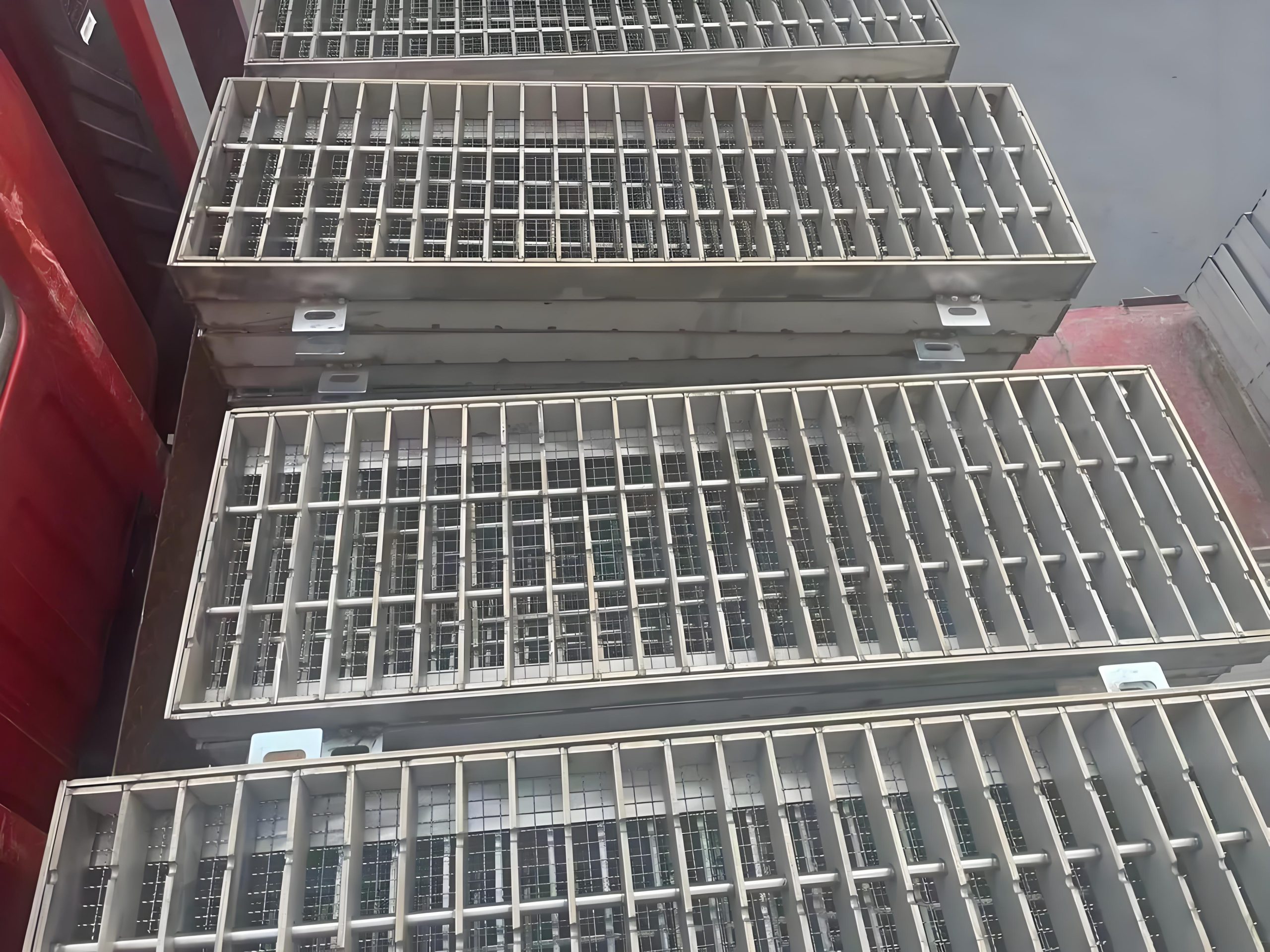
Heavy duty steel grating is generally more expensive than standard floor grating because it uses deeper and thicker bearing bars, stronger cross bars, more welding or riveting, heavier support details, and often more fabrication. Price should be compared by complete specification, not only by square meter.
| Heavy-Duty Grating Type | Indicative Factory Budget Range | Typical Scope |
|---|---|---|
| Mill-finish carbon steel heavy-duty grating | US$45–85/m² | Heavy bearing bars, standard welded panels, large-order factory basis |
| Hot-dip galvanized heavy-duty welded grating | US$60–115/m² | Outdoor platforms, industrial walkways, heavy trench covers |
| Serrated hot-dip galvanized heavy-duty grating | US$70–125/m² | Ramps, wet platforms, stairs, outdoor heavy-service areas |
| Custom framed or vehicle-rated heavy-duty grating | US$100–250/m² or more | Traffic covers, reinforced edges, complex cutouts, engineered assemblies |
| 304 stainless steel heavy-duty grating | US$150–270/m² | Washdown, food processing, corrosion-sensitive industrial service |
| 316 stainless steel heavy-duty grating | US$210–360/m² or more | Marine, coastal, chloride, and aggressive chemical environments |
These are preliminary budgeting ranges, not fixed quotations. Steel pricing, zinc pricing, stainless alloy pricing, currency movement, production capacity, order quantity, packaging, testing, certification, Incoterms, and destination freight can all change the final cost.
To receive an accurate quote and load recommendation, provide the following information:
A complete drawing and load description usually saves time and reduces the risk of selecting an undersized or unnecessarily expensive grating. For vehicle or critical structural applications, the final selection should be checked by a qualified engineer using the applicable heavy-duty load table and project design criteria.
What is considered heavy duty steel grating?
Heavy duty steel grating is grating designed for higher industrial loads, longer spans, concentrated equipment loads, forklifts, service vehicles, trucks, or demanding trench-cover applications. It commonly uses deeper and thicker bearing bars than standard walkway grating, but the actual heavy-duty rating depends on span, mesh, support condition, load type, deflection limit, and construction method.
Can heavy duty steel grating support forklifts?
Some heavy-duty steel grating can support forklift traffic, but it must be selected from the actual loaded wheel condition. The supplier needs the loaded forklift weight, axle load, wheel load, tire type, wheel contact area, clear span, support frame, and deflection requirement. A normal industrial platform grating should not be assumed suitable for forklift traffic without a heavy-duty load check.
How much does heavy duty galvanized steel grating cost?
Heavy-duty hot-dip galvanized steel grating commonly falls within a preliminary factory range of about US$60–115 per square meter for standard heavy panels. Vehicle-rated systems, deep bearing bars, close mesh, serrated surfaces, reinforced frames, custom fabrication, stainless steel, testing, and export delivery can raise the final cost substantially.