

Serrated steel grating is a slip-resistant bar grating made with toothed bearing bars. The small, regularly formed teeth along the top of each load-bearing bar provide extra grip for footwear in wet, oily, muddy, icy, or outdoor conditions. It is widely used for industrial platforms, catwalks, stair treads, ramps, maintenance routes, drainage covers, marine access areas, and process plants. For preliminary factory budgeting, serrated carbon steel grating may range from about US$25–55/m² in mill finish, US$35–75/m² in hot-dip galvanized carbon steel, and US$75–190/m² or more in stainless steel, depending on bar size, mesh, finish, quantity, fabrication, and delivery requirements. The correct anti-slip grating is not selected by surface pattern alone; it must also meet the required span, load, drainage, corrosion, access, and maintenance conditions.
Serrated steel grating uses bearing bars with a notched or toothed top edge rather than a smooth, flat top edge. When a shoe sole contacts the grating, the serrations create many small contact points that help resist sliding. This is particularly useful when water, oil, grease, mud, snow, ice, cleaning liquid, or process residue reduces the grip available on an ordinary smooth steel surface.
In conventional bar grating, the bearing bars carry the main structural load between supports. Serrations are usually formed along the top edge of these bars, where workers step. The cross bars keep the bearing bars in position and create the grid pattern, but the bearing bars remain the primary walking and load-carrying elements.
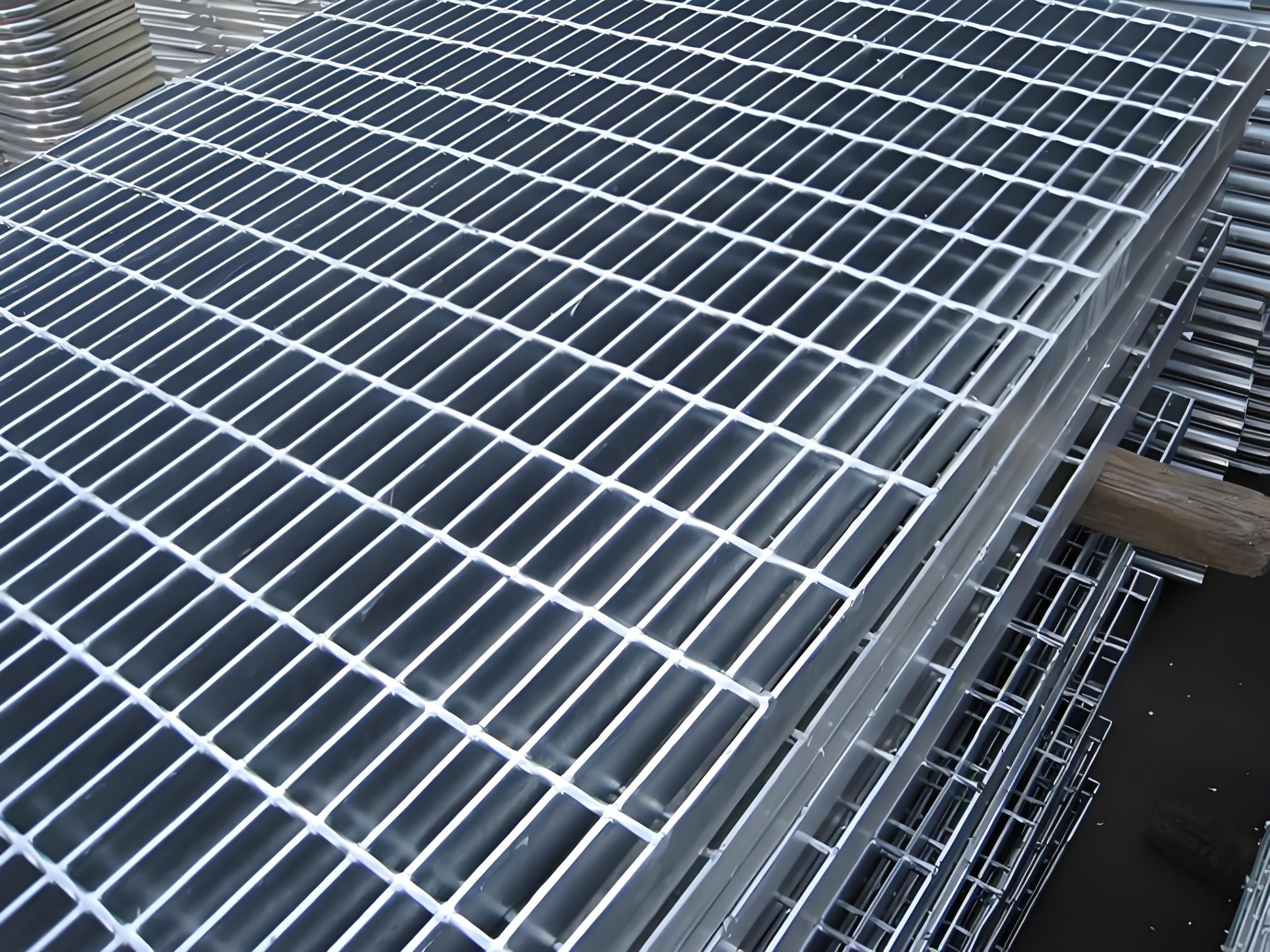
The teeth on a serrated bearing bar create a more aggressive walking surface than a smooth bar. Instead of relying only on friction between a shoe sole and a flat steel edge, the shoe sole engages with many raised points. This makes it more difficult for the foot to slide along the direction of travel.
The benefit is most noticeable where contaminants are likely to be present. For example, a smooth steel platform may feel acceptable in a dry indoor mechanical room, but the same platform can become hazardous when rainwater, oil mist, coolant, slurry, or mud is introduced. Serrated grating does not remove the need for housekeeping and drainage, but it provides an additional safety margin.
| Surface Condition | Smooth Steel Grating | Serrated Steel Grating |
|---|---|---|
| Dry indoor service | Often suitable when normal maintenance is maintained | Suitable, but may not be necessary for every area |
| Rain-exposed outdoor platform | Can become slippery, especially with dirt or algae | Usually preferred for improved footing |
| Oily maintenance area | Lower traction and higher slip risk | Common choice for improved traction |
| Snow, ice, or muddy access route | May require frequent cleaning and additional controls | Better grip, although ice removal is still necessary |
| Food or washdown area | May be suitable in controlled dry zones | Often selected where water or cleaning liquid is routine |
No steel grating should be described as completely slip proof. Even highly serrated surfaces can become unsafe if they are covered with thick grease, compacted mud, ice, product buildup, loose packaging, or debris. Good anti-slip performance depends on the complete walking surface system: correct grating selection, drainage, cleaning, inspection, lighting, handrails, stair design, footwear, and safe work procedures.
A serrated surface should therefore be treated as one part of a broader fall-prevention strategy. It improves traction, but it cannot compensate for poor maintenance, excessive slope, insufficient support, loose panels, damaged grating, or standing liquid.
When buyers request serrated steel grating, they normally mean serrated bearing bars. This distinction matters because bearing bars provide both the main walking surface and the primary structural capacity.
| Component | Main Function | Effect of Serration |
|---|---|---|
| Serrated bearing bar | Carries the main load and forms the main walking contact surface | Provides the most meaningful traction improvement |
| Plain bearing bar | Carries the main load with a smooth top edge | Lower initial cost and easier cleaning in dry, clean areas |
| Cross bar | Locks bearing bars into the grating pattern and adds transverse stability | May add texture, but does not replace serrated bearing bars for anti-slip service |
Twisted square cross bars are common in welded grating and can add some texture across the grating surface. However, they are spaced much farther apart than bearing bars in many standard mesh patterns. Their texture alone is not usually enough for an oily ramp, wet stairway, or exposed outdoor access platform.
For a true anti-slip bar grating specification, state clearly that the bearing bars must be serrated. If the project has a special safety requirement, specify the serration type, material, finish, load requirement, and intended environment rather than relying only on the word “serrated.”
Serrated steel bar grating is often the best choice when a project needs high structural strength, open drainage, and better footing at the same time. However, the best product depends on the liquid, contamination level, exposure, load, and maintenance routine.
| Environment | Recommended Anti-Slip Option | Why It Works |
|---|---|---|
| Outdoor industrial walkways | Serrated hot-dip galvanized steel bar grating | Provides traction, strength, drainage, and durable corrosion protection |
| Oily maintenance platforms | Serrated welded bar grating | Strong bearing bars with better grip in oil-contaminated conditions |
| Stairways and ramps | Serrated grating stair treads or serrated safety plank | Improves foothold at the leading edge and over the walking surface |
| Coastal or marine platforms | Serrated galvanized steel or serrated 316 stainless steel | Combines anti-slip performance with corrosion resistance suited to exposure |
| Food processing washdown areas | Serrated stainless steel grating | Suitable for washdown conditions where hygiene and corrosion resistance matter |
| Chemical areas with severe corrosion | Serrated FRP grating or specified stainless steel grating | Material selection must match the chemical exposure, not only the slip risk |
| Lightweight ladders, temporary access, or narrow walkways | Perforated safety grating plank | Provides many raised traction points with a lightweight channel shape |
Serrated bar grating is especially effective where the grating must carry substantial loads over a span. The vertical bearing bars provide strong structural performance, while the serrated top edge improves traction. It is a practical solution for industrial platforms, elevated walkways, pipe-rack access, power plants, wastewater facilities, offshore structures, refineries, and service corridors.
Perforated safety planks, channel grating, and diamond-pattern safety grating can provide very aggressive traction because they use punched, raised edges across the entire surface. They are commonly used for ladders, small walkways, lightweight platforms, stairs, ramps, and retrofit surfaces.
These products should not automatically replace serrated bar grating. Their load span, channel depth, support spacing, object-retention characteristics, and installation method are different. Where a project needs a heavy structural open floor, serrated bar grating may be more appropriate. Where a project needs many raised traction points in a lighter plank system, perforated safety grating may be the better fit.
Serrated steel grating can be manufactured as full panels, cut-to-size walkway sections, trench covers, stair treads, ramp surfaces, removable access panels, and framed grates. The same base product can be fabricated differently depending on the installation.
For elevated industrial platforms, serrated grating helps workers maintain footing around pumps, valves, tanks, pipework, rotating equipment, and maintenance stations. It is particularly useful where rainwater, oil leaks, condensate, or process liquid may occur.
Platform panels should be supported so that the bearing bars span between structural members. Clip fastening, welded connections, saddle clips, or bolted details may be used depending on whether panels need to be removable for access and maintenance.
Walkways often use serrated grating when they are outdoors, exposed to weather, or located beside equipment that can release oil, dust, mud, or water. Common bar spacing patterns include 30×100 mm, 30×50 mm, 40×100 mm, and North American patterns such as 19W4.
For public walkways or routes used by small wheels, the opening size may be as important as slip resistance. A highly serrated product with oversized openings can still be unsuitable for some pedestrian applications. The grating pattern should be selected for heel safety, wheel travel, drainage, and the applicable project requirements.
Serrated stair treads are one of the most common anti-slip grating products. A typical tread includes serrated bearing bars, a front nosing, end plates, and bolt holes for connection to stair stringers. The serrated surface helps improve traction during ascent and descent, where slips can have more serious consequences.
For stairs, tread width, depth, nosing form, clear span, end plate thickness, bolt-hole location, and stringer spacing should all be confirmed. The front edge must be secure and the tread should not rock, twist, or shift after installation.
Ramps need more attention than level platforms because gravity increases the tendency to slip. Serrated bar grating is often used on industrial ramps, access ramps, loading approaches, and sloped service routes. The correct bar direction should consider both structural span and the dominant walking direction.
Where the ramp is steep, heavily contaminated, or used in winter conditions, serrated grating may need to be combined with handrails, drainage details, cleaning procedures, and a more aggressive safety-grating profile. The safest selection is based on the actual slope and site conditions rather than a general assumption.
Serrations improve traction by removing small portions of steel from the top edge of each bearing bar. Because the top and bottom edges of a bearing bar contribute to its structural behavior, the teeth can slightly reduce the effective section compared with an equivalent smooth bar.
The reduction is not the same for every serration pattern. Tooth depth, tooth spacing, bar profile, steel grade, manufacturing method, and applicable load-table method all affect the result. A serrated 32×5 mm bar should therefore not automatically be assigned the exact same allowable span and load as a smooth 32×5 mm bar.
The safest approach is to use the manufacturer’s dedicated serrated load table. Some design methods apply a reduction factor to a smooth-bar load value. Other catalog systems require the designer to use a smooth-bar table with a reduced effective bearing-bar depth. The exact method must match the supplier’s tested or calculated product data.
For planning purposes, serrated grating can have a modest reduction in allowable load or span compared with smooth grating of the same nominal bearing bar size. The effect may be more important where the design is already close to its deflection or stress limit.
| Selection Issue | Smooth Grating | Serrated Grating |
|---|---|---|
| Nominal bearing bar size | Full flat top edge | Top edge includes serrations |
| Slip resistance | Suitable for dry or controlled environments | Better suited to wet, oily, muddy, icy, or sloped conditions |
| Load-table selection | Use smooth-bar load data | Use serrated-bar load data or the manufacturer’s stated correction method |
| Material weight | Standard weight for the bar profile | Usually very similar; tooth removal is small, but processing cost is higher |
| Price | Lower base cost | Higher due to serration processing and specification requirements |
A grating panel can be strong enough to avoid yielding but still deflect too much for comfortable or safe service. Excessive deflection can make a walkway feel unstable, affect drainage slope, loosen fasteners, create vibration, or cause equipment movement.
Deflection is highly sensitive to clear span. Increasing the unsupported span can reduce the allowable load quickly and increase visible movement. If a serrated panel is close to the allowable deflection limit, a deeper bearing bar, thicker bar, closer supports, or a different panel layout may be required.
Clear span is the unsupported distance between the supports under the bearing bars. It is not always the overall panel length. A 2,000 mm long panel may have a clear span of only 1,000 mm if it rests on intermediate support beams.
When requesting a quotation or load check, always show the support locations and the bearing-bar direction. A panel installed with bearing bars running in the wrong direction can have much lower capacity than expected.
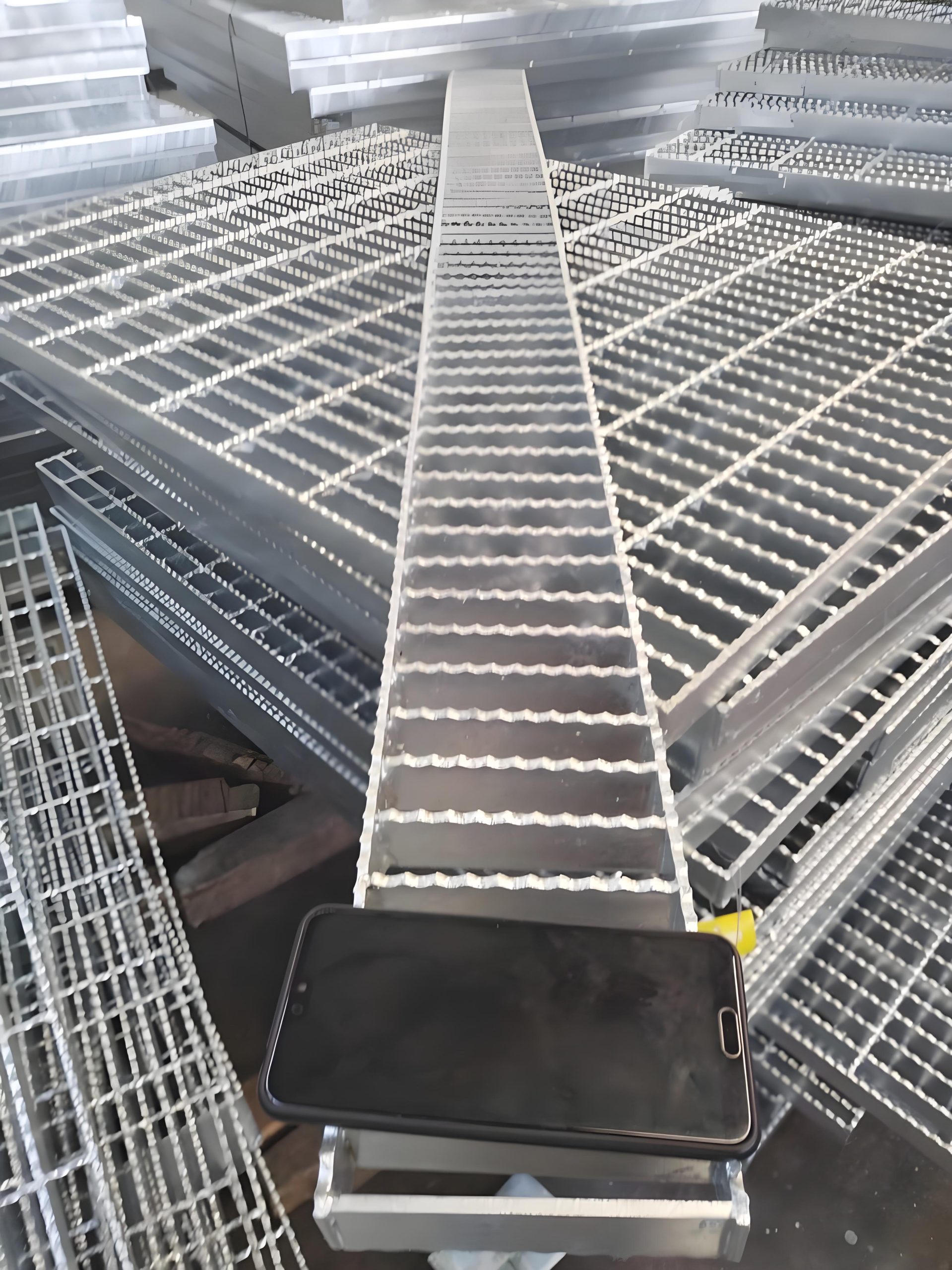
Serrated steel grating can be manufactured with a wide range of bearing bar sizes and mesh patterns. The most common products use carbon steel bearing bars from 25×3 mm to 50×5 mm or larger, depending on load and span requirements.
| Common Serrated Bearing Bar | Typical Mesh Options | Typical Use |
|---|---|---|
| 25×3 mm | 30×100 mm, 30×50 mm, 40×100 mm | Light walkways, short-span access panels, drainage covers |
| 25×5 mm | 30×100 mm, 30×50 mm | Medium-duty walkways and platforms |
| 30×3 mm | 30×100 mm, 30×50 mm, 40×100 mm | General industrial flooring and access routes |
| 30×5 mm | 30×100 mm, 30×50 mm | Heavier platforms, outdoor walkways, stair systems |
| 32×5 mm | 30×100 mm, 30×50 mm | Heavy industrial flooring, high-traffic areas, longer spans |
| 40×5 mm | 30×100 mm, 30×50 mm, 40×100 mm | Heavy-duty platforms, trench covers, demanding industrial access |
| 50×5 mm and above | Project-specific mesh and support layout | Longer spans, concentrated loads, engineered heavy-duty service |
Bearing bar spacing controls the opening between the primary load-carrying bars. A 30 mm bearing-bar pitch is commonly used for industrial walkways because it provides a relatively dense walking surface while maintaining good drainage. A 40 mm pitch uses fewer bearing bars, reducing weight and cost but creating a larger opening.
Close-mesh patterns may be required for public areas, small wheels, high heels, or special object-retention needs. A close mesh usually costs more because it requires more bearing bars per square meter.
Cross bars are often spaced at 100 mm, 50 mm, 76 mm, or 101.6 mm depending on the system. A 100 mm cross-bar pitch is common for standard industrial grating. A 50 mm pitch produces a denser grid pattern, adds steel and welding, and can improve transverse support for some loads.
Changing cross-bar spacing does not replace the structural role of the bearing bars. For a long support span, bearing-bar depth and thickness remain the most important factors in load capacity and stiffness.
One advantage of bar grating is its high open area. Water, light, air, dirt, and small debris can pass through the grid instead of collecting on the walking surface. This is valuable for outdoor walkways, drainage channels, wet processing areas, cooling towers, service platforms, and industrial access routes.
Serrations do not usually change the nominal open area very much because they only modify the top edge of the bearing bars. Bearing bar spacing, bearing bar thickness, cross-bar profile, and cross-bar spacing have a much larger effect on the amount of open area.
| Mesh Pattern | Open Area Tendency | Drainage and Retention Characteristics |
|---|---|---|
| 30×100 mm | High open area | Good drainage and common self-cleaning performance for industrial floors |
| 30×50 mm | Slightly lower open area | Denser cross pattern; may retain more debris than 30×100 mm |
| 40×100 mm | More open pattern | High drainage and lower weight, but larger openings need review |
| Close-mesh grating | Lower open area | Better small-wheel and heel support, but less free drainage than standard mesh |
A serrated surface performs best when liquid can drain away instead of forming a continuous film across the walking path. Proper slope, open area, clean trench channels, and regular removal of debris all help the grating maintain traction.
For an outdoor platform, selecting serrated grating without considering drainage can create a false sense of security. Leaves, plastic film, sludge, grease, or sediment can block openings and prevent water from draining. The result may be standing liquid over a serrated surface, which still requires cleaning and corrective action.
Serrations are excellent for grip, but they can retain sticky residue more easily than smooth bars in certain process areas. Food residue, dried mud, paint, wax, heavy grease, fibers, and chemical solids may collect around the teeth if cleaning is not regular.
For washdown or hygiene-sensitive applications, the supplier should confirm the material grade, bar profile, weld finish, access for cleaning, and whether a smooth or serrated surface is more suitable for the actual process. A serrated stainless steel product is often effective in wet areas, but it should still be selected with the cleaning method in mind.
Carbon steel is the most economical material for serrated steel grating. It offers high strength, good weldability, and broad availability. Mill-finish carbon steel is often used indoors, in dry service, for temporary works, or where a separate paint system will be applied.
For exposed outdoor use, untreated carbon steel is normally not the preferred long-term option because rust can form quickly in wet or humid conditions. Surface protection should match the expected environment.
Hot-dip galvanized carbon steel is the most common choice for outdoor anti-slip grating. The grating is fabricated first and then immersed in molten zinc. This process coats the bearing bars, cross bars, welded intersections, cut edges, edge banding, and fabricated details.
Galvanized serrated grating is widely used for outdoor stairs, platforms, catwalks, utility access routes, wastewater structures, plant walkways, loading zones, and industrial drainage covers. It offers a practical balance of strength, corrosion protection, and cost.
Type 304 stainless steel serrated grating is often selected for food processing, beverage plants, commercial washdown zones, pharmaceutical facilities, indoor wet areas, and locations where corrosion resistance and cleanliness are important.
It has a much higher initial cost than galvanized carbon steel, but it can reduce maintenance and replacement costs in the right environment. Stainless steel should be specified with the required finish, welding method, cleaning requirement, and material certificate when applicable.
Type 316 stainless steel provides stronger resistance to chloride exposure than 304 stainless steel. It is commonly considered for coastal installations, marine facilities, saltwater exposure, chemical areas, and severe washdown environments.
316 is not necessary for every wet project. It should be selected where the corrosion environment justifies the additional material cost. A detailed review of the actual chemicals, concentrations, temperatures, cleaning agents, and exposure cycle is important before final material selection.
For fabricated carbon steel serrated grating, hot-dip galvanizing after fabrication is generally the preferred corrosion-protection method. It protects difficult areas such as weld intersections, bar ends, edge banding, cutouts, notches, and custom fabricated details.
Projects may specify recognized galvanizing requirements such as ASTM A123/A123M, ISO 1461, or an equivalent local standard. The required coating thickness should be stated in the project specification rather than assumed. Coating requirements can depend on the applicable standard, steel category, base-steel thickness, inspection method, and service environment.
| Finish Option | Best Use | Advantages | Limitations |
|---|---|---|---|
| Mill finish carbon steel | Dry indoor areas or further coating by others | Lowest initial cost | Limited corrosion resistance |
| Painted carbon steel | Indoor industrial use or controlled environments | Color options and moderate protection | Cut edges and damaged areas may need maintenance |
| Hot-dip galvanized carbon steel | Outdoor, wet, industrial, and general exposed service | Durable zinc protection over fabricated details | Higher cost than mill finish; not ideal for every chemical environment |
| 304 stainless steel | Washdown, food, indoor wet, and general corrosion-resistant service | Corrosion resistance without zinc coating | Higher material cost |
| 316 stainless steel | Marine, coastal, chloride, and aggressive chemical environments | Improved corrosion resistance in severe service | Highest common material cost |
Cutting, welding, drilling, banding, toe-plate installation, and other fabrication are normally completed before galvanizing. This allows the zinc coating to protect the finished product as a whole.
If a galvanized panel is cut or welded afterward, bare steel can be exposed. Repair coating may be possible, but it is usually better to complete all factory work before galvanizing whenever possible. Clear fabrication drawings reduce unnecessary field changes and help preserve corrosion protection.
Serrated steel grating price is mainly driven by steel weight. The taller, thicker, and more closely spaced the bearing bars are, the more steel is required per square meter. Serration adds processing cost, and galvanizing adds material handling and zinc-coating cost.
The figures below are broad factory budgeting ranges for standard export-style orders. They are not fixed offers. Final quotations may be higher or lower depending on local steel pricing, quantity, specifications, packing, and delivery terms.
| Serrated Grating Type | Indicative Factory Budget Range | Typical Application |
|---|---|---|
| Light serrated carbon steel, mill finish | US$25–45/m² | Short-span indoor walkways and basic industrial access |
| Standard serrated carbon steel, mill finish | US$35–55/m² | General platforms, steps, and custom walkway panels |
| Standard serrated hot-dip galvanized steel | US$35–75/m² | Outdoor platforms, walkways, stairs, and industrial flooring |
| Heavy serrated galvanized steel grating | US$65–115/m² | Longer spans, heavier bars, demanding industrial service |
| 304 stainless steel serrated grating | US$75–150/m² | Food, washdown, wet process, and corrosion-sensitive areas |
| 316 stainless steel serrated grating | US$110–190/m² or more | Marine, chloride, coastal, and aggressive chemical exposure |
For a per-panel estimate, multiply the net panel area by the quoted square-meter rate, then add any fabrication, hardware, frame, packing, and shipping charges. For example, a 1,000 x 1,500 mm panel has an area of 1.5 m². If the selected serrated galvanized specification is quoted at US$60/m², the grating body value is approximately US$90 before cutouts, banding, clips, export packing, and freight.
Small orders often have a higher unit price because setup, cutting, handling, galvanizing, packing, and administration are spread over fewer square meters. Repeated standard panels and larger project quantities usually provide a more efficient factory price.
A low price is meaningful only when the complete specification is the same. Comparing a light 25×3 mm serrated panel with a heavy 40×5 mm serrated panel by square meter alone does not show the actual difference in steel weight or load capacity.
| Cost Factor | How It Changes Price |
|---|---|
| Bearing bar depth | Deeper bearing bars use more steel and provide higher stiffness |
| Bearing bar thickness | Thicker bars increase material weight, strength, and welding area |
| Bearing bar spacing | Closer pitch uses more bearing bars per square meter and raises cost |
| Cross bar spacing | Closer cross-bar spacing adds steel, welding, and labor |
| Serration | Usually adds machining or forming cost compared with smooth bars |
| Surface finish | Hot-dip galvanizing and stainless steel increase cost but improve corrosion resistance |
| Panel dimensions | Non-standard panel sizes can increase cutting loss and fabrication time |
| Cutouts and notches | Require layout, cutting, re-banding, welding, and inspection |
| Toe plates and frames | Add plate steel, welding, galvanizing, and assembly work |
| Quantity | Large repeated orders generally reduce unit cost |
| Packing and freight | Heavy grating can create substantial inland, container, and destination freight cost |
Steel grating is often priced indirectly by its theoretical or actual weight. A 30×5 mm serrated grating with 30 mm bearing-bar pitch contains much more steel than a 25×3 mm panel with 40 mm pitch. Even if the external panel dimensions are identical, the heavier panel requires more raw material, more welding energy, more galvanizing surface, and more freight capacity.
The teeth themselves remove a small amount of steel from the bearing bar, so serrated grating does not necessarily weigh more than smooth grating of the same nominal bar size. However, the serration process requires additional equipment time, tooling, quality control, and careful handling. This is why serrated grating usually costs more than smooth grating even when the nominal weight is similar.
Hot-dip galvanizing cost is affected by the total surface area of the fabricated steel, not only by its plan area. More bars, cut edges, banding, toe plates, and complex shapes create more surface to prepare and coat. Large panels may also require special handling or may be limited by galvanizing bath dimensions.
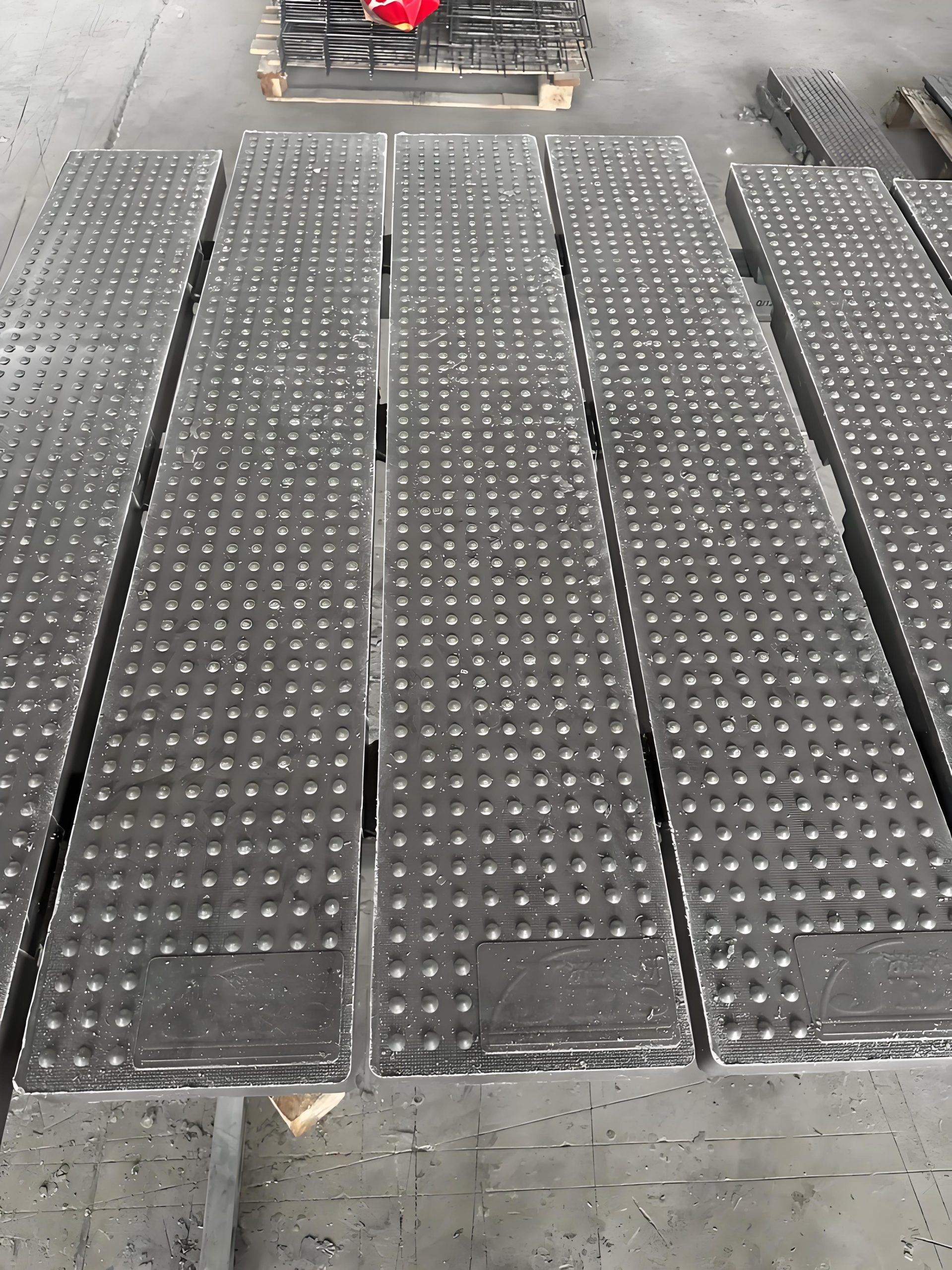
Most industrial grating projects include at least some custom fabrication. Standard panels are efficient, but field conditions often require exact sizes, penetrations, notches, support details, and safety accessories.
Cutouts are used around pipes, columns, cable trays, handrail posts, floor drains, equipment foundations, and existing structural steel. When a cutout interrupts bearing bars, the exposed edges may need banding or reinforcement to restore a clean, safe, and stable perimeter.
A simple square notch generally costs less than a large circular cutout or a complex irregular opening. The supplier should receive dimensioned drawings rather than only photographs whenever possible.
Banding closes the exposed ends of bearing bars and creates a finished edge. It improves panel appearance, reduces sharp exposed bar ends, and can strengthen the perimeter around cut panels or openings.
For serrated grating, banding is especially useful around removable access panels, trench covers, custom cutouts, and exposed walking edges. The banding bar should be sized to match the design requirement and should be included in the final factory weight and price.
Toe plates are vertical plates attached around elevated walkways and platforms to help prevent tools, bolts, parts, and loose materials from falling to a lower level. They are commonly used in industrial plants, offshore structures, maintenance platforms, and equipment access routes.
Toe plates add material, welding, galvanizing surface, and installation work. The required height, thickness, connection method, drain slots, and corner details should be shown on the fabrication drawing.
Custom serrated stair treads can include welded end plates, bolt holes, front nosing, custom width, special depth, and mounting details for different stringer systems. Treads should be ordered with the correct bearing-bar direction, as the bars must span between the stair stringers.
For accurate pricing, provide tread width, depth, nosing requirement, end-plate size, hole diameter, hole center distance, quantity, finish, and stringer drawing. Stair treads often have a higher per-square-meter price than full panels because each piece requires additional fabrication.
A reliable anti-slip grating supplier should do more than provide a low price. The supplier should understand how the grating will be used and should be able to confirm the correct bar direction, load-table basis, material, surface treatment, fabrication details, and packing method.
| Supplier Check | Why It Matters |
|---|---|
| Clear specification review | Prevents confusion between bar size, mesh, panel size, and span direction |
| Serrated bearing bars confirmed | Ensures the anti-slip surface is on the primary walking bars |
| Load-table support | Confirms bar size against clear span, design load, and deflection criteria |
| Material traceability | Important for stainless steel, project certifications, and controlled material grades |
| Weld quality control | Helps ensure cross bars, edge banding, and fabricated details are secure |
| Galvanizing inspection | Confirms coating quality, coverage, and project requirements after fabrication |
| Dimensional inspection | Reduces installation problems caused by incorrect panel sizes or cutouts |
| Fabrication drawing capability | Important for complex layouts, openings, toe plates, frames, and stair treads |
| Export packing experience | Helps protect galvanized or stainless panels during lifting, container loading, and shipping |
A detailed quote request should include the following information:
The most useful RFQ states the intended service condition, not only the dimensions. For example, “serrated galvanized grating for an outdoor oily maintenance walkway with a 1,200 mm clear span” gives a supplier far more useful information than “need 30×100 serrated grating.”
Is serrated steel grating better than smooth grating?
Serrated steel grating is better where slip resistance is important, such as wet, oily, muddy, outdoor, icy, or sloped areas. Smooth grating is often more economical and easier to clean in dry, controlled environments. The best option depends on site contamination, drainage, load requirements, and maintenance conditions.
Does serrated grating have lower load capacity?
Serrated grating can have slightly lower structural capacity than smooth grating with the same nominal bearing bar size because the teeth reduce the effective top edge of the bearing bar. The actual reduction depends on the serration design and supplier load table. Always use a dedicated serrated-grating load table or the manufacturer’s stated correction method.
How much does serrated galvanized steel grating cost?
Standard serrated hot-dip galvanized steel grating commonly falls in a preliminary factory range of about US$35–75 per square meter. Heavy-duty bars, close mesh, stainless steel, custom cutouts, toe plates, frames, small quantities, export packing, and freight can increase the final price significantly.