
40×5 heavy-duty steel grating uses 40 mm deep by 5 mm thick bearing bars. It is a strong and relatively heavy bar grating specification often selected for industrial platforms, truck-access areas, drainage covers, loading zones, utility facilities, and longer-span walkways. However, 40×5 does not automatically mean that a panel is suitable for every heavy-duty application. Bearing bar spacing, cross bar spacing, clear span, support design, wheel load, deflection limit, material grade, and fabrication details must be checked together. As a preliminary factory budget, 40×5 carbon steel grating commonly falls around US$48–80/m² in mill finish, US$58–98/m² when hot-dip galvanized, and US$64–108/m² for serrated hot-dip galvanized grating. The final factory price changes with mesh size, total steel weight, galvanizing, panel dimensions, custom work, quantity, packing, and delivery terms.
In a steel grating specification, 40×5 normally refers to the size of the load-bearing flat bar:
| Specification | Meaning | Structural Role |
|---|---|---|
| 40 mm | Bearing bar depth or height | Provides bending stiffness across the support span |
| 5 mm | Bearing bar thickness | Provides steel area, strength, weld area, and durability |
The 40 mm dimension is measured vertically when the grating is installed. It is not the width of the opening and it is not the panel thickness in every direction. The bearing bars are placed vertically so they act like a series of small beams spanning from one support to another.
A full 40×5 heavy-duty grating specification should include more than the bearing bar size. For example:
40×5 mm bearing bars, 30×100 mm mesh, welded construction, serrated surface, carbon steel, hot-dip galvanized after fabrication, 1.2 m clear span, 8 kN/m² uniform load, custom banding and cutouts.
Without bar pitch, cross bar pitch, span, load, finish, and panel dimensions, a supplier cannot accurately confirm weight, load capacity, production method, or final price.
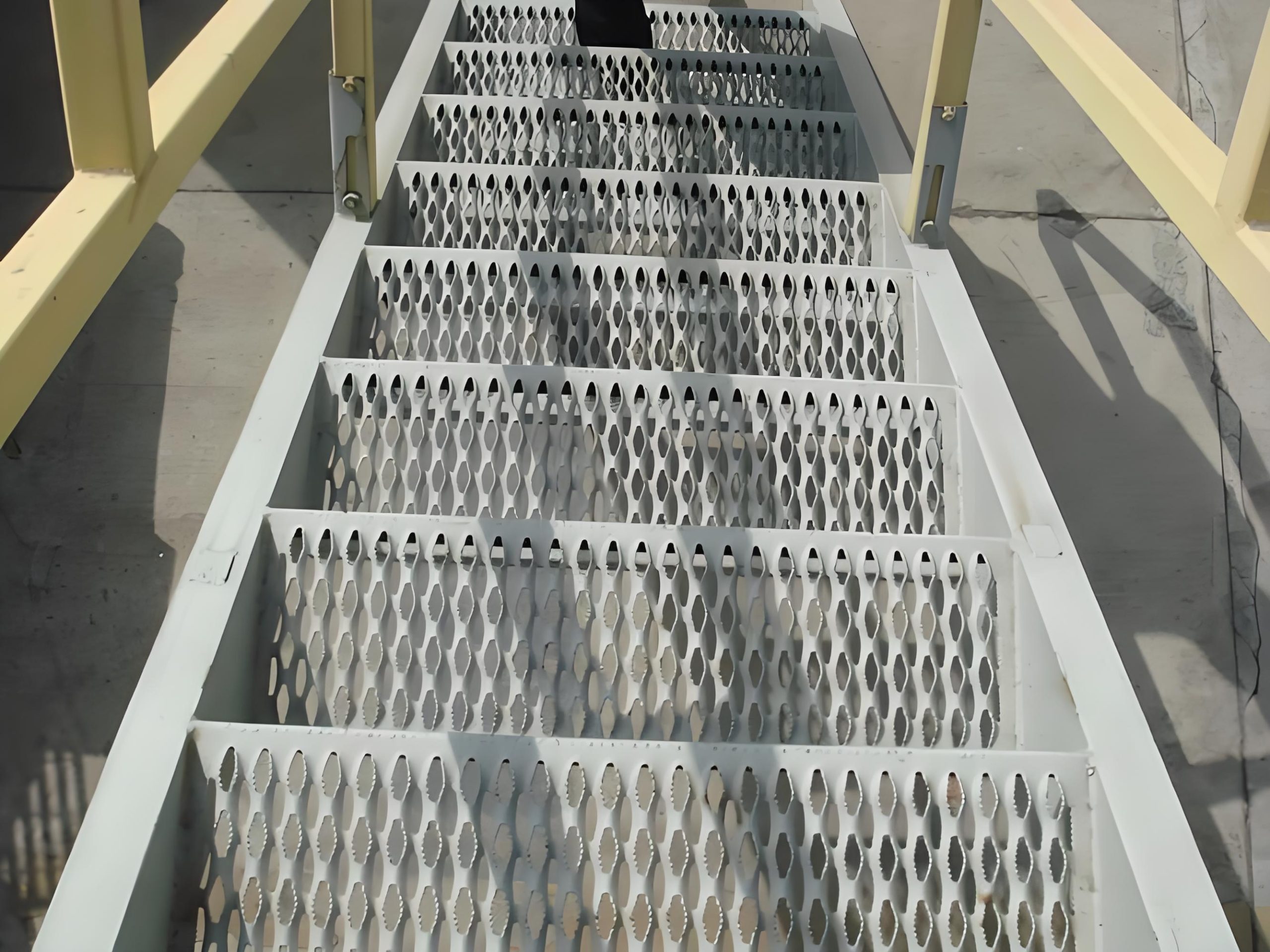
40×5 grating is commonly described as heavy duty because its bearing bars are deeper and thicker than many standard industrial grating specifications such as 25×3 mm, 30×3 mm, or 32×3 mm. In practical terms, it is often used where a standard walkway grating is not stiff enough, where the support span is longer, or where loads are more demanding.
Still, “heavy duty” is a performance description, not a universal size label. A 40×5 panel may be appropriate for one heavy industrial platform but unsuitable for a forklift route or truck crossing if the span is too long or the wheel loads are too concentrated.
| Application Type | Can 40×5 Be Suitable? | Important Checks |
|---|---|---|
| Industrial walkways and platforms | Often yes | Clear span, uniform live load, deflection limit, slip resistance |
| Longer-span catwalks | Often yes | Support spacing, vibration, panel fastening, bar direction |
| Trench covers | Often yes | Clear opening, support ledge, removable handling weight, point loads |
| Forklift or pallet-jack traffic | Possible, but not automatic | Wheel load, tire contact area, impact, frame strength, deflection |
| Truck-access covers | Possible only with engineered design | Vehicle class, wheel load, support frame, concrete surround, fatigue |
| Pedestrian public walkways | Yes, if the opening pattern is suitable | Heel safety, accessibility requirements, opening orientation, surface finish |
The term heavy duty should therefore be supported by a load table or engineering calculation. A supplier should know whether the project involves pedestrian traffic, maintenance carts, vehicle wheels, forklifts, impact loads, static equipment, or a combination of these conditions.
A 40×5 mm bearing bar has a cross-sectional area of 200 mm². Compared with lighter bars, it provides greater resistance to bending and deflection. The increased 40 mm depth has an especially important effect because the stiffness of a vertical bar rises rapidly as bar depth increases.
For bearing bars with the same 5 mm thickness and the same steel grade, the section properties change approximately as shown below. These ratios describe the individual bearing bar only; the final grating capacity also depends on bar spacing, support conditions, and the grating construction.
| Bearing Bar Size | Relative Steel Area | Relative Bending Strength | Relative Stiffness |
|---|---|---|---|
| 32×5 mm | 80% | 64% | 51% |
| 40×5 mm | 100% | 100% | 100% |
| 50×5 mm | 125% | 156% | 195% |
| 60×5 mm | 150% | 225% | 338% |
The table explains why changing from 40×5 to 50×5 can have a noticeable effect on span performance. The 50 mm bar is not merely 25% deeper; its bending strength and stiffness increase much more than its steel weight. In contrast, selecting a thicker bar without increasing depth can add cost and weight but may be a less efficient solution for a long span.
40×5 is often a practical middle ground. It is stronger than common medium-duty grating but is usually lighter and less expensive than 50×5 or 60×5 grating. The correct selection depends on the structural requirement, not only on the desire to use a heavier-looking product.
Mesh size describes the center-to-center spacing between bearing bars and cross bars. A common format such as 30×100 means bearing bars at 30 mm centers and cross bars at 100 mm centers.
| Mesh Size | Bearing Bar Pitch | Cross Bar Pitch | Typical Characteristics |
|---|---|---|---|
| 30×100 mm | 30 mm | 100 mm | Common industrial grating pattern with good support, drainage, and economy |
| 30×50 mm | 30 mm | 50 mm | Closer cross bar pattern for improved transverse support and a denser walking surface |
| 40×100 mm | 40 mm | 100 mm | More open and lighter than 30 mm pitch, with lower steel consumption |
| 40×50 mm | 40 mm | 50 mm | More transverse bars than 40×100, often used where a tighter cross pattern is needed |
For the same 40×5 bearing bar, 30 mm bearing-bar spacing uses more bearing bars per square meter than 40 mm spacing. It therefore produces a heavier, stronger, and more expensive panel. A 30×100 mesh is common for industrial flooring because it balances load distribution, open area, drainage, and walking comfort.
Changing the cross bar spacing from 100 mm to 50 mm increases the number of cross bars and weld locations. It can improve the grid density and support for objects moving across the panel, but it does not replace correct bearing bar selection. The bearing bars remain responsible for the main span between supports.
Weight is one of the most important factors in the price of 40×5 heavy-duty grating. More weight means more steel, more welding, more galvanizing surface, higher lifting requirements, and greater freight cost.
A quick estimate for the mass of the bearing bars is:
Bearing-bar mass per m² ≈ 7.85 × bearing bar depth (mm) × bearing bar thickness (mm) ÷ bearing bar pitch (mm)
For 40×5 bearing bars at 30 mm centers:
7.85 × 40 × 5 ÷ 30 ≈ 52.3 kg/m²
This is only the mass of the bearing bars. The finished grating also includes cross bars, forge-weld material, edge trim, and possible banding. Hot-dip galvanizing, cutouts, toe plates, frames, clips, and packing can further change the shipment weight.
| 40×5 Grating Mesh | Approximate Bare Grating Weight | Weight Considerations |
|---|---|---|
| 30×100 mm | About 56–59 kg/m² | Common heavy industrial pattern; exact weight depends on cross bar profile |
| 30×50 mm | About 60–64 kg/m² | Closer cross bar spacing increases steel and welding content |
| 40×100 mm | About 43–46 kg/m² | More open and lighter because fewer bearing bars are used |
| 40×50 mm | About 47–51 kg/m² | Intermediate weight with a denser cross-bar pattern |
These are planning values for the grating body before special fabrication. The factory should issue the final piece weight for each drawing item, especially when panels are large, have many cutouts, include reinforced edges, or will be transported internationally.
Clear span is the unsupported distance between supports under the bearing bars. It is one of the most important variables in a grating design. The overall panel length is not necessarily the clear span. A 2.0 m long panel may have a clear span of only 1.0 m if it is supported by intermediate beams.
As span increases, grating capacity decreases quickly. For a simply supported bearing bar under a uniform load, bending stress rises roughly with the square of the span. Deflection increases even faster, approximately with the fourth power of span for the same load.
| Span Change | Effect on Strength Check | Effect on Deflection |
|---|---|---|
| Span doubles | Bending effect becomes approximately 4 times greater | Deflection tendency becomes approximately 16 times greater |
| Span is reduced by half | Bending effect becomes approximately 1/4 as large | Deflection tendency becomes approximately 1/16 as large |
This is why a 40×5 grating panel can perform very well at a 1.0 m span but may require a deeper bar or additional supports at a 2.0 m span. The product itself has not changed; the support condition has.
When selecting 40×5 grating, the drawing should clearly show the bearing bar direction. Bearing bars must span from support to support. Installing a panel with the bearing bars running parallel to the supports rather than across them can create a serious load-capacity problem.
Uniform load is distributed over an area, such as people standing on a platform, stored material spread across a walkway, or general maintenance traffic. Point load is concentrated at a smaller location, such as a machine leg, jack stand, ladder foot, cart wheel, or dropped object.
Vehicle wheel loads are more complex than ordinary point loads because they involve tire contact area, axle load, dynamic impact, turning forces, fatigue, frame strength, and load distribution through the grating. A grating panel that is acceptable for a uniform platform load may not be suitable for a forklift, pallet truck, service vehicle, or truck wheel.
| Load Type | Example | Information Needed for Design |
|---|---|---|
| Uniform load | Personnel on a platform | Required kN/m² or psf, span, and deflection limit |
| Concentrated load | Equipment leg or maintenance cart | Load value, contact size, location, and support layout |
| Wheel load | Forklift, pallet truck, cart, or vehicle | Wheel load, wheel spacing, tire size, contact patch, impact, travel path |
| Dynamic load | Moving equipment or vibration | Speed, frequency, impact allowance, fatigue requirement |
For vehicle traffic, the grating panel is only one component of the system. The support frame, support ledges, welds, bolts, concrete surround, channels, and adjacent structure must also be designed for the required load. Heavy-duty grating should not be specified by bearing bar size alone when wheel loads are involved.
Comparing 40×5 with nearby bearing bar sizes helps identify when a heavier or lighter option may be more suitable.
| Bearing Bar Size | Typical Position | Advantages | Tradeoffs |
|---|---|---|---|
| 32×5 mm | Medium to heavy industrial grating | Lower weight and lower cost than 40×5 | Less stiffness for longer spans or higher loads |
| 40×5 mm | Heavy industrial grating | Good balance of strength, stiffness, availability, and cost | Heavier than standard-duty grating; may still be insufficient for severe wheel loads |
| 50×5 mm | Higher-load or longer-span grating | Substantially higher stiffness than 40×5 | Higher weight, deeper panel profile, and higher material cost |
| 60×5 mm | Very heavy-duty grating | Useful for demanding spans and loads when properly engineered | High weight, more difficult handling, increased cost, and deeper support requirement |
Moving from 32×5 to 40×5 can be a sensible upgrade when a 32 mm deep bar does not meet deflection or load requirements. Moving from 40×5 to 50×5 or 60×5 should be considered when spans become longer, wheel loads become more demanding, or support spacing cannot be reduced.
Before selecting a larger bearing bar, it is worth checking whether adding an intermediate support beam would reduce the clear span enough to allow a lighter grating. In some projects, a support change can lower the total cost of grating, structural steel, freight, and installation.
Welded grating and press-locked grating can both be used for industrial flooring, but their appearance, manufacturing method, load behavior, and price structure can differ.
Welded grating is made by joining bearing bars and cross bars through high-pressure resistance welding or forge welding. It is widely used for industrial platforms, process plants, access routes, drainage covers, and heavy-duty flooring because it creates a robust connection at every intersection.
For standard 30×100 and 30×50 heavy-duty mesh patterns, welded grating is often the most economical and familiar choice. It is suitable for carbon steel, galvanized steel, and many custom fabricated applications.
Press-locked grating is formed by inserting cross bars into notches in the bearing bars and mechanically locking the components together under pressure. It can provide a more architectural appearance and is often selected for building facades, pedestrian areas, platforms, and applications where a uniform grid is desired.
A press-locked panel should not be assumed to have the same load capacity as a welded panel with a similar mesh. The actual load table, material thickness, locking method, bearing bar size, and support condition must be reviewed. For severe heavy-duty or vehicle applications, the manufacturer should confirm whether the selected construction is appropriate.
40×5 grating is available with smooth or serrated bearing bars. The right surface depends on slip risk, cleaning requirements, and the way the grating is used.
| Surface | Best Suited For | Benefits | Considerations |
|---|---|---|---|
| Plain or smooth | Dry indoor platforms, equipment floors, clean service areas | Lower cost and easier cleaning | Less traction in oily, wet, icy, or muddy conditions |
| Serrated | Outdoor walkways, ramps, stairs, marine areas, wastewater plants, oily work zones | Improved traction under slippery conditions | Usually costs more and may retain dirt or residue more easily |
Serrated bearing bars are commonly selected where employees may encounter rain, oil, snow, grease, chemicals, slurry, or wet footwear. They can add approximately 8–20% to the grating body cost, depending on the bar size, pattern, quantity, and factory process.
Because serration removes small portions of the top edge of the bearing bar, the relevant serrated-grating load table should be used rather than assuming that smooth and serrated products have identical performance.
Carbon steel is the most economical material for 40×5 heavy-duty grating. It is strong, readily available, easy to weld, and suitable for dry interior areas or locations where a coating system will be applied. Mill-finish carbon steel may develop surface rust in outdoor or wet service if it is not protected.
Hot-dip galvanized carbon steel is the standard choice for many outdoor and industrial applications. The grating is fabricated first and then galvanized, allowing the zinc coating to cover welds, cut edges, edge banding, and fabricated details. This provides much better corrosion protection than coating only the original steel before cutting and welding.
Galvanized 40×5 grating is often used in power plants, refineries, ports, water treatment facilities, industrial walkways, loading platforms, external stairways, trench covers, and exposed service structures.
Stainless steel 40×5 grating is more expensive but offers better corrosion resistance in selected environments. Type 304 stainless steel is commonly considered for food processing, washdown zones, beverage plants, and general wet service. Type 316 stainless steel is more suitable for coastal sites, marine exposure, chloride-rich environments, and more aggressive chemical conditions.
Stainless steel should be selected for corrosion resistance, hygiene, or lifecycle value rather than simply for high load capacity. Its initial cost is much higher than galvanized carbon steel, so the specification should match the actual service environment.
Hot-dip galvanizing adds cost to 40×5 grating, but it can significantly extend service life in wet or outdoor environments. The process includes surface preparation, pickling, fluxing, immersion in molten zinc, cooling, inspection, and handling.
For fabricated carbon steel grating, project documents often reference a recognized hot-dip galvanizing standard such as ASTM A123/A123M or ISO 1461. The required coating thickness depends on the applicable standard, the steel category, base-steel thickness, and the project specification.
| Galvanizing Cost Factor | Effect on 40×5 Grating Price |
|---|---|
| Total steel weight | Heavier 40×5 panels require more handling and have more steel to protect |
| Surface area | More bars, banding, and fabricated edges increase coating area |
| Panel size | Large panels may require special handling or may be limited by galvanizing bath dimensions |
| Cutouts and complex shapes | Add preparation and handling work before galvanizing |
| Coating inspection requirement | May require thickness testing, reports, and additional quality documentation |
| Post-galvanizing modification | Cutting or welding afterward can require coating repair and increases risk of corrosion |
It is generally more efficient to complete banding, notching, welding, lifting lugs, toe plates, and other fabrication before hot-dip galvanizing. If field modifications are expected, the project should state the required repair method for damaged or uncoated zinc areas.
Heavy-duty grating often requires fabrication beyond a simple rectangular panel. These details can have a significant effect on both price and performance.
Edge banding closes the ends of bearing bars and creates a stronger, cleaner panel perimeter. It is commonly required on exposed edges, cut panel sides, openings, and removable trench covers. Banding adds steel, welding, and galvanizing surface, but it can improve durability and handling safety.
For trench covers, vehicle-access panels, or removable heavy grates, reinforced edges or integrated frames may be required. The support frame is often just as important as the grating body. A 40×5 grating panel cannot achieve its intended capacity if the support ledge, frame, channel, or surrounding concrete is undersized.
Pipe penetrations, columns, drain outlets, handrail posts, equipment bases, and irregular walls frequently require cutouts. Any cutout that interrupts bearing bars may need re-banding or reinforcement. The cost depends on the number of cuts, geometry, edge treatment, dimensional accuracy, and whether galvanizing occurs after fabrication.
Toe plates may be fitted around elevated walkways to help prevent tools and loose objects from falling. Saddle clips, bolted connections, weld lugs, or welded attachment details may be used to secure the panels. The fastening method should prevent panel movement while allowing removal when maintenance access is required.
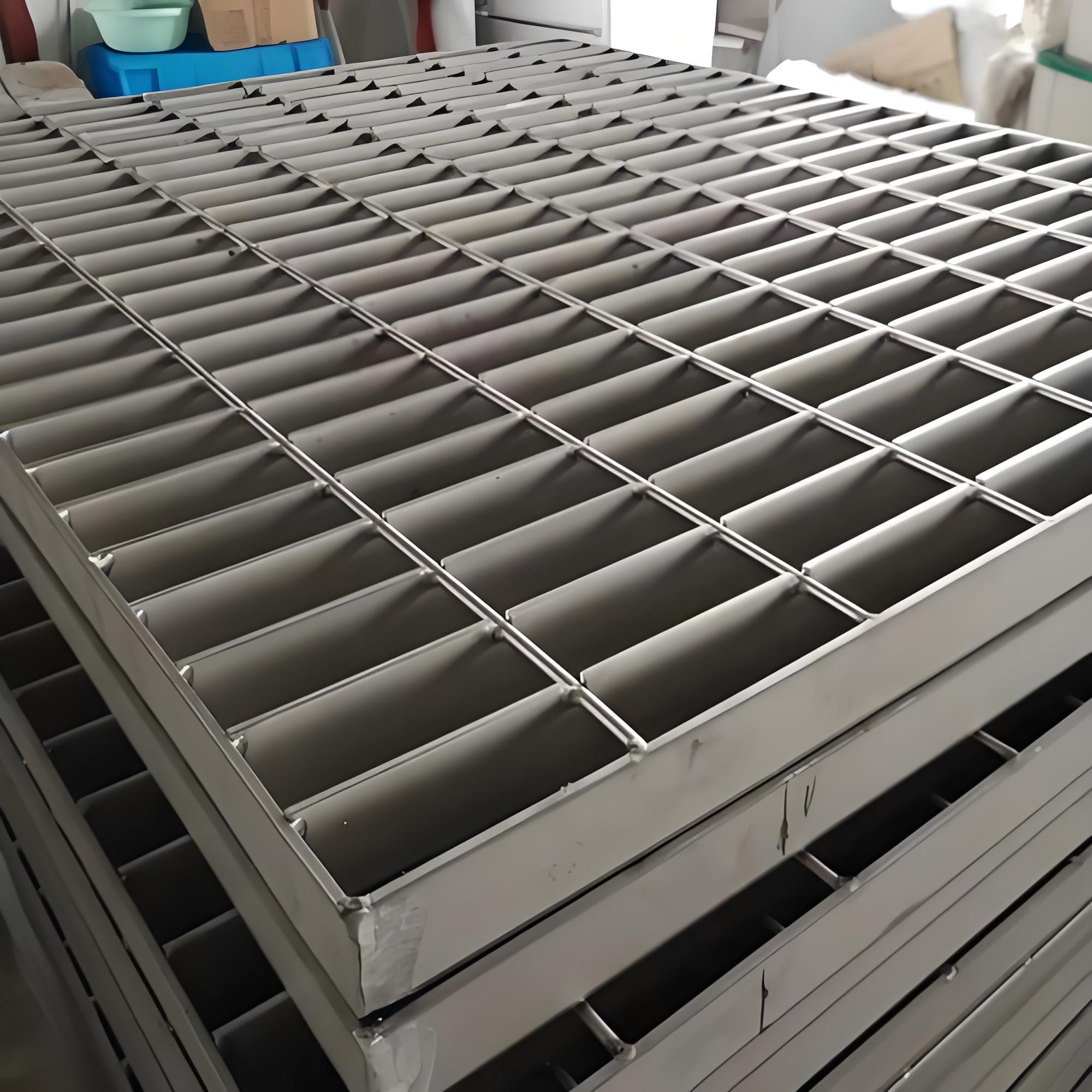
Factory price should be compared by complete specification, not by the phrase “40×5 grating” alone. A 40×5 panel with 30×50 mesh, serrated bars, hot-dip galvanizing, toe plates, and cutouts contains far more material and labor than a plain 40×5 panel with 40×100 mesh and no fabrication.
| 40×5 Grating Type | Indicative Factory Budget Range | Typical Price Basis |
|---|---|---|
| Smooth carbon steel, mill finish | US$48–80/m² | Standard welded grating body, excluding freight and special fabrication |
| Smooth hot-dip galvanized carbon steel | US$58–98/m² | Depends on mesh, panel weight, zinc coating, and order quantity |
| Serrated hot-dip galvanized carbon steel | US$64–108/m² | Higher due to serrated bearing bars and added processing |
| 304 stainless steel | US$150–250/m² | Grade, finish, welding, and certification can materially change price |
| 316 stainless steel | US$210–330/m² | Commonly selected for demanding corrosion environments |
These figures are preliminary factory budget ranges, not fixed quotations. Actual prices can change with raw steel cost, zinc price, stainless alloy pricing, currency movement, manufacturing route, stock availability, total quantity, lead time, export packing, certification, and Incoterm.
The most important factors affecting a 40×5 heavy-duty grating quotation are:
For an accurate quote, provide the grating layout or drawing, panel sizes, bar direction, mesh, material, finish, quantity, required load, clear span, and all fabrication details. A factory can then calculate net area, gross steel weight, cutting loss, galvanizing requirement, and packing needs correctly.
Is 40×5 grating strong enough for forklift traffic?
40×5 grating may be suitable for some forklift applications, but the bearing bar size alone is not enough to confirm it. The factory or project engineer needs the wheel load, tire contact area, axle arrangement, impact allowance, grating span, support frame details, and deflection limit. A panel that works for a uniform industrial load may not be safe for repeated forklift wheels.
How much does 40×5 steel grating weigh per square meter?
For 40×5 bearing bars at 30 mm centers with 100 mm cross bar spacing, the finished bare grating body commonly weighs about 56–59 kg/m². A 40×5 panel with 40 mm bearing-bar spacing is lighter, often around 43–46 kg/m². Actual weight changes with cross bar type, edge banding, cutouts, toe plates, and galvanizing.
What mesh is best for 40×5 heavy-duty grating?
30×100 mm is a widely used choice for heavy industrial platforms because it provides a strong, stable pattern with good drainage. Use 30×50 mm when a denser cross-bar pattern is needed, and consider 40×100 mm when lower weight and a more open surface are more important. The best mesh depends on load, wheel size, drainage, open-area requirements, and the project’s safety criteria.
