
11W4 steel grating is a close-mesh welded bar grating with bearing bars spaced 11/16 inch on center and cross bars spaced 4 inches on center. It is widely specified for public walkways, access routes, industrial flooring, drainage areas, platforms, and places where a narrower opening is needed for small wheels, high heels, or accessibility-focused designs. For factory budgeting, 11W4 grating normally costs more than standard 19W4 grating because it uses substantially more bearing bars per square meter. A typical factory reference range is about US$35–70/m² for smooth carbon steel, US$48–88/m² for hot-dip galvanized carbon steel, and US$55–100/m² for serrated galvanized 11W4 grating. Final prices depend on bearing bar size, material weight, finish, panel size, fabrication, quantity, packing, and shipping terms.
11W4 is a North American-style designation commonly used for welded steel bar grating. Each part of the designation describes the grating pattern:
| Designation Part | Meaning | Approximate Metric Value |
|---|---|---|
| 11 | Bearing bars are spaced 11/16 inch on center | 17.46 mm on center |
| W | Welded construction; cross bars are forge-welded to the bearing bars | Welded bar grating |
| 4 | Cross bars are spaced 4 inches on center | 101.6 mm on center |
The bearing bars are the vertical flat bars that carry the main load across the support span. Their depth and thickness determine most of the structural capacity of the grating. Cross bars hold the bearing bars at the required spacing, improve panel stability, and create the finished grid pattern.
An 11W4 designation alone is not a complete specification. A buyer must also identify the bearing bar depth, bearing bar thickness, bar type, material grade, surface style, panel dimensions, span direction, finish, and fabrication requirements. For example, “11W4, 1-1/4 × 3/16 inch serrated bearing bars, carbon steel, hot-dip galvanized after fabrication” is much more useful than simply requesting “11W4 grating.”
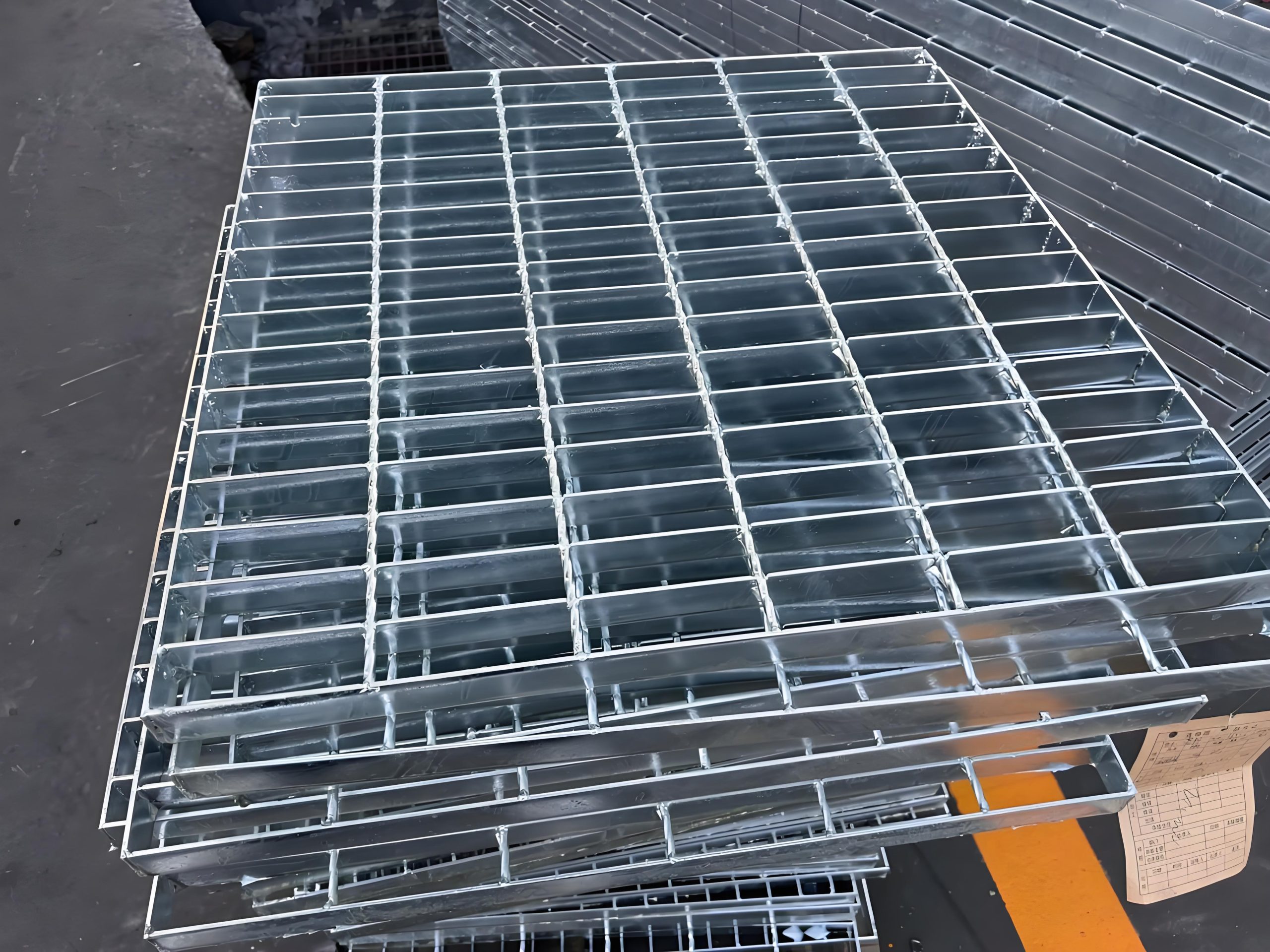
Close-mesh grating is selected when the opening between bearing bars matters as much as the load capacity. With bearing bars at 11/16 inch centers, the clear opening depends on the bar thickness.
A common 11W4 configuration uses 3/16 inch thick bearing bars. In that case, the nominal clear opening between adjacent bearing bars is approximately 1/2 inch:
11/16 inch bar spacing − 3/16 inch bearing bar thickness = 1/2 inch clear opening
This is one reason 11W4 is frequently chosen for accessible walking surfaces, public areas, maintenance paths, and places where narrow wheels or narrow heels may pass over the grating. A thinner 1/8 inch bearing bar creates a wider opening, approximately 9/16 inch, even though the nominal bearing bar pitch remains 11/16 inch.
| Bearing Bar Thickness | 11W4 Bearing Bar Pitch | Approximate Clear Opening | Typical Consideration |
|---|---|---|---|
| 1/8 inch | 11/16 inch | 9/16 inch | Light-duty close-mesh use where accessibility opening limits do not control |
| 3/16 inch | 11/16 inch | 1/2 inch | Common selection for public and accessibility-focused walking surfaces |
| 1/4 inch | 11/16 inch | 7/16 inch | Higher-strength or special-duty grating with a smaller opening |
For an accessible route, the entire installation must be reviewed, not only the grating designation. Opening direction, panel stability, elevation changes, surrounding floor conditions, local code requirements, and the dominant direction of travel all matter. Long grating openings are generally oriented perpendicular to the main direction of travel. A close-mesh product can support an accessibility-focused design, but the project team should confirm the complete installed assembly against the applicable code.
Standard industrial 19W4 grating has bearing bars at 1-3/16 inches on center. It provides high open area and efficient drainage, but its openings can be too wide for some public-facing routes, narrow cart wheels, wheelchairs, rolling equipment, heels, and small objects.
11W4 reduces the bearing bar spacing from 1-3/16 inches to 11/16 inch. The narrower opening provides a more continuous walking surface and improves support for small wheels. It is often considered for:
The tighter mesh does involve tradeoffs. It increases steel weight, lowers open area, costs more than standard spacing, and can retain more debris than a more open grating pattern. For a dirty outdoor location with leaves, snow, heavy sediment, or process debris, the drainage and cleaning requirements should be considered before choosing close-mesh grating.
19W4 and 11W4 both use welded construction and 4-inch cross bar spacing. The primary difference is the bearing bar spacing. A 19W4 panel has bearing bars at 1-3/16 inch centers, while an 11W4 panel has them at 11/16 inch centers.
| Feature | 11W4 Steel Grating | 19W4 Steel Grating |
|---|---|---|
| Bearing bar spacing | 11/16 inch on center | 1-3/16 inch on center |
| Cross bar spacing | 4 inches on center | 4 inches on center |
| Clear opening with 3/16 inch bars | About 1/2 inch | About 1 inch |
| Open area | Usually around 70%, depending on bar profile | Often around 77–80%, depending on bar profile |
| Steel weight | Higher because more bearing bars are required | Lower with the same bearing bar size |
| Typical use | Public routes, carts, small wheels, close-mesh flooring | General industrial platforms and walkways |
| Relative factory cost | Usually higher | Usually more economical |
With the same bearing bar profile, 11W4 commonly uses about 40–65% more steel than 19W4 after the whole grating body is considered. The exact difference is not simply the ratio of bar spacing because both products use cross bars, welds, trim, and edge banding. Still, the tighter bearing-bar pitch is the main reason an 11W4 quotation is normally higher than an equivalent 19W4 quotation.
For a standard industrial platform where drainage and low cost are the priorities, 19W4 may be the better choice. For a path used by pedestrians, carts, wheelchairs, or small-wheeled equipment, 11W4 can justify its higher material cost by providing a smaller opening and a more comfortable walking surface.
Bearing bar size should be selected from the actual clear span, required design load, allowable deflection, support layout, and local project standard. The first dimension is the bearing bar depth; the second is the thickness.
| Common Bearing Bar Size | Approximate Metric Size | Typical Use |
|---|---|---|
| 3/4 × 1/8 inch | 19 × 3 mm | Light-duty, short-span panels |
| 3/4 × 3/16 inch | 19 × 5 mm | Close-mesh light to medium-duty applications |
| 1 × 1/8 inch | 25 × 3 mm | Short-span walkways and platforms |
| 1 × 3/16 inch | 25 × 5 mm | Common close-mesh industrial flooring |
| 1-1/4 × 1/8 inch | 32 × 3 mm | Longer-span pedestrian and platform use |
| 1-1/4 × 3/16 inch | 32 × 5 mm | Higher-load close-mesh grating |
| 1-1/2 × 3/16 inch | 38 × 5 mm | Longer spans or heavier service conditions |
| 2 × 3/16 inch and above | 50 × 5 mm and above | Heavy-duty or specially engineered applications |
Increasing bar depth usually has the strongest effect on stiffness and load capacity. Increasing thickness also adds capacity, but it increases weight quickly. A deeper bar may be a more efficient solution than simply selecting a much thicker bar, provided the project can accept the greater grating depth.
The “4” in 11W4 means that the cross bars are spaced 4 inches, or approximately 101.6 mm, on center. In welded grating, cross bars may be twisted square bars, round bars, or formed cross rods, depending on the factory process and product standard.
Cross bars mainly lock the bearing bars into a stable grid. They also help distribute local contact forces across the panel and create the walking surface pattern. However, the bearing bars still carry the primary bending load between supports. Choosing a closer cross-bar spacing does not replace the need to select suitable bearing bar depth and thickness.
For applications involving small caster wheels, the panel should be reviewed for both bearing-bar spacing and cross-bar pattern. A wheel does not load the grating in the same way as a person walking across it. Small hard wheels can apply concentrated loads and may bridge only a few bars. A factory load table or engineering calculation is necessary for carts, wheeled bins, scissor lifts, mobile equipment, and forklift service.
11W4 grating is significantly heavier than standard 19W4 because the close-mesh pattern requires more bearing bars per square meter. Grating weight is important for price, lifting, support steel design, shipping, and installation planning.
The table below gives planning weights for smooth welded 11W4 carbon steel grating before hot-dip galvanizing, edge banding, cutouts, toe plates, and other fabrication. Actual factory weights can vary with cross-bar profile, production method, tolerances, and panel details.
| Bearing Bar Size | Approximate Weight per ft² | Approximate Weight per m² | General Weight Category |
|---|---|---|---|
| 3/4 × 1/8 inch | 6.1 lb/ft² | 29.8 kg/m² | Light close mesh |
| 3/4 × 3/16 inch | 9.1 lb/ft² | 44.4 kg/m² | Medium close mesh |
| 1 × 1/8 inch | 8.1 lb/ft² | 39.6 kg/m² | Light to medium duty |
| 1 × 3/16 inch | 11.9 lb/ft² | 58.1 kg/m² | Common heavy close mesh |
| 1-1/4 × 1/8 inch | 10.0 lb/ft² | 48.8 kg/m² | Deeper, moderate-thickness bar |
| 1-1/4 × 3/16 inch | 14.7 lb/ft² | 71.8 kg/m² | Higher-load close mesh |
| 1-1/2 × 3/16 inch | 17.7 lb/ft² | 86.4 kg/m² | Heavy-duty close mesh |
A simplified way to estimate the main bearing-bar mass is:
Bearing-bar mass per m² ≈ 7.85 × bearing bar depth (mm) × thickness (mm) ÷ bearing bar pitch (mm)
This quick calculation only estimates the primary bearing bars. It does not include cross bars, forge-weld material, edge banding, cutout reinforcement, toe plates, bolts, clips, zinc coating, or packing. A factory weight list should be used for purchasing, shipping, and structural design.
11W4 steel grating is generally quoted by square meter, square foot, panel, piece, or metric ton. Comparing prices only by square meter can be misleading unless the bearing bar size and weight are identical. A 1 × 3/16 inch 11W4 panel contains much more steel than a 3/4 × 1/8 inch 11W4 panel, even though both carry the same spacing designation.
| Typical 11W4 Product | Indicative Factory Budget Range | Approximate Price per ft² | Notes |
|---|---|---|---|
| Smooth carbon steel, mill finish | US$35–70/m² | US$3.25–6.50/ft² | Large-order reference for standard panels; excludes freight and special fabrication |
| Smooth hot-dip galvanized carbon steel | US$48–88/m² | US$4.50–8.20/ft² | Depends strongly on steel weight, zinc coating, and quantity |
| Serrated hot-dip galvanized carbon steel | US$55–100/m² | US$5.10–9.30/ft² | Serration, heavier bars, and fabrication increase cost |
| 304 stainless steel 11W4 | US$120–220/m² | US$11.15–20.45/ft² | Used where corrosion resistance or hygiene is important |
| 316 stainless steel 11W4 | US$175–300/m² | US$16.25–27.90/ft² | Often selected for marine, chloride, and aggressive chemical environments |
These ranges are intended for preliminary budgeting only. They are not fixed market quotations. Steel coil prices, zinc prices, exchange rates, order volume, factory capacity, delivery schedule, Incoterms, export packaging, destination port, certification, and project-specific fabrication can materially change the final price.
To calculate the approximate cost of a panel, multiply its net area by the quoted price per square meter, then add the cost of banding, cutouts, hardware, special finishing, packaging, and delivery. For example, a 1.0 × 2.0 m panel has a net area of 2.0 m². If the quoted price is US$68/m² for a galvanized 11W4 specification, the grating body value is about US$136 before fabrication and freight.
Carbon steel is the most economical base material for 11W4 grating. It provides high strength and is easy to weld, cut, band, and fabricate. Mill-finish carbon steel is suitable for dry indoor installations, temporary works, or projects where painting will be completed after installation. It is not usually the best choice for wet outdoor service without a suitable protective system.
Hot-dip galvanized carbon steel is the most common choice for outdoor industrial grating. The grating is fabricated first, then immersed in molten zinc so that weld zones, cut edges, and banding receive protective coating. This process is generally preferred for outdoor platforms, catwalks, access routes, utility areas, wastewater facilities, and exposed steel structures.
The galvanizing cost is affected by total steel surface area, coating requirement, zinc consumption, handling, venting, drainage, rework, inspection, and the size of the fabricated panels. A closely spaced 11W4 panel has more steel surface than a more open 19W4 panel of the same overall dimensions, so its galvanized price reflects both higher steel mass and higher coating work.
Stainless steel 11W4 grating has a higher initial price but can offer a lower maintenance burden in severe environments. Type 304 stainless steel is widely used for food processing, commercial washdown areas, indoor wet zones, and general corrosion resistance. Type 316 stainless steel is more suitable where chlorides, saltwater, coastal exposure, or more aggressive chemicals are present.
Stainless grating should be specified carefully because the selected grade, surface finish, welding procedure, pickling or passivation requirement, and required material certificates can significantly affect cost. Carbon steel with hot-dip galvanizing is usually more economical for ordinary outdoor service; stainless steel becomes more attractive where coating breakdown, contamination, or frequent replacement would be costly.
Smooth 11W4 grating has flat bearing bar tops. It is common for dry indoor platforms, equipment supports, trench covers, and applications where cleaning is important. Serrated 11W4 grating has notches or teeth along the top edge of the bearing bars to improve traction.
| Surface Type | Advantages | Typical Cost Effect |
|---|---|---|
| Smooth bearing bars | Lower cost, easier cleaning, less likely to trap residue | Base price |
| Serrated bearing bars | Better traction in wet, oily, icy, or sloped areas | Often adds about 8–20%, depending on size and quantity |
Serrated grating is often selected for outdoor stairs, ramps, oil and gas platforms, wastewater facilities, marine work areas, loading zones, and places where shoes may carry water, mud, grease, snow, or process residue. For dry indoor pedestrian areas, smooth grating can be sufficient and may be easier to clean.
A serrated surface improves slip resistance but does not remove the need for good drainage, maintenance, lighting, handrails, proper support, and safe access design. Surface choice should reflect the real site conditions rather than simply selecting the lowest-cost option.
Grating load capacity depends on much more than the 11W4 mesh pattern. The bearing bar section, clear span, support arrangement, load type, deflection limit, material yield strength, and safety factor all matter.
The bearing bars must run in the span direction. In other words, bearing bars should extend from one support to the next support. If a grating panel is rotated 90 degrees from the intended design direction, its load capacity can be greatly reduced even though the panel dimensions and mesh pattern appear unchanged.
| Design Factor | Why It Matters |
|---|---|
| Clear span | The unsupported distance between supports under the bearing bars; longer spans require deeper or thicker bars |
| Bearing bar depth | Greater depth generally provides substantially higher bending stiffness |
| Bearing bar thickness | Increases steel area, weight, and structural capacity |
| Uniform load | Represents distributed pedestrian, storage, or equipment loads over an area |
| Concentrated load | Important for point loads, carts, wheels, legs, tools, and localized equipment loads |
| Deflection limit | Controls serviceability, walking comfort, drainage slope performance, and perceived stiffness |
| Support condition | Continuous support, simple support, clips, welded connections, and bearing width affect panel behavior |
A load table may show that a specific bearing bar is strong enough for a stated uniform load at one span but not at a longer span. It may also pass a strength check while deflecting more than the project permits. For this reason, a price request should always include the clear span and design load rather than only the panel length and width.
Vehicle, forklift, pallet-jack, scissor-lift, and high point-load applications require special review. Close-mesh 11W4 can improve support for narrow wheels, but the correct bearing bar section and support frame remain essential. A manufacturer’s current load table or project engineering calculation should be used before release for fabrication.
Common grating panel widths often include 2 ft, 3 ft, and 4 ft, while standard manufacturing lengths may extend to 20 ft or 24 ft depending on factory equipment and handling limits. Metric projects may use panel widths such as 600 mm, 800 mm, 1,000 mm, or 1,200 mm with lengths selected to suit the support layout.
Close-mesh 11W4 may have less immediate stock availability than standard 19W4 because 19W4 is widely used for general industrial flooring. However, many grating factories can produce 11W4 efficiently when the order has clear dimensions, quantity, bar size, surface type, and finish requirements.
Stock panels can reduce lead time for simple rectangular pieces, but stock availability should always be confirmed for the exact bar size and finish. A 1 × 3/16 inch galvanized 11W4 panel is not interchangeable with a 1-1/4 × 3/16 inch galvanized 11W4 panel simply because both use the same spacing designation.
Many 11W4 grating orders require custom fabrication to fit pipe penetrations, columns, drains, handrail posts, equipment bases, irregular walls, curved edges, or existing structural steel. Fabrication usually adds cost because it involves layout, cutting, welding, banding, grinding, dimensional inspection, and sometimes secondary galvanizing repair or recoating.
| Fabrication Item | Purpose | Typical Cost Effect |
|---|---|---|
| Edge banding | Closes exposed bearing bar ends and strengthens panel edges | Moderate additional material and welding cost |
| Pipe cutout | Allows grating to fit around pipework or supports | Depends on shape, size, quantity, and required banding |
| Notch or corner cut | Fits columns, walls, equipment, or structural members | Usually lower than complex curved cutouts |
| Toe plate | Helps prevent objects from falling from elevated walkways | Adds plate steel, welding, and finish cost |
| Weld lugs or clips | Provides removable or fixed installation points | Depends on quantity and connection design |
| Custom frame | Supports trench covers or removable access panels | Can be a major part of the finished system cost |
For hot-dip galvanized grating, it is usually more economical to complete cutting, welding, banding, and fabrication before galvanizing. Cutting or welding after galvanizing can expose steel, damage the zinc coating, and require repair work. If field modifications are unavoidable, the repair method should be agreed on in advance.
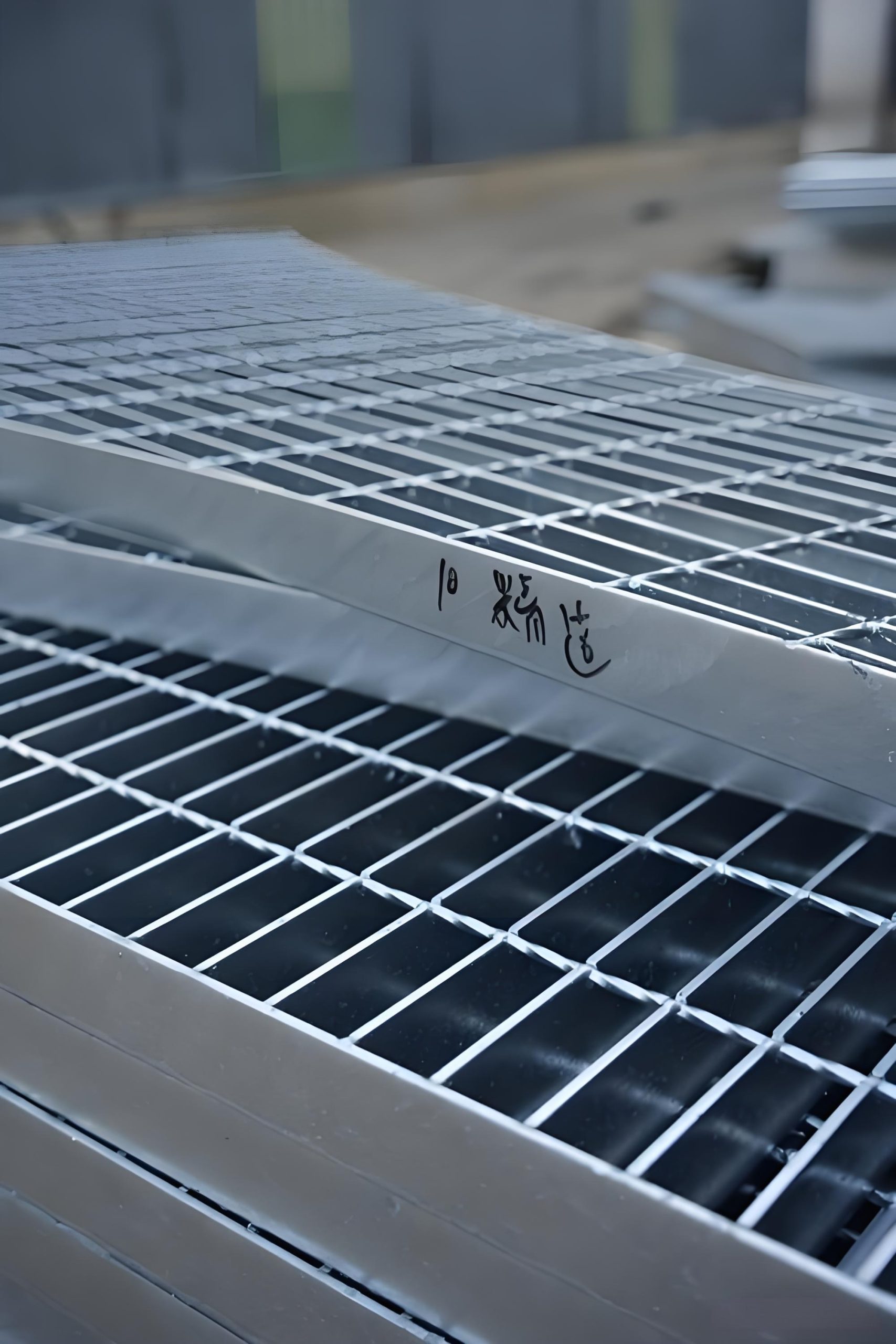
A complete request allows the factory to provide a realistic price, correct weight, workable manufacturing drawing, and suitable load recommendation. The following information should be included whenever possible:
The most useful quote request describes the performance requirement first and the physical size second. For example, state whether the grating will span 1.2 m between supports and carry pedestrian traffic, rolling carts, or equipment loads. This enables the factory to check whether the requested 11W4 bar size is suitable instead of merely pricing an incomplete pattern.
Is 11W4 grating ADA compliant?
11W4 grating with 3/16 inch thick bearing bars provides an approximate 1/2 inch clear opening, which is commonly used for accessibility-focused grating designs. However, a grating product is not automatically compliant in every installation. Opening orientation, direction of travel, panel stability, surrounding conditions, local code interpretation, and the complete walking surface must also meet the applicable requirements.
How much heavier is 11W4 than 19W4 grating?
With the same bearing bar size and 4-inch cross bar spacing, 11W4 is commonly about 40–65% heavier than 19W4 because it contains more bearing bars per square meter. The exact difference depends on the bearing bar profile, cross-bar type, edge banding, and fabrication details.
What is the best bearing bar size for 11W4 steel grating?
There is no single best size for every project. A 1 × 3/16 inch or 1-1/4 × 3/16 inch bearing bar is commonly used for close-mesh industrial flooring, but the correct choice depends on clear span, design load, concentrated wheel loads, deflection limit, and support arrangement. The selected size should be verified against a current load table or project engineering calculation.
