
Welded stainless steel grating is an open, load-bearing floor product made by joining stainless steel bearing bars and cross bars with controlled resistance welding. It is used for platforms, walkways, stairs, trench covers, drainage floors, food-processing areas, chemical plants, marine structures, wastewater facilities, and other locations where corrosion resistance and structural strength are both important. The factory price per square meter depends on the stainless grade, bearing bar size, mesh spacing, panel weight, plain or serrated surface, fabrication method, surface finish, custom cutouts, quantity, inspection documents, packing, and delivery terms. A reliable quotation should identify the complete construction instead of listing only “304 stainless grating” or “316 grating.”
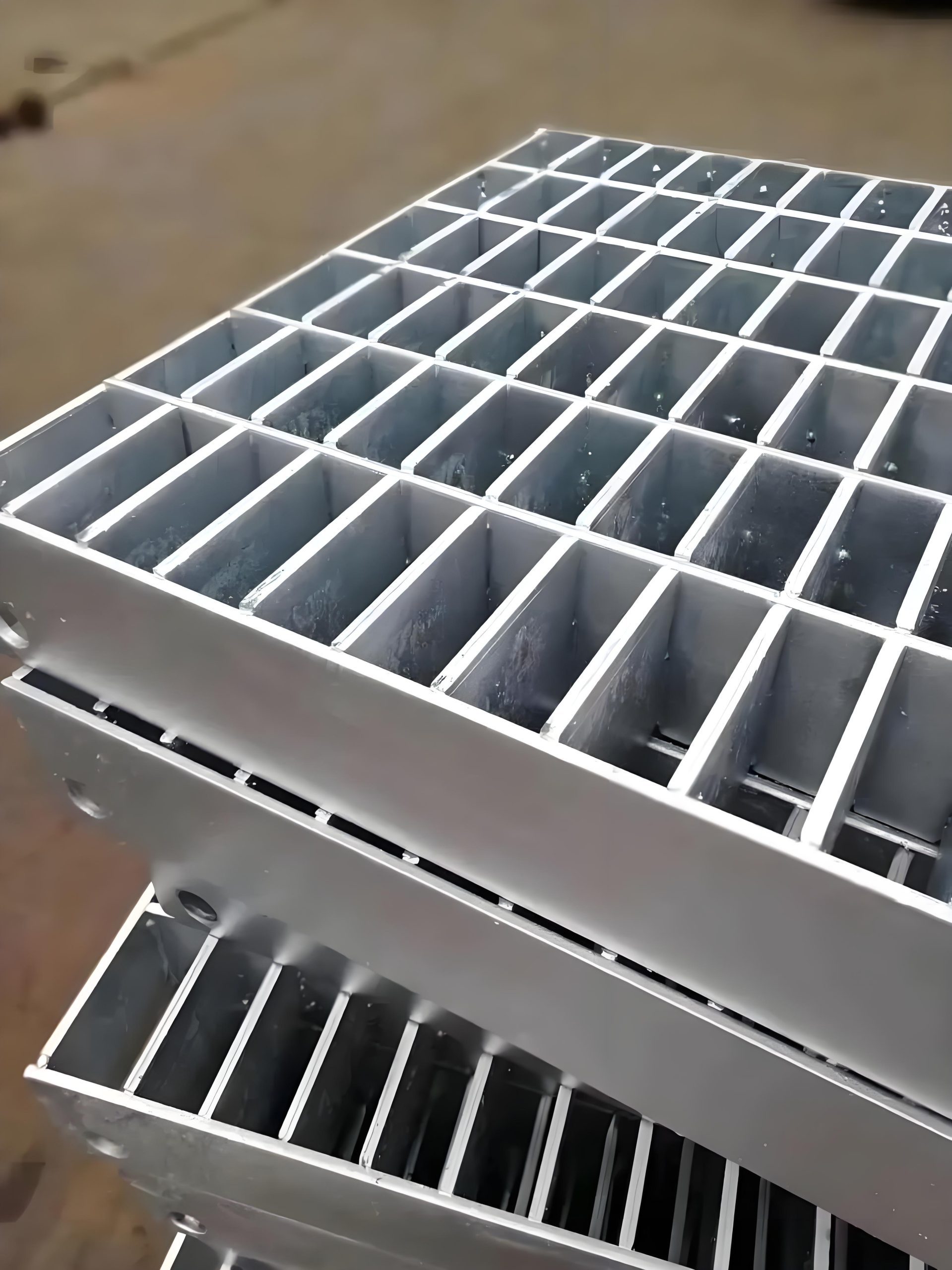
Welded stainless steel grating consists of parallel bearing bars connected by perpendicular cross bars. The bearing bars span between supports and carry most of the applied load. Cross bars hold the bearing bars at a consistent pitch, add lateral stability, and form the open mesh.
Unlike painted or galvanized carbon steel grating, stainless steel grating relies primarily on the corrosion resistance of the alloy rather than an external zinc or paint coating. This makes it useful in washdown areas, hygienic production spaces, marine environments, chemical service, and outdoor installations where coating damage could expose ordinary steel.
| Grating Part | Main Function | Typical Specification |
|---|---|---|
| Bearing Bar | Primary structural member spanning between supports | Height, thickness, pitch, material grade, plain or serrated top |
| Cross Bar | Maintains spacing and stabilizes the panel | Twisted square, round, flat, reticulated, diameter, pitch |
| Edge Banding | Closes exposed bar ends and reinforces the perimeter | Flat bar size, weld detail, perimeter length |
| Support Frame | Provides a bearing seat and transfers load to the structure | Angle or channel size, frame dimensions, anchors |
| Toe Plate | Limits falling tools and materials at platform edges | Height, thickness, folded or flat profile |
| Fastening Hardware | Prevents movement, lifting, rattling, or theft | Clips, bolts, saddle clamps, locks, hinges |
During production, bearing bars are placed in a welding machine and cross bars are fused at the specified intersections. Resistance welding uses controlled electrical current, pressure, and heat to create a permanent connection. The weld pattern keeps the panel rigid during handling and helps share local forces between adjacent bars.
The bearing bars must be installed in the direction of the structural span. If the panel is turned so that the bars run parallel to the supports, the effective span can become much longer than intended. This can lead to excessive deflection, loose connections, or failure even when the material and bar size are correct.
The open mesh allows water, air, light, dust, and process liquids to pass through the floor. This reduces standing water and can improve ventilation around pumps, tanks, motors, conveyors, and other equipment. The actual drainage performance depends on clear opening, slope, debris, flow rate, and the drainage system below the grating.
304 and 316/316L are the most common stainless grades for welded grating. The primary difference is corrosion resistance, not whether the panel is structurally heavy duty. Load capacity is controlled by bearing bar geometry, mesh, clear span, support conditions, and design load. The stainless grade determines how the finished panel performs in its environment and how much the raw material costs.
| Grade | Typical Environment | Advantages | Relative Price |
|---|---|---|---|
| 304 Stainless Steel | Indoor industrial areas, moderate washdown, food facilities, general outdoor service | Good general corrosion resistance and broad availability | Lower than 316/316L |
| 316 Stainless Steel | Marine, coastal, chloride-rich, chemical and wastewater environments | Better resistance to chloride pitting and crevice corrosion | Higher than 304 |
| 316L Stainless Steel | Welded marine, chemical, food, pharmaceutical and hygienic fabrications | Lower carbon grade often preferred for welded assemblies | Usually similar to or slightly above 316 |
304 is often selected for indoor platforms, food and beverage areas with controlled cleaning chemistry, pharmaceutical support floors, architectural walkways, equipment access, and moderate outdoor exposure. It offers a good balance between corrosion resistance and material cost when the environment does not contain high chloride levels or aggressive chemical exposure.
304 can be the more economical lifecycle choice when the site is dry or moderately humid. Paying for 316 in an environment that does not need its chloride resistance can raise the initial cost without producing a practical benefit.
316 contains molybdenum, which improves resistance to chloride-related pitting and crevice corrosion. It is commonly considered for coastal platforms, marine decks, salt-handling areas, desalination plants, wastewater treatment facilities, chemical washdown zones, and outdoor structures exposed to salt spray.
316L has a lower carbon content and is often selected for welded fabrications where post-welding corrosion performance and project material requirements are important. It is not automatically stronger than 304, and it does not resist every chemical. The buyer should provide chemical concentration, temperature, exposure time, cleaning agents, and whether the grating is splashed, washed, or immersed.
As a broad budgeting rule, 316 or 316L grating may cost approximately 20% to 50% more than an equivalent 304 panel, although the difference can be smaller or much larger depending on alloy availability, order quantity, bar weight, finish, and market conditions. A 316 panel with heavier bearing bars and electropolishing can cost considerably more than a simple 304 panel even when the outside dimensions are identical.
For a more detailed grade comparison, buyers can review this 304 and 316 stainless steel bar grating guide.
Neither 304 nor 316L is universally resistant to acids, hot chlorides, concentrated cleaning chemicals, or stagnant deposits. Crevices beneath clips, trapped salt, poor drainage, and contamination from carbon steel tools can cause localized corrosion. Material selection should be based on the actual service environment rather than the general label “stainless.”
Welded, press-locked, and swage-locked grating are different manufacturing constructions. Each can be made from stainless steel, but the appearance, production route, joint behavior, and price are different.
| Construction | How It Is Made | Typical Advantages | Cost and Selection Notes |
|---|---|---|---|
| Welded | Cross bars are resistance welded to bearing bars | Rigid one-piece panel, efficient production, broad industrial availability | Often the most economical stainless option for standard industrial panels |
| Press-Locked | Cross bars are pressed into pre-notched bearing bars | Flush appearance, close mesh, clean architectural lines | Notching and pressing can add tooling and setup cost |
| Swage-Locked | Cross bars are mechanically locked into bearing bars by swaging | Uniform appearance and flexible cross-bar patterns | Exact load data and manufacturing method should be confirmed |
| Riveted | Formed bars are connected by mechanical rivets | Useful for selected rolling-load and specialty applications | Usually more labor-intensive and higher cost |
Welded stainless grating is widely available, can be produced in standard and custom sizes, and provides a rigid panel with good resistance to handling and normal industrial traffic. The factory can add plain or serrated bearing bars, banded edges, frames, stair nosings, cutouts, and drain-cover details before final finishing.
Press-locked grating can provide a more uniform and architectural appearance, especially when flat cross bars create a flush surface. It is often considered for food facilities, interior platforms, architectural floors, shelving, and close-mesh applications. A clean appearance does not automatically indicate a higher load capacity. The exact bearing bar size, pitch, span, and manufacturer load table still control the design.
Swage-locked grating uses mechanical deformation to secure the cross bars. It may be selected when the project needs a particular visual pattern, cross-bar profile, or non-welded appearance. Buyers should ask how the connections are verified and which load table applies to the selected stainless grade and bar geometry.
Welded grating is not automatically stronger than every press-locked or swage-locked panel, and a mechanically locked panel is not automatically weaker. The correct comparison must use the actual product data, bearing bar size, mesh, span, support, and load type. For stainless steel, welding quality and post-weld cleaning can have a major effect on corrosion performance.
The bearing bar is the main load-carrying member in welded stainless steel grating. Its height, thickness, spacing, and span direction determine much of the panel’s structural behavior and weight.
| Illustrative Bearing Bar Size | Typical Use Discussion | Relative Material Consumption |
|---|---|---|
| 25 x 3 mm | Light platforms and short spans with modest loads | Low |
| 30 x 3 mm | General walkways and indoor access floors | Low to moderate |
| 32 x 5 mm | Medium industrial platforms and stronger pedestrian floors | Moderate |
| 40 x 5 mm | Heavier platforms, stair treads, and maintenance floors | Moderate to high |
| 50 x 5 mm | Longer spans or higher loads after table verification | High |
| 60 x 6 mm and above | Heavy equipment floors, covers, and project-specific high loads | Very high |
Increasing bearing bar height generally increases bending stiffness and reduces deflection over a given clear span. A 50 mm deep bar can perform very differently from a 30 mm deep bar, even when the thickness is the same.
A deeper bar also increases panel depth. This can affect frame recesses, stair risers, drainage-channel dimensions, floor elevations, clearance beneath the grating, and the weight of removable panels.
Thickness increases steel area, local strength, damage resistance, and panel weight. Changing a 40 x 5 mm bar to a 40 x 6 mm bar adds 20% to the bearing bar area before cross bars, banding, frames, and finishing are considered.
Because stainless steel costs more per kilogram than carbon steel, a small increase in thickness can have a visible effect on price per square meter. The most economical design is usually the smallest bar that meets the approved load and deflection requirements.
Common bearing bar pitches include approximately 19 mm, 25 mm, 30 mm, and 40 mm. A closer pitch provides more bearing bars beneath a local load and reduces the clear opening. A wider pitch increases open area and lowers material consumption but may be unsuitable for small wheels, narrow heels, or small objects.
Mesh designations such as 30 x 100 mm and 30 x 50 mm normally identify the bearing bar pitch first and the cross bar pitch second. The actual clear opening is smaller than the nominal pitch because the bars occupy part of the space.
For preliminary budgeting, the bearing bar contribution can be estimated using stainless steel density of approximately 7,900 kg/m3:
Approximate bearing bar weight (kg/m2) = 7.9 x bearing bar height (mm) x thickness (mm) / bearing bar pitch (mm)
This formula excludes cross bars, banding, frames, clips, and other fabrication. For example, 50 x 5 mm bearing bars at a 30 mm pitch contribute approximately 65.8 kg/m2 before those additions. The finished panel may weigh 10% to 25% more depending on cross-bar size and edge details.
Stainless grating price per square meter is closely related to finished weight. Two panels with the same outside dimensions can have very different costs if one uses deeper bearing bars, closer spacing, thicker cross bars, or extensive banding.
| Weight Factor | Effect on Finished Panel | Effect on Factory Price |
|---|---|---|
| Deeper Bearing Bars | Higher stiffness and greater panel depth | More stainless material and heavier handling |
| Thicker Bearing Bars | Greater steel area and local strength | Direct increase in stainless consumption |
| Closer Bearing Bar Pitch | Smaller opening and more bars sharing local loads | Higher bar count and fabrication time |
| Closer Cross Bar Pitch | More transverse support and smaller openings | More cross-bar material and welding |
| Edge Banding | Reinforced and finished panel perimeter | Additional stainless bar, welds, and finishing |
| Frames and Reinforcement | Improved support or cutout strength | Can dominate the cost of small panels and drain covers |
A supplier quoting US$200 per square meter for a 30 kg/m2 panel is not offering the same product as a supplier quoting US$200 per square meter for an 80 kg/m2 panel. The second quotation may be incomplete, or the first panel may not meet the required load.
Ask every supplier to state the estimated finished weight per square meter and per panel. Confirm whether the weight includes cross bars, banding, frames, stair nosings, clips, and accessories. This makes it easier to compare technically equivalent offers.
Heavy stainless panels cost more to pack and ship. A 1,000 x 3,000 mm panel with a finished weight of 70 kg/m2 weighs approximately 210 kg before crating. This may require a forklift, lifting beam, dedicated lifting points, stronger pallets, and additional labor during installation.
Welded stainless steel grating should be selected from a load table or engineering calculation that matches the exact panel construction. Material grade alone does not determine capacity.
| Design Item | Meaning | Why It Matters |
|---|---|---|
| Clear Span | Unsupported distance between the actual supports | Controls bending stress and deflection |
| Bearing Direction | Direction in which bearing bars span | Incorrect orientation can sharply reduce capacity |
| Support Width | Seating area beneath each panel end | Prevents edge damage and panel displacement |
| Uniform Load | Load spread over a broad floor area | Common for platforms and walkways |
| Point Load | Load applied over a small area | Important for machine feet, racks, and equipment legs |
| Wheel Load | Moving or static load applied by a wheel | Requires tire, axle, contact area, and traffic information |
| Deflection Limit | Maximum permitted movement under the design load | May require a larger bar even when strength is adequate |
A panel that is 3,000 mm long may have a 750 mm clear span if intermediate beams support it. The same panel could have a 3,000 mm clear span if it rests only at its ends. Those two installations require different bearing bar sizes and produce different load-table results.
Pedestrian platforms are often designed for a uniform live load and a specified concentrated load. Equipment floors may require additional checks for machine feet, rack legs, drums, tanks, or maintenance tools. A concentrated load can stress only a small group of bearing bars and may be more severe than the same total load spread over the floor.
Forklifts, pallet jacks, carts, and service vehicles require wheel-load information. Provide the maximum wheel load, wheel diameter, tire width, tire material, wheel spacing, traffic direction, turning movement, travel speed, and frequency. A grating that supports people may not support a hard-wheeled cart or forklift.
Excessive deflection can cause a noticeable bounce, loose clips, tire impact at joints, noise, water ponding, or damage to nearby equipment. Project requirements may specify a span-to-deflection ratio or a fixed maximum movement. The factory should use the governing project criterion rather than assuming that a general walkway limit applies to every application.
The support beam or frame also deflects under the applied load. A strong grating panel resting on a flexible angle or thin channel may not perform as expected. The grating, frame, concrete ledge, anchors, and surrounding structure should be reviewed as one load path.
Plain grating has a smooth bearing bar top. Serrated grating has notches or teeth along the top edge to improve traction. Both surfaces can be manufactured in 304, 316, or 316L stainless steel.
| Surface | Typical Application | Advantages | Trade-Offs |
|---|---|---|---|
| Plain | Dry indoor floors, food areas, cart routes, cleanrooms, architectural platforms | Smoother rolling, easier cleaning, uniform appearance | Less traction in wet, oily, icy, or contaminated areas |
| Serrated | Outdoor platforms, stairs, ramps, marine decks, wastewater and oily work areas | Improved grip for footwear in slippery conditions | Can retain debris and may be less comfortable for small wheels |
Serrated bearing bars are commonly selected for marine decks, outdoor stairs, wet process floors, wastewater plants, ramps, and locations exposed to oil, sludge, rain, snow, or washdown water. The teeth improve footwear traction when a smooth surface may become slippery.
Serration should not be treated as a complete safety system. Drainage, lighting, handrails, housekeeping, panel fixation, and maintenance remain important. A serrated profile can also make cleaning more difficult in food or hygienic areas, so the sanitation process should be considered before ordering.
Plain grating is often preferable for food processing areas, cleanrooms, indoor equipment platforms, cart routes, and locations where workers need to wash and inspect the surface frequently. It may also provide a smoother contact surface for wheels.
Serration removes a small amount of material from the top edge and changes the surface profile. The applicable manufacturer load table should identify whether the values apply to plain or serrated bars. Do not assume that a serrated panel has exactly the same capacity as a plain panel without checking the design data.
Stainless grating is often selected because it combines open drainage with a cleanable, corrosion-resistant surface. The mesh pattern must balance liquid flow, worker safety, wheel movement, debris retention, and hygiene.
Open grating allows washdown water and process liquids to leave the walking surface. This helps reduce puddles and can improve slip resistance. Drainage still depends on floor slope, channel capacity, outlet size, debris, and the cleaning schedule.
Food and pharmaceutical areas may require smooth welds, finished cut edges, minimal crevices, and a surface that can be cleaned without trapping residue. Plain bars are often easier to wash than serrated bars, but the final choice depends on the risk of slipping and the sanitation procedure.
Rough welds, uncleaned heat tint, carbon-steel contamination, and poorly detailed frames can create difficult-to-clean locations. These issues should be addressed in the fabrication and finishing specification.
A large opening may allow bolts, caps, product pieces, or tools to fall to a lower level. Closer mesh, toe plates, solid infill strips, or dedicated trays may be needed where falling-object risk is important. Very close mesh can reduce drainage and retain dirt, so the opening should be selected for the actual object size and cleaning method.
Stainless steel naturally forms a protective passive surface, but welding can create heat tint, oxide scale, and surface contamination around the joint. If these areas are not cleaned correctly, corrosion resistance near the weld may be lower than that of the original material.
Heat tint is the colored oxide layer that can appear beside a stainless weld. It may range from light gold to dark blue or gray. The appearance itself is not a complete measure of corrosion performance, but heavy oxide and contaminated weld zones should normally be removed where the project requires strong corrosion resistance or hygienic service.
Weld cleaning may include mechanical dressing, brushing with dedicated stainless tools, chemical pickling, electrolytic cleaning, or another approved method. The process should remove spatter, scale, embedded particles, and excessive discoloration without reducing the bearing bar section or creating sharp edges.
Stainless grating should be fabricated, stored, and handled in a way that limits contact with carbon-steel dust, grinding debris, slings, and tools that have been used on ordinary steel. Embedded iron particles can create rust stains that are sometimes mistaken for a failure of the stainless alloy.
Passivation supports the formation of a clean passive surface after the steel has been properly cleaned. It does not change 304 into 316, repair poor weld geometry, or make an incompatible chemical environment safe. Pickling and passivation should be specified separately when both are required.
Surface finish can have a significant effect on welded stainless steel grating price. The appropriate finish depends on corrosion exposure, hygiene, appearance, cleaning method, and project documentation.
| Finish | Purpose | Typical Application | Relative Cost |
|---|---|---|---|
| Mill Finish | Standard stainless surface after fabrication | General industrial floors and moderate environments | Lowest |
| Pickled | Removes heat tint, oxide scale, and weld contamination | Marine, chemical, wastewater, and corrosion-sensitive projects | Moderate |
| Passivated | Supports a clean passive surface after preparation | Food, pharmaceutical, marine, chemical, and documented projects | Moderate |
| Brushed or Polished | Improves appearance and surface uniformity | Architectural and visible interior installations | High |
| Electropolished | Produces a smoother, brighter, easier-to-clean surface | High-hygiene, laboratory, pharmaceutical, and specialty process areas | Highest |
Mill finish is usually the lowest-cost option. It may be suitable for general industrial grating where appearance and post-weld corrosion performance are not highly demanding. Welded areas can still show heat tint, and the surface may require additional cleaning before installation.
Pickling removes oxide scale and welding discoloration from the stainless surface. It is useful when the grating will be exposed to salt, chemical splash, washdown, or high humidity. Pickling requires controlled chemical handling, rinsing, neutralization, drying, and inspection.
Passivation is normally performed after suitable cleaning and, where specified, pickling. It supports the development of a clean chromium-rich passive surface. The process should be compatible with the stainless grade and the project environmental requirements.
Electropolishing can improve smoothness, cleanability, and visual appearance. It is more expensive than ordinary mill finish or passivation, especially when the grating includes large panels, many welds, frames, stair treads, cutouts, or complex fabricated sections.
Welded stainless steel grating is often selected for applications where corrosion, hygiene, and maintenance are more important than the lowest initial cost.
| Project Environment | Common Grade Direction | Important Considerations |
|---|---|---|
| Food and Beverage | 304 or 316L according to cleaners and chloride exposure | Cleanability, drainage, smooth welds, surface finish, residue control |
| Chemical Processing | Grade selected from chemical compatibility review | Concentration, temperature, splash, vapor, immersion, cleaning agents |
| Marine and Coastal | 316 or 316L is often evaluated | Salt spray, crevices, standing water, dissimilar-metal contact, drainage |
| Wastewater Treatment | 316L is often considered for corrosive wet service | Chlorides, biological deposits, gases, wet-dry cycles, washdown, slip resistance |
| Pharmaceutical and Clean Areas | 304 or 316L according to process requirements | Low-contamination surfaces, documentation, smooth details, cleanability |
| General Industrial Plant | 304 where exposure is moderate | Humidity, chemicals, traffic, maintenance frequency, panel handling |
Food plants often require frequent washdown and resistance to cleaning chemicals. The grating should provide sufficient drainage while remaining easy to clean. Plain surfaces, finished welds, pickled or passivated areas, and carefully detailed frames may be preferred. Serrated surfaces can be used where slip risk is high, but the sanitation procedure should confirm that residues will not collect in the teeth.
Stainless grade selection in a chemical plant should be based on the actual medium. Provide the chemical name, concentration, temperature, exposure frequency, splash or immersion condition, and cleaning method. 316L can be a good choice for many chloride-related environments, but it is not a universal solution for strong acids, hot concentrated chemicals, or severe crevice conditions.
Salt spray and deposits can attack stainless surfaces in crevices and poorly drained areas. 316 or 316L is commonly evaluated for marine platforms, docks, coastal plants, and offshore access systems. Support frames, clips, bolts, and adjacent metals should be selected to reduce galvanic and crevice-corrosion risks.
Wastewater plants combine moisture, chlorides, biological deposits, cleaning chemicals, and wet-dry cycles. 316L, serrated surfaces, pickling, passivation, and robust drainage are often considered, but the final selection should follow the actual water chemistry and service conditions.
Most industrial projects require some custom fabrication. Standard rectangular panels are economical, but pipes, columns, valves, cable trays, ladders, handrails, pumps, and drainage channels create irregular openings.
| Custom Feature | Purpose | Price Effect |
|---|---|---|
| Pipe Cutout | Allows the panel to fit around process piping | Moderate to high depending on shape and reinforcement |
| Column Notch | Fits around structural columns or posts | Moderate; support around the notch must be checked |
| Edge Banding | Closes exposed bar ends and reinforces the edge | Added per linear meter plus welding and finish |
| Reinforced Opening | Restores the load path where bearing bars are interrupted | High when trimming bars or frame sections are needed |
| Stair Tread | Creates a complete step with nosing and end plates | Higher per piece because of individual fabrication |
| Drain Cover | Provides removable access over a channel or pit | Depends on load, frame, locking, lifting, and drainage design |
| Support Frame | Provides a complete bearing seat and installation assembly | Can dominate the price of small panels |
A cutout can remove bearing bars and reduce the original load path. The factory may need to add trimming bars, banding, angles, or a separate support frame. Drawings should show the cutout shape, center location, dimensions, clearance, and required edge finish.
Edge banding provides a finished perimeter and closes the ends of bearing bars. It can improve edge safety, provide a fastening surface, and help transfer local loads near a cutout or panel edge. Banding should be welded and finished as part of the fabrication process.
Welded stainless stair treads may include serrated or plain bearing bars, a front nosing, end plates, bolt holes, and stringer connection details. Serrated treads are often selected for wet or outdoor stairs. The finish must cover the nosing, end plates, welds, and cut edges without filling the anti-slip profile.
Stainless drain covers must fit the clear opening, rest correctly on the bearing ledge, allow the required flow, and remain removable for cleaning. Hinges, lifting keys, locks, anti-rattle pads, and reinforced frames may be required. A drain-cover quote should include both the grating and the support frame when possible.
Factory pricing is commonly quoted per square meter, per panel, per kilogram, or per ton. The quotation basis should be clear because stainless grating can vary greatly in weight and fabrication complexity.
Factory price per m2 = stainless material cost + welding and fabrication + edge and frame work + surface treatment + inspection and documents + packing + delivery-related charges
The following figures are broad factory budgeting references in US dollars for standard project quantities. They are not fixed market quotations. Actual prices vary with stainless market conditions, grade, bar weight, mesh, finish, quantity, custom work, inspection, packing, freight, taxes, and Incoterms.
| Typical Welded Stainless Grating Scope | Indicative Factory Budget per m2 | Typical Assumption |
|---|---|---|
| 304 standard welded grating, plain surface, regular panels | About US$140-260 | Moderate bar size, mill finish, larger production quantity |
| 304 heavier or serrated welded grating | About US$220-400 | Higher steel weight, serration, banding, or ordinary custom work |
| 316 or 316L standard welded grating | About US$190-350 | Standard panels with higher-alloy stainless and normal fabrication |
| 316L heavy-duty or close-mesh grating | About US$300-550+ | Deep bars, thick bars, serration, banding, or heavy panel weight |
| Pickled and passivated welded stainless grating | About US$230-500+ | Additional chemical cleaning and controlled handling |
| Electropolished or heavily fabricated assemblies | About US$350-700+ equivalent | Hygienic finish, frames, cutouts, stair treads, or specialty details |
These figures are planning ranges only. Small one-off panels can be more expensive per square meter because setup, cutting, welding, inspection, and packing costs are spread over very little area. Repeated panels with simple geometry normally produce a lower unit price.
A 1,000 x 3,000 mm panel covers 3 m2. If a standard 304 welded panel is budgeted at US$220 per m2, the base grating value is approximately US$660 before cutouts, banding, frames, special finishing, clips, inspection documents, packing, and freight.
A 600 x 1,000 mm drain cover covers only 0.6 m2, but its price may not be 60% of the 1 m2 price because the frame, lifting hardware, locking system, and setup labor are charged per piece.
Large orders may be priced by ton when the panels use heavy bearing bars and the total steel consumption is substantial. Price per ton is useful for comparing material and fabrication efficiency, but it should be accompanied by the estimated finished weight per square meter and a list of included services.
Ask whether the quoted tonnage includes cross bars, edge banding, frames, reinforcement, clips, and accessories. Also confirm whether the price includes pickling, passivation, electropolishing, packaging, and inspection documents.
| Cost Driver | How It Changes the Price |
|---|---|
| 304 vs 316/316L | Higher-alloy stainless has a higher raw material cost and may require separate inventory. |
| Bearing Bar Geometry | Greater height and thickness increase stainless kilograms per square meter. |
| Mesh Spacing | Closer spacing increases bar count, weight, welding, and material usage. |
| Plain or Serrated Surface | Serration adds preparation and requires careful finishing around the teeth. |
| Construction Method | Welded, press-locked, swage-locked, and riveted panels have different labor and tooling costs. |
| Surface Finish | Pickling, passivation, polishing, and electropolishing add process and handling charges. |
| Cutouts and Notches | Irregular cutting, edge dressing, reinforcement, and material waste increase labor. |
| Edge Banding and Frames | Add stainless material, welding, fitting, and inspection. |
| Stair Treads | Nosing, end plates, holes, and individual handling increase the per-piece price. |
| Documentation | Material certificates, heat traceability, drawings, load calculations, and inspection reports add work. |
| Quantity and Lead Time | Repeat orders reduce setup cost, while urgent or small orders increase unit pricing. |
| Packing and Freight | Heavy stainless panels need separators, pallets, crates, lifting, and special transport protection. |
A complete request for quotation allows the manufacturer to select the right production route, calculate stainless consumption, and prepare a realistic price.
| Information to Provide | Example | Why It Matters |
|---|---|---|
| Stainless Grade | 304, 316, or 316L | Controls corrosion performance and raw material cost |
| Construction | Welded, press-locked, swage-locked, or riveted | Determines production route and available load data |
| Bearing Bar | 40 x 5 mm or factory-recommended size | Primary structural and weight factor |
| Mesh | 30 x 100 mm, 30 x 50 mm, 19W4, or another pattern | Defines openings, bar quantity, drainage, and appearance |
| Surface | Plain or serrated | Affects traction, cleaning, and fabrication |
| Panel Dimensions | Length, width, quantity, panel numbering | Determines material yield, handling, and packing |
| Clear Span | Unsupported distance between bearing supports | Required for load-table and deflection selection |
| Design Load | Uniform, point, wheel, forklift, impact, or project standard | Determines the required bearing bar size |
| Support Details | Beam, angle, channel, concrete ledge, frame, bearing seat | Confirms the complete load path and panel fit |
| Custom Fabrication | Cutouts, notches, banding, frames, stair treads, drain covers | Allows accurate labor and reinforcement pricing |
| Finish | Mill finish, pickled, passivated, polished, electropolished | Controls cleanability, appearance, corrosion performance, and price |
| Documents | Material certificates, heat traceability, drawings, inspection reports | Confirms project submittal requirements |
| Delivery | EXW, FOB, CIF, destination, packing, lead time | Separates factory product cost from logistics |
Projects may require mill test certificates showing stainless grade, chemical composition, mechanical properties, heat number, and material thickness. If EN 10204 3.1 certification, third-party inspection, or a specific document format is required, it should be requested before production.
Custom panels should be based on an approved drawing showing overall dimensions, bearing bar direction, support lines, panel joints, cutouts, banding, frames, stair nosings, bolt holes, lifting points, and finish notes. A clear drawing reduces the risk of incorrect orientation and expensive site modifications.
The applicable load table should match the stainless grade, bearing bar size, mesh, construction, span, support, and load type. A general carbon-steel table should not be applied to a stainless panel without confirming the design basis. Custom wheel loads, long spans, unusual supports, and equipment loads may require a project-specific calculation.
A capable factory controls the product from raw material receipt to final packing. Stainless grating requires attention to both structural fabrication and surface cleanliness.
Inspection normally checks bearing bar height and thickness, bearing bar pitch, cross bar pitch, overall length and width, diagonal accuracy, flatness, cutout location, banding alignment, and support-frame dimensions. Tolerances should be agreed in the purchase specification because panel size and fabrication method affect practical accuracy.
Welded panels should be checked for missing welds, incomplete fusion, excessive spatter, distortion, loose cross bars, and rough edges. The inspection method may be visual or may include additional testing if required by the project. Weld quality and post-weld cleaning are especially important in corrosive or hygienic service.
The factory should inspect heat tint, pickling uniformity, passivation, polishing, scratches, embedded particles, sharp edges, and contamination. Finished panels should be protected from carbon-steel dust and contact with unclean lifting equipment.
Stainless panels should be separated to prevent rubbing and surface scratches. Heavy bundles may require steel pallets, lifting points, moisture protection, and clear panel labels. Packaging should allow the receiving team to unload the panels without dragging them across concrete or steel surfaces.
Compare technically equivalent products rather than choosing the lowest number per square meter. A low quotation may omit edge banding, frames, surface treatment, certificates, lifting hardware, or export packing.
| Quote Item | Questions to Check |
|---|---|
| Material | Is the panel 304, 316, or 316L, and are certificates included? |
| Grating Geometry | Are bearing bar height, thickness, pitch, and cross bar spacing listed? |
| Construction | Is the panel welded, press-locked, swage-locked, or riveted? |
| Load Design | Are clear span, support width, bearing direction, and load type stated? |
| Surface | Is it plain or serrated, and is the surface included in the design data? |
| Finish | Is the panel mill finish, pickled, passivated, polished, or electropolished? |
| Custom Work | Are cutouts, banding, frames, stair details, toe plates, and drain hardware included? |
| Weight | Is finished weight per square meter and per panel stated? |
| Documents | Are shop drawings, load calculations, certificates, and inspection reports included? |
| Delivery | Is the price EXW, FOB, CIF, or delivered, and what packing is included? |
For a broader comparison of stock and custom stainless factory supply, buyers can review this stainless steel grating factory supply guide.
The most economical welded stainless steel grating is normally the lightest panel that meets the required load, span, deflection, opening, corrosion, hygiene, and maintenance requirements. Selecting the correct grade and complete fabrication details at the quotation stage prevents later problems with corrosion, panel movement, field cutting, and replacement cost.
How much does welded stainless steel grating cost per m2?
Broad factory planning ranges are approximately US$140-260 per m2 for many standard 304 welded panels, US$190-350 per m2 for standard 316 or 316L panels, and US$300-700+ per m2 for heavy-duty, close-mesh, pickled, passivated, electropolished, or heavily fabricated grating. The actual price depends on stainless grade, bar weight, mesh, finish, quantity, custom work, packing, and freight.
Is 304 or 316 stainless steel better for welded grating?
304 is usually the better value for moderate indoor, food, and general industrial environments. 316 or 316L is often preferred for marine, coastal, chloride-rich, wastewater, and aggressive washdown conditions. Neither grade automatically provides a higher load capacity; the bearing bar size, spacing, clear span, support, and load calculation determine structural performance.
What information is needed to order welded stainless steel grating?
Provide the stainless grade, welded construction, bearing bar height and thickness, mesh spacing, plain or serrated surface, panel dimensions, quantity, clear span, support details, design load, cutouts, banding, frames, finish, certificates, packing, and delivery terms. A dimensioned shop drawing showing bearing bar direction and all openings is strongly recommended for custom panels.
