

Steel grating price is usually calculated from finished steel weight, manufacturing method, mesh pattern, surface treatment, fabrication work, order quantity, packing, and delivery terms. For preliminary factory budgeting, basic untreated carbon steel grating may be around US$12–35/m², standard hot-dip galvanized steel grating commonly falls around US$20–70/m², and heavily fabricated, close-mesh, serrated, heavy-duty, or stainless steel grating can be substantially higher. The important point is that two panels with the same outside dimensions can have very different costs because their bearing bars, spacing, load capacity, and finished weight are different. This guide explains how factories build a steel grating quotation, how to read common sizes and specifications, and what buyers should check before comparing offers.
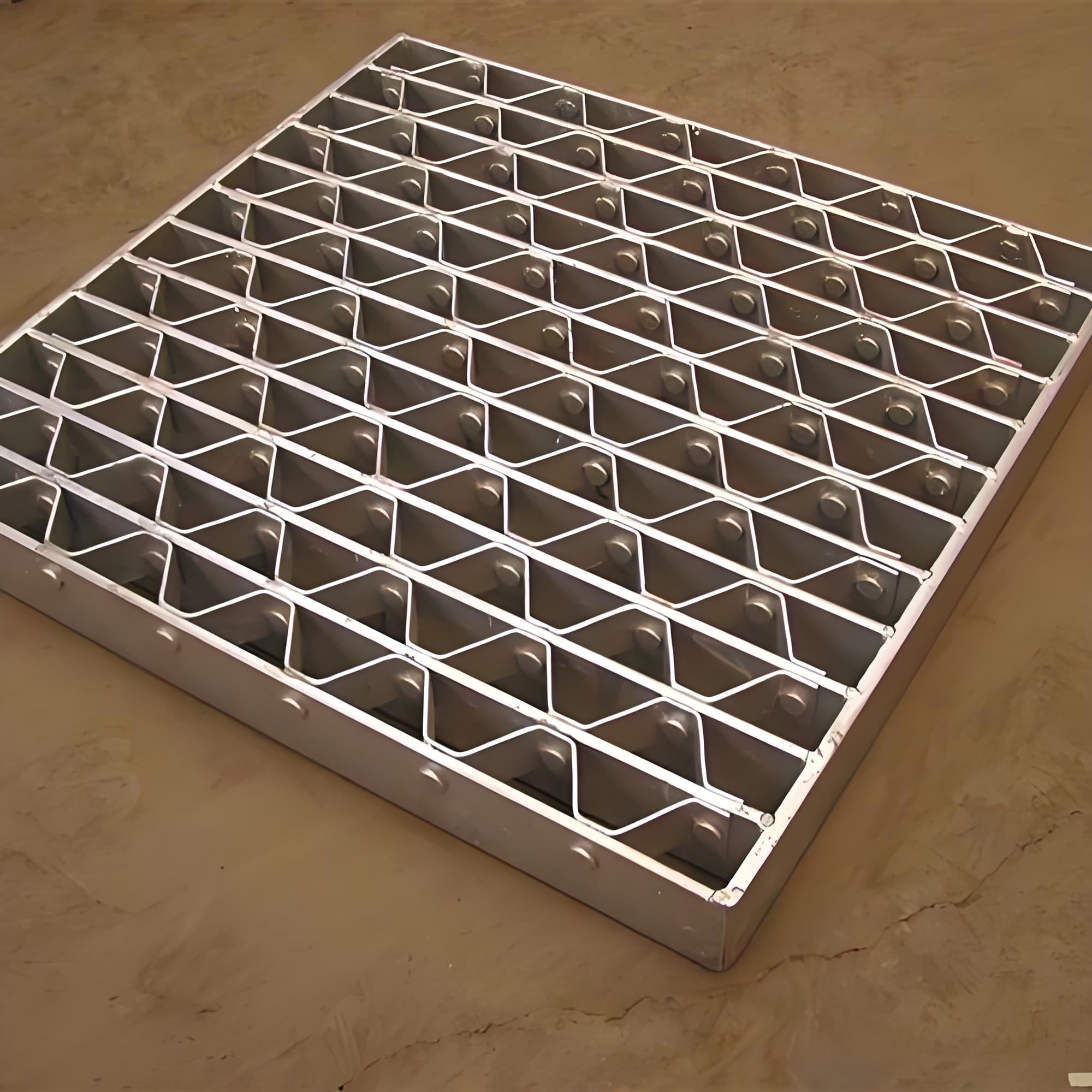
A steel grating factory does not normally begin with a simple price per square meter. The square meter rate is usually the result of a detailed calculation based on the selected grating structure. The factory first determines the theoretical steel weight, then adds manufacturing, fabrication, coating, inspection, packing, and commercial costs.
A simplified factory costing model can be expressed as:
Finished grating cost = raw steel cost + production cost + fabrication cost + surface treatment + inspection and packing + delivery-related cost
For standard welded bar grating, steel weight is usually the largest cost component. As bearing bars become deeper, thicker, or closer together, the panel uses more steel per square meter. This raises both the material cost and the hot-dip galvanizing cost. Custom work such as cutouts, banding, special frames, lifting holes, toe plates, bolt holes, or irregular shapes adds labor even when the finished panel area is small.
For a broader overview of how price, material, fabrication, and delivery affect a quotation, see this steel grating factory price reference.
The following figures are planning references for factory orders, not fixed offers. Raw material markets, product weight, order quantity, finish requirements, packing, and trade terms can change the final price.
| Steel Grating Type | Typical Factory Budget Range | Common Price Drivers |
|---|---|---|
| Untreated carbon steel grating | US$12–35/m² | Basic welded panels, standard mesh, limited fabrication |
| Painted carbon steel grating | US$18–50/m² | Paint system, surface preparation, panel weight |
| Standard hot-dip galvanized steel grating | US$20–70/m² | Steel weight, zinc coating, mesh spacing, quantity |
| Fabricated galvanized grating | US$35–110/m² | Banding, notches, cutouts, labels, clips, packing |
| Close-mesh or serrated galvanized grating | US$45–140/m² | More bearing bars, more welding, anti-slip processing |
| Heavy-duty steel grating | US$70–220/m² | Deep bearing bars, thick steel, reinforced edges, load verification |
| 304 stainless steel grating | US$45–125/m² | Stainless material price, finish, fabrication complexity |
| 316 or 316L stainless steel grating | US$65–170/m² | Alloy surcharge, corrosion requirement, finishing, quantity |
A low advertised price may apply only to an untreated, full-size stock panel with open bearing-bar ends and basic packing. A project-ready panel with banded edges, cutouts, hot-dip galvanizing, numbered labels, clips, export packing, and drawing-controlled dimensions will cost more, but it can greatly reduce site cutting and installation risk.
Steel grating may be quoted in several ways:
| Quotation Unit | Best Used For | What Buyers Should Confirm |
|---|---|---|
| Price per m² | Early budgeting and comparison of similar specifications | Finished kg/m², mesh pattern, finish, fabrication scope |
| Price per panel | Cut-to-size platforms, trench covers, access panels, stair parts | Exact dimensions, bearing-bar direction, banding, holes, fittings |
| Price per ton | Large repeated industrial orders | Whether galvanizing, fabrication, packing, and loss are included |
| Price per kilogram | Comparing raw grating body weight | Extra labor for irregular panels, frames, cutouts, and coating |
Price per kilogram is useful, but it is not enough on its own. Two panels can weigh almost the same while one requires only straight cutting and the other needs several pipe cutouts, reinforced edges, irregular angles, lifting holes, and individual packing. The second panel needs much more factory work.
Raw steel weight is the foundation of most steel grating quotations. Bearing bars carry the main load and normally make up the largest share of panel weight. Cross bars, edge banding, welding, serration, galvanizing, and accessories add to the finished mass.
For a quick preliminary estimate of rectangular bearing-bar weight:
Bearing-bar weight (kg/m²) ≈ 7.85 × bearing-bar depth (mm) × bearing-bar thickness (mm) ÷ bearing-bar spacing (mm)
This formula estimates only the bearing bars. It does not include cross bars, perimeter banding, weld material, zinc coating, clips, cutout reinforcement, or fabrication parts. The final approved factory weight should always be based on the finished drawing and bill of materials.
| Bearing-Bar Size | Typical Mesh Reference | Approximate Finished Grating Body Weight | Typical Use |
|---|---|---|---|
| 25 × 3 mm | 30 × 100 mm | About 22–24 kg/m² | Light walkways and short-span access areas |
| 30 × 3 mm | 30 × 100 mm | About 26–28 kg/m² | General industrial platforms and walkway panels |
| 25 × 5 mm | 30 × 100 mm | About 35–39 kg/m² | Medium-duty platforms and covers |
| 32 × 5 mm | 30 × 100 mm | About 45–48 kg/m² | Industrial flooring with increased load demand |
| 40 × 5 mm | 30 × 100 mm | About 55–60 kg/m² | Heavier platforms, longer spans, service decks |
| 50 × 5 mm or larger | Project-specific | Varies significantly | Heavy-duty, vehicle-related, or long-span conditions |
These values are estimates for common welded grating structures. Finished weight can increase when serrated bearing bars, close mesh, thick edge banding, frames, toe plates, fasteners, or hot-dip galvanizing are added. More details about grating mass and quotation logic are available in this galvanized steel grating weight guide.
Steel grating is often produced in large regular panels before being cut into project-specific pieces. If a factory can cut several finished panels efficiently from a standard production sheet, material yield is high and the cost per square meter stays competitive. If the drawing creates narrow offcuts, unusual angles, repeated curved pieces, or incompatible widths, more steel may be consumed than the finished panel area suggests.
Common causes of lower material yield include:
Good structural layout can reduce waste. When practical, platform modules should follow standard bar spacing and production-panel dimensions. This makes the factory process more efficient and also makes future replacement easier.
Manufacturing method changes the appearance, rigidity, production time, and price of steel grating. The correct choice depends on the application rather than appearance alone.
| Grating Type | How It Is Made | Typical Price Position | Common Applications |
|---|---|---|---|
| Welded steel bar grating | Cross bars are resistance welded to bearing bars | Usually the most economical standard option | Platforms, walkways, catwalks, stair treads, trench covers |
| Press-locked grating | Cross bars are pressed into slotted bearing bars | Often higher due to slotting and alignment control | Architectural flooring, facades, public areas, visible walkways |
| Riveted grating | Bars are mechanically assembled with riveted connections | Often higher for heavy-duty or specialty work | Traffic-related covers, demanding industrial service, specialty layouts |
Welded grating is the standard choice for many industrial projects because it offers a strong, rigid structure and efficient production. The bearing bars support the load while the welded cross bars keep the panel stable. It is widely used for plant floors, maintenance walkways, drainage covers, stair treads, access platforms, and equipment areas.
For standard carbon steel grating, welded production generally offers the best balance of cost, availability, and structural performance. It is also well suited to fabrication because panels can be cut, banded, notched, and welded before galvanizing.
Press-locked grating is produced by pressing cross bars into accurately slotted bearing bars. The result is a cleaner and more regular grid appearance than conventional welded grating. It is often selected where spacing accuracy, visual quality, and refined edge appearance are important.
Because the factory must control slot dimensions, bar alignment, pressing force, panel flatness, and finishing quality, press-locked grating may cost more than basic welded panels. It is a strong option for visible walkways, architectural screens, public areas, drainage covers, and commercial projects. Learn more about the process on the press-locked grating product page.
Riveted grating is generally used where the project calls for a particular heavy-duty or mechanically assembled structure. It can be suitable for demanding service where repeated traffic, concentrated loading, or special frame arrangements must be considered. Riveted construction often involves more components and assembly steps, so it should be priced from the actual load condition and fabrication drawing rather than from a generic square meter rate.
A complete steel grating specification includes much more than length and width. It should identify the material, manufacturing method, bearing-bar size, bearing-bar spacing, cross-bar spacing, surface type, panel dimensions, bearing-bar direction, finish, load requirement, and fabrication details.
For metric projects, a common written specification may look like this:
Welded carbon steel grating, 30 × 3 mm bearing bars, 30 × 100 mm mesh, serrated surface, hot-dip galvanized after fabrication, panel size 1000 × 1200 mm, bearing bars spanning 1000 mm, banded on four sides.
In this example, the first 30 × 3 mm refers to bearing-bar depth and thickness. The 30 × 100 mm mesh means 30 mm bearing-bar centers and 100 mm cross-bar centers. The bearing bars must be clearly shown on the drawing because they carry the main bending load.
In inch-based supply systems, a designation such as 19-W-4 may be used. The code normally identifies the bearing-bar spacing series, the welded construction, and the cross-bar spacing series. However, naming systems vary by manufacturer, so the drawing should still state the actual dimensions in millimeters or inches.
| Designation Example | General Meaning | What Must Still Be Stated |
|---|---|---|
| 19-W-4 | Welded grating with a common bearing-bar and cross-bar spacing pattern | Bearing-bar depth, thickness, surface, panel size, finish, span |
| 11-W-4 | Closer bearing-bar layout with 4-inch cross-bar spacing | Net opening, wheel or heel requirements, load and support direction |
| 30 × 100 mm | Metric mesh with 30 mm bearing-bar centers and 100 mm cross-bar centers | Bar section, material grade, surface, fabrication, coating |
A designation is a starting point, not a complete purchase specification. A 19-W-4 panel with 25 × 3 mm bearing bars and a 19-W-4 panel with 50 × 5 mm bearing bars may have the same mesh pattern but very different weights, capacities, and prices.
For a detailed explanation of bearing-bar dimensions, mesh openings, tolerances, and common standards, visit the steel bar grating dimensions guide.
The bearing bar is the main structural element of steel grating. It spans between supports and carries most of the applied load. Bearing-bar depth has a major influence on bending resistance, while thickness adds steel area, improves stiffness, and increases the robustness of the finished panel.
| Bearing-Bar Depth | Typical Thickness Options | General Use Range |
|---|---|---|
| 20–25 mm | 3 mm, 4 mm, 5 mm | Short-span pedestrian flooring, light covers, small access areas |
| 30–32 mm | 3 mm, 4 mm, 5 mm | General industrial platforms, walkways, maintenance floors |
| 40 mm | 3 mm, 5 mm | Higher-load walkways, longer spans, stronger covers |
| 50–65 mm | 5 mm, 6 mm | Heavy industrial platforms, service decks, demanding access zones |
| 75–100 mm | 5 mm, 6 mm or project-specific | Long spans, heavy-duty structures, engineered traffic applications |
Common bearing-bar spacing options include 30 mm, 34 mm, 40 mm, 50 mm, and 60 mm center to center. Closer spacing creates smaller openings and usually increases steel weight. Wider spacing reduces steel use and improves open area, but it may not be suitable for all pedestrian, wheel, tool-retention, or load-distribution requirements.
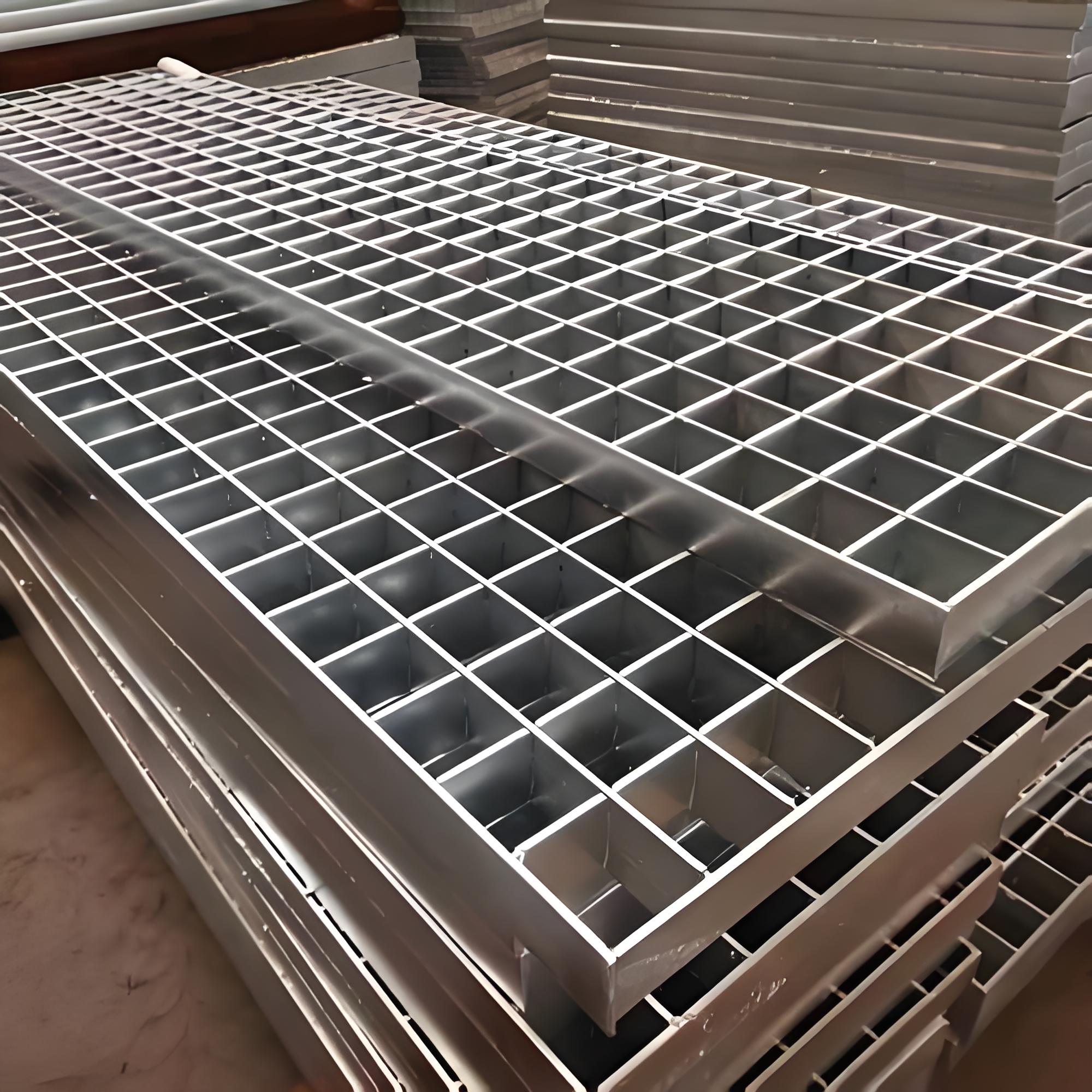
Cross bars connect the bearing bars and help keep the panel square, stable, and resistant to lateral movement. In welded steel grating, twisted square bars are commonly used as cross bars. In press-locked grating, flat cross bars or other slotted-bar designs may be used depending on the intended appearance and mesh layout.
Common cross-bar spacing is 50 mm or 100 mm. A 100 mm cross-bar spacing is widely used for standard industrial grating because it offers a practical balance between rigidity and cost. A 50 mm spacing produces a denser pattern and may be selected for stair treads, close-mesh panels, smaller access pieces, or applications where a tighter surface feel is preferred.
| Mesh Pattern | General Characteristics | Typical Use |
|---|---|---|
| 30 × 100 mm | Dense bearing-bar layout with economical cross-bar frequency | Industrial platforms, walkways, standard covers |
| 30 × 50 mm | Tighter transverse pattern and more panel rigidity | Stair treads, smaller panels, special access areas |
| 40 × 100 mm | More open area and lower steel consumption | General industrial walkways where larger openings are acceptable |
| 25–30 mm close mesh | Smaller openings, increased material use, improved walking feel | Public access, small-wheel areas, special pedestrian applications |
Net opening is not the same as center-to-center spacing. For example, a 30 mm bearing-bar pitch with 5 mm thick bars provides an approximate 25 mm clear opening. This matters for heel safety, drainage, ventilation, falling-object control, and the passage of small wheels.
Steel grating is commonly produced in large rectangular stock panels and then fabricated into finished project pieces. Common stock widths include 600 mm, 800 mm, 1000 mm, 1200 mm, and sometimes 1500 mm. Common lengths often range from 1000 mm to 6000 mm.
| Nominal Panel Size | Typical Application | Practical Consideration |
|---|---|---|
| 600 × 1000 mm | Narrow access routes and removable trench covers | Easy to handle; may require more joints |
| 800 × 1000 mm | Compact catwalks and maintenance panels | Useful where manual handling is important |
| 1000 × 1000 mm | Modular floor and platform panels | Easy to coordinate with structural grids |
| 1000 × 3000 mm | Walkways and platform strips | Confirm support locations and lifting method |
| 1000 × 6000 mm | Common production-panel reference | May be cut into smaller finished panels |
| 1200 × 6000 mm | Large platforms and industrial flooring | Handling, galvanizing capacity, and packing need review |
A stock panel size is not automatically the maximum manufacturing size. Factory welding equipment, galvanizing tank dimensions, panel weight, lifting capacity, transport limits, and export packing plans all affect the largest practical panel. Longer or wider panels may be available, but they should be reviewed together with the installation method and support layout.
Large panels reduce joints, but they can create handling and maintenance problems. Removable grating should be sized so that workers can safely lift, move, and replace it using the equipment available on site. More information about common widths and lengths can be found in this galvanized steel grating sizes guide.
Finished weight per square meter is one of the clearest ways to compare quotations. It directly affects raw steel consumption, welding time, galvanizing weight, handling, packing, container loading, and freight.
For example, a 1000 × 6000 mm panel has an area of 6 m². If the selected grating weighs 26.4 kg/m², the estimated grating body weight is:
1.0 m × 6.0 m × 26.4 kg/m² = 158.4 kg
This figure is only the starting point. Perimeter banding, toe plates, clips, special cutouts, additional framing, and coating variation can increase the finished shipping weight.
Buyers should be cautious when one supplier offers a much lower price per square meter than another. The difference may be caused by lighter bearing bars, wider spacing, thinner banding, lower coating requirements, missing fabrication items, or a different load assumption. Comparing the finished kg/m² is often more meaningful than comparing area price alone.
Steel grating must be selected according to how it is supported and loaded. The bearing bars carry the main load, so they must run in the direction between the supports. This is one of the most important details in any grating drawing.
A panel can be 6000 mm long overall while having a safe design span of only 1000 mm if intermediate support beams are installed every 1000 mm. The overall panel length is not the same as the clear span. The clear span is the distance between the effective supports beneath the bearing bars.
Strength is not the only criterion. A grating panel may remain below material yield strength but still deflect too much for walking comfort, machinery alignment, drainage slope, or public safety. Deflection requirements should be identified at the quotation stage rather than after fabrication.
Light pedestrian walkways, industrial maintenance floors, forklift routes, and roadway covers are different design conditions. A grating suitable for foot traffic may not be suitable for wheeled equipment, even when the total stated load appears similar. Wheel loads act over small contact areas and may create higher local stress.
Heavy-duty or vehicle-exposed grating should be selected from a verified load table or project-specific engineering calculation. The inquiry should clearly state whether traffic includes hand carts, pallet jacks, forklifts, maintenance vehicles, trucks, or other concentrated loads.
Smooth grating has plain bearing-bar tops. It is widely used in dry industrial areas, equipment platforms, interiors, and general maintenance access. It is usually the most economical surface option and is easy to clean.
Serrated grating has notches or teeth along the top of the bearing bars to improve traction. It is commonly selected for outdoor walkways, stairs, ramps, drainage zones, wet process areas, oily platforms, and locations exposed to snow or rain.
Serration adds processing cost and may slightly increase the finished price, but it can be worthwhile where slip risk is a real operating concern. The selected serration should match the application; an aggressive anti-slip surface may be appropriate for industrial stairs but unnecessary for a clean indoor access floor.
Heavy-duty grating normally uses deeper and thicker bearing bars, stronger edge banding, and project-specific support design. It is used for forklift zones, truck-access covers, ports, heavy industrial floors, road drainage, and locations with demanding concentrated loads.
It should not be priced by simply adding a small percentage to standard walkway grating. Heavy-duty products can contain two or three times the steel weight of lighter panels and may require special welding fixtures, reinforced frames, detailed load calculations, and controlled fabrication.
Carbon steel is the most common material for industrial grating because it provides good strength at a practical cost. The exact material grade should be stated in the quotation when the project requires it. Depending on the market and specification, buyers may request grades such as Q235, S235, ASTM A36, or another approved structural steel grade. Material names should not be treated as automatically interchangeable without checking the applicable project requirements.
Untreated carbon steel is suitable only where corrosion exposure is limited or another coating system is planned. For outdoor platforms, walkways, stairs, trench covers, and humid industrial areas, hot-dip galvanizing after fabrication is commonly selected.
Hot-dip galvanizing adds zinc, handling, processing, drainage preparation, inspection, and transport between the grating factory and galvanizing line. The cost depends on steel weight, surface area, coating requirement, steel chemistry, fabrication complexity, and order quantity.
For custom grating, galvanizing after cutting, welding, banding, and fabrication is usually preferred because the zinc coating can cover welded intersections, exposed cut edges, banding bars, and fabricated details. This is especially useful for outdoor and general industrial service.
Read more about the process and its value on this hot-dip galvanized steel grating guide.
| Finish | Cost Position | Typical Service Use |
|---|---|---|
| Black carbon steel | Lowest initial cost | Indoor, temporary, controlled environments, or later coating |
| Painted carbon steel | Moderate | Indoor structures and selected industrial environments |
| Hot-dip galvanized carbon steel | Moderate to higher | Outdoor walkways, stairs, platforms, drainage covers |
| 304 stainless steel | Higher | Wet service, food-related areas, architectural and industrial use |
| 316 or 316L stainless steel | Highest among common steel options | Coastal, marine, chemical, chloride-exposed environments |
Custom fabrication turns a raw grating panel into a part that fits the site. It can reduce installation time and eliminate risky field cutting, but it should be priced as a separate manufacturing scope.
Common fabrication work includes:
Edge banding deserves particular attention. It closes the exposed ends of bearing bars, improves handling safety, increases edge stiffness, and gives the panel a cleaner appearance. A panel with several cutouts may need far more banding than a plain rectangle of the same area.
When requesting a quote, submit a panel schedule or fabrication drawing that shows the overall dimensions, bearing-bar direction, support lines, all cutouts, banding requirements, hole locations, and panel identification marks. A factory can then calculate both steel consumption and fabrication time accurately.
Steel grating is often used as a walking, working, drainage, or access surface, so quality control should continue from raw material receiving through final packing. The inspection scope should match the project risk and specification.
| Inspection Stage | What the Factory Checks | Why It Matters |
|---|---|---|
| Raw material inspection | Steel grade, bar dimensions, straightness, surface condition | Supports consistent load performance and accurate production |
| Mesh and welding inspection | Bearing-bar spacing, cross-bar spacing, weld consistency | Prevents loose bars, irregular openings, weak panel structure |
| Fabrication inspection | Cutouts, banding, holes, frames, labels, special shapes | Ensures panels fit the installation drawing |
| Dimensional inspection | Length, width, diagonal, flatness, bearing-bar direction | Reduces fitting problems and unsafe gaps |
| Coating inspection | Zinc coverage, surface condition, visible coating defects | Supports corrosion protection and long-term service life |
| Packing inspection | Bundle stability, labels, separators, protection, quantity | Reduces transit damage and site sorting time |
Typical project references may include YB/T 4001.1-2019, ANSI/NAAMM MBG 531-20, BS 4592-0:2006, ASTM galvanizing requirements, ISO galvanizing requirements, or a project-specific standard. The exact standard should be confirmed before production because it can affect tolerances, coating checks, test documents, and acceptance criteria.
A qualified supplier should inspect welding quality before galvanizing, because zinc coating cannot correct a loose cross bar, missing weld, incorrect mesh, warped panel, or poorly fabricated edge. Additional information is available in this welded steel bar grating quality guide.
Order quantity has a direct influence on unit price. A one-panel sample may require drawing review, setup, material preparation, cutting, welding, galvanizing, inspection, and packing without the efficiency of a repeated production run. Large orders with the same bar size, mesh, panel dimensions, and finish generally receive better factory pricing.
| Order Type | Typical Unit-Cost Effect | Reason |
|---|---|---|
| Prototype or one replacement panel | Highest | Minimum charges, setup, individual fabrication, special packing |
| Small mixed order | Higher | Many sizes, lower yield, more sorting, limited production efficiency |
| Medium repeated order | Competitive | Better material use and distributed setup cost |
| Large standardized project order | Most efficient | Bulk steel purchasing, repeated production, improved packing efficiency |
Export price should also be compared on the same commercial basis. An EXW factory quote does not include the same services as an FOB, CFR, CIF, DAP, or delivered-site quote. Freight, insurance, customs duty, taxes, inland delivery, unloading, and installation are normally separate unless specifically included.
| Quote Item | Why It Should Match |
|---|---|
| Material grade | Carbon steel, galvanized steel, 304, and 316 have different costs and service lives |
| Bearing-bar depth and thickness | These strongly affect load capacity, weight, and price |
| Bearing-bar and cross-bar spacing | Different mesh patterns change open area, walking comfort, and steel consumption |
| Finished kg/m² | Allows a more meaningful cost comparison than area alone |
| Surface type | Smooth and serrated grating should not be treated as identical products |
| Load and deflection requirement | Prevents an under-designed panel from appearing cheaper |
| Surface treatment | Confirm hot-dip galvanizing after fabrication, painting, or stainless finishing scope |
| Fabrication scope | Banding, cutouts, frames, clips, holes, and labels can change the real cost |
| Packing and shipping term | Ensures freight and export services are compared fairly |
A clear inquiry might read: “Please quote hot-dip galvanized welded steel grating, 30 × 3 mm bearing bars, 30 × 100 mm mesh, serrated top surface, 1000 × 1200 mm finished panel, bearing bars spanning 1000 mm, banded on four sides, suitable for the stated pedestrian load and deflection requirement. Please state finished kg/m², galvanizing standard, fabrication scope, packing method, lead time, and FOB price.”
This level of detail helps the factory provide a technically comparable quotation instead of pricing from an incomplete area figure. For related buying guidance, review the steel floor grating price and size guide.
How much does steel grating cost per square meter?
Basic untreated carbon steel grating may be budgeted around US$12–35/m², while standard hot-dip galvanized steel grating commonly falls around US$20–70/m² for factory orders. The exact price depends on finished weight, bar size, mesh spacing, serration, fabrication, coating, quantity, packing, and delivery terms.
What is the most common steel grating size?
Common industrial specifications include 25 × 3 mm, 30 × 3 mm, 32 × 5 mm, and 40 × 5 mm bearing bars with 30 × 100 mm or 40 × 100 mm mesh. Common stock panel widths include 600 mm, 800 mm, 1000 mm, and 1200 mm, with lengths often produced up to 6000 mm.
Which direction should steel grating bearing bars run?
Bearing bars must run between the supports because they carry the main bending load. The drawing should always show bearing-bar direction and clear support span; overall panel length alone does not define the structural span.