
Hot dip galvanized steel grating is a corrosion-resistant steel grating product widely used for industrial platforms, walkways, stair treads, trench covers, drainage systems, bridge access areas, and outdoor service floors. It is made from steel bearing bars and cross bars, then protected by a hot dip galvanized zinc coating after fabrication. This combination gives the grating strong load capacity, good drainage, ventilation, anti-slip options, and long service life in outdoor, humid, and industrial environments. For buyers, engineers, contractors, and distributors, choosing the right hot dip galvanized steel grating requires understanding its structure, galvanizing process, bar size, spacing, load capacity, panel dimensions, installation method, and application environment.
Hot dip galvanized steel grating is a type of steel bar grating that has been coated with zinc through the hot dip galvanizing process. The grating is usually fabricated first by welding or locking bearing bars and cross bars into a strong open-grid panel. After cutting, welding, banding, and other fabrication steps are completed, the whole panel is immersed in molten zinc. The zinc coating bonds to the steel surface and helps protect the grating from corrosion.
The main purpose of hot dip galvanized steel grating is to provide a strong, safe, and durable flooring or covering solution in environments where steel may be exposed to water, rain, moisture, industrial dust, or outdoor weather. Compared with untreated steel grating, hot dip galvanized grating has much better rust resistance. Compared with solid steel plate, it is lighter, drains faster, allows air and light to pass through, and reduces accumulation of water, mud, oil, snow, or debris on the walking surface.
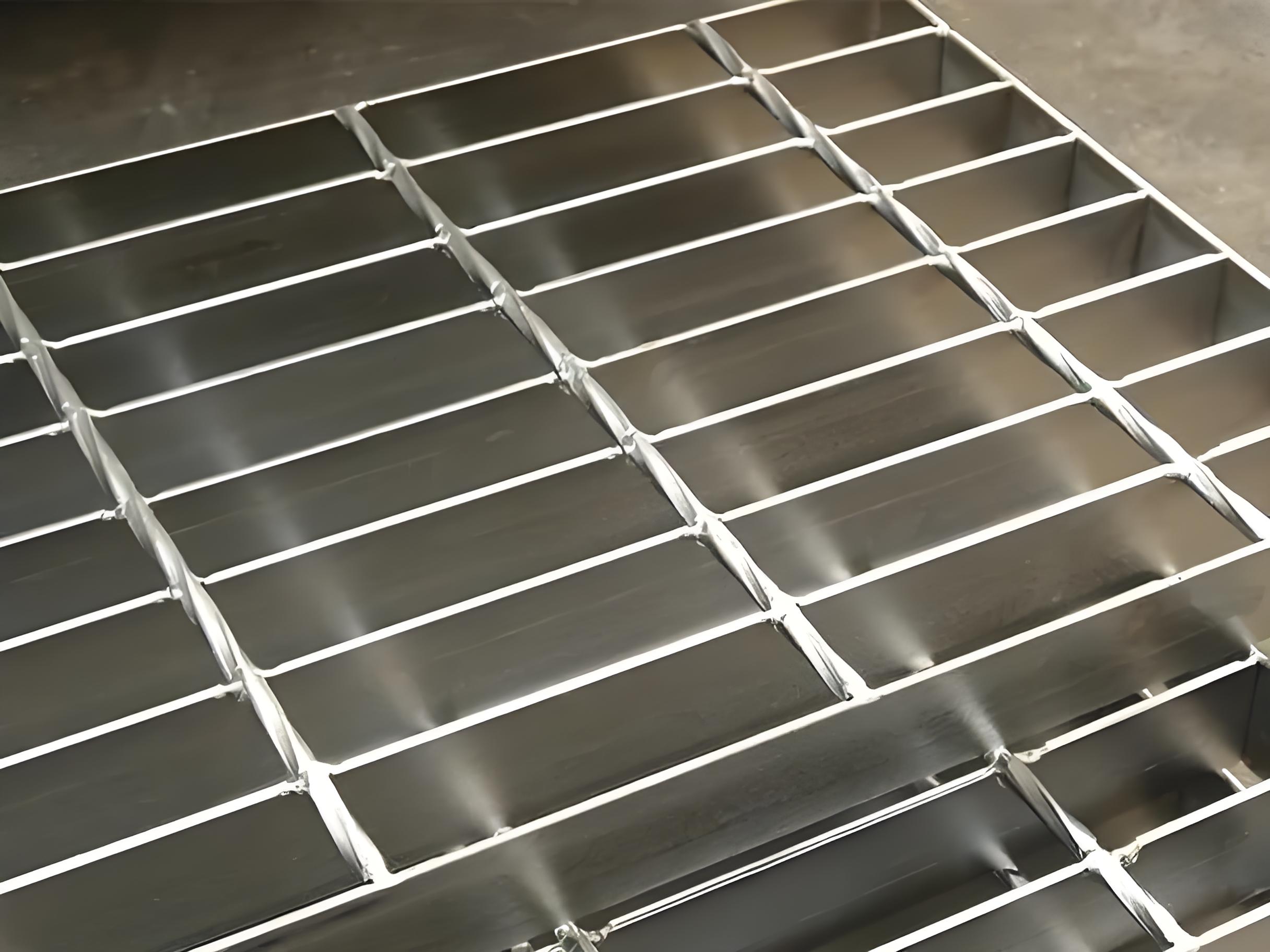
In practical industrial use, hot dip galvanized steel grating normally refers to welded carbon steel grating or press-locked steel grating with a zinc coating applied after fabrication. It can be supplied as plain surface grating, serrated anti-slip grating, heavy duty grating, stair treads, trench covers, platform panels, or custom-cut panels according to project drawings.
| Product Name | Main Feature | Typical Use |
|---|---|---|
| Hot dip galvanized steel grating | Steel grating protected by zinc coating | Platforms, walkways, stairs, trench covers, outdoor floors |
| Plain galvanized grating | Smooth bearing bar surface | Dry platforms, general industrial walkways, equipment access |
| Serrated galvanized grating | Toothed anti-slip bearing bar surface | Wet areas, outdoor walkways, stairs, drainage zones |
| Heavy duty galvanized grating | Thicker and deeper bearing bars | Forklift areas, vehicle access, heavy trench covers |
| Galvanized stair tread grating | Grating tread with side plates and nosing options | Industrial stairs, platform access, outdoor steps |
The manufacturing of hot dip galvanized steel grating includes raw material preparation, bearing bar cutting, cross bar assembly, welding or press-locking, edge banding, custom fabrication, surface cleaning, hot dip galvanizing, inspection, and packing. A stable manufacturing process is important because the product must provide both structural strength and corrosion resistance.
The factory first prepares steel flat bars, cross bars, banding bars, and other required materials. For standard welded steel grating, the bearing bars are usually flat steel bars, while the cross bars may be twisted square bars, round bars, or flat bars. The raw materials should be checked for size, straightness, surface condition, steel grade, and quantity before production.
Bearing bars are cut according to the required panel size and bearing direction. Cross bars are prepared according to the required cross bar spacing. For custom grating, the factory must confirm panel layout, cut-out positions, bearing bar direction, stair tread details, trench cover dimensions, and installation accessories before welding.
Most industrial hot dip galvanized steel grating is welded. The cross bars are welded onto the bearing bars to create a rigid grid. The welding quality must be stable because loose cross bars or weak welds can reduce panel stability. Press-locked grating is also available for projects requiring a cleaner appearance or different structural style.
After the main grid is formed, edge banding may be added around the panel. Banding improves appearance, handling safety, and edge strength. Custom fabrication may include cut-outs, notches, round holes, lifting holes, bolt holes, stair tread side plates, toe plates, kick plates, and special frames.
For best corrosion protection, grating is usually hot dip galvanized after welding and fabrication. This allows the zinc coating to cover welded joints, cut edges, serrated surfaces, banding bars, and other exposed areas. Galvanizing before fabrication is usually not preferred for welded grating because cutting and welding would damage the coating.
| Manufacturing Step | Main Control Point | Why It Matters |
|---|---|---|
| Raw material inspection | Steel grade, bar size, straightness | Ensures stable production and load performance |
| Cutting | Panel length, width, bearing bar direction | Controls fit and installation accuracy |
| Welding or locking | Joint strength and spacing consistency | Determines panel rigidity and safety |
| Banding | Edge condition and panel shape | Improves handling, appearance, and edge protection |
| Hot dip galvanizing | Zinc coating coverage and surface quality | Improves corrosion resistance and service life |
| Final inspection | Dimensions, coating, flatness, quantity | Reduces installation and quality problems |
The structure of hot dip galvanized steel grating is based on a grid formed by bearing bars and cross bars. Although the structure appears simple, each component affects load capacity, stability, safety, drainage, and installation performance.
Bearing bars are the main load-carrying members of the grating. They are usually arranged in one direction and must span between supports during installation. The bearing bar height, thickness, and spacing determine the grating’s strength and deflection performance. If bearing bars are installed in the wrong direction, the panel may not carry the intended load safely.
Cross bars connect the bearing bars and maintain the grid spacing. They help stabilize the panel and keep bearing bars from moving independently. Cross bars may be welded, press-locked, or mechanically fixed depending on the grating type.
Edge banding is often welded around the panel perimeter. It closes open bar ends, improves appearance, protects users during handling, and helps maintain panel shape. For trench covers, stair treads, and panels with cut-outs, banding is usually recommended.
The open grid is one of the biggest advantages of steel grating. It allows water, air, light, snow, dust, and small debris to pass through the panel. This makes hot dip galvanized steel grating suitable for outdoor walkways, drainage covers, wastewater treatment plants, industrial platforms, and bridge service areas.
| Structural Part | Function | Selection Note |
|---|---|---|
| Bearing bar | Carries the main load | Size and spacing must match load and span |
| Cross bar | Connects bearing bars and stabilizes the grid | Spacing affects rigidity and appearance |
| Banding bar | Closes edges and improves handling | Important for custom panels and exposed edges |
| Open grid | Allows drainage and ventilation | Useful for wet, outdoor, and industrial areas |
| Zinc coating | Protects steel from corrosion | Important for long-term outdoor performance |
Hot dip galvanizing is the process that gives hot dip galvanized steel grating its corrosion resistance. The fabricated steel grating is cleaned and immersed in molten zinc. The zinc reacts with the steel surface and forms a protective coating that helps prevent rust.
Before galvanizing, the grating surface must be cleaned properly. Oil, rust, scale, welding residue, and dirt can affect coating quality. Cleaning steps may include degreasing, pickling, rinsing, and fluxing. Proper surface preparation helps the zinc coating bond well with the steel.
After cleaning, the grating is dipped into molten zinc. Zinc covers the exposed steel surface, including bearing bars, cross bars, welded joints, edges, serrations, and banding bars. Because steel grating has many openings and edges, good zinc flow and drainage are important to avoid excessive zinc buildup.
The zinc coating protects steel in two ways. First, it works as a barrier between steel and the environment. Second, zinc provides sacrificial protection, meaning zinc corrodes before the steel in many conditions. This is why hot dip galvanized grating is preferred for outdoor and humid environments.
After galvanizing, the factory should inspect the coating for coverage, surface appearance, zinc buildup, sharp points, blocked openings, bare areas, and deformation. Good coating quality helps improve service life and makes installation easier.
| Galvanizing Stage | Main Purpose | Quality Concern |
|---|---|---|
| Degreasing | Removes oil and surface contamination | Poor cleaning may cause coating defects |
| Pickling | Removes rust and mill scale | Surface must be clean before zinc coating |
| Fluxing | Helps zinc bond with steel | Improves coating adhesion |
| Zinc dipping | Forms protective zinc coating | Controls coverage, drainage, and coating thickness |
| Cooling and inspection | Checks final coating condition | Removes sharp zinc, checks bare spots and deformation |
Hot dip galvanized steel grating is widely used because it combines strength, corrosion protection, drainage, safety, and long-term cost efficiency. These advantages make it suitable for many industrial, municipal, and outdoor applications.
The zinc coating protects the steel from rust and makes the grating suitable for outdoor use, humid areas, drainage zones, and industrial environments. Compared with untreated steel, hot dip galvanized steel grating has a much longer service life under normal exposure conditions.
Steel bearing bars provide strong load-carrying ability. By changing bearing bar size and spacing, grating can be designed for pedestrian walkways, industrial platforms, trench covers, forklift areas, or heavy-duty vehicle access.
The open-grid structure allows water, dust, snow, oil, and debris to pass through. This helps keep the walking surface cleaner and reduces standing water. It also allows air and light to pass through, which is useful for platforms, catwalks, and service areas.
Hot dip galvanized steel grating can be produced with plain or serrated bearing bars. Serrated grating improves traction in wet, oily, muddy, or outdoor conditions. Stair treads may also include anti-slip nosing.
Factories can produce hot dip galvanized grating according to project drawings. Custom options include panel size, cut-outs, stair treads, trench covers, toe plates, banding, fixing accessories, and special shapes around pipes, columns, or machines.
| Advantage | Practical Benefit |
|---|---|
| Corrosion resistance | Suitable for outdoor, humid, and industrial environments |
| Strong steel structure | Supports walkways, platforms, covers, and heavy-duty applications |
| Open grid design | Provides drainage, ventilation, and light transmission |
| Anti-slip option | Serrated surface improves safety in wet or oily areas |
| Custom processing | Can match drawings, cut-outs, stairs, and trench cover layouts |
| Long-term value | Reduces maintenance compared with untreated steel in many environments |
Most hot dip galvanized steel grating is made from carbon steel or mild steel. These materials provide good strength, weldability, and cost performance. After hot dip galvanizing, they become suitable for many outdoor and industrial applications.
Carbon steel is the most common material for hot dip galvanized steel grating. It is strong, economical, easy to fabricate, and suitable for welding. For platforms, walkways, trench covers, stair treads, and drainage grating, carbon steel with hot dip galvanizing is often the most practical option.
Mild steel is also widely used because it is easy to cut, weld, and form. It provides stable fabrication performance and works well with hot dip galvanizing. Many standard welded steel grating panels are made from mild steel.
For heavy-duty projects or engineering applications, structural steel grades may be specified by project drawings. The factory should confirm the required grade and provide material certificates if needed. This is important for vehicle areas, heavy platforms, bridges, and industrial structures.
Although this article focuses on hot dip galvanized steel grating, some environments may require stainless steel or aluminum instead. Stainless steel may be used in highly corrosive, chemical, marine, or hygienic areas. Aluminum may be selected where lightweight panels are required. However, for most general industrial and outdoor applications, hot dip galvanized carbon steel grating remains a strong and economical choice.
| Material | Main Benefit | Common Application |
|---|---|---|
| Carbon steel | Strong, economical, and suitable for galvanizing | Platforms, walkways, trench covers, industrial flooring |
| Mild steel | Good fabrication and welding performance | Standard welded grating and stair treads |
| Specified structural steel | Matches engineering load requirements | Heavy-duty floors, bridges, ports, power plants |
| Stainless steel | Higher corrosion resistance in harsh environments | Marine, chemical, food processing, and hygienic areas |
Bearing bar size and spacing are the main factors that determine the load capacity of hot dip galvanized steel grating. When selecting grating, buyers should not only look at panel length and width. The bearing bar height, thickness, spacing, span direction, and support distance must also be confirmed.
Bearing bar height affects bending strength. A deeper bearing bar can usually carry higher loads or span a longer distance between supports. For example, 40 mm or 50 mm high bearing bars are used for heavier applications, while 20 mm or 25 mm bars may be suitable for light-duty pedestrian use.
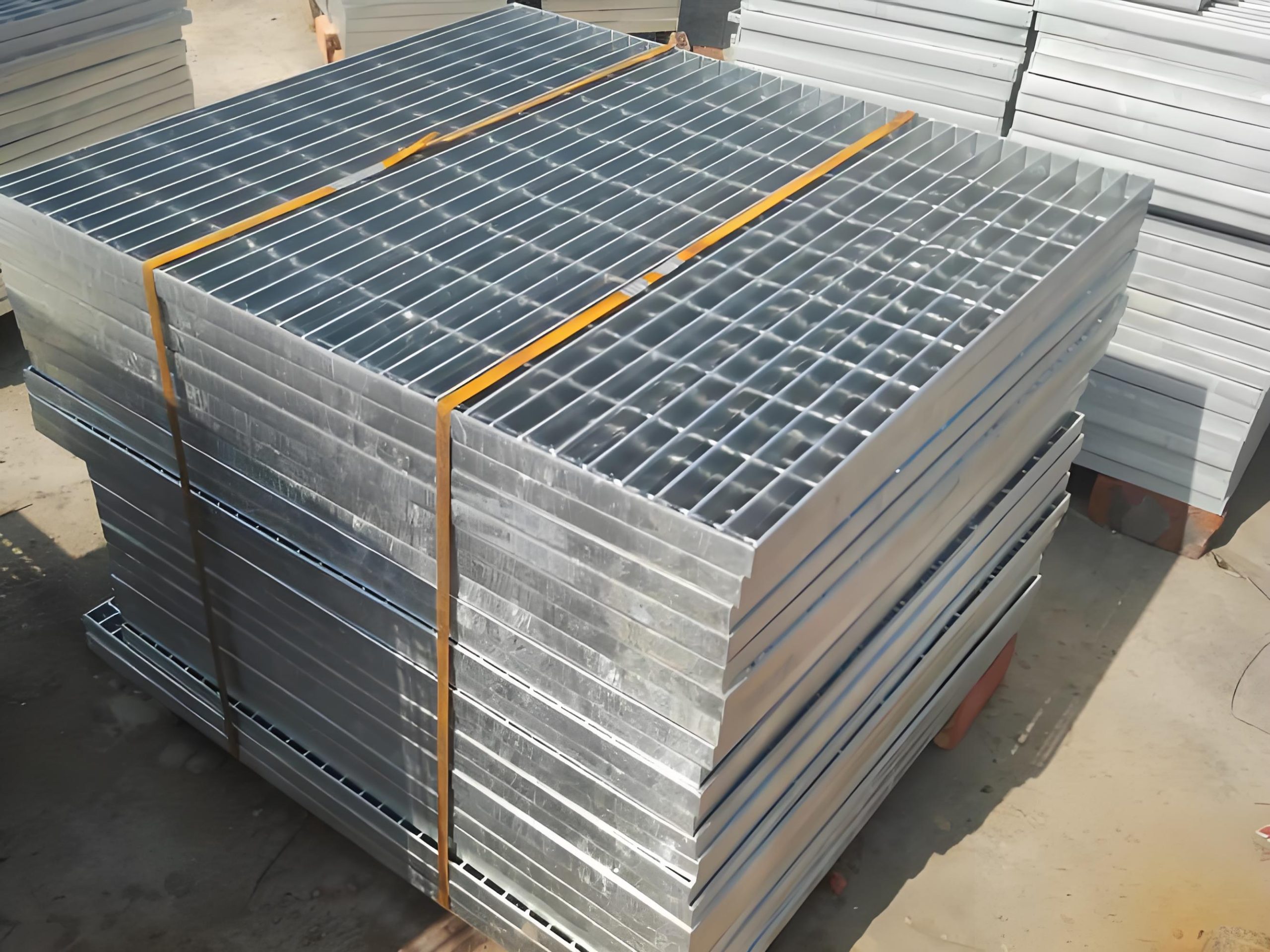
Thickness also affects load capacity and durability. A 30 x 5 mm bearing bar is stronger and heavier than a 30 x 3 mm bar. Thicker bars are often used for industrial platforms, trench covers, and areas with more frequent traffic.
Bearing bar spacing controls how many bearing bars are used in one panel. Closer spacing increases weight, load distribution, and walking comfort. Wider spacing reduces weight and cost but may not be suitable for high loads, small wheels, or public access areas.
| Bearing Bar Size | Relative Load Level | Common Use |
|---|---|---|
| 20 x 3 mm | Light | Small covers, light pedestrian access, short spans |
| 25 x 3 mm | Light to medium | General walkways and light platforms |
| 30 x 3 mm | Medium | Common platform grating and walkway panels |
| 30 x 5 mm | Medium to heavy | Industrial platforms and trench covers |
| 40 x 5 mm | Heavy | Heavy-duty platforms and longer spans |
| 50 x 5 mm | Very heavy | Heavy trench covers and vehicle-access areas |
| Bearing Bar Spacing | Weight Effect | Performance Effect | Typical Use |
|---|---|---|---|
| 25 mm | Higher weight | Smaller openings and better walking comfort | Public access, close-mesh walkways, special platforms |
| 30 mm | Medium to high weight | Strong load distribution | Industrial platforms, walkways, trench covers |
| 34 mm | Medium weight | Balanced strength and open area | General galvanized steel grating |
| 40 mm | Lower weight | Larger openings and lower material use | Drainage areas and economical panels |
Cross bar spacing affects the stability, appearance, and overall rigidity of hot dip galvanized steel grating. Although the bearing bars carry the main load, cross bars keep the grid aligned and help maintain the panel shape during handling, installation, and service.
Common cross bar spacing includes 50 mm, 76 mm, and 100 mm. Closer cross bar spacing creates a denser grid and can improve stability. Wider spacing reduces weight and cost while still meeting many industrial applications.
For walkways, stair treads, and frequent traffic areas, proper cross bar spacing helps the panel feel stable under foot. For heavy-duty grating, cross bars should be strongly connected because vibration, impact, and repeated movement may occur.
Closer cross bar spacing uses more material and requires more welding work. The price impact is usually smaller than changing bearing bar size, but it still matters in large orders. The correct spacing should balance stability, appearance, weight, and budget.
| Cross Bar Spacing | Structural Effect | Common Application |
|---|---|---|
| 50 mm | Closer grid and stronger stability feel | Stair treads, special walkways, tighter grid panels |
| 76 mm | Balanced stability and open area | General platforms and maintenance walkways |
| 100 mm | Common economical industrial spacing | Standard galvanized steel grating and drainage covers |
Hot dip galvanized steel grating can be supplied in standard sizes or custom specifications. Standard sizes are often used for stock, resale, and simple platform areas. Custom specifications are used when panels must match project drawings, steel structures, trench openings, stair frames, or irregular equipment layouts.
Common panel widths may include 500 mm, 600 mm, 750 mm, 900 mm, 1000 mm, and 1200 mm. Common panel lengths may range from 1000 mm to 6000 mm, depending on factory production capacity, galvanizing tank size, container loading, and installation requirements.
Custom hot dip galvanized steel grating may include special panel sizes, cut-outs, notches, round openings, edge banding, stair tread side plates, bolt holes, lifting holes, toe plates, and panel numbering. For industrial projects, custom fabrication can reduce site cutting and improve installation efficiency.
Standard grating panels are usually more economical and faster to produce. Custom panels may cost more because of drawing work, cutting, banding, and special processing, but they often save time during installation and reduce coating damage caused by site cutting.
| Item | Standard Size Grating | Custom Size Grating |
|---|---|---|
| Production speed | Usually faster | Requires drawing confirmation |
| Cost | Usually more economical | Higher due to special fabrication |
| Installation fit | May need site cutting | Designed to match project layout |
| Best use | Stock, resale, simple platforms | Industrial projects, trench covers, stairs, equipment areas |
| Surface protection | May need repair if cut on site | Galvanized after factory fabrication |
Hot dip galvanized steel grating can be made with smooth bearing bars or serrated bearing bars. The difference mainly affects anti-slip performance, cleaning convenience, price, and application suitability.
Smooth grating, also called plain grating, has flat bearing bar tops. It is suitable for dry indoor platforms, equipment access areas, maintenance floors, and general industrial walkways where slip risk is relatively low. Smooth grating is usually easier to clean and may be more economical than serrated grating.
Serrated grating has toothed bearing bar edges. The serrated profile improves traction and helps reduce slipping risk in wet, oily, dusty, muddy, or outdoor areas. It is commonly used for outdoor walkways, stairs, water treatment plants, drainage covers, shipyards, bridge walkways, and industrial platforms where surface safety is important.
If the grating is installed indoors and the floor remains dry, smooth grating may be sufficient. If the grating is used outdoors, near water, in oily zones, on stairs, or in areas where workers carry tools, serrated grating is usually a safer choice. The title question often asked by buyers is whether serrated or smooth galvanized steel grating is better. The answer depends on the working environment: smooth is suitable for general dry use, while serrated is better for higher slip-risk areas.
| Comparison Item | Smooth Galvanized Grating | Serrated Galvanized Grating |
|---|---|---|
| Surface | Flat bearing bar top | Toothed bearing bar top |
| Anti-slip performance | Suitable for dry areas | Better for wet, oily, and outdoor areas |
| Cleaning | Easier to clean | Serrations may hold more dirt in some areas |
| Cost | Usually lower | Usually higher due to serrated processing |
| Common use | Indoor platforms and dry walkways | Outdoor walkways, stairs, drainage areas, wet industrial floors |
Hot dip galvanized steel grating is used in many industries because it provides strength, corrosion resistance, drainage, ventilation, and easy installation. It can be used as flooring, covers, stair treads, walkways, access platforms, and safety surfaces.
Industrial platforms are one of the most common applications. Grating is installed around machines, tanks, pipe racks, boilers, conveyors, and equipment maintenance areas. It provides workers with safe access while allowing water, oil, dust, and debris to pass through.
Walkways and catwalks need strong but lightweight flooring. Hot dip galvanized steel grating is suitable because it is strong enough for pedestrian and maintenance traffic while reducing total structural weight compared with solid steel plate.
Hot dip galvanized grating is often used as trench covers and drainage covers. It allows water to flow through while supporting pedestrian, cart, forklift, or vehicle loads depending on the specification. Removable covers may include handles, lifting holes, or panel numbers.
Galvanized steel grating stair treads are used in industrial stairs, outdoor stairs, towers, and platform access systems. They may include side plates, bolt holes, and anti-slip nosing. Serrated grating is often selected for stairs because slip resistance is important.
Bridge walkways, municipal drainage covers, utility access panels, and public service areas often use hot dip galvanized steel grating. The open-grid design provides drainage and reduces water accumulation, while galvanizing improves outdoor durability.
Heavy industrial sites often require grating that can handle moisture, dirt, corrosion, and heavy use. Hot dip galvanized steel grating is used in ports, power plants, mining sites, wastewater treatment plants, chemical plants, and manufacturing facilities.
| Application | Why Hot Dip Galvanized Steel Grating Is Used |
|---|---|
| Industrial platforms | Strong walking surface with drainage and ventilation |
| Walkways and catwalks | Lightweight structure with good corrosion protection |
| Trench covers | Allows water flow while supporting required loads |
| Stair treads | Provides durable and anti-slip access steps |
| Bridge access | Resists outdoor exposure and reduces water accumulation |
| Water treatment plants | Handles wet conditions and maintenance access needs |
Choosing the right hot dip galvanized steel grating requires more than selecting a panel size. The buyer should confirm load requirement, clear span, bearing bar direction, bearing bar size, bar spacing, surface type, panel layout, installation method, corrosion environment, and project drawings.
Different applications require different load levels. A pedestrian walkway does not need the same grating as a forklift area. Before ordering, confirm whether the grating will carry only workers, workers with tools, carts, forklifts, vehicles, or heavy equipment parts.
The clear span is the unsupported distance between structural supports. Longer spans require deeper or thicker bearing bars. If the span is not confirmed, the selected grating may be too weak or unnecessarily heavy.
The bearing bars should span between supports. This direction must be clear in drawings and production documents. Wrong bearing bar direction is a common cause of installation and load performance problems.
Choose plain surface for dry indoor areas and serrated surface for wet, oily, outdoor, or stair applications. For safety-focused projects, serrated hot dip galvanized steel grating is often preferred.
Hot dip galvanizing is suitable for many outdoor and industrial environments. However, coastal, marine, chemical, or highly corrosive conditions may require special coating design, thicker zinc coating, maintenance planning, or stainless steel grating instead.
For platforms, stair systems, trench covers, and equipment areas, drawings are important. They help confirm panel sizes, cut-outs, edge banding, bolt holes, bearing direction, and installation sequence.
| Selection Item | What to Confirm | Why It Matters |
|---|---|---|
| Load | Pedestrian, cart, forklift, vehicle, or equipment load | Determines bearing bar size and spacing |
| Clear span | Unsupported distance between beams or supports | Controls load capacity and deflection |
| Bearing bar direction | Direction of main load-carrying bars | Critical for safe installation |
| Surface type | Plain or serrated | Affects anti-slip performance |
| Environment | Indoor, outdoor, wet, coastal, chemical, or industrial | Determines corrosion protection needs |
| Drawing details | Panel size, cut-outs, holes, banding, fixing accessories | Improves fit and reduces site modification |
Correct installation is essential for hot dip galvanized steel grating. A strong grating panel can still perform poorly if it is installed in the wrong direction, poorly supported, or not fixed securely. Installation should consider bearing bar direction, support length, panel gaps, fixing method, coating repair, and future maintenance.
Grating clips are commonly used when panels need to be removable. Clips allow the grating to be fixed without welding to the support structure. This is useful for maintenance platforms, drainage covers, walkways, and areas where panels may need to be lifted for inspection.
Welding creates a strong permanent fixing method. It is often used for fixed platforms where grating does not need to be removed. However, welding damages the galvanized coating at the welded points. After welding, zinc-rich repair paint or another repair method should be used to protect the exposed steel.
Bolted installation is common for stair treads, framed panels, trench covers, and heavy-duty grating. Bolt holes can be prepared in the factory according to drawings. Bolted fixing provides stable installation and allows future removal when needed.
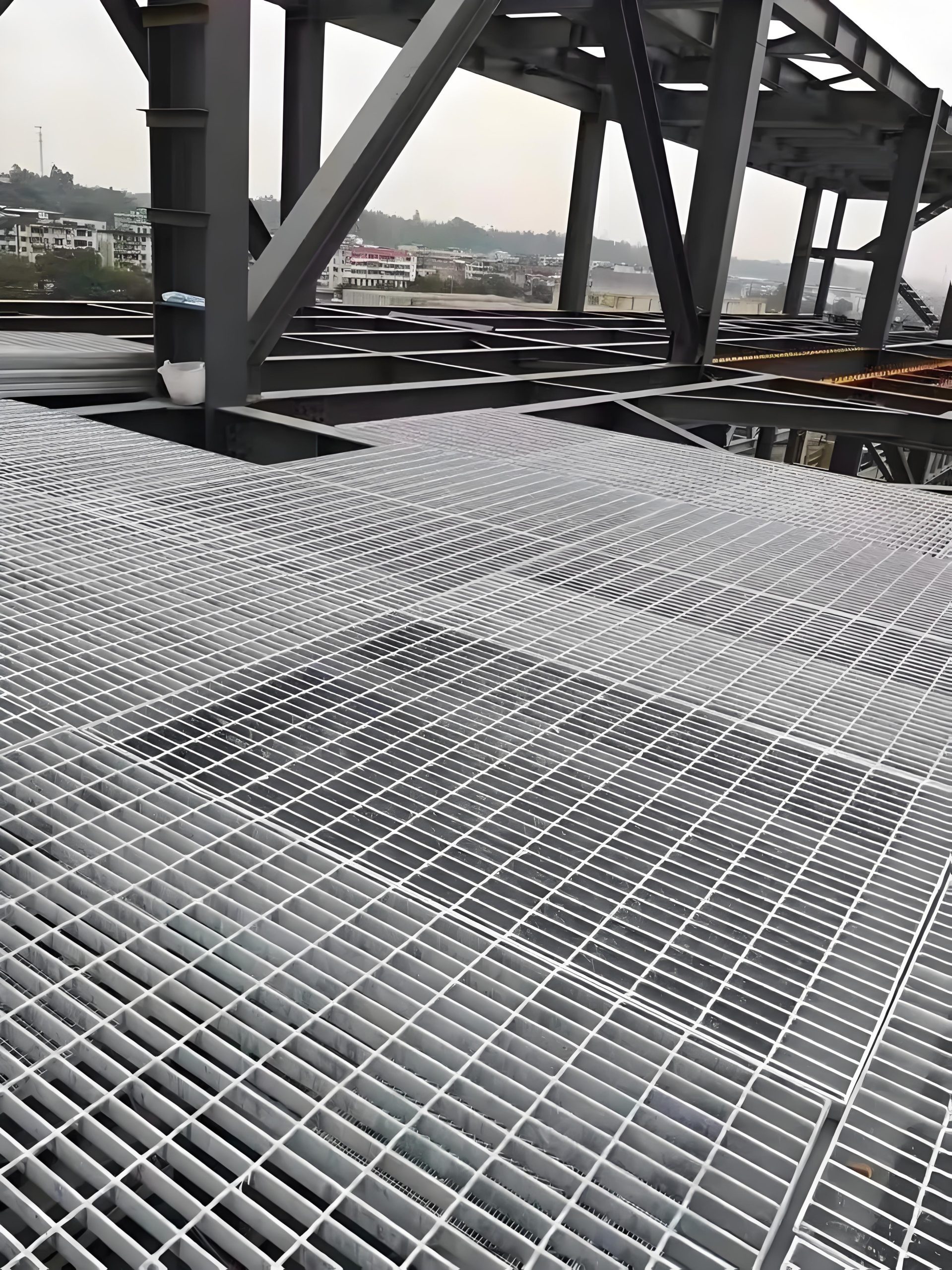
For trench covers and drainage covers, grating panels are often installed in angle frames or support ledges. The frame must provide enough bearing length and strength. If the frame is weak or uneven, the grating may move, make noise, or deform under load.
Accessories may include saddle clips, bottom clips, bolts, nuts, washers, stair tread side plates, toe plates, handles, lifting holes, anti-theft devices, and support frames. The right accessory depends on whether the grating is fixed, removable, heavy-duty, or installed in a public area.
| Installation Method | Main Advantage | Typical Application |
|---|---|---|
| Clips | Removable and easy to install | Walkways, platforms, maintenance areas |
| Welding | Strong permanent fixing | Fixed industrial platforms and non-removable panels |
| Bolting | Secure and removable | Stair treads, framed grating, heavy-duty covers |
| Frame support | Good positioning and load transfer | Trench covers, drainage covers, municipal panels |
The price of hot dip galvanized steel grating is affected by steel material cost, bearing bar size, bearing bar spacing, cross bar spacing, panel dimensions, surface type, zinc coating cost, custom fabrication, order quantity, packing, and shipping. Buyers should compare quotations based on complete specifications instead of only price per square meter.
Steel weight is one of the biggest cost factors. Larger bearing bars, thicker bars, closer spacing, and heavier banding increase material weight. Heavier grating costs more in raw material, galvanizing, handling, and transportation.
A grating panel with 40 x 5 mm bearing bars at 30 mm spacing will cost more than one with 25 x 3 mm bars at wider spacing. However, the heavier specification may be necessary for higher loads or longer spans.
Serrated hot dip galvanized steel grating usually costs more than smooth grating because the bearing bars need extra serration processing. It is often selected for wet, outdoor, oily, or stair applications where safety is more important than the small price difference.
Galvanizing cost depends on grating weight, surface area, zinc consumption, coating requirements, and local galvanizing process. Because steel grating has many edges and openings, coating quality control is important.
Cut-outs, notches, banding, stair tread side plates, bolt holes, lifting holes, toe plates, frames, and panel numbering all add fabrication labor. However, custom fabrication can reduce site cutting and improve installation speed.
Larger orders usually have better unit cost because raw material purchasing, production setup, galvanizing arrangement, and packing can be organized more efficiently. Export orders may require stronger packing, labels, pallets, container loading plans, and loading photos.
| Price Factor | Cost Impact | Buyer Advice |
|---|---|---|
| Raw steel price | Directly affects material cost | Confirm quotation validity when steel prices change |
| Bearing bar size | Larger bars increase weight and price | Select according to load and span |
| Bar spacing | Closer spacing increases steel quantity | Use closer spacing where load or safety requires it |
| Serrated surface | Adds processing cost | Recommended for wet or slippery areas |
| Galvanizing | Adds zinc and process cost | Important for outdoor and humid applications |
| Custom processing | Cut-outs and special parts increase labor | Provide drawings before requesting final price |
| Freight and packing | Heavy panels increase shipping cost | Confirm total weight and packing method |
What is hot dip galvanized steel grating used for?
Hot dip galvanized steel grating is used for industrial platforms, walkways, stair treads, trench covers, drainage systems, bridge access areas, outdoor service floors, equipment maintenance platforms, and heavy-duty industrial areas. It is selected because it provides load capacity, drainage, ventilation, corrosion resistance, and optional anti-slip performance.
Is hot dip galvanized steel grating rust resistant?
Yes, hot dip galvanized steel grating has good rust resistance because the zinc coating protects the steel surface from moisture and corrosion. It is suitable for many outdoor, humid, and industrial environments. In highly corrosive areas such as marine or chemical environments, the coating requirement, maintenance plan, or alternative material should be reviewed carefully.
How do I choose the right hot dip galvanized steel grating size?
To choose the right hot dip galvanized steel grating size, confirm the load requirement, clear span, bearing bar direction, bearing bar height and thickness, bearing bar spacing, cross bar spacing, panel dimensions, surface type, and installation method. For wet or outdoor walkways, serrated galvanized grating may be preferred. For heavy-duty areas, deeper and thicker bearing bars are usually required.
