

Diamond Grip safety grating is a formed metal plank designed for industrial walkways, platforms, stair treads, maintenance bridges, mezzanines, and access areas where slip resistance and drainage are important. Instead of using welded bearing bars, the sheet is cold-formed into rigid channels with raised serrated diamond openings. This structure provides a lightweight walking surface with strong traction, open drainage, and convenient installation. The right Diamond Grip grating size, material, channel depth, and gauge should be selected together because each affects load capacity, weight, corrosion resistance, fabrication options, and final factory price.
Diamond Grip safety grating is a one-piece metal safety plank with diamond-shaped openings and aggressive serrated edges around each opening. The surface is made from a continuous sheet rather than assembled from separate bearing bars and cross bars. During manufacturing, the sheet is punched, formed, and shaped into a channel profile that increases stiffness while keeping the product relatively light.
“Diamond-Grip” is also used as a branded product name by some manufacturers, while many buyers use “diamond grip grating,” “diamond safety grating,” “diamond plank grating,” and “serrated safety plank” as general search terms. When requesting a quote, it is important to confirm whether the project requires an exact branded profile, an equivalent diamond-pattern safety grating, or a custom channel plank made to the same functional requirements.
The surface combines open area with serrated traction. Water, mud, oil residue, snow, and small debris can pass through the diamond openings instead of collecting on a solid plate. At the same time, the raised metal edges create multiple contact points under footwear, helping workers maintain grip on industrial stairs and elevated access routes.
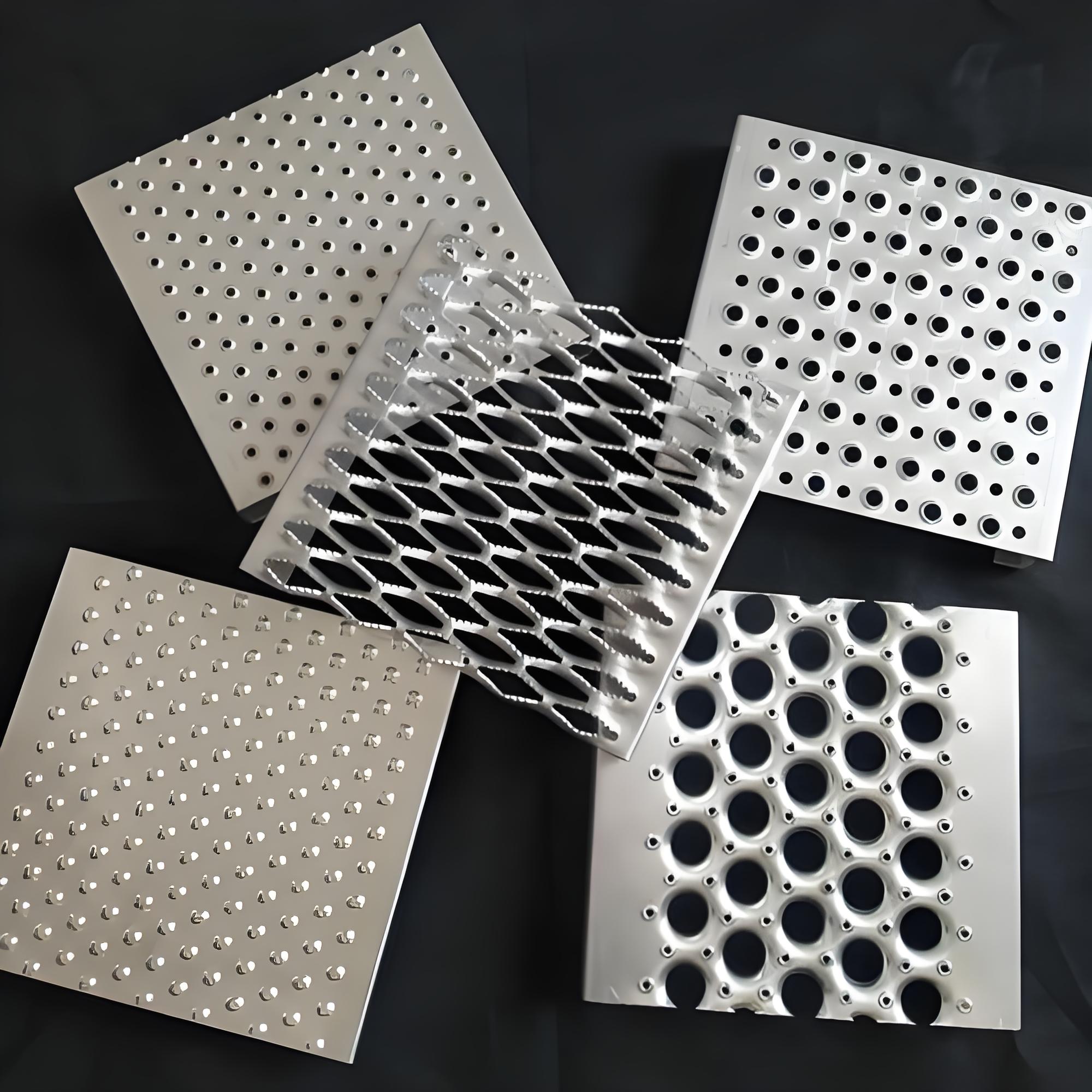
Diamond Grip safety grating is normally made as a channel plank. The longitudinal sides are bent downward to form a structural profile, while the top web contains repeated diamond-shaped openings. The punched diamonds are formed with rough, upward-facing serrations rather than smooth edges.
A flat perforated sheet can bend easily over a span. A formed channel is more rigid because the side walls create depth. As channel depth increases, the plank generally becomes stiffer and can often support greater loads or longer support spacing, provided the gauge, width, material, and installation method are also suitable.
The channel shape also creates a self-framing edge. In many installations, several planks are placed side by side to create a wider walkway. The formed side sections help each plank maintain its shape and make it easier to connect the grating to structural steel supports.
The diamond openings serve more than one purpose. They improve drainage, reduce standing water, allow light and air to pass through, and limit the buildup of dirt on elevated work surfaces. The serrated edges around the openings provide a biting surface for work boots and safety shoes, especially in wet, oily, snowy, or muddy locations.
Official Diamond-Grip product information describes the channel as a cold-formed, one-piece metal plank with rough serrated edges around diamond-shaped openings, intended to improve traction in difficult conditions such as grease, oil, snow, and ice. See the manufacturer’s Diamond-Grip product details.
Diamond Grip safety grating, Safety Grip grating, and welded bar grating are all used for industrial access, but their surface designs and best applications are different. Selecting the right type depends on the required grip level, drainage, opening size, span, load, cleaning requirements, and budget.
| Grating Type | Surface Structure | Main Strengths | Typical Applications |
|---|---|---|---|
| Diamond Grip Safety Grating | Formed channel with serrated diamond openings | High traction, drainage, self-cleaning performance, lightweight channel construction | Industrial walkways, stairs, platforms, catwalks, maintenance access |
| Safety Grip Grating | Large openings with raised traction buttons or perforated grip pattern | Very aggressive slip resistance and good drainage | Wet work areas, process plants, stairs, offshore access, maintenance routes |
| Welded Steel Bar Grating | Welded bearing bars and cross bars | High load capacity, broad size range, economical for larger flooring areas | Platforms, trenches, mezzanines, heavy industrial floors, drainage covers |
| Expanded Metal Grating | Slit and stretched sheet with diamond mesh | Continuous material, lower weight, flexible fabrication | Light-duty walkways, guards, ramps, architectural screens |
Bar grating is usually a stronger choice for wide panels carrying high industrial loads over engineered spans. Diamond Grip safety grating is often preferred when a narrow plank format, pronounced serrated traction, lighter handling weight, and rapid drainage are more important than a heavy-duty bar grating layout.
Diamond Grip safety grating is commonly supplied in a range of channel widths. Width is often described by the number of diamond rows across the walking surface. Standard sizes vary by manufacturer, but the dimensions below are widely used as reference points for diamond-pattern safety planks.
| Nominal Channel Width | Approximate Metric Width | Typical Diamond Rows | Common Use |
|---|---|---|---|
| 4-3/4 in. | 121 mm | 2 diamonds | Narrow stair treads, ladder access, small maintenance routes |
| 7 in. | 178 mm | 3 diamonds | Stair treads, narrow access planks |
| 9-1/2 in. | 241 mm | 4 diamonds | Standard industrial stair treads and walkways |
| 11-3/4 in. | 298 mm | 5 diamonds | Wider treads, platforms, maintenance access |
| 18-3/4 in. | 476 mm | 8 diamonds | Medium-width walkways and platform sections |
| 24 in. | 610 mm | 10 diamonds | Wide access paths and multi-plank platform layouts |
Common channel depths include 1-1/2 in., 2 in., 2-1/2 in., and 3 in. A deeper profile usually provides improved stiffness, but it also affects material use, dead weight, edge height, support detailing, and price. Not every width is available in every depth or material, so a final selection should be checked against the manufacturer’s current load table and production range.
Stock lengths are frequently supplied in 10 ft or 12 ft sections, although project requirements may call for cut lengths, stair tread blanks, special platform sections, or container-friendly export lengths. Buying standard stock lengths can reduce waste and fabrication cost when the layout allows it.
Diamond Grip safety grating is commonly specified by sheet gauge or nominal material thickness. The gauge affects the plank’s weight, stiffness, load performance, forming characteristics, and cost. However, gauge alone does not determine load capacity. Channel depth, plank width, support span, support direction, material grade, and allowable deflection must all be considered.
| Material | Common Thickness Range | General Selection Purpose |
|---|---|---|
| Carbon Steel / HRPO Steel | 14 gauge or 12 gauge | Economical industrial access, fabrication, painting, or later galvanizing |
| Pre-Galvanized Steel | 14 gauge or 12 gauge | General outdoor and indoor corrosion protection |
| Stainless Steel | Often 16 gauge or 14 gauge | Chemical, food, marine, washdown, and high-corrosion environments |
| Aluminum Alloy | 0.080 in. or 0.100 in. | Low-weight, corrosion-resistant, non-magnetic applications |
For reference, 14 gauge steel is approximately 1.9 mm thick, 12 gauge steel is approximately 2.7 mm thick, and 16 gauge steel is approximately 1.5 mm thick. Aluminum is often specified directly by decimal thickness rather than steel gauge, such as 0.080 in. or 0.100 in.
The most accurate unit weight should come from the selected manufacturer’s data sheet because each diamond pattern, channel depth, return flange, open area percentage, and material thickness changes the actual mass. Do not calculate weight as if the product were a solid sheet; the punched openings reduce material weight, while the formed side channels add stiffness without adding full-width sheet area.
A practical estimating method is:
Total Weight = Manufacturer Weight per Linear Foot × Required Length × Number of Planks
For a walkway made from multiple channel planks:
Number of Planks = Required Clear Walkway Width ÷ Nominal Plank Width
Then allow for overlap, side clearance, cut losses, end plates, toe boards, clips, bolts, and spare material. For export projects, total shipment weight should also include pallets, steel frames, packing straps, and protective packaging.
Material selection has a direct effect on Diamond Grip safety grating price and service life. The best material is not always the lowest-cost option. A grating that performs well indoors may corrode quickly in a coastal, chemical, or continuously wet environment.
Hot-rolled pickled and oiled steel, often called HRPO or HRP&O steel, is a practical base material for indoor industrial areas, protected installations, or projects that will receive paint or hot-dip galvanizing after fabrication. It is usually the most economical starting material, but uncoated carbon steel should not be selected for continuously wet or corrosive exposure.
Pre-galvanized steel is factory-coated zinc steel that provides useful corrosion resistance for many general industrial applications. It is commonly chosen for service platforms, plant stairs, rooftop access, equipment maintenance areas, and light-to-medium outdoor exposure. Cut edges, welded zones, and heavily damaged areas may require touch-up protection depending on the project specification.
Stainless steel Diamond Grip grating is frequently selected for food processing, pharmaceutical plants, water treatment facilities, marine sites, chemical production, and washdown areas. Type 304 stainless steel is suitable for many general corrosion-resistant applications. Type 316 or 316L stainless steel is usually preferred where chlorides, salt spray, seawater exposure, or stronger chemical conditions are expected.
Aluminum Diamond Grip safety grating is valued for its low weight and natural corrosion resistance. It is useful for marine walkways, mobile equipment, offshore support areas, architectural access, non-magnetic environments, and projects where reducing structural dead load is important. Aluminum has different stiffness characteristics from steel, so load span and support spacing must be checked carefully rather than copied from a steel design.
Common product data for Diamond-Grip channel planks lists pre-galvanized steel, HRP&O steel, 5052-H32 aluminum, and 304L or 316L stainless steel as available material options, with exact size availability depending on the selected profile. Review the published material options and profile range.
Load capacity is one of the most important parts of selecting Diamond Grip safety grating. A plank that is safe at a short support span may deflect too much or exceed its allowable loading when installed across a longer opening. For this reason, a supplier should never approve a grating size based only on walkway width or a previous order number.
In a typical channel-plank installation, the channel length runs from support to support. The longitudinal formed sides provide the primary stiffness. Installing the plank in the wrong span direction can greatly reduce performance, even if the product appears strong enough by visual inspection.
A deeper channel and heavier gauge can improve stiffness, but the designer must use the applicable manufacturer load table for the exact product. Load tables are not interchangeable between different diamond patterns, steel grades, aluminum profiles, or competing safety grating brands. Where public access, vehicle loading, fall protection, or personnel safety is involved, the final design should be reviewed by the responsible project engineer.
Diamond Grip grating is widely used in industrial access systems because it combines traction with open drainage. Its most common uses include:
For walkways, multiple channel planks can be installed side by side to create the required clear width. Wider routes may also use integrated toe boards or separate kick plates where tools or materials could fall from the edge. The open diamond pattern helps reduce standing water, which is especially useful in outdoor locations and washdown environments.
Diamond Grip stair treads are commonly fabricated with end plates that allow bolting to stair stringers. Tread width is normally based on the stair clear width, while tread depth is selected to match the step design and required footing area. A serrated front edge and open pattern can provide useful traction on industrial stairs where boots may carry mud, oil, water, or snow.
Diamond-pattern safety grating stair treads can be supplied with welded end plates, open ends, bolt holes, special nosing details, and custom lengths. See typical safety-grating stair tread configurations.
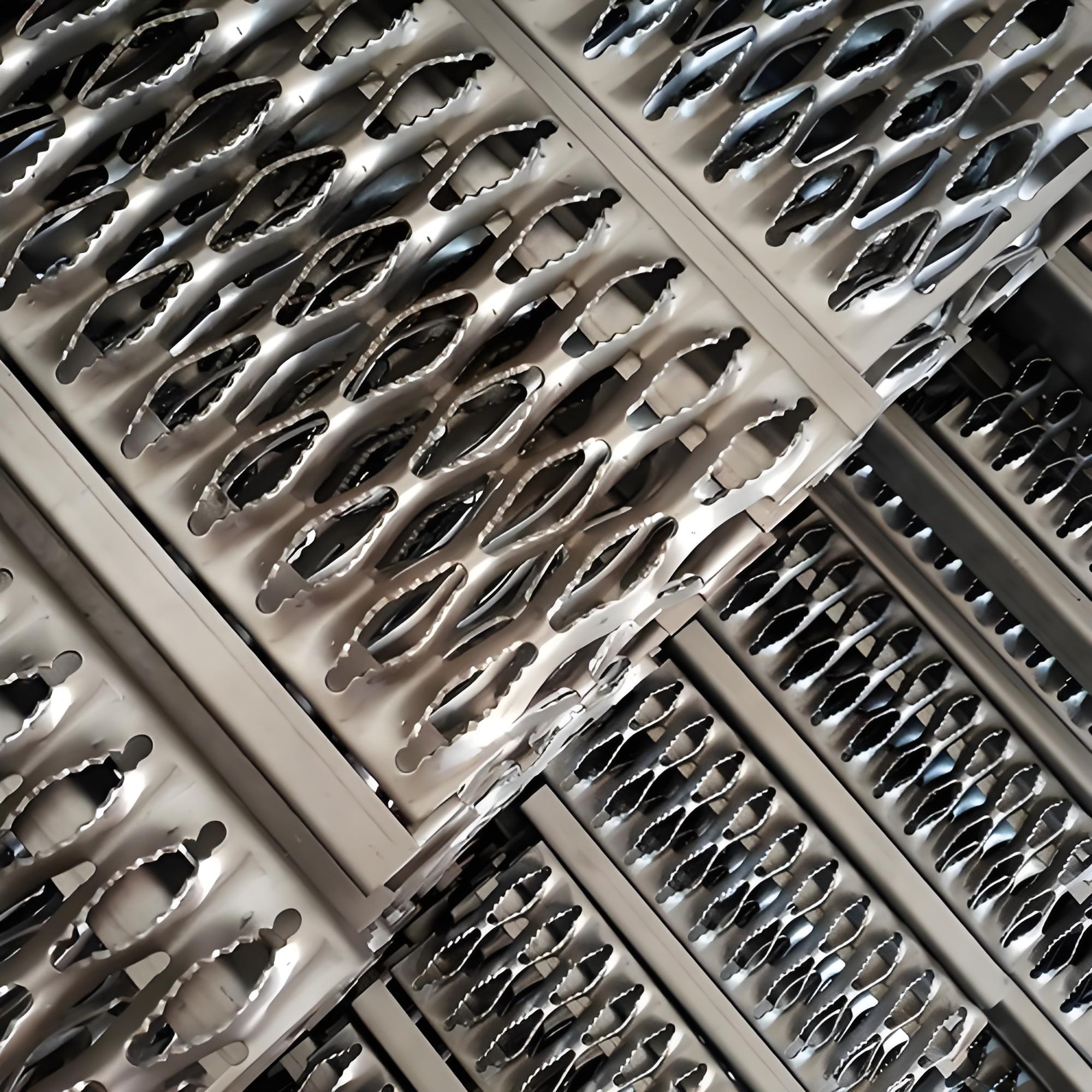
The main reason buyers choose Diamond Grip safety grating is its traction performance. The raised serrated diamond edges provide repeated gripping points under the sole of a shoe or boot. This can be especially valuable in outdoor plants, process areas, refineries, wastewater facilities, loading zones, and marine environments.
Open area also improves drainage. Water can drain through the surface instead of pooling on top, while small debris can fall through the openings. This reduces the cleaning burden compared with solid checker plate, although periodic cleaning is still necessary where debris, ice, process residue, or leaves can accumulate.
For projects with high heel-safety requirements, frequent pedestrian traffic, or small-wheel traffic, the opening pattern should be reviewed carefully. Diamond safety grating is excellent for many industrial areas, but a smaller opening pattern, close-mesh bar grating, perforated plate, or a different safety grating design may be better for certain public-facing applications.
One advantage of Diamond Grip safety grating is that it can be fabricated into project-specific pieces. Rather than forcing a layout to use full stock lengths, a factory can cut channel planks to length and prepare finished pieces for direct installation.
Custom work increases price because it involves measuring, programming, cutting, welding, inspection, and packing. However, factory fabrication can reduce installation time on site, improve fit-up accuracy, and reduce the risk of field modifications that damage protective coatings.
Diamond Grip safety grating should be fixed securely to the supporting structure. The correct method depends on the support type, expected vibration, corrosion environment, required removability, and whether drilling into the steel support is allowed.
Dedicated bolt seats are designed to fit within the formed diamond pattern below the walking surface so that the fastener does not create a major trip hazard. Typical bolt-seat arrangements use a round hole for a 3/8 in. bolt, while some designs can be supplied with square holes for carriage bolts. Material compatibility matters: galvanized steel, stainless steel, and aluminum accessories should be selected carefully to reduce corrosion and galvanic reaction risk.
J-clips can clamp the channel plank against a structural support without drilling the grating itself. They are useful where removability is needed, but they should not be used without checking the manufacturer’s restrictions for vibration-prone areas. Mid-support clips can connect adjacent channel planks and help limit relative movement or uneven deflection.
Manufacturer installation guidance for Diamond-Grip systems includes bolt seats, J-clips, and mid-support clips, with the exact accessory chosen according to the support arrangement and application. Refer to the safety grating catalog for accessory examples.
Diamond Grip safety grating price is usually quoted per linear foot, per plank, per square meter, or per completed fabricated item. A price per square meter can be helpful for early budgeting, but it is less precise for channel grating because a 24 in. wide, 3 in. deep plank uses a very different amount of material from a 7 in. wide, 1-1/2 in. deep plank.
| Price Factor | Effect on Final Cost |
|---|---|
| Material Type | HRPO carbon steel is generally the lowest-cost option; galvanized steel, aluminum, and stainless steel increase cost. |
| Steel Gauge or Material Thickness | Heavier material improves stiffness and durability but increases raw material weight and forming cost. |
| Channel Width and Depth | Wider and deeper channels use more material and may require more demanding forming processes. |
| Order Quantity | Full bundles, standard stock lengths, and repeated sizes usually lower unit pricing. |
| Cutting and Fabrication | Custom lengths, notches, stair end plates, holes, and welded parts add labor and setup cost. |
| Surface Protection | Galvanizing, passivation, polishing, powder coating, or special corrosion protection changes the price. |
| Accessories | Bolt seats, clips, bolts, toe boards, and mounting hardware should be included in a complete comparison. |
| Packaging and Freight | Long planks require careful bundling, export frames, container planning, and damage prevention. |
For broad industrial metal-grating budgeting, untreated carbon steel is commonly the lowest-cost material group, while galvanized steel, aluminum, and stainless steel move progressively higher depending on grade and market conditions. Special safety grating, heavy-duty profiles, serrated surfaces, and fabricated pieces can cost substantially more than basic flat grating products. See a current industrial metal grating price reference.
For an accurate Diamond Grip grating price, compare quotations on the same basis. A low initial price may exclude cut lengths, end plates, clips, galvanizing, packaging, freight, material certificates, or inspection documents. The best quote is the one that clearly defines the finished delivered product.
A complete inquiry allows the factory to recommend the right profile and avoid unnecessary revisions. Even a simple sketch can greatly improve quote accuracy.
For large or safety-critical projects, request a formal submittal showing channel profile, material, finish, dimensions, support span assumptions, fixing method, and itemized quantities. This helps ensure the supplied Diamond Grip safety grating matches the drawings and can be installed without site changes.
What sizes does Diamond Grip safety grating come in?
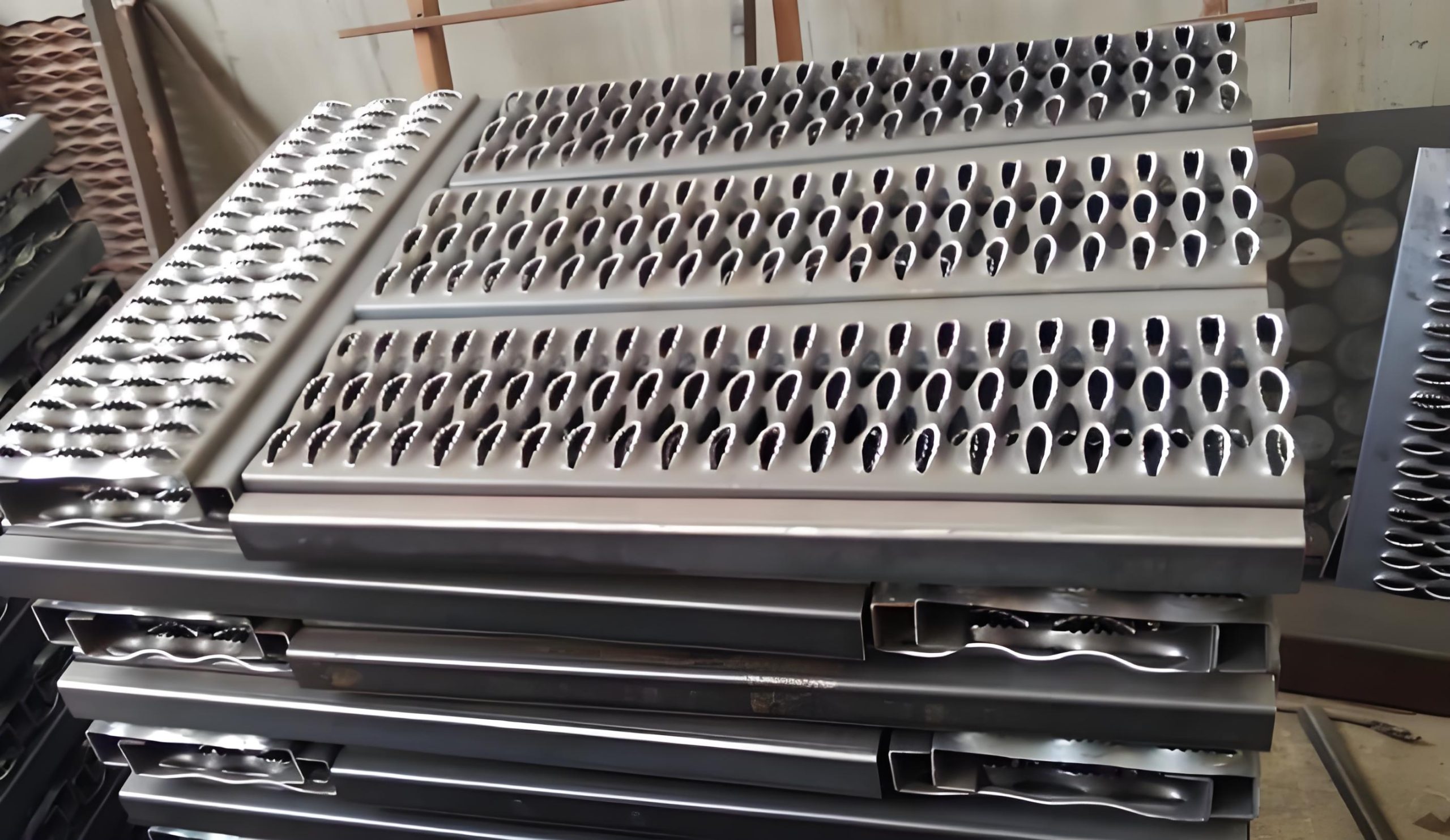
Common Diamond Grip channel widths include 4-3/4 in., 7 in., 9-1/2 in., 11-3/4 in., 18-3/4 in., and 24 in. Typical channel depths are 1-1/2 in., 2 in., 2-1/2 in., and 3 in. Stock lengths are often 10 ft or 12 ft, while factories can cut planks and fabricate stair treads to project dimensions.
Is Diamond Grip grating better than bar grating?
Neither is universally better. Diamond Grip safety grating is often better for aggressive slip resistance, drainage, lightweight channel planks, and industrial stairs or narrow access paths. Welded bar grating is often better for larger flooring areas, heavier loads, and long engineered spans. The correct choice depends on loading, support spacing, opening requirements, environment, and budget.
How much does Diamond Grip safety grating cost?
Diamond Grip safety grating cost depends on material, gauge, channel width and depth, quantity, cut lengths, accessories, corrosion protection, and shipping. HRPO steel is usually the most economical material, while galvanized steel, aluminum, and stainless steel cost more. Ask for a quote based on exact dimensions, support span, material grade, finish, fabrication details, and delivery location for a reliable price.