
Catwalk steel grating is used to create elevated walkways for maintenance personnel, inspection teams, and operating staff in factories, warehouses, power plants, refineries, chemical facilities, conveyor systems, pipe racks, tanks, and commercial buildings. The factory price depends on bearing bar size, mesh spacing, panel dimensions, steel grade, surface treatment, fabrication, quantity, and delivery conditions. This guide explains how to specify catwalk grating and how suppliers normally calculate the price per square meter.
Catwalk steel grating is an open-grid flooring system installed above ground level to provide safe access to equipment, pipes, valves, cable trays, tanks, roofs, and production lines. It is normally manufactured from load-bearing steel bars joined with cross bars by welding, press locking, or riveting.
The open surface allows rainwater, oil, dust, welding sparks, and small debris to pass through instead of collecting on the walkway. It also allows light and air to move between levels, reducing the need for a completely solid floor. Because the panels are lighter than solid steel plate, catwalk structures can often use smaller support members and require less lifting equipment during installation.
A catwalk should not be specified by appearance alone. The bearing bars must be selected for the clear span, worker loading, maintenance equipment, and deflection limit. The panel must also be fixed securely so it cannot lift, slide, or vibrate under normal service.
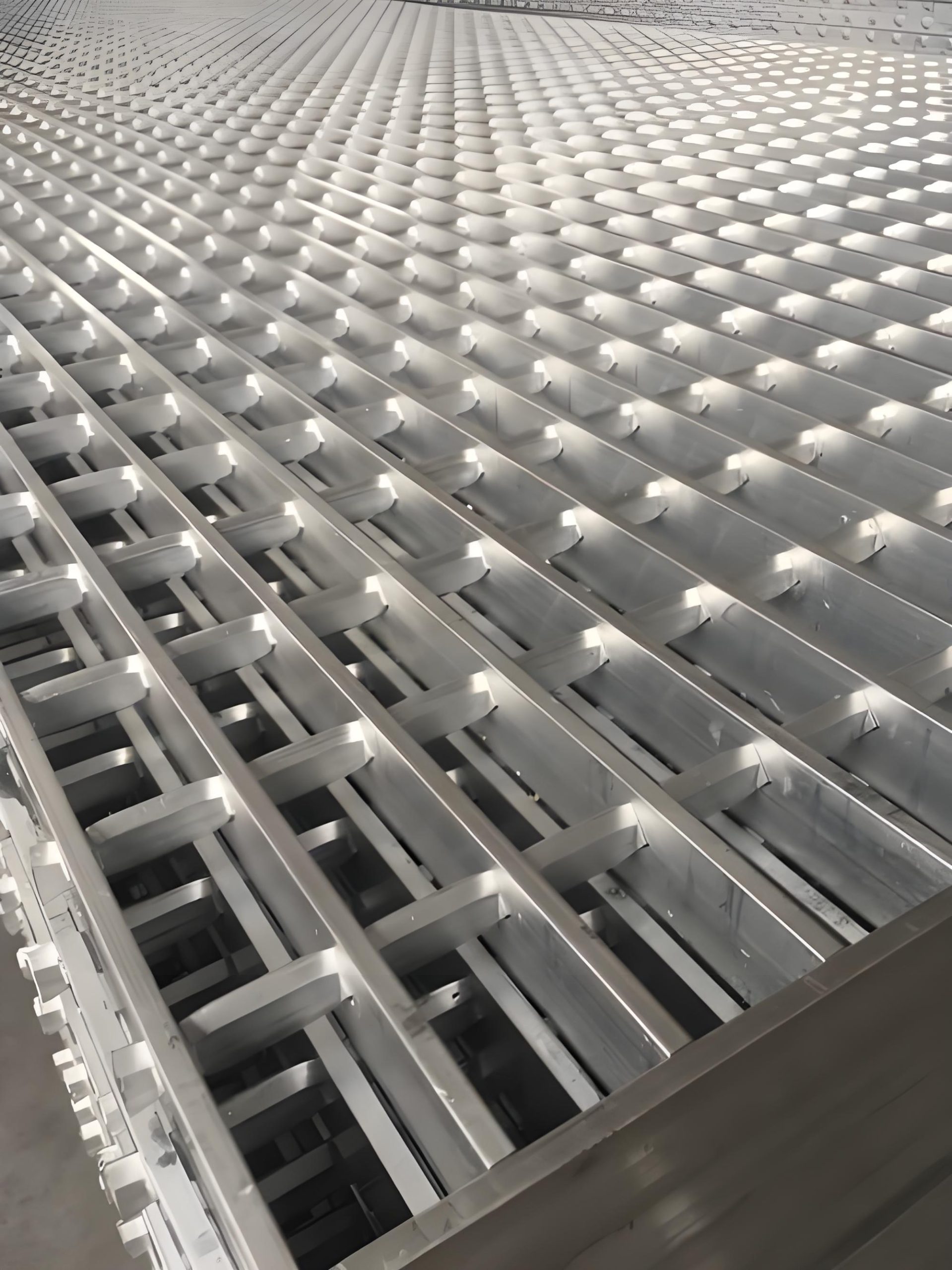
Catwalk layout has a direct effect on both safety and price. The first step is to define the walkway width, support spacing, access points, elevation, direction of span, and location of obstructions such as pipes, columns, ladders, cable trays, and equipment.
| Design Item | Typical Planning Approach | Effect on Grating Selection |
|---|---|---|
| Walkway width | Common modular widths include 300, 450, 600, 750, 900, 1,000, and 1,200 mm | Wider panels may need deeper bearing bars or additional support beams |
| Clear span | Measure the unsupported distance between bearing supports | Longer spans normally require thicker or deeper bearing bars |
| Support direction | Bearing bars should span between supports | Incorrect orientation can significantly reduce capacity |
| Headroom | Maintain the clearance required by the project and local safety rules | May affect floor elevation, stair geometry, and access openings |
| Panel joints | Plan joints over beams or support angles where possible | Reduces unsupported edges and simplifies fixing |
| Openings | Coordinate around columns, pipes, ladders, hatches, and machinery | Cutouts may require banding or a perimeter frame |
For industrial projects, the design may reference local building rules, occupational safety requirements, or standards such as ANSI/NAAMM, BS 4592, AS 1657, or an owner’s engineering specification. The required width, guardrails, toe plates, ladder access, and headroom should be confirmed before the factory starts fabrication.
Many factories keep standard welded grating panels in widths near 1,000 mm and lengths between 3,000 and 6,000 mm. Other common panel formats include 750 × 6,000 mm, 1,200 × 6,000 mm, and imperial sizes close to 36 × 240 inches or 48 × 240 inches.
| Common Panel Format | Approximate Use | Price and Lead-Time Advantage |
|---|---|---|
| 500 × 3,000 mm | Narrow access strips and compact platforms | Easy to handle and suitable for small openings |
| 750 × 6,000 mm | Pipe racks, service walkways, and maintenance routes | Often reduces cutting for narrow catwalks |
| 1,000 × 6,000 mm | General industrial catwalks and platforms | Common production format with efficient material use |
| 1,200 × 6,000 mm | Wider walkways and equipment access platforms | Fewer longitudinal joints but may require stronger supports |
Stock panels usually provide the shortest lead time and the lowest fabrication cost. Cut-to-length panels may still be economical when the factory can nest several pieces from one standard sheet. Custom panel dimensions, irregular cuts, and a large number of small pieces increase programming, handling, and inspection time.
When arranging a catwalk, try to keep the panel length compatible with the support beam layout. A design based on standard panel lengths can reduce the number of joints, edge cuts, and unused material sections.
Bearing bars carry the main floor load and must run in the direction of the clear span. Common catwalk bearing bar examples include 25 × 3 mm, 30 × 3 mm, 32 × 5 mm, 40 × 5 mm, and 50 × 5 mm. The correct choice depends on span, loading, support spacing, and allowable deflection.
Mesh design is normally described by bearing bar pitch and cross bar pitch. Examples include 30 × 100 mm, 30 × 50 mm, 40 × 100 mm, and 40 × 50 mm. The first value commonly identifies the center-to-center spacing of bearing bars, while the second identifies cross bar spacing. The factory drawing should confirm the exact designation.
| Grating Specification Example | General Characteristics | Typical Catwalk Use |
|---|---|---|
| 25 × 3 mm, 30 × 100 mm | Lightweight and economical | Short-span indoor maintenance walkways |
| 30 × 3 mm, 30 × 100 mm | Balanced weight and stiffness | General factory catwalks and platforms |
| 32 × 5 mm, 30 × 100 mm | Heavier bearing bars and lower deflection | Longer spans or heavier maintenance loads |
| 40 × 5 mm, 30 × 100 mm | Heavy-duty industrial flooring | Equipment areas and high-traffic access routes |
| 50 × 5 mm, 40 × 100 mm | High material weight and rigidity | Heavy loads, vehicle access, and demanding spans |
These examples are not universal load ratings. A 30 × 3 mm grating may be suitable over a short span but inadequate over a long opening. The factory should provide a load table or calculation for the exact bearing bar size, mesh, span, and load.
More information about pitch, bearing bar direction, and panel dimensions is available in this steel grating dimensions guide.
Catwalk loads normally include the weight of workers, hand tools, portable equipment, stored components, cable trays, small pipes, and occasional maintenance loads. Outdoor catwalks may also need to consider snow, ice, wind, rainwater, and vibration.
Uniform load and concentrated load should be considered separately. A uniform load distributed over the complete walkway may produce a different result from a person standing beside a heavy valve, a maintenance cart with small wheels, or a piece of equipment placed on four support feet.
| Load Type | Example | Design Concern |
|---|---|---|
| Uniform pedestrian load | Workers distributed along the catwalk | Overall bending and deflection |
| Concentrated foot load | One person standing in a less favorable position | Local deflection and opening behavior |
| Maintenance cart | Small wheels carrying tools or replacement parts | Wheel spacing, opening size, and point loads |
| Equipment point load | Valve actuator, motor, pump, or temporary lifting device | Local reinforcement and support arrangement |
| Pipe or cable load | Services supported by the catwalk structure | Combined dead load and maintenance access |
Deflection is often as important as ultimate strength. Excessive movement can make personnel uncomfortable, loosen fasteners, damage cable trays, or cause water and debris to collect. The project may specify a limit such as L/200 or L/240, but the applicable criterion must come from the engineer or owner.
Serrated grating has notches or teeth along the top of the bearing bars. These irregular surfaces increase traction when the walkway is wet, oily, icy, muddy, or contaminated with process materials.
| Feature | Serrated Catwalk Grating | Plain Catwalk Grating |
|---|---|---|
| Slip resistance | Higher traction in wet and oily areas | Acceptable for many dry indoor locations |
| Cleaning | May retain more dirt in the serrations | Smoother and easier to sweep |
| Common environment | Refineries, wastewater plants, outdoor platforms, ramps | Warehouses, dry factories, indoor service floors |
| Price | Usually higher because of serration processing | Lower for the same bar size and mesh |
Serration does not eliminate the need for proper drainage, handrails, lighting, or safe housekeeping. In a very wet catwalk, the best result normally comes from combining serrated bearing bars with a suitable open mesh, adequate slope, and regular cleaning.
Welded grating uses welded cross bars to connect the bearing bars. It is the most common choice for industrial catwalks because production is efficient, panels are rigid, and the design is familiar to engineers and installers. Cross bars may be twisted square bars, round bars, or flat bars, depending on the required appearance and load behavior.
Press-locked grating uses a locked cross bar inserted into pre-punched bearing bars. It provides a clean, uniform appearance and is often selected for architectural platforms, ventilation areas, and projects that require a more regular visual pattern. Press-locked panels may need different edge details and should be specified with the factory’s load data.
Riveted grating uses rivets or forged connections to join the bars. It can be selected for heavy-duty service, vibration, or projects where the owner has a traditional riveted-grating specification. Riveted panels generally require more labor and may have a higher factory price than standard welded panels.
| Material | Advantages | Typical Catwalk Environment |
|---|---|---|
| Carbon steel | Lowest material cost, high strength, easy welding | Indoor factories and protected structures |
| Hot-dip galvanized steel | Zinc protection on fabricated steel surfaces | Outdoor platforms, pipe racks, utility areas, and humid plants |
| 304 stainless steel | Good general corrosion resistance and clean appearance | Food processing, clean industrial rooms, and ordinary outdoor service |
| 316/316L stainless steel | Improved resistance to chlorides and aggressive chemicals | Marine, coastal, chemical, wastewater, and salt-exposed facilities |
Carbon steel may be supplied in grades such as ASTM A36, Q235, or another project-approved equivalent. The exact grade should be written in the purchase specification rather than assumed from the country of manufacture.
Hot-dip galvanizing is normally performed after cutting, welding, banding, and other fabrication. The completed steel panel is cleaned, fluxed, and immersed in molten zinc. This process protects the main bars as well as welds, cut edges, and fabricated connections.
Compared with mill-finished carbon steel, galvanized catwalk grating costs more because of zinc, handling, bath processing, inspection, and additional transport. The final charge may be based on the steel weight, the finished surface area, or a minimum batch fee.
Galvanizing can also affect dimensions. Zinc build-up around holes, corners, clips, and banded edges should be considered when tight-fitting panels are installed inside a frame. Drain holes and vent holes may be required in hollow sections to prevent pressure problems during dipping.
For more information about the process and coating considerations, buyers can review this hot-dip galvanized steel grating guide.
A catwalk project is not complete when the panels are delivered. The support and fixing system must be specified so the panels remain stable during foot traffic, vibration, and maintenance work.
| Accessory | Purpose |
|---|---|
| Saddle or clamp clip | Secures grating to a supporting beam without field welding |
| Hold-down clip | Reduces lifting and movement under vibration or wind |
| Bolted connection | Provides removable access for maintenance and inspection |
| Banding bar | Closes the open ends of bearing bars and improves edge rigidity |
| Toe plate | Helps prevent tools and objects from sliding off elevated walkways |
| Support angle | Creates a bearing ledge for removable panels |
| Stair or ladder connection | Coordinates the catwalk with access platforms and vertical circulation |
Clips and bolts may be stainless steel, galvanized steel, or painted carbon steel. When dissimilar metals are connected outdoors, the design should address galvanic corrosion and provide suitable isolation where required.
Industrial catwalks rarely consist only of rectangular panels. Factories often cut openings around pipes, structural columns, handrail posts, ladders, tanks, motors, cable trays, inspection hatches, and removable equipment.
Each cutout should be shown on a dimensioned drawing with the opening size, location from panel edges, required corner radius, and edge treatment. A cut edge that removes several bearing bars may require a welded banding bar or angle frame to restore stiffness and prevent sharp exposed ends.
For large openings, the supporting steel should be designed before the grating is cut. The grating should not be expected to bridge an unsupported opening simply because the remaining panel appears rigid. Custom notching, curved panels, hinged covers, removable access sections, and toe plates are normally priced as separate fabrication items.
Weight is one of the most important cost drivers because it affects steel consumption, galvanizing, packing, lifting, and freight. A simplified estimate for the bearing bars is:
Bearing-bar weight approximately equals 7.85 × bar height × bar thickness ÷ bearing-bar pitch.
When height, thickness, and pitch are entered in millimeters, the result is approximately kilograms per square meter for the bearing bars. Cross bars, banding, support frames, zinc, and fabrication must then be added.
| Illustrative Grating Style | Approximate Carbon Steel Weight Before Zinc | Price Position |
|---|---|---|
| 25 × 3 mm, 30 × 100 mm | Approximately 20–28 kg/m² | Light and economical |
| 30 × 3 mm, 30 × 100 mm | Approximately 24–32 kg/m² | Common general-duty catwalk option |
| 32 × 5 mm, 30 × 100 mm | Approximately 38–50 kg/m² | Medium to heavy-duty |
| 40 × 5 mm, 30 × 100 mm | Approximately 48–62 kg/m² | Heavy-duty industrial flooring |
| 50 × 5 mm, 40 × 100 mm | Approximately 60–78 kg/m² | High-load or long-span applications |
The figures are indicative only. Cross bar type, mesh pitch, serration, banding, and manufacturing tolerances can change the actual weight. A factory should provide the net weight from the approved drawing before the order is finalized.
| Catwalk Grating Type | Approximate Factory Budget | Price Conditions |
|---|---|---|
| Carbon steel plain, standard-duty | US$35–70/m² | Standard welded panels, mill finish, regular quantity |
| Carbon steel serrated | US$40–85/m² | Serrated bearing bars and standard fabrication |
| Hot-dip galvanized serrated | US$55–115/m² | Post-fabrication galvanizing, standard panels |
| Heavy-duty galvanized steel | US$80–160/m² | Thicker bearing bars, closer mesh, or custom support details |
| 304 stainless steel | US$140–280/m² | Depending on mesh, finish, and fabrication |
| 316/316L stainless steel | US$190–380+/m² | Higher alloy cost and corrosion-resistant service |
These are broad planning bands for factory inquiries and should not be used as a firm purchase price. EXW or FOB prices normally exclude destination freight, taxes, import duties, and local installation. Custom cutouts, framing, passivation, special packing, and small order quantities may increase the unit price significantly.
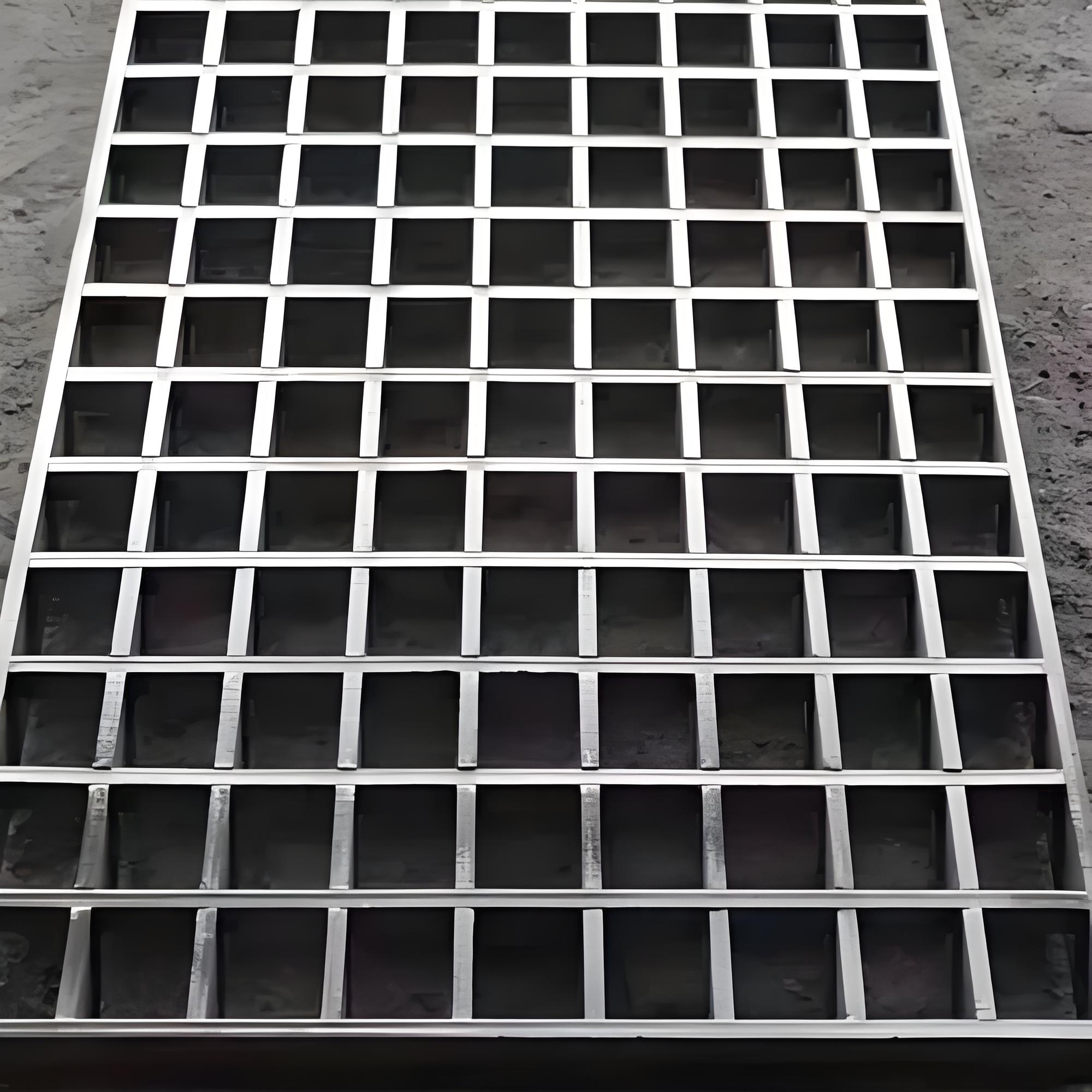
Quantity affects price through material purchasing, machine setup, welding time, galvanizing batches, inspection, and packing. A factory producing 500 identical panels can spread setup costs much more efficiently than a factory producing 20 panels with different dimensions.
| Order Situation | Likely Cost Effect |
|---|---|
| Standard panels from stock | Lowest price and shortest lead time |
| Standard length with cut-to-width panels | Moderate cutting charge and efficient material use |
| Many different panel sizes | Higher setup, marking, sorting, and inspection cost |
| Small quantity below factory MOQ | Minimum production or handling charge may apply |
| Irregular cutouts and notches | More CNC time, scrap, edge banding, and measurement work |
| Heavy-duty bearing bars | Higher steel consumption, lifting cost, and shipping weight |
| Galvanizing after fabrication | Additional zinc, handling, bath, and inspection charges |
Panel nesting is another important factor. If the layout can be arranged to use most of each standard panel, the factory can reduce scrap. If every walkway section has a different length or contains several large openings, the price per finished square meter may rise even when the steel grade remains unchanged.
Quality inspection should cover the items that affect installation and structural performance, not only visual appearance. Typical checks include bearing bar height and thickness, mesh pitch, panel length and width, squareness, flatness, cross bar welds, banding welds, serration consistency, bolt-hole locations, and overall weight.
For galvanized panels, the supplier may inspect coating appearance, zinc coverage, adhesion, and coating thickness according to the project specification. Excessive zinc build-up around bearing edges or support points should be corrected before shipment if it could prevent proper installation.
Catwalk panels are commonly bundled with steel straps and placed on pallets or skids. Long panels should be supported at several points during lifting to avoid bending. For export shipments, the factory should provide the bundle dimensions, gross weight, loading photographs if required, and a packing list that matches the panel marks.
A complete project quotation should clearly state the following:
Buyers comparing factory offers should make sure that each supplier is pricing the same finished panel, not merely the same nominal steel grade. A quotation that excludes clips, edge banding, galvanizing, or export packaging may appear cheaper while producing a higher final project cost.
How much does catwalk steel grating cost per square meter?
Typical factory planning prices may range from about US$35–70/m² for plain carbon steel standard-duty panels, US$55–115/m² for serrated hot-dip galvanized panels, and US$80–160/m² for heavy-duty galvanized grating. Stainless steel catwalk grating is usually much higher, often starting around US$140/m² for 304 and US$190/m² for 316. Exact pricing depends on weight, mesh, quantity, fabrication, packing, and delivery.
What grating size is suitable for an industrial catwalk?
Common starting points include 25 × 3 mm or 30 × 3 mm bearing bars for short-span, light-duty walkways and 32 × 5 mm, 40 × 5 mm, or larger bars for longer spans or heavier maintenance loads. The final selection must be based on clear span, load type, bearing direction, support width, and allowable deflection rather than walkway width alone.
Should catwalk grating be plain or serrated?
Serrated grating is generally the safer choice for wet, oily, outdoor, icy, or process areas because the teeth improve traction. Plain grating is often adequate for dry indoor catwalks and may be easier to clean. The project should also consider opening size, drainage, footwear, maintenance practices, and local safety requirements.
