

19W4 steel grating is a standard welded bar grating pattern widely used for industrial walkways, platforms, stair treads, catwalks, trench covers, maintenance floors, and drainage-related access areas. In the designation, 19 identifies the bearing-bar spacing, W means welded construction, and 4 identifies the cross-bar spacing. A serrated 19W4 panel has the same basic mesh pattern as smooth 19W4 grating, but the top edges of the bearing bars are notched to provide stronger traction in wet, oily, muddy, snowy, or outdoor conditions. Price depends on the bearing-bar depth and thickness, steel grade, finish, serration, fabrication, panel size, quantity, packing, and delivery terms rather than on the 19W4 spacing code alone.
19W4 is an industry-style designation for welded steel bar grating. It describes the spacing pattern and construction method, but it does not identify the complete bearing-bar size, material, load capacity, finish, or panel dimensions.
| Designation Element | Meaning | Practical Effect |
|---|---|---|
| 19 | Bearing bars spaced 19/16 inch center to center | Approximately 1-3/16 inch or 30.16 mm bearing-bar pitch |
| W | Welded steel grating construction | Cross bars are resistance welded to bearing bars |
| 4 | Cross bars spaced 4 inches center to center | Approximately 101.6 mm cross-bar pitch |
| Serrated | Notches or teeth formed on the top of bearing bars | Improves traction in many slippery service conditions |
A complete serrated 19W4 specification might read:
Serrated welded carbon steel bar grating, 19W4 spacing, 1-1/4 inch × 3/16 inch bearing bars, hot-dip galvanized after fabrication, panel size 3 feet × 20 feet, cut and banded according to approved drawings.
Two panels can both be called serrated 19W4 grating but perform very differently. A panel with 1 inch × 1/8 inch bearing bars is much lighter than a panel with 1-1/2 inch × 3/16 inch bearing bars. The heavier panel normally has greater bending resistance, lower deflection at the same span, and a higher price.
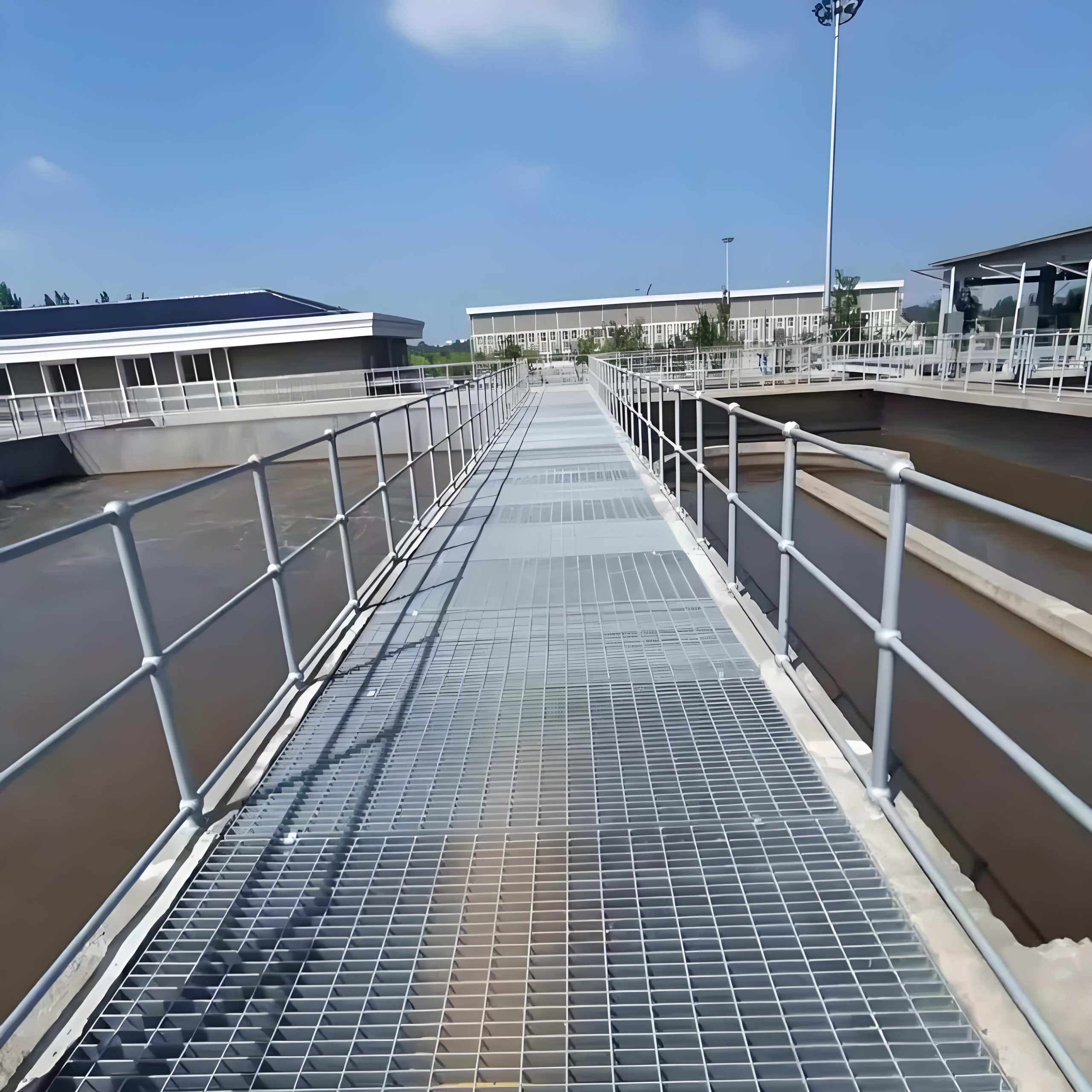
19W4 spacing is based on center-to-center dimensions. The bearing bars are placed at 1-3/16 inch centers, while the cross bars are placed at 4 inch centers.
The bearing-bar pitch controls how many primary load-bearing bars are present across the width of a panel. The cross-bar pitch affects panel stability, open area, surface appearance, cross-bar quantity, and manufacturing cost.
| Spacing Item | Imperial Dimension | Approximate Metric Dimension |
|---|---|---|
| Bearing-bar pitch | 1-3/16 in center to center | 30.16 mm center to center |
| Cross-bar pitch | 4 in center to center | 101.6 mm center to center |
| Typical bearing-bar thickness | 1/8 in or 3/16 in | About 3.2 mm or 4.8 mm |
| Typical bearing-bar depth | 3/4 in to 2 in or more | About 19 mm to 51 mm or more |
The clear opening between bearing bars is smaller than the 1-3/16 inch center spacing because the bearing-bar thickness occupies part of that distance. For example, a 19W4 panel with 3/16 inch thick bearing bars has an approximate clear opening of 1 inch between the bearing bars before considering cross-bar geometry.
Clear opening is important for walking comfort, heel safety, small-wheel performance, drainage, dropped-object control, ventilation, and compliance with project-specific safety requirements. It should always be evaluated from the finished grating structure rather than from the spacing designation alone.
19W4 is commonly described as the imperial equivalent of approximately 30 x 100 mm steel grating. This is a practical comparison, but the dimensions are not exactly identical:
| Mesh Description | Bearing-Bar Pitch | Cross-Bar Pitch |
|---|---|---|
| 19W4 | 1-3/16 in = 30.16 mm | 4 in = 101.6 mm |
| 30 x 100 mm metric mesh | 30 mm | 100 mm |
For general factory production and quotation, 19W4 and 30 x 100 mm are often treated as comparable standard industrial mesh patterns. However, a project drawing may require the exact imperial spacing, exact metric spacing, or a particular industry designation. The supplier should not assume that a near-equivalent metric pattern is acceptable when a drawing or specification specifically calls for 19W4.
The 19W4 pattern is popular because it creates an open grid with good drainage and ventilation while retaining a relatively dense bearing-bar layout for industrial walking surfaces. It is widely used in refinery platforms, power plants, steel structures, wastewater facilities, manufacturing plants, loading areas, outdoor catwalks, access stairs, and equipment platforms.
Serrated steel grating has teeth or notches formed along the upper edge of the bearing bars. These serrations create a more aggressive contact surface for work boots and industrial footwear. They are especially useful where water, rain, oil, mud, dust, process residue, snow, or ice can make a smooth metal surface more slippery.
Serration is commonly selected for:
The anti-slip benefit comes from the serrated top edge, not from the 19W4 mesh pattern itself. A smooth 19W4 panel and a serrated 19W4 panel have similar spacing, but the serrated version is generally a better choice where slip risk is significant.
Serration is not a replacement for proper drainage, cleaning, lighting, handrails, safe footwear, or good maintenance practices. The actual walking surface can still become hazardous if it is covered with ice, grease, mud, algae, chemical residue, or accumulated debris.
Because serrations remove a small amount of material from the top edge of a bearing bar, serrated grating should be selected using a serrated-grating load table or a manufacturer-approved design method. It is not good practice to assume that a serrated bearing bar has exactly the same load performance as a smooth bearing bar of the same nominal depth and thickness.
For some load-table systems, serrated grating requires a deeper bearing bar than smooth grating to achieve the same design rating. This does not mean serrated grating is weak; it means the effect of the tooth profile should be included in the engineering selection.
Serrated and smooth 19W4 grating use the same standard spacing pattern. The main difference is the top surface of the bearing bars.
| Comparison Item | Serrated 19W4 Grating | Smooth 19W4 Grating |
|---|---|---|
| Surface profile | Notched or toothed bearing-bar tops | Plain flat bearing-bar tops |
| Slip resistance | Better traction in many wet, oily, and outdoor conditions | Suitable for dry or controlled areas |
| Cleaning | May retain more debris in poor housekeeping conditions | Usually easier to sweep and wash |
| Factory cost | Higher because serration adds processing | Usually lower for the same bar size and finish |
| Best use | Outdoor stairs, ramps, wet areas, drainage zones, oily platforms | Indoor equipment platforms, dry walkways, controlled industrial floors |
For an indoor platform that remains dry and is cleaned regularly, smooth 19W4 grating can be a practical and economical choice. For an outdoor maintenance route, wet industrial floor, sloped walkway, or stair system, serrated 19W4 grating is normally the safer selection.
The 19W4 designation does not specify bearing-bar depth or thickness. These dimensions must be selected according to the clear span, design load, deflection limit, material grade, and application.
| Common Bearing-Bar Size | Approximate Metric Size | General Application Range |
|---|---|---|
| 3/4 in × 1/8 in | 19 mm × 3.2 mm | Light-duty, short-span access and limited pedestrian use |
| 1 in × 1/8 in | 25 mm × 3.2 mm | Short-span walkway panels and light industrial access |
| 1 in × 3/16 in | 25 mm × 4.8 mm | Standard light to medium industrial service |
| 1-1/4 in × 1/8 in | 32 mm × 3.2 mm | General industrial flooring with controlled spans |
| 1-1/4 in × 3/16 in | 32 mm × 4.8 mm | Common industrial platform and walkway specification |
| 1-1/2 in × 3/16 in | 38 mm × 4.8 mm | Longer spans, lower deflection, higher service loads |
| 1-1/2 in × 1/4 in | 38 mm × 6.4 mm | Medium to heavy-duty industrial applications |
| 2 in × 1/4 in or larger | 51 mm × 6.4 mm or larger | Heavy-duty, long-span, or engineered loading conditions |
Increasing bearing-bar depth is one of the most effective ways to improve bending resistance and reduce deflection. Increasing thickness also improves strength and stiffness, but it increases steel weight rapidly. The correct choice is not always the deepest or thickest bar; it is the bar that meets the required load and deflection with reasonable cost and weight.
19W4 grating is valued for its open structure. The mesh allows water, rain, snow, dust, heat, and process residue to pass through the floor instead of building up on the walking surface. It also allows airflow and light transmission through elevated platforms.
Typical open area for standard 19W4 grating can be high, often around the upper 70 percent range depending on the bearing-bar thickness, cross-bar profile, edge treatment, and construction method. The exact open-area percentage should be confirmed from the finished product specification.
| Performance Requirement | How 19W4 Grating Helps | What Still Needs Review |
|---|---|---|
| Drainage | Allows water and debris to pass through open mesh | Drainage channel, floor slope, cleaning, and debris control below |
| Ventilation | Allows air circulation through elevated floors | Required free area, pressure drop, and protection from debris |
| Light transmission | Allows light to reach lower levels | Lighting design, shadows, and safety visibility |
| Foot support | 30 mm bearing-bar pitch gives a practical industrial walking surface | Footwear type, heel safety requirements, public access rules |
| Dropped-object control | Open structure reduces buildup on the surface | Need for toe plates, secondary mesh, screens, or tool-control measures |
High open area improves drainage but can allow tools, bolts, parts, or debris to fall to lower levels. Where workers or equipment are located below the grating, the project should consider toe plates, lower screens, secondary mesh, tool lanyards, or other protective measures.
For public pedestrian areas, opening size should be reviewed carefully. A grating pattern that is suitable for a controlled industrial platform may not meet the opening, heel-safety, accessibility, or small-wheel requirements for public facilities.
19W4 and 11W4 are both welded bar grating designations, but they have very different bearing-bar spacing.
| Feature | 19W4 Grating | 11W4 Grating |
|---|---|---|
| Bearing-bar spacing | 19/16 in center to center | 11/16 in center to center |
| Approximate metric pitch | 30.16 mm | 17.46 mm |
| Cross-bar spacing | 4 in center to center | 4 in center to center |
| Mesh character | Standard industrial open grid | Close-mesh grid with smaller openings |
| Steel weight | Lower for the same bar depth and thickness | Higher because more bearing bars are used per panel width |
| Open area | Higher | Lower |
| Typical use | Platforms, walkways, stairs, drainage covers, industrial floors | Small-wheel areas, smaller-opening requirements, special pedestrian conditions |
19W4 is generally the more economical and widely used standard pattern for industrial flooring. It provides strong drainage and ventilation while maintaining a practical walking surface for work boots and industrial access.
11W4 is selected when the project needs a smaller opening. It may be used where there is concern about heels, small wheels, dropped objects, or an unusually close mesh requirement. Because 11W4 contains substantially more bearing bars per unit width, it is heavier and usually more expensive than 19W4 grating with the same bearing-bar depth and thickness.
Close mesh should not be selected only because it appears stronger. The correct choice depends on the full load requirement, opening requirement, span direction, deflection limit, and intended use of the finished surface.
19W4 spacing does not have one fixed load capacity. Load capacity depends on the bearing-bar section and the distance between supports. A 19W4 panel with 1 inch × 1/8 inch bars will not carry the same load as 19W4 grating with 1-1/2 inch × 3/16 inch bars.
The main structural factors are:
Bearing bars must run in the direction between supports. The cross bars help maintain the panel structure, but they are not the primary spanning members. A drawing must show bearing-bar direction clearly.
For example, a panel may be 3 feet wide by 20 feet long. If the bearing bars run along the 20-foot direction and supports are located every 3 feet, the design span is 3 feet. The 20-foot overall panel length affects handling and installation layout, but the bar span is controlled by the support spacing.
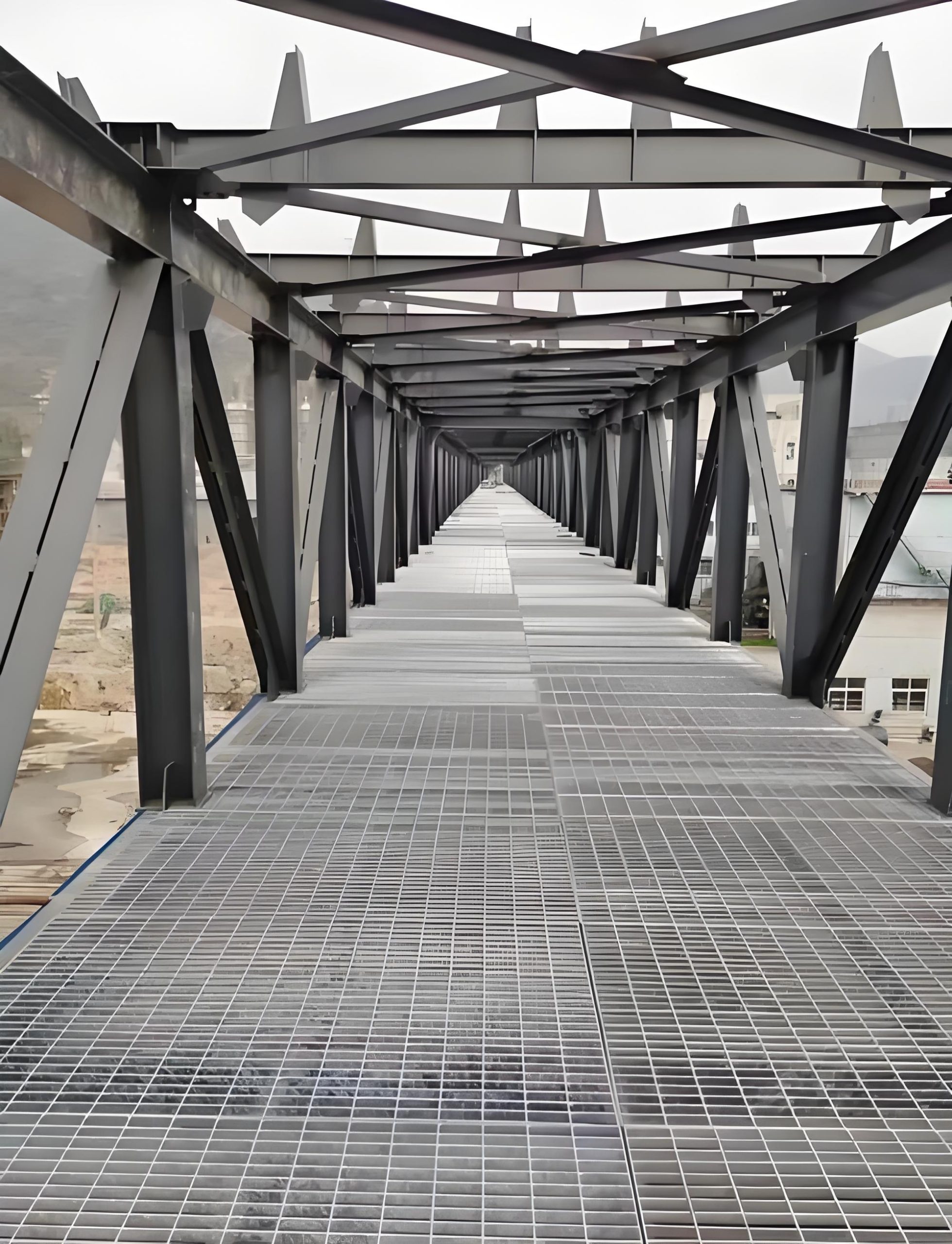
A grating panel can remain below steel yield strength while still deflecting too much under service loading. Excessive deflection may create uncomfortable walking, drainage problems, vibration, loose clips, rattling, uneven joints, and long-term maintenance issues.
Load tables should be checked against both strength and deflection requirements. For heavy loads, long spans, wheeled equipment, trucks, forklifts, or special structural conditions, the grating should be selected from a verified engineering table or project-specific calculation.
Serrated grating should be checked using the correct serrated load data. It should not be assumed to have exactly the same load rating as smooth grating with the same nominal bar dimensions.
19W4 grating is commonly produced in large stock panels and then cut into finished pieces for platforms, floors, stairs, trench covers, access hatches, and equipment areas.
| Common Stock Panel Format | Typical Use | Practical Note |
|---|---|---|
| 2 ft × 20 ft | Narrow walkways and access strips | Common stock width for industrial flooring |
| 3 ft × 20 ft | Platforms, walkways, catwalks, industrial floors | Widely used standard panel format |
| 3 ft × 24 ft | Longer industrial flooring layouts | May be cut into several project panels |
| 4 ft × 20 ft | Wider platform flooring and access areas | May require lifting equipment depending on bar size |
| 1000 mm × 6000 mm | Common metric production reference | Often cut into platform, cover, and walkway panels |
| 1200 mm × 6000 mm | Large industrial platform panels | Handling, galvanizing, and transport must be reviewed |
Standard stock sheets often have the lowest price per square foot or square meter because the factory can produce them in repeated batches with efficient material use. However, many projects need cut-to-size panels with banded edges, pipe cutouts, notches, lifting holes, frames, clips, toe plates, and panel identification marks.
Large panels reduce the number of joints but may be difficult to lift, remove, galvanize, transport, and install. Smaller panels are easier to replace and maintain, but they require more joints, more support details, and more installation labor.
Carbon steel is the most common material for 19W4 grating because it provides strong structural performance at a practical initial cost. Plain black carbon steel is usually the least expensive option, but it is not suitable for many outdoor or wet environments unless another protective coating is specified.
The main cost drivers for carbon steel 19W4 grating are:
For a factory order, the price should be calculated from finished steel weight and fabrication scope rather than from the 19W4 designation alone. A light 19W4 panel with 1 inch × 1/8 inch bearing bars may cost far less than a serrated 19W4 panel with 1-1/2 inch × 3/16 inch bars, even if both panels have the same outside dimensions.
Hot-dip galvanized serrated 19W4 grating is one of the most common specifications for outdoor industrial floors, stairs, platforms, catwalks, drainage areas, and exposed maintenance structures. The zinc coating helps protect the carbon steel surface, welded intersections, edge banding, and fabricated details against many atmospheric and general industrial corrosion conditions.
For preliminary budgeting, standard serrated 19W4 grating can be divided into broad cost levels:
| Product Level | Typical International Factory Budget Range | Typical Scope |
|---|---|---|
| Plain black 19W4 carbon steel grating | About US$28–45/m² | Standard welded panels, basic packing, limited fabrication |
| Hot-dip galvanized smooth 19W4 grating | About US$35–60/m² | Standard carbon steel industrial flooring panels |
| Hot-dip galvanized serrated 19W4 grating | About US$40–70/m² | Anti-slip industrial panels with standard sizes and repeated specifications |
| Fabricated serrated galvanized 19W4 panels | About US$55–110/m² or more | Cut-to-size, banded, notched, framed, identified, and export packed panels |
| Stainless serrated 19W4 grating | Project-specific and usually higher | Corrosive, hygienic, chemical, food, coastal, or marine service |
These figures are broad budgeting references, not fixed offers. The final price can change with steel market movement, zinc cost, bar size, actual kg/m², factory location, order quantity, fabrication complexity, packing, inspection requirements, currency, and trade term.
Small local retail orders are usually much more expensive than factory-volume pricing. Distributor stock, local warehousing, one-piece cutting, handling, taxes, freight, and short delivery requirements can increase the final price per square foot significantly.
Hot-dip galvanizing adds zinc, processing, handling, inspection, and finished shipping weight. It is usually performed after cutting, welding, edge banding, and fabrication so that exposed edges, welds, serrated surfaces, and custom details receive coating coverage.
Galvanizing cost is influenced by:
Galvanized grating should be checked after site cutting, drilling, welding, or impact damage. These activities can affect the protective coating and may require repair according to the project coating specification.
Factory fabrication converts a standard 19W4 panel into a part that fits the installation. It can reduce field cutting and speed up site work, but it adds material, labor, inspection, and coating cost.
| Fabrication Item | Purpose | Effect on Cost |
|---|---|---|
| Edge banding | Closes open bearing-bar ends and improves edge stiffness | Adds flat bar, welding, and galvanizing area |
| Load banding | Provides a stronger perimeter where specified | Higher than standard trim banding |
| Pipe cutouts | Allows grating to fit around pipes and equipment | Requires cutting, banding, and possible reinforcement |
| Column notches | Fits panels around structural columns | Increases cutting time and can reduce material yield |
| Toe plates | Helps reduce objects falling from platform edges | Adds steel, welding, coating, and installation coordination |
| Frames and support angles | Creates a finished cover or removable access assembly | Adds structural steel and fabrication work |
| Lift handles and hinges | Improves access for removable panels and covers | Adds fittings and individual assembly work |
| Fixing clips and bolt holes | Secures panels against uplift, movement, or theft | Adds accessories, drilling, packing, and labeling |
A panel with several internal cutouts can cost much more than a plain rectangle with the same total area because every cut edge may require banding and welding. Irregular shapes, curved panels, fan-shaped panels, angled cuts, and mixed-size schedules may also create material waste and slow factory production.
An accurate quotation should include more than the total area. The supplier needs enough information to calculate steel weight, fabrication time, galvanizing, packing, and shipment requirements correctly.
| Required Information | Example |
|---|---|
| Product type | Serrated welded steel bar grating |
| Spacing designation | 19W4 |
| Bearing-bar size | 1-1/4 in × 3/16 in |
| Material | Carbon steel, 304 stainless steel, or 316L stainless steel |
| Surface | Serrated bearing bars |
| Finish | Hot-dip galvanized after fabrication |
| Panel dimensions | 3 ft × 20 ft stock panel or a detailed cut-panel schedule |
| Bearing-bar direction | Bars span between supports at 3 ft centers |
| Load requirement | Uniform load, concentrated load, wheel load, and deflection limit |
| Fabrication | Banding, cutouts, toe plates, frames, clips, holes, lifting details |
| Quantity | Total panels, total area, and number of repeated panel sizes |
| Commercial terms | Packing method, destination, requested Incoterm, and delivery date |
A detailed inquiry could read: “Please quote hot-dip galvanized serrated welded steel bar grating, 19W4 spacing, 1-1/4 inch × 3/16 inch bearing bars, finished panel size 3 feet × 8 feet, bearing bars spanning 3 feet between supports, banded on four sides, suitable for the stated pedestrian load and deflection limit. Please provide finished weight, load-table reference, fabrication scope, packing method, lead time, and FOB price.”
This level of detail allows the factory to quote the correct product instead of making assumptions about bar size, span direction, surface treatment, or fabrication requirements.
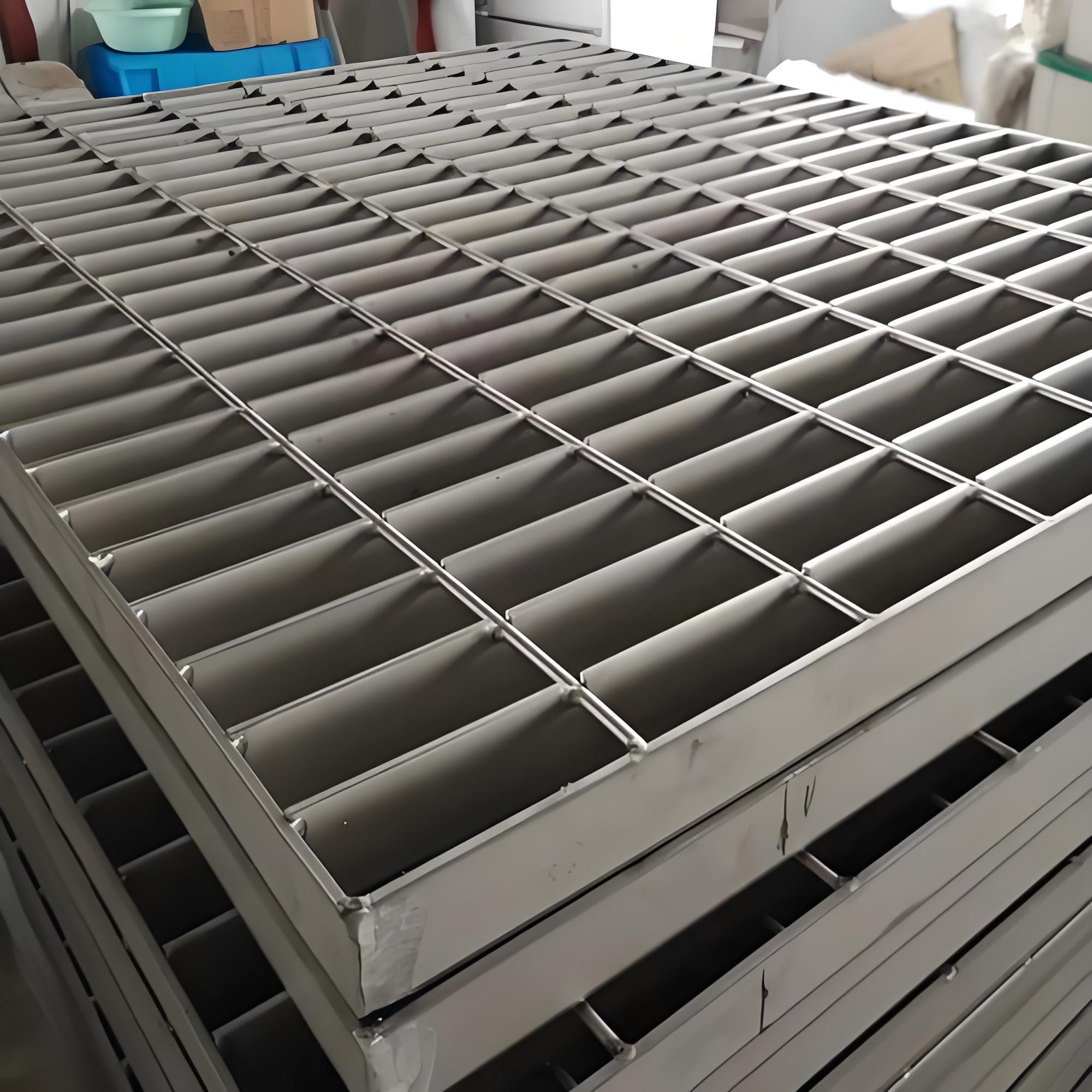
Is 19W4 the same as 30 x 100 mm steel grating?
19W4 is very close to 30 x 100 mm metric grating. 19W4 has bearing bars at 1-3/16 inch centers, or approximately 30.16 mm, and cross bars at 4 inch centers, or approximately 101.6 mm. They are often treated as comparable industrial mesh patterns, but exact project drawings should state the required system.
What is the difference between serrated 19W4 and smooth 19W4 grating?
Both have the same bearing-bar and cross-bar spacing. Serrated 19W4 has notched bearing-bar tops for improved traction in wet, oily, outdoor, or sloped areas, while smooth 19W4 has plain bearing-bar tops and is commonly used in dry, controlled environments.
How much does galvanized serrated 19W4 grating cost?
For preliminary factory budgeting, standard hot-dip galvanized serrated 19W4 grating may fall around US$40–70/m², depending on bearing-bar size, finished weight, order quantity, coating, and fabrication. Cut-to-size, banded, framed, close-mesh, or heavily customized panels can cost more.