

Steel grating for sale is available as standard stock panels, cut-to-size panels, fabricated stair treads, trench covers, platform flooring, and complete project packages. Buyers can choose welded, press-locked, riveted, safety plank, serrated, and heavy-duty grating in carbon steel, galvanized steel, stainless steel, or aluminum. For preliminary factory budgeting, basic untreated carbon steel grating may cost about US$15–40/m², standard hot-dip galvanized steel grating about US$25–75/m², and stainless steel grating about US$55–180/m² or more. The final price depends on bearing bar size, mesh spacing, steel weight, surface type, fabrication, quantity, packing, certificates, and shipping terms.
Factory steel grating supply usually falls into two categories: standard stock panels and custom fabricated orders. Stock panels are useful for urgent repairs, basic walkways, replacement covers, and simple floor layouts. Custom grating is made to match specific panel sizes, support spacing, cutouts, stair layouts, frames, toe plates, and project drawings.
Choosing between stock and custom panels is not only about lead time. It also affects material waste, installation labor, corrosion protection, and final cost. A standard panel may be cheaper per square meter, but a custom-made panel can be more economical when it reduces field cutting, re-banding, galvanizing repair, and installation errors.
| Supply Option | Typical Features | Best Use |
|---|---|---|
| Stock grating panels | Common bar sizes, standard mesh, regular panel dimensions | Simple rectangular floors, replacements, urgent maintenance work |
| Cut-to-size grating | Stock or raw panels cut to required width and length | Projects with basic dimensions and limited fabrication needs |
| Custom fabricated grating | Cutouts, banding, frames, toe plates, clips, irregular shapes | Industrial platforms, drainage systems, machinery areas, plant access |
| Stair tread fabrication | End plates, bolt holes, nosing, fixed width and depth | Industrial stairs, outdoor access stairs, maintenance structures |
| Project package supply | Drawing-based panel schedule, identification tags, packing lists | Large platforms, mezzanines, pipe racks, plant expansion projects |
Stock panels are practical when the required mesh, bearing bar size, surface treatment, and panel dimensions are common. They can reduce production time and are often suitable for straightforward floor openings, general walkways, and replacement panels.
Before selecting stock grating, buyers should still verify the bearing bar direction, clear span, load capacity, finish, support width, and opening size. A stock panel that fits physically may still be unsuitable if the bearing bars do not span correctly or if the load requirement is higher than the panel can safely carry.
Custom grating is often the better choice for industrial layouts with pipes, columns, cable trays, equipment bases, drainage channels, handrail posts, irregular edges, and multiple panel elevations. Factory fabrication allows details to be completed before galvanizing, which usually gives better corrosion protection than cutting and welding panels after delivery.
For projects with many different panel shapes, a drawing-based package can also reduce installation time. Each panel can be marked by location, packed in installation sequence, and supplied with the correct clips, frames, toe plates, or stair tread hardware.
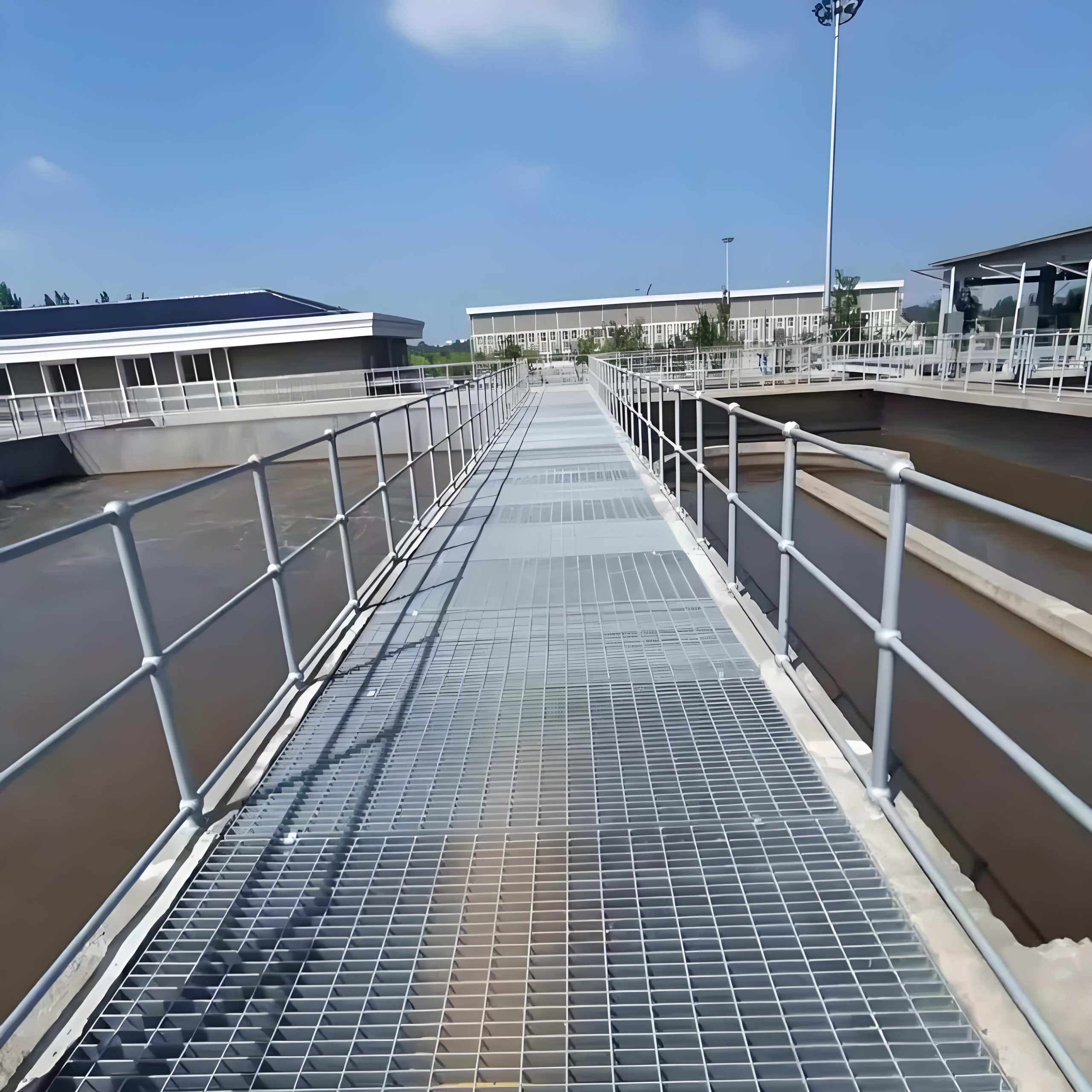
Steel grating for sale is available in several construction types. Each type has different strength characteristics, appearance, open area, fabrication options, and price structure.
| Grating Type | Construction Method | Common Use |
|---|---|---|
| Welded bar grating | Cross bars are welded to bearing bars at each intersection | Industrial platforms, floors, catwalks, stairs, trench covers |
| Press-locked grating | Cross bars are pressed into notched bearing bars | Architectural flooring, ventilation grilles, facades, public walkways |
| Riveted grating | Mechanical riveted connections between bars and formed cross members | Bridge decks, ramps, heavy-duty access, vehicle-related applications |
| Safety plank grating | Perforated or formed channel with raised traction points | Stairs, ramps, ladder rungs, narrow walkways, retrofit access surfaces |
| Swage-locked grating | Cross bars mechanically locked through pressure or deformation | Aluminum, stainless steel, marine, architectural, and corrosion-resistant projects |
Welded steel bar grating is the most common choice for industrial flooring. It combines vertical bearing bars with welded cross bars to form a rigid open-grid panel. It is widely used for platforms, walkways, drainage covers, mezzanines, stair treads, oil and gas facilities, water treatment plants, and factory access routes.
Welded grating is often the most economical option for standard carbon steel floor panels because factories can produce repeated mesh patterns efficiently. It is also suitable for many custom fabrication details, including cutouts, edge banding, toe plates, frames, and clips.
Press-locked grating uses cross bars pressed into accurately notched bearing bars. This creates clean intersections and a more uniform grid appearance. It is commonly selected for architectural floors, public spaces, entrance grilles, facades, ventilation panels, and visible platform areas.
For a detailed product option, see our press-locked steel grating. Press-locked grating may cost more than standard welded grating because it requires precise slotting, alignment, and pressing. The correct load table should always match the selected press-locked construction.
Riveted grating uses mechanical rivets and formed cross members rather than conventional welded intersections. It is often selected for bridge decks, ramps, roadway-related applications, and demanding heavy-duty service where repeated rolling loads are important.
Riveted grating should be selected from its own load data. It should not be assumed that every riveted panel is stronger than every welded panel. Bearing bar size, rivet spacing, support span, load type, and cross-member design all affect final performance.
Safety plank grating is made from perforated steel sheet that is formed into channels, planks, treads, or ladder-rung sections. Raised punched edges provide aggressive traction in wet, oily, muddy, or outdoor conditions.
Safety plank products are often lighter than heavy bar grating and are especially useful for stairs, ladder rungs, narrow walkways, ramps, and maintenance access. They should be selected from their own span and load data because their channel construction is different from bar grating.
Steel grating factories commonly produce standard panel widths and lengths that suit industrial support layouts and material handling. Standard size availability depends on the factory, material, mesh, bearing bar direction, and surface finish.
Typical metric panel widths include 600 mm, 800 mm, 1,000 mm, and 1,200 mm. Standard lengths may reach 6,000 mm or more, depending on bar size, production equipment, galvanizing-bath limits, and lifting requirements. Imperial stock programs often use common widths such as 2 ft, 3 ft, and 4 ft, with longer stock lengths available for industrial fabrication.
| Typical Panel Dimension | Common Use | Important Check |
|---|---|---|
| 600 mm wide panels | Narrow walkways, access routes, stair landings | Confirm support spacing and walking width requirement |
| 800 mm wide panels | Industrial walkways and maintenance platforms | Check panel lifting weight and bearing bar direction |
| 1,000 mm wide panels | Standard plant floors, platforms, trench cover sections | Useful for efficient material nesting and export packing |
| 1,200 mm wide panels | Wider platforms and larger floor areas | Consider handling weight, cutouts, and support layout |
| Long stock panels | Factory cutting, project package fabrication | Confirm transport, lifting, galvanizing, and distortion limits |
Panel dimensions should be coordinated with the steel support layout. It is often more efficient to position support beams so that floor grating can use repeated panel sizes without excessive trimming. This reduces waste, factory cutting, banding, installation time, and shipping complexity.
For related guidance on common panel dimensions, bearing bars, and mesh patterns, see our steel grating dimensions guide.
Custom fabrication allows steel grating to fit actual site conditions. Industrial floors rarely consist of only simple rectangles. Pipes, columns, equipment bases, cable trays, drains, walls, handrail posts, and structural beams often require custom details.
Cutouts allow floor grating to fit around pipes, columns, valves, cable trays, floor drains, equipment legs, and existing structural steel. The cost of a cutout depends on its size, shape, quantity, required tolerance, and whether the cut edges need banding.
Rectangular notches are usually easier to fabricate than large round, oval, curved, or irregular openings. Where a cutout interrupts bearing bars, the factory may need to add banding or reinforcement to maintain a safe and finished perimeter.
Edge banding closes exposed bearing bar ends and creates a finished edge around panels, cutouts, trench covers, and removable floor sections. It can improve appearance, reduce sharp exposed bar ends, and strengthen the edge of the panel.
Banding adds steel, welding, inspection, and galvanizing area. It should be included in the final weight and quotation rather than treated as an insignificant detail.
Toe plates are vertical steel plates attached to elevated platforms and walkways to help prevent tools, loose parts, and materials from falling to a lower level. They are common in industrial plants, offshore structures, maintenance platforms, pipe racks, and elevated access routes.
Toe plates may be welded directly to the grating, connected to support steel, or supplied as separate installation pieces. The required height, thickness, corners, drain openings, and connection details should be shown on the fabrication drawing.
Steel grating stair treads are normally fabricated with end plates, bolt holes, front nosing, and the required width and depth. Serrated bearing bars are often selected for outdoor stairs, wet areas, ramps, and oil-related service because they provide better traction than smooth bars.
To quote stair treads accurately, a factory needs tread width, tread depth, nosing requirement, end-plate dimensions, bolt-hole pattern, quantity, finish, and stringer layout. The bearing bars must span between the stair stringers.
Material selection affects price, corrosion resistance, weight, fabrication method, and expected service life. The best material depends on the location, moisture, chemicals, maintenance plan, load requirement, and project budget.
| Material | Price Level | Typical Use | Main Consideration |
|---|---|---|---|
| Carbon steel | Lowest | Dry indoor floors, temporary work, painted industrial structures | Needs corrosion protection in wet or outdoor environments |
| Hot-dip galvanized carbon steel | Medium | Outdoor platforms, walkways, drains, stair systems, industrial access | Practical balance of strength, corrosion resistance, and cost |
| 304 stainless steel | High | Food processing, washdown areas, indoor wet service, hygiene-sensitive facilities | Higher initial cost but reduced corrosion maintenance in suitable environments |
| 316 stainless steel | Very high | Marine, coastal, chloride, chemical, and severe washdown environments | Select when exposure justifies the alloy premium |
| Aluminum | Medium to high | Lightweight platforms, marine access, elevated walkways, corrosion-resistant projects | Requires consideration of galvanic corrosion at steel connections |
Carbon steel is the most economical material for general steel grating. It offers high strength, good weldability, and broad availability. Mill-finish carbon steel can be used indoors or where a separate paint system will be applied.
For outdoor floors, wet platforms, drainage areas, and exposed industrial structures, untreated carbon steel can rust quickly. Hot-dip galvanizing is often the preferred protection method.
Hot-dip galvanized steel grating is widely used for outdoor industrial flooring because zinc protects the fabricated steel from corrosion. It is commonly selected for power plants, wastewater facilities, refineries, loading areas, access platforms, maintenance routes, trench covers, and external stairs.
For more information on finish selection and post-fabrication coating, see our hot-dip galvanized steel grating guide.
Stainless steel grating is selected where corrosion resistance, hygiene, washdown performance, or low maintenance is more important than the lowest initial cost. Type 304 stainless steel is common for general wet service and food-related applications. Type 316 stainless steel is more suitable for saltwater, coastal exposure, chlorides, and more aggressive chemical environments.
Aluminum grating is lightweight and naturally corrosion resistant. It is useful for elevated platforms, marine access routes, towers, lightweight walkways, and projects where handling weight is important.
Aluminum should be isolated appropriately from dissimilar metals where galvanic corrosion may occur. The load table must also match aluminum rather than carbon steel, since the materials have different mechanical properties.
Bearing bars are the main vertical load-carrying members in steel grating. Their depth and thickness control much of the panel’s strength, stiffness, weight, and price. Mesh spacing controls the number of bars used per square meter and the size of the openings.
| Common Bearing Bar Size | Typical Application | General Cost Position |
|---|---|---|
| 25×3 mm | Light walkways, short spans, drainage covers | Lower cost |
| 25×5 mm | Medium-duty access floors and walkway panels | Low to medium cost |
| 30×3 mm | General industrial platforms and standard floor grating | Medium cost |
| 30×5 mm | Heavier platforms, longer spans, outdoor service | Medium to higher cost |
| 32×5 mm | Heavy industrial flooring and higher load requirements | Higher cost |
| 40×5 mm and above | Heavy-duty platforms, trench covers, demanding spans | Heavy-duty cost level |
Typical metric mesh patterns include 30×100 mm, 30×50 mm, 40×100 mm, and 40×50 mm. The first number normally describes bearing bar spacing, while the second describes cross-bar spacing.
| Mesh Pattern | Open Area Tendency | Typical Benefit |
|---|---|---|
| 30×100 mm | High | Common balance of strength, drainage, ventilation, and economy |
| 30×50 mm | Moderately high | Denser cross-bar pattern and more frequent support across the panel |
| 40×100 mm | Higher open area | Lower weight and good drainage where larger openings are acceptable |
| Close-mesh grating | Lower | Smaller openings for wheels, heels, public areas, and retention needs |
Open area improves drainage, ventilation, light transfer, and debris shedding. However, very open mesh may not be suitable for small wheels, high heels, public walking routes, or applications where dropped-object retention is important.
The right mesh should balance drainage with pedestrian safety, wheel support, load capacity, and material cost. More bearing bars per square meter usually means a stronger and heavier grating, but also a higher factory price.
Steel grating is available with smooth bearing bars, serrated bearing bars, and heavy-duty configurations. Surface selection should match the actual safety and loading conditions.
| Grating Surface or Type | Main Advantage | Typical Application |
|---|---|---|
| Plain steel grating | Lower cost and easier cleaning | Dry indoor floors, equipment platforms, controlled industrial areas |
| Serrated steel grating | Improved traction | Wet, oily, muddy, icy, sloped, or outdoor access areas |
| Heavy-duty steel grating | Higher strength and stiffness | Longer spans, heavy platforms, trench covers, vehicle-related applications |
| Close-mesh steel grating | Smaller openings | Public access, small wheels, heel-sensitive routes, selected drainage covers |
Plain grating has smooth bearing-bar tops. It is normally the lowest-cost option and is suitable for dry, clean, controlled environments. It is also easier to clean where process residue or dirt buildup is a concern.
Serrated grating has teeth along the top edge of the bearing bars. It is commonly selected for outdoor stairs, ramps, wet platforms, wastewater areas, oil-related service, marine access, and locations where workers may encounter mud, water, grease, snow, or process residue.
For a commonly specified anti-slip product, see our serrated 19-W-4 steel grating. Serrated bars usually add processing cost and may require a serrated-specific load table where capacity is critical.
Heavy-duty grating uses deeper or thicker bearing bars and may include stronger cross bars, closer spacing, reinforced edges, or special fabrication. It is selected for higher uniform loads, concentrated equipment loads, longer clear spans, forklift traffic, ramps, and vehicle-access covers.
A grating panel should not be called heavy duty based only on its appearance or bar depth. The required wheel load, support span, frame strength, deflection limit, and installation condition must be checked together.
Steel grating should be selected from the actual clear span and design load. Clear span is the unsupported distance between supports under the bearing bars. It is not necessarily the overall panel length.
The bearing bars must run from support to support. If a rectangular panel is rotated so that the bearing bars do not span correctly, the load capacity can be much lower than expected.
| Load Condition | Typical Example | Information Needed |
|---|---|---|
| Uniform load | Personnel walking on a platform | Required kN/m², psf, clear span, and deflection limit |
| Concentrated load | Machine leg, ladder foot, jack, cart, pump skid | Load value, contact area, location, and duration |
| Wheel load | Forklift, pallet truck, service vehicle, rolling equipment | Wheel load, tire size, axle arrangement, impact, support frame |
| Drain cover load | Pedestrian, cart, forklift, or vehicle traffic over trench | Clear opening, frame detail, support ledge, traffic condition |
Longer spans require deeper or thicker bearing bars. This increases steel weight, galvanizing cost, panel weight, lifting requirements, and freight cost. In some projects, adding an intermediate support beam can be less expensive than upgrading every panel to a much heavier grating section.
A grating panel may be strong enough to avoid failure but still deflect too much for safe, comfortable, or functional service. Excessive deflection can make a platform feel unstable, affect drainage, loosen clips, create vibration, and increase fatigue under repeated loads.
For standard industrial grating, current product load tables and the applicable project standard should be used. Heavy-duty and vehicle applications should be checked against dedicated heavy-duty load tables or project engineering calculations.
Steel grating is used in many industries because it provides a strong, open, drainable surface. The correct product changes with the application.
| Application | Typical Grating Selection | Important Considerations |
|---|---|---|
| Industrial walkway | Welded carbon steel or galvanized grating | Load, span, slip resistance, drainage, panel fastening |
| Outdoor platform | Serrated hot-dip galvanized grating | Rain, mud, corrosion, drainage, toe plates, handrails |
| Trench cover | Banded grating with frame support | Clear opening, bearing direction, traffic load, removable access |
| Stair tread | Serrated grating tread with end plates and nosing | Width, depth, stringer spacing, bolt holes, anti-slip performance |
| Mezzanine floor | Welded or press-locked floor grating | Uniform load, concentrated loads, vibration, openings, panel layout |
| Food or washdown area | 304 or 316 stainless steel grating | Corrosion resistance, cleaning method, hygiene, drainage |
| Vehicle area | Heavy-duty welded or riveted grating system | Wheel load, support frame, deflection, impact, traffic class |
Walkways and platforms commonly use welded steel grating because it provides high open area, efficient drainage, and strong support for personnel and general maintenance work. Serrated galvanized grating is often selected when the walking surface is exposed to weather, water, oil, or mud.
For a trench cover, bearing bars should span across the clear trench opening. The support ledge or frame must be strong enough to transfer the load to the channel walls or supporting structure.
Drainage grating should be selected by the actual traffic requirement. A pedestrian drain cover is different from a cover exposed to carts, forklifts, loading vehicles, or trucks.
Grating stair treads provide drainage and visibility while reducing dirt buildup. Serrated stair treads are common for outdoor and industrial access stairs because they improve traction. End plates, bolt holes, nosing, and proper stringer support are essential for secure installation.
Mezzanine grating may need to support people, stored materials, maintenance equipment, pipework, and occasional concentrated loads. The design should include clear span, uniform load, equipment loads, deflection limit, and any required dropped-object or toe-board protection.
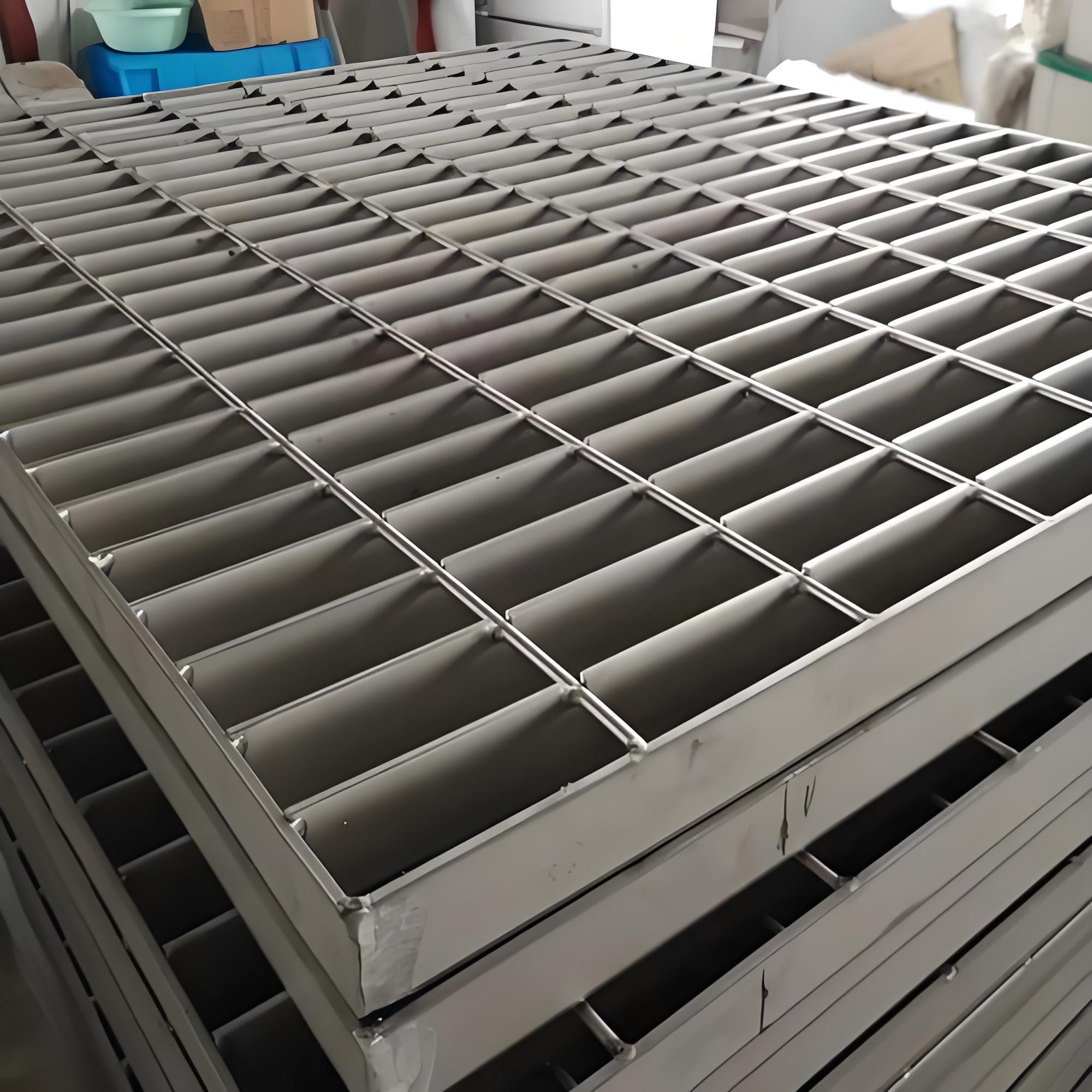
Surface treatment is one of the most important choices for steel grating used outside or in wet industrial environments. Carbon steel is strong and economical, but it needs protection where corrosion is likely.
Mill-finish carbon steel is the lowest-cost option. It is suitable for dry indoor locations, temporary installations, or projects where painting will be completed after installation. It is not normally recommended for long-term wet or outdoor exposure without a suitable protective system.
Painted grating can be suitable for controlled indoor industrial environments. It can provide color identification and moderate corrosion protection, but damaged areas, welds, cut edges, and high-wear zones may require periodic maintenance.
Hot-dip galvanizing is widely used for outdoor steel grating. The panel is fabricated first and then coated with zinc, helping protect bearing bars, cross bars, welded intersections, cut edges, banding, and custom details.
Project specifications may refer to recognized coating requirements such as ASTM A123/A123M, ISO 1461, or equivalent local standards. The required coating thickness, inspection method, repair procedure, and certification should be stated in the RFQ when necessary.
For buyers comparing finish costs, our steel grating price guide explains how steel weight, galvanizing, material type, and fabrication affect factory quotations.
Factories may quote steel grating by square meter, square foot, panel, piece, or metric ton. The most accurate method depends on the product type and fabrication level.
| Price Basis | Best For | Important Note |
|---|---|---|
| Price per square meter | Standard panels with the same bearing bar size and mesh | Only valid when weight, finish, and fabrication are comparable |
| Price per square foot | North American stock and standard grating systems | Confirm whether price includes cutting, banding, and finish |
| Price per panel | Custom panels, trench covers, stair treads, special access panels | Often includes fabrication and project-specific details |
| Price per metric ton | Large industrial orders and raw grating production | Fabrication and galvanizing may still be quoted separately |
Steel weight is the main cost driver. A simplified estimate for the main bearing bars is:
Bearing-bar mass per m² ≈ 7.85 × bearing bar depth (mm) × bearing bar thickness (mm) ÷ bearing bar pitch (mm)
This estimate does not include cross bars, welding, edge banding, cutouts, toe plates, frames, clips, zinc coating, or packing. The actual finished weight should be provided by the factory for freight planning and final commercial comparison.
A factory may quote a simple full panel at a low square-meter price, but the cost per square meter rises when the panel includes multiple openings, banded edges, toe plates, frames, bolt holes, lifting handles, special labels, or complex geometry.
Small fabricated parts such as stair treads and narrow trench covers may have a higher per-square-meter price because each piece needs handling, layout, cutting, welding, finishing, and inspection.
Stock pricing is usually based on regular panels with standard mesh, limited fabrication, and common surface finishes. Custom pricing is based on the actual drawings, steel weight, fabrication labor, coating scope, quantity, and delivery requirement.
| Product Type | Indicative Factory Budget Range | Typical Scope |
|---|---|---|
| Basic carbon steel welded grating | US$15–40/m² | Standard untreated panels with common mesh and light to medium bar sizes |
| Hot-dip galvanized welded grating | US$25–75/m² | Standard industrial panels for outdoor and wet service |
| Serrated galvanized grating | US$35–90/m² | Anti-slip walkways, stairs, ramps, outdoor platforms |
| Heavy-duty galvanized grating | US$60–125/m² | Deep bearing bars, heavier loads, longer spans, industrial covers |
| 304 stainless steel grating | US$55–150/m² | Washdown, food, wet process, corrosion-sensitive areas |
| 316 stainless steel grating | US$90–180/m² or more | Marine, coastal, chloride, and aggressive chemical environments |
| Custom fabricated grating | US$80–300/m² or more | Cutouts, frames, toe plates, stair treads, unusual layouts, special testing |
These figures are broad budgeting ranges, not fixed offers. Actual prices can change with steel market conditions, zinc cost, stainless alloy cost, order quantity, production capacity, finish, certification, packaging, and freight.
A good quote comparison should show the same bearing bar size, mesh, material, surface treatment, finished weight, fabrication scope, quantity, packing method, and shipping term. Comparing only the price per square meter can lead to incorrect purchasing decisions.
Minimum order quantity depends on the product type, material, finish, factory schedule, and degree of customization. Standard panels may be available in small quantities, while custom fabricated or galvanized project packages are usually more economical when grouped into a larger order.
Factories may accept small custom orders, but the unit price can be higher because setup, cutting, welding, galvanizing, quality inspection, and packing are spread across fewer panels. Repeated standard dimensions usually provide the most efficient price.
Lead time depends on raw material availability, panel quantity, mesh pattern, fabrication complexity, galvanizing schedule, drawing approval, inspection, packing, and export booking. Stock panels may ship quickly, while large project packages need time for detailing, fabrication, finishing, marking, and packing.
Steel grating is heavy, so export packing must protect the panels while allowing safe lifting and container loading. Typical packing may include steel straps, pallets, timber separators, corner protection, labels, packing lists, and lifting information.
Galvanized grating should be packed to reduce unnecessary abrasion. Stainless steel grating may need additional separation or protective wrapping to avoid contamination and surface scratches.
| Export Factor | Effect on Cost and Delivery |
|---|---|
| Small quantity | Higher unit packing and handling cost |
| Repeated panel sizes | More efficient production, nesting, packing, and container loading |
| Heavy-duty grating | Higher freight cost because of increased steel weight |
| Oversized panels | May require special handling or create low container utilization |
| Project documentation | May require panel marks, certificates, inspection reports, and export records |
Quality control helps ensure that steel grating fits correctly, performs as specified, and has the required corrosion protection. The level of inspection should match the application and project requirements.
For critical projects, buyers may request material certificates for carbon steel, stainless steel, or aluminum. Stainless steel orders may require confirmation of the selected grade, such as 304 or 316, because the material cost and corrosion resistance differ significantly.
Welded grating should have secure intersections between bearing bars and cross bars. Custom details such as edge banding, toe plates, frames, reinforcing bars, and stair tread end plates should also be inspected for workmanship and dimensional accuracy.
Projects may reference industry guidance such as ANSI/NAAMM metal bar grating publications, project-specific welding requirements, or another accepted engineering standard. The applicable standard should be stated in the purchase specification where required.
Factories should inspect panel length, width, bar direction, cutout dimensions, bolt-hole locations, edge banding, toe-plate height, and frame fit. Flatness matters especially for removable access panels, trench covers, visible floors, and areas used by wheeled equipment.
For galvanized steel grating, inspection may include coating coverage, visible bare areas, zinc buildup, sharp drips, blocked holes, and coating-thickness checks when required. For stainless steel grating, finish, weld cleanup, pickling, passivation, or polishing requirements should be defined before production.
When requesting steel grating for sale from a factory, provide the material, bearing bar size, mesh, panel dimensions, clear span, load requirement, surface type, finish, quantity, fabrication details, packing requirement, certificates, delivery location, and Incoterm. A complete RFQ helps the supplier quote the correct product instead of pricing an incomplete description.
Can I buy steel grating in custom sizes?
Yes. Steel grating can be cut and fabricated to custom widths, lengths, cutouts, notches, frames, toe plates, stair tread sizes, bolt holes, and lifting details. For the best corrosion protection, custom fabrication is normally completed before hot-dip galvanizing.
What is the cheapest type of steel grating?
Basic welded carbon steel grating with smooth bearing bars, standard mesh, no galvanizing, and limited fabrication is usually the lowest-cost option. However, it may not be suitable for outdoor, wet, oily, corrosive, or high-load applications. The most economical product is the one that safely meets the required load and service environment without unnecessary upgrades.
How do I choose the right steel grating size?
Choose steel grating by confirming the clear span, load type, bearing bar direction, required opening size, surface condition, corrosion environment, and support frame. The bearing bar size and mesh should then be selected from the applicable load table or project engineering calculation. For walkways and platforms, also consider drainage, slip resistance, toe plates, and installation method.