

Steel bar grating for sale is available as standard factory panels, cut-to-size sections, custom fabricated floor panels, trench covers, stair treads, and complete drawing-based project packages. Buyers can specify welded, press-locked, riveted, serrated, smooth, or I-bar grating in carbon steel, hot-dip galvanized steel, and stainless steel. The correct product is selected by bearing bar size, mesh pattern, clear span, load condition, corrosion environment, panel dimensions, and fabrication details. Standard stock panels can reduce lead time, while made-to-order grating provides a better fit for pipes, columns, equipment openings, frames, toe plates, and complex industrial layouts.
Steel bar grating is commonly supplied in two main forms: standard panels and custom fabricated panels. Stock panels are suitable for straightforward platforms, walkways, replacement grates, and simple floor openings. Made-to-order grating is produced to a drawing or panel schedule and can include custom dimensions, cutouts, edge banding, frames, toe plates, stair tread ends, clips, bolt holes, and lifting details.
| Supply Option | Main Features | Best Use |
|---|---|---|
| Standard stock panel | Common bearing bar sizes, mesh patterns, and regular panel dimensions | Simple platforms, repairs, replacement panels, standard walkways |
| Factory cut-to-size panel | Stock or raw panel trimmed to required width and length | Rectangular layouts with limited fabrication requirements |
| Custom fabricated grating | Cutouts, notches, banding, toe plates, frames, clips, special panel shapes | Industrial plants, equipment areas, drainage systems, complex platforms |
| Custom stair tread | End plates, bolt holes, nosing, specified width and depth | Industrial stairs, outdoor access stairs, service towers |
| Project package | Drawing-based fabrication, item marks, panel schedules, packing lists | Large floor areas, pipe racks, mezzanines, plant expansions |
Stock panels are often the fastest option when the required bearing bar size, mesh, finish, and dimensions are common. They can be useful for maintenance work, simple trench covers, replacement walkways, and basic industrial flooring.
A stock panel should still be checked against the actual project requirements. The grating must have the correct bearing bar direction, sufficient clear-span capacity, suitable opening size, proper support width, and the right corrosion protection. A panel that fits an opening may not be suitable if the bearing bars are oriented incorrectly or the load is higher than the panel can carry.
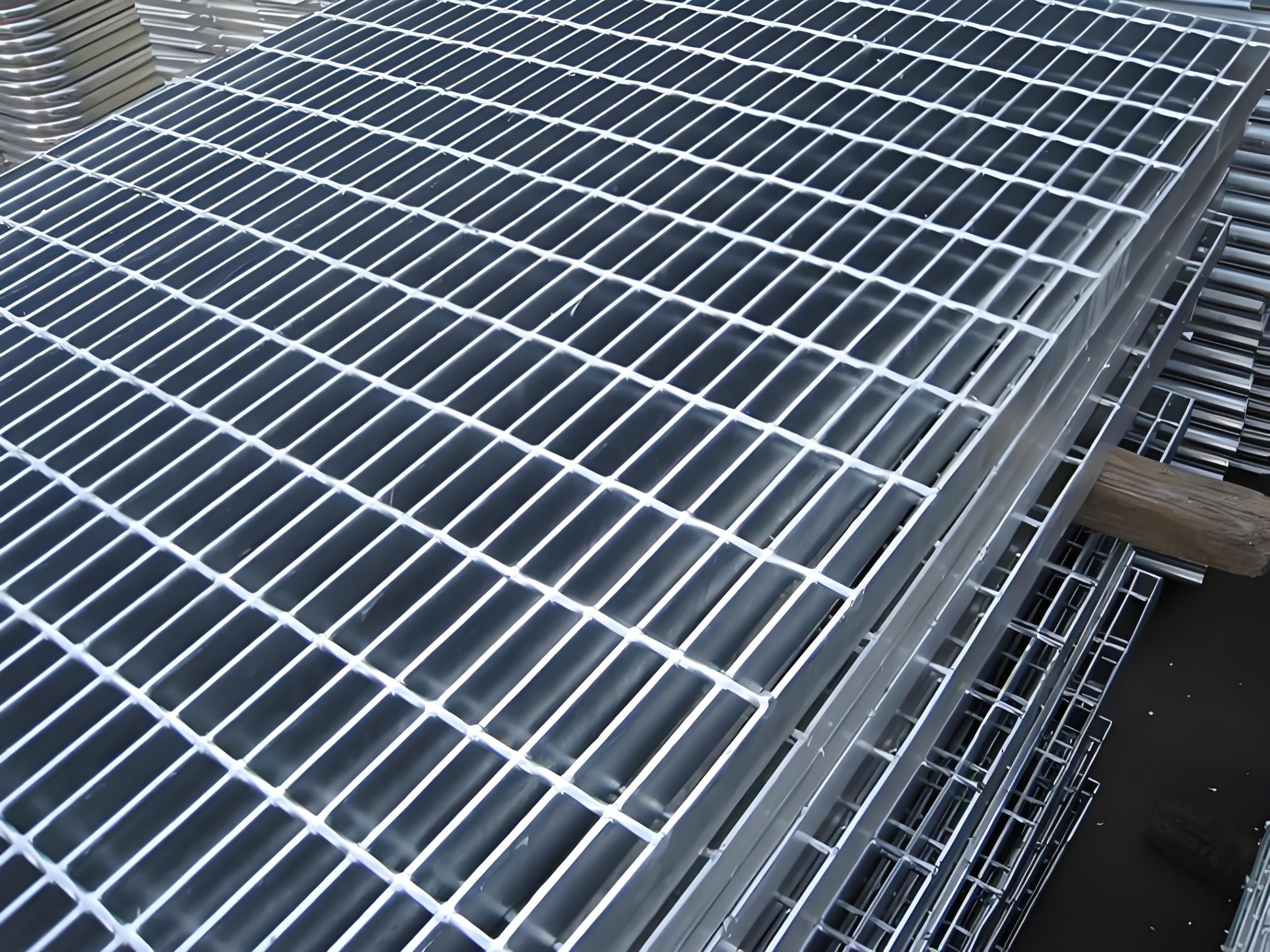
Custom steel bar grating is normally the best choice when a project has irregular floor geometry, pipes, columns, drains, equipment bases, cable trays, structural penetrations, or multiple panel elevations. The factory can produce each item to drawing dimensions and complete fabrication before final finishing.
For carbon steel grating that will be galvanized, it is normally preferable to complete cutting, edge banding, toe plate installation, welding, and reinforcement before hot-dip galvanizing. This helps protect the finished edges, welds, and custom details with zinc coating.
Steel bar grating can be manufactured using different construction methods. The correct type depends on load capacity, visual appearance, material, corrosion environment, mesh requirement, and fabrication needs.
| Grating Type | Construction | Typical Applications |
|---|---|---|
| Welded steel bar grating | Cross bars are welded to bearing bars at each intersection | Industrial floors, platforms, catwalks, drains, stair treads, mezzanines |
| Press-locked grating | Cross bars are mechanically pressed into notched bearing bars | Architectural floors, public walkways, entrance grilles, facades, ventilation panels |
| Riveted bar grating | Mechanical rivets join bearing bars and formed cross members | Bridge decks, ramps, vehicle routes, special heavy-duty installations |
| Swage-locked grating | Cross bars are mechanically locked by pressure or deformation | Aluminum, stainless steel, marine, architectural, and corrosion-resistant projects |
Welded bar grating is the standard choice for many industrial projects. It is strong, practical, widely available, and efficient for common mesh patterns. It is often used for floors, platforms, walkways, drainage covers, stair treads, process areas, and equipment access routes.
Welded grating is usually the most cost-effective option for repeated carbon steel industrial panels. It can also be fabricated with cutouts, edge banding, toe plates, frames, clips, lifting holes, and stair tread end plates. For related selection information, see our welded steel bar grating guide.
Press-locked grating is made by pressing cross bars into accurately notched bearing bars. It creates a clean, regular grid with aligned intersections. It is often selected for architectural floors, commercial buildings, ventilation grilles, public areas, façade screens, and visible walkways.
Press-locked grating may cost more than ordinary welded grating because it requires accurate slotting and controlled pressing. Its load performance should be checked using the applicable press-locked grating load table, not a welded-grating table. For product details, see our press-locked steel grating.
Riveted grating uses mechanical rivets and formed cross members instead of conventional welded intersections. It is commonly considered for bridge decks, ramps, roadway-related structures, vehicle service areas, and other projects where repeated rolling loads are important.
Riveted grating should be selected using its own load data and project criteria. Bearing bar size, cross-member design, rivet spacing, clear span, wheel load, and support frame all affect its suitability.
A complete custom grating specification tells the factory what to manufacture, how the panel will be supported, and what loads it must carry. A panel length and width alone are not enough for an accurate quote or safe selection.
| Specification Item | What to State | Why It Matters |
|---|---|---|
| Grating type | Welded, press-locked, riveted, or another required type | Determines manufacturing method and applicable load data |
| Material | Carbon steel, 304 stainless steel, 316 stainless steel, or aluminum | Controls strength, corrosion resistance, price, and finish options |
| Bearing bar size | For example, 30×5 mm, 32×5 mm, or 40×5 mm | Main factor in strength, stiffness, weight, and price |
| Mesh pattern | For example, 30×100 mm or 30×50 mm | Controls opening size, open area, material consumption, and drainage |
| Panel size | Length and width of each finished panel | Required for fabrication, weight, packing, and layout |
| Bearing bar direction | Show arrows on the drawing | Ensures the bars span between the intended supports |
| Load and span | Clear span, uniform load, point load, wheel load, deflection limit | Needed to confirm the correct bar size and panel type |
| Finish | Mill finish, painted, hot-dip galvanized, stainless finish | Determines corrosion protection and finishing cost |
| Fabrication | Cutouts, banding, toe plates, frames, clips, bolt holes, lifting points | Required for accurate production and quotation |
A dimensioned drawing is the best way to request custom grating. It should show panel length, panel width, bearing-bar direction, support locations, cutout positions, opening diameters, frame dimensions, bolt-hole centers, toe plates, and item quantities.
For irregular panels, it is useful to provide a plan view with a clear reference point. This allows the factory to locate each cutout accurately and avoid confusion between mirrored or rotated panels.
For trench covers and framed access panels, the clear opening is only one dimension. The factory also needs the outside panel size, bearing ledge width, frame dimensions, support angle size, and required clearance for lifting and removal.
A grating panel that is too tight may bind in its frame after galvanizing or thermal movement. A panel that is too loose can rock, shift, rattle, or create an unsafe gap. The final fabrication drawing should clearly identify the finished panel size and the support condition.
Bearing bars are the main load-carrying elements in steel bar grating. They are vertical flat bars that span from one support to another. Their depth, thickness, spacing, and orientation determine most of the panel’s structural performance.
| Common Bearing Bar Size | Typical Application | General Performance Level |
|---|---|---|
| 25×3 mm | Short-span walkways, light floor panels, basic drainage covers | Light duty |
| 25×5 mm | Medium walkways, access panels, selected trench covers | Light to medium duty |
| 30×3 mm | General industrial platforms and walkways | Medium duty |
| 30×5 mm | Heavier platform flooring and longer spans | Medium to heavy duty |
| 32×5 mm | Heavy industrial floors and demanding walkway areas | Heavy duty |
| 40×5 mm and above | Longer spans, heavy covers, high industrial loads | Heavy-duty service |
Increasing bearing bar depth usually provides a strong improvement in stiffness and load capacity. A deeper vertical bar resists bending more effectively than a shallow bar. This is why a 40×5 mm grating can perform much better over a long span than a 30×5 mm grating, even though both use 5 mm thick steel.
Thicker bars also increase capacity, but they add steel weight quickly. The most economical grating is usually the lightest specification that safely meets the required span, load, deflection, and service conditions.
Bearings bars must run in the span direction. In a typical panel supported by two parallel steel beams, the bearing bars should extend from one beam to the other. If the panel is turned 90 degrees during installation, the grating may not carry the intended load.
Every custom drawing should use an arrow or clear note to show bearing-bar direction. This is especially important for rectangular panels, trench covers, ramps, stair treads, and panels with unusual cutouts.
Mesh selection affects opening size, drainage, steel weight, walking comfort, wheel support, light transmission, and factory cost. A common metric grating designation such as 30×100 mm means bearing bars are spaced at 30 mm centers and cross bars are spaced at 100 mm centers.
| Mesh Pattern | Typical Characteristics | Common Use |
|---|---|---|
| 30×100 mm | Common industrial mesh with high open area and practical cost | Platforms, walkways, floors, general drainage areas |
| 30×50 mm | Denser cross-bar pattern and more frequent transverse connections | Selected floors, more dense walking surfaces, equipment areas |
| 40×100 mm | More open and lighter than 30 mm bearing-bar pitch | Drainage-focused areas where larger openings are acceptable |
| 40×50 mm | Open bearing-bar pattern with denser cross-bar spacing | Industrial access panels and selected drainage covers |
| Close-mesh grating | Smaller openings with more steel per square meter | Small wheels, heels, public areas, object-retention applications |
Closer bearing-bar spacing uses more primary load-carrying bars per square meter. It usually increases weight, cost, and support for narrow wheels or smaller objects. Wider bearing-bar spacing can improve open area and reduce steel consumption, but it creates larger openings that may not suit every application.
Cross bars stabilize the grating and create the grid pattern. A 50 mm cross-bar pitch generally uses more steel and more intersections than a 100 mm pitch. It can create a denser walking pattern, but it does not replace the structural role of the bearing bars.
For a long clear span, bearing bar depth and thickness are still the main factors in grating capacity. Cross-bar spacing should be selected for grid density, surface requirements, wheel interaction, and factory standard patterns.
Standard stock panel sizes depend on factory equipment, bearing bar pitch, raw material length, welding machine capacity, galvanizing bath size, lifting capacity, and transport limits. There is no one universal panel size for all steel bar grating factories.
Common metric stock panels are often close to 1,000 mm wide and up to 6,000 mm long. Typical panel widths can include 800 mm, 1,000 mm, and 1,200 mm. Finished project panels are commonly cut from larger raw panels to suit the support layout.
| Typical Panel Size | Common Use | Important Detail |
|---|---|---|
| 600×1,000 mm | Narrow walkways, small trench covers, removable access panels | Check bearing bar direction and manual handling weight |
| 800×1,000 mm | Modular platforms and smaller industrial floor sections | Useful for repeated floor layouts |
| 1,000×1,000 mm | General modular flooring | Easy to coordinate with regular steel support grids |
| 1,000×3,000 mm | Walkway strips and maintenance access routes | Confirm lifting weight and intermediate supports |
| 1,000×6,000 mm nominal stock panel | Factory raw panel for cutting and fabrication | Actual usable size depends on mesh pitch and edge arrangement |
Panel layout can influence the total project cost. Repeated rectangular panels normally reduce waste, cutting, banding, handling, and installation time. Narrow strips, unusual angles, many small pieces, and complex cutouts increase fabrication cost.
For more examples of standard galvanized panel dimensions and custom fabrication choices, see our galvanized steel grating sizes guide.
Steel bar grating can be supplied with smooth bearing bars, serrated bearing bars, and I-shaped bearing bars. Surface and bar profile should be selected according to traction requirements, cleaning conditions, load, weight, and appearance.
| Option | Main Benefit | Typical Application |
|---|---|---|
| Plain bearing bars | Lower cost and easier cleaning | Dry indoor platforms, equipment floors, clean industrial areas |
| Serrated bearing bars | Improved traction on wet or contaminated surfaces | Outdoor stairs, ramps, wastewater plants, oily work zones, marine access |
| I-bar grating | Reduced weight for selected load conditions | Walkways, platforms, architectural and weight-sensitive installations |
Plain grating uses smooth bearing bars and is normally the most economical option. It is suitable for dry indoor floors, controlled environments, equipment platforms, and applications where easy cleaning is important.
Serrated bearing bars have teeth along their top edge to improve traction. They are commonly specified for outdoor platforms, stairs, ramps, wet process areas, oil-related service, wastewater facilities, and locations exposed to mud, rain, snow, or ice.
For a related anti-slip option, see our serrated 19-W-4 steel grating. Serrated grating should be checked using the supplier’s serrated load data when span and capacity are critical.
I-bar grating uses bearing bars with an I-shaped profile rather than a solid rectangular flat bar. The shape can reduce weight while providing useful stiffness for appropriate applications. I-bar products should be selected from their own load tables because they do not behave exactly like rectangular-bar grating of the same overall depth.
I-bar grating can be useful where lower panel weight, reduced steel consumption, or easier handling is important. It may not be the best choice for every heavy-duty, concentrated-load, or vehicle application.
Custom cutouts are one of the main reasons buyers choose factory-fabricated steel bar grating. They allow panels to fit around existing equipment and structural elements without unsafe site modifications.
Pipe cutouts are used where process pipes, handrail posts, drain risers, conduits, and supports pass through the grating. The factory needs the pipe diameter, center location, reference dimensions, clearance requirement, and whether the panel must be removable without disconnecting the pipe.
When a pipe cutout interrupts several bearing bars, the exposed edges often require banding or reinforcement. This creates a cleaner edge, improves panel stability, and helps prevent sharp exposed bar ends.
Columns, beams, braces, and equipment supports may require square, rectangular, or angled notches. The drawing should show the exact location and orientation of each notch from a clear datum point.
Notching should not weaken the grating at support points. If a bearing bar is cut near a support, the supplier may need to revise the panel layout, add a support detail, or use a different grating arrangement.
Custom openings can be used for pumps, valves, inspection hatches, equipment bases, cable-tray penetrations, drains, and maintenance access. The project should state whether the opening requires a removable cover, hinged panel, lifting handle, frame, or locking system.
| Cutout Type | Factory Information Needed | Typical Extra Detail |
|---|---|---|
| Round pipe opening | Diameter, center point, required clearance | Banded edge or split-panel arrangement |
| Square column notch | Width, depth, location from panel edges | Edge banding and corner finishing |
| Irregular equipment opening | Detailed drawing or CAD file | Custom banding, reinforcement, removable cover |
| Drain outlet opening | Opening size, frame detail, flow requirement | Reinforced frame or removable grating section |
Fabrication details can affect both performance and price. Edge banding, toe plates, stair nosing, frames, clips, bolt holes, lifting points, and reinforcement should be included in the approved drawing before manufacturing begins.
Edge banding closes the exposed ends of bearing bars and creates a clean, strong panel perimeter. It is commonly used around cut panels, trench covers, openings, exposed floor edges, and removable access sections.
Load banding can also help distribute load along the panel edge. Where cutouts interrupt multiple bearing bars, banding or reinforcement is often needed to maintain a safe, finished edge.
Toe plates are vertical plates installed at the edges of elevated platforms and walkways to help prevent tools, loose parts, and materials from falling to lower levels. They are common on pipe racks, process platforms, maintenance routes, towers, and elevated industrial floors.
The toe plate height, thickness, drainage slots, corner treatment, weld details, and connection method should be specified. Toe plates add steel weight, welding, galvanizing surface, and fabrication time.
Grating stair treads may include serrated nosing, end plates, bolt holes, and custom mounting arrangements. The nosing improves traction at the leading edge, while end plates connect the tread to the stair stringers.
For stair tread fabrication, state tread width, depth, nosing type, end plate dimensions, bolt-hole diameter, hole centers, finish, and quantity. The bearing bars should span between the stringers.
Removable grating panels may use saddle clips, bolted connections, weld lugs, carrier plates, locking devices, or lifting handles. The connection method should prevent movement, uplift, and rattling while still allowing access for maintenance.
For heavy panels, lifting holes or lifting handles can improve installation safety. These details should be designed so they do not reduce the required load capacity or create sharp edges in the walking surface.
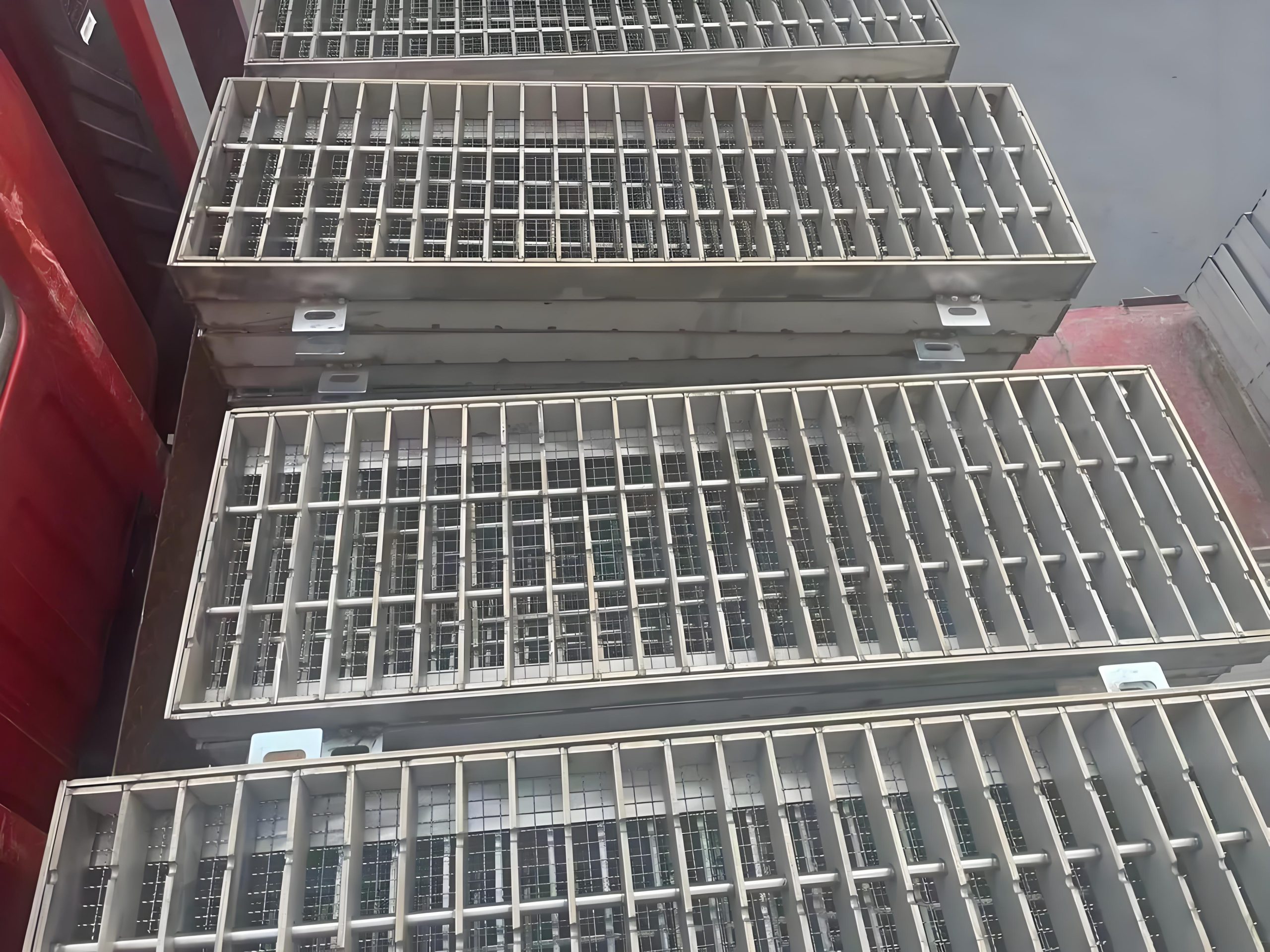
Material selection affects cost, corrosion resistance, finish requirements, fabrication method, service life, and maintenance needs. The right choice depends on the environment, not only the initial panel price.
| Material | Typical Use | Main Advantage | Main Consideration |
|---|---|---|---|
| Carbon steel | Dry indoor floors, industrial platforms, temporary works | Economical and strong | Needs protection in wet or outdoor service |
| Hot-dip galvanized carbon steel | Outdoor platforms, walkways, stairs, drains, exposed industrial floors | Strong corrosion protection at practical cost | Requires proper fabrication before galvanizing |
| 304 stainless steel | Food processing, washdown, indoor wet areas, hygiene-sensitive facilities | Good general corrosion resistance | Higher initial cost than galvanized steel |
| 316 stainless steel | Marine, coastal, chloride, and aggressive chemical environments | Improved chloride resistance | Higher alloy and fabrication cost |
Carbon steel is the most common and economical steel bar grating material. It offers good strength and weldability for industrial flooring, platforms, catwalks, stair treads, and trench covers.
Mill-finish carbon steel is suitable for dry indoor locations or projects where a separate paint system will be applied. It is not normally the preferred long-term choice for wet, corrosive, or outdoor environments without protective treatment.
Hot-dip galvanized carbon steel is widely used for outdoor access systems, drainage covers, utility plants, refineries, wastewater facilities, exterior stairs, and exposed platforms. The zinc coating helps protect the finished fabricated panel, including cut edges, welds, banding, and custom details.
Project specifications may require galvanizing to ASTM A123/A123M, ISO 1461, or another recognized standard. The required finish and coating documentation should be included in the RFQ.
Stainless steel grating is selected where corrosion resistance, washdown performance, hygiene, or reduced maintenance is important. Type 304 is common for general wet service and food-related facilities. Type 316 is commonly selected for saltwater, coastal exposure, chlorides, and more demanding chemical environments.
Steel bar grating must be selected by clear span, load type, support arrangement, and allowable deflection. The term “heavy duty” alone is not enough to confirm that a panel is suitable.
Clear span is the unsupported distance between supports under the bearing bars. It is one of the most important dimensions in a grating load calculation. A longer span increases bending stress and deflection, often requiring deeper or thicker bearing bars.
Uniform load is distributed over the grating surface. It is common for personnel, general maintenance, stored materials, and industrial platforms. The required load should be stated in kN/m², kPa, psf, or the project’s preferred design format.
Concentrated loads occur through small contact areas, such as equipment feet, ladder bases, jacks, carts, valves, mobile pumps, and machine legs. A grating panel may meet a uniform-load requirement but need a heavier section for a concentrated load.
Forklifts, pallet trucks, service carts, and vehicles create wheel loads that need special review. The factory or project engineer needs the actual wheel load, tire size, contact area, axle arrangement, clear span, frame details, impact requirement, and allowable deflection.
| Design Check | Why It Matters |
|---|---|
| Bearing bar size | Controls most of the load capacity and stiffness |
| Bearing bar direction | Must run from support to support |
| Clear span | Longer spans require stronger or deeper bars |
| Support width | Ensures stable bearing and prevents edge damage |
| Deflection limit | Controls visible movement, comfort, drainage, and serviceability |
| Load type | Uniform, concentrated, and wheel loads require different checks |
For projects using North American standards, grating may be specified in accordance with ANSI/NAAMM metal bar grating guidance. Heavy vehicle applications should use the appropriate heavy-duty grating data and project-specific engineering requirements.
Steel bar grating is used because it provides high strength, open area, drainage, ventilation, light transmission, and practical maintenance access. The best configuration changes with the application.
| Application | Typical Selection | Important Checks |
|---|---|---|
| Industrial platform | Welded carbon steel or galvanized grating | Uniform load, concentrated equipment loads, toe plates, support layout |
| Outdoor walkway | Serrated galvanized grating | Slip resistance, drainage, corrosion protection, handrail interface |
| Trench cover | Banded grating with frame support | Clear opening, bearing direction, support ledge, traffic load |
| Stair tread | Serrated grating tread with end plates and nosing | Width, depth, stringer spacing, bolt pattern, anti-slip performance |
| Mezzanine floor | Welded or press-locked grating | Load, vibration, panel layout, openings, dropped-object protection |
| Food or washdown area | 304 or 316 stainless steel grating | Cleaning method, corrosion exposure, hygiene, drainage |
Platforms and walkways commonly use welded grating because it is strong, open, and economical. Serrated galvanized grating is often selected for outdoor, wet, oily, muddy, or exposed areas where better traction is needed.
For drainage channels and trenches, bearing bars should span across the clear opening. The grating frame or support ledge must be strong enough to transfer the required load to the channel walls or supporting structure.
Pedestrian drainage covers, forklift covers, and vehicle covers are different products. The traffic requirement should be stated clearly so the factory can select the correct bearing bar size and frame detail.
Steel grating stair treads provide an open, drainable walking surface. Serrated treads are commonly selected for exterior stairs and industrial access routes. Tread fabrication should include the correct nosing, end plates, bolt holes, and bearing-bar direction.
Reliable factory supply depends on controlled manufacturing and inspection. The product must fit the approved drawing, have secure connections, and receive the correct finish.
For welded steel bar grating, the factory normally prepares bearing bars and cross bars, forms serrations if required, assembles the specified mesh, welds the intersections, cuts panels to size, adds banding and custom fabrication, checks dimensions, and applies the selected finish.
For galvanized carbon steel panels, hot-dip galvanizing is generally performed after welding and fabrication. Stainless steel grating may require additional finish work such as weld cleanup, pickling, passivation, blasting, or polishing, depending on the project specification.
Welded grating should have consistent intersections between bearing bars and cross bars. Edge banding, toe plates, frames, reinforcement, and stair tread end plates should also be securely welded.
Poor welding can cause loose cross bars, unstable panels, damaged edges, rattling, or reduced service life. Quality inspection should check visible weld consistency, fabrication details, and any project-specific welding requirements.
Factories should check panel length, width, bearing-bar direction, cutout dimensions, opening locations, edge treatment, bolt-hole centers, toe plate height, and frame fit. For large projects, item numbers and panel marks help installers place each panel correctly.
Flatness is also important. Excessive twist, bow, or rocking can make a panel difficult to install, especially for removable access covers, trench covers, public walking surfaces, and areas exposed to rolling equipment.
A complete quote request helps the factory provide a correct specification, accurate weight, fabrication drawing, price, and lead time. The following information should be sent whenever possible:
A clear drawing is the most valuable item in a custom grating RFQ. It should show the grating area, all cutouts, bearing-bar direction, support arrangement, critical dimensions, anchorage, surface type, and finish. This reduces the risk of incorrect panel orientation, missing fabrication, unexpected field cutting, or avoidable lead-time delays.
Can steel bar grating be made to custom sizes?
Yes. Steel bar grating can be fabricated to custom widths, lengths, shapes, cutouts, frames, toe plates, stair tread dimensions, bolt holes, and lifting details. A dimensioned drawing should show the finished panel size, bearing-bar direction, support locations, and all openings so the factory can produce the correct part.
What information is needed to order custom steel bar grating?
A custom order should include grating type, material, bearing bar size, mesh pattern, panel dimensions, clear span, load requirement, bearing-bar direction, finish, quantity, cutouts, edge banding, toe plates, frames, clips, and delivery requirements. A layout drawing or panel schedule is strongly recommended.
Which steel bar grating is best for outdoor platforms?
Hot-dip galvanized serrated welded steel bar grating is a common choice for outdoor industrial platforms because it combines strength, drainage, corrosion protection, and improved traction. The final bearing bar size and mesh should be selected from the platform span, load requirement, support layout, and local environmental conditions.