

Galvanized steel grating for sale is available as stock panels, cut-to-size panels, serrated walkway grating, stair treads, trench covers, heavy-duty floor panels, and drawing-based project packages. The most common industrial choice is carbon steel bar grating hot-dip galvanized after fabrication, because the zinc coating protects welded intersections, cut edges, edge banding, and custom details. For preliminary factory budgeting, standard hot-dip galvanized steel grating commonly falls around US$25–75/m², serrated galvanized grating around US$35–90/m², and heavy-duty galvanized grating around US$60–125/m² or more. Final pricing depends on steel weight, bearing bar size, mesh, zinc coating, fabrication, quantity, packing, certification, and shipping terms.
Galvanized steel grating can be supplied as standard stock panels or custom fabricated products. Stock panels are useful for simple industrial floors, standard walkways, repairs, replacement covers, and projects with common mesh patterns. Custom panels are produced to match exact drawings, support layouts, pipe penetrations, frames, toe plates, stair dimensions, and access requirements.
| Supply Type | Typical Features | Best Use |
|---|---|---|
| Stock galvanized grating panels | Standard bar sizes, common mesh patterns, regular panel dimensions | Simple floors, maintenance replacements, standard platforms |
| Cut-to-size galvanized panels | Stock or raw panels trimmed to required widths and lengths | Rectangular walkways, standard trench covers, regular support grids |
| Custom fabricated grating | Cutouts, banding, toe plates, frames, clips, bolt holes, lifting details | Industrial plants, equipment areas, drainage systems, complex platforms |
| Galvanized stair treads | End plates, bolt holes, nosing, serrated surface option | Outdoor stairs, service towers, plant access stairs |
| Project package supply | Drawing-based panel schedule, item tags, packing lists, accessories | Large platforms, mezzanines, pipe racks, infrastructure projects |
Stock panels can reduce lead time when the required bearing bar size, mesh, finish, and panel dimensions are common. They are practical for standard walkway sections, simple industrial flooring, replacement trench covers, and maintenance projects.
Stock availability should always be confirmed for the exact specification. A panel described simply as “galvanized grating” may have a different bearing bar size, mesh pattern, steel weight, finish, or load capacity than the one required for the project.
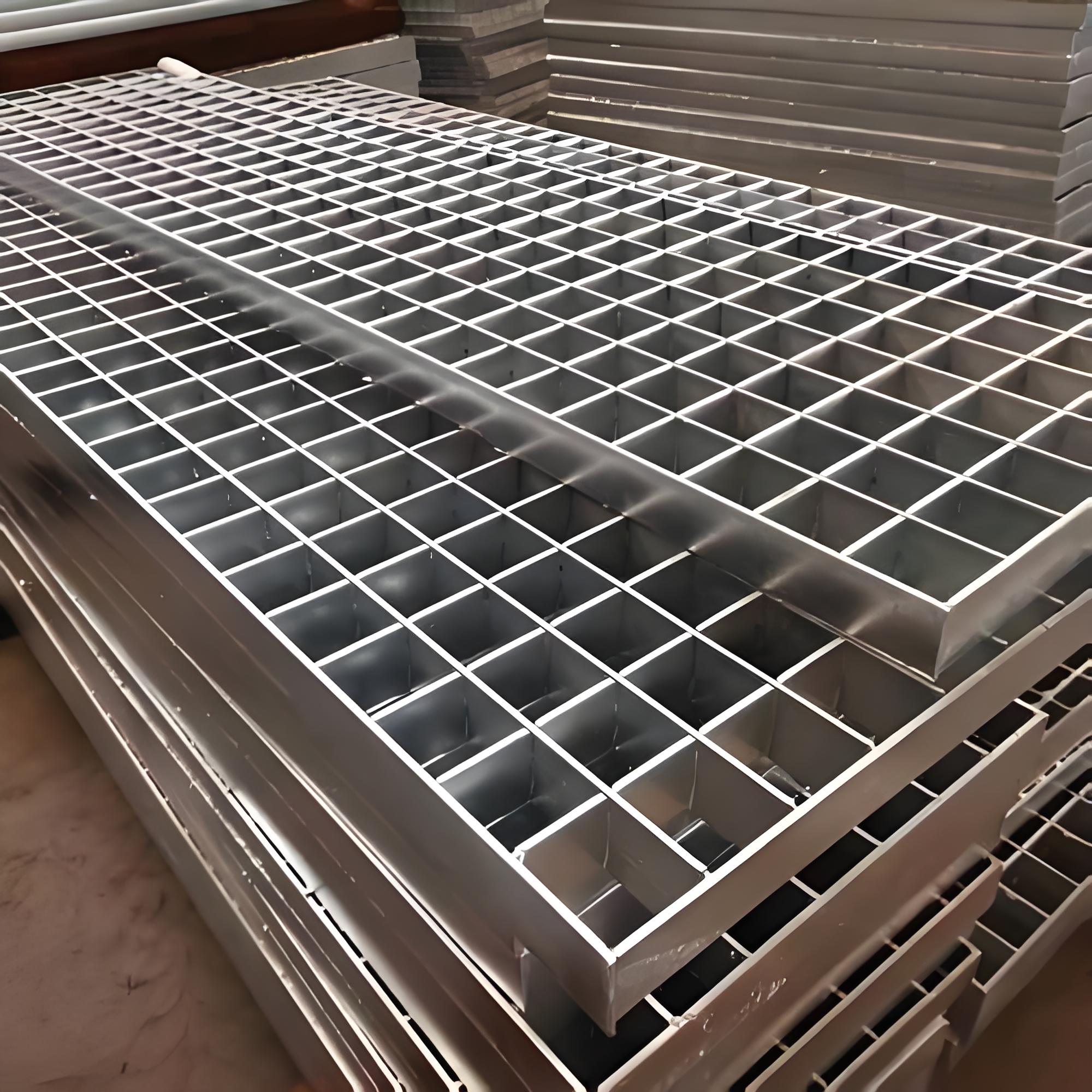
Custom grating is often more efficient when floors contain pipes, columns, cable trays, equipment supports, drains, handrail posts, access openings, or irregular edges. Factory fabrication can reduce field cutting and help ensure that panels fit the support layout correctly.
For hot-dip galvanized grating, cutting, banding, toe plate installation, welding, and custom reinforcement are normally completed before galvanizing. This allows the zinc coating to protect the finished fabricated panel rather than only the original raw material.
Pre-galvanized and hot-dip galvanized grating are not the same product. The distinction is important because steel bar grating is commonly cut, welded, banded, and fabricated after the original steel bars are supplied.
| Feature | Pre-Galvanized Steel | Hot-Dip Galvanized After Fabrication |
|---|---|---|
| When zinc is applied | Before cutting, punching, welding, and fabrication | After the grating panel is welded and fabricated |
| Weld and cut-edge protection | Cutting and welding can damage or expose the original coating | Welds, cut edges, banding, and fabricated details receive zinc coating |
| Typical appearance | Usually smoother and lighter coating on original sheet or strip | More robust zinc coating with visible hot-dip galvanized texture |
| Best use | Some plank products, light formed products, controlled indoor use | Outdoor bar grating, industrial platforms, stairs, drains, custom fabrication |
| Custom fabrication suitability | Less suitable for extensive cutting and welding | Better suited to cutouts, banding, toe plates, frames, and custom panels |
Pre-galvanized steel is coated before the steel is formed into the finished product. The coating may provide useful corrosion resistance on the original surfaces, but cutting, punching, drilling, and welding can expose edges or damage the zinc layer.
Pre-galvanized material may be suitable for certain formed safety planks, light-duty products, or indoor applications with controlled exposure. It is usually less suitable for custom welded steel bar grating intended for long-term outdoor or wet industrial service.
Hot-dip galvanized steel grating is fabricated first and then immersed in molten zinc. This allows the coating to cover bearing bars, cross bars, welded intersections, banding bars, cut edges, toe plates, frames, and other fabricated details.
For outdoor walkways, exposed platforms, industrial stairs, drainage covers, wastewater structures, refineries, power plants, and utility facilities, post-fabrication hot-dip galvanizing is commonly the preferred finish. For a related overview, see our hot-dip galvanized steel grating guide.
There is no one universal stock panel size for galvanized steel grating. Standard dimensions vary with the factory’s welding equipment, bearing bar pitch, raw steel length, handling capacity, galvanizing bath size, and export packing plan.
Many factories commonly produce raw panels close to 1,000 mm wide and up to 6,000 mm long. Finished grating panels can then be cut, banded, and fabricated to suit the required support layout.
| Typical Nominal Panel Size | Common Application | Important Check |
|---|---|---|
| 600×1,000 mm | Narrow walkways, access covers, small trench covers | Confirm bearing bar direction and lifting method |
| 800×1,000 mm | Modular platform flooring and access panels | Useful for repeated support layouts |
| 1,000×1,000 mm | General industrial floor modules | Easy to coordinate with regular steel structures |
| 1,000×2,000 mm | Platform panels and larger removable covers | Check finished panel weight and support spacing |
| 1,000×3,000 mm | Long walkway strips and maintenance routes | Confirm clear span and intermediate supports |
| 1,000×6,000 mm nominal stock panel | Raw factory panel for cutting and fabrication | Finished dimensions depend on mesh pitch and edge details |
Stock panel dimensions should not be confused with the final fabricated size. A factory may start with a nominal 1,000×6,000 mm raw panel and cut multiple finished items from it. The most efficient project layout usually uses repeated panel dimensions that match support beams and minimize waste.
For related panel and mesh guidance, see our galvanized steel grating sizes guide.
Bearing bars are the vertical flat bars that carry the primary load between supports. Their depth and thickness have a major effect on load capacity, stiffness, steel weight, galvanizing cost, and final price.
| Bearing Bar Size | Typical Use | General Duty Level |
|---|---|---|
| 25×3 mm | Short-span walkways, light floor panels, drainage covers | Light duty |
| 25×5 mm | Medium walkways, small industrial platforms, covers | Light to medium duty |
| 30×3 mm | General industrial floors and access routes | Medium duty |
| 30×5 mm | Heavier platforms, outdoor walkways, longer spans | Medium to heavy duty |
| 32×5 mm | Heavy industrial flooring and demanding platform service | Heavy duty |
| 40×5 mm and above | Longer spans, heavy covers, higher industrial loads | Heavy-duty service |
Bearing bar spacing controls the number of primary load-carrying bars in each square meter. Closer spacing uses more steel and creates smaller openings. It can improve wheel support, reduce dropped-object risk, and improve pedestrian comfort, but it also increases weight and price.
Common bearing bar pitches include 30 mm and 40 mm in metric systems. North American grating may use designations such as 19W4, 15W4, or 11W4, where the first number identifies the bearing bar spacing series and the final number identifies the cross-bar spacing series.
Cross bars hold the bearing bars in position and create the finished grid pattern. Common cross-bar pitches include 50 mm and 100 mm in metric welded grating. A denser cross-bar pattern generally requires more steel and welding, but it can create a more closely supported surface across the panel.
| Mesh Pattern | Typical Characteristics | Common Use |
|---|---|---|
| 30×100 mm | Common industrial mesh with high open area | Platforms, walkways, industrial floors, drainage areas |
| 30×50 mm | Denser cross-bar pattern | Selected platforms, equipment floors, denser walking surfaces |
| 40×100 mm | More open and lighter pattern | Drainage-focused areas where larger openings are acceptable |
| 40×50 mm | Open bearing-bar pitch with denser cross bars | Industrial access panels and selected covers |
| Close-mesh grating | Small openings and higher steel consumption | Small wheels, public areas, heel-sensitive routes, object retention |
A complete galvanized steel grating specification should identify the material, bearing bar size, mesh, surface type, finish, panel dimensions, bar direction, load requirement, and fabrication details.
For example, the following is a more complete specification than simply requesting “galvanized grating”:
Welded steel bar grating, carbon steel, 32×5 mm bearing bars, 30×100 mm mesh, serrated surface, hot-dip galvanized after fabrication, finished panel size 1,000×1,500 mm, bearing bars spanning 1,000 mm, banded perimeter, two pipe cutouts, supplied with clips.
| Specification Part | Meaning |
|---|---|
| Welded bar grating | Cross bars are welded to the bearing bars |
| Carbon steel | Base material before zinc coating |
| 32×5 mm bearing bar | 32 mm deep and 5 mm thick primary load-carrying bar |
| 30×100 mm mesh | Bearing bars at 30 mm centers and cross bars at 100 mm centers |
| Serrated surface | Toothed bearing bar tops for improved traction |
| Hot-dip galvanized | Zinc coating applied after fabrication |
| Finished panel dimensions | Outside size of the completed grating panel |
| Bearing-bar direction | Direction the load-bearing bars must span between supports |
For standard bearing-bar and mesh terminology, see our steel grating dimensions guide. A drawing should show the bearing-bar direction with arrows, especially for rectangular panels, trench covers, ramps, and panels with cutouts.
Zinc coating is the main corrosion-protection layer on galvanized steel grating. The zinc acts as a barrier and can also provide sacrificial protection to exposed steel in normal service conditions. Coating performance depends on coating thickness, zinc quality, surface preparation, steel chemistry, exposure environment, installation details, drainage, and maintenance.
Required zinc coating thickness depends on the applicable standard, base-steel category, steel thickness, and project specification. A project may refer to ASTM A123/A123M, ISO 1461, or another approved standard for hot-dip galvanizing after fabrication.
It is better to request compliance with the required coating standard and inspection method than to assume that every galvanized grating panel has the same zinc thickness. The supplier should confirm the applicable standard, acceptance criteria, and any certificate or test-report requirement before production.
Hot-dip galvanized grating performs well in many outdoor and industrial environments, but corrosion resistance is affected by moisture, salt, chlorides, chemicals, temperature, pollution, standing water, and cleaning agents.
| Service Environment | Typical Material Consideration |
|---|---|
| Dry indoor industrial area | Mill finish, painted steel, or galvanized steel depending on maintenance policy |
| Outdoor platform or walkway | Hot-dip galvanized carbon steel is commonly suitable |
| Wet drainage or wastewater area | Galvanized serrated grating is common; confirm chemical exposure |
| Food processing washdown area | 304 stainless steel may be more suitable than galvanized steel |
| Coastal or marine exposure | 316 stainless steel or a project-specific corrosion system may be needed |
| Strong chemical exposure | Material should be selected for the actual chemical concentration and temperature |
Galvanized steel grating can be supplied with plain or serrated bearing bars. The surface choice should match the actual slip risk and cleaning requirements.
| Surface Type | Main Advantage | Typical Application |
|---|---|---|
| Plain galvanized grating | Lower cost and easier cleaning | Dry indoor platforms, equipment floors, controlled industrial areas |
| Serrated galvanized grating | Improved traction on wet or contaminated surfaces | Outdoor platforms, stairs, ramps, wastewater facilities, oily work zones |
Plain bearing bars have a smooth top edge. They are often selected for dry indoor floors, equipment platforms, and areas where easy cleaning is important. Plain grating is normally the lower-cost surface option.
Serrated bearing bars have teeth along their top edge to improve traction. They are commonly used for outdoor stairs, ramps, oil-related service, wet platforms, marine access, wastewater facilities, and areas exposed to rain, mud, snow, or grease.
For a commonly specified anti-slip option, see our serrated 19-W-4 steel grating. Serrated grating normally costs more than equivalent plain grating because of additional bar processing, and load-critical projects should use serrated-specific load data.
Standard-duty galvanized grating is commonly used for pedestrian walkways, platforms, stairs, maintenance routes, and general industrial flooring. Heavy-duty galvanized grating is selected for longer spans, higher uniform loads, concentrated equipment loads, forklift routes, vehicle-access covers, and demanding trench applications.
| Grating Category | Typical Bearing Bar Range | Common Applications |
|---|---|---|
| Light duty | 25×3 mm and similar sections | Short-span walkways, basic covers, light access floors |
| Standard duty | 30×3 mm, 25×5 mm, 30×5 mm | Industrial platforms, walkways, stairs, general floors |
| Heavy duty | 32×5 mm, 40×5 mm, 50×5 mm and larger | Longer spans, heavy platforms, industrial covers, selected vehicle service |
| Vehicle-rated system | Project-specific heavy bearing bars and support frame | Forklifts, trucks, service vehicles, traffic trench covers |
A grating panel is not automatically heavy duty because it uses a deep bearing bar. The correct selection depends on the clear span, bar spacing, support condition, wheel load, concentrated load, allowable deflection, frame strength, and installation direction.
Galvanized steel grating should be selected by its actual support condition and loading requirement. The zinc coating provides corrosion protection, but it does not increase the underlying structural load capacity of the steel bar grating.
Clear span is the unsupported distance between supports under the bearing bars. It is the key dimension used in grating load tables. The overall panel length may be much longer than the actual clear span if intermediate supports are present.
Longer spans require deeper or thicker bearing bars. This increases steel weight, zinc coating area, panel weight, freight cost, and factory price. In some projects, adding an intermediate support can be more economical than selecting a much heavier grating panel.
| Load Type | Typical Example | Information Required |
|---|---|---|
| Uniform load | Personnel on a platform or walkway | Required kN/m², psf, clear span, and deflection limit |
| Concentrated load | Machine foot, jack, ladder base, pump skid, cart | Load value, contact area, location, duration |
| Wheel load | Forklift, pallet truck, service vehicle | Wheel load, tire size, axle arrangement, impact, frame details |
A grating panel that safely supports a uniform pedestrian load may not be suitable for a forklift or a small hard wheel. Vehicle-related applications require dedicated heavy-duty load tables or project engineering calculations.
The bearing bars must run from support to support. In a typical rectangular panel resting on two parallel beams, the bearing bars should cross from one beam to the other. If the panel is rotated incorrectly, its actual capacity can be much lower than the expected load-table value.
The support ledge must also provide enough bearing width to prevent edge damage, rocking, or poor load transfer. Trench covers and removable access panels require special attention to frame size, support angles, clearances, and fastening method.
Factory fabrication is especially valuable for galvanized grating because it allows the finished panel to be cut, welded, banded, and then galvanized as one complete piece.
Factory cut-to-size panels are produced to the exact finished width and length required by the layout drawing. This reduces on-site cutting and helps preserve the galvanizing finish.
Cutting stock panels in the field can expose bare steel at cut edges. If field changes are unavoidable, the project should state the approved zinc repair method. Factory fabrication is generally cleaner, more accurate, and easier to inspect.
Custom cutouts are used around pipes, columns, cable trays, drain outlets, equipment bases, handrail posts, and structural members. The drawing should show each opening size, center point, clearance requirement, and reference dimension.
When a cutout interrupts bearing bars, the exposed edges often need banding or reinforcement. This improves the panel perimeter and helps retain a safe, finished edge around the opening.
Edge banding closes the exposed ends of bearing bars. It is commonly used around cut panels, removable covers, pipe openings, exposed walkway edges, trench covers, and custom-shaped grating sections.
Banding adds steel, welding, galvanizing area, and fabrication time. It should be included in the quote and final weight rather than treated as a minor accessory.
Toe plates help prevent tools and loose materials from falling from elevated platforms. Frames provide seating and support for trench covers, access hatches, removable panels, and drainage grates.
Both toe plates and frames should be shown on the approved fabrication drawing. They can be important parts of the final system cost, especially for heavy-duty covers and industrial access areas.
| Fabrication Detail | Purpose | Typical Cost Effect |
|---|---|---|
| Simple notch | Fits around a column or support | Low to moderate |
| Pipe cutout | Allows pipe penetration through the grating | Moderate; higher when banding is required |
| Edge banding | Closes exposed bearing-bar ends | Moderate material and welding cost |
| Toe plate | Helps prevent falling objects | Moderate to high, depending on height and length |
| Support frame | Provides seating for covers and removable panels | Can be a major part of system cost |
| Clips and fasteners | Secures panels to supports | Depends on quantity, material, and installation method |
Galvanized steel grating is used in many industrial and infrastructure applications because it combines open area, strength, drainage, ventilation, and corrosion protection.
| Application | Typical Galvanized Grating Selection | Important Considerations |
|---|---|---|
| Industrial walkway | Standard welded galvanized grating | Clear span, load, drainage, clips, slip resistance |
| Outdoor platform | Serrated hot-dip galvanized grating | Rain, mud, corrosion, toe plates, handrails |
| Stair tread | Serrated galvanized tread with end plates and nosing | Width, depth, stringer spacing, bolt holes, traction |
| Trench cover | Banded galvanized grating with support frame | Clear opening, bearing direction, traffic load, removable access |
| Mezzanine floor | Welded or press-locked galvanized grating | Uniform load, concentrated loads, vibration, panel layout |
| Vehicle-related cover | Heavy-duty galvanized grating system | Wheel load, frame strength, impact, deflection, anchorage |
For ordinary industrial walkways, galvanized welded grating provides a durable open surface with good drainage. Serrated grating is often preferred where the surface may become wet, oily, muddy, icy, or slippery.
Galvanized stair treads are commonly fabricated with end plates, bolt holes, and nosing. Serrated bearing bars provide improved traction for exterior stairs, ramps, and industrial access routes.
Ramp grating should be checked for slope, surface contamination, wheel travel, fastening, drainage, and support conditions. A level walkway panel should not automatically be used as a ramp panel without reviewing these factors.
For drainage channels and trench covers, bearing bars should span across the clear opening. The support frame, bearing ledge, channel wall, and surrounding structure must be able to support the required load together with the grating panel.
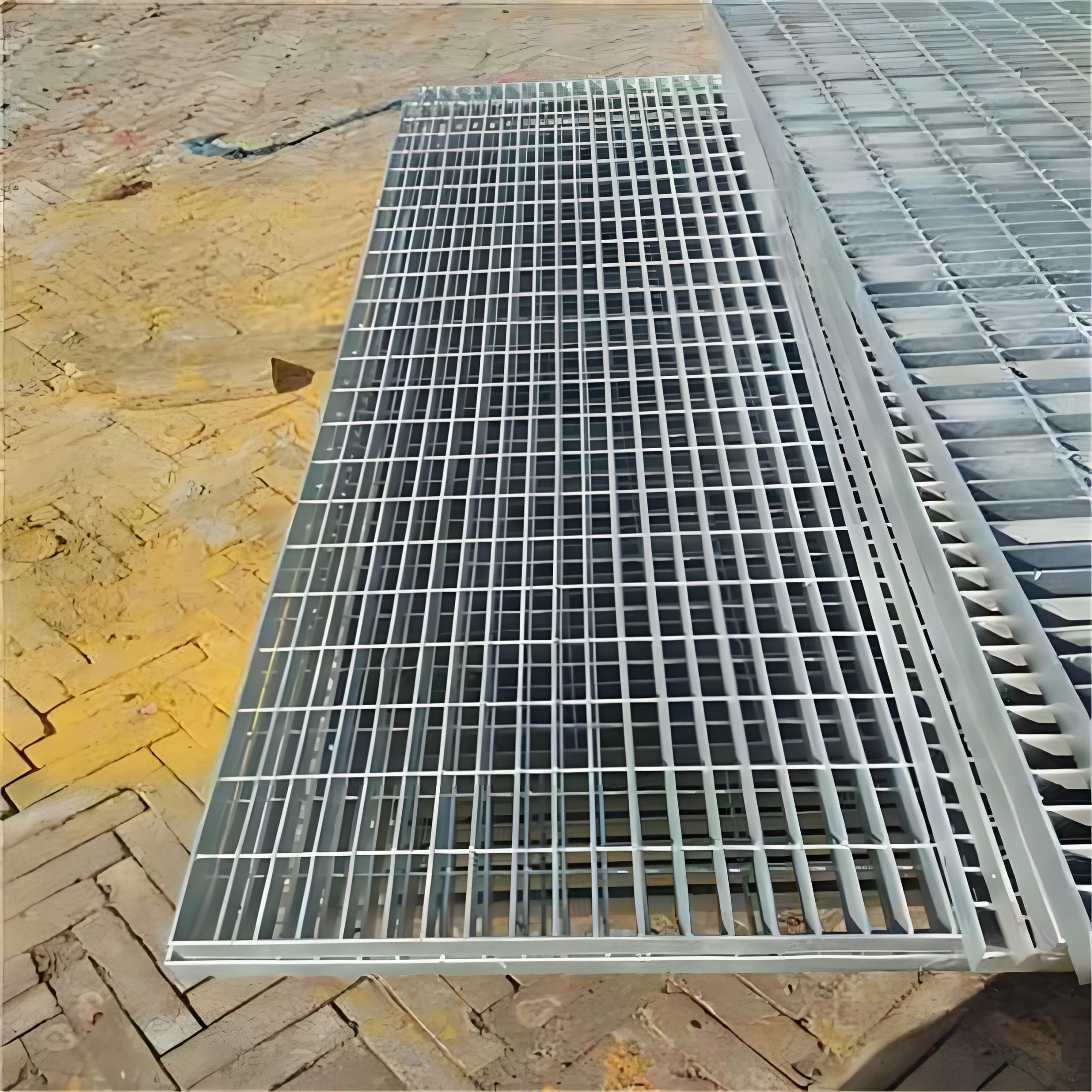
Factories may quote galvanized steel grating by square meter, panel, piece, or metric ton. The best basis depends on the product type and the degree of fabrication.
| Price Basis | Best Used For | Key Comparison Point |
|---|---|---|
| Price per square meter | Standard panels with the same bearing bar size, mesh, and finish | Compare only when steel weight and fabrication scope are the same |
| Price per panel | Custom covers, stair treads, cut-to-size panels, framed sections | Should include fabrication, banding, cutouts, and hardware details |
| Price per piece | Stair treads, trench covers, special access panels | Useful for items with different shapes or individual fabrication |
| Price per metric ton | Large industrial orders and basic grating body production | Confirm whether galvanizing, fabrication, packing, and freight are included |
| Galvanized Grating Type | Indicative Factory Budget Range | Typical Scope |
|---|---|---|
| Light-duty galvanized welded grating | US$25–45/m² | Common stock-style panels with smaller bearing bars |
| Standard galvanized industrial grating | US$35–75/m² | Platforms, walkways, industrial floors, standard fabrication |
| Serrated galvanized grating | US$35–90/m² | Outdoor access, stairs, ramps, wet and oily areas |
| Heavy-duty galvanized grating | US$60–125/m² | Deep bearing bars, longer spans, heavy covers, demanding industrial service |
| Custom fabricated galvanized panels | US$60–180/m² or more | Cutouts, toe plates, frames, special edges, complex layout |
These ranges are preliminary factory budgeting references, not fixed quotations. Steel price, zinc price, panel weight, order quantity, galvanized coating requirement, factory capacity, export packing, certification, delivery location, and Incoterm can change the final price.
The primary cost driver for galvanized steel grating is steel weight. Deeper bearing bars, thicker bars, closer bearing-bar spacing, closer cross-bar spacing, and larger edge details all increase the amount of steel used per square meter.
A simplified estimate for the weight of the main bearing bars is:
Bearing-bar mass per m² ≈ 7.85 × bearing bar depth (mm) × bearing bar thickness (mm) ÷ bearing bar pitch (mm)
This formula estimates only the bearing bars. It does not include cross bars, welding, edge banding, toe plates, frames, cutout reinforcement, zinc coating, clips, or packaging.
| Cost Factor | How It Affects Price |
|---|---|
| Bearing bar depth | Deeper bars add steel weight and improve stiffness |
| Bearing bar thickness | Thicker bars add steel weight, strength, and welding area |
| Bearing bar spacing | Closer spacing uses more primary load-carrying bars per square meter |
| Cross-bar spacing | Closer pitch adds cross bars, welding, and processing |
| Serrated surface | Adds bearing-bar processing cost for improved traction |
| Hot-dip galvanizing | Adds zinc coating, preparation, handling, and inspection cost |
| Cutouts and banding | Add layout, cutting, welding, reinforcement, and galvanizing area |
| Frames and toe plates | Add significant steel, welding, finishing, and handling cost |
| Order quantity | Repeated standard panels generally lower the unit price |
Hot-dip galvanizing cost is affected by the total surface area of the finished steel item, not only by the plan area of the grating. More bars, exposed edges, toe plates, banding, frames, and custom details create more steel surface to prepare, handle, coat, and inspect.
Large or complex panels may also affect galvanizing logistics. The factory must consider lifting points, venting and drainage details where relevant, bath dimensions, panel handling, distortion control, and final inspection.
Before placing an order, buyers should confirm the complete technical and commercial scope. A clear RFQ avoids incorrect bar direction, inadequate load capacity, missing banding, unsuitable coating, unexpected fabrication charges, and installation problems.
| Check Item | Why It Matters |
|---|---|
| Material and steel grade | Confirms the base material before galvanizing |
| Galvanizing method | Confirms pre-galvanized or hot-dip galvanized after fabrication |
| Coating standard | Defines corrosion-protection and inspection requirement |
| Bearing bar size and mesh | Controls weight, opening size, load capacity, and price |
| Bearing bar direction | Must align with the actual support span |
| Clear span and load | Required to confirm correct grating selection |
| Support frame and ledge width | Ensures stable bearing and proper load transfer |
| Custom fabrication | Prevents missing cutouts, banding, toe plates, frames, clips, or holes |
| Finished panel weight | Important for handling, installation, packing, and freight |
| Certificates and inspection | Confirms material, dimensions, coating, and project requirements |
A drawing-based quotation is usually the most accurate. The drawing should show all panel sizes, support locations, bearing-bar direction, cutouts, critical dimensions, anchorage, surface type, finish, and quantity. This allows the factory to calculate steel weight, galvanizing scope, fabrication work, packing, and delivery requirements correctly.
Is hot-dip galvanized grating better than pre-galvanized grating?
For custom welded steel bar grating used outdoors or in wet industrial conditions, hot-dip galvanizing after fabrication is usually the better option because welds, cut edges, edge banding, and fabricated details receive zinc coating. Pre-galvanized material can be suitable for some formed products, but cutting and welding may expose or damage the original coating.
What is the standard size of galvanized steel grating?
Common raw factory panel sizes are often close to 1,000 mm wide and up to 6,000 mm long, but there is no single universal standard. Finished panels may be 600×1,000 mm, 1,000×1,000 mm, 1,000×2,000 mm, 1,000×3,000 mm, or custom sizes based on the support layout and fabrication drawing.
How much does galvanized steel grating cost per square meter?
Standard hot-dip galvanized steel grating commonly falls within a preliminary factory range of about US$25–75 per square meter. Serrated, close-mesh, heavy-duty, framed, or custom fabricated grating can cost more. Final price depends on steel weight, bar size, mesh, zinc coating, fabrication, quantity, packing, and freight terms.