

Galvanized steel grating is carbon steel bar grating protected by a zinc coating, most commonly applied through hot-dip galvanizing after welding and fabrication. It is widely used for industrial walkways, platforms, stair treads, trench covers, drainage floors, catwalks, mezzanines, utility structures, and outdoor access systems. Factory price depends on the carbon steel weight, bearing-bar size, mesh pattern, zinc coating requirement, panel dimensions, fabrication details, quantity, packing, and delivery terms. Standard hot-dip galvanized grating is often one of the most economical choices for outdoor industrial flooring because it combines carbon steel strength with practical corrosion protection.
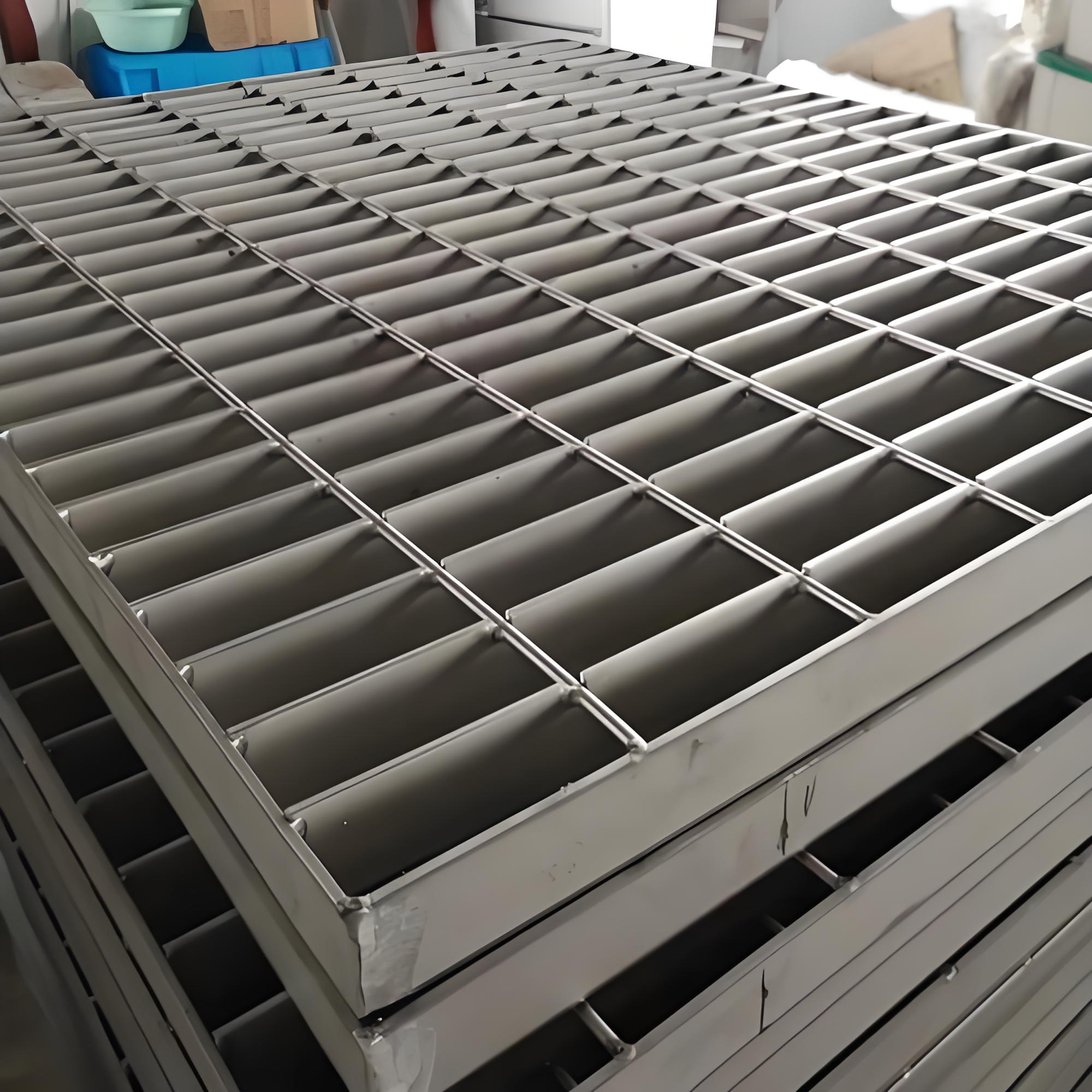
Galvanized steel grating is not priced only by outside panel size. Factories usually calculate the finished steel weight first, then add manufacturing, fabrication, galvanizing, inspection, packing, and delivery-related costs.
A simplified price structure is:
Galvanized grating price = carbon steel cost + grating production + fabrication + zinc coating + inspection + packing + delivery-related cost
The largest cost component is usually the carbon steel weight in the bearing bars. Deep, thick, or closely spaced bearing bars contain more steel per square meter. This increases the raw material cost, galvanizing cost, freight weight, and handling requirement.
| Price Factor | How It Affects the Final Quote |
|---|---|
| Finished kg/m² | More steel increases raw material, zinc coating, packing, and freight cost |
| Bearing-bar depth | Deeper bearing bars improve span capacity but increase steel consumption |
| Bearing-bar thickness | Thicker bars increase strength, durability, and panel weight |
| Mesh pattern | Closer spacing adds more bearing bars or cross bars per square meter |
| Surface type | Serrated grating costs more than plain grating because of anti-slip processing |
| Galvanizing | Adds zinc, processing, inspection, handling, and finished shipping weight |
| Custom fabrication | Banding, cutouts, frames, toe plates, holes, and clips add labor and steel |
| Order quantity | Large repeated orders generally lower setup and packing cost per m² |
For factory budgeting, standard hot-dip galvanized steel grating may commonly fall around US$30–60/m². Light standard panels may be lower, while serrated, close-mesh, heavy-duty, cut-to-size, framed, or highly fabricated panels can be substantially higher.
Carbon steel is the structural base of galvanized steel grating. The zinc coating improves corrosion resistance, but it does not replace the steel structure. A panel with heavier bearing bars costs more than a light panel even before galvanizing is added.
Carbon steel cost is mainly linked to the finished grating weight. Galvanizing cost is related to steel weight, coated surface area, coating requirement, zinc market conditions, handling, drainage, inspection, and production batch efficiency.
| Cost Component | What It Includes | Buyer Checkpoint |
|---|---|---|
| Carbon steel material | Bearing bars, cross bars, edge banding, frames, toe plates | Compare finished kg/m² and material grade |
| Welding or pressing | Panel assembly, cross-bar attachment, fabrication welding | Confirm welded, press-locked, or special construction |
| Hot-dip galvanizing | Cleaning, fluxing, zinc coating, handling, inspection | State the required galvanizing standard and coating requirement |
| Fabrication | Cutting, banding, holes, cutouts, frames, handles, clips | Submit a complete drawing or panel schedule |
| Packing and shipping | Bundles, pallets, labels, separators, export documentation | Compare the same packing scope and trade term |
For a light standard panel, galvanizing may be a modest part of the final price. For a heavily fabricated panel with many welds, cutouts, edge bars, and large coated surface area, galvanizing and related handling can become more significant.
Pre-galvanized steel is coated before the steel is cut or formed. Post-fabrication hot-dip galvanizing means the completed grating panel is galvanized after welding, cutting, banding, and fabrication.
For industrial steel bar grating, post-fabrication hot-dip galvanizing is normally preferred because the finished zinc coating can cover welded intersections, cut edges, banding bars, notches, serrated bearing bars, and custom details.
| Feature | Pre-Galvanized Steel | Post-Fabrication Hot-Dip Galvanized Grating |
|---|---|---|
| Coating timing | Steel is coated before fabrication | Finished grating is coated after fabrication |
| Cut edges | May be exposed after cutting | Coated after final cutting and fabrication |
| Welded areas | Welding can damage or remove nearby zinc coating | Welded joints receive zinc coating after fabrication |
| Typical use | Sheet, strip, light formed products, selected pre-coated components | Industrial grating, platforms, stairs, trench covers, outdoor structures |
| Corrosion protection at custom details | Requires careful repair or treatment after fabrication | Generally better coverage for completed fabricated panels |
Pre-galvanized material can be efficient for high-volume formed products, but it is less suitable when steel grating needs extensive welding, edge banding, cutouts, or custom fabrication. Cutting and welding pre-galvanized steel can expose bare edges or affect the coating near the weld zone.
For outdoor platforms, exposed walkways, drainage covers, industrial stair treads, and custom grating panels, post-fabrication hot-dip galvanizing is usually the more reliable corrosion-protection route.
Zinc coating thickness is important because it affects expected corrosion protection and finished product weight. Coating requirements are often specified by minimum coating mass, average coating thickness, minimum local thickness, or a recognized galvanizing standard.
Hot-dip galvanized coatings are commonly measured in microns or micrometers. The appropriate requirement depends on steel thickness, fabrication design, exposure conditions, and the standard named in the project specification.
| Coating Consideration | Why It Matters |
|---|---|
| Steel thickness | Galvanizing standards commonly set coating categories according to base steel thickness |
| Environmental exposure | Outdoor, coastal, chemical, humid, and marine conditions may require more careful selection |
| Surface preparation | Cleaning and pretreatment affect coating adhesion and coverage |
| Drainage and venting | Fabricated frames and enclosed details need proper drainage for safe galvanizing |
| Coating inspection | Thickness and coverage checks help confirm the required corrosion-protection level |
As a general reference, hot-dip galvanizing standards specify thicker coatings for thicker fabricated steel. However, buyers should not specify a coating thickness from memory alone. The quotation should identify the applicable standard, required coating class, inspection method, and any special corrosion environment.
Galvanizing provides both barrier protection and sacrificial zinc protection. This can help protect nearby exposed steel at small damaged areas, but it is not a reason to ignore severe coating damage, field welding, deep abrasion, or aggressive chemical exposure.
Standard galvanized steel grating size includes more than panel length and width. A complete size description should include the bearing-bar section, mesh pattern, panel dimensions, bearing-bar direction, surface type, and finish.
| Common Panel Width | Common Panel Length Range | Typical Application |
|---|---|---|
| 500–600 mm | 1000–6000 mm | Narrow walkways, service routes, removable trench covers |
| 800 mm | 1000–6000 mm | Industrial catwalks and maintenance access platforms |
| 1000 mm | 1000–6000 mm | General platforms, access floors, large-area grating layouts |
| 1200 mm | 1000–6000 mm | Wide industrial platforms and equipment areas |
| 1500 mm or wider | Custom length | Large fabricated platforms and special industrial structures |
Common stock dimensions are practical production references, not universal limits. Maximum panel size depends on the factory welding line, raw material length, galvanizing bath size, lifting capacity, transport limits, installation access, and safe handling requirements.
Large grating panels reduce the number of joints, but they can become difficult to lift, remove for maintenance, or transport safely. Smaller panels are easier to handle and replace but require more supports and fixing points.
Bearing bars are the primary load-carrying elements in galvanized steel grating. Their height, thickness, spacing, and span direction determine the structural behavior of the panel.
| Bearing-Bar Size | General Duty Level | Typical Application |
|---|---|---|
| 20×3 mm | Light duty | Short-span access panels and light maintenance covers |
| 25×3 mm | Light to standard duty | Short-span walkways and pedestrian access floors |
| 30×3 mm | Standard duty | General industrial walkways, catwalks, and platforms |
| 32×3 mm | Standard duty | Metric industrial flooring with moderate span requirements |
| 30×5 mm | Medium duty | Higher-load walkways and stronger platform panels |
| 32×5 mm | Medium duty | Industrial access areas and controlled longer spans |
| 40×5 mm | Heavy duty | Heavy platforms, demanding service routes, stronger covers |
| 50×5 mm or larger | Heavy duty | Long spans, high loads, vehicle-related or engineered applications |
Common bearing-bar spacing options include 30 mm, 34 mm, 40 mm, 50 mm, and 60 mm center to center. Closer spacing provides more bearing bars per meter width, smaller openings, and higher steel weight. Wider spacing improves open area and can reduce cost, provided that the application allows it.
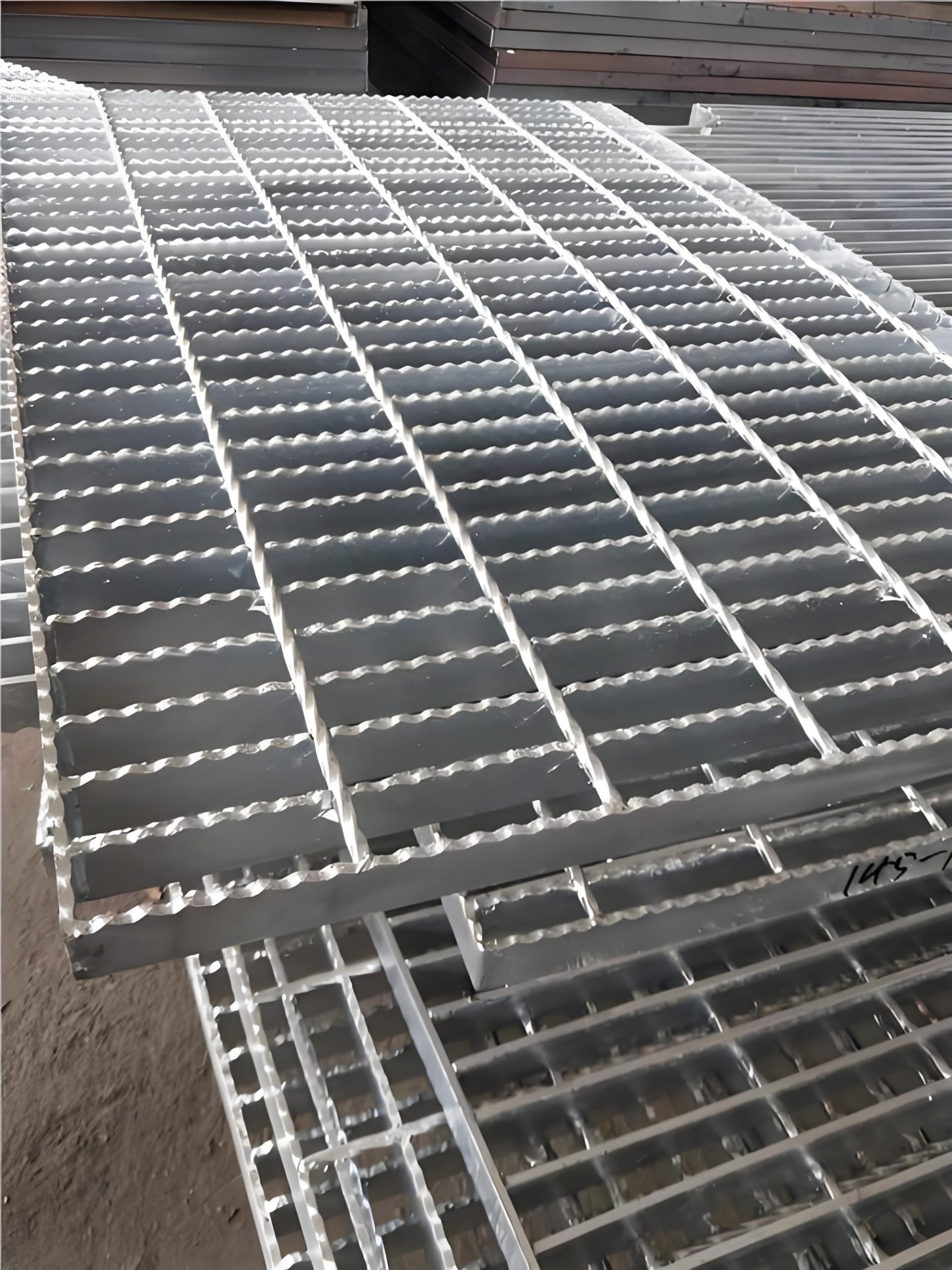
Cross bars keep the bearing bars aligned and help form a rigid grating panel. Common cross-bar pitches are 50 mm and 100 mm, although other patterns are available for custom applications.
| Mesh Pattern | General Characteristic | Typical Application |
|---|---|---|
| 25×50 mm | Close mesh with smaller openings and higher weight | Controlled openings and dense industrial flooring |
| 25×100 mm | Close bearing-bar pitch with standard cross-bar spacing | Small-opening walkways and special access floors |
| 30×50 mm | Standard bearing-bar pitch with denser cross bars | Stair treads, close-pattern floors, special industrial access |
| 30×100 mm | Balanced weight, drainage, open area, and production efficiency | General platforms, walkways, catwalks, drainage covers |
| 40×50 mm | More open bearing-bar pattern with a closer transverse layout | Selected industrial platforms and access routes |
| 40×100 mm | Higher open area and lower steel consumption | Light to standard access areas where larger openings are acceptable |
A closer cross-bar pattern adds material and production work, but it does not replace the need for correctly sized bearing bars. The bearing bars remain the primary load-carrying members between supports.
Panel weight is one of the most important figures in galvanized grating pricing. It affects carbon steel consumption, zinc coating cost, lifting requirements, packing, freight, and support dead load.
For rectangular carbon steel bearing bars, a preliminary weight estimate can be calculated as:
Bearing-bar mass (kg/m²) ≈ 7.85 × bearing-bar depth (mm) × bearing-bar thickness (mm) ÷ bearing-bar pitch (mm)
This calculation includes only the bearing bars. Cross bars, welds, edge banding, toe plates, clips, frames, zinc coating, and custom fabrication must be added separately.
For example, a 30×3 mm bearing bar at 30 mm centers has an estimated bearing-bar weight of:
7.85 × 30 × 3 ÷ 30 = 23.55 kg/m²
After adding cross bars and standard welded construction, a 30×3 mm, 30×100 grating body commonly weighs approximately 26–28 kg/m² before galvanizing and fabrication allowances.
| Bearing-Bar Size | Typical 30×100 Grating Body Weight | Typical Use |
|---|---|---|
| 25×3 mm | About 22–24 kg/m² | Light industrial walkways and short-span access |
| 30×3 mm | About 26–28 kg/m² | General industrial flooring and platforms |
| 32×3 mm | About 28–30 kg/m² | Standard metric industrial flooring |
| 30×5 mm | About 42–45 kg/m² | Medium-duty walkways and stronger platform floors |
| 32×5 mm | About 45–46 kg/m² | Industrial platforms with higher load requirements |
| 40×5 mm | About 55–58 kg/m² | Heavy-duty service platforms and demanding access routes |
Hot-dip galvanizing adds zinc to all coated steel surfaces, so it increases finished weight. Zinc consumption cannot be estimated accurately from plan area alone because grating has many exposed bar surfaces, edges, intersections, and fabricated details.
A useful conceptual calculation is:
Zinc coating mass = total coated steel surface area × coating mass per square meter
The total coated surface area of a grating panel is much larger than its floor-plan area. Deeper bearing bars, closer spacing, serrated profiles, edge banding, frames, toe plates, and cutout reinforcement all increase the surface area that must be galvanized.
Standard-duty and heavy-duty grating should not be selected by appearance alone. The required duty level depends on clear span, load type, support condition, deflection limit, and traffic pattern.
| Feature | Standard-Duty Galvanized Grating | Heavy-Duty Galvanized Grating |
|---|---|---|
| Bearing bars | Common light to medium sections | Deeper and thicker bearing bars |
| Weight | Lower to moderate | Higher |
| Typical use | Pedestrian walkways, platforms, stairs, maintenance access | Heavy platforms, concentrated equipment loads, vehicle-related areas |
| Factory cost | More economical | Higher due to steel weight and fabrication requirements |
| Support design | Standard platform support arrangement | Requires closer coordination with structural supports and load conditions |
Heavy-duty grating may require thicker edge banding, reinforced frames, stronger weld details, and project-specific engineering verification. It should not be priced by applying a simple percentage increase to standard walkway grating because the finished steel weight may be much higher.
Galvanizing protects carbon steel from corrosion, but it does not change the basic structural design requirement. Load capacity still depends on bearing-bar size, bearing-bar spacing, clear span, material grade, support condition, load type, and deflection limit.
The bearing bars must run between supports. This is the primary span direction.
| Design Item | Why It Matters |
|---|---|
| Clear span | Controls bearing-bar bending and deflection |
| Bearing-bar direction | Must align with the support spacing |
| Uniform load | Used for pedestrian, maintenance, and distributed floor loads |
| Concentrated load | Important for workers, equipment feet, valves, and local loads |
| Wheel load | Needed for carts, pallet jacks, forklifts, and vehicle traffic |
| Deflection limit | Controls walking comfort, vibration, drainage, and panel serviceability |
| Support bearing width | Ensures bars have adequate seating on the support structure |
A long panel can be structurally suitable when it has several intermediate supports. For example, a 6000 mm long panel may have a design span of only 1000 mm if steel supports are installed every 1000 mm beneath the bearing bars.
There is no universal maximum span for galvanized steel grating. The final selection should come from a verified load table or engineering calculation for the exact bar size, mesh pattern, load condition, support layout, and deflection requirement.
Galvanized steel grating can be supplied with plain smooth bearing bars or serrated bearing bars. Both can receive hot-dip galvanizing after fabrication.
| Surface Type | Typical Use | Cost Effect |
|---|---|---|
| Plain galvanized grating | Dry industrial platforms, indoor access floors, controlled environments | Lower |
| Serrated galvanized grating | Outdoor stairs, ramps, wet areas, oily floors, drainage zones | Higher due to serration processing |
Plain galvanized grating is widely used for general industrial flooring. Serrated galvanized grating is often selected for outdoor and wet locations because the teeth improve traction for industrial footwear.
Serration should be selected based on actual slip risk. It does not eliminate the need for drainage, cleaning, appropriate footwear, handrails, or safe operating procedures.
Cutting and welding are major reasons why post-fabrication hot-dip galvanizing is commonly preferred for carbon steel grating. If these operations are performed after galvanizing, they can expose bare steel and damage the nearby zinc coating.
| Fabrication Activity | Effect on Galvanized Grating | Best Practice |
|---|---|---|
| Cutting to size | Creates exposed steel at cut edges if done after galvanizing | Cut before hot-dip galvanizing whenever practical |
| Welding banding bars | Can damage pre-existing zinc coating near welds | Complete banding before galvanizing |
| Pipe or column cutouts | Creates new edges that may need banding and coating | Fabricate from approved drawings before galvanizing |
| Toe-plate welding | Adds welded joints and extra coated surface area | Install before galvanizing when possible |
| Field drilling or welding | May damage zinc coating during installation | Minimize field work and repair coating as required by project specification |
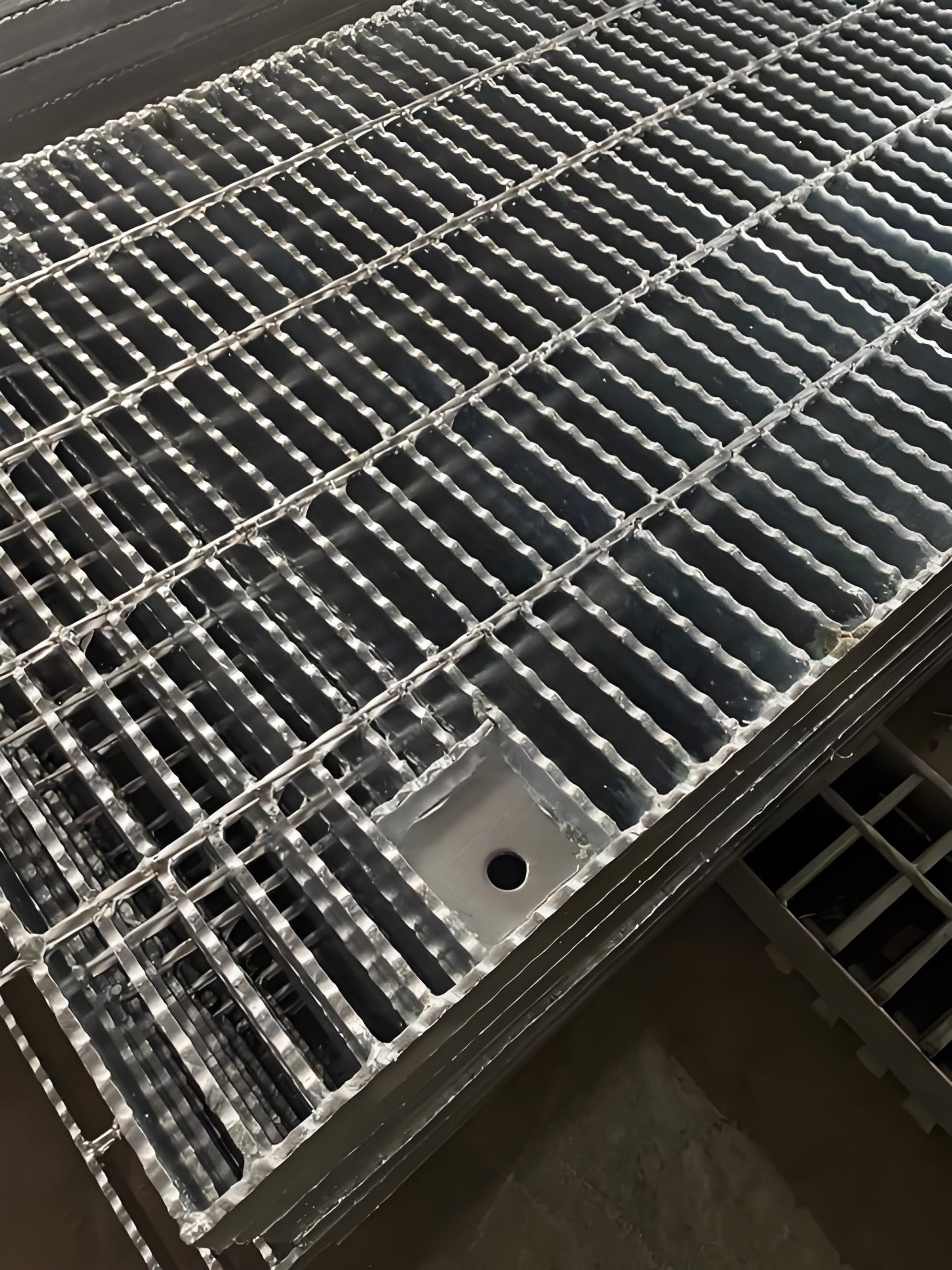
Edge banding improves handling safety, closes exposed bearing-bar ends, improves panel stiffness, and creates a cleaner finished appearance. It also adds steel weight, welding, galvanizing area, and cost.
Stock panels are regular rectangular grating sheets produced in common mesh patterns and bearing-bar sizes. They usually have the lowest price per square meter because the factory can manufacture them in repeated batches with high material efficiency.
Custom fabrication converts stock panels into installation-ready products. This can reduce site cutting, improve fit, and simplify installation, but it raises the factory cost.
| Supply Type | Advantages | Limitations |
|---|---|---|
| Stock galvanized panels | Lower price, quicker production, efficient material use | May need site cutting or local fabrication |
| Cut-to-size panels | Ready to install, reduced site cutting, better fit | Higher fabrication cost and more detailed drawings required |
| Custom framed panels | Suitable for trench covers, access hatches, removable covers | More steel, welding, galvanizing, and inspection work |
| Special shapes | Fits curved platforms, columns, pipes, tanks, and irregular structures | May create more material waste and a higher unit price |
Common custom fabrication includes:
Galvanized steel grating is heavy, so packing and shipping can have a meaningful effect on the delivered cost. Standard panels may be stacked and strapped into bundles. Fabricated panels may need separators, edge protection, pallets, steel frames, labels, or custom export packing.
| Shipping Factor | Why It Matters |
|---|---|
| Total shipment weight | Controls freight, container planning, lifting, and unloading requirements |
| Panel dimensions | Affects container loading efficiency and handling method |
| Bundle arrangement | Helps prevent shifting, deformation, and coating damage in transit |
| Panel labels | Reduce sorting errors during installation |
| Protective separators | Help prevent scratching and abrasion of coated surfaces |
| Trade term | Determines whether the quote is EXW, FOB, CFR, CIF, DAP, or another scope |
To receive an accurate galvanized steel grating quotation, provide the complete technical and commercial information:
A clear inquiry could read: “Please quote welded carbon steel grating with 30×3 mm serrated bearing bars, 30×100 mm mesh, hot-dip galvanized after fabrication, finished panel size 1000×1200 mm, bearing bars spanning 1000 mm, banded on four sides, suitable for the stated pedestrian load and deflection limit. Please provide finished kg/m², galvanizing standard, fabrication scope, packing method, lead time, and FOB price.”
How much does galvanized steel grating cost per square meter?
Standard hot-dip galvanized steel grating commonly falls around US$30–60/m² for factory orders. The final price depends on the bearing-bar size, mesh pattern, finished weight, serration, fabrication details, galvanizing requirement, quantity, packing, and delivery terms.
Is post-fabrication hot-dip galvanizing better than pre-galvanized steel for grating?
For welded and custom-fabricated steel grating, post-fabrication hot-dip galvanizing is usually preferred because it coats the finished welds, cut edges, banding bars, notches, and fabricated details. Pre-galvanized steel can leave exposed areas after cutting and welding.
What is the standard size of galvanized steel grating?
Common panel widths include 600 mm, 800 mm, 1000 mm, and 1200 mm, with lengths often ranging from 1000 mm to 6000 mm. A complete standard size also includes the bearing-bar section, mesh spacing, surface type, bearing-bar direction, and load requirement.