

Carbon steel dovetail grating, also called dovetail pressure-locked or dove-tail grating, is a rigid open-grid panel made by hydraulically locking cross bars into slotted bearing bars. It is used for industrial platforms, walkways, mezzanines, bridge decks, stair treads, drain covers, equipment floors, and architectural access areas. Factory prices depend on the bearing bar size, mesh spacing, panel weight, surface finish, fabrication, quantity, and delivery terms. This guide explains how dovetail grating is manufactured, how it compares with welded and swage-locked grating, and how to obtain a realistic factory quotation.
Carbon steel dovetail pressure-locked grating is a type of bar grating in which flat bearing bars and cross bars are assembled in an egg-crate pattern and permanently locked together under high hydraulic pressure. The bearing bars contain pre-punched slots. These slots have a dovetail or tapered shape that mechanically captures the cross bars after pressing.
The finished panel has an open structure that allows air, water, light, heat, dust, and small particles to pass through. The bearing bars carry the main load and must span from one support to another. The cross bars provide lateral stability and maintain the specified mesh pattern, but they are not normally treated as the primary span members.
Unlike welded grating, the main bar intersections do not rely on resistance welds. This gives pressure-locked grating a clean, uniform appearance and avoids weld heat-affected areas in the middle of the panel. Perimeter banding, frames, stair nosing, or other accessories can still be welded when required.
| Component | Function | Typical Options |
|---|---|---|
| Bearing bar | Carries the principal bending load between supports | 25 × 3 mm, 30 × 3 mm, 30 × 5 mm, 32 × 5 mm, 40 × 5 mm |
| Cross bar | Locks the bearing bars together and stabilizes the panel | Rectangular or flat bar sized for the dovetail slot |
| Dovetail slot | Receives and mechanically captures the cross bar | Pre-punched tapered or dovetail-shaped slot |
| Banding bar | Closes and reinforces cut or exposed panel edges | Flat bar, matching bearing bar, or load-carrying band |
| Frame | Provides perimeter support or a removable border | Angle, channel, flat bar, or welded structural frame |
Carbon steel dovetail grating is normally supplied as bare steel, painted steel, or hot-dip galvanized steel. A serrated bearing bar can be selected for wet, oily, icy, or outdoor areas. Close-mesh versions are often used where heels, small wheels, tools, or loose components must be prevented from passing through the floor.
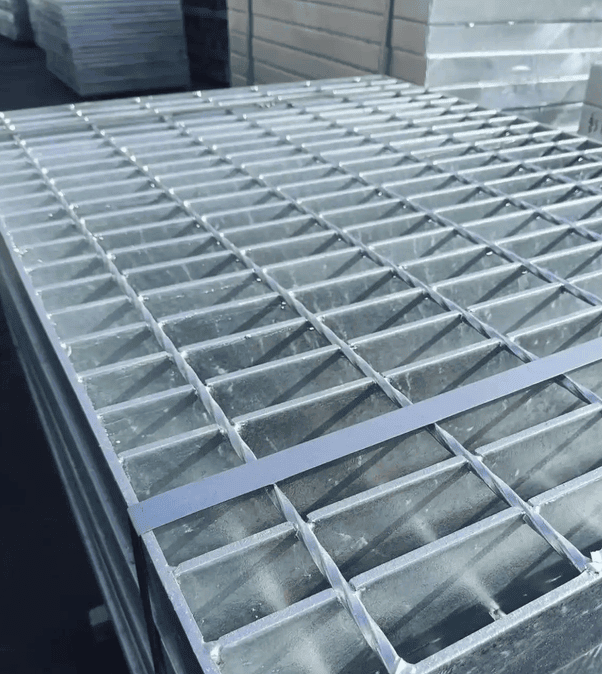
Dovetail pressure-locked, welded, and swage-locked grating all use bearing bars as the primary load-carrying members, but the connection between the bearing bars and cross bars is different.
| Feature | Dovetail Pressure-Locked | Welded Grating | Swage-Locked Grating |
|---|---|---|---|
| Connection method | Rectangular cross bars pressed into dovetail slots | Cross bars resistance-welded at intersections | Round, hexagonal, or tubular cross bars mechanically swaged into slots |
| Appearance | Regular, clean, and generally weld-free in the field of the panel | Visible weld pattern and industrial appearance | Clean mechanical joints, often with a flush or recessed cross bar |
| Typical materials | Carbon steel, stainless steel, and selected alloys | Carbon steel, stainless steel, and aluminum | Aluminum, stainless steel, and carbon steel |
| Load behavior | Must be checked using the exact pressure-locked load data | Widely available load tables and strong welded intersections | Depends on bar geometry, swage depth, and connection design |
| Typical cost | Usually higher than standard welded carbon steel | Usually the most economical industrial option | Often higher than welded steel because of specialized forming |
| Common applications | Architectural platforms, close mesh, walkways, stairs, and equipment floors | Heavy industrial platforms, catwalks, drains, and vehicle areas | Lightweight, corrosion-resistant, architectural, and close-mesh applications |
Welded grating is often selected when the project prioritizes the lowest cost, high-volume production, or familiar heavy-load tables. Dovetail grating is attractive when a clean appearance, close mesh, flat pattern, or weld-free panel field is required. Swage-locked grating is frequently used with aluminum or stainless steel, where avoiding extensive welding helps preserve the parent material and appearance.
Neither pressure locking nor welding automatically determines the capacity. A dovetail panel can be engineered for substantial loads, but its load rating must match the exact bearing bar, mesh, span, support condition, and deflection requirement. The supplier’s certified data should always govern the selection.
More information about pressure-locked construction is available on this press-locked grating product page.
The manufacturing sequence is important because the slot geometry, pressing force, and dimensional control determine the quality of the finished panel.
The dovetail slot is more than a simple rectangular hole. Its shape allows the cross bar to lock in place after pressing and helps resist movement in both directions. Slot depth, width, cross bar thickness, and pressing force must be controlled together. If the slot is too loose, the panel may rattle or distort. If it is too tight, the bars may be damaged during assembly.
Pressure locking normally produces a flat and regular panel, but small dimensional variations can still occur because of steel tolerances, bar straightness, pressing force, trimming, and finishing. Critical projects should use an approved shop drawing and a sample inspection before full production.
Carbon steel dovetail grating can be produced from several grades, depending on the project country, design code, availability, and certification requirement.
| Material Designation | Typical Description | Specification Consideration |
|---|---|---|
| ASTM A36 | Common structural carbon steel grade | Often specified for North American structural work |
| ASTM A1011 | Carbon steel sheet or strip specification used by some grating producers | Check thickness, grade, and forming suitability |
| Q235B | Common Chinese structural carbon steel designation | Confirm mechanical properties and certificate format |
| S235JR | European structural steel designation | Check the required EN documentation and impact requirements |
| Other approved equivalent | Local or owner-approved grade | Confirm chemical composition, yield strength, weldability, and traceability |
The material specification should state the bearing bars, cross bars, banding bars, and frames separately if they use different thicknesses or grades. A factory should be able to provide a mill test certificate showing the heat number and mechanical or chemical information requested by the project.
Carbon steel is usually the lowest-cost structural option, but it requires paint, galvanizing, or another corrosion-protection system when exposed to moisture. Selecting a stronger steel grade does not eliminate the need for a suitable surface treatment.
Bearing bar height and thickness have the greatest influence on the stiffness, load capacity, and weight of dovetail grating. The bars must be installed in the direction of the clear span.
| Bearing Bar Example | General Service Position | Possible Application |
|---|---|---|
| 25 × 3 mm | Light-duty and short-span | Indoor access panels and light walkways |
| 25 × 5 mm | Light to medium-duty | Platforms requiring more local strength |
| 30 × 3 mm | Standard-duty | General industrial floors and maintenance walkways |
| 30 × 5 mm | Medium to heavy-duty | Equipment platforms, ramps, and longer spans |
| 32 × 5 mm | Medium to heavy-duty | Industrial decks and close-mesh flooring |
| 40 × 5 mm | Heavy-duty | High-load platforms and service areas |
| 50 × 5 mm or larger | Very heavy-duty | Vehicle loads, long spans, and concentrated equipment loads |
Common bearing bar pitches include approximately 19, 25, 30, and 40 mm. A closer pitch places more bars beneath the load and creates smaller openings, but it also increases the steel weight and factory price.
Dovetail specifications may use designations such as 11-DT-4 or 19-DT-4. The number commonly relates to the bearing bar spacing system, DT identifies dovetail pressure locking, and the final number refers to the cross bar spacing in inches. Metric products may be described as 19 × 50 mm, 30 × 50 mm, or 30 × 100 mm. Because manufacturers may use different coding conventions, the drawing should show the actual pitch and clear opening.
For more detail on bar dimensions, pitch, panel width, and tolerances, buyers can consult this steel bar grating dimensions guide.
Dovetail pressure-locked grating normally uses rectangular or flat cross bars that fit into the prepared bearing bar slots. The cross bar dimensions must provide enough material for the hydraulic lock without creating excessive weight or restricting the open area.
| Cross Bar Spacing | General Characteristics | Typical Use |
|---|---|---|
| 25–50 mm | Close visual pattern and better small-object retention | Pedestrian floors, stair treads, carts, and public access areas |
| 50 mm | Balanced mesh density and stability | Close-mesh industrial platforms |
| 75 mm | Intermediate opening and material use | Equipment floors and general walkways |
| 100 mm | Open pattern, good drainage, and lower cross bar consumption | Industrial platforms, catwalks, and outdoor service decks |
The clear opening is not the same as the nominal pitch. For example, a 19 mm bearing bar pitch minus a 5 mm bearing bar thickness produces a smaller clear opening than 19 mm. Cross bar width, bar overlap, and the exact slot geometry also influence the finished opening.
Openings should be selected according to foot safety, wheel size, drainage, ventilation, debris retention, and local accessibility requirements. A close mesh can reduce the risk of heels, canes, small wheels, and tools entering the opening. A larger mesh can improve drainage and reduce weight where pedestrian restrictions are not a concern.
| Example Designation | Approximate Geometry | Typical Selection Logic |
|---|---|---|
| 11-DT-4 | Approximately 11/16 in bearing bar spacing and 4 in cross bar spacing | Close mesh for pedestrian, small-wheel, and object-retention needs |
| 19-DT-4 | Approximately 1-3/16 in bearing bar spacing and 4 in cross bar spacing | General industrial platform and walkway pattern |
| 19-DT-2 | Approximately 1-3/16 in bearing bar spacing and 2 in cross bar spacing | Closer cross bars for carts, tools, and smaller objects |
| 30 × 100 mm | Approximately 30 mm bearing pitch and 100 mm cross pitch | Metric general-purpose industrial flooring |
| 30 × 50 mm | Approximately 30 mm bearing pitch and 50 mm cross pitch | Metric close cross-bar pattern |
Plain dovetail grating has smooth bearing bar tops. Serrated grating has notches or teeth along the top edge of the bearing bars. The serrations create more contact points with footwear and improve traction when the panel is wet, oily, muddy, icy, or contaminated by process materials.
| Feature | Plain Dovetail Grating | Serrated Dovetail Grating |
|---|---|---|
| Walking surface | Smooth and regular | Notched or toothed on the bearing bar tops |
| Slip resistance | Suitable for dry and controlled areas | Better for wet, oily, outdoor, and inclined areas |
| Cleaning | Generally easier to sweep and wash | May retain more dirt in the serrations |
| Price | Lower for the same bar and mesh | Higher because of serration processing and inspection |
| Load-table treatment | Use the plain-bar data for the exact profile | Confirm whether the manufacturer applies a serration adjustment |
Serration may be formed before or after the slots are punched, depending on the factory’s equipment and production sequence. The supplier should confirm that the serration does not interfere with the slot geometry, pressing operation, edge banding, or stair nosing.
Serrated grating is not automatically slip-proof. Safety also depends on slope, footwear, lighting, drainage, housekeeping, handrails, and maintenance. If the project requires a defined anti-slip test or classification, it should be stated in the purchase documents.
Dovetail grating must be selected from the actual load and support conditions. The bearing bars span between supports, and the panel’s capacity is directional. Rotating the panel ninety degrees can place the shorter or weaker direction over the supports and reduce performance.
The main design inputs are:
Clear span is the unsupported distance between the bearing supports. It is not necessarily the overall panel length. A 3,000 mm-long panel may have intermediate beams and a clear span of only 1,000 mm. A shorter panel may need much deeper bearing bars if it bridges a large opening.
| Load Condition | Example | Design Concern |
|---|---|---|
| Uniform pedestrian load | Workers distributed over the platform | Overall bending, deflection, and vibration |
| Concentrated load | One person, tool box, or equipment foot | Local bending between adjacent bearing bars |
| Maintenance cart | Small wheels carrying tools or components | Clear opening, wheel spacing, and point load |
| Equipment load | Pump, motor, valve actuator, or temporary lifting device | Local reinforcement and support location |
| Forklift load | Wheel and pallet load on an industrial deck | Heavy-duty bar size, impact, and wheel-path design |
| Vehicle load | Service truck or bridge traffic | Vehicle class, fatigue, framing, and engineering verification |
Deflection is often the governing serviceability issue. Excessive movement can make workers uncomfortable, loosen clips, damage pipes or cable trays, and create vibration problems. Project criteria may use limits such as L/200, L/240, or L/360, but the correct limit depends on the owner, local code, use of the deck, and structural engineer.
Some published bar-grating tables are based on simple spans and uniform loads only. They may not cover impact, fatigue, vehicle wheels, uplift, dynamic machinery, or unusual support conditions. A dovetail grating supplier should provide a load table or calculation for the exact panel construction and not substitute data from a welded or swage-locked product without approval.
Close-mesh dovetail grating is often selected for public walkways, accessible platforms, transit areas, stair landings, ramps, and industrial routes used by carts or small-wheeled equipment. The reduced opening helps prevent heels, canes, wheelchair casters, guide-dog paws, tools, and small components from entering the mesh.
An 11-DT-4 pattern is a common example of a close bearing-bar arrangement with approximately 11/16-inch centers and 4-inch cross bar spacing. The exact clear opening depends on the bearing bar thickness and the slot profile. A 19-DT-4 panel has a wider bearing bar pitch and is often used for general industrial flooring.
| Requirement | Preferred Dovetail Approach |
|---|---|
| Public pedestrian traffic | Close mesh with a verified heel-safe opening |
| Wheelchairs and mobility aids | Confirm opening size, surface flatness, transitions, and local accessibility rules |
| Small carts and casters | Use close bearing and cross bar spacing with a wheel-load check |
| Outdoor ramps | Serrated bearing bars, close mesh, proper slope, and drainage |
| Industrial maintenance floors | Choose mesh according to tools, debris, and equipment access |
A product designation such as “ADA grating” should not be treated as a universal certification. Accessibility requirements may address opening size, direction of openings, surface changes, ramp slope, handrails, edge protection, and other parts of the route. The final project must be checked against the applicable local rules and owner specification.
Dovetail grating is produced in stock and made-to-order panel sizes. Factory equipment and bar-count conventions determine the practical width range.
| Common Panel Format | Approximate Use | Production Consideration |
|---|---|---|
| 600 × 1,000 mm | Small access covers and compact platforms | Easy to handle and suitable for limited quantities |
| 600 × 2,000 mm | Narrow walkways and equipment access | Low lifting weight and simple installation |
| 1,000 × 2,000 mm | Modular platform sections | Convenient for framing and container packing |
| 1,000 × 3,000 mm | General industrial platforms and catwalks | Balances panel size and handling requirements |
| 1,000 × 6,000 mm | Long walkways and larger decks | Fewer joints but greater lifting and transport weight |
| 2 ft, 3 ft, or 4 ft wide panels | Imperial project layouts | Final width depends on bar count and pressure-lock equipment |
Stock widths and lengths vary between factories. Some producers manufacture regular two-foot, three-foot, or four-foot widths, while others focus on metric panels. The finished width may be based on the number of bearing bars rather than a simple cutting dimension.
Important tolerances include:
Pressure-locked panels can be very regular, but they are not produced without tolerances. A tight-fitting panel inside an angle frame should include installation clearance for dimensional variation, coating thickness, thermal movement, and removal for maintenance.
Stock panels usually have the shortest lead time. Custom widths, irregular cutouts, serrations, banding, frames, and hot-dip galvanizing require additional production stages and may increase lead time. Minimum order quantities are factory-specific and may be based on square meters, panels, or a minimum processing charge.
Bare or mill-finish carbon steel is normally the lowest-cost option. It is suitable for indoor areas where humidity is controlled or where the panel will receive a separate coating after installation. Bare steel can show mill scale, handling marks, and light surface oxidation if it is stored in a damp environment.
Painted grating may use a shop primer, epoxy system, polyurethane topcoat, or another project-approved coating. Cost depends on surface preparation, primer type, number of coats, color, dry-film thickness, curing, and inspection.
Paint is useful for color coding, indoor corrosion protection, and architectural appearance. It can be damaged by forklift wheels, tools, chemicals, and frequent handling, so the maintenance plan should be considered before choosing a paint-only system.
Hot-dip galvanizing is normally performed after the panel has been pressure-locked, cut, banded, framed, and inspected. The finished panel is cleaned and immersed in molten zinc, allowing the coating to cover the bearing bars, cross bars, edges, and fabricated components together.
Post-fabrication galvanizing usually provides better protection for cut edges and accessory welds than starting with pre-galvanized material. Pre-galvanized steel can be used for certain products, but punching, pressing, cutting, and welding expose areas that require zinc repair.
Project specifications may reference ASTM A123/A123M, ISO 1461, or another local galvanizing standard. Coating requirements depend on the steel thickness, surface condition, exposure environment, and specified standard. Zinc appearance can vary from bright to dull gray, and color uniformity is not the only measure of coating quality.
| Finish | Price Position | Typical Use |
|---|---|---|
| Bare steel | Lowest | Indoor or separately coated structures |
| Shop-painted | Low to medium | Indoor platforms and color-finished projects |
| Hot-dip galvanized | Medium to high | Outdoor walkways, platforms, bridges, and humid plants |
| Duplex galvanized and painted | High | Severe environments requiring additional barrier protection |
Custom fabrication can represent a significant part of a dovetail grating quotation. Standard rectangular panels are efficient to produce, while irregular panels require more programming, cutting, handling, inspection, and material planning.
Cutouts may be required around pipes, columns, cable trays, tanks, valves, ladders, machines, drainage outlets, and access hatches. Each cutout should be dimensioned from two reference edges and should show the required corner radius and edge reinforcement.
Cutting through bearing bars can reduce local capacity. A banding bar or load-carrying band may be required around the opening. For large penetrations, a structural support frame is still necessary; edge banding does not replace the beam beneath the opening.
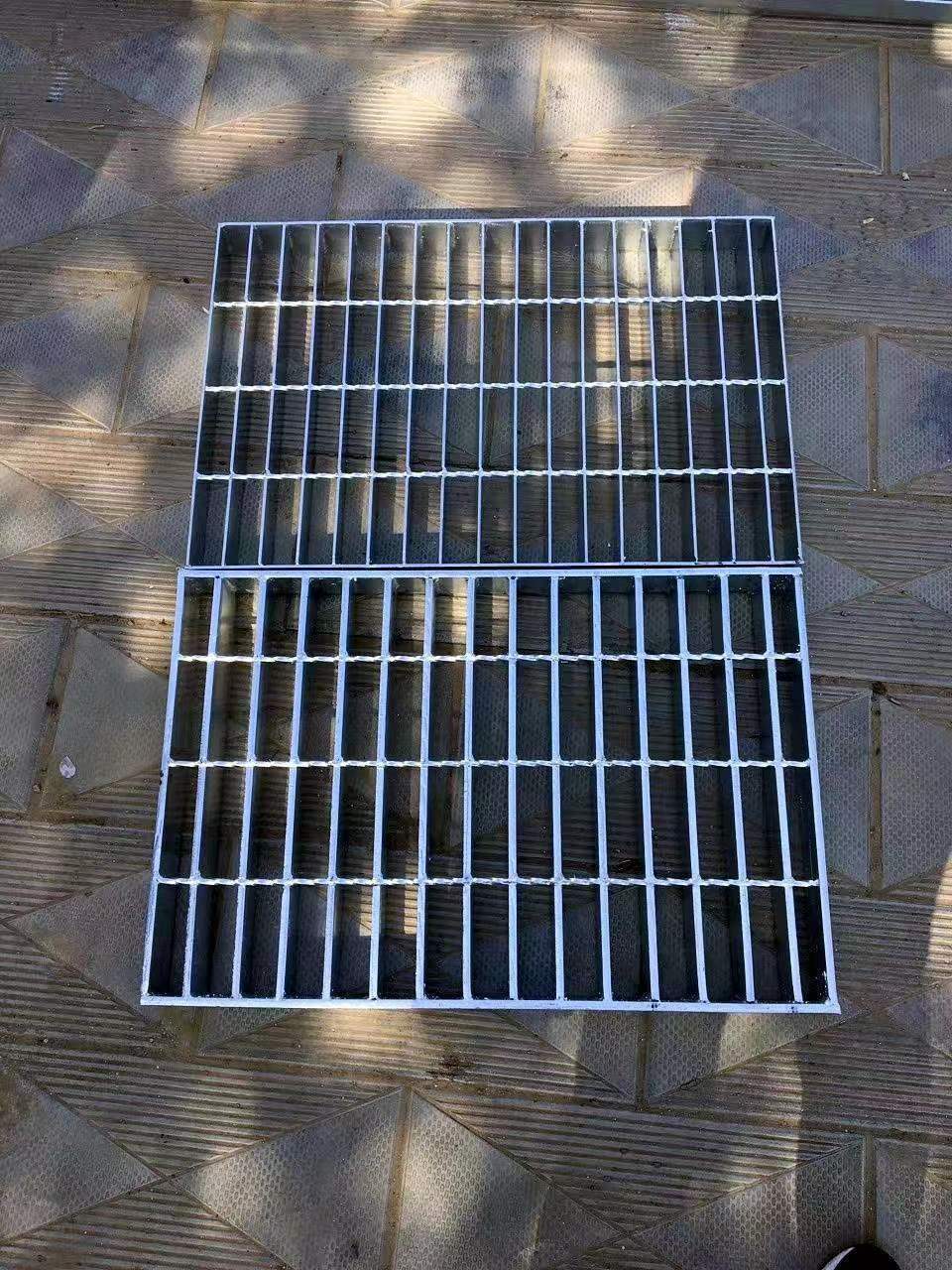
Banding closes exposed bearing bar ends and improves the panel’s edge appearance and rigidity. It is commonly specified at cut edges, stair tread ends, removable access panels, and panels that rest on a narrow support ledge.
Banding adds flat-bar material, cutting, fitting, welding, grinding, galvanizing, and inspection. A banded edge may also affect the finished width and the clearance inside the support frame.
Frames can be made from angle, channel, or flat bar. A frame may provide a bearing ledge, protect the panel perimeter, or create a removable cover assembly. The frame must be designed for the reaction forces and connection details rather than added only as a decorative border.
Dovetail grating can be fabricated into stair treads with front nosing, end plates, bolt holes, side angles, and serrated edges. Stair treads require separate checks for tread depth, support width, walking clearance, nosing projection, rise-and-run geometry, and concentrated foot load.
Drain covers require a close fit with the channel frame, adequate open area, safe openings, removable or hinged access, and a load rating appropriate for pedestrians, carts, forklifts, or vehicles. A light platform panel should not be used as a traffic-rated drain cover without a wheel-load calculation.
Factory price is closely related to the amount of carbon steel used in each square meter. Bearing bar height, thickness, pitch, cross bar dimensions, banding, frames, and cutouts all influence the weight.
A preliminary estimate for the bearing bar portion is:
Bearing-bar weight approximately equals 7.85 × bar height × bar thickness ÷ bearing-bar pitch.
When the dimensions are entered in millimeters, the result is approximately kilograms per square meter for the bearing bars. Cross bars, bands, frames, serrations, and galvanizing must then be added.
For example, a 30 × 5 mm bearing bar at a 30 mm pitch contributes approximately 39.25 kg/m² before cross bars and edge components. Depending on the cross bar spacing and panel details, the finished panel may weigh approximately 44–52 kg/m². The factory’s approved drawing and packing list should be used for the final weight.
| Dovetail Grating Category | Indicative Weight Range | General Price Position |
|---|---|---|
| Light-duty 25 × 3 mm class | Approximately 20–30 kg/m² | Lower material and handling cost |
| Standard-duty 30 × 3 mm class | Approximately 25–36 kg/m² | Common industrial platform range |
| Medium-duty 30 × 5 mm class | Approximately 40–55 kg/m² | Higher stiffness and concentrated-load resistance |
| Heavy-duty 40 × 5 mm class | Approximately 50–70 kg/m² | High material, galvanizing, and shipping cost |
| Close mesh or framed panel | Often above the basic bar-weight range | More bars, banding, frames, and fabrication |
The following are broad 2026 planning ranges for factory inquiries. They are not fixed market prices or firm quotations. The ranges assume normal export production and may be stated on an EXW or FOB basis before destination freight, taxes, import duties, and installation.
| Product Type | Indicative Factory Price | Typical Conditions |
|---|---|---|
| Bare standard-duty dovetail grating | Approximately US$40–75/m² | Regular welded-equivalent bar sizes, standard panels, normal quantity |
| Painted carbon steel dovetail grating | Approximately US$48–90/m² | Shop primer or basic paint system |
| Hot-dip galvanized standard dovetail grating | Approximately US$60–120/m² | Galvanizing after pressure locking and standard fabrication |
| Close-mesh 11-DT-4 class | Approximately US$65–135/m² | More bearing bars, smaller openings, and additional material |
| Heavy-duty dovetail grating | Approximately US$85–180/m² | Thicker or deeper bars, heavy loads, and stronger edge details |
| Custom framed or heavily fabricated panels | Approximately US$120–260+/m² | Cutouts, frames, stair treads, drain covers, toe plates, and testing |
For ton-based pricing, divide the square-meter price by the net weight in metric tons per square meter. If a galvanized panel weighs 50 kg/m² and is priced at US$100/m², the equivalent value is approximately US$2,000 per metric ton. This is only a comparison method; a ton quotation may use separate assumptions for steel, zinc, labor, scrap, and packing.
A 1,000 × 2,000 mm panel contains approximately 2 m². At US$60–120/m², the grating-only value may be approximately US$120–240 per standard galvanized panel. A 1,000 × 3,000 mm panel contains approximately 3 m² and may be approximately US$180–360 at the same rate. Custom cutouts, frames, clips, packing, and freight are additional unless included in the quote.
For general factory pricing terminology and project-ready cost factors, buyers can also review this steel grating prices and manufacturers guide.
A factory cannot prepare a dependable price from the words “carbon steel dovetail grating” alone. The request should identify the technical, fabrication, quality, and delivery requirements.
| Quote Information | Example or Question |
|---|---|
| Grating type | Dovetail pressure-locked, DT or PD profile |
| Material grade | ASTM A36, ASTM A1011, Q235B, S235JR, or approved equivalent |
| Surface | Plain or serrated bearing bars |
| Bearing bar size | Height × thickness, such as 30 × 5 mm |
| Bearing bar pitch | 11/16 in, 1-3/16 in, 19 mm, 25 mm, or 30 mm centers |
| Cross bar | Rectangular profile, size, and spacing |
| Panel dimensions | Length, width, thickness, quantity, and tolerance |
| Load requirement | Uniform load, point load, wheel load, clear span, and deflection limit |
| Bearing direction | Direction in which the bearing bars span between supports |
| Fabrication | Cutouts, notches, banding, frames, holes, toe plates, and stair nosing |
| Finish | Bare, painted, hot-dip galvanized, or duplex coating |
| Quality documents | Mill certificate, dimensional report, coating report, and load data |
| Packaging | Bundles, pallets, timber crates, separators, and moisture protection |
| Commercial terms | MOQ, lead time, quotation validity, EXW, FOB, CIF, or another Incoterm |
A clear request might read: “Supply 120 m² of carbon steel dovetail pressure-locked grating, 30 × 5 mm bearing bars, 30 mm bearing bar pitch, 100 mm cross bar pitch, serrated top surface, hot-dip galvanized after fabrication, panels approximately 1,000 × 3,000 mm, clear span 1,200 mm, uniform load as shown on the attached drawing, with banded cutouts and stainless or galvanized fixing clips.”
The factory should return a drawing showing the actual panel dimensions, bearing direction, clear opening, edge details, and accessory locations. Ask for the net panel weight and the gross packed weight separately. This helps avoid a quotation that appears inexpensive per square meter but becomes expensive after galvanizing, framing, and export packing are added.
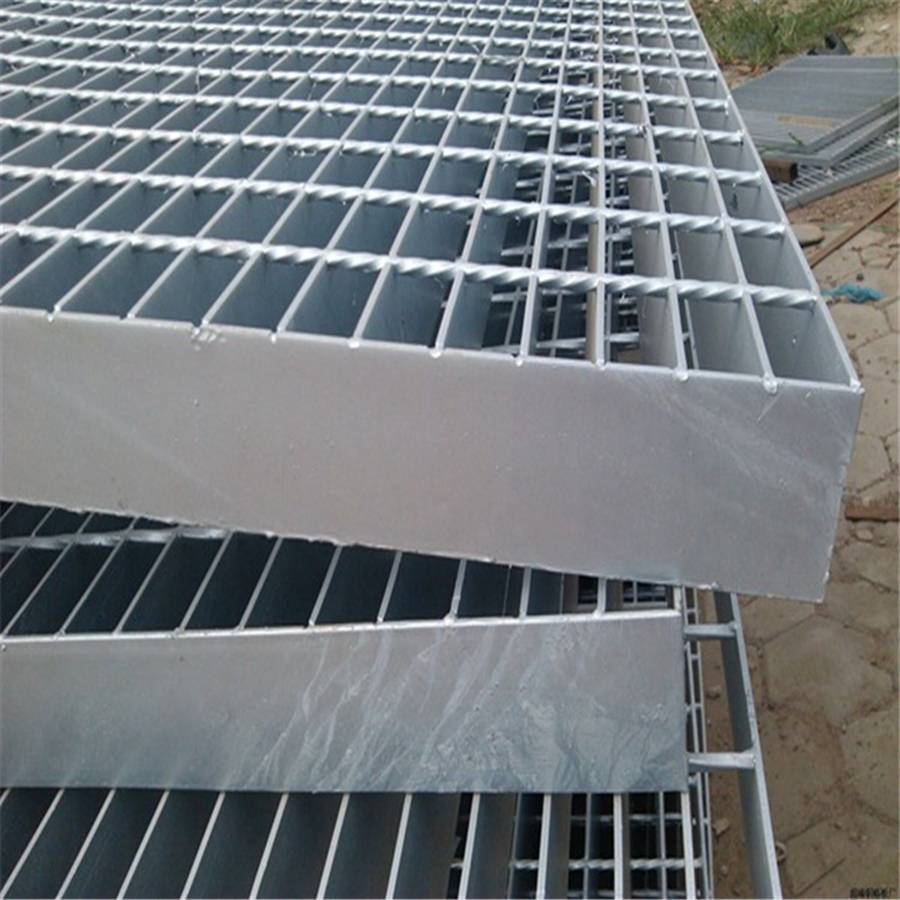
How much does carbon steel dovetail grating cost per square meter?
As a broad factory budgeting reference, bare standard-duty dovetail grating may cost approximately US$40–75/m², painted grating approximately US$48–90/m², hot-dip galvanized grating approximately US$60–120/m², and close-mesh or heavy-duty panels approximately US$65–180/m². Custom framed, vehicle-rated, or heavily fabricated panels can exceed US$260/m². The actual price depends on bar size, mesh, weight, quantity, finish, fabrication, packing, and delivery.
Is dovetail pressure-locked grating stronger than welded grating?
Neither type is universally stronger. Welded grating often has a cost and load-table advantage for heavy industrial applications, while dovetail grating provides a clean mechanically locked panel and can be designed for substantial loads. The correct comparison must use the exact bearing bar, mesh, span, support condition, connection, and allowable deflection from the manufacturer’s engineering data.
What information does a factory need to quote dovetail grating accurately?
Provide the steel grade, dovetail or DT profile, bearing bar height and thickness, bearing bar pitch, cross bar profile and spacing, plain or serrated surface, panel dimensions, quantity, clear span, load type, deflection limit, cutouts, banding, frames, finish, certificates, packaging, and delivery terms. A dimensioned panel schedule or marked-up layout gives the factory the best basis for a complete quotation.