
Steel grating panels are factory-made open flooring units used for platforms, walkways, catwalks, mezzanines, trench covers, stair landings, equipment decks, and industrial access systems. The factory price is based on the bearing bar size, mesh spacing, panel dimensions, steel weight, load rating, surface finish, fabrication, quantity, packaging, and delivery terms. This guide explains the main steel grating panel types, standard sizes, weight calculations, load requirements, and practical ways to compare factory quotations.
Steel grating panels are assemblies of parallel bearing bars connected by cross bars. The bearing bars run in the primary load-bearing direction and must span between structural supports. Cross bars hold the bearing bars at the specified spacing and give the panel stability.
The open construction allows water, oil, dust, snow, light, and air to pass through the floor. Compared with solid steel plate, an open grating panel normally weighs less and provides better drainage and ventilation. It also allows workers to see equipment, pipes, and structures below the platform.
Steel grating panels can be supplied in carbon steel, hot-dip galvanized steel, 304 stainless steel, 316 stainless steel, or other project-approved grades. Plain surfaces are common in dry indoor areas, while serrated surfaces are preferred where oil, rainwater, mud, ice, or process liquid may reduce traction.
| Panel Component | Purpose | Common Options |
|---|---|---|
| Bearing bars | Carry the principal bending load | 25 × 3 mm, 30 × 3 mm, 32 × 5 mm, 40 × 5 mm, 50 × 5 mm |
| Cross bars | Connect and stabilize the bearing bars | Twisted square bar, round bar, or flat bar |
| Banding bars | Close and reinforce exposed or cut edges | Flat bar, matching bearing bar, or load-carrying band |
| Toe plates | Reduce the risk of tools and objects falling from an elevated platform | Steel plate or angle, often around 100 mm high |
| Frames and supports | Provide bearing ledges and perimeter restraint | Angle, channel, flat bar, or structural steel frame |
Welded grating panels are made by placing cross bars over the bearing bars and welding them at each intersection. Resistance welding produces a rigid, repeatable panel and is the most common production method for industrial flooring.
Welded panels are available in standard-duty and heavy-duty forms. They can use plain or serrated bearing bars, twisted square cross bars, round cross bars, or flat cross bars. Because welded grating is widely used, load tables and installation accessories are readily available.
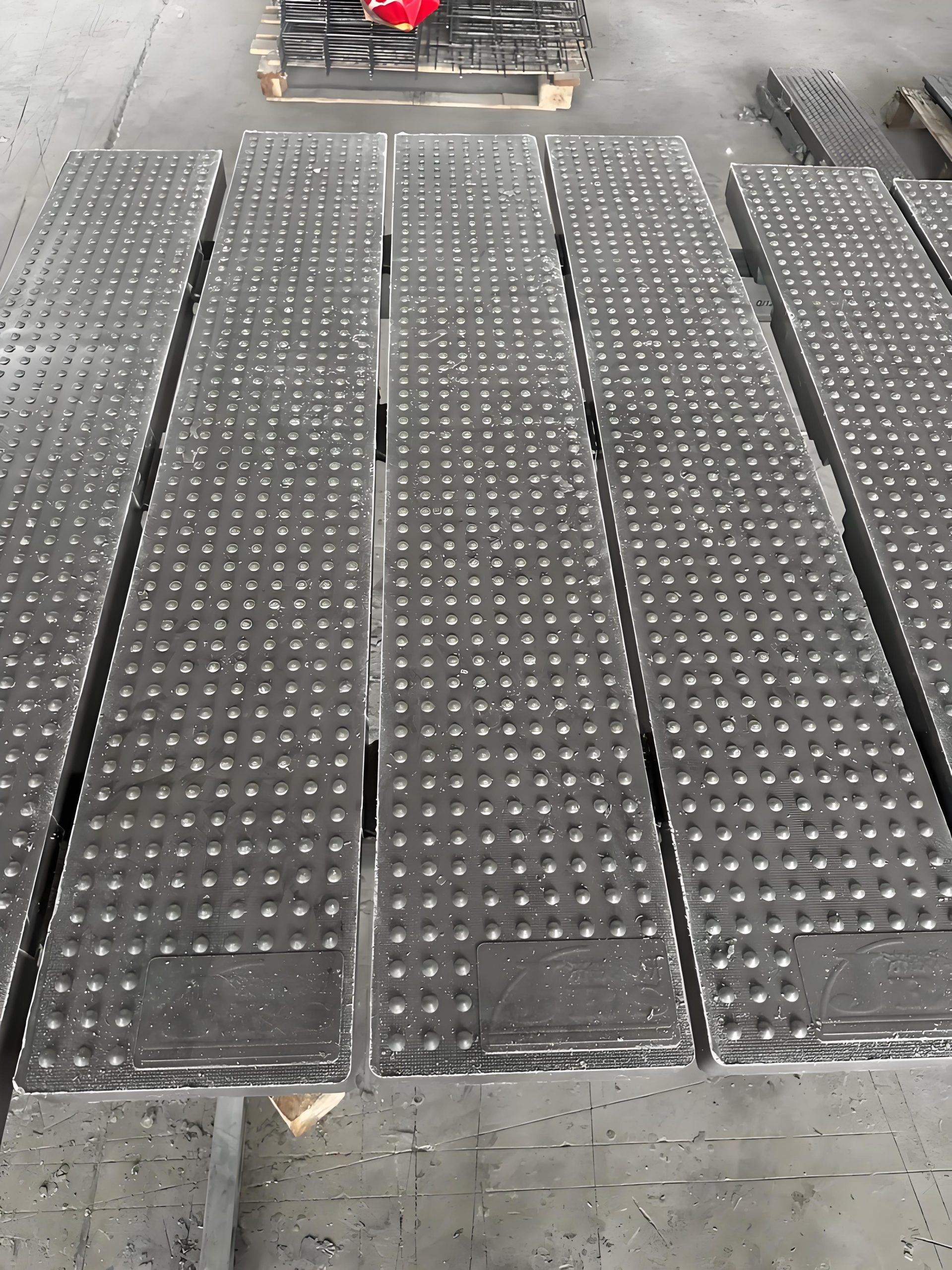
Press-locked grating is made by inserting cross bars into pre-punched bearing bars and pressing the assembly together. It has a neat, uniform appearance and can be useful for architectural floors, ventilation panels, platforms, and close-mesh areas.
Press-locked grating does not have exactly the same connection behavior as welded grating. The supplier should provide load information for the exact press-locked profile, bearing bar, span, and support condition.
Riveted grating uses rivets or forged connections to join the bearing bars and cross bars. It can be selected for heavy industrial service, vibration, repeated dynamic loads, or projects that specifically require riveted construction.
Riveted panels normally involve more labor and specialized equipment than standard welded panels. Their unit price may be higher, especially for short production runs, custom widths, or extensive edge fabrication.
Heavy-duty grating uses deeper or thicker bearing bars, closer support spacing, reinforced edges, or special profiles to handle higher uniform loads, point loads, wheel loads, and equipment loads. Some projects use I-bar or reinforced bearing bars to achieve greater stiffness without using a solid steel plate.
| Panel Type | Main Advantage | Typical Price Position |
|---|---|---|
| Welded standard-duty | Efficient production and broad availability | Lowest for most industrial orders |
| Press-locked | Clean appearance and regular pattern | Medium to high, depending on tooling |
| Riveted | Suitable for vibration and demanding service | Higher labor cost |
| Heavy-duty welded or riveted | Higher stiffness and concentrated-load capacity | Highest among carbon steel panels |
There is no single universal panel size because factories use different welding machines, press-locking equipment, steel widths, and export formats. However, the following dimensions are common starting points for industrial projects.
| Typical Panel Width | Typical Panel Length | Common Application |
|---|---|---|
| 300 mm | 1,000–3,000 mm | Narrow access strips, trench edges, and equipment gaps |
| 500 mm | 2,000–6,000 mm | Compact walkways and removable covers |
| 600 mm | 2,000–6,000 mm | Single-person maintenance routes |
| 750 mm | 3,000–6,000 mm | Pipe racks and industrial catwalks |
| 900 mm | 3,000–6,000 mm | General maintenance platforms |
| 1,000 mm | 3,000–6,000 mm | Common platform and mezzanine panels |
| 1,200 mm | 3,000–6,000 mm | Wide walkways, ramps, and bridge sections |
Common production lengths include 2,000, 3,000, 4,000, 5,800, and 6,000 mm. Imperial stock panels may be close to 3 × 20 ft, 3 × 24 ft, 4 × 20 ft, or 4 × 24 ft. The actual size should be confirmed with the factory because banding, bar count, and tolerances affect the finished width.
Stock panels are usually less expensive and faster to ship than fully custom panels. However, choosing a stock size that creates many field cuts or unsupported joints can increase the total installed cost. Good panel layout uses standard sizes while keeping joints over structural supports.
Bearing bar dimensions are among the most important factors in both price and structural performance. A deeper bar generally provides greater bending stiffness. A thicker bar increases material weight and improves resistance to local damage or concentrated loads.
| Typical Bearing Bar | General Service Position | Possible Application |
|---|---|---|
| 25 × 3 mm | Light-duty and short-span | Indoor walkways and light access panels |
| 30 × 3 mm | Standard-duty | Platforms, catwalks, and general factory flooring |
| 30 × 5 mm | Medium-duty | Longer spans and maintenance equipment areas |
| 32 × 5 mm | Medium to heavy-duty | Ramps, equipment platforms, and mezzanines |
| 40 × 5 mm | Heavy-duty | Industrial decks, traffic areas, and high point loads |
| 50 × 5 mm | Very heavy-duty | Long spans, vehicle access, and demanding equipment loads |
Bearing bar pitch is the center-to-center distance between adjacent bars. Common metric pitches include 19, 25, 30, and 40 mm. Imperial designations such as 11W4 and 19W4 are also widely used. A closer pitch places more bearing bars beneath the load and reduces the opening, but it increases steel consumption and price.
For example, 19W4 uses bearing bars at approximately 30 mm centers and cross bars at approximately 100 mm centers. 11W4 uses a much closer bearing bar spacing of approximately 17.5 mm and is often selected where small wheels, heels, or dropped tools must be retained.
Additional information about bar height, thickness, pitch, panel dimensions, and tolerances is available in this steel bar grating dimensions guide.
Cross bar spacing affects panel stability, visual appearance, drainage, and the ability to retain small objects. Common cross bar spacings include 50, 75, and 100 mm.
| Mesh Pattern | Approximate Spacing | General Characteristics |
|---|---|---|
| 11W4 | Approximately 17.5 mm bearing bar pitch × 100 mm cross bar pitch | Close mesh for pedestrian safety and small wheels |
| 19W4 | Approximately 30 mm × 100 mm | Common industrial platform pattern |
| 19W2 | Approximately 30 mm × 50 mm | Closer cross bars and improved object retention |
| 30 × 100 mm | Metric general-purpose mesh | Good drainage and moderate material use |
| 30 × 50 mm | Metric close cross-bar mesh | Better support for small carts and tools |
| 40 × 100 mm | More open metric mesh | High drainage and ventilation with lower cross-bar consumption |
Open area is the percentage of the panel that consists of openings instead of steel. A higher open area reduces weight and improves drainage, ventilation, light transmission, and visibility below the floor. A smaller open area improves heel safety and small-wheel support but usually requires more steel.
The clear opening should be measured rather than inferred from the nominal pitch. For welded and press-locked grating, pitch is normally measured center-to-center. The clear opening is the pitch minus the bearing bar thickness. Riveted grating may use a different spacing convention, so the supplier drawing should state both nominal spacing and clear opening.
Steel grating panel weight is a major component of the factory price. It affects the cost of raw steel, welding, galvanizing, lifting, packaging, container loading, and freight.
A preliminary estimate for the bearing bar portion can be made with:
Bearing-bar weight approximately equals 7.85 × bar height × bar thickness ÷ bearing-bar pitch.
When height, thickness, and pitch are entered in millimeters, the result is approximately kilograms per square meter for the bearing bars. Cross bars, banding, zinc, and tolerances must then be added.
| Bearing Bar Example | Approximate Grating Weight Range | General Cost Effect |
|---|---|---|
| 25 × 3 mm | Approximately 20–28 kg/m² | Lower material and handling cost |
| 30 × 3 mm | Approximately 24–32 kg/m² | Common standard-duty cost position |
| 32 × 5 mm | Approximately 38–50 kg/m² | Higher steel use and stronger panel |
| 40 × 5 mm | Approximately 48–62 kg/m² | Heavy-duty material and shipping cost |
| 50 × 5 mm | Approximately 60–78 kg/m² | High material, galvanizing, and lifting cost |
These are planning ranges rather than certified weights. The actual value changes with cross bar diameter, mesh pitch, panel width, banding, serration, and manufacturing tolerances. The supplier should provide a net and gross weight on the approved packing list.
Material yield also affects the price. Standard rectangular panels use steel efficiently, while narrow strips, angled sections, pipe openings, columns, curved edges, and numerous small cutouts produce more scrap. A factory may need to charge for the full raw panel even when the customer receives only the net cut area.
Steel grating panel capacity is controlled mainly by the bearing bars and the distance between supports. Panel width alone does not determine capacity.
Important design inputs include:
Clear span is the unsupported distance between supports under the bearing bars. It is not necessarily the total panel length. A 6,000 mm-long panel can have several intermediate beams and a clear span of only 1,000 mm. A shorter panel may need much deeper bearing bars if it bridges a large opening.
| Load Condition | Example | Grating Design Concern |
|---|---|---|
| Pedestrian load | Workers distributed across the panel | Deflection, vibration, and opening safety |
| Concentrated foot load | One person standing in an unfavorable location | Local panel bending and opening response |
| Equipment point load | Motor, pump, valve, or support foot | Local reinforcement and support arrangement |
| Cart or trolley load | Small wheels carrying tools or components | Clear opening, wheel spacing, and point load |
| Forklift load | Forklift wheel and pallet loads | Heavy-duty bars, impact, and wheel-path design |
| Vehicle load | Service vehicle on a bridge or deck | Vehicle load class, fatigue, framing, and verified calculations |
A supplier load table should identify the exact bearing bar size, pitch, panel type, span, support condition, and load type. A table for welded 19W4 grating should not automatically be applied to press-locked, riveted, close-mesh, or heavy-duty panels with different geometry.
Plain grating has smooth bearing bar tops, while serrated grating has notched or toothed tops. Serration improves traction when water, oil, mud, ice, or process residue is present.
| Feature | Plain Panel | Serrated Panel |
|---|---|---|
| Surface | Smooth bearing bar top | Notched or toothed bearing bar top |
| Slip resistance | Suitable for dry and controlled areas | Better for wet, oily, outdoor, and contaminated areas |
| Cleaning | Usually easier to sweep and wash | Serrations may retain more dirt |
| Price | Lower for the same bar and mesh | Higher due to serration processing |
| Typical use | Warehouses, indoor platforms, dry mezzanines | Refineries, ramps, wastewater plants, stairs, and outdoor decks |
Serrated grating is not automatically slip-proof. Footwear, contamination, drainage, slope, lighting, and housekeeping also affect safety. If a project requires a particular anti-slip test or classification, that requirement should be written into the purchase specification.
| Material | Advantages | Typical Environment | Price Position |
|---|---|---|---|
| Carbon steel, mill finish | High strength and lowest initial material cost | Indoor or protected structures | Lowest |
| Painted carbon steel | Color selection and basic corrosion protection | Indoor and moderate industrial service | Low to medium |
| Hot-dip galvanized steel | Zinc protection on fabricated surfaces | Outdoor platforms, walkways, and humid plants | Medium |
| 304 stainless steel | Good general corrosion resistance and clean appearance | Food processing and clean industrial areas | High |
| 316/316L stainless steel | Improved resistance to chlorides and aggressive chemicals | Marine, coastal, chemical, and wastewater facilities | Highest |
Carbon steel grades may include ASTM A36, Q235B, S235JR, or another project-approved equivalent. The exact grade should be stated in the purchase order together with the required mill certificate and mechanical properties.
Steel grating factories commonly quote by square meter for project flooring, by panel for stock or cut-to-size units, and by metric ton for high-volume orders. Linear-meter pricing may be used for narrow walkway strips or stair treads.
| Quotation Basis | Best Use | What to Confirm |
|---|---|---|
| Per square meter | Flooring, platforms, and project quantities | Gross area or net finished area |
| Per panel | Standard 1,000 × 6,000 mm or similar panels | Exact area, weight, mesh, and included fabrication |
| Per metric ton | Large orders and repeat production | Steel weight basis, zinc, labor, packing, and wastage |
| Per linear meter | Narrow strips, stair treads, and trench covers | Finished width and edge treatment |
The following ranges are broad EXW or FOB budgeting references for standard carbon steel grating panels. They are not fixed offers. Steel and zinc prices, order size, production location, freight, and exchange rates can change the final quotation.
| Panel Type | Indicative Factory Price | Typical Conditions |
|---|---|---|
| Mill-finish carbon steel, standard-duty | Approximately US$30–65/m² | Standard welded panels and regular production quantity |
| Plain hot-dip galvanized grating | Approximately US$45–95/m² | Post-fabrication galvanizing and standard panel sizes |
| Serrated galvanized grating | Approximately US$55–115/m² | Serration, banding, and standard industrial fabrication |
| Heavy-duty galvanized grating | Approximately US$80–170/m² | Thicker bearing bars and higher load requirements |
| Custom framed or vehicle-rated panels | Approximately US$110–280+/m² | Wheel loads, cutouts, frames, tests, and special fabrication |
| 304 stainless steel panels | Approximately US$130–260/m² | Depending on mesh, surface, and finishing |
| 316/316L stainless steel panels | Approximately US$180–360+/m² | Severe corrosion environments and custom finishing |
A 1,000 × 6,000 mm panel has approximately 6 m² of area. At US$45–95/m², a standard galvanized panel may be approximately US$270–570 before accessories, packaging, and freight. A heavy-duty panel priced at US$80–170/m² may be approximately US$480–1,020 per panel.
For a ton-based comparison, divide the square-meter price by the net weight in metric tons per square meter. For example, a 45 kg/m² panel priced at US$80/m² has an approximate equivalent of US$1,780 per metric ton. This calculation is for comparing quotations only and does not replace the factory’s actual weight-based offer.
For additional information on factory pricing units and project-ready costs, buyers can review this steel grating prices and manufacturers guide.
Steel weight is usually the strongest direct price factor. Larger bearing bars, closer bearing bar spacing, closer cross bars, thicker banding, and reinforced frames all increase material consumption.
| Specification Change | Effect on Performance | Effect on Price |
|---|---|---|
| Increase bearing bar height | Improves stiffness and span capability | Increases steel weight and fabrication cost |
| Increase bearing bar thickness | Improves resistance to point loads and damage | Increases steel consumption and welding time |
| Reduce bearing bar pitch | Smaller openings and more bars sharing the load | Increases weight per square meter |
| Reduce cross bar spacing | Improves stability and object retention | Increases cross bar material and assembly time |
| Use serrated bars | Improves traction | Adds serration processing cost |
| Increase load rating | Allows greater span or heavier equipment | Usually requires heavier bars or closer supports |
| Add banding or framing | Improves edge rigidity and installation fit | Adds steel, welding, grinding, and coating work |
There is often a more economical way to meet a load requirement than simply choosing the heaviest panel. Adding an intermediate support beam, reducing clear span, changing the bearing direction, or using a closer mesh may reduce the total installed cost. These changes should be approved by the project engineer.
Standard rectangular panels are the most efficient to manufacture. Custom shapes require additional programming, layout, cutting, deburring, marking, sorting, and inspection.
Straight cuts are usually the least expensive custom operation. The factory should state whether cut ends are supplied with banding, whether the cut edge is deburred, and whether the zinc coating is repaired after cutting.
Cutouts around columns, pipes, drains, cable trays, tanks, motors, and valves should be shown on a dimensioned drawing. The drawing should identify the cutout location from two panel edges, the opening dimensions, corner radius, and required edge reinforcement.
Banding closes the ends of cut bearing bars and creates a stronger, cleaner panel edge. A load-carrying band may be required around a large opening or where the cut edge bears on a support. Banding does not replace the structural beam required beneath a large opening.
Angled panels, curved sections, hinged covers, removable access panels, perimeter frames, toe plates, lifting handles, bolt holes, and clips all add fabrication time. Stainless steel and heavy galvanized panels may require additional grinding, cleaning, passivation, or coating repair after fabrication.
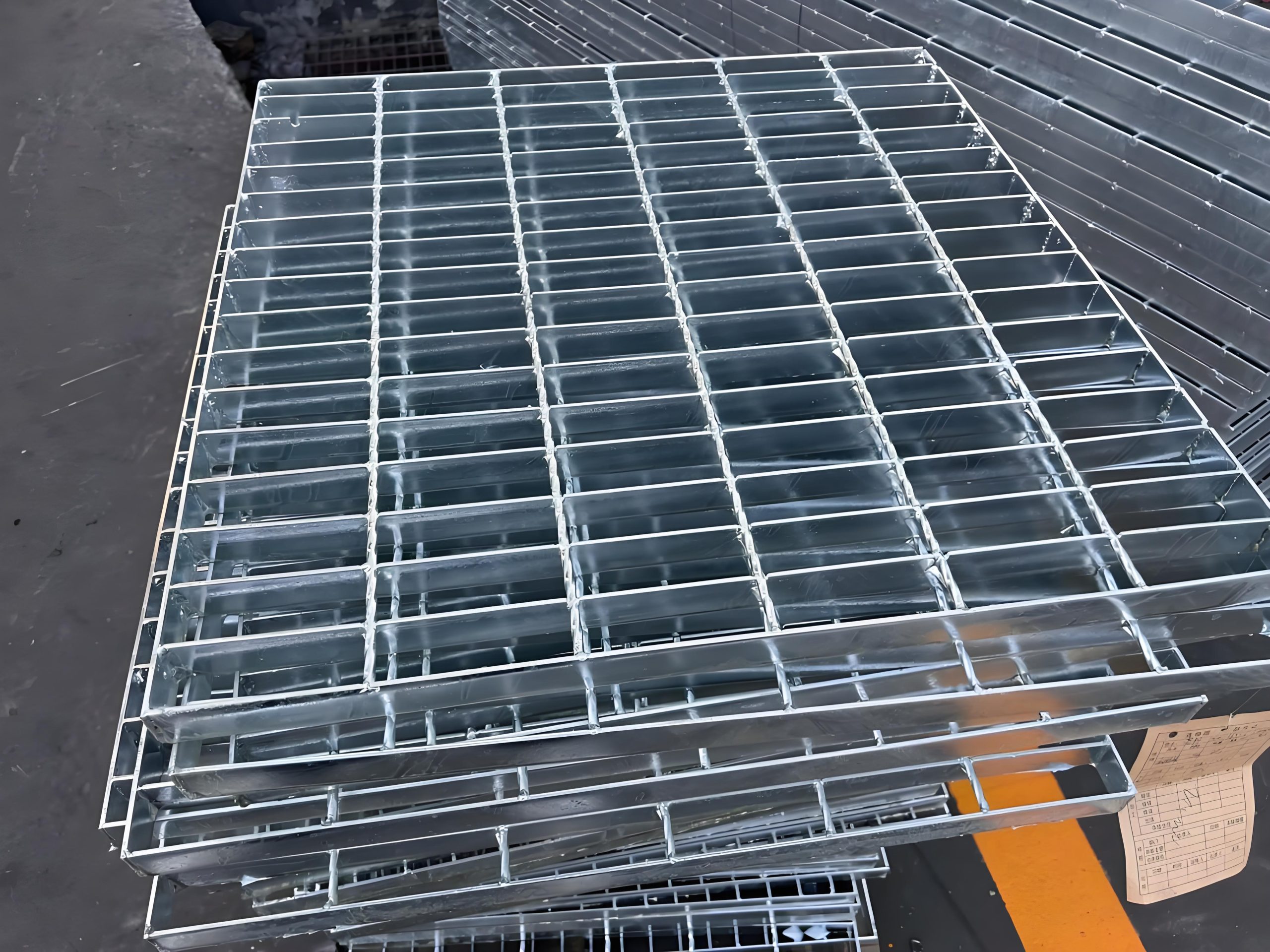
Post-fabrication hot-dip galvanizing is normally performed after the panel has been welded, cut, banded, and inspected. This allows the main bars, cross bars, welds, and many fabricated edges to receive zinc protection together.
The galvanizing charge includes zinc consumption, transport to the galvanizing plant, bath processing, handling, cleaning, inspection, and possible repair. Project specifications may reference ASTM A123/A123M, ISO 1461, or another local standard. The required coating should be confirmed according to the steel thickness and exposure environment.
More information about galvanizing sequence, coating, and service conditions is available in this hot-dip galvanized steel grating guide.
Paint or powder coating may be selected for indoor service, color matching, or additional protection over galvanized steel. The price depends on surface preparation, primer, number of coats, film thickness, color, curing, and inspection.
Grating panels are usually bundled with steel straps and placed on pallets or skids. Export orders may need timber crates, separators, edge protection, moisture-resistant wrapping, bundle labels, and lifting points. Heavy-duty panels can require stronger skids and special container loading plans.
The supplier should provide package dimensions, gross weight, number of bundles, loading method, estimated lead time, and delivery terms. Freight is affected by both the panel weight and the amount of space occupied by the bundles.
Every quotation should be checked against the same technical and commercial assumptions. A price comparison based only on the word “steel grating panel” is not reliable because two panels can have very different weights and load capacities.
| Comparison Item | Information to Confirm |
|---|---|
| Material | Carbon steel grade, galvanized steel, 304, 316, or another approved material |
| Manufacturing method | Welded, press-locked, riveted, or heavy-duty construction |
| Bearing bars | Height, thickness, pitch, tolerance, and bearing direction |
| Cross bars | Type, size, spacing, and connection method |
| Surface | Plain or serrated, mill finish, painted, galvanized, or polished |
| Panel dimensions | Overall length, width, squareness, flatness, and quantity |
| Load requirement | Uniform, point, wheel, equipment, impact, and deflection criteria |
| Fabrication | Cutouts, notches, banding, frames, toe plates, holes, and hinges |
| Accessories | Clips, bolts, support angles, lifting handles, and replacement coating materials |
| Documents | Material certificates, inspection reports, load tables, and coating records |
| Commercial terms | MOQ, lead time, quotation validity, packing, Incoterm, and freight |
A panel schedule or marked-up layout helps the factory calculate the correct quantity, cutting plan, weight, and packing arrangement. It should show panel numbers, finished dimensions, bearing bar direction, openings, support locations, edge treatment, and accessories.
When the quote is for a heavy-duty or vehicle-rated panel, request a load table or project-specific calculation. When it is for galvanized material, request the coating standard and inspection method. When it is for custom panels, ask for a drawing before production so the panel count, dimensions, and price can be verified.
How much do steel grating panels cost from a factory?
As a broad 2026 factory budgeting range, mill-finish carbon steel panels may cost approximately US$30–65/m², standard hot-dip galvanized panels approximately US$45–95/m², serrated galvanized panels approximately US$55–115/m², and heavy-duty or vehicle-rated panels approximately US$80–280+/m². Stainless steel panels are generally more expensive. Exact pricing depends on weight, mesh, quantity, fabrication, packing, and delivery.
What is the standard size of a steel grating panel?
Common factory formats include widths of 500, 600, 750, 900, 1,000, and 1,200 mm with lengths of 3,000 to 6,000 mm. Imperial panels may be close to 3 × 20 ft or 4 × 24 ft. Stock sizes vary by factory, and custom panels are often produced for cutouts, supports, stair areas, platforms, and irregular layouts.
How do I choose the correct steel grating panel for a load?
Define the clear span, bearing direction, support width, uniform load, point load, wheel load, equipment load, and allowable deflection. Then select the bearing bar height, thickness, pitch, and mesh from the manufacturer’s load table or an engineering calculation. Panel width alone cannot determine load capacity.
