

Galvanized walkway plank grating is a formed steel walking surface used for industrial platforms, catwalks, ramps, maintenance routes, stairs, bridges, rooftops, water-treatment plants, power facilities, warehouses, and outdoor access areas. Unlike conventional welded bar grating, plank grating is normally punched and formed from a single steel sheet into a channel profile. The formed side channels add stiffness while the open or textured walking surface provides traction and drainage. Factory price depends on plank width, channel depth, steel gauge, surface pattern, galvanizing method, load span, cut length, accessories, quantity, packing, and delivery terms.
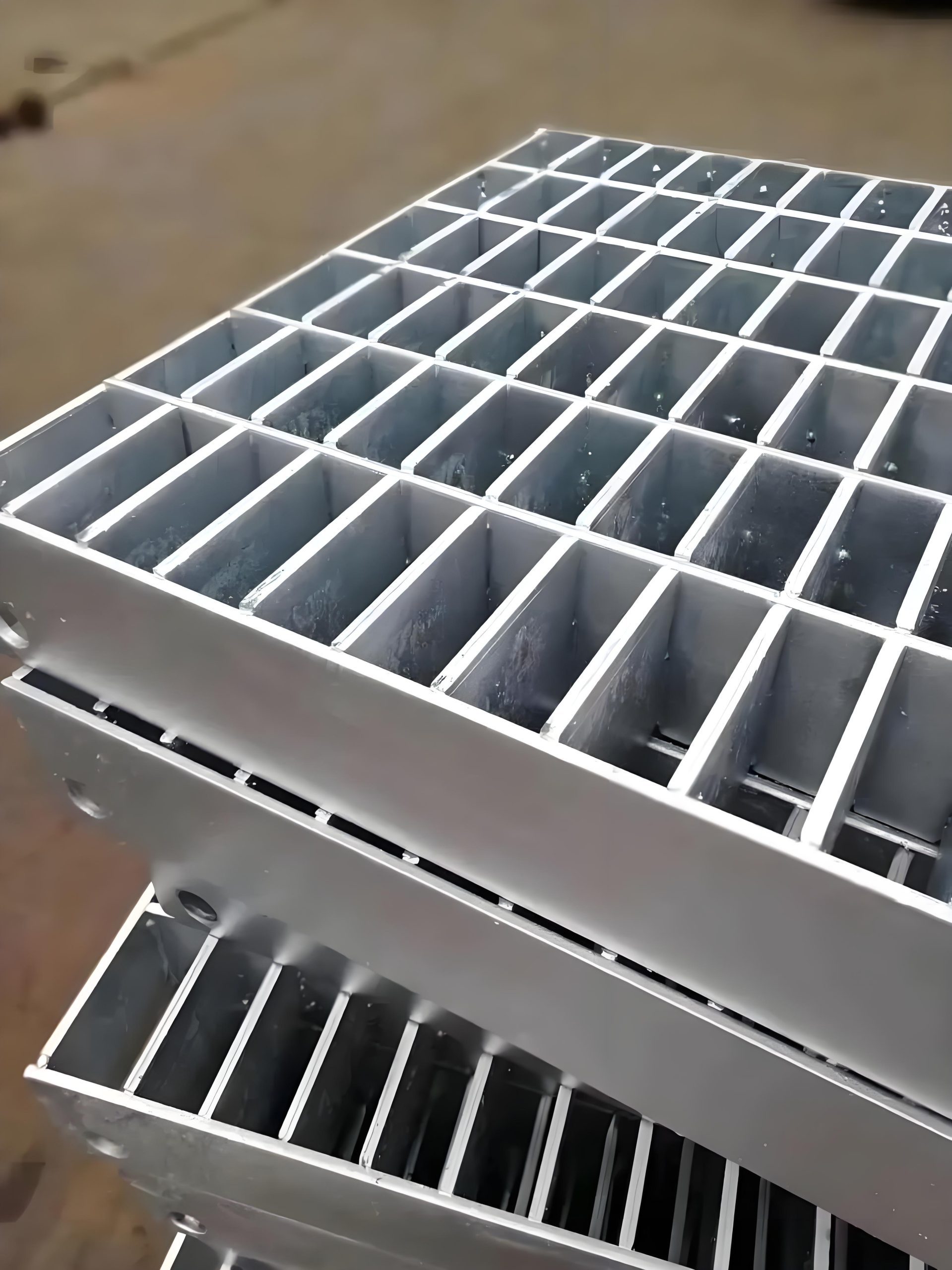
Galvanized walkway plank grating is a metal safety plank made from carbon steel sheet that has been punched, formed, and protected by a zinc coating. The sheet is usually cold-formed into a channel shape, creating side walls that improve stiffness. The top surface may have serrated diamond openings, perforated raised buttons, slots, mesh openings, or a more solid anti-slip pattern.
The galvanized coating helps protect the carbon steel from corrosion in outdoor, wet, humid, and general industrial environments. Galvanized walkway plank grating is commonly used where the project needs a lighter formed plank profile with good traction, open drainage, and fast installation.
Compared with solid checker plate, plank grating can reduce water accumulation and provide better traction. Compared with conventional bar grating, it can provide a lighter channel-style product with a formed anti-slip surface. The right selection depends on the required span, load, opening pattern, corrosion environment, and foot-traffic condition.
Channel plank grating and traditional bar grating are both used for industrial walking surfaces, but they have different structures and selection methods.
Traditional bar grating is made from bearing bars and cross bars. The bearing bars carry the primary load between supports, while cross bars hold the panel together. Channel plank grating is made from a continuous metal sheet formed into a channel, with the side walls providing structural depth.
| Feature | Channel Plank Grating | Traditional Bar Grating |
|---|---|---|
| Construction | Punched and formed one-piece steel channel | Welded, press-locked, swage-locked, or riveted bars |
| Main Stiffening Feature | Formed side channels and profile depth | Vertical bearing bar depth and thickness |
| Walking Surface | Serrated diamonds, raised buttons, slots, perforations, or formed texture | Plain or serrated bearing bar tops with open mesh |
| Common Widths | Individual plank widths combined side by side | Large panels cut to project dimensions |
| Drainage | Depends on opening pattern and surface design | Usually high open area with standard mesh |
| Typical Uses | Catwalks, ramps, narrow access paths, safety stairs, maintenance routes | Platforms, wide walkways, trenches, floors, stairs, industrial covers |
| Price Basis | Width, channel depth, gauge, length, surface pattern, fabrication | Weight, bearing bar size, spacing, panel size, fabrication, finish |
Channel plank grating is useful when a project needs self-framing planks, compact handling, aggressive traction, or a formed sheet profile. Traditional bar grating is often preferred for wider industrial platforms, heavy loads, long spans, or projects requiring a broad range of bearing bar sizes and mesh patterns.
The top surface of galvanized walkway plank grating affects traction, drainage, debris shedding, foot comfort, and price. The best pattern depends on whether the area is wet, oily, muddy, exposed to snow, used by pedestrians, or subject to small-wheel traffic.
Serrated diamond plank grating uses diamond-shaped openings with raised serrated edges. The aggressive surface provides many gripping points under work boots and can help improve traction in wet, oily, muddy, icy, or outdoor conditions.
Diamond plank grating is commonly selected for refinery access, wastewater plants, outdoor stairs, roof platforms, equipment walkways, maintenance bridges, and industrial catwalks. Its larger openings generally provide good drainage and debris-shedding performance.
Perforated-button plank grating uses closely spaced punched and raised buttons. The button pattern provides multi-directional traction while maintaining smaller openings than diamond safety plank. This makes it useful for pedestrian walkways, ramps, commercial access areas, stairs, and locations where smaller-object retention is important.
Perforated-button planks can be more comfortable for regular foot traffic and may be better suited to some ramp or pedestrian applications. Their smaller open area can reduce debris fall-through, but it may also require more cleaning in leaf-heavy or sediment-heavy areas.
Some formed walkway planks use a more solid surface with anti-slip embossing, tread patterns, slots, or limited perforations. These are useful where high drainage is not the main requirement but a formed, stiff, anti-slip steel surface is needed.
Solid-plank surfaces may retain more water and debris than open diamond or perforated grating. They should be used only where drainage is not critical or where the project includes another water-management method.
| Surface Option | Main Benefit | Typical Application |
|---|---|---|
| Serrated Diamond Openings | Aggressive traction, strong drainage, good debris shedding | Outdoor catwalks, wet stairs, industrial platforms, oil and wastewater areas |
| Perforated Raised Buttons | Multi-directional grip and smaller openings | Ramps, pedestrian access, stairs, commercial and industrial walkways |
| Slotted or Perforated Surface | Controlled drainage with a cleaner appearance | Equipment platforms, pedestrian routes, selected drainage areas |
| Solid or Low-Open-Area Plank | Continuous walking surface with formed stiffness | Dry service routes, protected access areas, selected equipment floors |
Galvanized walkway plank grating is supplied in a range of standard widths, channel depths, gauges, and stock lengths. Available dimensions vary by surface pattern and factory production range, so buyers should confirm the exact profile before ordering.
Diamond-pattern safety plank grating is commonly supplied in nominal widths such as 4-3/4 in., 7 in., 9-1/2 in., 11-3/4 in., 18-3/4 in., and 24 in. Wider walkway surfaces are created by placing several planks side by side.
Perforated-button walkway planks are commonly supplied in widths such as 7 in., 10 in., and 12 in. These widths are often used for access routes, ramps, stair tread blanks, and walkway systems that require smaller perforated openings.
Common channel depths include 1-1/2 in., 2 in., 2-1/2 in., and 3 in. A deeper channel profile generally provides greater stiffness and may allow a longer support span or higher load, provided the steel gauge and installation condition are also suitable.
Common carbon steel gauges for formed walkway plank grating include 11 gauge, 12 gauge, 13 gauge, and 14 gauge depending on the plank style and required strength. Heavier gauge steel provides more material thickness and stiffness but also increases product weight, galvanizing cost, freight cost, and unit price.
| Plank Dimension or Feature | Common Range | Selection Effect |
|---|---|---|
| Diamond Plank Width | 4-3/4 in. to 24 in. | Wider planks create faster walkway coverage but use more steel per linear meter |
| Perforated-Button Plank Width | 7 in., 10 in., 12 in. | Useful for ramps, stairs, and pedestrian walkway systems |
| Channel Depth | 1-1/2 in. to 3 in. | Greater depth generally improves stiffness and load capacity |
| Steel Gauge | 11 gauge to 14 gauge | Heavier gauge increases strength, weight, and price |
| Stock Length | Often 10 ft or 12 ft | Standard lengths can reduce waste and fabrication cost |
Actual availability may vary. A wide diamond plank may not be available in every channel depth or gauge, and certain surface patterns may have different standard stock lengths. The final selection should be checked against the required load span and factory production drawing.
One of the main reasons to use walkway plank grating is its ability to reduce water and debris accumulation. The surface openings allow rainwater, washdown water, snow, mud, dust, and small debris to pass through instead of remaining on the walking line.
Open-area performance depends on the plank pattern. Serrated diamond planks generally provide more open drainage than perforated-button planks. Perforated-button surfaces provide smaller openings and better small-object retention, but they may require more frequent cleaning where leaves, sediment, food waste, or process residue are common.
For outdoor walkways, water-treatment plants, drainage areas, roofs, bridges, and exposed catwalks, open serrated plank grating is often preferred. For ramps, pedestrian areas, and areas where dropped tools or small parts are a concern, a smaller perforated-button pattern may be more suitable.
Walkway plank load capacity depends on the plank width, channel depth, steel gauge, surface pattern, clear support span, support direction, fastening method, and allowable deflection limit. The same plank can carry a much higher load over a short span than over a long span.
The formed channel sides provide the main stiffness. In a typical installation, the long direction of the plank spans between support beams. Installing the plank in the wrong direction can significantly reduce its load capacity.
A wider or deeper plank may look stronger, but its actual capacity depends on the complete profile and gauge. A 2 in. deep 12 gauge plank may perform differently from a 2 in. deep 14 gauge plank, even if both have the same width. Surface openings also affect the section properties and should be included in the manufacturer’s load table.
For long spans, it may be more economical to add intermediate support beams than to select a much deeper or heavier gauge plank for the full walkway length. The final choice should be based on the applicable factory load table or a project-specific structural check.
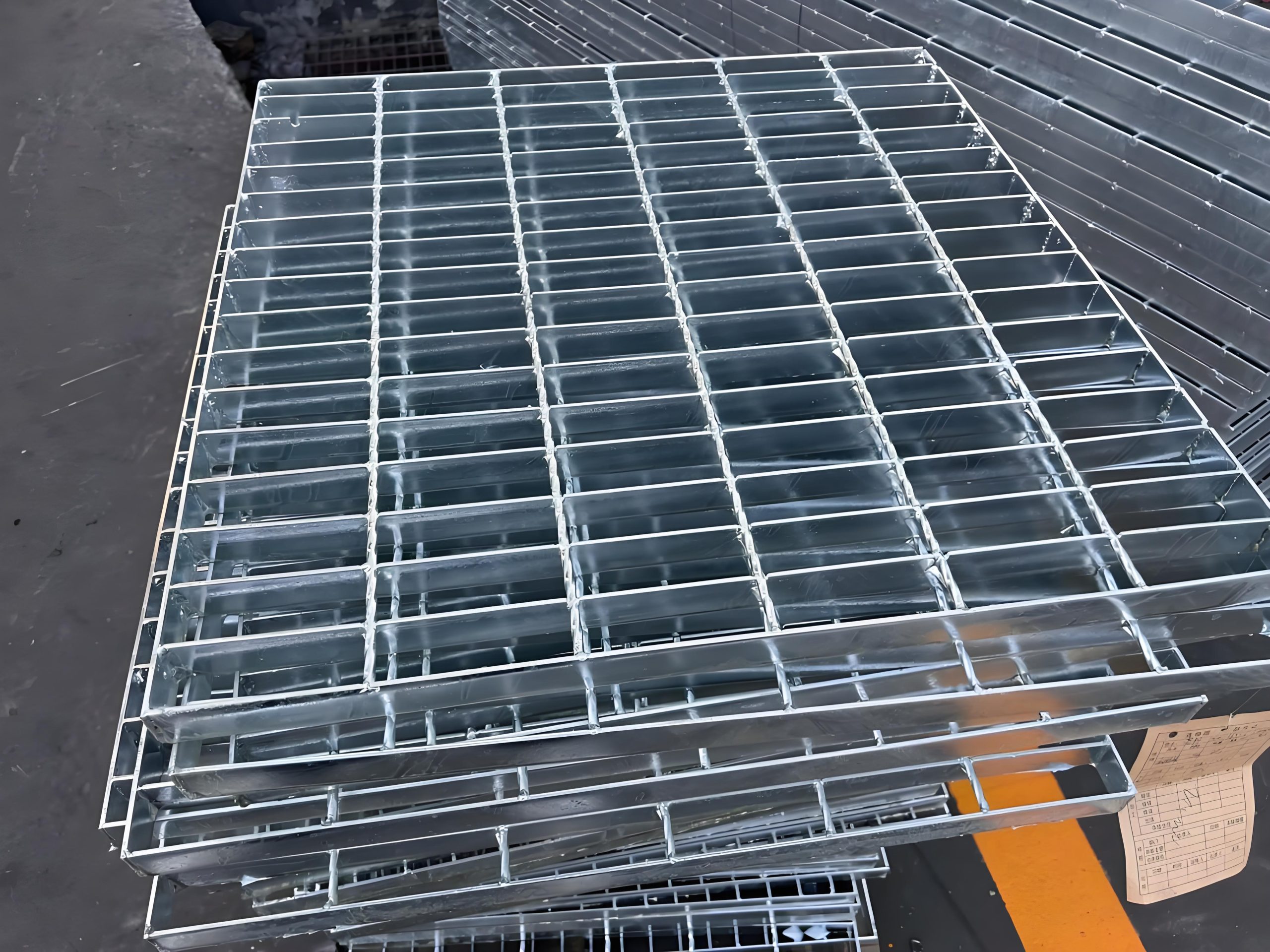
Galvanized walkway plank grating can be made from pre-galvanized steel sheet or from carbon steel that is hot-dip galvanized after punching, forming, cutting, and fabrication. These two methods provide different corrosion protection and different price structures.
Pre-galvanized steel is zinc-coated sheet steel supplied before the plank is punched and formed. It can be an economical choice for standard formed planks because the base sheet already has zinc protection before manufacturing.
However, punching, cutting, welding, drilling, and fabrication can create edges or areas that require attention depending on the process and exposure environment. Pre-galvanized plank grating may be suitable for many general industrial applications, but the final corrosion requirement should be reviewed before selection.
Post-fabrication hot-dip galvanizing is completed after the carbon steel plank has been punched, formed, cut, welded, fitted with closures, drilled, and fabricated. This process coats many exposed edges, welds, cut ends, and added components together.
For outdoor, wet, humid, or demanding industrial environments, post-fabrication galvanizing is often preferred because it protects the completed product rather than only the original steel sheet.
| Feature | Pre-Galvanized Steel | Post-Fabrication Hot-Dip Galvanizing |
|---|---|---|
| Coating Timing | Zinc coating applied before punching and forming | Zinc coating applied after fabrication is complete |
| Standard Plank Production | Often practical for standard formed plank production | Common for custom fabricated, cut, welded, and outdoor products |
| Cut Edges and Welds | May require special review after fabrication | Coated together with the completed fabricated plank |
| Custom Fabrication | Best for limited modifications | Better for extensive cutting, welding, closures, and custom parts |
| Relative Price | Can be economical for standard repeated planks | Higher processing cost but often stronger corrosion protection |
All fabrication requirements should be stated before selecting the galvanizing method. If planks require welded end closures, custom brackets, stair end plates, lifting details, or special bolt seats, post-fabrication hot-dip galvanizing is often the more complete solution.
Galvanizing thickness affects the expected corrosion protection of walkway plank grating. A thicker zinc coating generally provides a longer protective life in many environments, but coating performance also depends on steel chemistry, exposure conditions, abrasion, drainage, pollution, salt, chemicals, and maintenance.
Galvanizing cost is usually linked to finished product weight, zinc consumption, surface area, processing, handling, inspection, and minimum batch charges. Heavy-gauge planks, wide planks, deep channel profiles, end closures, clips, and custom parts increase the amount of steel handled and coated.
For general outdoor and industrial access systems, hot-dip galvanized carbon steel is often one of the most cost-effective corrosion-resistant options. In marine, coastal, strong chemical, food-processing, or aggressive washdown areas, stainless steel may provide better long-term value despite a higher initial cost.
For further discussion of zinc coating, factory price factors, and outdoor service, see our hot-dip galvanized steel grating guide.
Galvanized walkway plank grating can be quoted per linear meter, per linear foot, per panel, per square meter, or per finished fabricated piece. The most useful pricing method depends on how the planks are supplied and installed.
Price per linear meter is common for standard-width channel planks because each plank has a fixed width and profile. The price increases with plank width, channel depth, steel gauge, surface pattern, galvanizing method, and cut length.
For preliminary factory planning, carbon steel or galvanized safety plank grating may be broadly estimated around US$35 to US$140 per m². A linear-meter estimate can be made by multiplying the plank width in meters by the square-meter rate.
Price per Linear Meter = Plank Width in Meters × Price per Square Meter
For example, a 10 in. wide plank is approximately 0.254 m wide. At a basic area reference of US$35 to US$140 per m², the material-area equivalent is approximately US$8.90 to US$35.60 per linear meter before allowing for custom fabrication, end closures, clips, special coating, packing, and freight.
A 24 in. wide plank is approximately 0.610 m wide. At the same broad reference range, the material-area equivalent is approximately US$21.35 to US$85.40 per linear meter before project-specific charges.
Price per panel is useful when several planks are supplied as a walkway module or when a plank has a fixed cut length. The panel price may include the plank body, end closures, clips, bolts, toe plates, edge details, galvanizing, labels, and packing.
Price per square meter is useful for early budgeting and comparing different plank widths. It should not be used as the final price for custom planks without confirming the plank profile, steel gauge, channel depth, fabrication, and finish.
| Quotation Method | Best Use | Important Comparison Point |
|---|---|---|
| Per Linear Meter | Standard-width channel planks | Confirm width, depth, gauge, pattern, and coating |
| Per Panel | Cut-to-length planks and preassembled walkway sections | Confirm all fabrication, accessories, and finish are included |
| Per Square Meter | Preliminary budgeting and broad material comparison | Compare the same plank pattern, gauge, and channel depth |
| Per Kilogram or Ton | Large industrial orders with similar specifications | Does not include all fabrication and minimum processing charges |
For broader pricing context, see our industrial metal grating factory price guide.
Standard stock lengths are often the most economical way to purchase walkway plank grating. However, many projects require cut-to-length planks, end closures, notches, stair treads, custom holes, angles, or special support details.
Custom fabrication increases cost because it adds measuring, drawing review, cutting, welding, grinding, inspection, handling, galvanizing, and packing work. However, factory fabrication can reduce site labor and help avoid field cutting that may damage the zinc coating or create unsafe sharp edges.
Short custom pieces can have a higher cost per meter than long standard planks because each piece requires individual setup and handling. Repeated lengths, standard hole patterns, and grouped fabrication details can help reduce unit cost.
Galvanized walkway plank grating should be secured to the supporting structure. The fixing method depends on support type, vibration, corrosion environment, removability requirement, traffic condition, and whether drilling into the support steel is permitted.
Bolt seats are designed to connect the plank to a structural support while keeping the fastener below or close to the walking surface. They can be used where a secure mechanical connection is required and may be supplied in galvanized steel, aluminum, or stainless steel according to the application.
J-clips or similar clamps can hold the plank against a support without drilling through the walking surface. They are useful for removable systems and for installations where the grating may need to be lifted for inspection or maintenance. Vibration conditions should be reviewed before selecting this type of connection.
For galvanized planks, field welding should be avoided where possible because it damages the zinc coating and creates a repair area. Bolted clips and factory-prepared connections are often preferred for outdoor walkway installations.
Galvanized plank grating can be adapted to many access structures. The surface pattern, channel depth, steel gauge, and fixing details should be selected according to the application.
Ramps require traction in the direction of travel and across the direction of travel. Perforated-button planks may be useful for pedestrian ramps because they provide a closely distributed anti-slip surface with smaller openings. Ramp slope, transition details, opening size, and accessibility requirements should be checked before final selection.
Platforms may use multiple planks side by side to create the required clear width. Wider access routes may need toe plates, handrails, removable sections, or custom cutouts around equipment. The support system must be designed to carry the combined plank load and the required service load.
Catwalks often use narrow planks with open serrated surfaces because they provide drainage, traction, and a lighter structure than solid plate flooring. For outdoor catwalks, diamond-pattern planks can help shed rainwater, mud, snow, and debris.
Stair treads can be fabricated from walkway planks with end plates, bolt holes, nosings, and custom widths. The tread depth, stringer spacing, nosing configuration, and anti-slip requirement should be shown on the stair drawing.
For standard walkway grating, support spacing, safety features, and surface selection, see our walkway grating size and factory price guide.
Quality control for galvanized walkway plank grating begins with the steel sheet and continues through punching, forming, fabrication, galvanizing, and packing. A well-made plank should have consistent openings, straight channel sides, stable dimensions, clean cut edges, and a coating suitable for the specified environment.
For post-fabrication galvanized planks, the inspection should confirm that cut edges, welded end closures, support tabs, and custom fabricated parts have received the required coating coverage. For pre-galvanized planks, the factory should verify that fabrication details are suitable for the intended exposure environment.
Order quantity has a direct effect on galvanized walkway plank grating factory price. Large orders with repeated widths, depths, gauges, and cut lengths are more efficient to punch, form, galvanize, inspect, and pack. Small orders, prototype pieces, replacement planks, and highly customized sections usually have a higher unit price.
Long galvanized planks should be bundled and supported properly to prevent bending, coating damage, and edge deformation during transport. Export orders may require timber supports, steel stillages, protective separators, straps, corner protection, labels, and container-loading plans.
When comparing factory quotations, confirm whether the quoted price includes standard bundles, export packing, pallets, loading photos, packing lists, certificates, port delivery, international freight, customs charges, or destination delivery. The lowest product price may not be the lowest delivered project cost.
What is galvanized walkway plank grating used for?
Galvanized walkway plank grating is used for industrial walkways, catwalks, ramps, platforms, stairs, maintenance routes, rooftop access, water-treatment facilities, outdoor service areas, and equipment access structures. Its formed channel shape provides stiffness, while the open or textured surface improves traction and drainage.
Is pre-galvanized plank grating the same as hot-dip galvanized plank grating?
No. Pre-galvanized plank grating starts with zinc-coated sheet steel before punching and forming. Post-fabrication hot-dip galvanized plank grating is coated after cutting, welding, forming, and custom fabrication are complete. Post-fabrication galvanizing usually provides more complete protection for welds, cut edges, end closures, and custom components.
How much does galvanized walkway plank grating cost?
For preliminary factory planning, carbon steel or galvanized safety plank grating may broadly range from about US$35 to US$140 per m². Price per linear meter depends on plank width: a 10 in. wide plank has a basic area-equivalent value of approximately US$8.90 to US$35.60 per meter before fabrication and freight, while a 24 in. wide plank has an area-equivalent value of approximately US$21.35 to US$85.40 per meter. The final price depends on channel depth, steel gauge, surface pattern, galvanizing method, cut length, accessories, quantity, packing, and delivery location.