
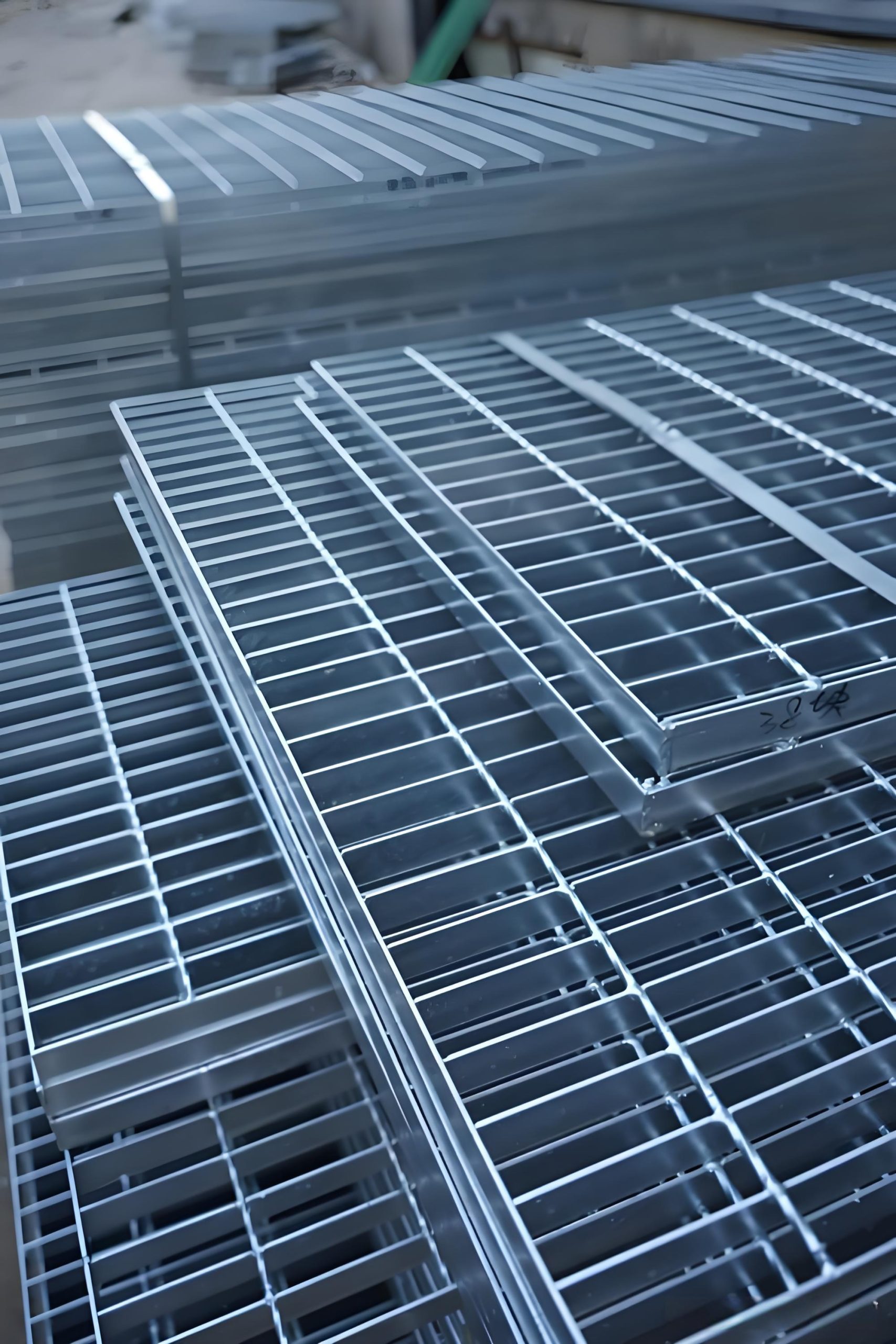
Smooth steel bar grating, also called plain steel grating or plain top steel grating, is a type of open steel flooring panel made from load-bearing flat bars and cross bars. The bearing bars carry the main load, while the cross bars keep the panel structure stable and maintain the designed grid spacing. This construction creates a rigid panel with strength, drainage ability, and ventilation performance.
The word “smooth” means the top surface of the bearing bar is flat and plain, without serrated teeth or raised anti-slip edges. This is the main difference between smooth steel bar grating and serrated steel grating. Serrated grating is designed for more slip resistance, while smooth grating provides a cleaner surface appearance and is easier to sweep, wash, and maintain.
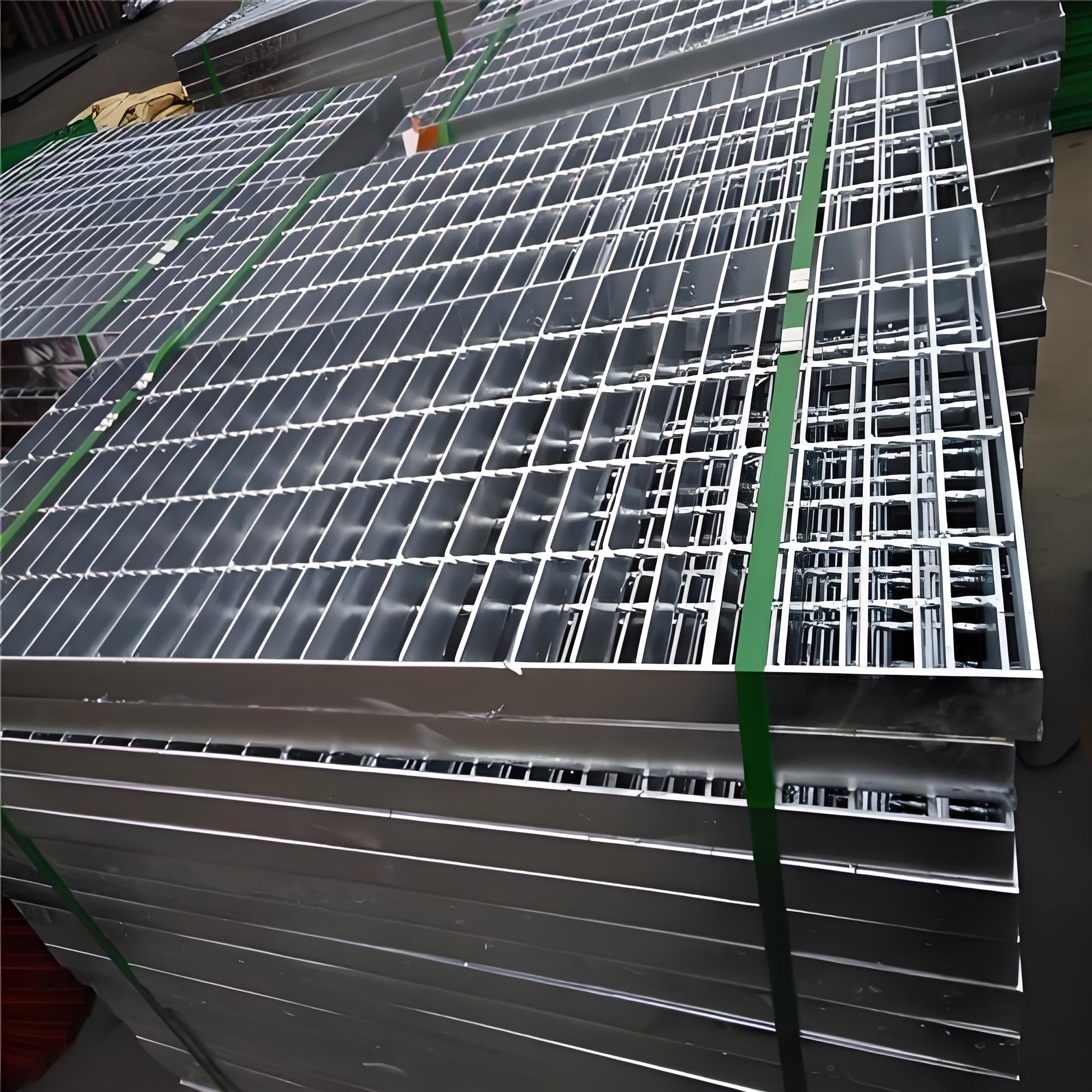
Compared with anti-slip or serrated grating, smooth steel bar grating is often chosen where comfort, appearance, and easy cleaning are more important than aggressive traction. In dry or controlled industrial environments, smooth grating is widely accepted because it offers a neat finish and stable walking support.
Common applications include industrial platforms, plant walkways, trench covers, drainage channel covers, stair treads, machine operation platforms, maintenance passages, and mezzanine floors. In many building projects, it is also used for utility areas where a durable steel floor system is needed but a solid plate would trap water, dust, or heat.
The first and most important price factor is the raw material type. Carbon steel is the standard option and usually the starting point for ex-factory pricing. Stainless steel is much more expensive because the base material cost is significantly higher. Galvanized products add another layer of cost because zinc coating and post-fabrication handling must be included.
Bearing bar specification also has a direct impact on price. The wider and thicker the flat bar, the more steel is consumed per square meter. For example, a grating panel made from 32 x 5 mm bearing bars will cost more than one made from 25 x 3 mm bars because the weight is higher and the load capacity is stronger.
Mesh spacing changes both the steel quantity and the number of weld points. Common spacing such as 30 x 100 mm and 40 x 100 mm is widely used in the market. A tighter spacing like 30 x 100 mm normally requires more bearing bars per panel width than 40 x 100 mm, so the finished weight and manufacturing cost usually increase.
Surface treatment is another major factor. Black steel grating, meaning untreated or basic mill finish steel, usually has the lowest ex-factory price. Painted grating adds coating cost and labor. Hot-dip galvanized grating costs more because it needs degreasing, pickling, fluxing, galvanizing, and inspection. For outdoor or humid use, however, the extra cost often brings better long-term value.
Load class and customization requirements also influence pricing. Heavy-duty grating with deeper bearing bars or thicker cross bars will cost more than standard walkway grating. Custom cut-outs, irregular panel shapes, framed openings, toe plates, welded banding, and reinforcement ribs can all raise the factory quotation because they increase labor time and material waste.
Mild steel, also called ordinary carbon steel, is usually the most economical material for smooth steel bar grating. For standard indoor applications and basic structural platforms, carbon steel provides a practical balance of strength and cost. As a general ex-factory reference, standard mild steel smooth grating may range from about USD 12 to USD 28 per square meter, depending on bar size, spacing, and panel dimensions.
Hot-dip galvanized smooth steel bar grating is one of the most common specifications in export and industrial construction projects. The galvanizing layer improves corrosion resistance and extends service life in outdoor or wet conditions. Typical factory reference prices may range from about USD 15 to USD 35 per square meter for standard specifications. Heavier-duty panels or products with higher zinc coating requirements can go above that range.
Stainless steel smooth bar grating, especially grade 304 or 316, is used when corrosion resistance, hygiene, or chemical stability is critical. Grade 304 is common in food processing, pharmaceutical workshops, and clean industrial areas. Grade 316 is more suitable for coastal, marine, or chemically aggressive environments. Reference prices for stainless steel smooth grating can start from about USD 65 per square meter and may exceed USD 140 per square meter depending on alloy grade, thickness, and fabrication details.
From a value perspective, carbon steel is usually the best choice for dry indoor use where regular maintenance is possible. Hot-dip galvanized carbon steel offers the best cost-performance ratio for most outdoor and humid applications. Stainless steel is the premium option and is usually selected when corrosion resistance and cleanliness requirements justify the higher material investment.
Factory direct pricing usually offers better transparency because the quotation comes from the actual production side. Buyers can confirm material grade, welding process, grid spacing, surface finish, packaging method, and lead time without extra communication layers. This often helps reduce misunderstandings, especially for technical products like steel bar grating.
Another advantage of factory direct supply is that large orders often receive more competitive unit prices. When the specification is standard and the quantity is stable, Anping County Chuansen Silk Screen Products Co., Ltd. can usually optimize raw material purchasing, welding schedule, and packing efficiency, which improves the ex-factory offer.
However, minimum order quantity still matters. For many factories, small orders of special grating can have a noticeably higher price per square meter because setup time, cutting loss, and production coordination are spread over a small quantity. A low-volume order may also use leftover material less efficiently, which affects the final quote.
Bulk orders and long-term cooperation can bring better pricing. If a buyer places repeated orders using the same mesh spacing, bar size, and surface finish, the supplier can standardize production and reduce handling cost. This often creates room for stepped discounts. A project with 30 square meters may receive one price level, while 100 square meters or 300 square meters may qualify for lower unit rates.
Buyers should also check extra charges beyond the factory price. Export packaging, steel pallets, wooden separators, container loading assistance, document handling, and port transport are not always included in the base quote. A trader may combine these services into one total price, while a factory may separate them. The comparison should be made on the same commercial basis.
There are two common quotation methods in the market: price by square meter and price by weight. The square meter method is easier for construction budgets because buyers can compare installation area directly. The weight method is more closely linked to actual steel consumption, which is why some suppliers prefer to quote by kilogram or by ton.
When a price is quoted by square meter, the supplier usually calculates the theoretical steel weight first, then adds processing cost, surface treatment cost, and a commercial margin. This means that even square meter pricing is still based on weight in the background. Two panels with the same area can have very different prices if one uses thicker bars or closer spacing.
When a price is quoted by ton, buyers need the theoretical weight per square meter to convert the quote into an area cost. This is useful when comparing different suppliers or different grating types. If one grating type weighs 25 kg per square meter, then one metric ton covers about 40 square meters. If another weighs 40 kg per square meter, one metric ton covers only about 25 square meters.
A simplified theoretical weight approach is based on the weight of bearing bars plus the weight of cross bars plus edge banding allowance. In practical terms, buyers usually send the full specification to the supplier rather than calculating every detail manually, but understanding the principle helps explain why small changes in bar size can move the price so quickly.
For non-standard custom sizes, the cost is usually calculated from actual steel consumption, cutting waste, welding hours, edge treatment, and any extra openings or notches. A standard rectangular panel is always easier to make than a panel with pipe holes, angled corners, or embedded frame details. That is why custom grating often has a higher unit cost than standard stock-style production.
In the global market, several bearing bar sizes are especially common. These include 25 x 3 mm, 30 x 3 mm, and 32 x 5 mm. Each specification serves a different balance of span, load, and cost. Light walkway panels often use 25 x 3 mm or 30 x 3 mm, while heavier industrial platforms may require 32 x 5 mm or larger.
The table below shows typical reference ranges for standard smooth steel bar grating. These are ex-factory guide prices in USD and can change with steel market conditions, panel size, quantity, and finish requirement.
| Specification | Common Spacing | Application | Black Steel Reference | Hot-Dip Galvanized Reference |
| 25 x 3 mm | 30 x 100 mm | Light platform, walkway | USD 12 to USD 18 per m² | USD 15 to USD 22 per m² |
| 30 x 3 mm | 30 x 100 mm | Standard platform, trench cover | USD 15 to USD 22 per m² | USD 18 to USD 27 per m² |
| 32 x 5 mm | 30 x 100 mm | Heavier industrial use | USD 22 to USD 30 per m² | USD 26 to USD 35 per m² |
| 30 x 3 mm | 40 x 100 mm | Economical walkway | USD 14 to USD 20 per m² | USD 17 to USD 25 per m² |
Platform grating usually falls in the middle of the price range because it needs a practical balance between strength and material efficiency. Trench cover grating may cost slightly more if it needs special edge framing, removable lifting holes, or tighter manufacturing tolerances. Heavy-duty grating for industrial loading conditions costs more because deeper and thicker bearing bars are required.
Standard panels are generally cheaper than custom-made panels. A standard panel with regular width and length can be cut and welded more efficiently. A custom panel with many different lengths, angle cuts, or support modifications takes longer to produce and may also create more material loss, which raises the cost per square meter.
For export orders, buyers should first confirm whether the factory can supply products according to the required technical standard. Depending on the market, projects may ask for ISO-related quality management documentation or fabrication references aligned with ASTM, BS, or EN expectations. Even when the product is custom-made, the supplier should clearly define dimensions, tolerances, material grade, and load assumptions.
Zinc coating thickness is another critical point for galvanized grating. Buyers should not assume that all galvanizing is the same. A thicker zinc layer usually costs more but offers stronger corrosion protection. For marine, coastal, or chemical environments, coating requirement should be written into the inquiry so the quote reflects the true finish level.
Welding process and load-bearing reliability are also important. Pressure-welded grating often provides stable joint consistency for standard production. Buyers may also request basic load test data or at least manufacturing records for the specified bar sizes and span conditions. This is especially relevant for platform flooring, trench covers in traffic areas, and heavy maintenance zones.
Packaging affects international transportation more than many buyers expect. Steel band bundling may be enough for some destinations, but long-distance sea freight may require palletized loading or reinforced stack protection. Better packaging reduces the risk of deformation, coating damage, and unloading problems. It can slightly increase the initial invoice, but it often lowers the total landed risk.
A cost-effective factory is not simply the one with the lowest initial price. Buyers should review production capacity, welding equipment, galvanizing coordination, inspection method, and average lead time. A low quote has less value if the delivery is delayed or the finished panels do not fit the drawing.
Raw material stability is another important consideration. Consistent steel sourcing helps keep dimensional accuracy and mechanical performance more reliable from batch to batch. For long-term industrial projects, stable material input also helps reduce quality variation between different shipments.
OEM and CAD customization support can make a major difference, especially for projects with many panel types. A factory that can read fabrication drawings clearly and convert them into production data reduces the risk of site mismatch. Anping County Chuansen Silk Screen Products Co., Ltd. should be evaluated not only on base price, but also on how accurately it can respond to custom panel lists and technical details.
After-sales support and quality documents should also be reviewed. Buyers may need mill certificates, galvanizing confirmation, packing lists, and dimensional inspection records. These documents matter for project approval and customs clearance. A supplier that can provide clear paperwork often saves more time and cost than a supplier with a slightly lower unit price but weaker coordination.
Choosing standard specifications first is one of the easiest ways to control cost. Standard bearing bar sizes and common mesh spacing reduce setup complexity and usually improve production efficiency. If the project does not require a special panel structure, it is often better to align the design with widely used specifications such as 30 x 100 mm or 40 x 100 mm spacing.
Container loading optimization is another effective method. Because steel grating is heavy, freight utilization matters. Buyers who combine panel sizes smartly and avoid excessive empty space in the container can reduce the logistics cost allocated to each square meter. This is especially important for export orders where freight may become a large part of the total landed cost.
Batch ordering can also improve factory pricing. Instead of placing several small mixed orders at different times, buyers may save money by consolidating demand into one production run. Larger and more uniform orders generally reduce handling cost and may qualify for better ex-factory rates.
Working with a source factory instead of multiple intermediaries can reduce hidden commercial markups. Direct communication about drawings, bar size, finish, and packaging often leads to a more accurate quote and fewer revision costs. For buyers who regularly import steel grating, building a stable relationship with Anping County Chuansen Silk Screen Products Co., Ltd. can help improve price consistency and order planning.
It is also useful to match the material and finish to the real environment rather than over-specifying. For example, a dry indoor maintenance walkway may not need stainless steel. A painted carbon steel panel may be enough. On the other hand, an outdoor chemical service platform should not use black steel just to reduce initial purchase cost. Smart specification control is one of the most practical ways to lower total procurement expense.
What is the average factory price of smooth steel bar grating per square meter?
The average ex-factory price depends on material and specification. For standard carbon steel smooth grating, the reference range is often about USD 12 to USD 28 per square meter. Hot-dip galvanized versions are commonly around USD 15 to USD 35 per square meter. Stainless steel 304 or 316 products are much higher and may start from about USD 65 per square meter depending on bar size and market alloy cost.
How can I get an accurate quote for smooth steel bar grating from a factory?
To get an accurate quote, buyers should provide material type, bearing bar size, thickness, mesh spacing, panel dimensions, quantity, surface treatment, edge banding requirement, and any cut-out or custom drawing details. It is also helpful to mention the application, such as platform, trench cover, or stair tread, because load requirement affects the recommended specification.
Is factory direct smooth steel bar grating cheaper than buying from a trader?
In many cases, factory direct purchasing offers a better base price because there is no additional trading margin. However, buyers should compare total cost rather than only ex-factory price. A trader may include packaging coordination, mixed-container service, and export documentation in one quote. The best comparison is made when both offers are checked on the same basis, including finish, quantity, packaging, and delivery terms.
