
Steel deck grating is an open steel flooring system used for platforms, catwalks, mezzanines, bridges, equipment decks, ramps, and industrial access areas. Factory prices depend on the bearing bar size, mesh spacing, panel dimensions, design load, steel grade, surface treatment, fabrication, quantity, packaging, and delivery terms. This guide explains how steel deck grating is specified, how factories calculate the price, and what buyers should check before comparing supplier quotations.
Steel deck grating is normally a load-bearing open-grid panel made from parallel bearing bars joined by cross bars. The bearing bars carry the primary bending load and span between structural supports. Cross bars keep the bearing bars aligned, improve panel stability, and help distribute localized loads.
In this article, “steel deck grating” means open bar grating used as a floor or deck. It is different from corrugated steel roof decking or composite metal floor deck used as permanent formwork for concrete. Open steel deck grating is selected when a project needs drainage, ventilation, light transmission, access to equipment below, and a relatively lightweight structural walking surface.
Depending on the design, steel deck grating may be welded, press-locked, or riveted. It may be supplied in carbon steel with mill finish, painted steel, hot-dip galvanized steel, 304 stainless steel, or 316 stainless steel. Plain and serrated surfaces are available, as well as banded edges, toe plates, frames, hinges, lifting handles, and custom cutouts.
| Component | Function | Typical Specification |
|---|---|---|
| Bearing bar | Carries the primary span load | 25 × 3 mm, 30 × 5 mm, 40 × 5 mm, 50 × 5 mm, or project-specific sizes |
| Cross bar | Connects and stabilizes bearing bars | Twisted square bar, round bar, or flat bar |
| Banding bar | Closes and reinforces cut panel edges | Flat bar or matching bearing bar |
| Toe plate | Helps retain tools and objects on elevated decks | Steel plate or angle fixed along exposed edges |
| Support frame | Provides a bearing ledge or perimeter restraint | Angle, channel, flat bar, or structural steel frame |
Steel deck grating can be designed for many different access conditions. A narrow maintenance catwalk, a mezzanine carrying storage equipment, and a pedestrian bridge may all use open grating, but they do not have the same load, span, support, or safety requirements.
| Application | Typical Requirements | Important Price Drivers |
|---|---|---|
| Industrial platforms | Worker loads, equipment access, removable panels, handrails | Bearing bar size, support spacing, cutouts, clips, toe plates |
| Catwalks | Long narrow panels, maintenance traffic, pipe and cable openings | Panel layout, span direction, serration, galvanizing, lifting weight |
| Mezzanines | Higher uniform loads, storage or process equipment, rigid supports | Heavy bearing bars, close supports, deflection limits, framing |
| Pedestrian bridges | Public access, heel safety, guardrails, vibration control, drainage | Close mesh, anti-slip surface, structural calculations, finishing |
| Service bridges | Maintenance vehicles or equipment loads | Heavy-duty grating, wheel-load design, reinforced frames |
| Equipment decks | Motors, pumps, valves, skids, and concentrated point loads | Local reinforcement, bearing bar depth, cutouts, support beams |
| Ramps | Inclined walking surface, traction, transition details | Serrated bars, edge angles, nosing, slope, fixing method |
Pedestrian bridge grating can often use standard-duty panels when the support spacing and loading are moderate. A bridge carrying service vehicles, forklifts, or maintenance trucks needs a separate heavy-duty design. Normal walkway grating should not be used for vehicle traffic just because the panel appears thick.
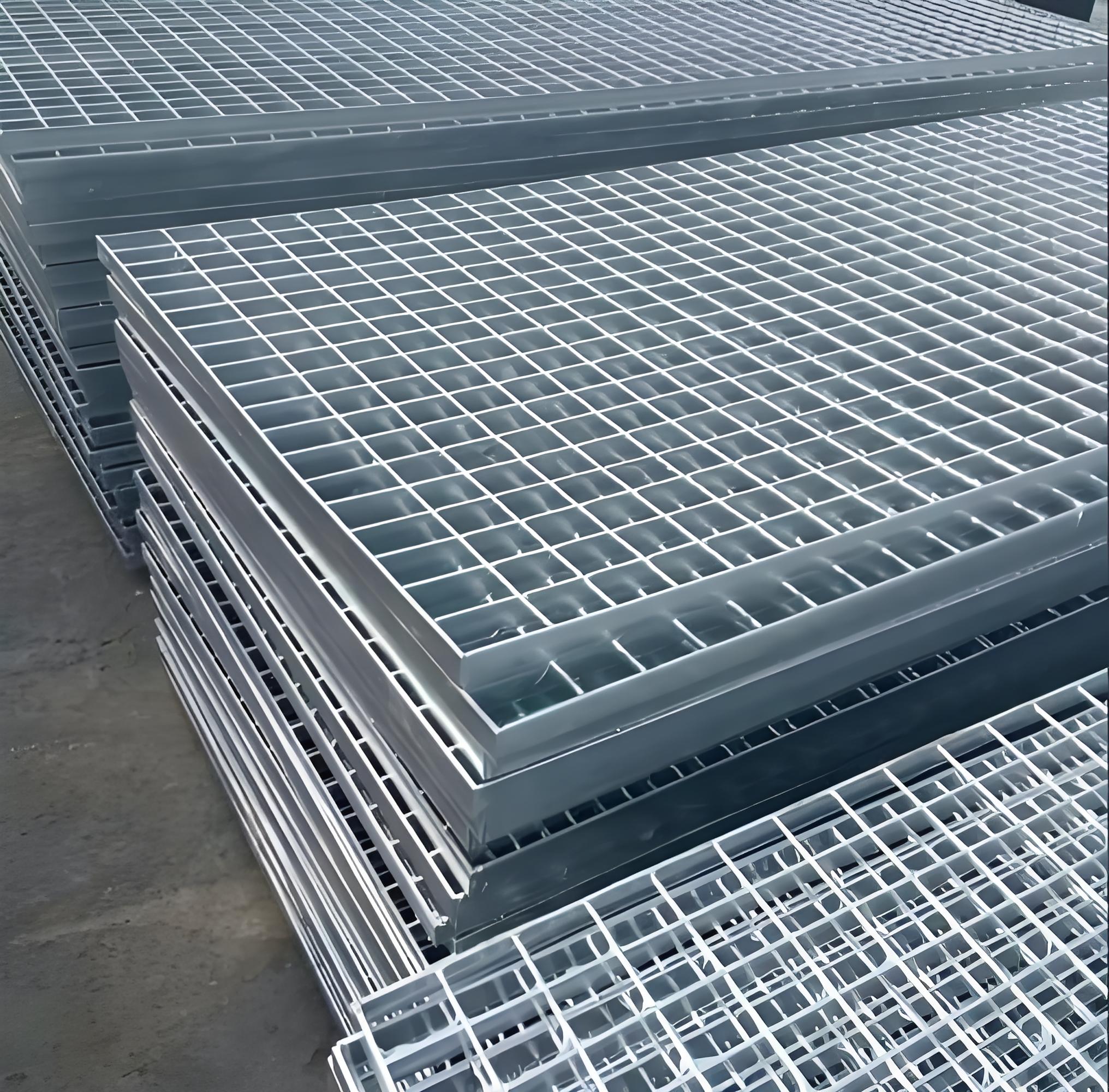
Welded grating is produced by placing cross bars over the bearing bars and applying pressure and resistance welding at the intersections. It is the most common industrial deck grating because it offers efficient production, good rigidity, and familiar load-table data.
Welded panels can use twisted square cross bars, round bars, or flat bars. Twisted square bars create a traditional appearance and provide good mechanical locking at the weld. Round cross bars can produce a smoother profile, while flat cross bars may be selected for specific architectural or fabrication requirements.
Press-locked grating is made by inserting cross bars into pre-punched bearing bars and pressing the assembly together. It provides a neat, uniform pattern and is often used for architectural platforms, ventilation areas, walkways, and areas where the visual appearance of the mesh is important.
Press-locked panels may have different stiffness and connection behavior from welded panels with the same bearing bar size. The factory should provide load data for the exact press-locked construction rather than applying a welded-grating table without confirmation.
Riveted grating uses rivets or forged connections to join the bearing bars and cross bars. It can be useful for heavy-duty service, vibration, repeated dynamic loading, or projects that specifically require a riveted construction.
Riveted panels usually require more labor and specialized equipment than standard welded panels. Their factory price may therefore be higher, especially for small quantities, non-standard widths, or custom edge fabrication.
| Grating Type | Advantages | Cost Considerations |
|---|---|---|
| Welded | Efficient production, rigid panel, widely available load tables | Usually the lowest cost for standard industrial panels |
| Press-locked | Clean appearance, regular mesh, suitable for architectural layouts | Higher setup or tooling cost in some factories |
| Riveted | Suitable for vibration and heavy-duty specifications | Higher labor and fabrication cost |
Bearing bars must span from support to support. Their height, thickness, pitch, and orientation determine much of the panel’s load capacity and deflection performance.
Common bearing bar sizes include 25 × 3 mm, 25 × 5 mm, 30 × 3 mm, 30 × 5 mm, 32 × 5 mm, 40 × 5 mm, and 50 × 5 mm. In most metric designations, the first number indicates the bar height and the second indicates the thickness, although the final purchase drawing should always confirm the order of dimensions.
| Bearing Bar Size | General Load Position | Typical Deck Application |
|---|---|---|
| 25 × 3 mm | Light-duty and short-span | Indoor walkways, light access platforms, and covers |
| 30 × 3 mm | Standard-duty | Industrial platforms and general catwalks |
| 30 × 5 mm | Medium-duty | Maintenance floors and longer standard spans |
| 32 × 5 mm | Medium to heavy-duty | Equipment platforms, ramps, and mezzanine areas |
| 40 × 5 mm | Heavy-duty | High-load platforms and service traffic areas |
| 50 × 5 mm | Very heavy-duty | Long spans, vehicle loads, and demanding industrial decks |
A taller bearing bar normally provides greater bending stiffness. A thicker bar increases steel consumption and helps resist local damage from concentrated loads. Reducing the bearing bar pitch places more bars under a given load, but it also increases the weight and price per square meter.
The bearing bars should normally be installed perpendicular to the support beams so that they span between supports. An incorrectly oriented panel may have much lower capacity even though the overall dimensions, bar size, and weight remain unchanged.
For terminology related to bearing direction, panel measurements, and grating dimensions, buyers can review this steel grating dimensions guide.
Mesh spacing is normally stated by bearing bar pitch and cross bar pitch. Common patterns include 19W4, 19W2, 30 × 100 mm, 30 × 50 mm, 40 × 100 mm, and 40 × 50 mm.
| Pattern | Approximate Spacing | General Use |
|---|---|---|
| 11W4 | Approximately 17.5 mm bearing bar pitch and 100 mm cross bar pitch | Close mesh, small wheels, heel safety, and tool retention |
| 19W4 | Approximately 30 mm bearing bar pitch and 100 mm cross bar pitch | Common industrial walkways and platforms |
| 19W2 | Approximately 30 mm bearing bar pitch and 50 mm cross bar pitch | Closer cross bars, small carts, and improved object retention |
| 30 × 100 mm | Approximately 30 mm bearing bar pitch and 100 mm cross bar pitch | Metric industrial flooring and catwalks |
| 30 × 50 mm | Approximately 30 mm bearing bar pitch and 50 mm cross bar pitch | Metric close-mesh applications |
Open area is the percentage of the deck surface that remains open. A larger open area improves drainage, ventilation, light transmission, and weight reduction. A smaller opening improves heel safety, small-wheel performance, and retention of tools or components.
Open area should not be considered separately from load capacity. A panel with very large openings may be economical and light, but the remaining bearing bars must still support the required load. A close-mesh panel may cost more because it contains more bars per square meter.
Drainage also depends on the slope of the deck, direction of the openings, support framing, dirt accumulation, and the presence of toe plates or solid edge plates. An open mesh does not replace proper floor drainage or housekeeping in an industrial environment.
Factories commonly produce steel deck grating in standard widths close to 500, 600, 750, 900, 1,000, and 1,200 mm. Standard lengths often include 2,000, 3,000, 4,000, 5,800, and 6,000 mm. Imperial stock may be close to 3 ft × 20 ft, 3 ft × 24 ft, 4 ft × 20 ft, or 4 ft × 24 ft.
| Panel Format | Typical Use | Layout Benefit |
|---|---|---|
| 500 × 3,000 mm | Narrow equipment access and edge strips | Easy handling and simple placement around obstructions |
| 600 × 3,000 mm | Compact walkways and short platforms | Low lifting weight and convenient field movement |
| 750 × 6,000 mm | Pipe racks and maintenance catwalks | Efficient for narrow, long access routes |
| 1,000 × 6,000 mm | General platforms, mezzanines, and industrial decks | Common factory size with efficient production |
| 1,200 × 6,000 mm | Wide platforms, ramps, and bridge sections | Fewer longitudinal joints but higher panel lifting weight |
Panel layout should place joints over support beams wherever possible. A panel that is too long may be difficult to lift, galvanize, transport, and remove for maintenance. Excessively short panels increase the number of joints, clips, and potential trip points.
For bridges and mezzanines, support spacing should be developed before the grating size is finalized. Adding an intermediate beam can sometimes reduce the bearing bar size and total steel consumption, while a long unsupported span may require a heavy-duty panel and stronger framing.
Steel deck grating should be selected using the actual load condition, not a general label such as “industrial” or “heavy duty.” The design may need to consider uniform loads, point loads, wheel loads, impact, vibration, snow, stored material, and temporary maintenance equipment.
| Load Category | Example | Primary Design Concern |
|---|---|---|
| Pedestrian load | Workers or visitors distributed over the deck | Overall bending, deflection, vibration, and opening safety |
| Maintenance load | Workers carrying tools or replacement parts | Concentrated foot loads and local panel response |
| Equipment load | Pumps, motors, valves, skids, and temporary lifting gear | Point load, support feet, and local reinforcement |
| Cart or trolley load | Small wheels carrying tools or components | Opening size, wheel spacing, and concentrated load |
| Forklift load | Forklift wheels and pallet loads | Heavy wheel loads, impact, support spacing, and deflection |
| Vehicle load | Service trucks or maintenance vehicles on a bridge | Vehicle load class, wheel path, fatigue, and reinforced framing |
Clear span is the unsupported distance between the structural supports under the bearing bars. It is not necessarily the overall panel length. A 6,000 mm-long panel can have multiple intermediate supports and a clear span of 1,000 mm, while a shorter panel may bridge a much larger opening.
Deflection limits are important for comfort, vibration, drainage, equipment alignment, and perceived safety. A project may specify a limit such as L/200, L/240, or L/360, but the correct value depends on the owner, local code, and structural engineer.
Load tables should identify the bearing bar size, pitch, span, load type, support condition, and deflection criterion. A table for 19W4 welded grating should not automatically be applied to 11W4, 19W2, press-locked grating, riveted grating, or a different metric mesh.
Heavy-duty steel deck grating normally uses deeper and thicker bearing bars, closer support spacing, stronger banding, and a design based on concentrated or wheel loads. Some projects use I-bar or reinforced bearing bar profiles to obtain high stiffness without using a solid plate.
Heavy-duty deck grating may be required for:
Heavy-duty design is not based on bearing bar height alone. The support beam, panel edges, connections, wheel path, load distribution, impact factor, and allowable deflection must all be checked. In some projects, the specification may reference ANSI/NAAMM MBG 532 for heavy-duty steel or stainless steel grating, while standard pedestrian platforms may use the applicable standard-duty manual or a local engineering specification.
Buyers can use this heavy-duty steel grating price and specification guide to compare the effect of heavy bearing bars, vehicle loads, and custom fabrication on the final factory cost.
Plain grating has smooth bearing bar tops. Serrated grating has notches or teeth along the top surface to improve traction where water, oil, ice, mud, or process residue may be present.
| Feature | Plain Deck Grating | Serrated Deck Grating |
|---|---|---|
| Surface profile | Smooth flat bearing bar | Notched or toothed bearing bar |
| Slip resistance | Suitable for many dry indoor areas | Better traction in wet, oily, outdoor, and contaminated locations |
| Cleaning | Generally easier to sweep and wash | Serrations can retain dirt and may require more attention |
| Price | Lower for the same steel size and mesh | Usually higher because of serration processing |
| Common use | Warehouses, dry platforms, indoor mezzanines | Refineries, wastewater plants, ramps, bridges, and outdoor decks |
Serrated grating is not automatically slip-proof. Footwear, surface contamination, slope, drainage, lighting, housekeeping, and maintenance all affect safety. If the project requires a specific anti-slip test or classification, it should be stated in the purchase documents.
| Material | Advantages | Typical Environment | Price Position |
|---|---|---|---|
| Carbon steel, mill finish | High strength and lowest initial material cost | Indoor factories and protected structures | Lowest |
| Painted carbon steel | Color selection and basic corrosion protection | Indoor or moderately corrosive service | Low to medium |
| Hot-dip galvanized steel | Zinc protection on fabricated surfaces | Outdoor platforms, bridges, pipe racks, and humid plants | Medium |
| 304 stainless steel | Good general corrosion resistance and clean appearance | Food processing, clean industrial areas, ordinary outdoor service | High |
| 316/316L stainless steel | Improved chloride and chemical resistance | Marine, coastal, wastewater, and aggressive chemical environments | Highest |
For carbon steel, the required grade may be ASTM A36, Q235B, S235JR, or another approved equivalent. The grade should be written into the specification because strength, weldability, and certification requirements can differ.
Steel deck grating is primarily priced by the amount of steel required to produce the finished panel. Heavier bearing bars, closer bearing bar pitch, closer cross bars, banded edges, and frames all increase weight and material cost.
A preliminary estimate for the bearing bar portion can be made with:
Bearing-bar weight approximately equals 7.85 × bar height × bar thickness ÷ bearing-bar pitch.
When dimensions are entered in millimeters, the result is approximately kilograms per square meter for the bearing bars. Cross bars, banding, zinc, tolerances, and frames must be added to obtain the actual shipping weight.
| Illustrative Bearing Bar | Approximate Weight Range Before Accessories | General Price Position |
|---|---|---|
| 25 × 3 mm | Approximately 20–28 kg/m² | Light-duty and economical |
| 30 × 3 mm | Approximately 24–32 kg/m² | General standard-duty deck |
| 32 × 5 mm | Approximately 38–50 kg/m² | Medium to heavy-duty |
| 40 × 5 mm | Approximately 48–62 kg/m² | Heavy-duty platform and bridge deck |
| 50 × 5 mm | Approximately 60–78 kg/m² | High-load or long-span application |
These values are illustrative only. Actual weight changes with mesh spacing, cross bar size, panel dimensions, serration, banding, and manufacturing tolerance. A factory should provide the net weight from the approved production drawing.
For 2026 budgeting, the following broad EXW or FOB factory ranges can be used as a starting point for standard carbon steel products. Small orders, custom fabrication, high freight costs, and special testing can move the final price outside these bands.
| Product Type | Indicative Price | Typical Conditions |
|---|---|---|
| Mill-finish carbon steel deck grating | Approximately US$35–70/m² | Standard welded panels and normal production quantity |
| Plain hot-dip galvanized grating | Approximately US$50–105/m² | Standard-duty panels galvanized after fabrication |
| Serrated galvanized grating | Approximately US$60–130/m² | Serrated bearing bars and regular banding |
| Heavy-duty galvanized deck grating | Approximately US$90–180/m² | Thicker bars, closer supports, or high-load design |
| Custom vehicle-rated deck grating | Approximately US$120–300+/m² | Heavy wheel loads, frames, cutouts, testing, and special fabrication |
| 304 stainless steel deck grating | Approximately US$140–280/m² | Depending on mesh, finish, and fabrication |
| 316/316L stainless steel deck grating | Approximately US$190–380+/m² | Higher alloy cost and severe corrosion service |
A 1,000 × 6,000 mm panel has approximately 6 m² of nominal area. At US$50–105/m², a standard galvanized panel may therefore be approximately US$300–630 before clips, special fabrication, packing, and freight. A heavy-duty panel priced at US$90–180/m² may be approximately US$540–1,080 per panel. These examples are for budget comparison only, not guaranteed offers.
Post-fabrication hot-dip galvanizing is normally performed after grating is welded, cut, banded, and prepared. The complete panel is immersed in molten zinc so that the main bars, cross bars, welds, and many cut edges receive protection.
Galvanizing adds the cost of zinc, handling, transport to the galvanizing plant, bath processing, cleaning, inspection, and possible repair. It can also affect tight dimensions because zinc may build up around holes, corners, clips, and banded edges.
Project specifications may reference ASTM A123/A123M, ISO 1461, or another local coating standard. The required coating is determined by steel thickness, environment, and the specified standard rather than by a single universal value.
More details about coating sequence and protection are available in this hot-dip galvanized steel grating guide.
Painted carbon steel may be less expensive than hot-dip galvanizing for indoor service, but the coating system must match the humidity, chemicals, abrasion, and maintenance plan. A duplex system combines galvanizing with paint or powder coating. It costs more initially but can provide an additional barrier and color finish in demanding environments.
Banding bars close the ends of bearing bars and provide a cleaner, stronger edge. They are often required around cutouts, exposed panel edges, removable covers, and stair treads. Banding adds flat-bar material, welding, grinding, galvanizing exposure, and inspection.
Cutouts around pipes, columns, drains, valves, cable trays, and equipment require measuring, marking, cutting, deburring, and sometimes edge reinforcement. Irregular shapes and a large number of small panels produce more waste and labor than standard rectangular panels.
Angle frames, channels, support bars, hinges, lifting handles, clips, bolts, toe plates, and stair nosing are normally priced separately. These components should be included on the drawing so the supplier can calculate the complete project package instead of quoting only the open grating area.
A typical steel deck grating production process includes material preparation, bearing bar cutting, cross bar preparation, welding or pressing, panel trimming, banding, surface treatment, inspection, marking, and packing.
| Production Stage | Quality Check |
|---|---|
| Material preparation | Steel grade, thickness, heat number, and material certificates |
| Bearing bar cutting | Length, height, thickness, and straightness |
| Panel assembly | Bearing bar pitch, cross bar spacing, squareness, and alignment |
| Welding or pressing | Joint continuity, weld appearance, connection strength, and panel rigidity |
| Banding and cutouts | Opening dimensions, edge closure, weld quality, and sharp-edge removal |
| Surface treatment | Galvanizing coverage, coating appearance, paint thickness, or stainless finish |
| Load verification | Load-table review, test panel, or project-specific structural calculation |
| Final inspection | Panel dimensions, flatness, weight, marking, and packing condition |
Not every order requires a destructive load test. For many projects, the supplier provides a certified load table or calculation based on the exact grating geometry and support condition. A full test may be required for special bridge decks, vehicle-rated panels, proprietary designs, or an owner’s inspection plan.
The factory should be informed if the panels must meet ANSI/NAAMM MBG 531, ANSI/NAAMM MBG 532, BS 4592, AS 1657, or another project standard. Standards should be specified by the correct edition and application because standard-duty, heavy-duty, stair, and bridge requirements are not identical.
Comparing only the price per square meter can produce an inaccurate result. A complete quote comparison should use the same structural and commercial assumptions for every supplier.
| Quote Item | What to Confirm |
|---|---|
| Material grade | Carbon steel, galvanized steel, 304, 316, or another specified grade |
| Manufacturing type | Welded, press-locked, or riveted |
| Bearing bars | Height, thickness, pitch, direction, and edge configuration |
| Cross bars | Type, size, pitch, and connection method |
| Surface | Plain or serrated, mill finish, painted, galvanized, or polished |
| Panel dimensions | Overall length, width, tolerance, and quantity |
| Load design | Uniform, concentrated, wheel, equipment, impact, and deflection requirements |
| Fabrication | Cutouts, banding, notches, frames, toe plates, holes, and hinges |
| Accessories | Clips, bolts, support angles, lifting handles, and replacement coating materials |
| Documents | Material certificates, inspection report, load table, and coating records |
| Commercial terms | MOQ, lead time, quotation validity, packing, Incoterm, and freight |
A supplier should receive a panel schedule or marked-up layout showing each panel number, finished dimensions, bearing direction, cutouts, support locations, surface treatment, and accessories. This prevents a low initial quotation from becoming a much higher final price after revisions and field changes.
For broader factory pricing terminology, buyers can also consult this steel grating prices and manufacturers guide before requesting a project quotation.
How much does steel deck grating cost per square meter?
As a broad 2026 factory budgeting range, mill-finish carbon steel deck grating may cost approximately US$35–70/m², standard hot-dip galvanized grating approximately US$50–105/m², serrated galvanized grating approximately US$60–130/m², and heavy-duty galvanized or vehicle-rated panels approximately US$90–300+/m². Stainless steel options are generally higher. The exact price depends on weight, mesh, load design, fabrication, quantity, packing, and delivery.
What bearing bar size is suitable for a steel deck?
Short-span pedestrian decks may use 25 × 3 mm or 30 × 3 mm bearing bars, while longer spans, equipment loads, and vehicle traffic may require 32 × 5 mm, 40 × 5 mm, 50 × 5 mm, or a special heavy-duty profile. The correct size must be selected from a load table or structural calculation using the clear span, support width, bearing direction, load type, and allowable deflection.
Is welded or press-locked steel deck grating better?
Welded grating is normally the most economical and widely available option for industrial decks. Press-locked grating provides a clean, regular appearance and can suit architectural or close-mesh applications. Neither is automatically stronger; the correct choice depends on the exact bearing bar, cross bar, connection, span, load, and manufacturer’s verified performance data.
