
Galvanized steel bar grating prices are determined by the steel weight, bearing bar size, mesh spacing, manufacturing method, zinc coating, fabrication requirements, order quantity, packaging, and delivery terms. A standard plain panel from factory stock can cost much less than a serrated heavy-duty panel with cutouts, banded edges, toe plates, or stair tread nosing. This guide explains how galvanized steel bar grating is quoted and how to compare prices per square meter, panel, ton, or linear meter without overlooking important specification differences.
Factories use several quotation methods for galvanized steel bar grating. The most suitable unit depends on whether the buyer is ordering standard panels, a complete industrial platform, stair treads, or a large tonnage project.
| Quotation Unit | Typical Use | Important Confirmation |
|---|---|---|
| Price per square meter | Project flooring, walkways, platforms, and cut-to-size panels | Confirm whether the area is gross panel area or net finished area |
| Price per panel | Standard 1,000 × 6,000 mm or similar stock panels | Check the exact bearing bar, mesh, weight, finish, and included fabrication |
| Price per metric ton | Large-volume orders and repeat production | Confirm whether steel, zinc, welding, packing, and fabrication are included |
| Price per linear meter | Narrow walkways, stair treads, trench covers, and planks | State the finished width because one linear meter can represent different areas |
| Price per kilogram | Custom fabricated work and weight-based factory calculations | Ask whether the weight is before or after galvanizing |
For a reliable comparison, each supplier should quote the same material grade, bearing bar dimensions, mesh spacing, surface, panel size, zinc coating requirement, fabrication, and delivery basis. A low price per square meter may exclude banding, clips, galvanizing, export packing, or cutouts that another factory has already included.
The following figures are broad factory planning ranges for galvanized carbon steel bar grating. They are not fixed market prices or firm offers. Actual prices change with steel and zinc prices, production location, order quantity, exchange rates, packing, and freight.
| Galvanized Grating Type | Indicative Factory Budget | Typical Specification |
|---|---|---|
| Plain standard-duty welded grating | Approximately US$45–85/m² | 25 × 3 mm or 30 × 3 mm bearing bars, regular mesh |
| Serrated standard-duty grating | Approximately US$55–110/m² | 30 × 3 mm or 32 × 5 mm bearing bars |
| Close-mesh 11W4 or 19W2 | Approximately US$65–135/m² | Smaller openings and greater cross-bar consumption |
| Heavy-duty galvanized grating | Approximately US$90–180/m² | 40 × 5 mm, 50 × 5 mm, or larger bearing bars |
| Custom framed or heavily fabricated grating | Approximately US$120–260+/m² | Cutouts, banding, frames, toe plates, stair treads, and special finishes |
These ranges normally describe an EXW or FOB-style factory budget. Destination freight, customs duties, taxes, unloading, and installation are usually additional. For large orders, the factory may quote by ton instead of square meter, but the approved drawing and net weight should still be used to compare offers.
Buyers can also review this steel grating price guide for general factory cost terminology before requesting a product-specific galvanized quotation.
Each pricing unit answers a different purchasing question. The buyer should convert all offers to a common basis before deciding which one is more economical.
Price per square meter is convenient when the project has a known floor area. For example, a 1,000 mm-wide catwalk panel that is 6,000 mm long has a nominal area of 6 m². If the quoted price is US$75/m², the grating-only value is approximately US$450 per panel before accessories and delivery.
Panel prices are useful when the supplier keeps standard sizes in stock. A 1,000 × 6,000 mm panel, a 750 × 6,000 mm panel, and a 1,200 × 6,000 mm panel should not be compared by piece price alone because they contain different areas and different amounts of steel.
Ton pricing is common for large industrial projects. A rough normalization can be made by dividing the total grating value by the net galvanized weight. For example, if a panel weighs 45 kg/m² and sells for US$80/m², the equivalent finished value is approximately US$1,780 per metric ton. This is only a comparison method; a real ton quotation may use different steel, zinc, labor, and packaging assumptions.
Linear-meter pricing is practical for narrow products. A 600 mm-wide grating strip contains 0.6 m² in each linear meter. At US$75/m², the grating-only price is approximately US$45 per linear meter. A 1,000 mm-wide strip contains 1 m² per linear meter and would be approximately US$75 per linear meter at the same rate.
| Finished Width | Area in One Linear Meter | Example at US$75/m² |
|---|---|---|
| 300 mm | 0.30 m² | Approximately US$22.50/m |
| 600 mm | 0.60 m² | Approximately US$45/m |
| 750 mm | 0.75 m² | Approximately US$56.25/m |
| 1,000 mm | 1.00 m² | Approximately US$75/m |
Hot-dip galvanized and pre-galvanized grating are not the same product. The zinc is applied at different stages, which affects corrosion protection, fabrication, appearance, and price.
| Feature | Post-Fabrication Hot-Dip Galvanizing | Pre-Galvanized Material |
|---|---|---|
| Production sequence | Grating is welded, cut, banded, and then immersed in molten zinc | Steel sheet or strip is coated before grating fabrication |
| Weld protection | Welds and most cut edges receive zinc during dipping | Welding burns off zinc locally and requires repair |
| Corrosion resistance | Usually stronger for fabricated outdoor structures | Suitable for lighter or controlled service if damaged areas are treated |
| Appearance | May show a normal spangle, shade variation, or zinc runs | Usually more uniform before fabrication |
| Cost | Higher processing, handling, zinc, and inspection cost | Lower for certain light products and high-speed production |
| Typical application | Outdoor platforms, pipe racks, walkways, and industrial structures | Light-duty panels, guards, covers, and protected areas |
Hot-dip galvanizing after fabrication is often preferred for catwalks and platforms because the complete welded assembly can be coated. The process should be specified together with the applicable coating standard, such as ASTM A123/A123M or ISO 1461, where required by the project.
More information about the process is available in this hot-dip galvanized steel grating guide.
Carbon steel is the structural base of most galvanized bar grating. Common project specifications may call for ASTM A36, Q235B, S235JR, or another approved grade. These designations should not be treated as automatically interchangeable without checking yield strength, chemical composition, weldability, and the owner’s requirements.
Raw material cost is influenced by:
For a large order, the factory may calculate the price from a material index or a steel purchase cost at the time of production. Ask how long the offer is valid and whether a significant raw-material change can trigger a price adjustment.
Bearing bars carry the primary bending load and must span between supports. Their height has a strong effect on stiffness, while thickness affects material weight and resistance to concentrated loads.
Common bearing bar examples include 25 × 3 mm, 30 × 3 mm, 30 × 5 mm, 32 × 5 mm, 40 × 5 mm, and 50 × 5 mm. The first number is normally the bar height and the second is thickness, although the order should always be confirmed on the supplier drawing.
A preliminary bearing-bar weight estimate can be made with this formula:
Bearing bar weight approximately equals 7.85 × bar height × bar thickness ÷ bearing bar pitch.
When dimensions are entered in millimeters, the result is approximately kilograms per square meter for the bearing bars. Cross bars, banding, zinc, and tolerances must then be added.
| Bearing Bar | Effect on Weight and Price | Typical Position |
|---|---|---|
| 25 × 3 mm | Lower steel consumption and easier handling | Short-span light-duty walkways |
| 30 × 3 mm | Balanced weight and stiffness | General industrial flooring |
| 30 × 5 mm | Higher local strength and weight | Medium-duty platforms and ramps |
| 32 × 5 mm | More rigidity for longer or heavier spans | Industrial access floors and equipment areas |
| 40 × 5 mm | Heavy steel consumption and higher load potential | Heavy-duty platforms and traffic areas |
| 50 × 5 mm | High weight, stiffness, and fabrication cost | Long spans and concentrated industrial loads |
Increasing bar height is often more efficient for controlling deflection than simply increasing thickness, but the final decision must come from the load table and support arrangement. A smaller clear span with an additional beam may be more economical than using a very heavy bearing bar across the entire project.
Grating mesh is a major price factor because it determines the number of bearing bars and cross bars used in each square meter.
| Designation | Bearing Bar Spacing | Cross Bar Spacing | General Price Position |
|---|---|---|---|
| 19W4 | 1-3/16 in, approximately 30.2 mm | 4 in, approximately 101.6 mm | Common standard-duty welded pattern |
| 11W4 | 11/16 in, approximately 17.5 mm | 4 in, approximately 101.6 mm | Higher material use because of closer bearing bars |
| 19W2 | 1-3/16 in, approximately 30.2 mm | 2 in, approximately 50.8 mm | More cross bars and usually higher cost than 19W4 |
| 30 × 100 mm | Approximately 30 mm bearing bar pitch | Approximately 100 mm cross bar pitch | Metric pattern close to 19W4 |
| 30 × 50 mm | Approximately 30 mm bearing bar pitch | Approximately 50 mm cross bar pitch | Metric pattern close to 19W2 |
11W4 provides a closer bearing bar pattern and smaller openings than 19W4. It is often selected where heel safety, small-wheel support, or tool retention is important. It generally costs more per square meter because more bearing bars are required.
19W2 has the same approximate bearing bar pitch as 19W4 but uses closer cross bars. The extra cross bars increase production time and material consumption. Metric and imperial patterns should be compared by actual clear opening, not by the designation alone.
For buyers specifically comparing a 19W4 product, this 19W4 steel grating page provides a relevant internal reference.
Plain grating has smooth bearing bar tops, while serrated grating has notched or toothed tops. Serration improves traction on wet, oily, icy, or contaminated walkways, but it adds a processing step and may increase the price.
| Feature | Plain Grating | Serrated Grating |
|---|---|---|
| Surface | Smooth bearing bar top | Notched or toothed bearing bar top |
| Slip resistance | Suitable for many dry indoor areas | Better for wet, oily, outdoor, and process environments |
| Cleaning | Generally easier to sweep and wash | Serrations may hold more dirt |
| Cost | Lower for the same bar and mesh size | Usually higher due to serration labor and tooling |
| Typical use | Warehouses, dry platforms, indoor service floors | Refineries, wastewater plants, ramps, stairs, and exterior catwalks |
Serrated grating should not be described as universally slip-proof. The required performance also depends on footwear, contamination, drainage, slope, cleaning, and the condition of the serrated edge. If a project requires a specific anti-slip classification, that requirement should be included in the purchase specification.
Standard-duty grating is commonly used for pedestrian walkways, maintenance platforms, catwalks, and light industrial access. Heavy-duty grating uses taller or thicker bearing bars, closer spacing, or reinforced framing for forklifts, service vehicles, equipment wheels, and high concentrated loads.
| Grating Class | Typical Characteristics | Indicative Price Position |
|---|---|---|
| Light-duty | 25 × 3 mm or similar, short span, low self-weight | Lowest |
| Standard-duty | 30 × 3 mm or 30 × 5 mm, normal pedestrian and maintenance loads | Medium |
| Heavy-duty | 40 × 5 mm, 50 × 5 mm, or larger, greater stiffness and weight | High |
| Vehicle-duty | Special heavy bars, closer support, and verified wheel-load design | Highest |
Heavy-duty classification should be based on a load table or structural calculation, not only on the word “heavy” in a catalog title. Uniform load, point load, wheel load, support width, span direction, and allowable deflection all affect the selection.
The zinc coating protects carbon steel by providing a barrier and sacrificial protection. Coating thickness and service life depend on the steel thickness, surface condition, galvanizing process, environment, drainage, and maintenance.
Project specifications may reference ASTM A123/A123M, ISO 1461, or another local standard. These standards define coating properties, test methods, and minimum requirements according to the type and thickness of the fabricated steel. There is no single coating thickness that is correct for every grating panel.
| Coating or Finish Item | Price and Performance Effect |
|---|---|
| Standard hot-dip galvanized coating | Normal cost for outdoor industrial grating and broad corrosion protection |
| Specified higher coating requirement | May require additional bath control, inspection, or minimum zinc consumption |
| Repair of cut or welded areas | Required when galvanized material is cut or welded after coating |
| Post-galvanizing cleaning | Removes excess zinc, spikes, ash, or sharp deposits |
| Duplex coating or paint over zinc | Higher cost but may extend service life in severe environments |
Coating thickness should be measured and documented according to the agreed standard. Buyers should also specify whether visible color variation, dull areas, dark weld zones, or small surface marks are acceptable. A uniform bright appearance is not always a sign of better corrosion performance.
Welded bar grating is the most common and usually the most economical production method. Cross bars are welded to the bearing bars at each intersection, creating a rigid panel suitable for platforms, walkways, drains, and stair treads.
Press-locked grating uses pre-punched bearing bars and inserted cross bars. It provides a neat appearance and regular pattern, but it can require more specialized equipment and setup. Press-locked panels may have different load behavior from welded panels with the same nominal mesh.
Riveted grating uses rivets or forged connections and is often selected for vibration, heavy-duty, or traditional industrial specifications. Its labor and fabrication time are usually higher than standard welded grating, but it may be appropriate where repeated dynamic loading is a concern.
When grating is to be hot-dip galvanized, the fabrication sequence should be agreed in advance. Galvanizing after welding and banding generally provides better coverage of the completed panel than coating the raw material first.
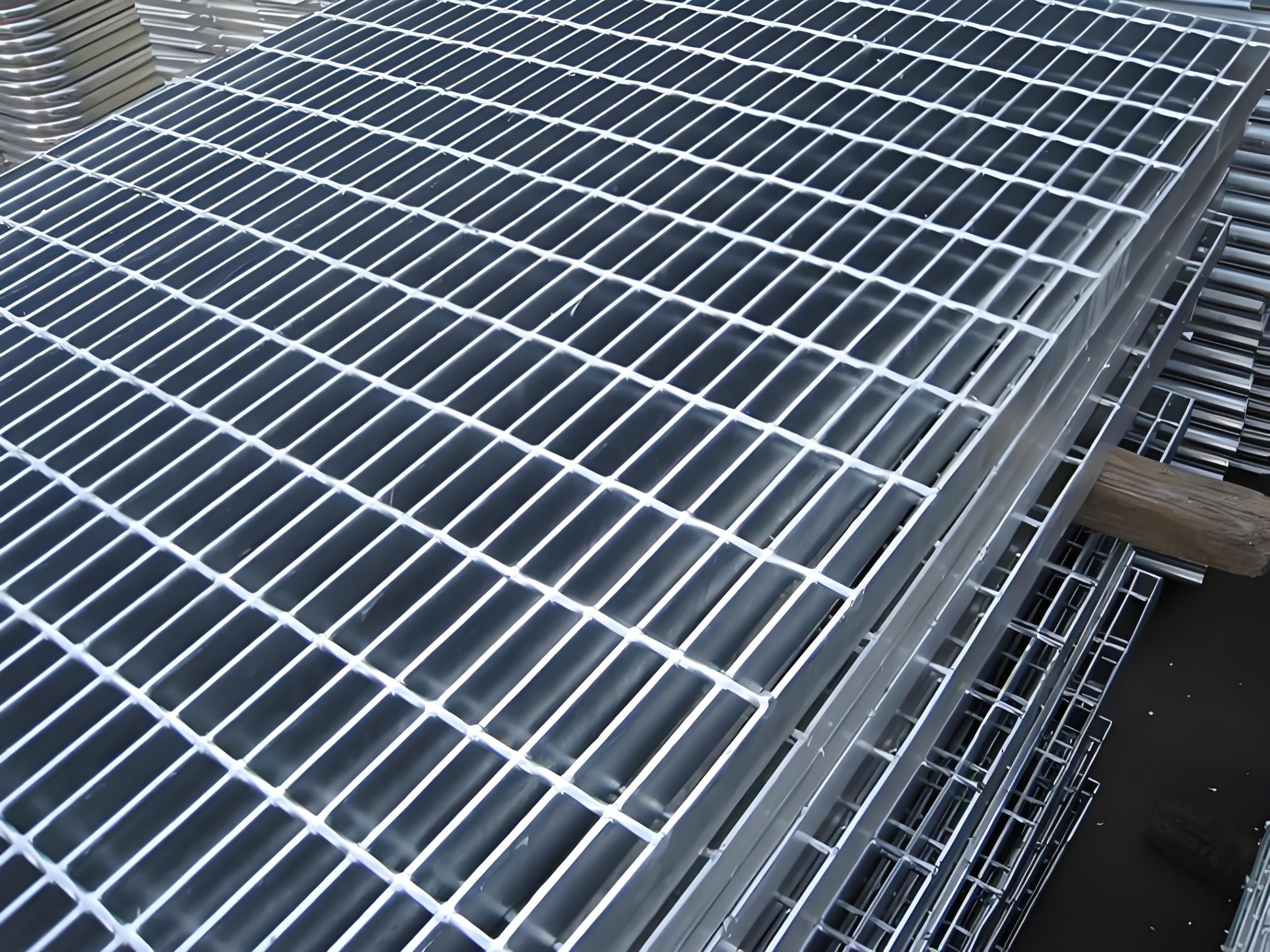
Common galvanized steel grating stock panels include widths close to 500, 600, 750, 900, 1,000, and 1,200 mm, with lengths around 3,000, 5,800, or 6,000 mm. Some factories also keep 2,000 mm and 2,440 mm lengths for smaller projects or container loading.
| Panel Format | Typical Advantage |
|---|---|
| 600 × 3,000 mm | Easy to handle and suitable for compact access routes |
| 750 × 6,000 mm | Efficient for narrow industrial walkways |
| 1,000 × 6,000 mm | Common catwalk and platform panel format |
| 1,200 × 6,000 mm | Useful for wider platforms and ramps |
| Custom cut-to-size | Best for irregular layouts, openings, and project-specific panel joints |
Stock availability can reduce lead time and price, but stock panels may not match the exact mesh, serration, coating, or panel width required. Made-to-order production allows better nesting and fitting, although it may require additional welding, galvanizing, inspection, and scheduling.
Galvanizing adds a separate production stage. For a project with many different panel sizes, the factory may need to sort, bundle, and re-identify panels before sending them to the galvanizing plant. This can increase lead time compared with a simple stock order.
Custom fabrication is often necessary when grating must fit around columns, pipes, tanks, ladders, drains, valves, and equipment. The factory quotation should separate material and fabrication charges so the buyer can understand the cost.
| Custom Work | Why It Increases Price |
|---|---|
| Straight cut-to-length | Cutting, deburring, marking, and sorting |
| Irregular cutout | CNC programming, layout, scrap, and edge finishing |
| Notching around a column or pipe | Additional measurement and possible reinforcement |
| Edge banding | Flat-bar material, welding, grinding, and galvanizing coverage |
| Toe plate | Additional plate, welding, corner details, and coating |
| Stair tread nosing | Front angle or serrated nosing, end plates, and bolt holes |
| Perimeter frame | Angle, channel, or flat-bar frame and dimensional inspection |
| Hinged or removable panel | Hinges, locks, lifting handles, and reinforcement |
Large openings should be supported by structural steel designed for the opening. A banded grating edge closes the cut bars, but it does not automatically replace a support beam. For galvanized panels, any field cutting or welding after delivery requires an approved zinc repair system.
The grating price is closely linked to the load it must carry. The important design inputs are:
Clear span is the unsupported distance between supports under the bearing bars. It is not necessarily the overall panel length. A 6,000 mm-long panel may have several intermediate beams and a clear span of only 1,000 mm. Conversely, a 2,000 mm panel may be required to bridge a 2,000 mm opening and need much heavier bars.
Load tables should be used for the exact grating type, bearing bar size, span, load direction, and deflection criterion. A 19W4 load table should not be substituted for 11W4, 19W2, or a metric mesh without confirmation. The same caution applies when comparing plain and serrated products or welded and press-locked panels.
Additional structural terminology and dimension guidance can be found in this steel grating dimensions guide.
Quantity discounts generally come from more efficient purchasing and production rather than from a lower material standard. Large orders can reduce the cost per square meter because the factory spreads machine setup, tooling, inspection, galvanizing batches, and packing over more panels.
| Order Situation | Typical Price Effect |
|---|---|
| Small order below the factory MOQ | Minimum production, cutting, or handling charge may apply |
| Standard stock panels | Lower unit price and shorter production schedule |
| Repeated identical panels | Better nesting, faster welding, and simpler inspection |
| Many different panel dimensions | Higher marking, sorting, setup, and quality-control cost |
| Project package with clips and frames | Higher total value but potentially lower combined logistics cost |
| Export container order | Lower average packing and freight cost per square meter |
Galvanized grating is normally bundled with steel straps and placed on pallets or skids. Export shipments may require timber crates, separators, edge protectors, moisture-resistant wrapping, and bundle marks. The packing method affects the number of panels that fit in a container and can influence the final delivered cost.
Before accepting a quotation, request the bundle dimensions, gross weight, number of packages, loading method, production lead time, and delivery term. Confirm whether clips, bolts, frames, stair tread fittings, and replacement zinc repair paint are included.
Use a specification-based comparison instead of looking only at the lowest price. Every offer should be checked against the following items:
| Comparison Item | Question to Ask the Supplier |
|---|---|
| Steel grade | Which carbon steel grade and material certificate are supplied? |
| Grating method | Is the panel welded, press-locked, or riveted? |
| Bearing bars | What are the exact height, thickness, pitch, and load direction? |
| Cross bars | What type, size, and spacing are used? |
| Surface | Is the grating plain or serrated, and is serration included in the price? |
| Galvanizing | Is it pre-galvanized or post-fabrication hot-dip galvanized? |
| Coating requirement | Which standard and minimum coating measurements apply? |
| Fabrication | Are cutouts, banding, notches, frames, toe plates, and holes included? |
| Load data | Is a load table or calculation supplied for the actual span? |
| Quantity and MOQ | Does the price assume a minimum order or a full container? |
| Packing and delivery | Are pallets, export wrapping, freight, and local charges included? |
A factory that receives a marked-up layout, panel schedule, load requirements, and delivery location can usually provide a more accurate quote than one receiving only the words “galvanized steel grating.” A complete quotation should also state its validity period because steel and zinc prices can change during a project.
How much does galvanized steel bar grating cost per square meter?
As a broad factory planning reference, standard plain galvanized steel grating may cost approximately US$45–85/m², serrated standard-duty grating approximately US$55–110/m², close-mesh 11W4 or 19W2 grating approximately US$65–135/m², and heavy-duty grating approximately US$90–180/m². Custom framed panels, stair treads, cutouts, and special packing can increase the price above these ranges.
Is hot-dip galvanized grating better than pre-galvanized grating?
Post-fabrication hot-dip galvanizing is generally preferred for outdoor platforms, catwalks, and industrial structures because the completed welded panel, including many edges and welds, receives zinc protection. Pre-galvanized material can be economical for light products, but welding and cutting expose areas that must be repaired. The correct choice depends on the environment, coating requirement, fabrication method, and service-life target.
What size galvanized grating do I need for a walkway?
Short-span pedestrian walkways commonly start with 25 × 3 mm or 30 × 3 mm bearing bars, while longer spans, maintenance equipment, and concentrated loads may require 32 × 5 mm, 40 × 5 mm, or heavier bars. Choose the size from a load table using the clear span, bearing direction, support width, load type, and allowable deflection rather than selecting by walkway width alone.
