

A metal grate stair tread manufacturer can supply ready-to-install stair steps for industrial platforms, outdoor access systems, towers, mezzanines, marine structures, fire escapes, commercial buildings, and custom steel stair assemblies. A complete tread normally includes the grating body, front nosing, welded end plates, bolt holes, edge banding, surface finish, and fixing details. To receive an accurate quote, buyers should provide tread width, depth, material, bearing-bar size, mesh pattern, load requirement, support span, surface treatment, quantity, and installation drawing.
A capable metal grate stair tread manufacturer should provide more than a standard rectangular grating panel. The supplier should be able to match the tread to the stair stringers, stair width, traffic load, environmental conditions, anti-slip requirement, and local project specification.
Standard stair treads are commonly manufactured from welded bar grating, press-locked grating, expanded metal, perforated metal, formed safety tread, or checker plate. They can be supplied in carbon steel, galvanized steel, aluminum, stainless steel, and other project-specific materials.
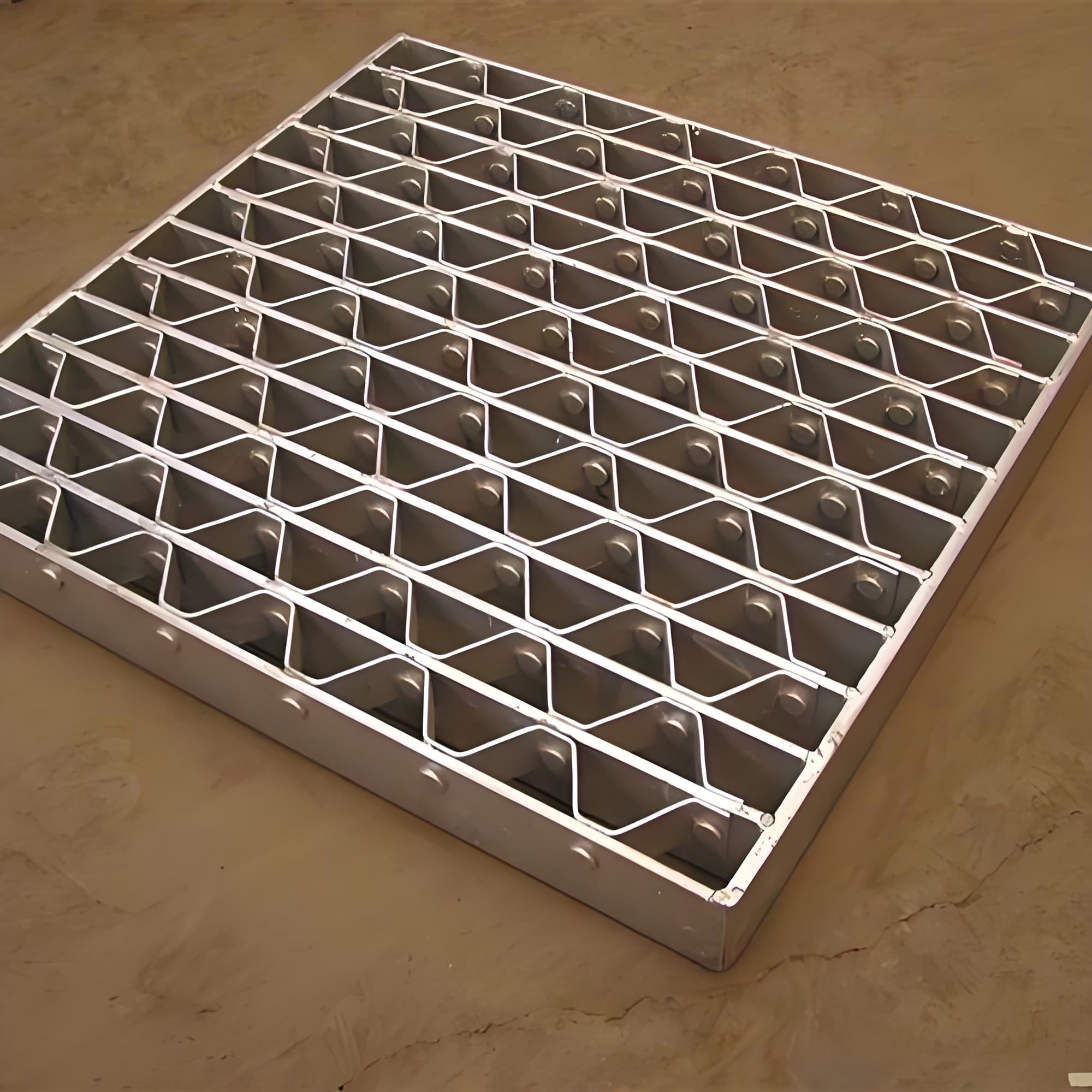
Metal grate stair treads are available in several construction styles. Each style has different drainage, strength, slip-resistance, weight, and appearance characteristics.
Bar grating stair treads are the most common option for industrial and outdoor stairs. They are made from vertical bearing bars that carry the load between stringers and cross bars that hold the panel together. The open grid allows rainwater, dirt, snow, light, and air to pass through the tread.
Bar grating treads can be welded, press-locked, or swage-locked depending on the material and product design. Welded steel bar grating is commonly used for carbon steel and galvanized stair treads. Press-locked grating can provide a cleaner appearance and more flexible mesh layouts. Aluminum bar grating is often produced with swage-locked construction.
Expanded metal stair treads are made by cutting and stretching steel sheet to form a raised mesh pattern. They can provide a lightweight, open, and slip-resistant walking surface. Expanded metal is commonly used for maintenance stairs, fire escapes, outdoor platforms, and economy-focused industrial access systems.
The structural performance of expanded metal treads depends on sheet thickness, mesh profile, tread shape, formed edge, support spacing, and any added reinforcing bars. Expanded metal should not be selected only for appearance; the manufacturer should confirm the span and load requirement.
Perforated stair treads are manufactured from sheet or plate with punched holes, slots, raised buttons, formed dimples, or serrated perforations. They can provide a more continuous walking surface than open bar grating while still allowing drainage and traction.
Perforated metal stair treads are often used in commercial buildings, food-processing sites, public-access stairs, architectural applications, and maintenance systems where small openings or improved foot support are needed.
Checker plate treads use raised diamond or chequer patterns to improve traction. Formed safety treads use punched and raised surface features that create aggressive grip. These options are useful where a more solid surface is required for small wheels, narrow equipment feet, or dropped-object control.
| Tread Type | Main Benefit | Typical Limitation | Common Use |
|---|---|---|---|
| Bar grating tread | Strong, open, drainable, and widely available. | Openings may not suit high heels or small wheels. | Industrial stairs, towers, outdoor access, platforms. |
| Press-locked grating tread | Clean appearance and flexible mesh design. | Can cost more than standard welded grating. | Architectural, commercial, and stainless steel stairs. |
| Expanded metal tread | Lightweight and open anti-slip surface. | Capacity depends strongly on sheet profile and support. | Fire escapes, maintenance stairs, light industrial access. |
| Perforated tread | Fine openings and continuous foot support. | May retain debris and need more cleaning. | Public stairs, food plants, commercial interiors. |
| Checker plate tread | Solid surface with raised anti-slip pattern. | Less drainage than open grating. | Equipment access, utility stairs, small-wheel areas. |
| Formed safety tread | Aggressive grip and lightweight formed structure. | Requires correct profile depth and support spacing. | Outdoor stairs, industrial maintenance access. |
The selected metal affects tread weight, corrosion resistance, strength, maintenance, price, and expected service life. The best material depends on whether the stair is dry, wet, outdoor, coastal, chemical-exposed, hygienic, temporary, or architecturally visible.
Carbon steel stair treads are economical and strong. They are suitable for dry indoor industrial stairs, temporary access systems, protected utility areas, and projects that will receive a separate coating system. Unprotected carbon steel can rust quickly in wet or outdoor environments.
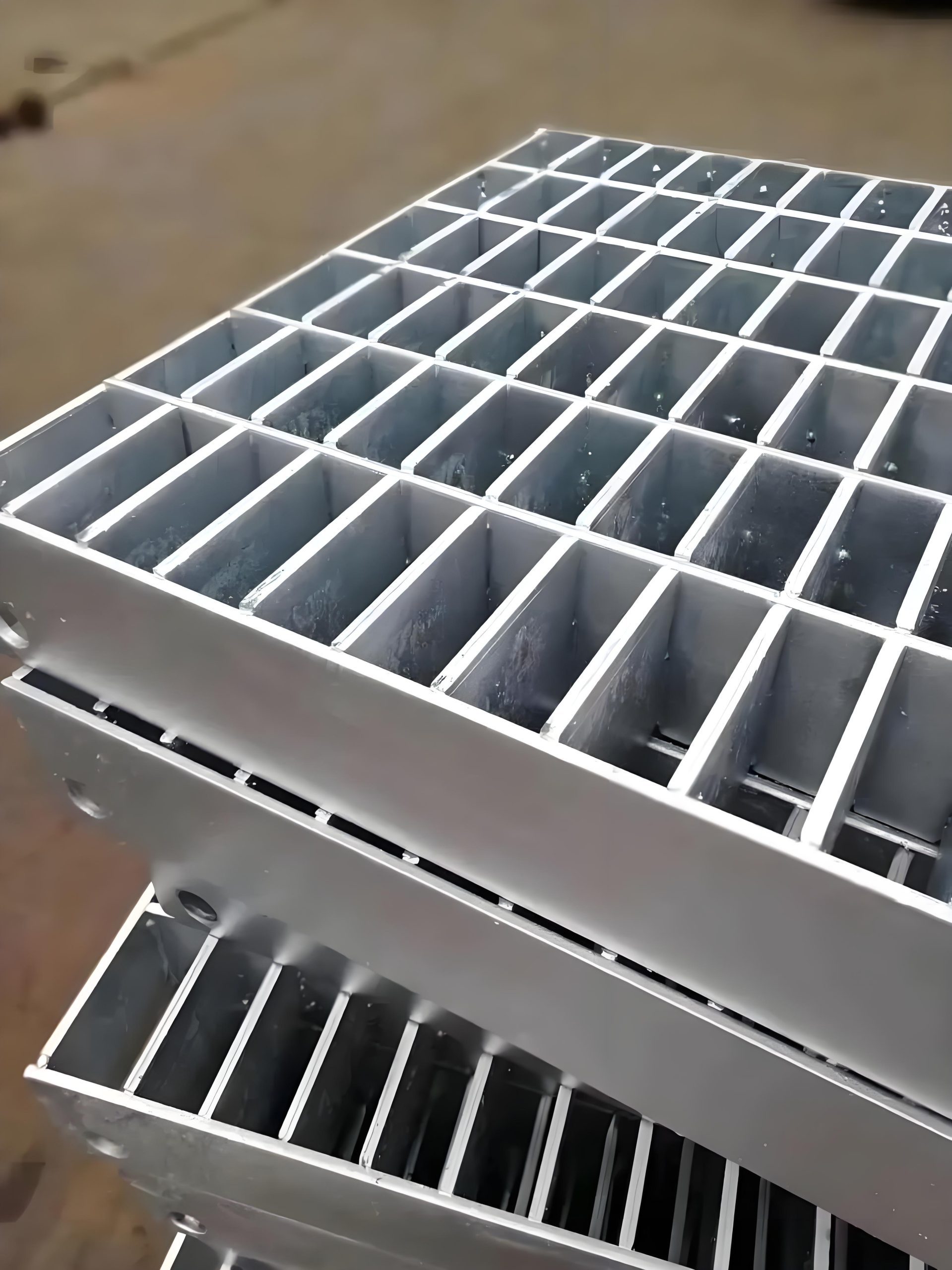
Hot-dip galvanized steel stair treads are widely used for outdoor industrial stairs, factory access platforms, utility structures, towers, catwalks, wastewater plants, and general exterior access systems. The zinc coating protects the carbon steel from corrosion in many atmospheric and industrial environments.
Hot-dip galvanizing is usually applied after the stair tread has been fabricated, welded, and fitted with end plates and nosing. This helps protect the welded joints and fabricated edges. ASTM A123/A123M covers hot-dip galvanized zinc coatings on iron and steel products, including fabricated steel products within its scope.
Aluminum stair treads are lightweight and naturally corrosion resistant. They are commonly used for roof access, marine-adjacent walkways, water-treatment plants, removable stair systems, pedestrian bridges, and structures where reduced dead load is important.
Because aluminum is more flexible than steel, tread deflection should be checked carefully. Aluminum is also not suitable for every chemical environment. Strong alkalis, some acids, and galvanic contact with dissimilar metals can affect performance.
Stainless steel stair treads are used where corrosion resistance, hygiene, cleanability, or appearance is important. Grade 304 is commonly selected for indoor washdown areas, food facilities, commercial buildings, and moderate industrial environments. Grade 316 or 316L is often selected for coastal, marine, swimming-pool, salt-exposed, and more demanding chemical environments.
| Material | Relative Cost | Corrosion Resistance | Typical Application |
|---|---|---|---|
| Carbon steel | Lowest | Low without protective coating. | Dry indoor platforms, temporary stairs, protected utility areas. |
| Hot-dip galvanized steel | Low to medium | Good for many outdoor and industrial environments. | Outdoor stairs, factories, towers, plant accessways. |
| Aluminum | Medium to high | Good atmospheric corrosion resistance. | Lightweight stairs, roof access, marine-adjacent projects. |
| 304 stainless steel | High | Good for many wet and washdown applications. | Food plants, commercial stairs, hygiene-sensitive areas. |
| 316 or 316L stainless steel | Premium | Higher resistance in many chloride and marine conditions. | Coastal, marine, pool, and chemical-process stairs. |
For bar grating stair treads, the bearing bars are the primary structural members. They should run from one stair stringer to the other. The bearing-bar depth, thickness, spacing, and clear span determine the tread strength and deflection.
Common carbon steel and stainless steel bearing-bar sizes include 20 mm × 3 mm, 25 mm × 3 mm, 30 mm × 3 mm, 30 mm × 5 mm, 32 mm × 5 mm, 40 mm × 3 mm, 40 mm × 5 mm, and custom heavy-duty sizes. Larger bar sizes increase load capacity but also increase tread weight, galvanizing cost, freight, and price.
Typical metric grating patterns include 25 mm × 100 mm, 30 mm × 100 mm, 30 mm × 50 mm, 32 mm × 100 mm, and 40 mm × 100 mm. The first dimension usually describes bearing-bar spacing, while the second describes cross-bar spacing.
| Grating Pattern | Typical Characteristic | Common Use |
|---|---|---|
| 25 mm × 100 mm | Close bearing-bar spacing and improved foot support. | Walkways, stair treads, close-mesh industrial access. |
| 30 mm × 100 mm | Common open industrial mesh. | Outdoor stairs, platforms, general factory access. |
| 30 mm × 50 mm | Closer cross-bar spacing with more contact points. | Public-use stairs, equipment areas, close-mesh requirements. |
| 32 mm × 100 mm | Common metric industrial grating pattern. | Standard platforms, maintenance stairs, access towers. |
| 40 mm × 100 mm | More open mesh with reduced material content. | Low-traffic industrial stairs where drainage is important. |
| Custom close mesh | Smaller openings for special safety or architectural needs. | High-heel, small-tool, commercial, and public-access areas. |
A manufacturer needs the clear span between stringers, design load, tread width, and deflection requirement to select the correct bearing bar. A 25 mm × 3 mm bearing bar may be suitable for a short-span pedestrian tread, while a wider tread or heavier industrial application may need 30 mm × 5 mm, 40 mm × 5 mm, or a deeper structural profile.
The wrong bearing-bar direction can greatly reduce tread capacity. The bars should be positioned so they span across the stair width from one support to the other, not from front to back unless the stair frame has been designed for that arrangement.
Slip resistance is a major factor in metal stair tread selection. Stairs are more sensitive to water, oil, frost, dust, mud, chemical residue, and debris than level platforms because users place weight on the front edge while moving downward.
Serrated grating treads have notched upper edges on the bearing bars. The notches improve grip for work boots and are commonly used for outdoor industrial stairs, oil and gas sites, marine platforms, towers, wastewater plants, loading areas, and emergency access systems.
Plain bar grating has smooth bearing-bar tops. It is suitable for dry, clean, controlled environments and may be easier to wash down than serrated grating. It is often selected for indoor industrial areas, commercial applications, and locations where aggressive serrations are not necessary.
The correct anti-slip surface should balance safety with cleaning requirements. A highly aggressive serrated surface can offer excellent traction outdoors, but a food-processing area may require a surface that is easier to wash and less likely to retain residue.
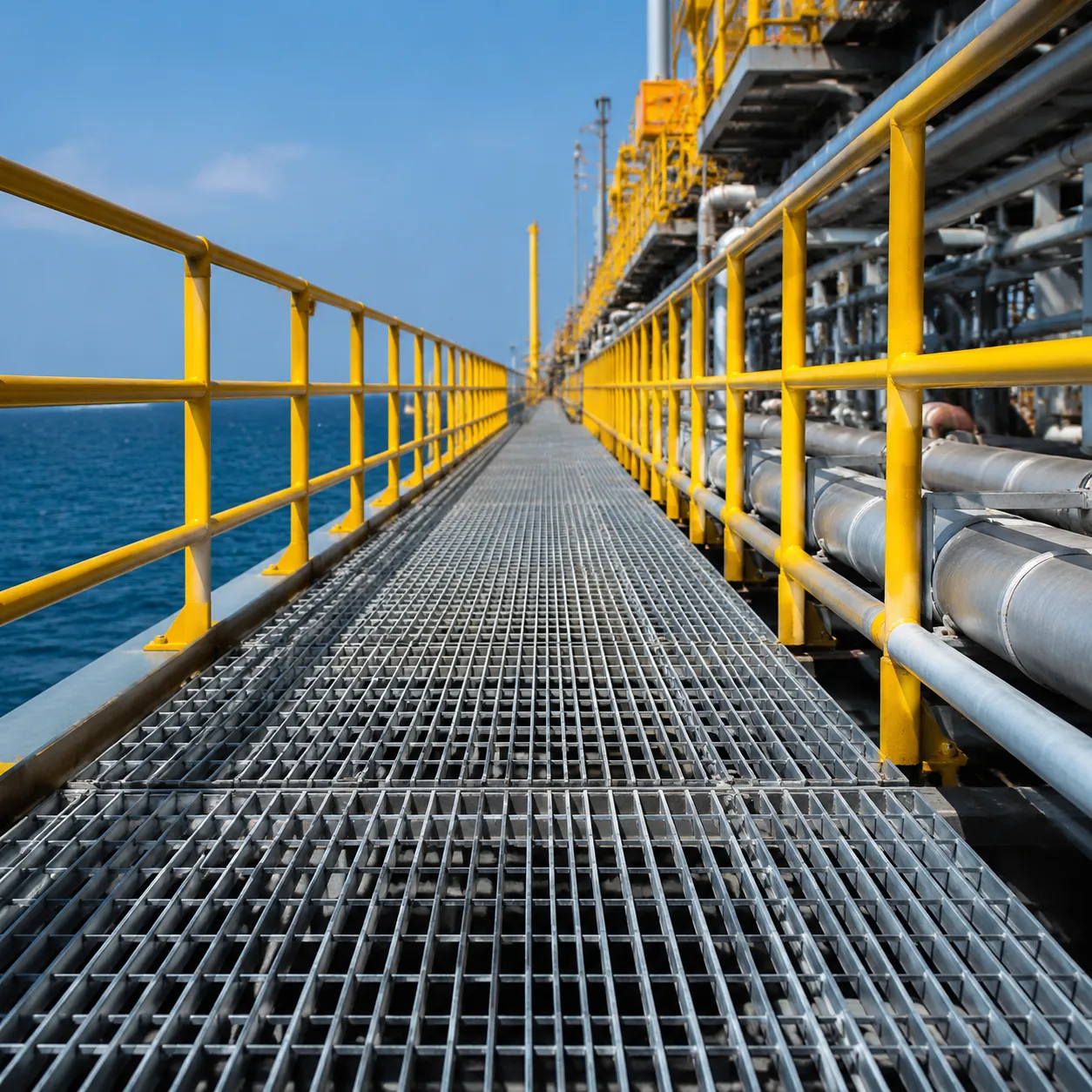
Standard metal grate stair treads are usually manufactured in common widths and depths, but custom fabrication is available for special stair layouts. The manufacturer should know the overall stair geometry before confirming the final tread dimensions.
| Dimension | Common Sizes | Selection Consideration |
|---|---|---|
| Tread width | 600 mm, 700 mm, 800 mm, 900 mm, 1000 mm, 1200 mm | Must match stringer spacing, user traffic, and required stair width. |
| Tread depth | 240 mm, 250 mm, 270 mm, 300 mm | Must suit the stair rise, angle, local code, and safe foot placement. |
| Front nosing | 25 mm, 30 mm, 40 mm, 50 mm, or custom | Improves leading-edge visibility, stiffness, and traction. |
| End plate height | Usually matched to bearing-bar depth | Provides connection to stringers and supports the tread ends. |
| End plate thickness | 3 mm, 5 mm, 6 mm, or custom | Must suit the bolt connection and applied load. |
| Bolt hole diameter | 11 mm, 13 mm, 14 mm, or custom | Must match bolt size and installation tolerance. |
Custom fabrication limits are influenced by material weight, bearing-bar span, galvanizing-kettle size, available sheet size, transport width, handling equipment, and the ability to keep the finished tread flat after welding. Very wide or heavy treads may require stronger end plates, additional support, custom frames, or division into multiple sections.
For U.S. general-industry stairs within the scope of OSHA 1910.25, standard stairs are installed at angles between 30 and 50 degrees from horizontal, with a maximum riser height of 9.5 in, a minimum tread depth of 9.5 in, and a minimum width of 22 in between vertical barriers. Local building codes can have different requirements, so these figures should not be used as a universal global stair design rule.
The grating manufacturer supplies the tread, but the owner, designer, contractor, and local authority are responsible for ensuring that the complete stairway—including stringers, landings, risers, handrails, guards, headroom, and fixing—meets the applicable code.
Metal grate stair treads must be selected according to the actual load and support conditions. The manufacturer should not select a tread only from its outside dimensions. A 900 mm-wide industrial tread carrying workers and tools needs a different design from a narrow maintenance stair or a public commercial stair.
Industrial stairs may carry workers in safety boots, hand tools, maintenance equipment, hoses, replacement parts, and occasional concentrated loads. Outdoor industrial stairs may also experience snow, ice, vibration, and corrosion. Serrated galvanized steel or stainless steel grating treads are common choices where drainage and grip are important.
Commercial stairs may serve employees, visitors, customers, or the public. They may need closer mesh, smaller openings, smoother surface finishing, better edge visibility, and more controlled tread dimensions. Public stairs may also need to consider accessibility, footwear types, cleaning, and architectural appearance.
Outdoor stairs should account for rain, ice, wind-driven debris, mud, and corrosion. Marine stairs may need 316 stainless steel, aluminum, FRP, or specialized coated steel depending on chloride exposure and support materials. The fastening system should be suitable for vibration, wind uplift, and corrosive conditions.
For general-industry stairs within OSHA scope, each stair must support at least five times the normal anticipated live load and never less than a 1,000 lb concentrated load applied at any point. This is a system-level requirement for the installed stair, not a substitute for proper engineering of individual treads and stringers. Refer to OSHA 1910.25 for current requirements and scope.
Nosing, end plates, and fixing holes determine how a metal grate stair tread connects to the stair structure. These details should be shown on the approved drawing before fabrication begins.
The front nosing creates a stronger, more visible leading edge. Common nosing options include checker plate angle nosing, flat-bar nosing, serrated angle nosing, formed safety nosing, and custom folded plate nosing.
A checker plate angle nosing is a common choice for metal bar grating treads because it stiffens the front edge and provides a visible step line. Serrated nosing can improve traction in wet and outdoor conditions.
End plates, also called carrier plates, are welded to the open ends of the bearing bars. They provide the connection between the tread and the stair stringers. The end-plate height normally matches or exceeds the bearing-bar depth so the tread can transfer load effectively to the supports.
| Fixing Type | Typical Use | Benefit |
|---|---|---|
| Round bolt holes | Standard stair stringer connections. | Simple, secure, and economical fixing method. |
| Slotted bolt holes | Projects needing installation tolerance. | Allows minor adjustment for field-fit conditions. |
| Bolted end plates | Removable and replaceable tread systems. | Supports easy maintenance and future replacement. |
| Welded connection | Permanent industrial stairs. | Rigid connection with no visible fasteners. |
| Clip or clamp fixing | Special access stairs and removable grating assemblies. | Useful where drilling or welding is restricted. |
| Custom brackets | Towers, tanks, curved stairs, and modular structures. | Adapts the tread to non-standard support geometry. |
Bolts, washers, clips, and anchors should match the environment. Galvanized bolts are common for galvanized steel treads, while stainless steel fasteners may be required for stainless steel or corrosive environments. The supplier should identify whether fasteners are included in the quote.
Surface treatment protects the tread and can improve appearance. The required finish should be selected according to indoor or outdoor exposure, corrosion risk, maintenance access, expected service life, and project budget.
Hot-dip galvanizing is the standard corrosion-protection option for many carbon steel stair treads. It is suitable for outdoor industrial access, factory stairs, towers, platforms, utility plants, and general wet environments.
Galvanizing should normally be completed after welding, end-plate fitting, nosing installation, and final fabrication. The supplier should confirm whether the treads will be galvanized to ASTM A123/A123M, ISO 1461, or another required project standard.
Powder coating can provide color, decorative finish, and additional barrier protection. It is often used for architectural stairs, indoor commercial access systems, and controlled outdoor environments. Powder coating can be damaged by impact, abrasion, or field cutting, so edge treatment and maintenance should be considered.
Painted steel treads can be economical for dry indoor locations or temporary installations. Paint systems vary in thickness, durability, and corrosion resistance. Painted carbon steel is usually less suitable than galvanizing for long-term outdoor industrial exposure unless a properly designed coating system is used.
Aluminum can be supplied with mill finish, anodized finish, or powder coating. Stainless steel can be supplied with mill finish, pickled finish, passivated finish, brushed finish, or polished finish depending on the project requirements.
Custom metal grate stair treads are often required when the stair has non-standard stringer spacing, curved geometry, pipe interference, landing connections, handrail posts, equipment supports, or special safety requirements.
An approved drawing should show the tread width, depth, bearing-bar orientation, mesh pattern, nosing, end plates, bolt holes, support location, and all cut-outs. It should also identify the quantity and position of every tread in the stair assembly.
For large projects, marking each tread with a drawing reference can reduce installation errors. This is especially useful when a stair includes several widths, landing panels, pipe cut-outs, or left-hand and right-hand end-plate configurations.
Metal grate stair treads are structural access components, so quality control should include material verification, dimensional inspection, weld inspection, surface-finish inspection, and packing checks.
For project-controlled orders, the manufacturer should be able to provide material information for carbon steel, galvanized steel, aluminum, stainless steel, or other specified materials. Stainless steel projects may require a material test certificate, heat-number traceability, or positive material identification testing.
Welded bar grating and stair treads should have secure connections between bearing bars, cross bars, end plates, nosing, and any custom reinforcement. Welds should be checked for completeness, distortion, sharp edges, surface contamination, and compatibility with the required coating or finish.
The NAAMM Metal Bar Grating Division publishes current technical guidance, including the ANSI/NAAMM MBG 531-24 Metal Bar Grating Manual and welding standards for fabrication of steel, stainless steel, and aluminum bar grating. These references are useful when a project requires established grating practices and technical documentation.
Typical inspection items include tread width, tread depth, bearing-bar direction, mesh spacing, nosing alignment, end-plate height, end-plate thickness, bolt-hole diameter, hole spacing, overall flatness, and edge condition.
Galvanized treads should be checked for coating coverage and handling damage. Powder-coated treads should be inspected for scratches and exposed steel. Stainless steel treads should be protected from carbon steel contamination, surface scratches, and welding discoloration where a specified finish is required.
Export packing should keep treads stable during transport. Bundles should be marked clearly, protected from rubbing, and packed to suit forklift handling, container loading, and site installation.
The fastest way to receive an accurate quotation is to provide a complete technical request. A price based only on “metal grating stair treads” may not include the correct material, load capacity, nosing, end plates, coating, or fixing details.
“Please quote hot-dip galvanized serrated welded steel grating stair treads for an outdoor industrial stair. Tread width: 900 mm. Tread depth: 270 mm. Bearing bars: 30 mm × 3 mm at 30 mm centers. Cross bars: 100 mm centers. Bearing bars to span 900 mm between stringers. Include checker plate angle nosing, 65 mm × 5 mm end plates, two 14 mm bolt holes per end plate, four-side edge banding where required, and hot-dip galvanizing after fabrication. Quantity: 80 pieces. Please state finished weight per tread, coating standard, packing, lead time, FOB price, and optional fastener price.”
What information do I need for a metal stair tread quote?
Provide the material, tread width, tread depth, clear span between stringers, bearing-bar size, mesh pattern, surface type, nosing design, end-plate holes, load requirement, finish, quantity, drawing, and delivery destination. This allows the manufacturer to quote the correct tread rather than an unsuitable standard panel.
Are serrated metal grate stair treads safer?
Serrated metal grate stair treads usually provide better slip resistance in wet, oily, muddy, icy, and outdoor conditions. They are commonly used for industrial stairs, towers, platforms, marine access, and emergency exits. Plain treads can be suitable for dry or hygiene-sensitive areas where easier cleaning is important.
Can metal grate stair treads be custom made?
Yes. Metal grate stair treads can be customized by width, depth, bearing-bar size, mesh opening, nosing, end plates, bolt holes, cut-outs, material, finish, and load capacity. Custom drawings are especially important for curved stairs, tank stairs, unusual stringer spacing, pipe openings, and large industrial stair systems.