

Carbon steel stair treads are widely used for industrial stairs, factory platforms, maintenance access routes, warehouses, power plants, outdoor service stairs, water treatment facilities, and equipment platforms. They offer high strength, flexible fabrication, and competitive pricing compared with stainless steel or aluminum. Common configurations include welded bar grating treads with 25 × 3 mm, 30 × 3 mm, 32 × 5 mm, or 40 × 5 mm bearing bars, usually fitted with nosing and end plates for bolted installation. The final price depends on tread size, steel weight, bearing bar specification, surface type, fabrication detail, coating, quantity, and delivery requirements.
Carbon steel stair treads are prefabricated steps made from carbon steel bar grating, perforated safety plank, checker plate, expanded metal, or fabricated steel plate. In industrial applications, welded bar grating stair treads are among the most common because they provide high load capacity, open drainage, and anti-slip surface options.
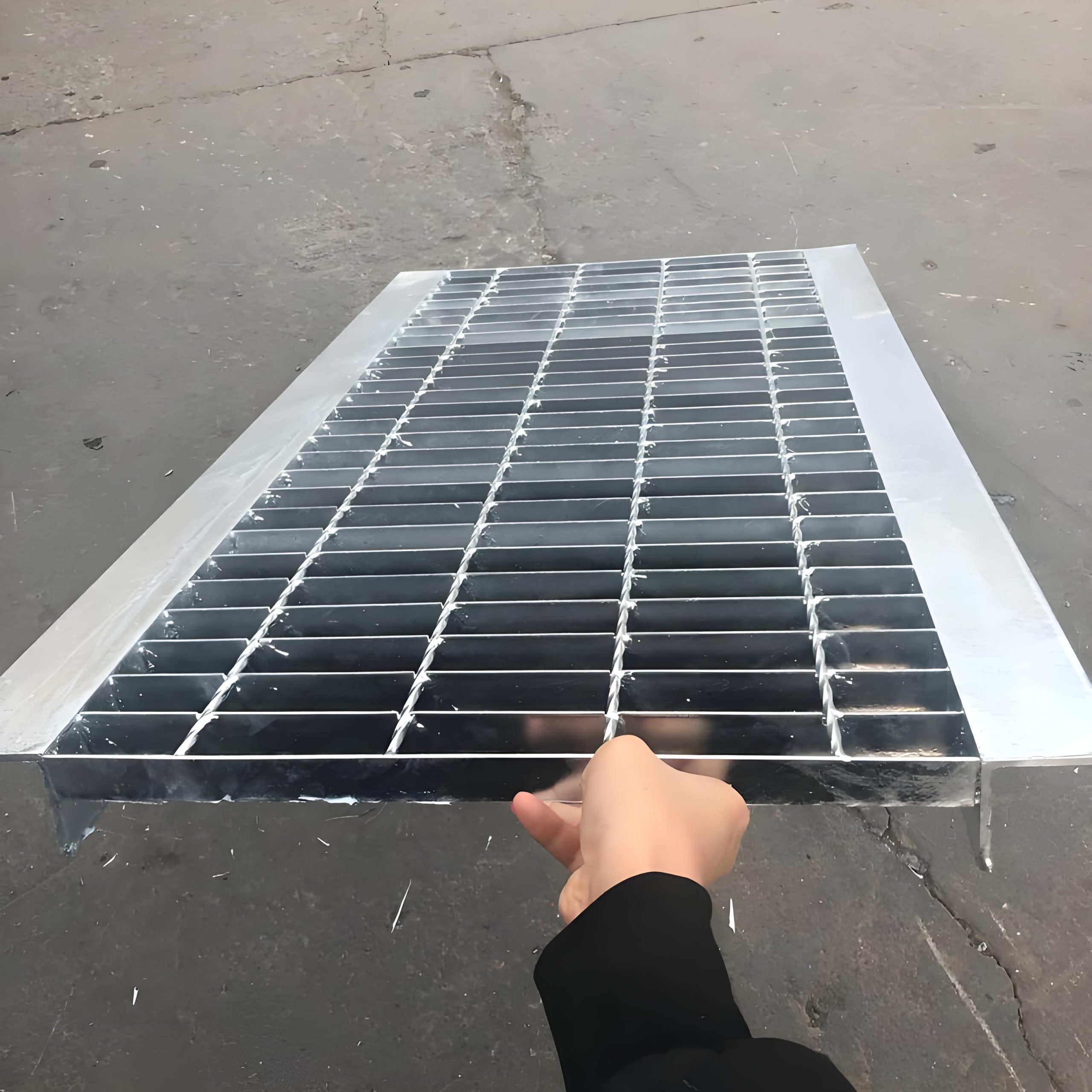
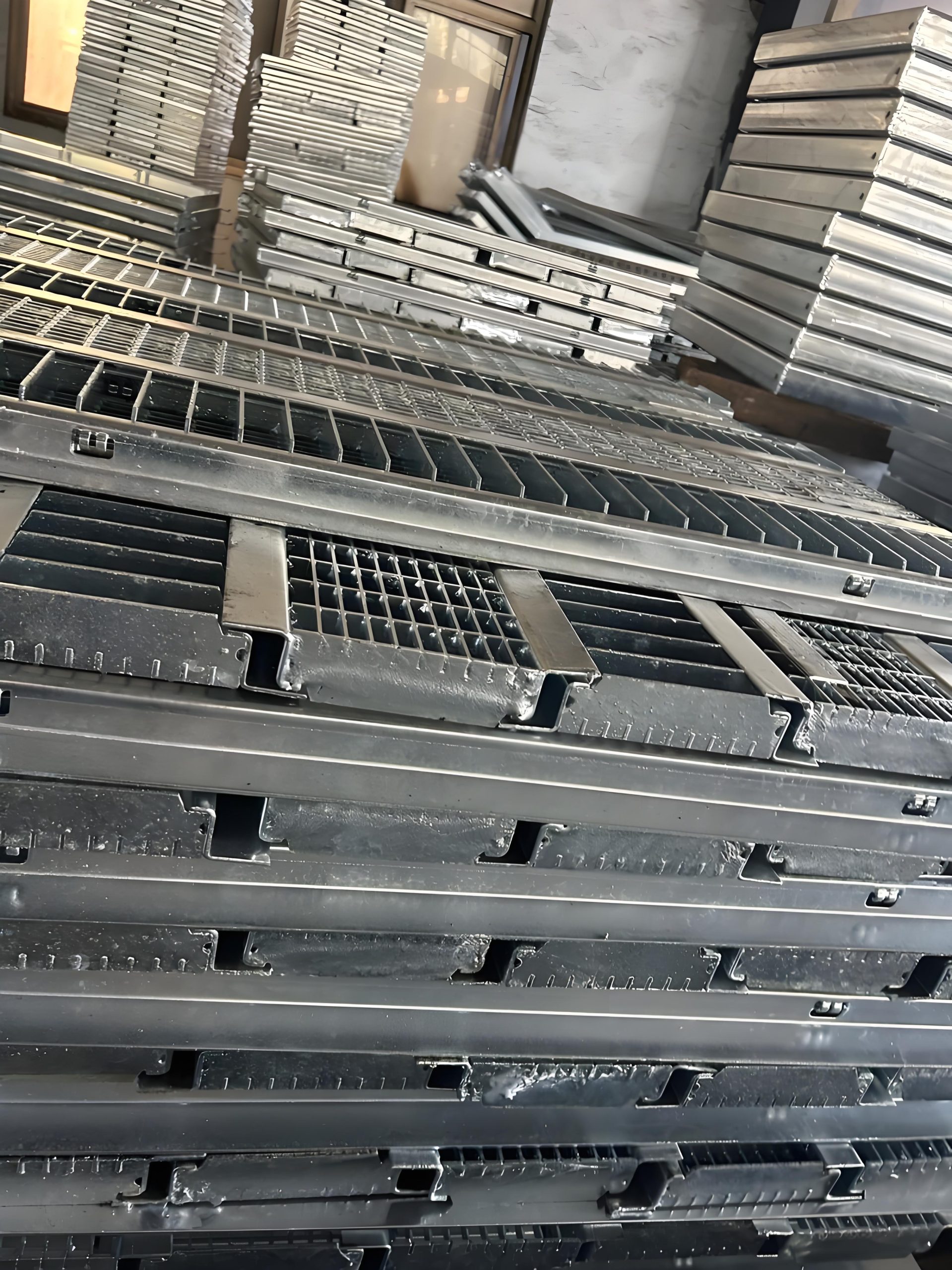
A standard carbon steel bar grating stair tread normally includes bearing bars, cross bars, a front nosing, and two end plates. The bearing bars span between the stair stringers and carry the main load. Cross bars connect the bearing bars and maintain the mesh pattern. End plates transfer the load into the stair stringers and provide bolt holes or slots for fixing.
FixingsSecure the tread to the stair stringers or support frame
| Component | Function |
|---|---|
| Bearing bars | Carry the main load between stair stringers |
| Cross bars | Connect bearing bars and form the grating mesh |
| Nosing | Reinforces the front edge and improves visibility and traction |
| End plates | Provide mounting strength and bolt-hole locations |
| Surface treatment | Protects the tread from corrosion and improves appearance |
Carbon steel stair treads are a practical choice where strength, long service life, and cost control are important. They can be supplied as black steel, painted steel, powder-coated steel, or hot-dip galvanized steel depending on the environment.
Carbon steel grating treads are commonly used on industrial platforms, machinery access stairs, tank stairs, pipe rack stairs, maintenance towers, utility structures, warehouses, and processing plants.
Hot-dip galvanized carbon steel treads are widely used for outdoor stairs because the zinc coating protects the steel from rain, moisture, and many normal industrial environments. Serrated surfaces are often selected where mud, snow, ice, or rainwater may affect traction.
Carbon steel stair treads are often installed on mezzanine stairs, storage platforms, loading areas, and equipment rooms. Standard-duty welded bar grating is normally suitable for many indoor applications when the support span and load are correctly verified.
Galvanized carbon steel stair treads are commonly used in water treatment plants, pumping stations, utility platforms, drainage areas, and outdoor access routes. In highly corrosive chemical environments, stainless steel, aluminum, or FRP may be a better long-term choice.
Equipment platformsCustom-cut and banded steel treadsCoordinate holes, clips, and stringer spacing
| Application | Typical Carbon Steel Tread Option | Important Requirement |
|---|---|---|
| Indoor factory stairs | Black steel, painted, or powder-coated grating | Check load capacity and tread uniformity |
| Outdoor maintenance stairs | Serrated hot-dip galvanized grating | Drainage and corrosion protection |
| Warehouse mezzanine | Standard-duty welded bar grating | Confirm support span and pedestrian load |
| Water treatment plant | Galvanized serrated treads | Wet conditions and corrosion exposure |
| Oil and gas access stairs | Galvanized serrated treads with anti-slip nosing | Oil, weather, vibration, and safety requirements |
There is no single universal carbon steel stair tread size. Standard sizes vary by region, manufacturer, stair geometry, stringer spacing, load requirement, and local safety rules. Most grating stair treads are supplied in common dimensions or fabricated to the approved project drawing.
For metric projects, common tread lengths range from 600 mm to 1200 mm. Tread depth commonly ranges from 240 mm to 305 mm. The tread length normally corresponds to the span between the stair stringers, while tread depth refers to the front-to-back stepping surface.
| Common Tread Length × Depth | Typical Application | Selection Note |
|---|---|---|
| 600 × 240 mm | Compact maintenance stairs | Check clear-width requirements before use |
| 700 × 240 mm | Narrow equipment access stairs | Useful where installation space is limited |
| 800 × 240 mm | General industrial access stairs | Common compact tread size |
| 900 × 240 mm | Factory and warehouse stairs | Provides a wider clear walking area |
| 800 × 270 mm | General service stairs | Balanced tread depth for industrial use |
| 900 × 270 mm | Industrial platforms and maintenance routes | Common choice for regular personnel access |
| 1000 × 270 mm | Wide access stairs | Check bearing bar capacity for full span |
| 1000 × 300 mm | Comfortable industrial stairway | Confirm whether depth includes the nosing |
| 1200 × 300 mm | Wide service stairs and major access routes | May need heavier bearing bars or extra support |
For North American projects, common stair tread lengths include 24, 30, 36, 42, and 48 inches. Common tread depths include approximately 9-3/4 inches, 10-15/16 inches, and 12-1/8 inches, depending on the bar grating pattern and manufacturer.
The tread drawing should state whether the quoted length includes the end plates. Carrier plate thickness can affect the final overall span dimension, so it should be accounted for before ordering replacement treads.
Bearing bars are the main load-carrying elements in a carbon steel grating stair tread. Their depth and thickness affect strength, stiffness, weight, corrosion allowance, and price.
| Bearing Bar Size | Typical Duty | Common Use |
|---|---|---|
| 25 × 3 mm | Light to standard duty | Short-span maintenance treads |
| 25 × 5 mm | Medium duty | Short spans requiring thicker steel |
| 30 × 3 mm | Standard duty | General industrial stairs |
| 30 × 5 mm | Medium to heavy duty | Higher traffic and concentrated loads |
| 32 × 3 mm | Standard duty | Metric industrial access systems |
| 32 × 5 mm | Medium duty | Longer spans or lower deflection limits |
| 40 × 3 mm | Medium duty | Longer-span steel stair treads |
| 40 × 5 mm | Heavy duty | High-load and long-span access routes |
| 50 × 5 mm or larger | Heavy duty | Special industrial or engineered applications |
| Imperial Size | Approximate Metric Size | Typical Use |
|---|---|---|
| 3/4 × 1/8 in | 19 × 3 mm | Light-duty short-span grating |
| 3/4 × 3/16 in | 19 × 5 mm | Standard light industrial treads |
| 1 × 3/16 in | 25 × 5 mm | General industrial stair treads |
| 1-1/4 × 3/16 in | 32 × 5 mm | Common standard-duty tread section |
| 1-1/2 × 3/16 in | 38 × 5 mm | Longer spans and heavier service |
| 1-1/2 × 1/4 in | 38 × 6 mm | Medium to heavy-duty access stairs |
| 2 × 1/4 in | 51 × 6 mm | Heavy-duty and long-span treads |
Increasing bearing bar depth usually improves stiffness more effectively than increasing thickness alone. However, thickness improves strength, corrosion allowance, impact resistance, and weld area. The final bearing bar size should be selected from the correct load table or engineering calculation.
Tread length is normally the span between stair stringers. The bearing bars should run parallel to this direction and be supported at both ends. A longer tread span generally requires deeper or thicker bearing bars.
Tread depth is the front-to-back dimension in the direction of travel. Common industrial grating depths include 240 mm, 250 mm, 270 mm, 280 mm, 300 mm, and 305 mm.
The quoted grating depth is not always the same as the code-defined tread depth. Some regulations measure the horizontal usable depth between the leading edges of adjacent treads. A projecting or sloped nosing may not count fully toward the required tread depth.
Carbon steel stair treads are often supplied with a 90-degree angle nosing at the front edge. Checkered plate nosing is common because it reinforces the leading edge and improves visibility.
Typical nosing profiles may use equal or unequal legs, often in the range of approximately 30 to 50 mm, with thicknesses commonly around 3 to 5 mm. Final nosing dimensions should be selected according to tread depth, bearing bar size, exposure conditions, and stair design.
Carrier plates, also called end plates, are welded to both ends of the tread. They close the bearing bar ends and provide fixing holes or slots for bolting the tread to the stringers.
As one common industry example, 2-1/2 inch high carrier plates are often used with carbon steel grating bearing bars from 3/4 inch to 1-1/4 inch high, while 3 inch high carrier plates are commonly used with bearing bars from 1-1/2 inch to 2-1/2 inch high. Actual end plate size, thickness, holes, and edge distances should follow the approved tread drawing.
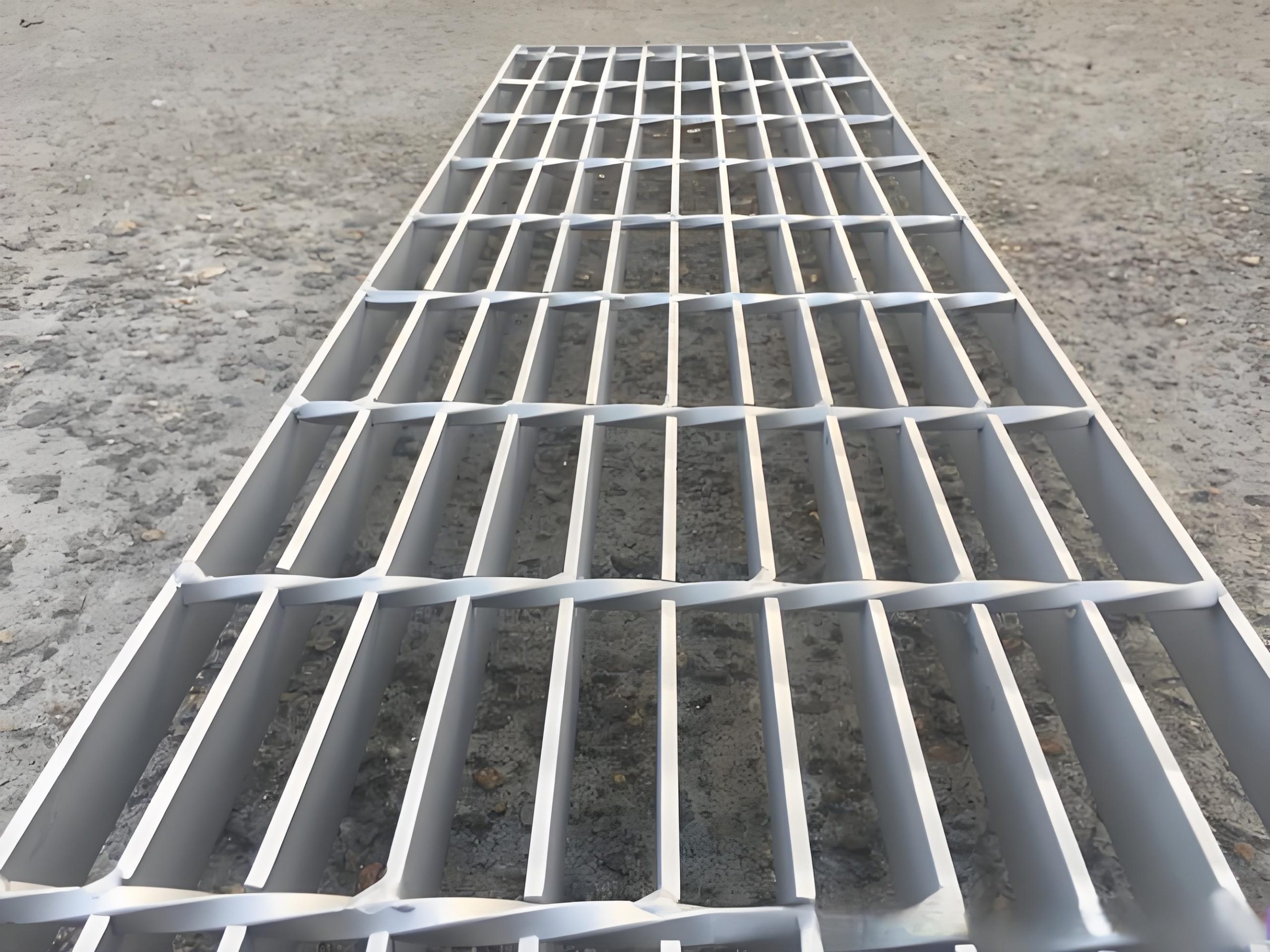
Cross bars connect the bearing bars and maintain the grating mesh. In welded carbon steel grating, twisted square cross bars are commonly resistance-welded to the bearing bars.
| Mesh Pattern | Bearing Bar Pitch | Cross Bar Pitch | Typical Use |
|---|---|---|---|
| 25/100 mm | 25 mm | 100 mm | Close bearing bar spacing with standard cross bars |
| 30/50 mm | 30 mm | 50 mm | Closer mesh and more cross bar support |
| 30/100 mm | 30 mm | 100 mm | General industrial stair tread pattern |
| 32/100 mm | 32 mm | 100 mm | Common metric industrial configuration |
| 40/50 mm | 40 mm | 50 mm | More open bearing bar spacing with closer cross bars |
| 40/100 mm | 40 mm | 100 mm | Light to standard-duty open grating |
A common North American designation is 19-W-4.
A 19-W-4 carbon steel tread with 1 inch × 3/16 inch bearing bars is a commonly supplied industrial configuration. The complete specification should also identify whether the surface is plain or serrated, the nosing profile, end plates, material finish, and tread dimensions.
The finished tread weight is important for pricing, freight, manual handling, installation, and structural dead-load calculations. It includes the grating body, nosing, end plates, welds, and any permanent accessories.
The following chart provides preliminary carbon steel tread weights for a typical configuration using 30 × 3 mm bearing bars at approximately 30 mm spacing, cross bars at approximately 100 mm spacing, a standard steel nosing, and two 3 mm thick end plates. It is intended for estimating only and should not replace the manufacturer’s finished weight.
| Tread Size | Estimated Uncoated Carbon Steel Weight | Approximate Weight in Pounds |
|---|---|---|
| 600 × 240 mm | Approximately 5.6 kg | Approximately 12.3 lb |
| 700 × 240 mm | Approximately 6.4 kg | Approximately 14.1 lb |
| 800 × 240 mm | Approximately 7.2 kg | Approximately 15.9 lb |
| 900 × 240 mm | Approximately 8.1 kg | Approximately 17.9 lb |
| 1000 × 240 mm | Approximately 8.9 kg | Approximately 19.6 lb |
| 600 × 270 mm | Approximately 6.2 kg | Approximately 13.7 lb |
| 800 × 270 mm | Approximately 8.0 kg | Approximately 17.6 lb |
| 900 × 270 mm | Approximately 8.9 kg | Approximately 19.6 lb |
| 1000 × 270 mm | Approximately 9.8 kg | Approximately 21.6 lb |
| 1200 × 270 mm | Approximately 11.5 kg | Approximately 25.4 lb |
| 800 × 300 mm | Approximately 8.7 kg | Approximately 19.2 lb |
| 1000 × 300 mm | Approximately 10.6 kg | Approximately 23.4 lb |
| 1200 × 300 mm | Approximately 12.6 kg | Approximately 27.8 lb |
Hot-dip galvanized treads normally weigh slightly more than black steel treads because zinc is added to the surface. A tread made from 40 × 5 mm bearing bars will weigh significantly more than the values shown above. Serrated surfaces may remove a small amount of metal, but the finished weight difference is usually minor compared with the effect of bar size, nosing, end plates, and coating.
Finished tread weight = grating body weight + nosing weight + two end plate weights + permanent accessories + coating allowance
For preliminary estimating:
Grating body weight = tread length × tread depth × grating unit weight
Factory quotations should use the finished fabricated weight, especially when freight, lifting, export packing, or large quantities are involved.
Carbon steel stair treads must be selected according to the actual support span and load requirement. A tread that appears strong may deflect excessively if the bearing bars are too shallow, too thin, or installed across an unsupported span that is too long.
For applicable United States general-industry workplaces, OSHA 29 CFR 1910.25 requires each stair to support at least five times the normal anticipated live load and not less than a 1,000 pound concentrated load applied at any point.
For standard stairs within the regulation’s scope, OSHA also includes requirements for tread depth, riser height, stair width, angle, landings, handrails, and uniformity. These requirements apply to the complete installed stairway, not just to the grating tread supplied by a manufacturer.
Clear span is the unsupported distance between the stair stringers or other supports. The bearing bars should span directly between these supports. As the span increases, stress and deflection increase.
Load selection should include both strength and deflection. A tread may stay below the steel yield limit but still feel unstable if it deflects too much. Excessive deflection can also loosen bolts, damage coatings, and create uneven tread edges.
| Information Needed | Why It Matters |
|---|---|
| Clear stringer spacing | Defines bearing bar span |
| Bearing bar direction | Confirms correct structural orientation |
| Uniform load | Represents normal stair traffic |
| Concentrated load | Checks local force from people and equipment |
| Deflection limit | Controls stair stability and comfort |
| Material and surface type | Ensures the correct load table is used |
| End plate and fixing detail | Confirms load transfer to the stringers |
Plain grating treads have smooth bearing bar tops. They are economical, easier to clean, and often suitable for dry indoor areas where water, oil, mud, and ice are not expected.
Serrated treads have notches along the top of the bearing bars. The serrations create additional gripping edges and can improve traction in wet, oily, muddy, icy, or outdoor environments.
Serrated treads are commonly selected for outdoor stairs, water treatment plants, oil and gas facilities, utility access, industrial platforms, and locations exposed to rain or process liquids.
Checkered plate nosingGeneral industrial stairsReinforced visible leading edgeMay need serrated bars in severe conditions
| Surface Type | Best Environment | Main Benefit | Main Consideration |
|---|---|---|---|
| Plain grating | Dry and clean indoor areas | Lower cost and easier cleaning | Lower traction when wet or oily |
| Serrated grating | Wet, muddy, oily, icy, or outdoor areas | Improved grip across the tread | Requires correct serrated load data |
| Abrasive nosing | High slip-risk areas | High traction and visual contrast | Surface can wear and require replacement |
Black carbon steel is the lowest-cost material option. It is suitable for dry indoor installations or projects where the entire stair system will receive a specified paint coating after fabrication.
Painted steel treads can provide color coding, visual identification, and corrosion protection in controlled environments. The coating system should match the expected exposure. A basic shop primer is not the same as a long-life exterior paint system.
Powder coating provides a durable and visually consistent finish. It is commonly used for interior stairs, warehouses, commercial areas, and protected exterior access systems. Surface preparation is important for coating adhesion and long-term performance.
Hot-dip galvanizing is widely used for outdoor carbon steel stair treads. The tread is fabricated first, then coated with zinc after welding, drilling, and edge banding are complete.
For fabricated steel products, ASTM A123/A123M-24 and ISO 1461:2022 are commonly referenced galvanizing standards. The selected standard, inspection scope, and repair procedure for field damage should be stated in the order.
A duplex system combines hot-dip galvanizing with paint or powder coating. It is a premium option for projects requiring stronger corrosion protection and a specific visible color.
Shop primerLow to mediumTemporary protection before final paintingPaint systemMediumIndoor and controlled industrial areas
| Finish | Initial Cost Trend | Typical Application |
|---|---|---|
| Black steel | Low | Dry indoor areas or later-painted stair systems |
| Powder coating | Medium | Architectural, warehouse, and protected access stairs |
| Hot-dip galvanizing | Medium | Outdoor industrial stairs and platforms |
| Duplex coating | Medium to high | Premium exterior corrosion protection |
A complete carbon steel stair tread specification should identify the grating pattern, bearing bar size, surface, nosing, end plates, finish, load requirement, and fixing method.
Welded carbon steel bar grating stair tread, 900 mm long × 270 mm deep, 30 × 3 mm bearing bars at 30 mm centers, twisted cross bars at 100 mm centers, serrated top surface, checkered plate angle nosing, 3 mm thick carrier plates with slotted bolt holes, hot-dip galvanized after fabrication, suitable for the approved support span and design load.
Welded carbon steel bar grating stair tread, 36 inch span × 10-15/16 inch depth, 19-W-4 spacing, 1-1/4 × 3/16 inch serrated bearing bars, 90-degree checkered plate nosing, carrier plates with bolt holes, hot-dip galvanized after fabrication, supplied according to approved shop drawings.
| Standard or Regulation | Application |
|---|---|
| ANSI/NAAMM MBG 531-24 | Metal bar grating technical data, load tables, and typical stair tread details |
| ANSI/NAAMM MBG 534-24 | Metal bar grating engineering design procedures |
| NAAMM MBG 533-21 | Fabrication welding standards for steel, stainless steel, and aluminum bar grating |
| OSHA 29 CFR 1910.25 | Applicable U.S. workplace stairway requirements |
| ASTM A123/A123M-24 | Hot-dip galvanized coatings on fabricated steel products |
| ISO 1461:2022 | Hot-dip galvanized coatings on fabricated iron and steel articles |
Custom carbon steel stair treads are often needed because actual stair stringer spacing, support angles, stair geometry, and bolt locations vary between projects. A factory can cut grating to exact dimensions and fabricate the nosing, end plates, holes, and frames required by the drawing.
Round holes provide a controlled connection when the stringer drilling is accurate. Slotted holes provide more installation adjustment. The hole type, diameter, slot size, center distance, plate thickness, washer size, and bolt grade should be shown on the approved drawing.
End plates need sufficient edge distance around the holes to transfer load safely. Long slots should not be used without checking the remaining plate section and washer bearing area.
The shop drawing should show tread dimensions, bearing bar direction, nosing, end plate size, holes, slots, material, finish, welds, support spacing, and installation orientation. Accurate drawings reduce field modification, galvanizing damage, and installation delays.
Carbon steel stair tread price is affected by finished weight and fabrication detail more than by tread dimensions alone. Two treads with the same length and depth can have very different prices if one uses heavier bars, serrated surfaces, special end plates, galvanizing, or custom cutouts.
Deeper bearing bars, thicker bars, closer spacing, larger nosing, heavier end plates, and additional framing all increase steel weight. Carbon steel price changes also affect the quotation, so supplier prices usually have a limited validity period.
Close mesh grating uses more bearing bars and cross bars per square meter than an open pattern. A 25 mm bearing bar pitch generally weighs more than a 30 mm or 40 mm pitch when using the same bearing bar size.
Serrated bearing bars require additional processing and generally cost more than plain bars. The added cost is often justified for outdoor stairs and wet industrial environments where improved traction is important.
Nosing and carrier plates are essential parts of a finished stair tread. Their thickness, dimensions, hole pattern, welding, and material weight affect the final price. A simple standard tread costs less than a custom tread with special nosing, large end plates, multiple slots, or heavy-duty brackets.
Black steel is usually the lowest-cost option. Painting, powder coating, and hot-dip galvanizing add cost. Galvanizing is often more economical than repeated repainting for exposed outdoor stair systems.
Large quantities of identical stair treads generally have lower unit prices because material purchasing, cutting, welding fixtures, galvanizing, inspection, and packing are more efficient. One-off replacement treads often have a higher unit cost.
Mesh spacingCloser spacing increases bar quantity and unit weightSurface typeSerrated surfaces usually cost more than plain surfacesNosing and end platesHeavier profiles and custom holes increase fabrication costFinishGalvanizing, paint, and powder coating add processing costCustom cutoutsRequire cutting, banding, welding, and inspectionQuantitySmall orders have higher setup cost per treadExport packingLabels, pallets, frames, and protective packing affect delivered cost
| Price Factor | Effect on Price |
|---|---|
| Bearing bar size | Larger bars increase steel weight and fabrication cost |
A reliable supplier should understand stair geometry, bearing bar direction, end plate design, load capacity, corrosion protection, and installation requirements. The lowest quoted price is not always the best value if it excludes nosing, end plates, clips, galvanizing, inspection, or accurate drawings.
Choose a supplier with experience manufacturing welded bar grating stair treads, carrier plates, nosing, serrated surfaces, hot-dip galvanized products, and custom fixing details.
The supplier should provide load information that matches the exact bearing bar size, spacing, material, surface, and clear span. Do not accept a load table for a different grating type or support arrangement.
The drawing should show all dimensions, bearing bar direction, nosing, end plates, holes, slots, cutouts, finish, and installation orientation. This is especially important for replacement treads and stair systems with non-standard stringer spacing.
For outdoor projects, confirm whether the tread will be hot-dip galvanized after fabrication, painted, powder coated, or supplied in black steel. The finish should match the expected exposure, maintenance plan, and project standard.
When comparing suppliers, confirm that each quotation includes the same material, grating size, surface, nosing, end plates, holes, finish, clips, quantity, packing, inspection, and delivery term.
How much do carbon steel stair treads cost?
Carbon steel stair tread cost depends on finished weight, bearing bar size, mesh spacing, tread dimensions, nosing, end plates, surface type, galvanizing, quantity, and delivery terms. Black steel treads are usually the lowest-cost option, while serrated hot-dip galvanized treads cost more but are often better suited to outdoor and wet industrial conditions.
What is the standard size of a carbon steel stair tread?
Common carbon steel grating stair treads range from approximately 600 to 1200 mm long and 240 to 305 mm deep. Frequently used sizes include 800 × 240 mm, 900 × 270 mm, 1000 × 270 mm, and 1000 × 300 mm. The correct tread size must match the stringer spacing, stair geometry, load requirement, and applicable code.
Are serrated carbon steel stair treads better than plain treads?
Serrated carbon steel stair treads are generally better for wet, muddy, oily, icy, and outdoor areas because the notched bearing bar tops provide more gripping edges. Plain treads are often suitable for dry, clean indoor environments and can be easier to clean. The final choice should be based on slip risk, drainage, footwear, maintenance, and the required load capacity.