

Corrosion-resistant gratings are open-floor panels designed to provide safe walking, drainage, ventilation, and load-bearing performance in wet, chemical, coastal, outdoor, and industrial environments. The right grating is not simply the product with the highest corrosion resistance. It must also match the project’s load, span, slip risk, exposure conditions, maintenance plan, installation method, and budget. Stainless steel, aluminum, FRP fiberglass, galvanized steel, and coated steel gratings all have different strengths. A material that performs well on an outdoor platform may not be the best choice for a chemical trench, seawater jetty, wastewater plant, or food-processing walkway.
Grating is a load-bearing floor, platform, walkway, trench cover, stair tread, or access panel made with regularly spaced openings. Those openings allow water, dirt, air, light, and process liquids to pass through instead of collecting on the surface. In corrosion-prone areas, the material and surface protection of the grating are as important as the bar size and mesh pattern.
A corrosion-resistant grating system normally includes more than the grating panel itself. It may include banding bars, support angles, stair tread nosings, clamps, bolts, frames, handrails, edge protection, and cut-out reinforcement. If only the panel is corrosion-resistant while the fasteners and support steel corrode rapidly, the complete walking surface can still become unsafe.
Common forms include welded steel bar grating, press-locked grating, swage-locked aluminum grating, molded FRP grating, pultruded FRP grating, perforated metal walkway panels, and fabricated trench covers. The most suitable product depends on the environment and the actual duty of the installation.
| Selection Factor | Why It Matters | Typical Questions to Ask |
|---|---|---|
| Exposure medium | Different materials react differently to salt, acids, alkalis, solvents, moisture, and gases. | Is the area exposed to seawater, acid mist, chlorine, fertilizer, wastewater, or cleaning chemicals? |
| Load and span | Corrosion resistance does not replace structural capacity. | What is the clear span, expected live load, wheel load, impact load, and support arrangement? |
| Slip risk | Wet, oily, icy, or contaminated floors require a more aggressive walking surface. | Will workers wear safety boots? Is the surface frequently wet or oily? |
| Service temperature | High temperatures can change coating, resin, and material performance. | Is the grating near steam, hot process equipment, furnaces, or hot chemical lines? |
| Maintenance access | A hard-to-reach platform often justifies a longer-life material. | Can the area be repainted, cleaned, or inspected easily after installation? |
| Project life-cycle cost | Lower purchase cost can lead to higher replacement and shutdown costs later. | Is the project optimized for first cost, operating cost, or long-term reliability? |
Corrosion can reduce bearing-bar thickness, weaken welded joints, damage edge banding, seize fasteners, and create sharp edges or uneven walking surfaces. In serious cases, the panel can no longer support its intended load. Corrosion is therefore a structural issue as well as an appearance issue.
Industrial walking surfaces are often exposed to more than ordinary rainwater. Salt spray, chlorides, sulfur compounds, acidic fumes, caustic washdown, fertilizer dust, oil, food residue, wastewater gases, and trapped moisture can all accelerate deterioration. Crevices around clips, fasteners, cut edges, and supports are especially important because moisture and contaminants may remain there longer than on the open grating surface.
For U.S. workplaces, OSHA requires walking-working surfaces to be kept free of hazards including corrosion and requires each surface to support its maximum intended load. It also requires regular inspection and repair of hazardous conditions before workers use the surface again. These requirements apply to the installed system, not only to the grating panel. See the current OSHA walking-working surface requirements for the regulatory wording.
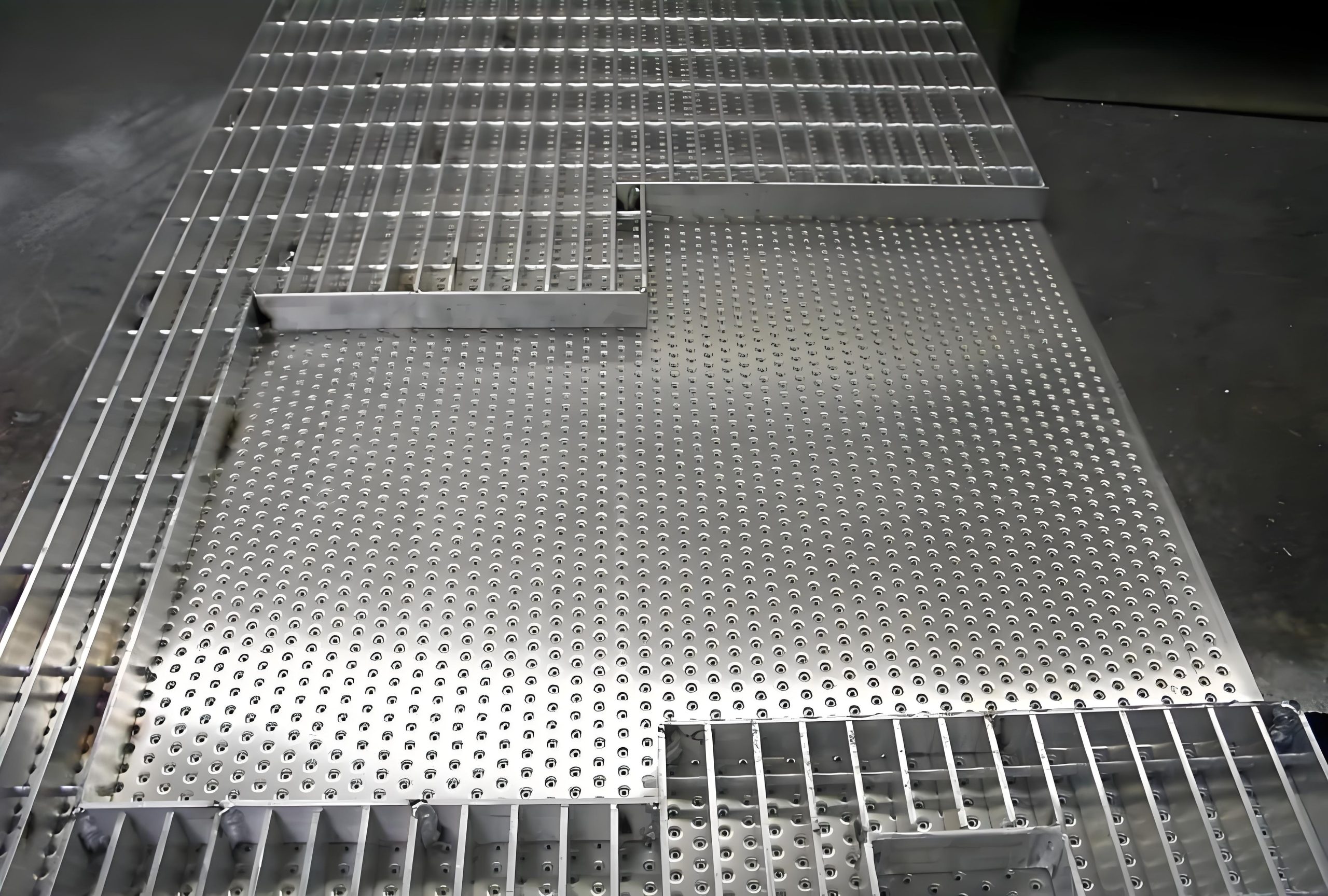
“Outdoor use” is too broad to specify a grating material. A covered inland platform exposed to occasional rain is very different from a coastal desalination plant, a pickling line, a chlor-alkali facility, or a wastewater aeration deck. The chemical concentration, temperature, wet-dry cycle, cleaning procedure, airborne contaminants, and exposure duration all matter.
Common corrosion mechanisms include general surface corrosion, pitting, crevice corrosion, galvanic corrosion, under-film corrosion, chemical attack, ultraviolet degradation, and localized attack around welds or damaged coatings. The correct approach is to identify the likely mechanism before selecting the grating.
A painted carbon steel grating may be economical for a dry indoor platform. In a wet coastal or chemical environment, frequent repainting, shutdown time, labor, scaffold access, and replacement panels may make it more expensive over the life of the facility than aluminum, stainless steel, or FRP. The best value is often the product that provides the required service life with manageable inspection and maintenance.
The principal corrosion-resistant grating materials are stainless steel, aluminum, FRP fiberglass, hot-dip galvanized steel, and coated steel. Each material has a different balance of weight, strength, chemical resistance, fabrication options, temperature capability, appearance, and cost.
| Material | Main Advantages | Key Limitations | Common Applications |
|---|---|---|---|
| Stainless steel | Strong corrosion resistance, high strength, hygienic appearance, good durability. | Higher initial cost; grade selection is critical in chloride and chemical service. | Food plants, pharmaceutical areas, marine facilities, chemical platforms, architectural drainage. |
| Aluminum | Lightweight, naturally corrosion resistant, non-rusting, easy to handle. | Lower stiffness than steel; not suitable for every chemical environment or heavy wheel-load condition. | Offshore accessways, water-treatment facilities, rooftops, pedestrian bridges, marine walkways. |
| FRP fiberglass | Excellent resistance to many chemicals, light weight, nonconductive, nonmagnetic. | Resin selection and temperature limit are important; structural behavior differs from metal. | Chemical plants, wastewater plants, cooling towers, electroplating facilities, offshore platforms. |
| Hot-dip galvanized steel | High strength, cost-effective, widely available, suitable for many outdoor projects. | Zinc coating can be consumed over time; less suitable for strong acids and some aggressive chemicals. | Industrial walkways, outdoor platforms, stair treads, trench covers, utility facilities. |
| PVC-coated or powder-coated steel | Additional color, visual finish, and barrier protection in controlled environments. | Coating damage, edges, welds, and trapped moisture need attention; not a universal chemical solution. | Architectural walkways, light industrial areas, decorative access platforms, guarded indoor installations. |
Stainless steel grating is widely selected where corrosion resistance, hygiene, strength, and long service life are required. It is commonly fabricated as welded bar grating, press-locked grating, or press-locked serrated grating. It is often used where painted or galvanized carbon steel would require frequent maintenance.
Grade 304 stainless steel is a common choice for many indoor, washdown, food-processing, and moderately corrosive environments. Grade 316 or 316L stainless steel is often preferred where chlorides, marine exposure, salt spray, or more severe chemical conditions are expected. However, no stainless grade is immune to every chemical. Chloride concentration, temperature, stagnant water, crevices, cleaning agents, and surface contamination must all be considered.
Stainless steel grating is frequently used in food and beverage processing, pharmaceutical plants, dairy facilities, marine terminals, coastal public walkways, laboratories, water-treatment equipment areas, chemical-process platforms, and architectural drainage applications. Its clean appearance and ability to withstand repeated washing also make it suitable for visible installations.
Do not specify only “stainless steel grating” when the service environment is demanding. A complete request should identify the grade, surface requirement, bearing-bar size, cross-bar spacing, mesh opening, banding, welding method, support condition, serrated or plain surface, and fastener material. Fasteners should normally be compatible with the grating and surrounding structure to reduce galvanic-corrosion risk.
Stainless steel sheet, strip, and plate used for general applications are covered by specifications such as ASTM A240/A240M. The applicable specification for a finished grating project may differ according to the product form, country, purchaser requirement, and engineering documents.
Aluminum grating offers excellent value where low weight and natural corrosion resistance are important. It develops a thin oxide layer that helps protect the underlying metal, and it does not rust in the way carbon steel does. Aluminum is particularly useful where panels must be lifted manually, where existing supports have limited capacity, or where equipment access requires frequent removal of grating panels.
Aluminum bar grating is commonly manufactured with swage-locked or press-locked construction. The bearing bars carry the primary span load, while cross bars lock the panel together and create the selected mesh pattern. Because aluminum has lower elastic modulus than steel, deflection must be checked carefully. A panel may be strong enough to avoid failure but still feel too flexible if it is undersized for the span.
Aluminum can perform well in marine environments, but selection cannot be based on “marine use” alone. Salt deposits should be washed away where practical, water should drain freely, and dissimilar-metal contact should be controlled. Direct contact between aluminum and more noble metals in a wet electrolyte can encourage galvanic corrosion. Isolation pads, compatible fasteners, coatings, and drainage details can be important.
Aluminum is also not the preferred solution for every chemical process. Strong alkalis, some acids, and specific industrial chemicals can attack aluminum. If the grating will receive chemical splashes, fumes, concentrated cleaning solutions, or continuous immersion, a chemical-resistance review is necessary before production.
FRP grating, also called fiberglass reinforced plastic grating, is a strong option for corrosive industrial environments. It combines glass-fiber reinforcement with a thermoset resin system. Unlike steel, FRP does not rust. It is lightweight, electrically nonconductive, nonmagnetic, and available with highly aggressive anti-slip surfaces.
There are two widely used forms: molded FRP grating and pultruded FRP grating. Molded grating has an integrated grid construction and is often selected for chemical resistance and multidirectional strength. Pultruded grating uses load-bearing pultruded bars and can provide high strength in the bearing-bar direction, making it useful for longer spans when properly engineered.
FRP is not one universal material. The resin system controls much of the chemical and environmental performance. Common resin families include polyester, vinyl ester, phenolic, and specialty systems. A resin that performs well around mild wastewater may not be suitable for concentrated acid, solvent vapor, high-temperature service, or fire-sensitive areas.
| FRP Grating Type | Typical Strength | Typical Benefit | Selection Note |
|---|---|---|---|
| Molded FRP grating | Bidirectional grid structure | Very good corrosion resistance and excellent anti-slip surface options. | Common in chemical, wastewater, and cooling-tower applications. |
| Pultruded FRP grating | High strength in the bearing-bar direction | Useful for longer spans and higher structural demands. | Span direction and support layout must be clearly identified. |
| Phenolic FRP grating | Designed for demanding fire-performance applications | Can provide low-smoke and fire-related advantages in selected projects. | Confirm all project fire, smoke, certification, and corrosion requirements. |
FRP grating is popular in chemical plants, electroplating workshops, fertilizer facilities, desalination plants, wastewater treatment facilities, pulp and paper mills, cooling towers, offshore structures, and electrical areas. It can reduce installation labor because panels are lighter and can often be cut on site with appropriate tools.
At the same time, FRP should not be selected only because it is corrosion resistant. Its load capacity, deflection, fire performance, smoke requirements, UV protection, operating temperature, chemical compatibility, edge sealing, and fastening system must be checked. It may require closer support spacing than a steel panel with the same overall depth. Point loads, rolling loads, concentrated equipment feet, and unsupported cut-outs require special review.
Hot-dip galvanized steel bar grating is one of the most common corrosion-resistant grating options for industrial projects. It combines the structural capacity and economy of carbon steel with a zinc coating that protects the steel surface. For outdoor walkways, access platforms, stair treads, trench covers, utility facilities, and general industrial service, galvanized steel often provides a practical balance between initial cost and durability.
Most industrial galvanized grating is fabricated first and then hot-dip galvanized. This allows the zinc coating to cover the welded joints, bearing bars, cross bars, and cut edges created during fabrication. The coating quality, drainage holes in enclosed details, weld cleaning, material chemistry, and handling all affect the final appearance and performance.
ISO 1461:2022 specifies general properties and test methods for hot-dip galvanized coatings on fabricated iron and steel articles. It is important to distinguish this type of post-fabrication galvanizing from continuously galvanized sheet or wire products, which are outside the scope of that standard.
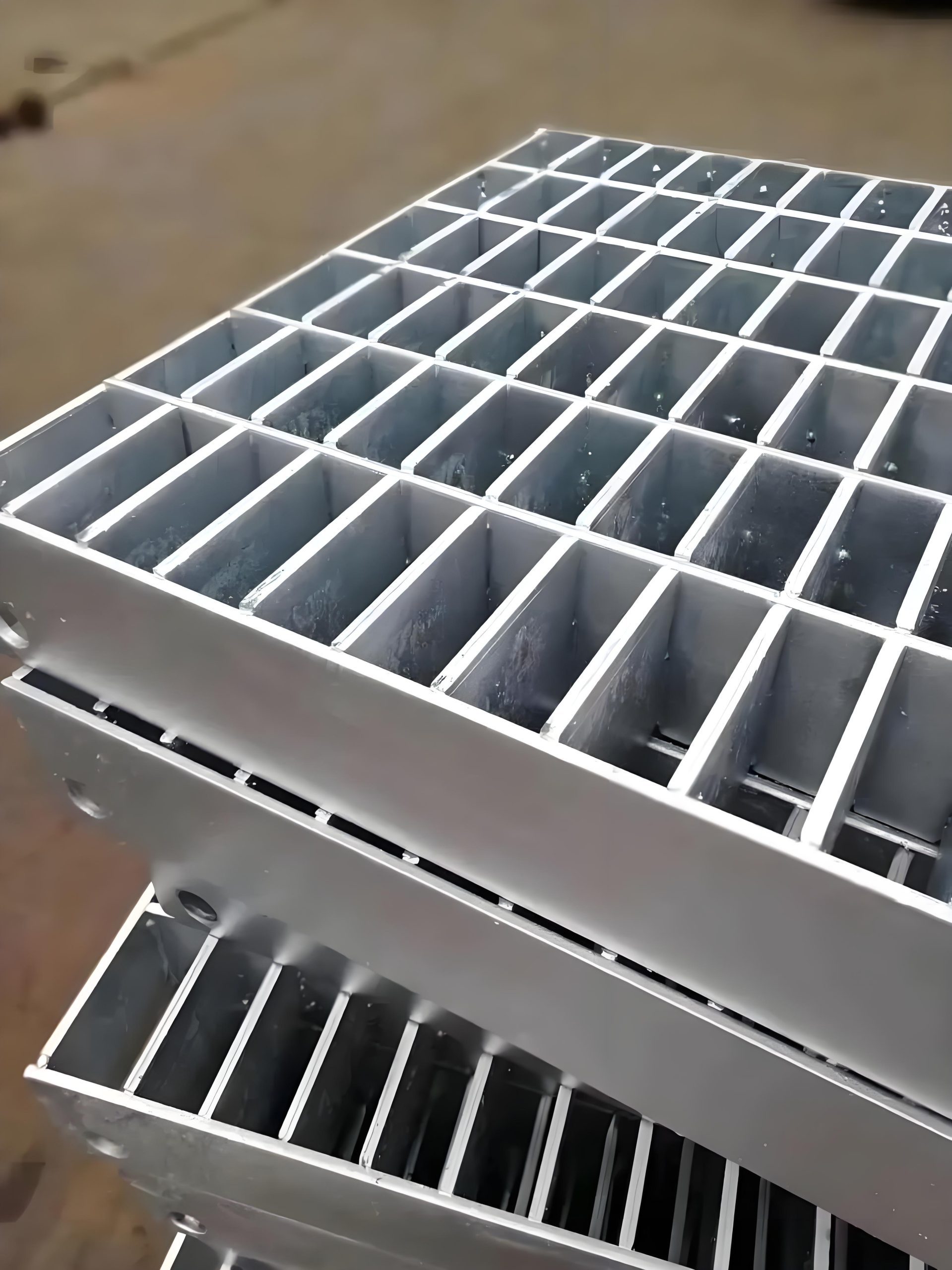
Galvanized steel grating is generally suitable for many outdoor and wet industrial settings where exposure is atmospheric, intermittent, or moderate. It is commonly used for refinery walkways, power-plant platforms, drainage covers, factory access stairs, equipment platforms, municipal facilities, and industrial catwalks.
Hot-dip galvanizing is not a universal answer for severe chemical exposure. Strong acids can rapidly consume zinc, and some alkaline or chemical environments may also be unsuitable. Areas with constant chemical splash, immersion, extreme chloride exposure, or retained corrosive deposits may require FRP, stainless steel, aluminum, a specialized lining system, or a different structural design.
Galvanized grating should also be inspected after field cutting, drilling, welding, or damage during installation. Those activities can affect the protective coating. Any repair method should follow the project specification and the coating supplier’s recommendations.
PVC-coated and powder-coated steel gratings add a polymer barrier over the steel substrate. They are often selected where color coding, visual appearance, touch comfort, or additional surface protection is required. These options can work well in controlled atmospheric environments, decorative areas, light industrial facilities, and projects where the grating must match a surrounding architectural finish.
However, coating systems require realistic expectations. A coating can be scratched during transport, installation, panel removal, or impact. Coating defects near welds, edges, clips, bolt holes, and cut-outs can allow moisture to reach the steel. Once corrosion begins under a damaged coating, it may spread beyond the visible defect.
Coated steel can be practical for indoor platforms, guard-protected accessways, pedestrian areas, and installations where exposure is relatively mild and regular inspection is possible. It is usually not the first choice for continuous chemical immersion, aggressive solvent exposure, heavy abrasion, or severe salt spray unless the coating system has been specifically engineered and tested for that service.
The manufacturing method affects strength, appearance, open area, load direction, fabrication flexibility, and corrosion performance. The material should be selected together with the grating type rather than as separate decisions.
Welded bar grating is commonly made by resistance welding cross bars to load-bearing bars. It is widely used in carbon steel and stainless steel applications. Welded construction can provide excellent rigidity and economical production for standard industrial panels. When used in corrosive service, the weld quality, coating coverage, and edge banding should be considered carefully.
For carbon steel grating, hot-dip galvanizing after fabrication is a common approach. For stainless steel welded grating, weld cleaning and appropriate finishing may be needed for the project environment. The required finish should be discussed with the manufacturer rather than assumed.
Press-locked grating is assembled by mechanically interlocking notched bearing bars and cross bars. It is popular where a clean architectural appearance, close mesh, or special layout is needed. Aluminum grating is often swage-locked, which uses mechanical locking to secure cross bars into bearing bars.
Press-locked and swage-locked gratings are available in carbon steel, galvanized steel, stainless steel, and aluminum depending on the product design. They are suitable for platforms, walkways, facades, drainage applications, stair treads, and architectural screening where both function and appearance matter.
Molded FRP grating is formed as an integrated fiberglass-resin grid. Its one-piece construction provides resistance to corrosion across the mesh rather than relying on a metallic coating. It is especially useful in wet chemical areas because the open grid allows drainage while the gritted surface can provide dependable traction.
FRP panels should still be correctly fastened. A lightweight panel can lift, shift, or vibrate if clips and supports are inadequate. In outdoor or offshore locations, the fastening layout should consider wind uplift, vibration, thermal movement, and maintenance access.
Chemical and marine environments are among the most demanding locations for grating. A product chosen only on the basis of “corrosion resistant” can fail early if the exposure is not understood. The project team should identify the chemicals, concentrations, temperatures, cleaning cycles, splash frequency, immersion time, and ventilation conditions before finalizing material selection.
In chemical service, FRP is often selected because specific resin systems can resist many acids, alkalis, and corrosive vapors. Stainless steel may be suitable for certain chemical environments, but grade and process chemistry must be reviewed. Galvanized steel is often unsuitable where strong acids or continuous corrosive chemical exposure are present.
Areas beneath pumps, valves, chemical-transfer lines, tank vents, scrubbers, and washdown stations deserve special attention. A platform may be exposed not only to liquid spills but also to vapor, condensation, and deposits that become more concentrated as water evaporates.
Marine projects face salt spray, salt deposits, tidal moisture, high humidity, ultraviolet exposure, wind-driven rain, and sometimes direct seawater contact. Aluminum, stainless steel, FRP, and carefully specified galvanized steel are all used in marine construction, but their suitability differs by location.
For a sheltered coastal platform, galvanized steel may provide acceptable service life. For splash-zone, continuously wet, or high-chloride conditions, aluminum, FRP, or an appropriately selected stainless steel grade may offer better durability. In all cases, drainage, washdown access, crevice control, and compatible fasteners are important.
Galvanic corrosion can occur when dissimilar metals are electrically connected in the presence of moisture or another electrolyte. For example, aluminum, stainless steel, galvanized steel, and carbon steel can behave differently when connected in a wet environment. The risk depends on the material combination, surface-area ratio, electrolyte, coating condition, and electrical connection.
Good design practices include using compatible fasteners, isolating dissimilar metals with nonconductive pads or washers where appropriate, avoiding water traps, sealing inaccessible joints when suitable, and ensuring that drainage paths remain open. The support structure, clips, handrails, bolts, and nearby pipework should be reviewed as part of the system.
Corrosion resistance and slip resistance should be considered together. A platform can remain structurally intact yet still be unsafe if oil, water, frost, algae, powder, or chemical residue makes the surface slippery. The more severe the contamination risk, the more important the surface profile becomes.
Plain bearing bars have a smooth upper edge. They are suitable for dry indoor areas, architectural applications, and locations where footwear, cleaning practices, and contamination conditions do not create a high slip risk. Plain grating is often easier to clean and may be preferred where product residue can collect in serrations.
Serrated grating has notched bearing-bar tops that improve traction in wet, oily, muddy, or icy conditions. It is widely used for outdoor stair treads, maintenance platforms, ramps, offshore accessways, and industrial walkways. Serrated surfaces can be highly effective, but they may be less comfortable for bare-foot traffic and may retain some debris in certain process environments.
FRP grating is often supplied with an integrally bonded gritted top surface. Fine, medium, or coarse grit may be chosen according to the expected contamination and cleaning requirement. Coarser grit generally provides greater traction but can be more difficult to clean. Food, pharmaceutical, and hygiene-sensitive areas should balance slip resistance with sanitation requirements.
| Surface Type | Best Use | Advantages | Points to Review |
|---|---|---|---|
| Plain bar surface | Dry and controlled environments | Clean appearance and easier washdown. | May not provide enough traction in oil, water, ice, or mud. |
| Serrated metal surface | Wet outdoor and industrial access areas | Strong mechanical grip for safety footwear. | Confirm cleaning needs and user comfort. |
| Fine-grit FRP surface | Moderate wet environments | Good traction with a relatively smoother finish. | Verify resin and grit compatibility with cleaning chemicals. |
| Coarse-grit FRP surface | Oily, muddy, offshore, and severe wet conditions | High slip resistance. | Can be harder to clean and may not suit all pedestrian uses. |
Corrosion-resistant grating must be designed for the required load and clear span. The bearing bars should normally run in the direction of the span between supports. If the panel is rotated ninety degrees from its intended orientation, its load capacity can change dramatically.
Structural selection should consider uniform live load, concentrated load, equipment loads, point loads from ladders or wheels, impact, vibration, wind uplift, thermal movement, support width, deflection limits, and safety factors. A trench cover may need to resist occasional maintenance loads, while a process platform may carry workers, tools, mobile equipment, and stored materials every day.
For metal grating, deeper bearing bars generally increase span capability and stiffness. Bar thickness also affects capacity and weight. Common carbon steel bearing-bar depths might range from 20 mm to 50 mm or more, depending on the application. Aluminum and stainless steel selections should be based on their own load tables and material properties rather than copied directly from carbon steel designs.
Smaller openings can improve foot support, reduce dropped-object risk, and accommodate certain wheel or heel requirements. Larger openings improve drainage, ventilation, light transmission, and ease of cleaning. Typical metric mesh patterns may use bearing-bar spacing of 25 mm, 30 mm, 32 mm, 40 mm, or other project-specific dimensions, with cross-bar spacing such as 50 mm or 100 mm.
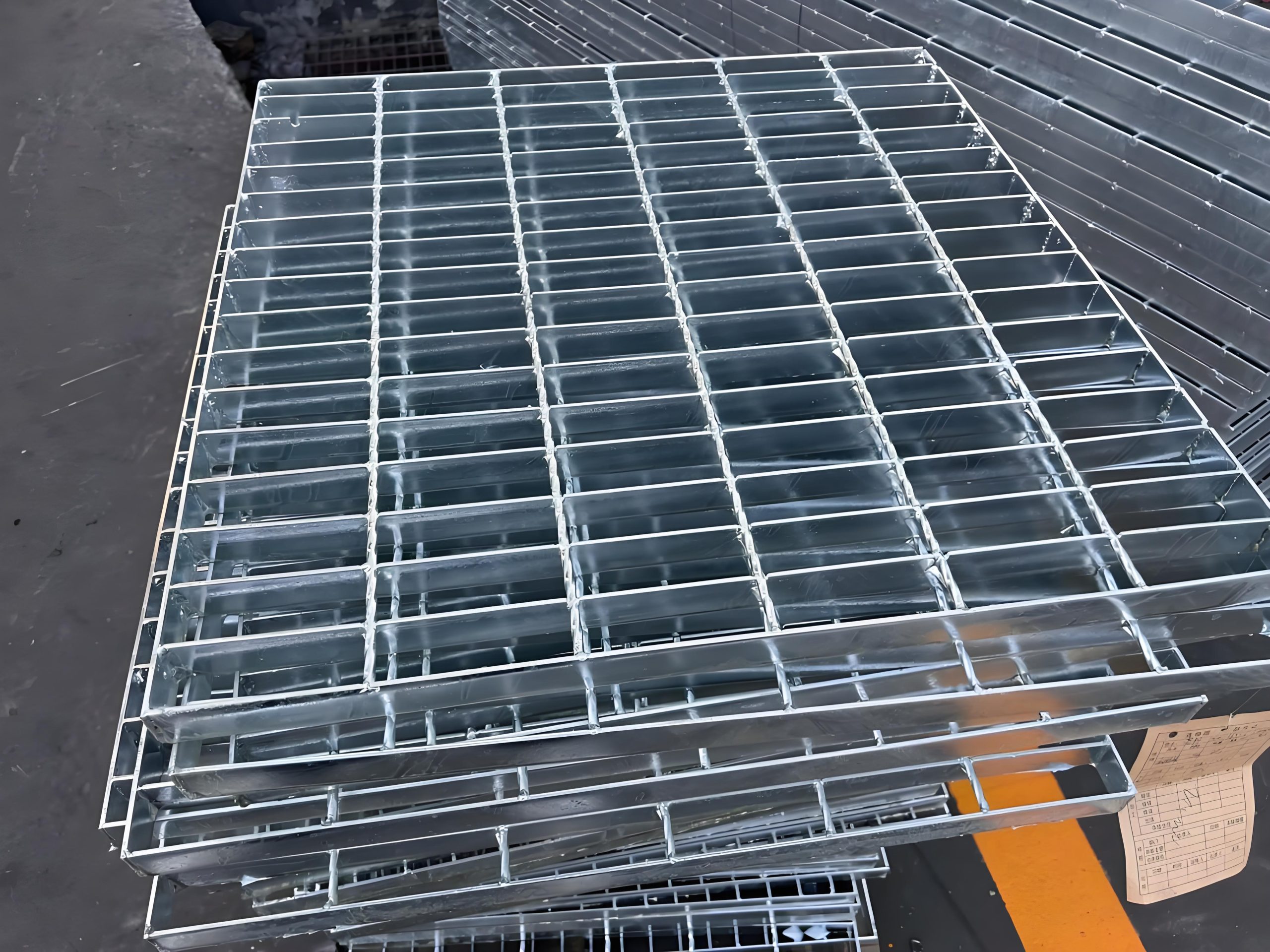
The selected opening must also suit the intended users. High-heel pedestrian traffic, small hand tools, animal hooves, trolley wheels, and dropped-object controls may require a different mesh from a standard industrial walkway.
Grating should not be selected only by failure capacity. Excessive deflection can make a walkway feel unstable, damage adjacent finishes, affect drainage, create trip points, or reduce user confidence. Aluminum and FRP, in particular, often need close attention to deflection because they may be more flexible than comparable steel products.
For critical platforms, bridges, elevated walkways, public accessways, or areas carrying unusual loads, the grating should be reviewed by a qualified engineer using the actual support geometry and project load cases. Manufacturer load tables are useful tools, but they apply only when the product orientation, supports, load type, and design assumptions match the installation.
Corrosion-resistant gratings are used wherever an open, strong, drainable walking surface is needed in an environment that could damage ordinary unprotected steel. The same material is not ideal for every industry, so application-based selection is valuable.
| Industry or Location | Typical Exposure | Common Material Choices | Important Design Focus |
|---|---|---|---|
| Wastewater treatment plant | Moisture, gases, cleaning chemicals, biological deposits. | FRP, aluminum, galvanized steel, stainless steel. | Slip resistance, chemical compatibility, removable panels, ventilation. |
| Chemical processing facility | Acid, alkali, solvent, vapor, splash, washdown. | FRP with suitable resin, selected stainless steel. | Chemical-resistance data, temperature, fire requirements, drainage. |
| Marine terminal or dock | Salt spray, sea air, humidity, tidal water. | Aluminum, FRP, stainless steel, galvanized steel. | Chloride exposure, galvanic isolation, anti-slip surface, uplift. |
| Food and beverage plant | Washdown water, detergents, sanitation chemicals. | Stainless steel, FRP in suitable areas. | Cleanability, hygiene, drainage, compatibility with cleaning agents. |
| Oil, gas, and energy facility | Weather, oil, vibration, salt air, process contamination. | Galvanized steel, aluminum, FRP, stainless steel. | Load, fire requirements, anti-slip performance, maintenance access. |
| Cooling tower | Continuous moisture, chemical treatment, heat, UV exposure. | FRP, selected stainless steel. | Resin selection, temperature limit, wet-slip performance, support spacing. |
| Architectural exterior walkway | Rain, pollution, de-icing salts, appearance requirements. | Aluminum, stainless steel, galvanized and coated steel. | Appearance, pedestrian comfort, drainage, heel-safe opening, maintenance. |
Corrosion-resistant trench grating is used around washdown zones, loading areas, swimming facilities, factories, food plants, chemical lines, and wastewater channels. The panel must be selected for the intended traffic. Pedestrian drainage covers, forklift-access covers, and vehicular trench covers have very different structural requirements.
Drainage details should allow easy removal for cleaning. If channels accumulate solids, the grating opening size should balance drainage with debris retention. A small opening may improve foot safety but can require more frequent cleaning; a larger opening may drain quickly but allow larger objects to fall into the channel.
Corrosion-resistant stair treads are used on emergency exits, industrial stairs, towers, tanks, jetties, offshore modules, and outdoor access structures. Serrated bar grating treads are common for steel and aluminum installations, while gritted FRP treads are used where chemical resistance and electrical insulation are priorities.
For stair treads, the material choice must be coordinated with tread width, tread depth, nosing, end plates, bolt holes, stringer connection, handrails, and local building or occupational-safety requirements. A corrosion-resistant tread still needs adequate load capacity and a safe, consistent stair geometry.
The best way to select corrosion-resistant grating is to start with the environment and the load case, then narrow the material and construction type. A detailed request for quotation produces a more reliable product recommendation and avoids expensive revisions after fabrication.
State whether the grating will be indoors, outdoors, under cover, coastal, offshore, submerged, exposed to chemical splash, exposed to fumes, or subject to washdown. If chemicals are present, provide their names, concentrations, temperatures, and exposure frequency. If the exact chemistry is confidential, a general process description can still help the supplier recommend a suitable direction.
Provide the clear span between supports, panel dimensions, direction of bearing bars, expected live load, concentrated load, wheel load if any, and acceptable deflection. Include drawings or photographs of the support structure whenever possible. A grating supplier should not guess the span direction from panel length alone.
Choose plain, serrated, or gritted surfaces according to the slip condition. Then confirm the mesh pattern. Tight mesh may be needed for small tools, heels, or specific safety requirements. Larger openings may be more suitable for drainage, airflow, and self-cleaning industrial platforms.
Identify cut-outs for pipes, columns, ladders, valves, or cable trays before production. Cut-outs should be properly banded or reinforced where necessary. Also define edge banding, toe plate interfaces, lifting handles, removable-panel marking, stair nosing, clips, bolt holes, and any required field-fit tolerance.
Clips, bolts, nuts, washers, and support steel should be compatible with the selected grating material and environment. In corrosive locations, corrosion-resistant clips can be as important as the panel itself. Avoid relying on loose, unprotected fasteners for removable panels exposed to vibration, water flow, wind, or process activity.
| Project Condition | Practical Starting Point | Final Check Needed |
|---|---|---|
| General outdoor industrial walkway | Hot-dip galvanized welded steel grating. | Atmospheric corrosivity, coating requirement, span, serrated surface need. |
| High-chloride coastal platform | Aluminum, FRP, or appropriately selected stainless steel. | Salt concentration, direct splash, galvanic contact, support materials. |
| Acid or caustic process area | FRP with chemical-compatible resin, or selected stainless steel. | Specific chemical, concentration, temperature, fire and smoke requirements. |
| Food washdown area | Stainless steel grating with suitable surface and drainage design. | Cleaning chemical, sanitation method, hygiene and slip-resistance needs. |
| Lightweight removable roof access panel | Aluminum grating. | Deflection, wind uplift, pedestrian load, drainage, panel lifting method. |
| Electrical or nonmagnetic environment | FRP grating. | Resin system, load, fire performance, static-control requirements if applicable. |
What is the best grating for a chemical plant?
FRP grating with a resin system matched to the chemical exposure is often the first option for chemical plants because it does not rust and can resist many corrosive liquids and vapors. Stainless steel may also be suitable in selected processes, but the exact chemical, concentration, temperature, splash frequency, and cleaning method must be checked before choosing a grade.
Is galvanized steel grating corrosion resistant?
Yes. Hot-dip galvanized steel grating has a zinc coating that provides good corrosion protection for many outdoor and industrial applications. It is a practical choice for general atmospheric exposure, but it is not suitable for every chemical environment. Strong acids, continuous chemical splash, and severe immersion conditions may require FRP, stainless steel, aluminum, or a specialized protective system.
Which is better for marine grating: aluminum, FRP, or stainless steel?
Each can be the right choice. Aluminum is lightweight and performs well in many marine applications, FRP offers excellent corrosion resistance and electrical insulation, and stainless steel provides high strength and a durable premium finish when the correct grade is selected. The decision should be based on chloride exposure, direct seawater contact, load, fire requirements, support material, galvanic-corrosion risk, maintenance access, and project budget.