

Welded steel bar grating is a strong, open-grid flooring product used for industrial walkways, platforms, trench covers, stair treads, drainage areas, maintenance routes, and access systems. It is made by joining load-bearing steel bars with cross bars through a high-pressure welding process. Standard specifications commonly include bearing bar sizes such as 25 × 3 mm, 30 × 3 mm, 32 × 5 mm, and 40 × 5 mm, with 30/100 mm and 30/50 mm mesh patterns widely used for industrial projects. Factory price depends mainly on steel weight, bearing bar size, spacing, surface type, fabrication, galvanizing, quantity, and delivery requirements.
Welded steel bar grating is one of the most widely used metal flooring products in industrial construction. It consists of vertical bearing bars that carry the applied load and horizontal cross bars that keep the bearing bars evenly spaced. The cross bars are welded to the bearing bars under heat and pressure, creating a rigid grating panel with high strength and good dimensional stability.
The bearing bars are the primary structural members. They must run in the direction of the support span. Cross bars provide lateral stability, maintain the mesh pattern, and help distribute local loads, but they are not normally the main members carrying the panel between support beams.
Compared with solid checker plate or steel sheet flooring, welded steel bar grating offers better drainage, ventilation, light transmission, and debris removal. Its open construction also reduces dead load and wind resistance in elevated industrial structures.
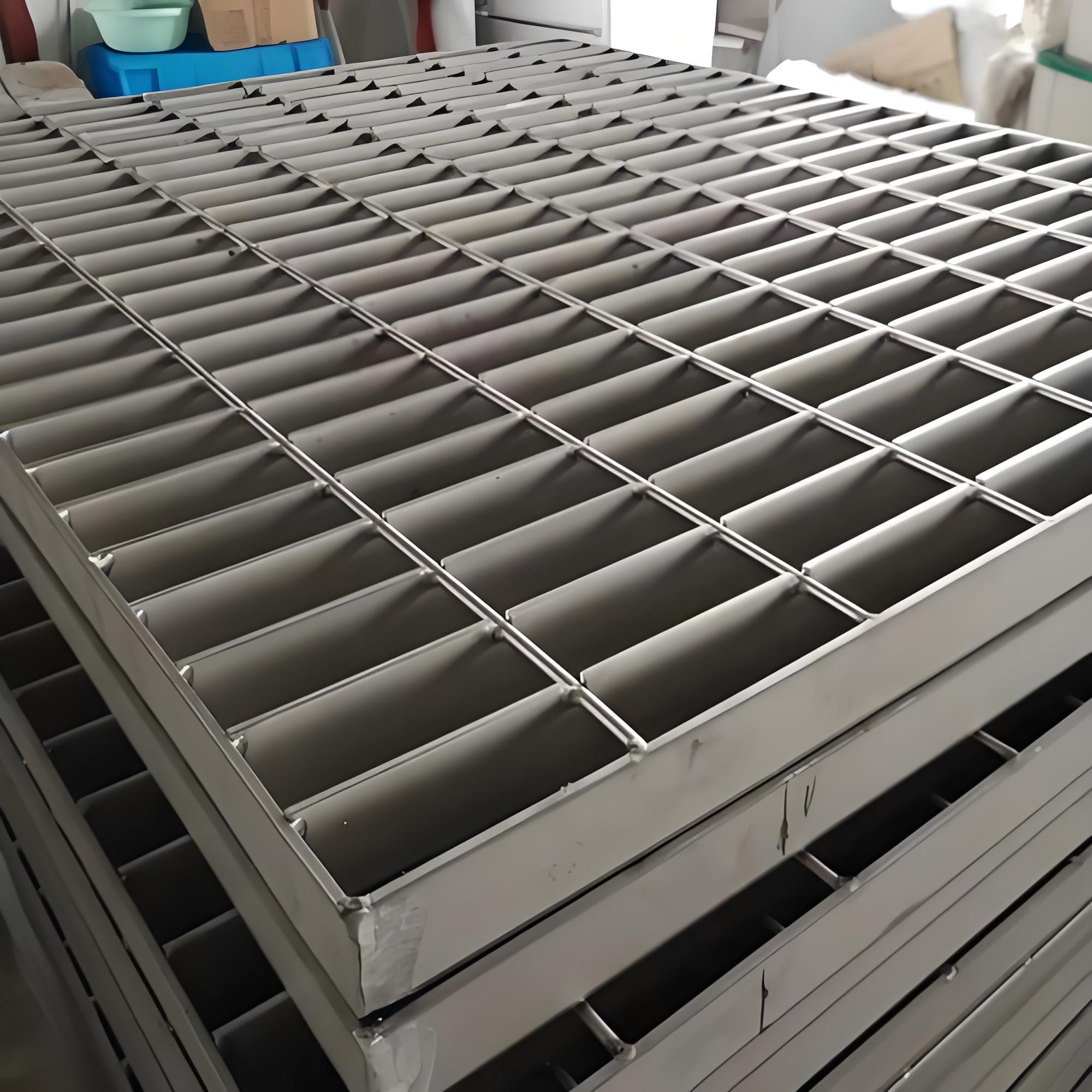
Typical welded steel bar grating components include:
Welded grating is often selected when a project needs a durable and cost-effective walking surface that can withstand regular industrial traffic. It is available in standard stock panels and can also be fabricated to match equipment layouts, trench openings, handrail posts, columns, pipes, valves, and structural steel details.
Welded steel bar grating is used in many industries because it combines load capacity with drainage and safety. The same basic grating structure can be fabricated into flat panels, stair treads, drain covers, access hatches, removable platform sections, and framed covers.
| Application | Typical Grating Requirement | Important Selection Point |
|---|---|---|
| Industrial walkways | Standard-duty welded grating | Confirm pedestrian load, span, and slip resistance |
| Maintenance platforms | Galvanized or painted steel grating | Check support spacing and removable-panel needs |
| Trench covers | Heavy-duty or framed welded grating | Confirm concentrated load and frame design |
| Stair treads | Serrated grating with nosing and end plates | Check tread depth, span, fixing holes, and local codes |
| Drainage grates | Open grating with corrosion-resistant finish | Review opening size and debris passage requirements |
| Mezzanine flooring | Standard or close-mesh grating | Consider walking comfort, dropped-object risk, and load |
| Catwalks | Serrated galvanized grating | Check outdoor weather exposure and fall protection |
| Machine access platforms | Custom-cut welded grating | Coordinate cut-outs, clips, guardrails, and equipment openings |
Industrial walkways are one of the most common uses of welded steel bar grating. They provide a stable walking route around machinery, tanks, conveyors, pumps, pipe racks, processing equipment, and elevated platforms.
For walkway applications, the grating should be selected according to the clear support span, expected traffic, footwear, environmental exposure, and maintenance requirements. A light-duty grating panel may be suitable for an indoor inspection route but not for a heavily used outdoor platform where workers carry tools and equipment.
Welded steel bar grating is frequently installed around pumps, valves, compressors, heat exchangers, generators, and production machinery. The open grid allows liquids and dust to pass through, reducing standing water around equipment.
Custom openings are often required for pipes, support columns, cable trays, handrail posts, and equipment bases. All cut edges should be properly banded or framed to maintain panel rigidity and protect exposed bearing bar ends.
Elevated platforms often use galvanized welded steel bar grating because of its lower weight compared with solid plate flooring. The open surface reduces wind pressure and allows daylight to pass through lower levels.
For elevated walkways, the complete safety system should be considered. Grating alone does not provide fall protection. Guardrails, toe plates, access points, support beams, clips, and panel edges must be coordinated with the applicable site safety requirements.
For workplaces covered by United States regulations, OSHA 29 CFR 1910.28 addresses fall protection for employees exposed to unprotected sides and edges in applicable situations.
Welded steel bar grating can be used for mezzanine floors where ventilation, sprinkler penetration, lower-level visibility, or weight reduction is important. Close-mesh grating may be selected where smaller openings are needed, while standard open grating is often used in industrial storage and service areas.
Mezzanine grating should be selected with attention to load distribution, pallet movement, maintenance carts, rolling equipment, and local building requirements. Standard pedestrian grating may not be appropriate for wheeled traffic unless the product is specifically designed for that load.
Welded steel bar grating is commonly fabricated into trench covers, drainage grates, pit covers, sump covers, channel covers, and access panels. The open mesh allows water to enter a drainage system while maintaining a walking surface above the channel.
Trench covers must be selected according to the width of the opening, support frame design, pedestrian or vehicle loading, and maintenance access requirements. A standard walkway grating panel should not automatically be used over a wide trench without checking its concentrated load capacity and support arrangement.
For trench covers, the bearing bars should span across the trench opening. The supporting frame must provide sufficient bearing width along both ends of the grating panel. Loose or inadequate support can cause rocking, noise, clip failure, or damage to the surrounding concrete or steel frame.
Drainage grating is often used in wet process plants, chemical facilities, food processing areas, wastewater plants, outdoor yards, and loading zones. The mesh pattern should balance drainage efficiency with the need to prevent large debris or tools from falling through.
A more open grating pattern provides better drainage and lower weight, while closer spacing reduces the opening size. The correct choice depends on the application, footwear, dropped-object risk, cleaning method, and drainage flow requirements.
Welded steel grating can be made into removable access covers for valves, cable trenches, drains, inspection pits, and utility channels. Removable panels may include lifting handles, lift holes, hinges, safety chains, anti-rattle clips, or identification labels.
When manual lifting is expected, the panel weight should be checked. A large fabricated grating cover can become difficult or unsafe to remove without lifting equipment. Dividing one heavy cover into several smaller panels may improve maintenance access and reduce handling risk.
Welded steel bar grating is commonly used to fabricate industrial stair treads. A typical welded grating stair tread includes serrated or plain bearing bars, a front nosing, end plates, and bolt holes or slots for attachment to the stair stringers.
Grating stair treads are widely used for outdoor stairs, maintenance stairs, tank access stairs, platform connections, utility structures, and process plant access systems. The open surface allows rainwater, mud, ice, and debris to pass through instead of collecting on the tread.
Serrated bearing bars are often selected for stair treads because the front edge of each bar provides additional grip. A checkered plate, serrated angle, perforated edge, or abrasive nosing can further improve visibility and traction at the leading edge.
| Detail | Purpose |
|---|---|
| Bearing bar direction | Bearing bars must span between stair stringers |
| Nosing | Strengthens the leading edge and improves visibility |
| End plates | Transfer load to stringers and provide fixing holes |
| Bolt holes or slots | Allow secure installation and adjustment |
| Serrated surface | Improves traction in wet or contaminated areas |
| Galvanizing | Protects outdoor carbon steel treads from corrosion |
Stair tread dimensions should be coordinated with the complete stair geometry. Tread depth, riser height, stair angle, clear width, handrails, landings, and headroom are part of the installed stair system. A grating tread supplier can fabricate the product, but the final stair design must meet the applicable project and local safety requirements.
Bearing bar size is one of the most important welded steel bar grating specifications. The first number identifies the height of the bearing bar, and the second number identifies thickness. For example, 30 × 3 mm means a bearing bar 30 mm high and 3 mm thick.
| Bearing Bar Size | Typical Duty Level | Common Use |
|---|---|---|
| 20 × 3 mm | Light duty | Short-span indoor access platforms |
| 25 × 3 mm | Light to standard duty | Maintenance walkways and short-span platforms |
| 25 × 5 mm | Medium duty | Short spans requiring thicker bearing bars |
| 30 × 3 mm | Standard duty | General industrial walkways and flooring |
| 30 × 5 mm | Medium to heavy duty | Higher-load access routes and platforms |
| 32 × 3 mm | Standard duty | Metric industrial flooring systems |
| 32 × 5 mm | Medium duty | Longer spans and higher traffic areas |
| 40 × 3 mm | Medium duty | Longer-span walkways and platforms |
| 40 × 5 mm | Heavy duty | Industrial service routes and demanding platform loads |
| 50 × 5 mm or larger | Heavy duty | High-load, long-span, or specially engineered applications |
Common metric bearing bar pitches include 25 mm, 30 mm, 32 mm, 34 mm, and 40 mm. The bearing bar pitch is measured from the center of one bearing bar to the center of the next.
Closer bearing bar spacing creates smaller openings and increases the number of load-carrying bars per square meter. This can improve local load distribution, but it also increases product weight and factory price.
| Bearing Bar Pitch | General Effect | Typical Use |
|---|---|---|
| 25 mm | Closer spacing and smaller openings | Controlled opening requirements and close-mesh flooring |
| 30 mm | Balanced open area and strength | General industrial welded grating |
| 32 mm | Common metric alternative | Regional industrial flooring specifications |
| 34 mm | Moderate spacing | Manufacturer-specific or pressure-locked systems |
| 40 mm | More open pattern and lower steel weight | Light to standard industrial applications where permitted |
Cross bars connect the bearing bars and form the visible mesh pattern. In welded steel bar grating, twisted square cross bars are commonly welded to the bearing bars under heat and pressure. Common metric cross bar spacings are 50 mm and 100 mm.
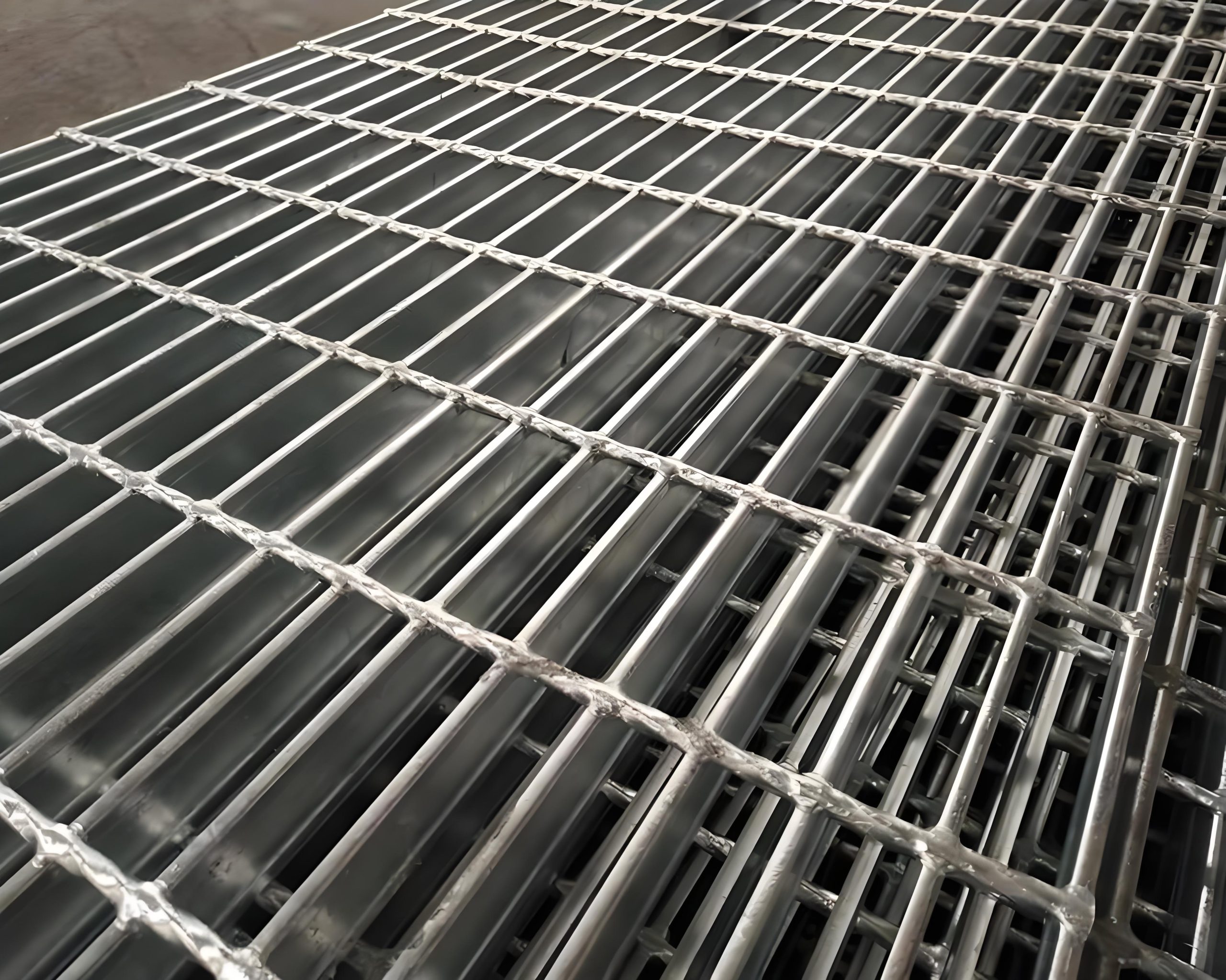
| Mesh Pattern | Bearing Bar Spacing | Cross Bar Spacing | Typical Application |
|---|---|---|---|
| 25/100 mm | 25 mm | 100 mm | Close bearing-bar pattern with open cross bar spacing |
| 30/100 mm | 30 mm | 100 mm | General industrial walkway and platform grating |
| 30/50 mm | 30 mm | 50 mm | Closer mesh pattern for selected access and flooring areas |
| 32/100 mm | 32 mm | 100 mm | Common metric industrial pattern |
| 40/100 mm | 40 mm | 100 mm | More open and lighter grating layout |
| 40/50 mm | 40 mm | 50 mm | Open bearing bar spacing with closer cross bar support |
A 30/100 mm pattern is often selected for industrial walkways because it provides a practical combination of drainage, open area, weight, and strength. A 30/50 mm pattern includes more cross bars and may be preferred where a denser mesh pattern is required.
North American welded steel bar grating is often specified using designations such as 19-W-4, 19-W-2, 15-W-4, and 11-W-4. In a common 19-W-4 pattern, bearing bars are spaced 1-3/16 inches on center and cross bars are spaced 4 inches on center.
The designation does not state the bearing bar height or thickness. A complete specification should include both the spacing pattern and the bearing bar size, such as 19-W-4, 1-1/4 × 3/16 inch bearing bars, serrated, hot-dip galvanized.
Welded steel bar grating can be supplied in standard stock panels or fabricated to customer drawings. Common factory panel dimensions vary according to welding machine capacity, raw material length, galvanizing bath size, lifting capacity, and transport limits.
In metric production, 1000 × 6000 mm is a frequently supplied stock panel size. Other common dimensions include 800 × 6000 mm, 1000 × 5000 mm, 1200 × 6000 mm, and custom-cut sections.
| Nominal Panel Size | Typical Use | Important Detail |
|---|---|---|
| 500 × 1000 mm | Small covers and access panels | Often fabricated from larger stock panels |
| 600 × 1000 mm | Narrow walkways and trench covers | Check support direction carefully |
| 800 × 1000 mm | Small industrial platform sections | Suitable for modular layouts |
| 1000 × 1000 mm | General modular flooring panels | Easy to handle and coordinate with steel grids |
| 1000 × 3000 mm | Walkway strips and maintenance routes | Confirm support spacing and lifting weight |
| 1000 × 5000 mm | Long industrial walkway panels | Usually cut from factory stock grating |
| 1000 × 6000 mm | Common factory production panel | Actual fabrication size depends on supplier capability |
| 1200 × 6000 mm | Wide platforms and large access routes | May need special lifting and export packing |
Every shop drawing should clearly identify the bearing bar direction. If a panel is 1000 × 6000 mm and the bearing bars run in the 6000 mm direction, the panel must be supported at suitable intervals along that direction. The actual span is the distance between support beams, not simply the overall panel length.
Incorrect bearing bar orientation is one of the most serious grating installation errors. It can lead to excessive deflection, damaged clips, unsafe walking conditions, and potential structural failure.
Welded steel bar grating must be selected based on load and span requirements. A thicker-looking panel is not automatically suitable for every application. The correct grating depends on bearing bar size, spacing, material grade, support span, applied load, deflection limit, and fabrication details.
Concentrated loads can be more severe than uniform loads. A worker standing on one foot, a maintenance trolley wheel, or a heavy tool can apply high force over a small area. The selected grating should therefore be checked using the manufacturer’s appropriate load table.
Load selection must consider both strength and deflection. Strength checks confirm that the bearing bars will not yield or fail under the specified load. Deflection checks confirm that the panel remains stable and comfortable in service.
Excessive deflection can create a poor walking experience, damage coatings, loosen clips, and cause uneven edges between adjacent panels. A walkway may feel unsafe even when the steel has not reached its yield limit.
ANSI/NAAMM MBG 531-24 provides technical data, load tables, recommended practices, and typical details for metal bar grating. Final selection should be based on the required span, loading, material, and applicable project specifications.
The bearing bars need adequate end bearing on the steel frame, concrete ledge, channel, or support beam. The support width must be sufficient to prevent edge damage and provide stable load transfer. Clips or bolts should hold the grating in position without creating local distortion.
Where panels are removable, the support arrangement should prevent rocking. If a walkway includes cut-outs or narrow strips of grating, extra support framing may be required around the opening.
Plain welded steel bar grating has smooth bearing bar tops. It is economical, easy to clean, and suitable for dry indoor areas where water, grease, mud, and ice are not expected to create serious slip hazards.
Plain grating is often used for:
Serrated welded steel bar grating has notches or teeth along the top of the bearing bars. These raised edges improve traction in wet, oily, muddy, snowy, or outdoor environments.
Serrated grating is commonly selected for:
| Surface Type | Best Environment | Main Advantage | Main Consideration |
|---|---|---|---|
| Plain | Dry and clean indoor areas | Easy cleaning and lower production cost | Less traction when wet or oily |
| Serrated | Wet, outdoor, oily, muddy, or icy areas | Improved grip and more contact edges | Can retain debris and may have different load data |
| Abrasive insert | High slip-risk locations | High traction surface | Wear and chemical compatibility must be checked |
Serrated grating improves traction but does not eliminate the need for cleaning and maintenance. For applicable workplaces, OSHA requires walking-working surfaces to be kept clean and orderly, with drainage maintained for wet processes where feasible. See OSHA 29 CFR 1910.22 for general walking-working surface requirements.
Carbon steel welded grating is economical and easy to fabricate. It is usually supplied in black steel condition for dry indoor locations or for projects where a separate paint system will be applied after installation.
Uncoated carbon steel will rust when exposed to moisture. It should not be selected for outdoor, wet, coastal, chemical, or washdown environments unless a suitable protective coating is included.
Hot-dip galvanized steel grating is one of the most popular options for industrial projects. The grating is fabricated first and then immersed in molten zinc. The zinc coating protects the bearing bars, cross bars, weld areas, cut edges, and edge banding.
Hot-dip galvanized welded steel bar grating is widely used for:
Stainless steel welded grating is selected when high corrosion resistance, hygiene, washdown performance, or long-term appearance is required. Type 304 stainless steel is common for food processing and indoor corrosive environments. Type 316 stainless steel is generally preferred for chloride exposure, coastal conditions, marine structures, and many chemical applications.
| Material | Relative Cost | Corrosion Resistance | Typical Application |
|---|---|---|---|
| Carbon steel | Low | Low without coating | Dry indoor platforms and painted structures |
| Galvanized steel | Medium | Good for many outdoor industrial environments | Outdoor walkways, stairs, platforms, drainage covers |
| 304 stainless steel | High | Good in many hygienic and moderately corrosive environments | Food plants, indoor washdown zones, pharmaceutical areas |
| 316 stainless steel | Higher | Higher resistance in many chloride and marine environments | Coastal, marine, chemical, and severe washdown facilities |
Hot-dip galvanizing after fabrication is a highly effective corrosion-protection method for carbon steel grating. It is commonly selected because it covers the welded intersections and cut edges that would otherwise be vulnerable to rust.
For projects using United States standards, ASTM A123/A123M-24 covers hot-dip zinc coatings on fabricated iron and steel products. For international specifications, ISO 1461:2022 covers hot-dip galvanized coatings on fabricated iron and steel articles.
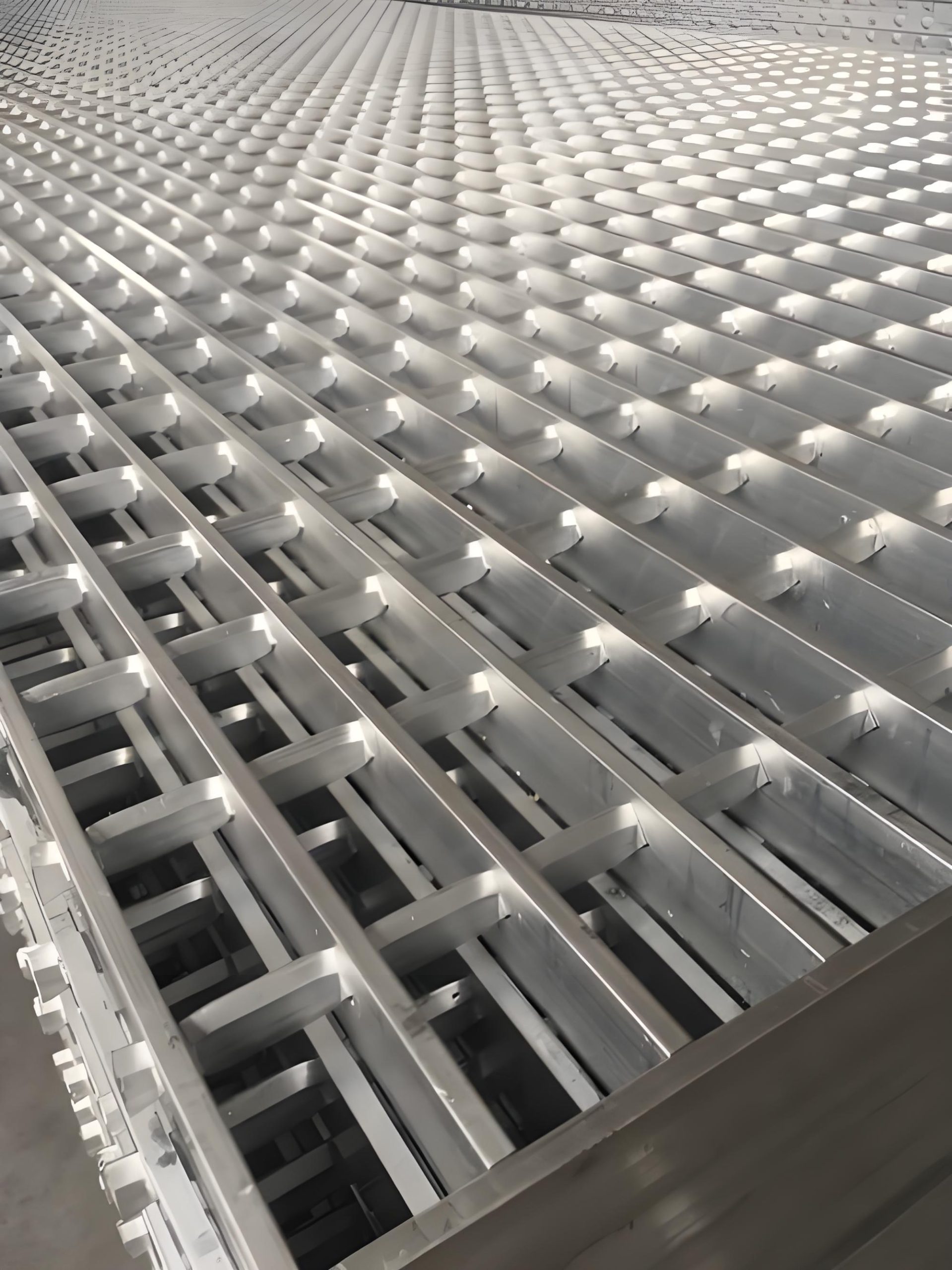
Painted grating may be selected for color coding, indoor corrosion protection, architectural requirements, or projects using a complete steel paint system. A temporary shop primer should not be confused with a final protective coating designed for outdoor or chemical exposure.
A duplex system combines hot-dip galvanizing with a paint or powder coating. It may be used where color identification, extended service life, or severe corrosion protection is required. Surface preparation is important before painting galvanized steel, especially where long-term coating adhesion is required.
Stainless steel grating may require pickling, passivation, electropolishing, or another project-specific treatment after fabrication. These treatments help remove welding discoloration and surface contamination in hygienic or corrosive service environments.
Welded steel bar grating specifications should clearly state the product construction, bearing bar size, spacing, material, surface, panel dimensions, fabrication, finish, load requirement, and applicable standards.
| Standard or Reference | Application |
|---|---|
| ANSI/NAAMM MBG 531-24 | Technical data, load tables, and recommended practices for metal bar grating |
| ANSI/NAAMM MBG 534-24 | Engineering design procedures for metal bar grating |
| NAAMM MBG 533-21 | Welding standards for steel, stainless steel, and aluminum bar grating |
| NAAMM MBG 535-25 | Metal bar grating code of standard practice |
| ASTM A123/A123M-24 | Hot-dip galvanized coatings on fabricated iron and steel products |
| ISO 1461:2022 | Hot-dip galvanized coatings on fabricated iron and steel articles |
| OSHA 29 CFR 1910.22 | General walking-working surface conditions in applicable U.S. workplaces |
| OSHA 29 CFR 1910.28 | Fall protection and falling-object protection requirements in applicable U.S. workplaces |
Welded steel bar grating, 30 × 3 mm bearing bars at 30 mm centers, twisted cross bars at 100 mm centers, serrated top surface, carbon steel fabricated and hot-dip galvanized after fabrication, all cut edges flat-bar banded, panels supplied with galvanized fixing clips, load and deflection requirements according to approved project drawings and applicable standards.
A complete purchase description should also include panel dimensions, bearing bar direction, support span, cut-outs, toe plates, handrail interfaces, clip type, quantity, packing requirements, inspection scope, and delivery term.
Welded steel bar grating price is influenced by more than panel area. Two panels with the same dimensions can have very different factory costs if one uses heavier bearing bars, closer spacing, serrated surfaces, multiple cut-outs, galvanizing, toe plates, or additional certification.
Steel weight is one of the largest cost factors. Larger bearing bars, thicker bars, closer spacing, extra banding, and toe plates all increase the amount of steel required.
For example, a 40 × 5 mm grating panel can weigh more than twice as much as a 25 × 3 mm panel of the same area. Comparing prices only by square meter can be misleading unless the unit weight and full specification are also compared.
Carbon steel generally has the lowest material cost. Galvanized steel adds processing cost for zinc coating. Stainless steel has a much higher material cost, especially 316 stainless steel because of its alloy content.
Closer bearing bar spacing increases steel weight. Closer cross bar spacing increases cross bar material and welding work. Serrated bearing bars also require additional processing, which usually increases the factory price compared with plain grating.
Plain rectangular panels are faster and less expensive to produce than heavily fabricated panels. Cut-outs, notches, round openings, diagonal cuts, edge banding, frames, toe plates, hinges, handles, bolt holes, and special clips all add material and labor.
Hot-dip galvanizing cost depends on finished weight, surface area, local zinc prices, batch size, handling, inspection, and logistics. Small orders can have a higher galvanizing cost per kilogram because minimum processing charges and handling costs are spread over fewer panels.
Large orders often have a lower unit price because production setup, welding fixtures, inspection, galvanizing handling, and packing are distributed across a larger quantity. Small replacement orders and highly customized panels usually have a higher price per square meter.
| Price Factor | Effect on Price | Practical Advice |
|---|---|---|
| Bearing bar size | Larger bars increase steel weight and cost | Select from verified load tables instead of oversizing |
| Bar spacing | Closer pitch increases material consumption | Use the mesh pattern required for safety and load needs |
| Surface | Serrated grating usually costs more than plain grating | Use serration where slip risk justifies it |
| Material | Stainless steel costs more than carbon steel | Match material to the actual corrosion environment |
| Galvanizing | Adds zinc, handling, and inspection cost | Complete all fabrication before galvanizing |
| Cut-outs and banding | Add labor, welding, and extra flat bar | Provide accurate drawings before production |
| Quantity | Small orders usually have a higher unit cost | Combine panel schedules where possible |
| Testing and certificates | Add quality-control and documentation cost | Specify the exact documents required by the project |
| Export packing and freight | Can significantly affect delivered cost | Confirm Incoterms and packing requirements early |
For an accurate factory quotation, provide more than the total square meter quantity. The supplier needs enough information to calculate raw material weight, fabrication time, coating requirements, packing, and delivery cost.
| Information to Provide | Example |
|---|---|
| Product type | Welded steel bar grating |
| Material | Carbon steel, galvanized steel, 304 stainless steel, or 316 stainless steel |
| Bearing bar size | 30 × 3 mm, 32 × 5 mm, or 40 × 5 mm |
| Mesh pattern | 30/100 mm or 30/50 mm |
| Surface type | Plain or serrated |
| Panel dimensions | 1000 × 6000 mm or detailed panel schedule |
| Bearing bar direction | Bars span between supports at 1000 mm centers |
| Load requirement | Uniform load, concentrated load, and deflection limit |
| Fabrication details | Cut-outs, edge banding, toe plates, handles, bolt holes, clips |
| Surface treatment | Hot-dip galvanized after fabrication |
| Required standard | ANSI/NAAMM, ASTM A123, ISO 1461, or project specification |
| Quantity | Total area and number of panels |
| Delivery term | EXW, FOB, CIF, DDP, or site delivery |
A detailed panel drawing and fabrication schedule are the best basis for a final factory price. They help prevent unexpected charges caused by missing cut-outs, unlisted edge banding, incorrect bearing bar direction, special packing, or unplanned galvanizing work.
What is welded steel bar grating used for?
Welded steel bar grating is used for industrial walkways, maintenance platforms, catwalks, trench covers, drainage grates, stair treads, mezzanine floors, machine access routes, and elevated service platforms. It is popular because it provides strength, drainage, ventilation, and slip-resistant surface options.
What is the standard size of welded steel bar grating?
Common welded steel bar grating specifications include 25 × 3 mm, 30 × 3 mm, 32 × 5 mm, and 40 × 5 mm bearing bars. Common mesh patterns include 30/100 mm, 30/50 mm, 40/100 mm, and 40/50 mm. A frequently supplied metric stock panel is 1000 × 6000 mm, although custom fabrication is available.
How is welded steel bar grating price calculated?
Welded steel bar grating price is calculated from steel weight, bearing bar size, bar spacing, surface type, material grade, fabrication work, edge banding, cut-outs, galvanizing, quantity, inspection, packing, and delivery terms. The most accurate factory quotation is based on approved drawings and a complete panel schedule.