
19W4 galvanized grating is a standard welded steel bar grating pattern used for industrial flooring, platforms, walkways, stair treads, catwalks, trench covers, and maintenance access areas. The designation describes the bar spacing and welded construction, while the bearing-bar depth, thickness, finish, panel size, load requirement, and fabrication details determine the real weight, capacity, and factory price. For outdoor and general industrial use, hot-dip galvanized 19W4 grating is commonly selected because the zinc coating protects the finished carbon steel panel, including welds, cut edges, and edge banding.
19W4 is an industry designation for welded steel bar grating. It identifies the standard spacing pattern, not the complete bar size.
| Designation | Meaning | Approximate Metric Equivalent |
|---|---|---|
| 19 | Bearing bars at 19/16 inch centers | 30.16 mm center to center |
| W | Welded steel grating construction | Cross bars welded to bearing bars |
| 4 | Cross bars at 4 inch centers | 101.6 mm center to center |
| Galvanized | Carbon steel protected with zinc coating | Normally hot-dip galvanized after fabrication |
In metric terms, 19W4 is close to a 30×100 mm mesh pattern. The bearing bars are spaced approximately 30 mm apart, and the cross bars are spaced approximately 100 mm apart.
However, 19W4 does not state the bearing-bar depth or thickness. A 19W4 panel with 1 inch x 1/8 inch bars is much lighter than a 19W4 panel with 1-1/2 inch x 3/16 inch bars. Both have the same mesh pattern, but their load capacity, clear span, weight, and price are very different.
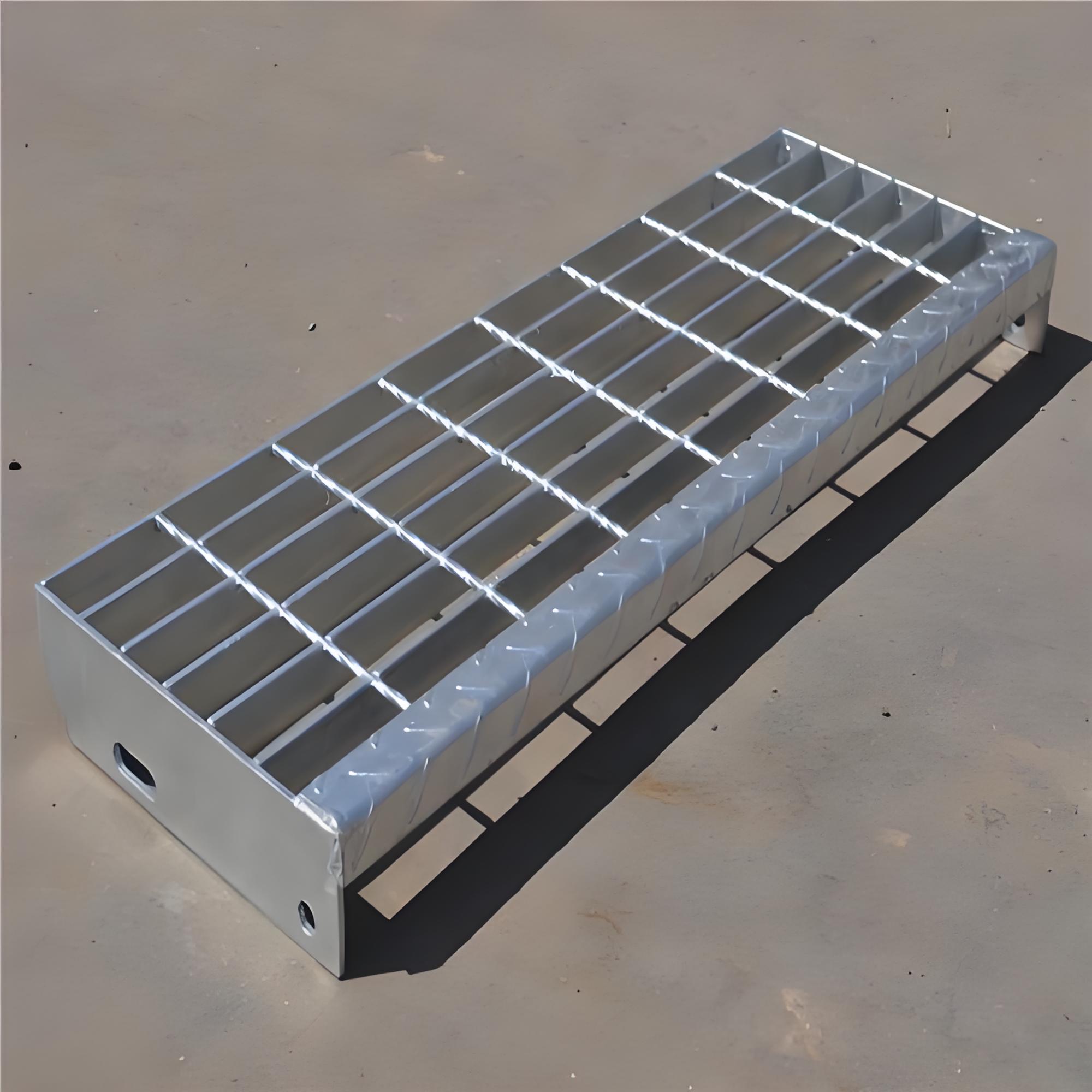
The bearing bars in 19W4 grating are at 1-3/16 inch centers. These are the primary load-carrying bars, and they must span between the structural supports. The cross bars run perpendicular to the bearing bars at 4 inch centers and hold the panel together.
| Grating Element | Imperial Dimension | Approximate Metric Dimension |
|---|---|---|
| Bearing-bar pitch | 1-3/16 in center to center | 30.16 mm |
| Cross-bar pitch | 4 in center to center | 101.6 mm |
| Common bearing-bar thickness | 1/8 in or 3/16 in | About 3.2 mm or 4.8 mm |
| Common bearing-bar depth | 3/4 in to 2 in or more | About 19 mm to 51 mm or more |
The clear opening between bearing bars is smaller than 1-3/16 inch because the bearing-bar thickness occupies part of the spacing. For example, 3/16 inch thick bearing bars leave an approximate 1 inch clear opening between bars. Clear opening should be reviewed where heel safety, small wheels, dropped objects, drainage, ventilation, or public-access requirements apply.
19W4 is one of the most common industrial grating patterns because it provides a practical balance between open area, drainage, walking support, production efficiency, and cost. It has a denser bearing-bar arrangement than more open industrial grating patterns while retaining a relatively open surface for water, dust, heat, and debris to pass through.
Typical 19W4 applications include:
The 19W4 pattern is not automatically suitable for every application. Public pedestrian areas, wheelchair routes, very small wheels, narrow heels, food-processing areas, forklift routes, and vehicle covers may need a different mesh pattern, material, load class, or surface design.
Galvanized 19W4 grating may be described as pre-galvanized or hot-dip galvanized, but the two methods are not the same.
Pre-galvanized steel is coated before it is cut, welded, or fabricated. Post-fabrication hot-dip galvanizing means the completed grating panel is galvanized after welding, cutting, edge banding, and custom fabrication.
| Feature | Pre-Galvanized Grating Material | Post-Fabrication Hot-Dip Galvanized 19W4 Grating |
|---|---|---|
| Coating timing | Applied before fabrication | Applied after welding and fabrication |
| Cut edges | May be exposed after cutting | Coated after final cutting |
| Weld zones | Welding may affect nearby zinc coating | Finished welds receive zinc coverage |
| Custom fabrication | Needs coating repair after some operations | Well suited to banding, cutouts, frames, and custom panels |
| Typical application | Light formed products and selected pre-coated components | Industrial flooring, stairs, outdoor platforms, trench covers |
For welded 19W4 grating, hot-dip galvanizing after fabrication is normally the preferred process. It helps protect the finished bearing bars, cross bars, welded intersections, serrated surfaces, exposed edges, banding bars, cutouts, and fabricated details.
Zinc coating thickness affects the corrosion protection of galvanized 19W4 grating. Requirements are commonly stated through a galvanizing standard, coating mass, coating thickness, or inspection criteria.
Common standards such as ASTM A123/A123M and ISO 1461 define coating requirements for fabricated iron and steel products. The required coating thickness depends on the steel section thickness, the applicable standard, and project requirements.
| Coating Factor | Why It Matters |
|---|---|
| Base steel thickness | Galvanizing standards commonly classify coating requirements by steel thickness |
| Surface preparation | Cleaning, pickling, and fluxing affect coating quality and adhesion |
| Steel chemistry | Carbon, silicon, and phosphorus content can influence zinc reaction and finish appearance |
| Service environment | Outdoor, coastal, chemical, humid, and marine conditions require different corrosion planning |
| Fabrication details | Frames, enclosed sections, holes, and corners need suitable drainage and venting |
For typical fabricated carbon steel sections, hot-dip coating thickness may often fall in a range suitable for general outdoor industrial service, but the exact requirement should be specified by the applicable standard. A heavier zinc coating does not automatically make galvanized grating suitable for every chemical or marine environment.
Expected service life depends on local atmosphere, rainfall, salt exposure, retained moisture, chemical splash, temperature, cleaning practices, mechanical damage, and maintenance. Galvanized grating is practical for many outdoor and general industrial environments, but stainless steel or another material may be better for severe chlorides, strong acids, continuous immersion, or aggressive chemical exposure.
The bearing-bar size is the main structural part of a 19W4 galvanized grating specification. Bearing-bar depth has a strong effect on stiffness and span capacity, while thickness increases steel area, strength, and finished weight.
| Bearing-Bar Size | Approximate Metric Equivalent | General Application Range |
|---|---|---|
| 3/4 in x 1/8 in | 19 mm x 3.2 mm | Light-duty, short-span access panels |
| 1 in x 1/8 in | 25 mm x 3.2 mm | Light industrial walkways and short-span flooring |
| 1 in x 3/16 in | 25 mm x 4.8 mm | Light to medium industrial access areas |
| 1-1/4 in x 1/8 in | 32 mm x 3.2 mm | General pedestrian platforms with controlled spans |
| 1-1/4 in x 3/16 in | 32 mm x 4.8 mm | Common industrial platform and walkway specification |
| 1-1/2 in x 3/16 in | 38 mm x 4.8 mm | Longer spans and lower-deflection industrial flooring |
| 2 in x 1/4 in or larger | 51 mm x 6.4 mm or larger | Heavy-duty, long-span, or engineered loading conditions |
The 19W4 pattern remains unchanged across these bar sizes. A larger bearing bar does not change the mesh spacing, but it increases the finished weight, steel cost, galvanizing surface area, load capacity, and possible clear span.
The finished weight of 19W4 galvanized grating depends on bearing-bar dimensions, cross-bar profile, panel width, edge banding, serration, galvanizing, and custom fabrication. Weight is important for pricing, structural dead load, lifting, export packing, container planning, and installation.
For preliminary estimating, the bearing-bar portion can be calculated from steel density and bar geometry. The actual finished weight must be supplied by the factory because cross bars, welding, zinc coating, banding, and fabrication details change the result.
| 19W4 Bearing-Bar Size | Approximate Bare Grating Body Weight | Approximate Metric Weight | General Use |
|---|---|---|---|
| 3/4 in x 1/8 in | About 3.9–4.5 lb/ft² | About 19–22 kg/m² | Light-duty, short-span access |
| 1 in x 1/8 in | About 4.8–5.5 lb/ft² | About 23–27 kg/m² | Light industrial walkways |
| 1 in x 3/16 in | About 6.8–7.8 lb/ft² | About 33–38 kg/m² | Standard light to medium service |
| 1-1/4 in x 1/8 in | About 5.8–6.8 lb/ft² | About 28–33 kg/m² | General industrial flooring |
| 1-1/4 in x 3/16 in | About 8.3–9.5 lb/ft² | About 41–46 kg/m² | Industrial walkways and platforms |
| 1-1/2 in x 3/16 in | About 9.8–11.0 lb/ft² | About 48–54 kg/m² | Longer-span industrial flooring |
These values are planning estimates for standard welded carbon steel grating before custom fabrication. Hot-dip galvanizing adds zinc mass to the finished product. Serration, edge banding, toe plates, cutouts, frames, clips, stair components, and reinforced edges can increase the final shipping weight.
19W4 galvanized grating can be quoted per square meter, square foot, panel, kilogram, or ton. A square meter price is useful for budgeting, but it must be tied to a specific bearing-bar size and fabrication scope.
| 19W4 Galvanized Product | Indicative Factory Budget Range | Typical Scope |
|---|---|---|
| Light smooth 19W4 galvanized grating | About US$28–42/m² | Lighter bearing bars, standard stock panels, limited fabrication |
| Standard smooth 19W4 galvanized grating | About US$35–55/m² | General industrial panels with standard-duty bar sections |
| Serrated 19W4 galvanized grating | About US$40–70/m² | Outdoor, wet, oily, sloped, or anti-slip industrial use |
| Heavy-duty 19W4 galvanized grating | About US$65–130/m² or more | Deep or thick bearing bars, higher loads, stronger fabrication |
| Fabricated 19W4 galvanized panels | About US$55–120/m² or more | Cut-to-size, banded, notched, framed, labeled, and export packed |
These prices are broad factory planning references, not binding quotations. Local retail, stocked inventory, one-piece orders, urgent lead times, domestic freight, taxes, installation, and distributor margins can produce a much higher delivered price.
A standard 3 ft x 20 ft panel may have a lower unit price because it is made in a repeated production format. A custom 3 ft x 7 ft panel with cutouts, four-side banding, serrated bars, clips, lifting handles, and individual packing may cost more per square foot even though its total area is smaller.
Steel weight is usually the main cost driver for 19W4 galvanized grating. The heavier the bearing bars, the higher the raw material cost, galvanizing cost, packing weight, and freight cost.
Zinc cost also affects the final price because hot-dip galvanizing adds zinc metal, chemical processing, handling, inspection, and transport between manufacturing and galvanizing operations.
| Cost Change | Effect on 19W4 Grating |
|---|---|
| Increase bearing-bar depth | Higher stiffness and span capacity, but more steel and zinc-coated surface |
| Increase bearing-bar thickness | Higher section capacity and weight, with a noticeable price increase |
| Use serrated bearing bars | Additional processing and anti-slip value, usually a higher unit price |
| Add edge banding | More flat bar, welding, galvanizing area, and fabrication labor |
| Add cutouts or notches | More cutting, edge treatment, possible reinforcement, and lower material yield |
| Increase zinc price or coating requirement | Higher galvanizing cost and potentially higher finished weight |
| Increase order quantity | Can reduce setup, material handling, and packing cost per panel |
Factories often calculate the theoretical grating weight first and then add separate costs for fabrication and galvanizing. A detailed quote should state whether the price is based on raw stock panels or fully fabricated installation-ready panels.
Smooth and serrated 19W4 grating use the same bearing-bar and cross-bar spacing. The difference is the top edge of the bearing bars.
| Feature | Smooth 19W4 Galvanized Grating | Serrated 19W4 Galvanized Grating |
|---|---|---|
| Surface profile | Plain bearing-bar tops | Notched or toothed bearing-bar tops |
| Slip resistance | Suitable for dry and controlled areas | Better traction in many wet, oily, and outdoor conditions |
| Factory cost | Usually lower | Usually higher due to serration processing |
| Cleaning | Generally easier to sweep and wash | May retain fine debris if cleaning is poor |
| Typical use | Indoor platforms, dry plant areas, equipment access | Outdoor stairs, ramps, wet floors, drainage zones, oily platforms |
Serrated grating should be selected where the operating environment has a real slip hazard. It is widely used for outdoor maintenance routes, industrial stairs, ramps, wastewater facilities, marine access areas, and wet process floors.
When serrated grating is selected, the load requirement should be checked using the appropriate serrated-grating load data. Serration changes the top edge profile of the bearing bar, so it should not automatically be treated as identical to smooth grating for every span and load condition.
The overall size of a 19W4 panel affects handling, packing, installation, and joint layout. The clear span between supports determines the structural demand on the bearing bars.
The bearing bars must run from one support to the next. This is the primary span direction.
| Design Information | Why It Must Be Included |
|---|---|
| Overall panel length and width | Needed for cutting, handling, packing, and installation layout |
| Bearing-bar direction | Shows the direction in which the main load-carrying bars span |
| Clear span | Controls bending stress and deflection of the bearing bars |
| Uniform load | Used for general pedestrian and distributed platform loading |
| Concentrated load | Important for workers, tools, equipment feet, and local service loads |
| Wheel load | Required for carts, pallet jacks, forklifts, and vehicle traffic |
| Deflection limit | Controls walking comfort, vibration, drainage, and serviceability |
A 20 ft long 19W4 panel does not necessarily span 20 ft. If intermediate supports are placed every 3 ft beneath the bearing bars, the structural span is 3 ft. This distinction is essential when selecting the correct bearing-bar size.
There is no single load capacity for 19W4 grating. A 1 inch x 1/8 inch bar and a 1-1/2 inch x 3/16 inch bar may use the same 19W4 spacing, but they have different allowable spans and deflection performance.
Custom fabrication turns a stock 19W4 panel into a finished piece that fits the project. It can reduce site cutting and installation time, but it adds cost.
| Fabrication Detail | Purpose | Effect on Price |
|---|---|---|
| Edge banding | Closes exposed bearing-bar ends and improves perimeter stiffness | Adds flat bar, welding, galvanizing area, and labor |
| Load banding | Provides a stronger edge where specified for structural loading | Higher than standard trim banding |
| Pipe cutouts | Allows grating to fit around pipes and equipment | Requires cutting, edge treatment, and possible reinforcement |
| Column notches | Allows panels to fit around structural columns | Increases fabrication time and may reduce material yield |
| Toe plates | Helps reduce falling-object risk at exposed platform edges | Adds steel, welding, galvanizing, and installation coordination |
| Frames and lifting handles | Creates removable access covers and finished trench assemblies | Adds parts, welding, fitting, and individual assembly work |
| Clips and bolt holes | Secures panels against uplift, vibration, or movement | Adds accessories, drilling, labels, and packing complexity |
For galvanized grating, custom cutting, welding, banding, and fabrication should normally be completed before hot-dip galvanizing. Field cutting or welding after galvanizing can damage the zinc coating and may require repair according to the project specification.
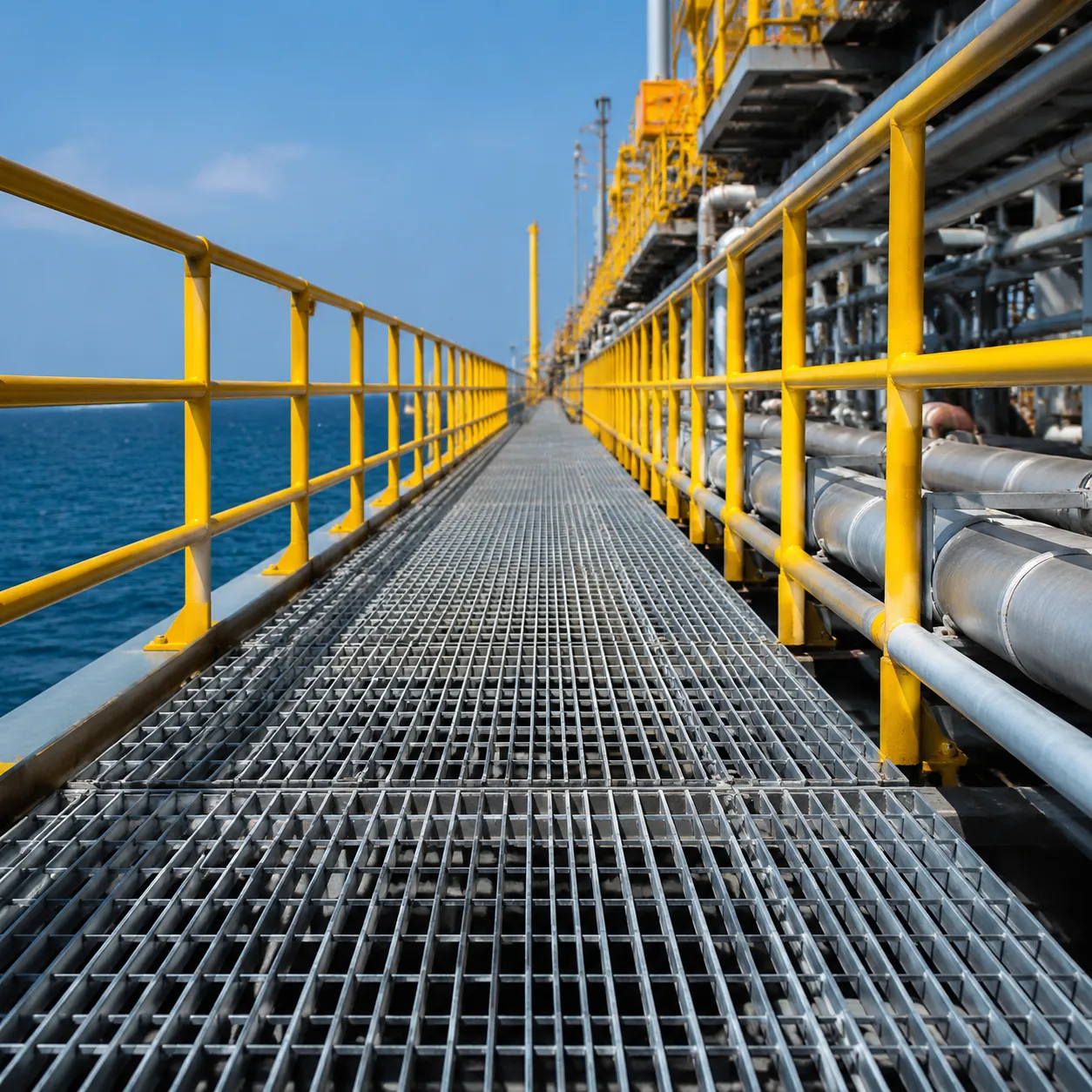
Standard stock panels use common bearing-bar sections, mesh patterns, and manufacturing dimensions. They normally have the lowest price per square meter because production is repeated and material yield is efficient.
Custom hot-dip galvanized orders are fabricated to drawings before galvanizing. They are useful for complex platform layouts, equipment openings, drainage channels, stairs, curved structures, and replacement panels that must fit existing supports.
| Supply Type | Main Advantage | Main Limitation |
|---|---|---|
| Standard stock panel | Lower unit cost and efficient production | May require local cutting or fabrication |
| Cut-to-size panel | Ready for installation and better fit | Higher fabrication cost and drawing review required |
| Custom banded panel | Safe finished edges and improved panel stiffness | Additional steel, welding, and galvanizing cost |
| Framed or hinged cover | Suitable for access hatches and trench covers | More fabrication, fittings, and individual inspection |
| Curved or irregular panel | Fits tanks, pipes, columns, and non-standard platforms | Lower material yield and higher fabrication cost |
Custom orders should include a panel schedule or drawing showing all dimensions, bearing-bar direction, supports, cutouts, edge treatment, fixing details, panel numbers, and installation sequence.
A detailed inquiry allows the factory to select the correct bar section, calculate the finished weight, estimate galvanizing cost, and quote fabrication accurately.
| Required Information | Example |
|---|---|
| Grating type | Welded steel bar grating |
| Spacing designation | 19W4 |
| Bearing-bar size | 1-1/4 in x 3/16 in |
| Material | Carbon steel with hot-dip galvanized finish |
| Surface type | Smooth or serrated |
| Panel dimensions | 3 ft x 6 ft finished panel or complete panel schedule |
| Bearing-bar direction | Bars spanning 3 ft between supports |
| Load requirement | Uniform load, concentrated load, wheel load, and deflection limit |
| Fabrication details | Four-side banding, cutouts, toe plates, clips, holes, lifting handles |
| Galvanizing requirement | Hot-dip galvanized after fabrication to the required project standard |
| Commercial details | Quantity, packing, destination, trade term, and required delivery date |
A clear request could read: “Please quote welded 19W4 carbon steel grating with 1-1/4 inch x 3/16 inch serrated bearing bars, hot-dip galvanized after fabrication, finished panel size 3 ft x 6 ft, bearing bars spanning 3 ft, banded on four sides, suitable for the stated pedestrian load and deflection limit. Please provide finished weight, galvanizing standard, fabrication scope, packing method, lead time, and FOB price.”
What is 19W4 galvanized grating?
19W4 galvanized grating is welded carbon steel bar grating with bearing bars at 1-3/16 inch centers and cross bars at 4 inch centers. It is then protected with a zinc coating, usually by hot-dip galvanizing after fabrication.
How much does 19W4 galvanized grating cost?
For preliminary factory budgeting, standard smooth 19W4 galvanized grating may cost around US$35–55/m², while serrated 19W4 galvanized grating may be around US$40–70/m². The exact price depends on bearing-bar size, finished weight, fabrication, quantity, packing, and delivery terms.
Is serrated 19W4 grating better than smooth 19W4 grating?
Serrated 19W4 grating is generally better for wet, oily, outdoor, sloped, or higher-slip-risk areas because its bearing-bar teeth improve traction. Smooth 19W4 grating is usually more economical and suitable for dry indoor platforms and controlled industrial environments.
