
Galvanized and stainless steel stair treads are both widely used for industrial stairs, maintenance platforms, plant access systems, walkways, towers, wastewater facilities, and outdoor structures. The right choice depends on more than the purchase price. Material grade, corrosion exposure, stair location, load, surface profile, nosing design, support details, fastener compatibility, maintenance access, and expected service life all affect the final result. Hot-dip galvanized carbon steel usually provides a strong and economical solution for many outdoor industrial stairs, while stainless steel is often selected for hygienic, marine, chemical, coastal, and highly corrosive environments. This guide compares galvanized and stainless steel stair treads in detail so engineers, contractors, distributors, and project buyers can select a safe, durable, and cost-effective tread system.
Galvanized steel stair treads are normally manufactured from carbon steel and protected with a zinc coating after fabrication. Stainless steel stair treads are manufactured from corrosion-resistant stainless alloys, commonly Type 304, 316, or 316L. Both products can use welded bar grating, serrated bearing bars, side plates, front nosings, and bolted connections.
| Comparison factor | Hot-dip galvanized steel stair treads | Stainless steel stair treads |
|---|---|---|
| Base material | Carbon steel protected with a zinc coating | 304, 316, 316L, or another stainless steel grade |
| Initial cost | Usually lower to medium | Usually higher |
| Outdoor atmospheric exposure | Good for many industrial and general outdoor environments | Very good when the grade matches the exposure |
| Marine and chloride exposure | May require additional coating review or a different material | 316 or 316L is often preferred over 304 |
| Hygiene and wash-down | Suitable when the zinc coating is compatible with the process | Often preferred for food, pharmaceutical, and clean facilities |
| Surface appearance | Industrial zinc finish, normally grey or silver | Clean metallic appearance, with optional brushed, pickled, or polished finish |
| Maintenance | Requires inspection of zinc coating, cut areas, and damaged zones | Requires cleaning, contamination control, and corrosion inspection |
| Welded fabrication | Normally fabricated before galvanizing | Can be welded and then pickled or passivated |
| Best general use | Outdoor industrial stairs, factories, utilities, towers, and general plant access | Marine, chemical, food, hygienic, wastewater, and architecturally visible stairs |
Neither material is automatically better in every project. Galvanized steel can provide an excellent service-life-to-cost ratio in normal atmospheric exposure. Stainless steel can provide better lifecycle value where coating repair, rust contamination, shutdowns, or aggressive corrosion would make a galvanized system expensive to maintain.
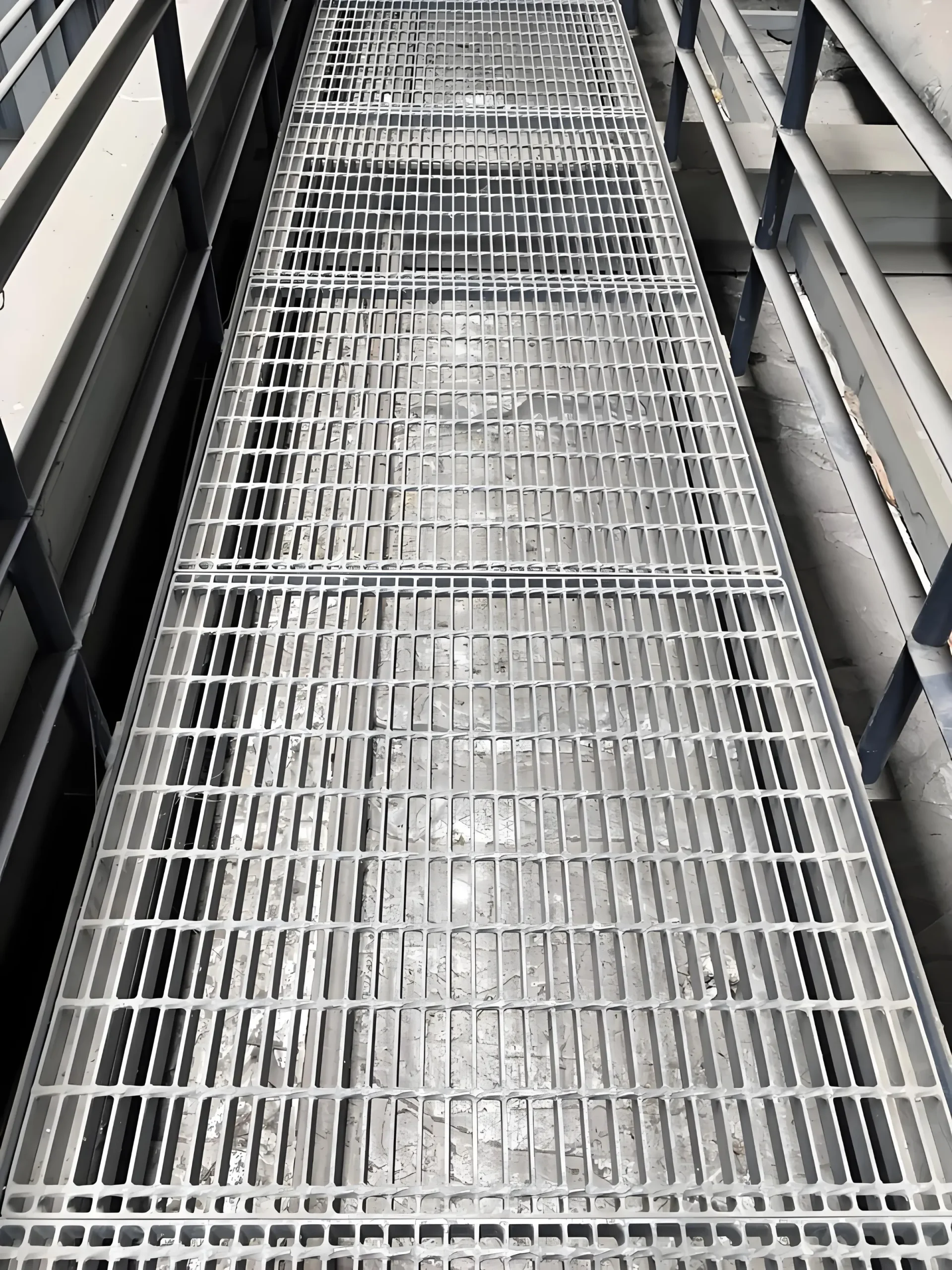
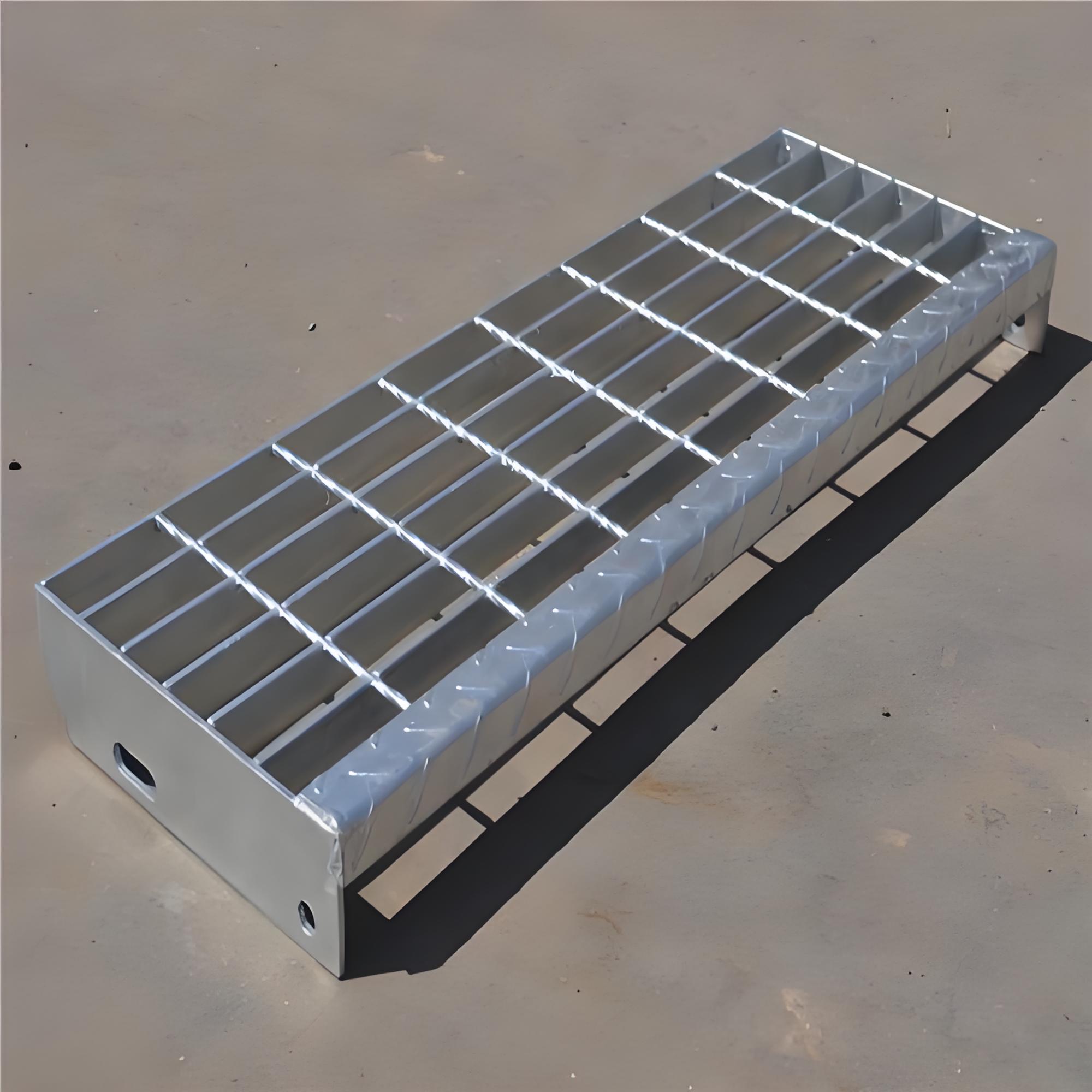
Galvanized steel stair treads are grating stair steps made from carbon-steel bearing bars and cross bars, normally fitted with side carrier plates and a front nosing. After cutting, welding, drilling, banding, and other fabrication are completed, the tread is immersed in molten zinc during the hot-dip galvanizing process.
The zinc coating provides sacrificial protection. When the surface is exposed to moisture, zinc corrodes preferentially before the underlying carbon steel. This protection is particularly useful for outdoor stairs, factory platforms, towers, power plants, warehouses, loading areas, water facilities, and general industrial access systems.
Galvanizing should normally be completed after the stair tread has been fully fabricated. If the tread is drilled, welded, or cut after galvanizing, the exposed steel must be repaired using an approved zinc-rich coating or other specified method.
Stainless steel stair treads are grating steps manufactured from stainless steel bearing bars and cross bars. The most common grades are 304, 316, and 316L. They are selected for their corrosion resistance, clean appearance, hygiene, and ability to perform in wet or chemically exposed areas without depending on a separate zinc coating.
304 stainless steel is suitable for many indoor wet areas, food-processing facilities, commercial kitchens, clean utility rooms, architectural stairs, and general wash-down environments. It is often more economical than 316 and provides good general corrosion resistance.
316 stainless steel contains molybdenum, which improves resistance to chloride-related pitting compared with 304. It is commonly considered for coastal facilities, marine access, wastewater plants, chemical processing, salt-containing products, and outdoor areas exposed to chloride deposits.
316L has a lower maximum carbon content than standard 316. The lower carbon level helps reduce sensitization risk in heat-affected areas during welding. It is often selected when the tread requires extensive welding, stainless frames, welded nosings, banding, or custom fabrication in a corrosive environment.
Stainless steel is not completely immune to corrosion. High chloride concentrations, stagnant liquids, deposits, tight crevices, high temperatures, and unsuitable cleaning chemicals can attack even 316 or 316L. Grade selection should be based on the actual service environment.
Carbon steel provides high strength, good weldability, easy fabrication, and competitive pricing. The steel is cut into bearing bars, cross bars, end plates, nosings, and support components. The tread is welded or mechanically assembled, inspected, and then sent for hot-dip galvanizing.
The zinc coating forms a physical barrier and also provides sacrificial protection when small areas are exposed. Coating performance depends on steel chemistry, surface preparation, coating thickness, drainage, exposure, abrasion, and the condition of cut or welded areas.
Stainless grades contain chromium, which forms a passive oxide film. 316 and 316L also contain molybdenum to improve resistance to localized corrosion in many chloride environments. Nickel contributes to the austenitic structure, ductility, and fabrication performance.
A typical stair tread manufacturing sequence includes:
Fabrication before final coating or finishing is important. Site drilling and welding can damage galvanizing, create stainless steel heat tint, introduce contamination, and change the structural condition of the tread.
| Environment | Galvanized steel suitability | Stainless steel suitability | Important selection issue |
|---|---|---|---|
| Dry indoor factory | Usually suitable, although coating may not be essential | Suitable but may increase cost without a major benefit | Initial cost and appearance |
| Outdoor industrial stairs | Common and economical choice | Suitable, especially where appearance or contamination matters | Rain, humidity, abrasion, and maintenance |
| Wet wash-down area | Suitable if chemicals do not attack zinc | Often preferred for repeated cleaning | Cleaning agent and drainage compatibility |
| Coastal facility | May require additional corrosion review | 316 or 316L is commonly preferred | Salt spray and chloride deposits |
| Marine facility | May have a shorter coating life in severe exposure | 316, 316L, duplex, or another specified alloy may be required | Continuous saltwater, splash zone, and crevices |
| Chemical plant | Depends heavily on chemical compatibility with zinc | Grade must be matched to the chemical and temperature | Concentration, temperature, splash, vapor, and immersion |
| Food-processing plant | Possible in suitable non-contact areas | 304 or 316 is often preferred for hygiene | Cleaning, rust contamination, and surface finish |
| Wastewater plant | Suitable in selected areas with controlled exposure | 316 or 316L may be preferred in aggressive wet zones | Hydrogen sulfide, chlorides, chemicals, and deposits |
Galvanized steel performs well in many outdoor atmospheric environments because the zinc coating protects the carbon-steel substrate. Service life depends on humidity, industrial pollution, salt deposits, rainfall, coating thickness, and abrasion.
Stainless steel relies on its passive film rather than a sacrificial coating. It generally maintains its appearance better in visible areas, but deposits and crevices must still be controlled.
Repeated wetting and drying can concentrate salts and chemicals. Galvanized steel may experience coating loss, while stainless steel may develop staining, pitting, or crevice attack if contaminated liquids remain trapped.
Good drainage, open details, ventilation, and regular washing can improve the performance of both systems.
Zinc is not compatible with every acid, alkali, solvent, or process chemical. Stainless steel is also not universally chemical-resistant. The chemical name, concentration, temperature, exposure time, and cleaning process should be reviewed before selecting either material.
For comparable bearing bar dimensions, galvanized carbon steel and stainless steel stair treads can both provide reliable structural performance. The material grade alone does not determine capacity. Bearing bar height, thickness, span, spacing, tread width, support condition, weld quality, side plates, nosing, and load type are more important design variables.
The bearing bars usually span between the stair stringers and support the user’s weight. Their direction must be shown clearly on the drawing. Cross bars stabilize the panel but are not normally the primary load-carrying members.
A stair tread may be exposed to a person’s full weight, dynamic foot impact, tools, maintenance equipment, and occasional concentrated loads near the front edge. Industrial stairs may also be used while carrying materials, so the design should not assume a light pedestrian load without confirmation.
Excessive tread deflection can cause discomfort, noise, loose bolts, rocking panels, and premature damage to nosings or side plates. Deflection limits should be stated in the project specification or confirmed by the engineer.
Side plates transfer the tread load to the stair stringers. Their thickness, height, hole pattern, and welds must match the stringer connection. A strong grating panel can still fail as a system if the end plates or bolts are undersized.
| Design item | Effect on stair tread performance |
|---|---|
| Bearing bar depth | Strongly affects bending stiffness and load capacity |
| Bearing bar thickness | Affects strength, local durability, weight, and cost |
| Tread span | Longer span increases bending and deflection |
| Bearing bar spacing | Controls load distribution and clear opening |
| Side plate thickness | Affects connection strength and bolt-hole durability |
| Front nosing | Improves edge visibility and may add local stiffness |
| Surface profile | Improves traction but does not automatically increase capacity |
| Fastener arrangement | Controls movement, vibration, and connection reliability |
Plain grating stair treads have flat bearing bar surfaces. They are suitable for dry indoor stairs, clean access areas, and locations where smooth movement and easy cleaning are important.
Plain surfaces may be less suitable for outdoor, oily, wet, muddy, or sloped stairs. The decision should consider footwear, rain, cleaning, process liquids, and the consequences of a slip.
Serrated bearing bars have notches along the top edge to improve traction. Serrated galvanized and stainless steel treads are widely used for exterior industrial stairs, wastewater plants, chemical facilities, loading areas, towers, marine access, and wet platforms.
Serrations improve grip but do not make the tread completely slip-proof. Grease, sludge, ice, algae, polymer residue, or chemical deposits can still create a hazardous surface. Drainage, cleaning, lighting, handrails, and suitable footwear remain important.
The front nosing receives repeated foot impact and helps users identify the leading edge of each step. Common nosing options include:
For industrial stairs, a nosing can improve visibility and traction, but its projection and shape must be coordinated with the stair geometry and local regulations.
There is no single universal stair tread size. The finished tread must match the clear stair width, stringer spacing, rise and run, angle, connection holes, nosing position, and applicable building or workplace requirements.
| Tread component | Common options | What must be confirmed |
|---|---|---|
| Tread length | 600, 800, 900, 1,000, 1,200 mm or custom | Clear stair width, stringer spacing, handling, and support |
| Tread depth | 240, 250, 270, 300 mm or custom | Stair run, foot placement, nosing projection, and local code |
| Bearing bar size | 25 x 3, 30 x 3, 30 x 5, 40 x 5 mm and heavier sizes | Span, load, deflection, and impact |
| Bearing bar spacing | 25, 30, 34, 40 mm or imperial patterns | Opening size, traction, cleaning, and object retention |
| End plate thickness | 3, 5, 6 mm or custom | Bolt size, stringer design, load, and corrosion allowance |
| Front nosing | 25, 30, 40, 50 mm or custom | Visibility, traction, stiffness, and stair geometry |
| Bolt holes | Round, slotted, or project-specific holes | Stringer hole pattern, tolerance, and installation access |
Common market sizes are only starting points. For retrofit work, the existing stair stringers should be measured or templated before production. Old drawings may not accurately represent actual hole positions, corrosion, modifications, or field tolerances.
Stair treads are safety-critical walking components. A strong tread with a smooth contaminated surface can still create a serious hazard. Slip resistance should be assessed together with stair angle, drainage, handrails, lighting, footwear, housekeeping, and the presence of oil or chemicals.
Serrated galvanized or stainless steel treads are often preferred for outdoor and wet stairs. Openings allow rainwater and wash-down liquid to drain, while serrations improve footwear engagement.
Workers may climb industrial stairs while carrying tools, samples, hoses, or components. Handrails should provide secure support, and tread nosings should remain visible under variable lighting. Excessively aggressive surfaces can damage footwear or make wheeled equipment difficult to move, so the final profile should match the work process.
The opening between bearing bars should be reviewed for narrow heels, small tools, wheels, and objects. A close mesh may be preferable in public, commercial, or small-equipment areas, while a larger mesh may be acceptable in restricted industrial access.
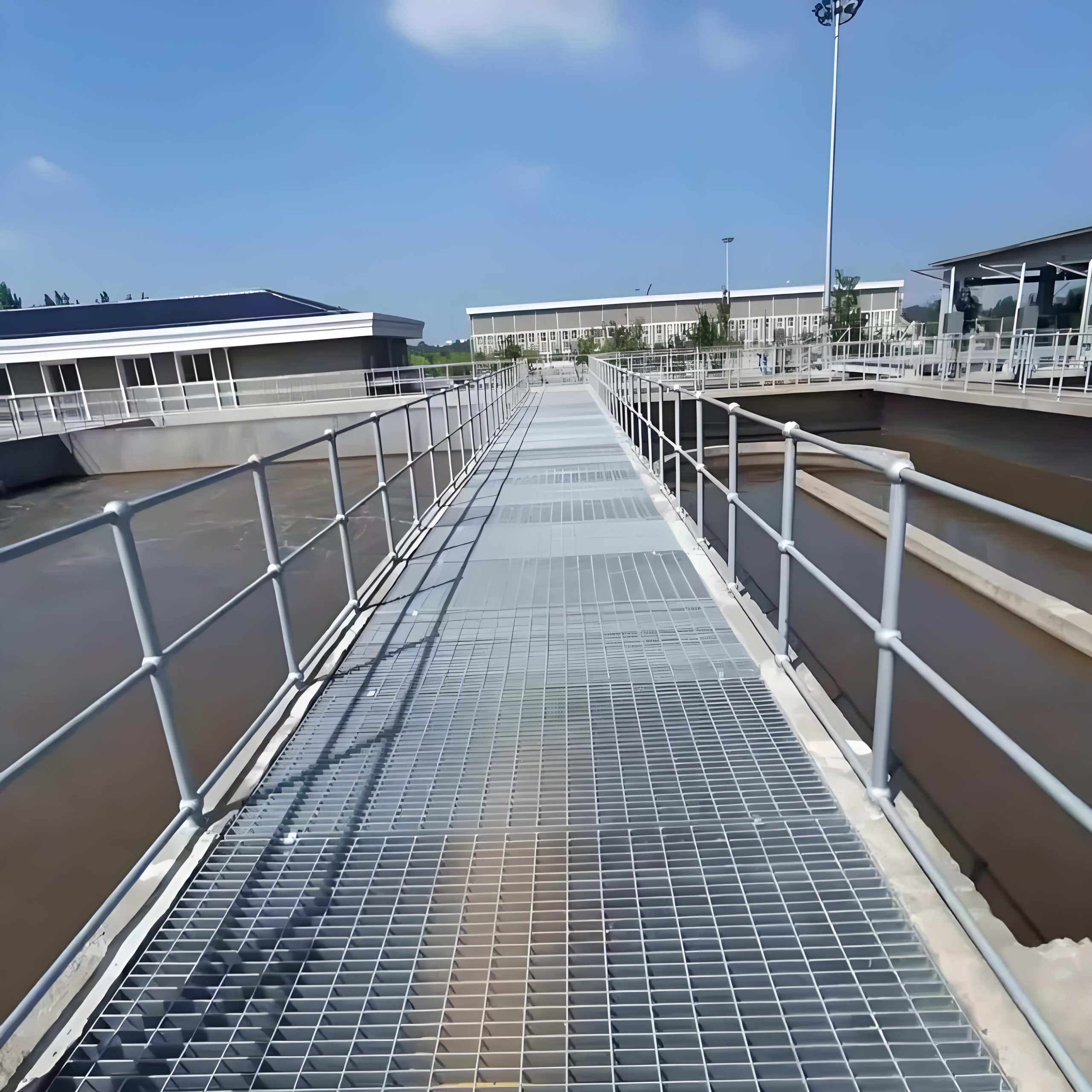
The tread is only one part of a compliant stairway. The complete system may include:
The applicable local code should always be checked because stair geometry and safety requirements vary by country, building type, machinery access, and workplace use.
Hot-dip galvanizing is normally completed after the grating tread, side plates, nosing, and bolt holes have been fabricated. This allows zinc to cover the finished steel surface, welded areas, edges, and holes.
All cutting, drilling, welding, and grinding should preferably be completed before galvanizing. Site modifications can expose bare steel and reduce the protection of the original system.
Galvanizing specifications may define minimum coating thickness, coating mass, inspection methods, appearance, adhesion, and repair requirements. The exact requirement depends on the applicable standard and steel thickness.
The purchase order should state the standard, such as the applicable ISO or ASTM hot-dip galvanizing specification, rather than using only the word “galvanized.” Pre-galvanized sheet, electroplated zinc, zinc-rich paint, and batch hot-dip galvanizing are different processes and should not be treated as equivalent without approval.
Closed sections, side plates, nosings, and boxed details need suitable vent and drain holes. Poorly designed enclosed spaces can retain air, acids, or molten zinc, creating processing hazards, uneven coating, or excess zinc accumulation.
Transport scratches, field drilling, welding, and impact can expose carbon steel. Damaged areas should be cleaned and repaired with the approved zinc-rich coating or other specified repair method. Repair areas should be recorded and inspected before the stair is placed into service.
Galvanized service life depends on the atmospheric environment, coating thickness, wetness, industrial pollution, salt deposits, abrasion, and maintenance. It is usually longer in clean, ventilated outdoor conditions than in enclosed areas with acidic condensate or continuous chemical exposure.
304 stainless steel stair treads may be supplied with a standard mill finish, brushed finish, pickled finish, or another specified surface. It is commonly selected for indoor wash-down, food-processing, commercial, and architectural applications.
316 and 316L are commonly selected for coastal, marine, chemical, wastewater, and chloride-exposed areas. The grade should be stated separately from the finish because a polished surface does not change the alloy’s chemical resistance.
Pickling removes welding oxidation, heat tint, and some surface contamination. It is useful after stainless steel grating fabrication, especially when there are many welded intersections, side plates, nosings, and frames.
Passivation helps restore a clean passive surface after fabrication and pickling. It is often specified for hygienic, chemical, food, pharmaceutical, marine, and water-treatment applications.
Brushed or polished finishes may be selected for visible architectural stairs or areas where appearance is important. They require careful handling and protection during transport to avoid scratches, embedded iron, and surface contamination.
Stainless steel should be fabricated using clean tools and storage practices. Carbon-steel dust, contaminated slings, grinding particles, and incorrect abrasives can leave rust marks on the stainless surface. These marks may be superficial, but they still affect appearance and can hide localized corrosion.
Galvanized steel stair treads generally have a lower initial purchase price than stainless steel treads. However, the total project cost includes fabrication, galvanizing or finishing, fasteners, installation, inspection, cleaning, coating repair, replacement, access shutdowns, and disposal.
| Cost factor | Galvanized steel | Stainless steel |
|---|---|---|
| Raw material | Usually lower | Higher due to alloy content |
| Fabrication | Efficient and widely available | Requires stainless-compatible tools and welding controls |
| Surface treatment | Hot-dip galvanizing adds a separate processing cost | Pickling, passivation, brushing, or polishing may add cost |
| Fasteners | Galvanized or compatible fasteners required | Stainless fasteners may be required, especially in corrosive zones |
| Maintenance | Coating inspection and repair may be required | Cleaning and corrosion inspection are required |
| Replacement risk | Higher where zinc is rapidly consumed or damaged | Lower when the correct grade is used and crevices are controlled |
| Appearance value | Good industrial appearance | Higher architectural and hygienic value |
| Lifecycle value | Very good in moderate outdoor exposure | Often better in aggressive, hygienic, or highly visible environments |
Galvanized steel is often the better value for outdoor industrial stairs, warehouses, towers, utility structures, factories, power plants, and general platforms where the environment is not dominated by chlorides or aggressive chemicals.
Stainless steel may provide better lifecycle value in food plants, chemical facilities, marine areas, wastewater plants, cleanrooms, pharmaceutical facilities, and highly visible architectural installations. The higher initial cost may be offset by reduced coating repair, less rust contamination, longer service, and fewer shutdowns.
Bolted stair treads are common because they can be installed, removed, inspected, and replaced without cutting the stair stringers. Side plates are drilled to match the stringer holes. The bolt diameter, hole size, washer, nut, and tightening method should be specified.
Welding provides a permanent connection but makes replacement and maintenance more difficult. Galvanized surfaces must be repaired after welding, while stainless steel welds may require pickling and passivation.
Clips may be used for removable grating treads or specialized stair systems. The clip must fit the tread profile and support detail and should resist vibration, impact, and movement.
Side plates should seat evenly against the stringers. Uneven support can create local overload, rocking, noise, and bolt-hole deformation. The tread should not rely on a small unsupported edge or a single fastener where the design requires a full connection.
Nosing may be flat, angle-shaped, checker plate, serrated plate, perforated, or abrasive. Its projection should be coordinated with the tread depth and stair geometry. The nosing should be firmly attached and protected against impact and corrosion.
Fasteners should be compatible with the tread and stringer materials. Galvanized steel treads may use galvanized or suitably coated bolts. Stainless steel treads often require stainless fasteners, especially in wet or chloride environments.
Direct contact between stainless steel and carbon steel, galvanized steel, or aluminum may require isolation measures to reduce galvanic corrosion and staining.
Inspect galvanized treads for red rust, zinc loss, white corrosion products, impact damage, abrasion at the nosing, and coating damage around bolt holes. Particular attention should be paid to areas where water, salt, sludge, or chemicals can remain trapped.
Inspect stainless treads for tea staining, pitting, crevice corrosion, embedded iron, damaged welds, loose bolts, and deposits. Clean with products approved for the stainless grade and avoid carbon-steel brushes or contaminated abrasives.
Regular cleaning removes salt, grease, sludge, food residue, algae, dust, and chemicals. A surface that is technically corrosion-resistant can still deteriorate when deposits create a concentrated and oxygen-depleted crevice.
Small galvanized coating damage can often be repaired after surface preparation with an approved zinc-rich system. Severely corroded carbon-steel treads may need replacement rather than patching. Stainless treads with pitting should be evaluated to determine whether corrosion is superficial or has reduced the bearing section.
| Facility type | Preferred starting material | Important review points |
|---|---|---|
| General factory | Galvanized steel for outdoor areas; painted or galvanized steel indoors | Humidity, impact, traffic, and maintenance budget |
| Marine and coastal | 316 or 316L stainless steel; specialized alloys for severe service | Salt spray, immersion, splash zone, crevices, and fastener compatibility |
| Chemical plant | Galvanized steel only where zinc is compatible; 316 or 316L for selected chemicals | Chemical type, concentration, temperature, splash, and vapor |
| Food processing | 304 stainless steel for general areas; 316 for salt or aggressive cleaning | Hygiene, wash-down, surface finish, and contamination control |
| Wastewater treatment | Galvanized steel in selected zones; 316 or 316L in aggressive wet areas | Hydrogen sulfide, chlorides, ferric chemicals, deposits, and ventilation |
| Pharmaceutical facility | 304 or 316 stainless steel | Cleanability, passivation, surface finish, and documentation |
| Architectural project | Stainless steel where appearance is important | Brushed finish, polishing, scratches, visible joints, and alignment |
Galvanized steel may be acceptable in sheltered or moderately exposed coastal areas, but severe salt spray, splash zones, and continuous wetting can consume zinc rapidly. 316 or 316L is often a better starting point for marine stairs, although warm stagnant seawater and crevices can still attack stainless steel.
The correct choice depends on the chemical. Zinc coatings can be attacked by acids and strong alkalis, while stainless steel performance varies with chemical concentration and temperature. Material compatibility should be confirmed before purchasing.
Stainless steel is often preferred because it supports wash-down, hygiene, clean appearance, and rust control. 304 is common in general areas, while 316 or 316L may be selected for brine, chloride, or aggressive sanitation exposure.
Galvanized steel can be economical in ventilated outdoor zones with moderate exposure. Stainless steel is often considered around wet wells, chemical dosing, sewage channels, clarifiers, and locations where hydrogen sulfide, chlorides, deposits, or frequent wash-down are present.
CSSP Grating provides related information about heavy-duty industrial stairs and stainless steel options for more demanding environments.
Galvanized treads have a practical industrial appearance with a grey or silver zinc surface. The coating may show normal variations, spangle patterns, darker weld areas, or local texture differences. These variations do not necessarily indicate a performance problem.
Stainless steel offers a cleaner and more consistent visual appearance. Brushed, polished, pickled, and passivated surfaces can be selected for architectural stairs, public facilities, food plants, commercial buildings, and visible process areas.
Stainless steel is often preferred where the tread must be washed frequently or where rust particles, peeling coatings, and zinc residues are unacceptable. However, hygiene also depends on weld smoothness, edge design, drainage, accessible cleaning, and the absence of dirt-trapping crevices.
Architectural stair projects may require consistent nosing lines, concealed or coordinated fasteners, uniform surface finish, close mesh, special frames, and carefully aligned panels. Stainless steel may justify its higher initial cost in these locations because the tread remains a visible part of the design.
Both galvanized carbon steel and stainless steel are recyclable materials. Environmental performance should be considered across raw material production, fabrication, coating, transport, maintenance, replacement, and end-of-life recovery.
Galvanized steel uses a carbon-steel base that is widely available and easy to process. The zinc coating extends the service life and reduces the need for frequent repainting. At the end of service, steel and zinc can be recovered through established recycling processes.
Stainless steel usually has a higher embodied material cost, partly because of alloying elements such as chromium, nickel, and molybdenum. However, it can provide long service with low coating maintenance and is highly recyclable. The longer service life may reduce replacement materials, labor, transport, and downtime.
The better environmental and financial choice depends on how long the stair must operate, how difficult replacement is, how aggressive the environment is, and whether maintenance requires plant shutdowns or confined-space work. A lower-cost galvanized tread may be the best lifecycle choice in a moderate atmosphere, while stainless steel may be more sustainable in a corrosive facility where early replacement would otherwise be likely.
The final decision should be based on an exposure map, structural calculation, safety assessment, maintenance plan, and lifecycle cost review.
| Specification category | Information to include |
|---|---|
| Material | Carbon steel, hot-dip galvanized steel, 304, 316, 316L, or approved alternative |
| Surface protection | Galvanizing standard, coating thickness, passivation, polishing, or approved repair system |
| Construction | Welded, press-locked, heavy-duty, or another specified type |
| Bearing bars | Height, thickness, spacing, direction, and design span |
| Cross bars | Type, size, spacing, and connection method |
| Tread dimensions | Length, depth, tolerances, weight, and quantity |
| Side plates | Thickness, height, shape, hole diameter, hole spacing, and orientation |
| Nosing | Type, projection, material, anti-slip profile, and finish |
| Loads | Pedestrian, maintenance, equipment, impact, wheel, and allowable deflection |
| Stair geometry | Rise, going, angle, width, landings, headroom, and local code requirements |
| Fasteners | Material, grade, washers, nuts, clips, anti-loosening details, and torque |
| Support | Stringer section, bearing seat, welds, bolts, and corrosion compatibility |
| Inspection | Dimensions, flatness, welds, coating, surface, holes, and documentation |
| Delivery | Panel marks, packing protection, lifting instructions, and replacement policy |
For standard industrial stair applications, buyers can also review the CSSP Grating product range and compare heavy-duty stairs, stainless steel grating, galvanized grating, stair treads, and trench-cover products before requesting a project quotation.
Are stainless steel stair treads better than galvanized stair treads? Stainless steel stair treads are better when the project requires higher corrosion resistance, hygiene, clean appearance, or long-term performance in marine, chemical, food-processing, and wastewater environments. Galvanized stair treads are often the better value for outdoor industrial stairs, factories, towers, warehouses, and general platforms with moderate atmospheric exposure. The correct choice depends on the environment, maintenance plan, load, and lifecycle cost.
How long do galvanized steel stair treads last outdoors? The service life depends on zinc coating thickness, humidity, salt exposure, industrial pollution, abrasion, drainage, and maintenance. Galvanized treads can provide long service in many outdoor industrial environments, but they may deteriorate faster in coastal splash zones, acidic condensate, continuous wetting, or aggressive chemical areas. The galvanizing standard and coating requirements should be included in the purchase specification.
Should I choose 304 or 316 stainless steel stair treads? Choose 304 stainless steel for many indoor wet, hygienic, food-processing, and general wash-down areas. Choose 316 or 316L when the stairs are exposed to chloride, salt spray, marine conditions, wastewater, brine, or more aggressive chemical cleaning. 316L is often preferred for extensive welded fabrication because its lower carbon content reduces sensitization risk around heat-affected areas.
