

Carbon steel riveted bar grating is a heavy-duty open flooring system made by joining load-bearing bars, reticulated cross bars, and high-strength rivets. It is often selected for bridge decks, plant floors, service platforms, trench covers, ramps, walkways, and areas exposed to rolling or repetitive loads. Factory prices depend on the bearing bar size, rivet spacing, panel weight, surface finish, fabrication, order quantity, and delivery terms. This guide explains how riveted grating is constructed, where it performs best, and how manufacturers calculate the price.
Carbon steel riveted bar grating is a bar-grating panel in which the bearing bars are mechanically joined to reticulated cross bars with rivets. The bearing bars run in the primary load-bearing direction and span between supports. The cross bars are often formed into a truss-like or reticulated profile, which provides lateral stability and helps spread localized loads across the panel.
Rivets are installed through prepared holes in the bearing bars and cross bars. Mechanical or hydraulic riveting equipment then deforms the rivet to create a permanent connection. The assembly does not depend on resistance welds at every intersection, although perimeter bands, frames, toe plates, and special reinforcement may still be welded.
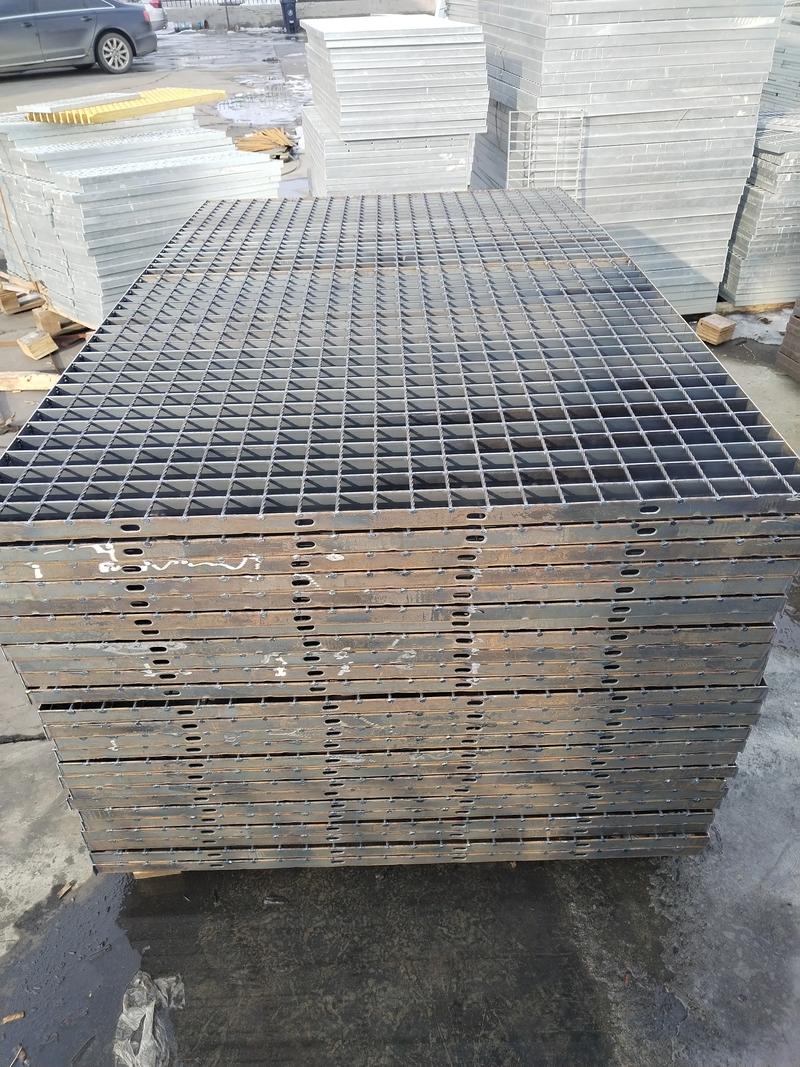
Riveted grating has a long history in industrial and transportation applications because the reticulated cross bars can provide a firm, durable surface under wheel contact. The open mesh allows water, oil, light, air, and small debris to pass through, while the bearing bars provide the main structural capacity.
| Grating Component | Structural or Functional Role | Typical Specification |
|---|---|---|
| Bearing bars | Carry the principal bending load across the clear span | 25 × 6 mm, 32 × 6 mm, 40 × 6 mm, 50 × 6 mm, or heavier sizes |
| Reticulated bars | Form the cross-bar network and distribute local forces | Flat, formed, or truss-style cross members |
| Rivets | Lock the reticulated bars to the bearing bars | Steel rivets sized for the grating duty and project specification |
| Banding bars | Close and reinforce panel edges and cutouts | Flat bar, matching bearing bar, or load-carrying band |
| Support frame | Provides a bearing ledge or perimeter restraint | Angle, channel, flat bar, or structural steel frame |
The bearing bars are placed parallel to one another at a specified spacing. Reticulated cross bars are then arranged perpendicular to the bearing bars. Unlike a simple round cross rod, a reticulated bar may have a formed or repeated profile that gives the panel additional depth and helps distribute rolling contact between several bearing bars.
Rivets pass through aligned holes in the cross bars and bearing bars. When the rivets are compressed or upset, their ends expand and lock the members together. The rivet head is normally formed flush or near-flush with the walking surface, depending on the product design.
The connection pattern affects panel rigidity, vibration, maintenance, and price. Standard rivet spacing is often around 7 inches on center, while close rivet spacing around 3.5 inches may be specified for certain heavy-duty or high-impact applications. These values are common examples rather than universal requirements.
| Structural Detail | Effect on the Panel |
|---|---|
| Bearing bar pitch | Controls the number of primary load bars per unit width and the clear opening |
| Cross bar profile | Influences lateral stability, rolling behavior, appearance, and weight |
| Rivet spacing | Controls connection density and resistance to movement between members |
| Rivet diameter and head | Affects joint capacity, surface profile, and compatibility with replacement panels |
| Edge banding | Improves perimeter stability and closes open bar ends |
| Panel orientation | Determines whether the bearing bars span in the intended load direction |
The cross bars and rivets should not be used to compensate for undersized bearing bars. If the clear span or load increases, the bearing bar depth and thickness normally need to increase as well.
Riveted, welded, and press-locked grating can all be used for industrial floors, but they suit different project priorities.
| Feature | Riveted Grating | Welded Grating | Press-Locked Grating |
|---|---|---|---|
| Intersection connection | Mechanical rivets through reticulated bars | Resistance-welded cross bars | Cross bars pressed into slots in bearing bars |
| Rolling loads | Often selected for repetitive cart, dolly, and vehicle contact | Suitable when the exact welded design is engineered for wheel loads | Used mainly where appearance or close mesh is important |
| Industrial strength | Can be engineered for high loads and long service | Very efficient for heavy industrial platforms and high-volume production | Capacity depends on the exact slot and bar geometry |
| Walking surface | Reticulated bars can provide a relatively smooth rolling route | Cross bars and welds may create a more pronounced industrial profile | Usually clean and regular, with a flush appearance |
| Fabrication cost | Higher labor and riveting time | Usually the lowest-cost carbon steel method | Higher machining and setup cost than standard welded panels |
| Typical applications | Bridge decks, heavy floors, ramps, trench covers, and rolling traffic | Platforms, walkways, stairs, drains, and general plant flooring | Architectural flooring, close mesh, and appearance-sensitive areas |
Welded grating is normally the most economical choice for ordinary carbon steel platforms. Riveted grating is considered when repeated rolling loads, bridge traffic, impact, or a traditional heavy-duty specification is important. Press-locked grating is attractive when a clean visual pattern and mechanically locked construction are required.
Load capacity should be compared using the actual bearing bar, mesh, span, support, and load condition. A riveted panel should not be assumed to have the same rating as a welded or press-locked panel with similar nominal dimensions.
For a broader comparison of bearing bar dimensions and construction types, buyers can review this steel bar grating dimensions guide.
Riveted grating is often specified for rolling loads because its reticulated cross bars form a deeper, interconnected pattern than a simple light cross rod. When a cart wheel, dolly, forklift, or service vehicle passes over the panel, the load can be shared by several adjacent bearing bars through the cross-bar network.
The surface of a riveted panel can also be relatively smooth for wheels, particularly when a plain bearing bar is specified. This can reduce abrupt contact with protruding welds or cross rods. In bridge and plant-floor applications, a smoother rolling path can reduce wheel vibration, noise, and localized impact.
Repeated loading still requires an engineering check. The relevant factors include wheel spacing, tire contact area, impact, speed, turning, braking, fatigue, support rigidity, connection condition, and the number of load cycles. Rivets do not make an undersized panel suitable for vehicle traffic.
| Rolling Load | Design Information to Provide | Why It Matters |
|---|---|---|
| Hand cart or dolly | Wheel diameter, wheel spacing, total load, and route direction | Small wheels can impose concentrated forces over a narrow area |
| Maintenance trolley | Loaded weight, wheel arrangement, turning points, and frequency | Repeated passes can create fatigue and vibration concerns |
| Forklift | Wheel load, axle spacing, tire type, and impact factor | Forklift wheels produce high concentrated and dynamic loads |
| Service vehicle | Vehicle class, wheel path, speed, braking, and support spacing | Bridge or roadway panels require a vehicle-rated design |
| Equipment skids | Support-foot dimensions, spacing, and installation method | Point loads may require local reinforcement or support beams |
Heavy-duty manuals such as ANSI/NAAMM MBG 532 include separate static and vehicular load tables for suitable riveted constructions. These tables are based on defined bearing bar sizes, spans, loads, and deflection limits. The exact project specification and current edition should govern the final selection.
Riveted grating is available in light-duty and heavy-duty constructions. The difference is mainly the bearing bar size, panel weight, support spacing, and intended load rather than the word “riveted” itself.
| Category | Typical Characteristics | Possible Application |
|---|---|---|
| Light-duty riveted | Smaller or thinner bearing bars, lower panel weight, shorter spans | Pedestrian walkways, light platforms, and protected access routes |
| Standard-duty riveted | Balanced bar size, weight, and rolling performance | Plant floors, ramps, service decks, and maintenance routes |
| Heavy-duty riveted | Deep and thick bearing bars, robust reticulated bars, stronger supports | Bridge decks, forklifts, service vehicles, and equipment floors |
| Vehicle-rated riveted | Special load table, wheel-load design, reinforced framing, and controlled deflection | Roadway grates, industrial bridges, and traffic areas |
Common riveted products may use bearing bars spaced approximately 3/4 inch or 1-1/8 inch apart. A closer spacing reduces the opening and places more bars under a wheel or foot load, but it increases steel consumption and price.
Heavy-duty bearing bars may be around 2 to 5 inches deep and 1/4 to 3/8 inch thick in North American-style constructions, while metric factories may use approximately 50 × 6 mm, 60 × 8 mm, 75 × 8 mm, or larger bars. These are examples only. The exact size must be selected from the applicable load table.
Bearing bar height and thickness control the bending stiffness and load capacity of a riveted panel. The bars should span perpendicular to the support beams. The cross bars and rivets stabilize the panel but do not replace the primary bearing members.
| Specification Item | Common Options | Price Effect |
|---|---|---|
| Bearing bar height | 25, 32, 40, 50, 60, 75 mm or larger | Taller bars increase stiffness, weight, and material cost |
| Bearing bar thickness | 5, 6, 8, 9.5, 10 mm or project-specific | Thicker bars improve local strength but increase steel use |
| Bearing bar pitch | Approximately 19, 25, 30, 38, or 40 mm | Closer pitch increases bar count and reduces openings |
| Rivet spacing | Approximately 7 in standard or 3.5 in close spacing | Closer riveting increases connection labor and material |
| Cross bar profile | Reticulated, flat, formed, or project-specific | More complex profiles require additional forming and setup |
Metric and imperial designations are not always directly interchangeable. An imperial 3/4-inch bearing bar spacing may be close to 19 mm, while a 1-1/8-inch pattern may be close to 28.6 mm, but the actual clear opening depends on the bar thickness and product convention.
When replacing old panels, measure the bearing bar spacing from center to center or face to face according to the original standard. Also measure bar height, thickness, rivet spacing, cross bar profile, panel width, and edge banding. A replacement panel with the same overall length but a different bar count may not fit the existing frame.
Plain riveted grating has smooth bearing bar tops and is often preferred where carts, dollies, forklifts, or service vehicles need to roll across the surface. Serrated bearing bars have notches or teeth that improve traction for pedestrians in wet or contaminated conditions.
| Feature | Plain Riveted Grating | Serrated Riveted Grating |
|---|---|---|
| Wheel movement | Smoother path for carts and rolling equipment | More surface interruption and possible tire vibration |
| Pedestrian traction | Suitable for dry and controlled environments | Better traction in wet, oily, muddy, or icy areas |
| Cleaning | Generally easier to sweep and wash | Serrations can retain more dirt or process residue |
| Price | Lower for the same bar and mesh | Higher because of serration processing and inspection |
| Load-table effect | Use plain-bar data for the exact construction | Confirm whether the required depth changes for serrated bars |
Some heavy-duty load tables require the next greater bearing bar depth when serrated grating is specified. This is because notches reduce part of the effective top section. The supplier should confirm the required adjustment for the exact product.
Serrated grating is not automatically slip-proof. Footwear, contamination, drainage, lighting, slope, housekeeping, and handrails also determine practical safety. For bridge decks with both vehicle and pedestrian traffic, the designer may use a plain rolling lane and a separate serrated pedestrian strip.
Riveted grating should be selected according to the complete load condition. The key structural inputs are:
Clear span is the unsupported distance between the supports beneath the bearing bars. It is not the overall panel length. A long panel can have several intermediate beams and a short clear span, while a smaller panel may bridge a large opening and need much deeper bearing bars.
| Load Type | Typical Design Check |
|---|---|
| Uniform pedestrian load | Bending, deflection, vibration, and walking comfort |
| Concentrated pedestrian load | Local load sharing between adjacent bearing bars |
| Equipment point load | Support-foot size, local reinforcement, and panel damage risk |
| Cart or dolly load | Wheel size, wheel spacing, and concentrated load |
| Forklift load | Wheel load, impact, turning, braking, and fatigue |
| Vehicle bridge load | Vehicle class, axle spacing, wheel path, and structural framing |
Published heavy-duty tables may list static uniform loads, concentrated loads, forklift loads, or vehicle classes such as H-15, H-20, and H-25. These ratings are tied to a specific grating construction and support condition. They should not be transferred to another panel without engineering review.
Deflection is often a controlling serviceability issue. Excessive movement can loosen rivets, damage frames, create uncomfortable vibration, or cause vehicles to bounce. The allowable limit may be expressed as a fraction of span or as a maximum millimeter value. The owner or structural engineer should identify the governing limit.
Carbon steel riveted grating can be made from ASTM A36, ASTM A1011, Q235B, S235JR, or another approved structural grade. The bearing bars, reticulated bars, rivets, bands, and frames should be specified clearly when different materials or thicknesses are used.
| Material or Finish | Advantages | Typical Use |
|---|---|---|
| Mill-finish carbon steel | Lowest initial cost and simple fabrication | Indoor or protected plant floors |
| Shop-painted carbon steel | Color selection and basic corrosion protection | Indoor platforms and moderate service |
| Hot-dip galvanized carbon steel | Zinc coating on the completed fabricated panel | Outdoor bridge decks, walkways, ramps, and humid plants |
| Duplex galvanized and painted | Additional barrier protection and color finish | Severe exposure or long maintenance intervals |
Riveted grating can be galvanized after the panel is assembled and fabricated. Post-fabrication hot-dip galvanizing protects the completed bearing bars, reticulated bars, bands, and many edge areas. The factory should confirm whether the panels are galvanized before or after banding and framing.
Project specifications may reference ASTM A123/A123M, ISO 1461, or another galvanizing standard. Coating requirements depend on steel thickness, surface preparation, exposure conditions, and the specified standard. Zinc build-up around rivet heads, cutouts, and frame edges should be considered where close-fitting panels are installed.
If the panel is cut or welded after galvanizing, the exposed area requires an approved zinc repair system. Field repairs should be documented because they can affect long-term corrosion protection.
Riveted grating is used for pedestrian bridges, service bridges, industrial crossing platforms, and vehicle bridge decks. The design must account for wheel paths, impact, fatigue, drainage, edge restraint, guardrails, and the support beams beneath the panels.
Plant floors may combine pedestrian traffic, maintenance carts, equipment supports, and pipe penetrations. Riveted grating is useful where the surface must remain open for ventilation and drainage while tolerating repeated maintenance movement.
Trench covers require accurate fit, removable access, safe openings, and an appropriate pedestrian, forklift, or vehicle rating. A riveted cover may use banded edges, lifting handles, hinges, locks, or a perimeter frame. Large trench openings need structural support independent of the grating edge.
Walkways and ramps may use plain grating for dry rolling traffic or serrated grating for wet pedestrian traction. The panel should be checked for slope, nosing, handrails, toe plates, opening size, and drainage direction.
| Application | Preferred Design Emphasis |
|---|---|
| Pedestrian bridge | Close opening, slip resistance, deflection, guardrails, and drainage |
| Service vehicle bridge | Wheel loads, impact, fatigue, clear span, and reinforced support frame |
| Plant floor | Equipment point loads, removable panels, cutouts, and maintenance traffic |
| Trench cover | Load class, removable access, edge fit, locking, and corrosion protection |
| Industrial ramp | Serrated surface, slope, nosing, wheel path, and side restraint |
Riveted grating is commonly supplied in standard widths close to 2, 3, or 4 feet and lengths near 20 or 24 feet. Metric factories may offer panels such as 600 × 2,000 mm, 750 × 3,000 mm, 1,000 × 3,000 mm, and 1,000 × 6,000 mm. Actual stock depends on the riveting equipment, bearing bar count, transport limits, and market.
| Panel Format | Typical Use | Handling Consideration |
|---|---|---|
| 600 × 2,000 mm | Compact access routes and removable covers | Low lifting weight and easy field handling |
| 750 × 3,000 mm | Narrow industrial walkways and ramps | Balances coverage and panel weight |
| 1,000 × 3,000 mm | Plant floors and equipment platforms | Convenient modular layout |
| 1,000 × 6,000 mm | Long catwalks and bridge sections | Fewer joints but greater lifting and shipping weight |
| 2, 3, or 4 ft wide panels | Imperial bridge and industrial layouts | Width is often based on bearing bar count and spacing |
Important tolerances include overall length and width, squareness, flatness, bearing bar pitch, reticulated bar alignment, rivet position, banding alignment, and cutout location. A custom panel width may cause the spacing at one edge to differ slightly from the regular pattern, so the approved drawing should show the finished dimensions.
When replacing an existing riveted panel, measure more than the outside length and width. Confirm the following:
Photographs alone are rarely enough for a replacement quote. A dimensioned sketch and measurements from an undamaged panel give the factory a much better basis for compatibility.
Riveted grating quality control should verify both the individual components and the completed panel. A panel can have the correct overall size but still be unsuitable if the bearing bars are undersized, rivets are loose, or the support direction is incorrect.
| Inspection Stage | Typical Check |
|---|---|
| Raw material | Steel grade, thickness, heat number, straightness, and surface condition |
| Bearing bar preparation | Height, thickness, spacing, length, and hole position |
| Reticulated bar forming | Profile, depth, alignment, and dimensional consistency |
| Riveting | Rivet diameter, head formation, tightness, spacing, and visible defects |
| Panel assembly | Flatness, squareness, twist, mesh pattern, and edge alignment |
| Banding and frames | Weld quality, frame dimensions, cutouts, and sharp-edge removal |
| Surface treatment | Galvanizing coverage, coating thickness, paint adhesion, and appearance |
| Final documentation | Weight, dimensions, load data, certificates, and packing records |
For heavy-duty or vehicle applications, request a load table or project-specific structural calculation. The document should identify the bearing bar size, grating type, span, support condition, static or wheel load, and allowable deflection.
Material documentation may include a mill test certificate, certificate of conformity, dimensional inspection report, galvanizing report, coating record, welding records for frames, and a certificate of origin. If a project requires ANSI/NAAMM MBG 532, AASHTO vehicle loading, BS 4592, or another standard, include the exact edition and application in the purchase specification.
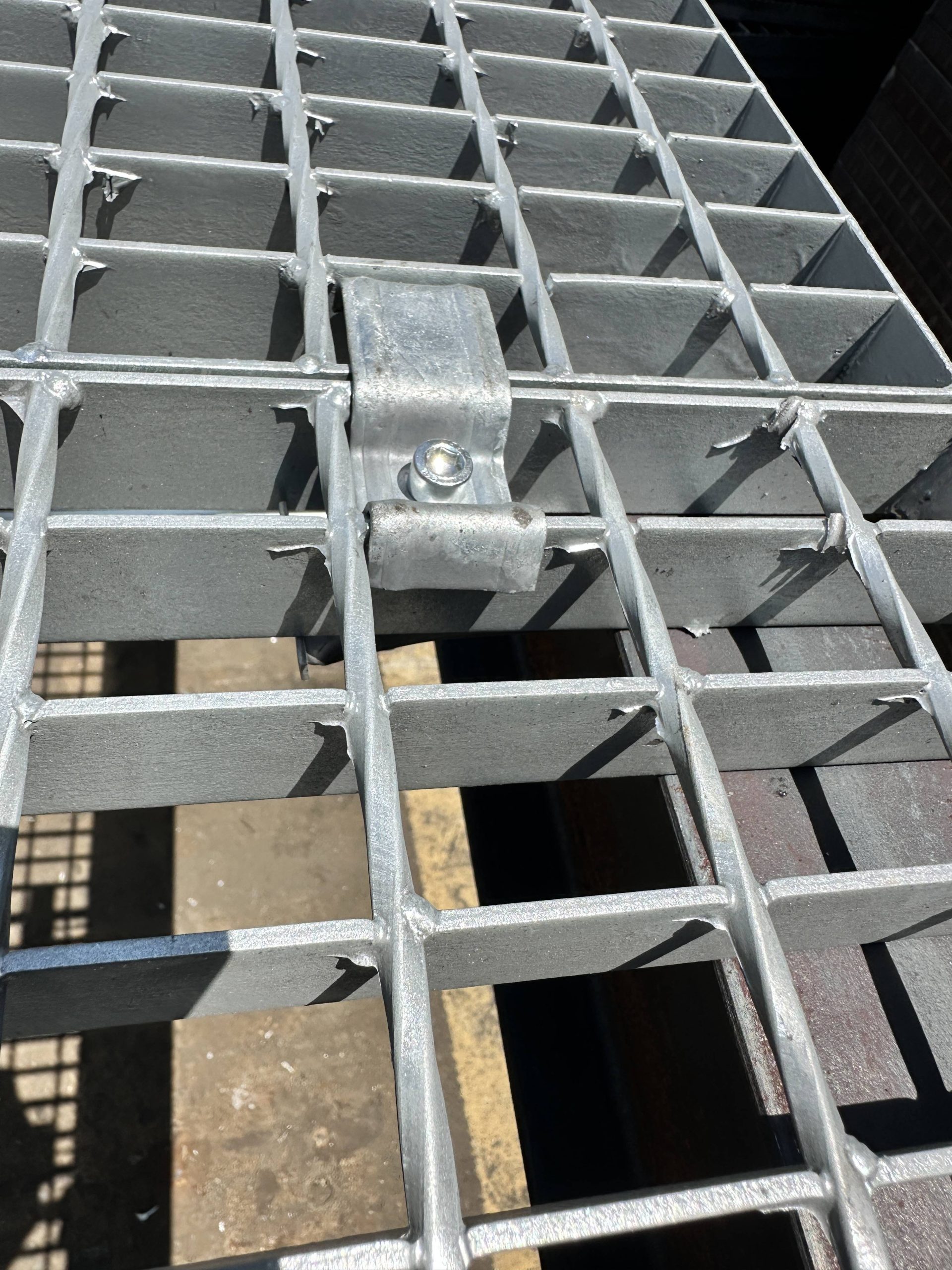
Industrial riveted grating is often fabricated around columns, pipes, valves, ladders, tanks, conveyors, cable trays, hatches, and drainage channels. Custom work adds material, machine time, layout, handling, inspection, and finishing cost.
Cutouts should be located from two panel reference edges and shown with their length, width, corner radius, and required edge treatment. Cutting through multiple bearing bars may reduce local strength and require a load-carrying band or support angle.
Banding closes the ends of the bearing bars and improves edge rigidity. A load-carrying band may be required around a large opening or where the panel bears on a narrow support. Banding does not replace a structural beam under a large penetration.
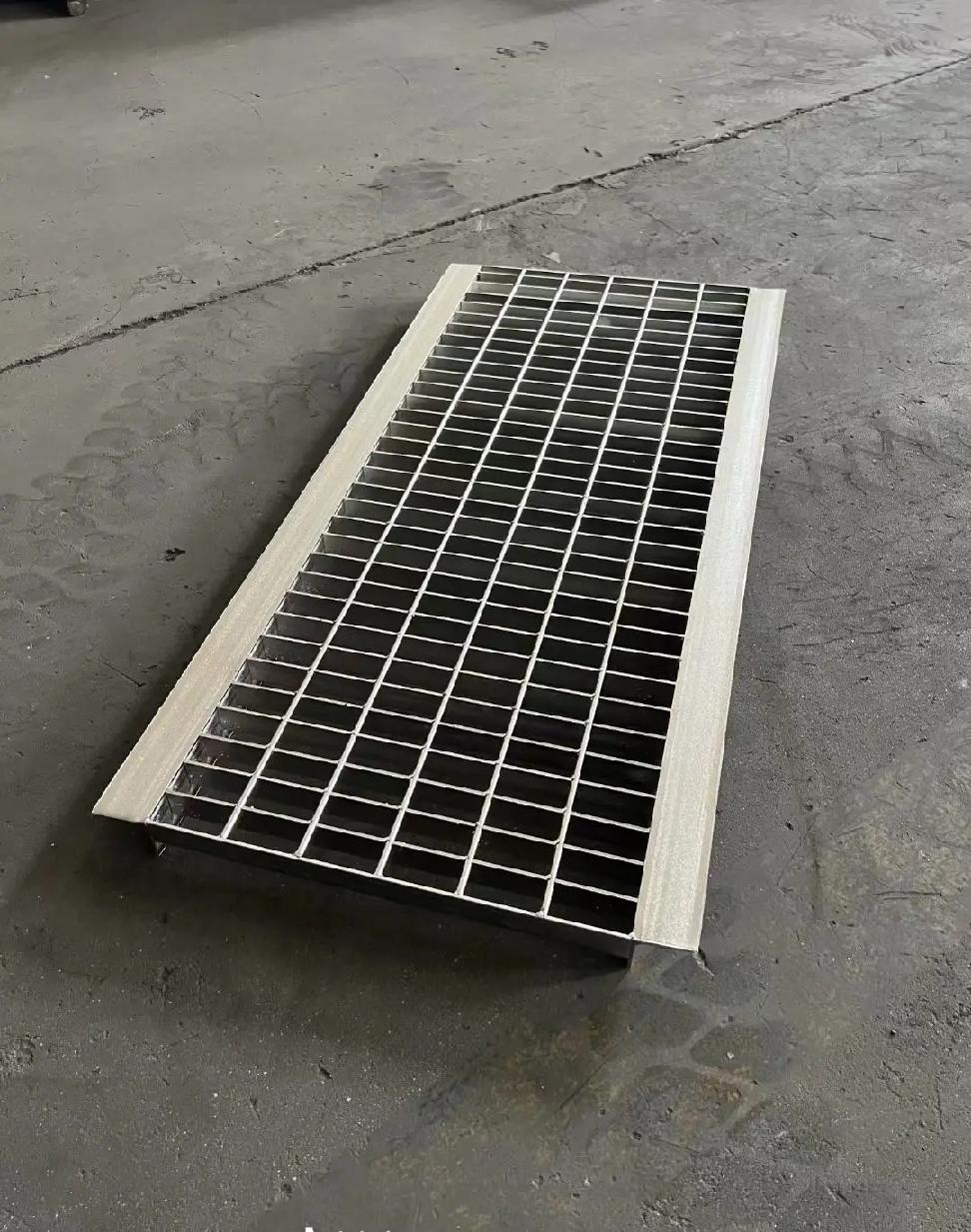
Angle or channel frames can provide a bearing ledge, protect the panel perimeter, and simplify removal. Hinged covers, lifting handles, locks, and anti-theft fasteners are useful for trench covers and service hatches. The frame must be designed for the panel reaction and traffic condition.
Riveted grating can be fabricated into stair treads with nosing, end plates, bolt holes, side angles, and serrated edges. The tread depth, support width, nosing projection, rise-and-run geometry, and concentrated foot load should be shown on the drawing.
Riveted grating is usually more expensive than standard welded carbon steel because it requires formed reticulated bars, drilled or punched holes, individual rivets, mechanical riveting, and additional inspection. The higher initial cost may be justified when rolling loads, durability, or a project-specific heavy-duty design are important.
| Cost Factor | Effect on Factory Price |
|---|---|
| Bearing bar size | Deeper and thicker bars increase steel weight and load capacity |
| Bearing bar spacing | Closer spacing increases the number of bars and reduces openings |
| Reticulated bar profile | Formed or truss-style bars require additional shaping and tooling |
| Rivet spacing | Close rivet spacing increases rivet count and labor |
| Plain or serrated surface | Serration adds processing and inspection cost |
| Panel dimensions | Large panels increase handling and shipping weight; small panels increase joints and setup |
| Load rating | Vehicle or heavy equipment loads require larger bars, closer supports, or testing |
| Surface treatment | Painting or hot-dip galvanizing adds processing, handling, and inspection |
| Custom fabrication | Cutouts, banding, frames, toe plates, hinges, and holes add labor and material |
| Quantity and MOQ | Large repeat orders spread setup and tooling costs over more panels |
| Packaging and shipping | Heavy panels require stronger skids, export protection, and careful container loading |
The following ranges are broad EXW or FOB budgeting references for carbon steel riveted bar grating. They are not fixed offers. Actual prices change with steel and zinc markets, production location, order quantity, panel weight, fabrication, certificates, packing, and freight.
| Riveted Grating Type | Indicative Factory Price | Typical Conditions |
|---|---|---|
| Light-duty bare riveted grating | Approximately US$45–85/m² | Smaller bearing bars, plain surface, standard panels |
| Standard-duty bare riveted grating | Approximately US$60–115/m² | Regular industrial floor or walkway construction |
| Hot-dip galvanized standard riveted grating | Approximately US$80–160/m² | Galvanizing after panel assembly and normal edge treatment |
| Heavy-duty riveted grating | Approximately US$110–220/m² | Deep bearing bars, close supports, and higher static loads |
| Vehicle-rated bridge or traffic grating | Approximately US$150–320+/m² | Wheel-load design, reinforced framing, testing, and custom fabrication |
| Custom framed or heavily fabricated panels | Approximately US$180–380+/m² | Cutouts, frames, hinges, toe plates, special finish, and project documents |
For ton-based pricing, divide the square-meter price by the net weight in metric tons per square meter. If a heavy riveted panel weighs 80 kg/m² and is priced at US$160/m², the equivalent value is approximately US$2,000 per metric ton. This conversion is only for comparing quotations; a factory may calculate a ton price using separate assumptions for steel, rivets, scrap, galvanizing, labor, and packing.
A 1,000 × 3,000 mm panel has approximately 3 m² of nominal area. At US$80–160/m², a standard galvanized panel may be approximately US$240–480 before special cutouts, accessories, packaging, and delivery. A vehicle-rated panel can be considerably higher because its weight, framing, inspection, and engineering requirements are different.
For more information about factory quotation units and project-ready grating costs, buyers can review this steel grating prices guide.
A complete RFQ should include the technical details needed to calculate weight, load capacity, production time, and delivery cost.
| Required Information | Example |
|---|---|
| Grating type | Riveted, reticulated cross-bar construction |
| Steel grade | ASTM A36, Q235B, S235JR, or another approved grade |
| Bearing bars | Height, thickness, pitch, and span direction |
| Reticulated bars | Profile, size, orientation, and spacing |
| Rivet details | Diameter, head type, standard or close spacing |
| Surface | Plain or serrated |
| Panel dimensions | Length, width, quantity, and allowable tolerance |
| Load requirements | Uniform, point, wheel, forklift, vehicle, impact, and fatigue loads |
| Support conditions | Clear span, support width, frame type, and bearing direction |
| Fabrication | Cutouts, notches, banding, frames, toe plates, holes, hinges, and locks |
| Finish | Bare, painted, hot-dip galvanized, or duplex coating |
| Documents | Load table, mill certificate, inspection report, and coating record |
| Delivery | MOQ, lead time, packing, destination, and EXW, FOB, or CIF terms |
A marked-up layout or panel schedule should identify each panel number, finished size, bearing direction, support line, cutout, banded edge, and accessory. This allows the manufacturer to optimize the cutting plan and provide a complete price rather than revising the quotation after production begins.
When comparing suppliers, ensure that all offers use the same bearing bar, reticulated bar, rivet spacing, surface, load rating, finish, fabrication, and delivery basis. A quotation that excludes edge banding, galvanizing, testing, or export packaging may appear cheaper but produce a higher installed cost.
How much does carbon steel riveted bar grating cost?
As a broad factory budgeting reference, light-duty bare riveted grating may cost approximately US$45–85/m², standard-duty products approximately US$60–115/m², hot-dip galvanized grating approximately US$80–160/m², and heavy-duty or vehicle-rated panels approximately US$110–320+/m². Custom frames, cutouts, testing, special packaging, and small quantities can increase the price.
Is riveted grating better than welded grating for vehicle traffic?
Riveted grating is often selected for repeated cart, dolly, forklift, and vehicle loads because its reticulated cross bars can distribute concentrated forces and provide a relatively smooth rolling surface. Welded grating can also be designed for vehicle traffic. The correct choice must be based on the exact load table, wheel load, span, support condition, impact, fatigue, and deflection requirements.
What information does a riveted grating manufacturer need for a quotation?
Provide the steel grade, bearing bar height and thickness, bearing bar spacing, reticulated bar profile, rivet diameter and spacing, plain or serrated surface, panel dimensions, quantity, clear span, uniform and wheel loads, support details, cutouts, banding, frames, finish, certificates, packing, and delivery terms. A dimensioned drawing is especially important for replacement panels and bridge or traffic applications.