

Welded and press-locked grating are two widely used open-grid flooring systems for industrial platforms, walkways, equipment access areas, stairs, drainage covers, and architectural floors. Both can provide drainage, ventilation, light transmission, and a stable walking surface, but they are manufactured differently and are often selected for different project priorities. Welded grating is commonly chosen for economical industrial platforms, heavy-duty loads, custom fabrication, and broad material availability. Press-locked grating is often selected where clean bar alignment, a refined appearance, flexible mesh design, and architectural quality are important. The correct choice depends on bearing bar size, span, load, deflection, surface profile, corrosion exposure, panel dimensions, installation method, fabrication requirements, maintenance, and lifecycle cost. This guide explains the practical differences between welded and press-locked grating so buyers can select the right platform system for industrial and commercial projects.
| Comparison factor | Welded grating | Press-locked grating |
|---|---|---|
| Connection method | Cross bars are welded to bearing bars | Cross bars are pressed into pre-slotted bearing bars |
| Typical appearance | Visible welded intersections and industrial appearance | Clean, regular, mechanically locked grid |
| Industrial load use | Widely used for standard and heavy-duty platforms | Suitable when the selected design and load table support the application |
| Mesh flexibility | Common standard patterns and selected custom layouts | Flexible mesh combinations and close alignment |
| Fabrication | Easy to cut, band, weld, frame, and reinforce | Can be cut and fabricated but requires accurate slots and controlled pressing |
| Initial manufacturing cost | Usually lower for repeated industrial panels | Often higher because of slotting and pressing operations |
| Surface options | Plain or serrated, with paint, galvanizing, or stainless finish | Plain or serrated, with similar finish options depending on material |
| Architectural suitability | Good for functional industrial design | Often preferred for visible floors, screens, facades, and public areas |
| Best general application | Factories, power plants, chemical platforms, warehouses, and heavy-duty access | Architectural platforms, commercial walkways, screens, facades, and refined industrial areas |
Manufacturing method alone does not determine structural performance. A press-locked panel with deeper bearing bars can carry more load than a light welded panel, while a properly designed welded panel may outperform a light press-locked panel over a long span. The comparison must always use the actual bearing bar size, spacing, material, clear span, support condition, load, and allowable deflection.
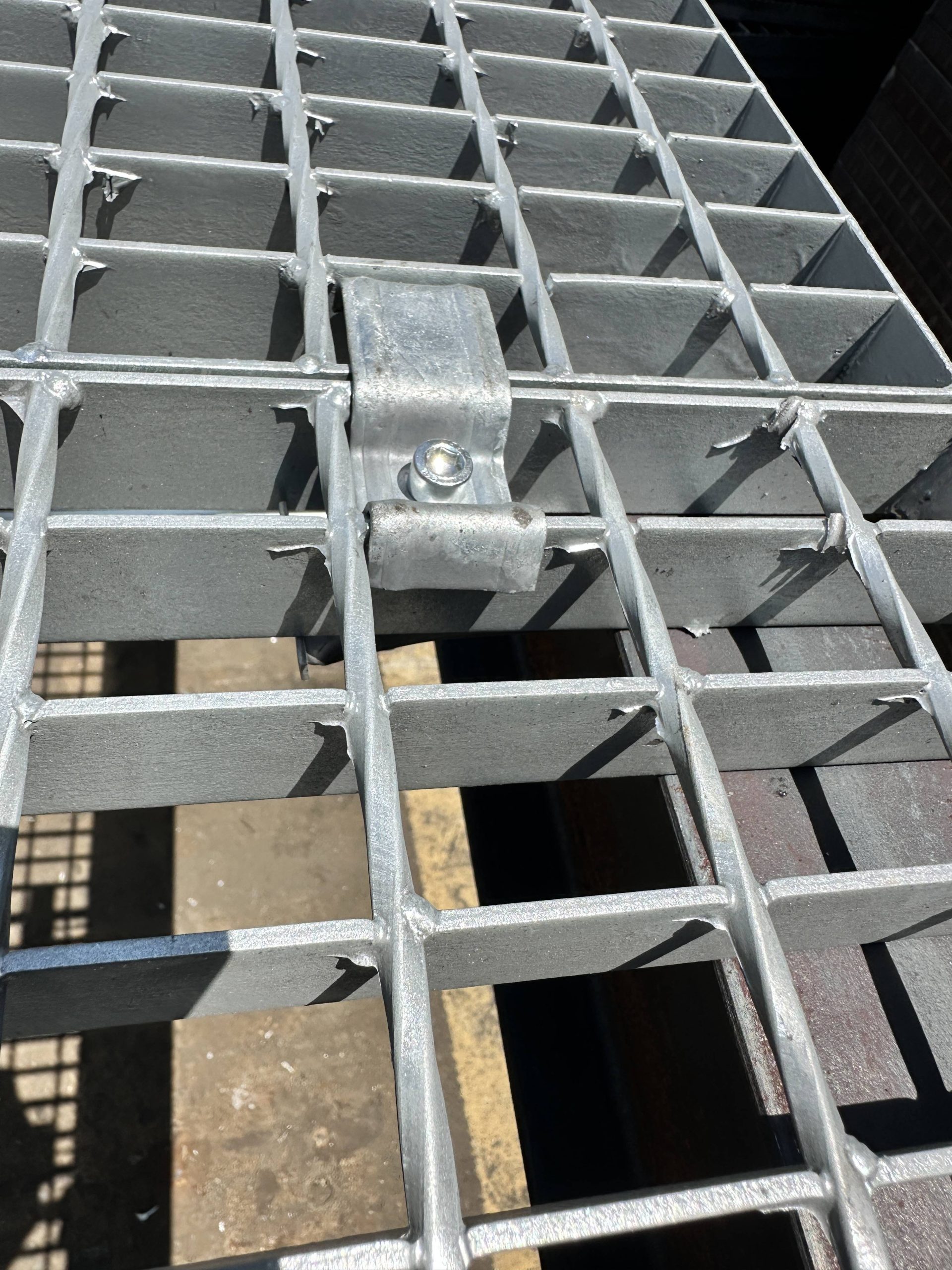
Welded steel grating is an open-grid panel made by joining bearing bars and cross bars through welding. The bearing bars are the primary load-carrying members and normally run perpendicular to the supporting beams. Cross bars maintain spacing and provide stability across the panel.
Welded grating is one of the most common industrial flooring products because it offers:
A welded panel may include flat bearing bars, twisted square cross bars, round cross bars, trim banding, load-carrying banding, toe plates, frames, lifting handles, and special cut-outs. The panel can be supplied untreated, painted, hot-dip galvanized, pickled, passivated, brushed, or polished depending on the material and application.
Welded grating is particularly practical for industrial platforms around tanks, pumps, conveyors, pipe racks, machines, boilers, and maintenance routes. It can also be manufactured as removable panels that are secured with clips or bolts.
Press-locked steel grating is manufactured by pressing cross bars into slots cut into the bearing bars. The hydraulic or mechanical pressing process creates a tight interference connection and a regular open-grid panel without conventional welded intersections at every cross bar.
Press-locked grating is often selected for projects where visual alignment and a clean grid are important. Typical uses include platforms, walkways, stair treads, trench covers, facades, ventilation screens, sunshades, security panels, ceilings, and architectural flooring.
Press-locked construction should not be assumed to be weaker or stronger than welded construction without reviewing the manufacturer’s structural data. Load capacity depends on the bearing bar geometry, slot depth, cross bar size, material, panel depth, support span, and connection quality.
Additional product information is available in the CSSP Grating press-locked grating guide.
Welded grating transfers load through welded intersections and the bearing bars. Press-locked grating transfers load through the bearing bars and the mechanical engagement between slotted bearing bars and cross bars. In both systems, the bearing bars normally carry the primary bending load across the support span.
For a platform design, the engineer should review the applicable load table for the actual construction type. A welded-grating load table should not be used automatically for press-locked grating, and vice versa.
Load capacity is usually the first engineering question when selecting platform grating. The manufacturing method is only one part of the design. The following parameters must be confirmed:
Welded grating is widely used for heavy industrial platforms because deeper and thicker bearing bars can be produced efficiently. Welded intersections provide good panel stability, but the load calculation still depends primarily on the bearing bars and span.
Press-locked grating can provide reliable platform performance when the bearing bars, slots, cross bars, and support arrangement are designed correctly. It is often selected for light to medium industrial floors and architectural platforms, but heavy loads may require deeper bearing bars, closer supports, or a project-specific calculation.
A platform may be designed for a uniform pedestrian load but later carry a machine part, portable pump, pallet, wheel, or maintenance trolley. Concentrated loads can be more critical than uniform loads because they may be carried by only a few bearing bars.
Deflection affects walking comfort, vibration, noise, clip movement, drainage, and the appearance of the platform. A panel may satisfy a strength requirement but still be unacceptable if it feels springy or moves excessively under foot traffic.
| Design variable | Effect on platform performance |
|---|---|
| Greater bearing bar depth | Usually increases bending stiffness and reduces deflection |
| Greater bearing bar thickness | Increases section capacity, durability, weight, and cost |
| Closer bearing bar spacing | Improves load distribution and reduces clear openings |
| Shorter clear span | Strongly improves capacity and serviceability |
| Wider support seat | Improves bearing stability and edge performance |
| Closer support spacing | Reduces panel span and can reduce required bar size |
| Serrated surface | Improves traction but does not automatically increase capacity |
Bearing bars may be rectangular flat bars, I-bars, or other approved structural profiles. They are specified by height and thickness, such as 25 x 3 mm, 30 x 5 mm, or an imperial equivalent. The selected size should be based on clear span, load, deflection, and environmental durability.
Welded grating commonly uses twisted square bars, round bars, flat bars, or formed bars. Cross bar spacing may be selected for panel stability, mesh appearance, drainage, and cost.
Press-locked grating uses cross bars that fit into pre-slotted bearing bars. The cross bar may be square, round, or another formed profile. Slot width, slot depth, cross bar dimensions, and pressing force must be coordinated accurately.
Closer bearing bar spacing provides a denser walking surface and may help retain small tools or components. Wider spacing increases open area and may reduce material weight. The final spacing should consider workers’ footwear, wheels, dropped objects, drainage, ventilation, and any applicable safety rules.
| Specification item | Common options | Selection effect |
|---|---|---|
| Bearing bar depth | 20, 25, 30, 32, 40, 50 mm and heavier | Primary effect on span capacity and deflection |
| Bearing bar thickness | 3, 4, 5, 6 mm or project-specific | Strength, weight, local durability, and cost |
| Bearing bar spacing | 25, 30, 34, 40, 60 mm or imperial patterns | Open area, walking comfort, load sharing, and appearance |
| Cross bar type | Twisted square, round, flat, pressed, or formed bar | Panel stability, appearance, and manufacturing method |
| Cross bar spacing | 50, 76, 100, 101.6 mm or custom | Rigidity, mesh density, drainage, and material usage |
More information about bearing bar dimensions, mesh patterns, and specification formats is available in the steel bar grating dimensions guide.
Platform grating must support workers while controlling slip, trip, fall-through, dropped-object, and panel-movement risks. The selected construction should be evaluated as part of the complete access system.
The bearing bars should span from one support to the next. Drawings should include arrows or clear symbols showing the bearing direction. Incorrect orientation can reduce capacity even when the product was manufactured correctly.
Panels should be secured against movement, vibration, uplift, and accidental displacement. Clips, bolts, welded attachments, anti-lift devices, or captive fixings may be required depending on the location.
Opening size should be reviewed for foot placement, narrow heels, small wheels, tools, bolts, and components that could fall to a lower level. Closer mesh, secondary screens, toe plates, kick plates, or solid curbs may be required above occupied areas.
Platforms above lower levels may need handrails, guardrails, toe plates, gates, and protected access openings. Handrail posts should be attached to the structural support system rather than relying only on lightly banded grating.
Wet, oily, dusty, inclined, and outdoor platforms often require serrated or anti-slip surfaces. Plain grating may be suitable for dry interiors, clean areas, and locations where smooth cart movement or easy cleaning is more important.
Plain grating has flat bearing bar tops. It provides a clean visual appearance and is usually easier to sweep, wash, and inspect. It is suitable for dry platforms, clean industrial interiors, architectural floors, mezzanines, and areas where slip risk is controlled.
Serrated grating has notches along the top edge of the bearing bars. It improves traction in wet or contaminated areas and is commonly used in chemical plants, power plants, water-treatment facilities, outdoor platforms, stairs, drainage areas, and industrial walkways.
Anti-slip performance depends on the actual working conditions. Oil, mud, ice, grease, chemical residue, and biological growth can cover any surface. Cleaning, drainage, suitable footwear, lighting, handrails, and housekeeping remain essential.
Welded grating should be checked for overall length, width, diagonal dimensions, flatness, bow, twist, bearing bar spacing, cross bar spacing, banding, cut-outs, and weld distortion. Heat from welding can create local distortion if the panel is not correctly restrained or straightened.
Press-locked grating depends on accurate slots and consistent pressing force. Inspection should confirm cross bar engagement, slot alignment, panel flatness, mesh dimensions, edge squareness, and the absence of loose or under-pressed intersections.
Large panels may be more efficient to install because they reduce the number of joints, but they are heavier and more difficult to handle. Smaller panels are easier to remove but may create more joints, clips, and visible lines.
Platform drawings should identify support edges, pipe openings, columns, equipment, handrail posts, access hatches, and panel marks. Accurate fabrication reduces site cutting and helps preserve the intended load path.
| Inspection item | Welded grating | Press-locked grating |
|---|---|---|
| Overall dimensions | Check length, width, diagonals, and squareness | Check length, width, diagonals, and squareness |
| Bar alignment | Check spacing and weld distortion | Check slot alignment and pressed intersections |
| Flatness | Check bow, twist, and welding distortion | Check pressing distortion and panel flatness |
| Connection quality | Check weld size, continuity, and defects | Check mechanical engagement, tightness, and bar seating |
| Edge treatment | Check banding, welds, and cut edges | Check banding, edge alignment, and slot termination |
| Finish | Check paint, galvanizing, stainless treatment, or bare surface | Check the selected finish and any handling damage |
Carbon steel is economical, strong, easy to weld, and widely available. It is suitable for dry indoor platforms or projects where a specified paint or coating system will be applied. Untreated carbon steel should not be used in wet or outdoor areas without an appropriate corrosion-protection plan.
Galvanized welded or press-locked grating is suitable for many outdoor platforms, factory walkways, utility areas, towers, warehouses, and general industrial environments. Galvanizing provides zinc protection after fabrication, but the coating can deteriorate in strong chemicals, continuous wet exposure, salt spray, or abrasive traffic.
304 stainless steel is suitable for many hygienic and moderately corrosive applications. It may be used for indoor chemical platforms, food facilities, clean production areas, and general wet environments.
316 and 316L contain molybdenum and provide better resistance to chloride exposure than 304. They are commonly considered for marine, coastal, wastewater, chemical, and salt-containing environments. 316L is often preferred when extensive welding is required.
Aluminum grating is lightweight and can be suitable for architectural platforms, roofs, marine-adjacent areas, and projects where manual handling is important. Its lower stiffness means deflection should be checked carefully. Galvanic contact with steel or stainless steel also requires attention.
| Material | Main advantage | Typical platform use | Important limitation |
|---|---|---|---|
| Carbon steel | Strength and low initial cost | Dry indoor factories and protected platforms | Rusts without protection |
| Galvanized steel | Good outdoor protection and cost balance | Industrial platforms, plants, towers, warehouses | Zinc can deteriorate in severe chemical exposure |
| 304 stainless steel | General corrosion resistance and clean appearance | Food, clean, and moderately wet areas | Less resistant to chloride than 316 |
| 316 or 316L stainless steel | Improved chloride and chemical resistance | Marine, chemical, wastewater, and coastal platforms | Higher initial cost and not immune to severe attack |
| Aluminum | Low weight and attractive appearance | Architectural, rooftop, and lightweight access | Lower stiffness and galvanic compatibility issues |
Untreated or painted carbon steel may be suitable for dry interiors. Galvanized steel can be used where humidity or occasional water is present. Stainless steel may be preferred for food, pharmaceutical, chemical, and clean industrial areas where rust contamination or coating maintenance is unacceptable.
Galvanized welded grating is commonly used outdoors because it provides a practical balance of cost, structural strength, and corrosion protection. Press-locked grating can also be galvanized, but the coating and fabrication requirements should be specified clearly.
Stainless steel, particularly 316 or 316L, may be more appropriate for chloride, chemical, wastewater, and marine areas. FRP or specialty materials may be considered when exposure exceeds the practical limits of common stainless grades.
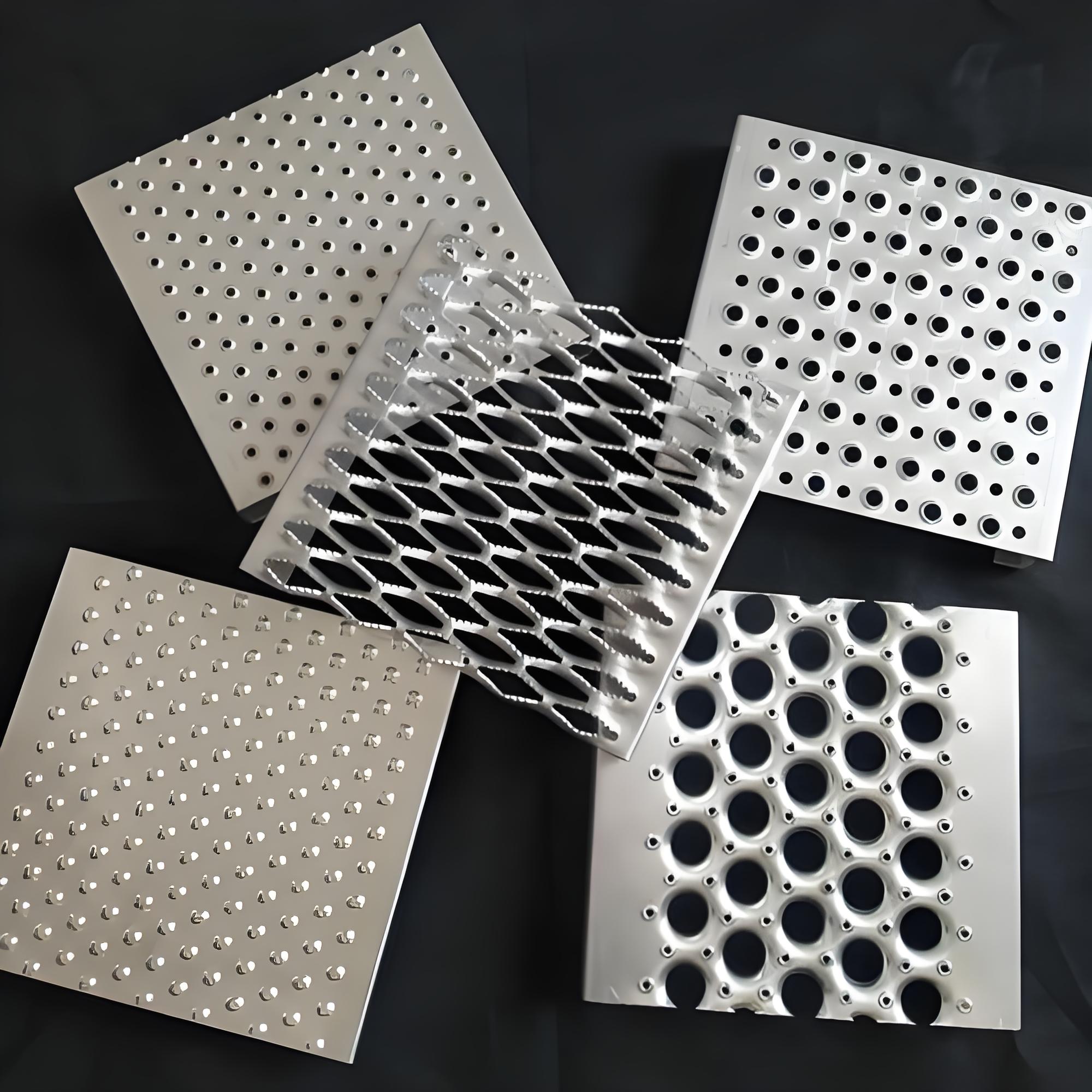
The buyer should separate surface profile from surface finish. Surface profile means plain or serrated. Surface finish means untreated, painted, galvanized, powder coated, pickled, passivated, brushed, polished, or anodized.
Heavy-duty platform selection should begin with the load and span, not with the appearance of the intersections.
Press-locked grating can be engineered for industrial platforms, but the manufacturer should provide load data for the actual bar size and construction. Heavy-duty requirements may favor welded grating simply because deeper load-bearing profiles and standard tables are more widely available.
| Industry | Common platform application | Typical grating choice |
|---|---|---|
| Factories | Machine access, mezzanines, maintenance walkways, production platforms | Welded carbon or galvanized grating; press-locked for visible areas |
| Power plants | Boiler access, turbine platforms, pipe racks, service stairs | Welded heavy-duty galvanized or stainless grating |
| Chemical facilities | Tank platforms, pump areas, process walkways, drainage channels | Galvanized, 304, 316, 316L, or specialty material by exposure |
| Warehouses | Mezzanines, loading access, stairs, storage platforms | Welded grating for economy and load capacity |
| Commercial buildings | Public walkways, screens, facades, ventilation panels | Press-locked stainless, aluminum, or powder-coated steel |
| Water treatment | Tank access, channels, pump platforms, maintenance walkways | Galvanized or stainless steel; other materials for aggressive zones |
Factories often prioritize load capacity, fast fabrication, easy maintenance, and economical replacement. Welded grating is commonly selected for production platforms, access floors, and maintenance walkways.
Power plant platforms may carry workers, tools, pipe supports, valves, and equipment. Heat, vibration, fire safety, and corrosion protection should be reviewed. Welded grating is often used for heavy industrial areas, while stainless steel may be selected in wet or chemically exposed zones.
Chemical platform material should be selected according to chemical compatibility, temperature, drainage, and cleaning. Press-locked grating may be suitable for visible or moderate-duty access, while welded grating may be preferred for heavily loaded process platforms.
Warehouses often require a cost-effective platform with good strength and easy installation. Galvanized welded grating is common for elevated walkways, mezzanines, loading platforms, and stairs.
Clips secure panels to supporting beams while allowing removal. Top clips, bottom clips, saddle clamps, anti-lift clips, and bolted hold-downs may be used. Clip selection should match bar spacing, support flange, panel thickness, vibration, wind uplift, and maintenance needs.
Bolted connections provide positive restraint and are useful for removable panels, equipment access, and locations subject to vibration. The drawing should show bolt diameter, hole size, washer type, nut type, spacing, and tightening requirements.
Welding can provide permanent attachment but makes panel removal more difficult. Galvanized surfaces require coating repair around the weld, and stainless steel welds may need cleaning and passivation.
Panels need a level and sufficiently wide bearing seat. Unsupported cut edges, uneven beams, and narrow seating can create local overload, movement, noise, and trip hazards.
Panel joints should occur over supports wherever possible. Adjacent panels should align without excessive height differences or unsupported gaps. A joint detail should account for thermal movement, access, drainage, and maintenance removal.
Field cutting should be minimized because it can remove bearing bars, weaken the edge, expose unprotected carbon steel, damage galvanizing, or create stainless steel contamination. Any required site cutting should be reviewed by the responsible engineer.
Trim banding closes exposed bar ends and improves the appearance and handling safety of the panel. Load-carrying banding may be required when the edge transfers load or when a cut-out interrupts the primary bearing bars.
Cut-outs may be required around pipes, columns, valves, cables, machines, and handrail posts. Large openings should be framed or reinforced so the load path remains continuous.
Welded and press-locked grating can be fabricated into trapezoidal, notched, framed, curved-layout, and irregular panels. Press-locked panels require careful slot and edge planning, while welded panels generally allow more flexible site-specific welding and reinforcement.
Each custom panel should be numbered to match the installation drawing. Numbering helps the contractor identify orientation, support location, removable access, and correct placement.
Inspect welded panels for cracked welds, broken cross bars, bent bearing bars, corrosion, coating damage, loose clips, and excessive deflection. Galvanized panels require particular attention at field cuts, weld repairs, bolt holes, and heavily trafficked areas.
Inspect press-locked panels for loose or displaced cross bars, damaged slots, bar separation, edge distortion, and local impact. Mechanical locking depends on accurate engagement, so any looseness should be investigated rather than ignored.
Open grating should be cleaned so that dirt, grease, chemical residue, and debris do not block drainage or hide structural damage. Serrated surfaces may require more detailed cleaning than plain surfaces.
Service life depends on material, surface treatment, exposure, traffic, support condition, installation quality, cleaning, and repair. Galvanized welded grating can provide long service in many outdoor environments. Stainless steel can provide long service in corrosive or hygienic areas when the grade and finish are correct. Press-locked grating may provide similar service where the mechanical connections are properly designed and protected.
| Inspection point | Welded grating | Press-locked grating |
|---|---|---|
| Primary connection | Check weld continuity, cracks, and defects | Check slot engagement, bar movement, and looseness |
| Panel edge | Check banding welds and cut edges | Check banding, slot ends, and edge alignment |
| Surface | Check paint, galvanizing, rust, or stainless contamination | Check finish, coating, surface wear, and impact |
| Structural bars | Check bent, cracked, or corroded bearing bars | Check bent or damaged bearing bars and cross bars |
| Fixings | Check clips, bolts, welds, and anti-lift details | Check clips, bolts, and panel restraint |
Welded grating is often more economical for standard industrial panels because the production process is efficient and widely established. Press-locked grating may cost more because bearing bars must be slotted accurately and cross bars must be pressed under controlled force.
Carbon steel is generally the lowest-cost material. Galvanizing adds a finishing cost but extends outdoor service. Stainless steel and aluminum have higher raw material costs. The material should be selected based on exposure and service life rather than initial price alone.
Large welded panels may reduce the number of joints but require lifting equipment. Press-locked panels can be easier to handle if they are lighter, although custom fabrication and precise installation may require more coordination.
Lifecycle cost includes coating repair, cleaning, inspection, replacement, downtime, access equipment, and labor. Galvanized welded grating may provide the best lifecycle value for general outdoor platforms. Stainless or press-locked grating may be more economical where appearance, hygiene, corrosion, or maintenance access justifies the higher initial cost.
| Cost item | Welded grating | Press-locked grating |
|---|---|---|
| Standard manufacturing | Usually economical | Often higher due to slotting and pressing |
| Custom fabrication | Flexible and generally straightforward | Possible, but requires accurate slot and edge design |
| Heavy-duty capability | Broad range of standard industrial options | Available, but must use the correct press-locked design data |
| Installation | Efficient for repeated panels | May provide clean alignment but needs coordinated support and joints |
| Maintenance | Weld and coating inspection | Mechanical connection and alignment inspection |
| Replacement | Easy to reproduce common welded patterns | Replacement should match slot, bar, and mesh specifications |
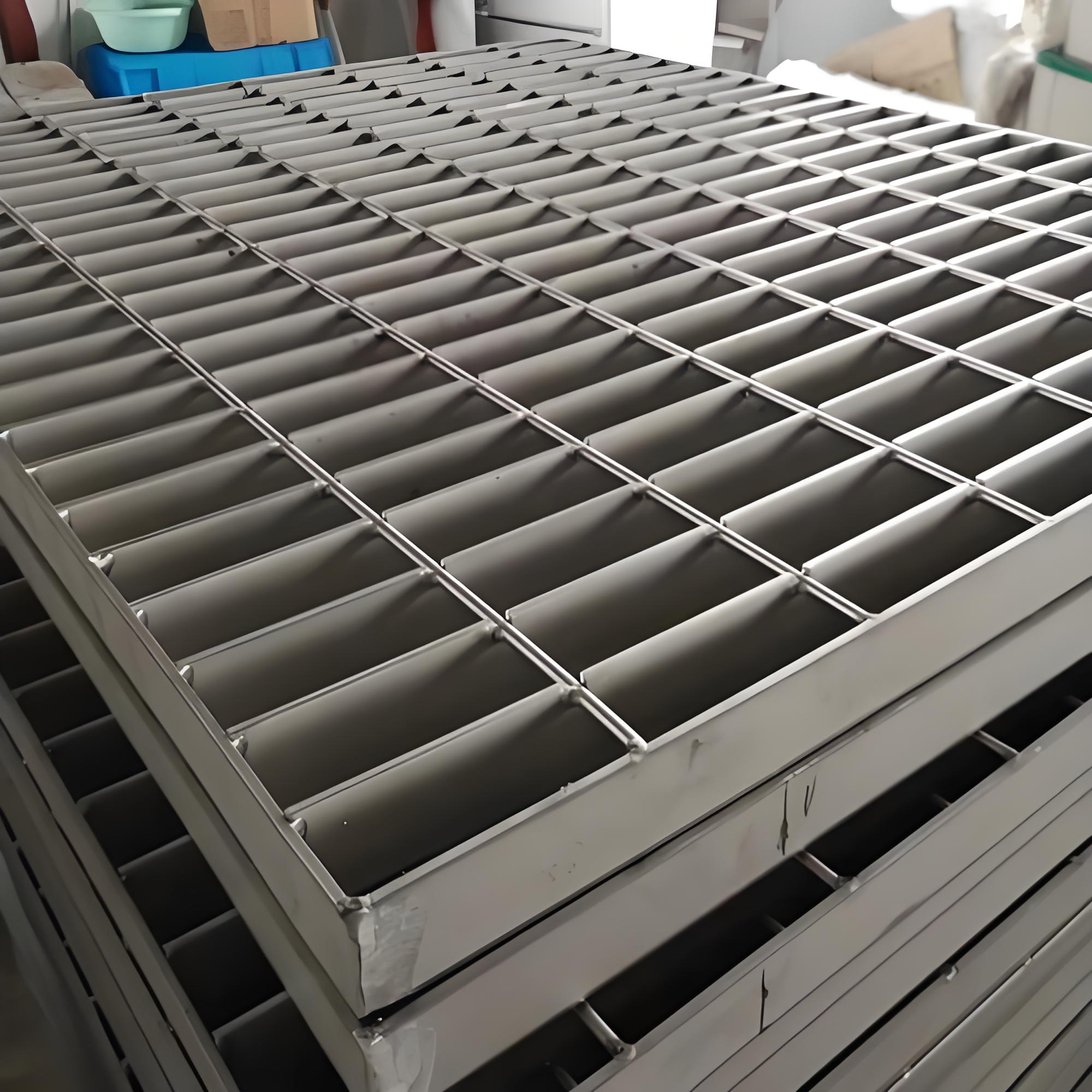
Welded grating has a recognizable industrial appearance with visible welded intersections. Press-locked grating has a cleaner, more regular grid and is often preferred for commercial, public, architectural, and visible industrial platforms.
Both systems allow air and light to pass through the open structure. Mesh spacing can be selected to balance visibility, shading, ventilation, privacy, and safety.
Open grating allows rainwater, wash-down water, and process liquids to pass through. Drainage performance depends on open area, support layout, debris accumulation, and the drainage system below.
Press-locked grating may be selected for balconies, public walkways, screens, sunshades, facade panels, and visible stair systems because the bar alignment is uniform. Stainless steel, aluminum, powder-coated steel, and special mesh patterns can support architectural design requirements.
Welded galvanized grating remains a practical choice where function is more important than visual refinement. It is widely used in plants, warehouses, power facilities, towers, and maintenance structures.
Identify whether the platform is for pedestrian access, maintenance, equipment support, carts, forklifts, vehicles, ventilation, drainage, or architectural screening.
Provide clear span, support width, bearing bar direction, uniform load, concentrated load, wheel load, impact, vibration, and allowable deflection. This information is more important than the manufacturing label alone.
Choose welded construction for broad industrial availability, heavy-duty fabrication, and economical standard panels. Choose press-locked construction where clean alignment, flexible mesh, or architectural appearance is important.
Specify carbon steel, galvanized steel, stainless steel, aluminum, painted steel, powder coating, pickling, passivation, or another finish. The surface protection should match the indoor, outdoor, wet, marine, chemical, or hygienic environment.
Use plain surfaces where smooth movement and easy cleaning are priorities. Use serrated or anti-slip surfaces where water, oil, slope, outdoor exposure, or process contamination creates a higher slip risk.
Provide panel dimensions, bearing direction, cut-outs, banding, frames, toe plates, handrail penetrations, access hatches, lifting points, and panel numbers.
State support details, clips, bolts, welds, anti-lift devices, fastener material, isolation requirements, and removal procedures.
| RFQ category | Information to provide |
|---|---|
| Product type | Welded or press-locked platform grating |
| Application | Factory, power plant, chemical platform, warehouse, walkway, screen, or facade |
| Material | Carbon steel, galvanized steel, stainless steel 304/316/316L, or aluminum |
| Bearing bars | Height, thickness, spacing, and span direction |
| Cross bars | Type, size, spacing, and connection method |
| Panel dimensions | Length, width, tolerance, quantity, and panel marks |
| Load requirements | Uniform, concentrated, wheel, equipment, impact, and deflection criteria |
| Surface | Plain, serrated, abrasive, close mesh, or special anti-slip surface |
| Finish | Untreated, painted, galvanized, powder coated, pickled, passivated, or anodized |
| Fabrication | Banding, cut-outs, frames, notches, toe plates, handles, and lifting points |
| Installation | Supports, clips, bolts, welds, anti-lift, isolation, and removable panels |
| Quality records | Certificates, calculations, inspection reports, packing list, and conformity statement |
For a direct product comparison, buyers can review the CSSP Grating press-locked grating range and the wider steel grating product category. The final selection should be based on the project drawing, load requirement, material exposure, support condition, and required finish.
Is welded grating stronger than press-locked grating? Not automatically. Strength depends on bearing bar height, thickness, spacing, material, clear span, support condition, and load type. Welded grating is widely used for heavy-duty platforms because deep and thick bearing bars are readily available, while press-locked grating can also provide reliable structural performance when designed with the correct load data. The two products should be compared using equivalent bar sizes, spans, loads, and deflection limits.
Which is better for a heavy-duty industrial platform, welded or press-locked grating? Welded grating is often the practical choice for heavy-duty industrial platforms because it offers broad standard availability, efficient fabrication, deep bearing bar options, and flexible reinforcement. Press-locked grating may be suitable when the platform has moderate loads and a cleaner appearance is important. For heavy equipment, wheel loads, long spans, or severe impact, the supplier should provide a project-specific calculation before approval.
Is press-locked grating more expensive than welded grating? Press-locked grating is often more expensive to manufacture because the bearing bars must be slotted accurately and the cross bars must be pressed into position. However, it may provide additional architectural value, better visual alignment, and flexible mesh options. Welded grating is usually more economical for repeated industrial panels. The final lifecycle cost should include material, finish, installation, maintenance, replacement, and the value of appearance.