
Steel grating for oil and gas platforms must provide safe access, reliable load-bearing performance, rapid drainage, slip resistance, corrosion protection, and predictable installation in demanding environments. Offshore decks face salt spray, seawater, wind, waves, humidity, hydrocarbon contamination, vibration, and difficult maintenance access. Onshore refineries, petrochemical plants, tank farms, drilling sites, and gas-processing facilities add chemical exposure, hot surfaces, heavy equipment, emergency escape requirements, and vehicle traffic. The correct grating specification therefore depends on much more than bar size or price. Material grade, surface treatment, fire and blast requirements, bearing direction, design loads, support span, open area, fastening, custom cut-outs, inspection, and documentation must be considered together. This guide explains the main technical and purchasing requirements for steel grating used on offshore and onshore oil and gas platforms.
Oil and gas platform grating is an open-grid structural flooring product used for walkways, production decks, pipe racks, stair treads, equipment platforms, maintenance routes, drainage covers, trenches, and access hatches. The open structure allows water, rain, wash-down liquid, air, light, and some debris to pass through the floor.
| Requirement | Why it matters on oil and gas platforms |
|---|---|
| Load capacity | Platforms may support workers, tools, pipe supports, equipment, forklifts, carts, or maintenance loads |
| Slip resistance | Oil, water, mud, rain, and chemicals can make ordinary smooth floors unsafe |
| Corrosion protection | Salt spray, humidity, hydrocarbon residues, and chemical vapors can rapidly attack unprotected steel |
| Drainage | Open grating helps prevent standing water and hydrocarbon pooling on decks |
| Fire and emergency access | Escape routes, stairways, and platform access must remain stable during emergency conditions |
| Vibration and impact resistance | Compressors, pumps, drilling equipment, vehicles, and dropped tools create repeated dynamic loads |
| Secure fixing | Wind, waves, blast effects, vibration, and traffic can move unsecured panels |
| Traceability | Oil and gas projects usually require material certificates, calculations, inspection records, and approved drawings |
The preferred product may be hot-dip galvanized carbon steel, stainless steel, heavy-duty welded grating, riveted grating, or a specialty alloy. The correct choice depends on whether the grating is located on an offshore deck, an onshore pipe rack, a chemical process platform, a drilling floor, a tank farm, or a protected indoor area.
Operators and maintenance teams need access to valves, pumps, compressors, separators, heat exchangers, drilling equipment, pipework, instruments, cable trays, and emergency systems. Grating provides a stable walking surface while keeping the floor relatively light and allowing services to pass below.
Offshore decks are exposed to heavy rain, spray, and wash-down. Onshore process areas may receive water, foam, oil, or chemical spills. Open grating allows liquid to pass through into drainage systems, reducing the amount of standing water on the walking surface.
Drainage grating does not replace hydrocarbon drainage, containment, or firewater systems. The trench, sump, drain line, and separator below the grating must be designed for the expected flow and contamination.
Open flooring allows air and light to reach lower levels and makes it easier to inspect pipework, supports, cable trays, and equipment below the deck. In enclosed or hazardous areas, however, grating openings should not be treated as the only method of controlling gas accumulation. Mechanical ventilation and gas detection may still be required.
Compared with solid plate flooring, grating can provide a strong working surface with less material and lower dead weight. This can reduce the demand on secondary steelwork and make panels easier to transport and install.
Platforms can be divided into removable panels, hinged hatches, stair treads, and framed access sections. This allows maintenance teams to reach equipment below without removing a complete deck.
Carbon steel provides high strength, good weldability, broad availability, and competitive cost. It is often selected for heavy-duty platforms and support structures. In areas exposed to moisture or outdoor conditions, it normally requires galvanizing, paint, or a qualified protective coating system.
Hot-dip galvanized carbon steel is one of the most common choices for onshore oil and gas platforms, pipe racks, stairways, walkways, and drainage covers. The grating is normally fully fabricated before it is immersed in molten zinc so the coating covers the bearing bars, cross bars, welds, banding, edges, and holes.
Galvanized steel is economical and effective in many atmospheric environments, but zinc may deteriorate in strong acids, highly alkaline chemicals, constant saltwater immersion, abrasive traffic, or hot process zones. The coating system must be matched to the exposure.
304 stainless steel can be suitable for indoor process platforms, food-related oil and gas facilities, clean utility areas, and moderate corrosion conditions. It is generally less resistant than 316 to chloride-induced pitting and marine exposure.
316 and 316L contain molybdenum and generally provide better resistance to chloride and salt exposure than 304. They are commonly considered for offshore platforms, coastal facilities, seawater-adjacent systems, chemical process areas, and wet drainage zones.
316L has a lower carbon content and is often selected where extensive welding, banding, framing, toe plates, or stair fabrication is required. The lower carbon level can reduce sensitization risk around heat-affected areas when the welding and surface-treatment procedures are correctly controlled.
Aluminum grating is lightweight and may be useful for selected marine-adjacent or architectural applications. However, aluminum has lower stiffness than steel and may not be suitable for high-temperature, fire-critical, high-impact, or heavy vehicle-duty areas. Galvanic contact with steel or stainless steel must also be controlled.
Duplex stainless steel, nickel alloys, or other specialty materials may be required for severe chloride, high-strength, or high-temperature service. These materials involve higher cost and more specialized fabrication and inspection.
| Material | Main advantage | Typical oil and gas application | Important limitation |
|---|---|---|---|
| Uncoated carbon steel | Strong, weldable, and economical | Dry indoor areas or temporary construction | Rapid rusting when exposed to moisture |
| Hot-dip galvanized steel | Good corrosion protection and cost balance | Onshore platforms, pipe racks, stairs, tank farms, walkways | Zinc can be attacked by aggressive chemicals, saltwater, or high heat |
| 304 stainless steel | Good general corrosion resistance and clean appearance | Indoor process areas, moderate wet exposure, clean facilities | Less resistant to marine chlorides than 316 |
| 316 stainless steel | Improved chloride and chemical resistance | Coastal, offshore, wet process, and marine-adjacent platforms | Higher cost and not immune to severe localized corrosion |
| 316L stainless steel | Better suitability for extensive welded fabrication | Offshore, chemical, wastewater, and corrosion-sensitive structures | Requires controlled welding and post-weld cleaning |
| Duplex stainless steel | High strength and strong chloride resistance | Severe offshore, seawater, and specialty process areas | More complex and expensive fabrication |
| Aluminum | Low weight and easy manual handling | Selected marine-adjacent or architectural access | Lower stiffness, fire limitations, and galvanic risk |
Oil and gas grating design must account for both normal operating loads and abnormal maintenance or emergency loads. A platform may support personnel, hand tools, hoses, portable equipment, pipe supports, valves, lifting devices, pallets, carts, or vehicles.
The clear span is the unsupported distance between structural supports. It is one of the most important inputs in the load calculation. A panel that is adequate over a short span may deflect excessively or fail over a longer opening.
Bearing bars must span between the supports. Drawings should clearly show the bearing direction with arrows or notes. Incorrect orientation can reduce load capacity even when the grating itself meets the specified material and dimensions.
Uniform loads represent distributed personnel, tools, stored materials, or process loads. The specification should state whether the value is a service load, factored design load, allowable load, or test load.
Equipment feet, pipe supports, maintenance jacks, pallets, and small wheels may load only a few bearing bars. Contact area, load position, and load duration should be considered rather than relying only on a general platform load.
Forklifts, maintenance vehicles, cranes, and transport carts create concentrated wheel loads, impact, braking, and repeated stress cycles. The design should identify tire dimensions, wheel spacing, axle load, traffic direction, impact factor, and frame stiffness.
Deflection affects walking comfort, equipment operation, vibration, drainage, noise, and clip security. An oil and gas platform may require a stricter serviceability limit than a temporary industrial floor because excessive movement can affect piping, instruments, emergency access, or rotating equipment.
| Calculation input | Information to confirm |
|---|---|
| Clear span | Distance between the actual bearing supports |
| Support width | Beam flange, angle frame, channel, or concrete seat width |
| Design load | Personnel, equipment, uniform, concentrated, wheel, or vehicle load |
| Impact | Dynamic factor for rolling, dropping, braking, or moving equipment |
| Deflection | Allowable service movement under the specified load |
| Fatigue | Number and frequency of repeated load cycles |
| Environment | Corrosion allowance, temperature, fire, blast, and maintenance exposure |
| Panel restraint | Clipped, bolted, welded, hinged, framed, or removable installation |
Heavy-duty grating should be selected from the correct load tables for its construction type. Welded, pressure-locked, and riveted grating may have different load-distribution behavior. A standard pedestrian table should not be used to approve a drilling floor or vehicle deck.
Oil and gas projects commonly combine product standards, structural codes, offshore design rules, fire and safety requirements, coating specifications, and owner engineering practices. The governing documents depend on the project location, operator, classification society, facility type, and contract.
These documents do not all control the same subject. One may define the grating product, another the steel material, another the coating, another the offshore structure, and another the escape route or fire system. The purchase order should identify which document governs each requirement.
Many oil and gas companies maintain their own specifications for grating, coating, fireproofing, dropped objects, hazardous areas, and inspection. Owner requirements may be more restrictive than a general product standard and should be reviewed before quotation.
Suppliers should submit fabrication drawings, load calculations, material certificates, coating records, weld procedures, inspection plans, and compliance matrices for approval. “Suitable for oil and gas” is not a substitute for project-specific documentation.
Bearing bar height and thickness control much of the bending capacity and deflection. Heavy-duty platforms, drilling floors, ramps, and vehicle areas typically require deeper or thicker bearing bars than pedestrian walkways.
Closer spacing increases the number of load-bearing bars under a foot, wheel, or equipment contact area and reduces the clear opening. Wider spacing increases open area and may reduce weight, but it can create fall-through, tool-drop, or wheel hazards.
Cross bar spacing affects panel stability, appearance, drainage, and handling. In welded grating, cross bars are attached by welding. In riveted grating, formed connecting bars and rivets may be arranged to provide additional lateral restraint.
Open area affects drainage, ventilation, light, debris passage, and firewater flow. A highly open panel can reduce liquid accumulation but may allow small objects to fall to lower levels. Close-mesh panels may be required around instrument areas, walkways above occupied spaces, or locations with small tools.
| Design feature | More open design | Closer design |
|---|---|---|
| Drainage | Higher flow-through area | Lower opening area and greater blockage sensitivity |
| Ventilation | More air and light passage | More visual screening |
| Object retention | Tools and small parts may pass through | Better retention of small items |
| Walking comfort | May feel less solid underfoot | Denser and more comfortable for some users |
| Weight and cost | Potentially lower material use | Usually higher weight and cost |
| Cleaning | More open but may allow debris below | More surface area to clean and inspect |
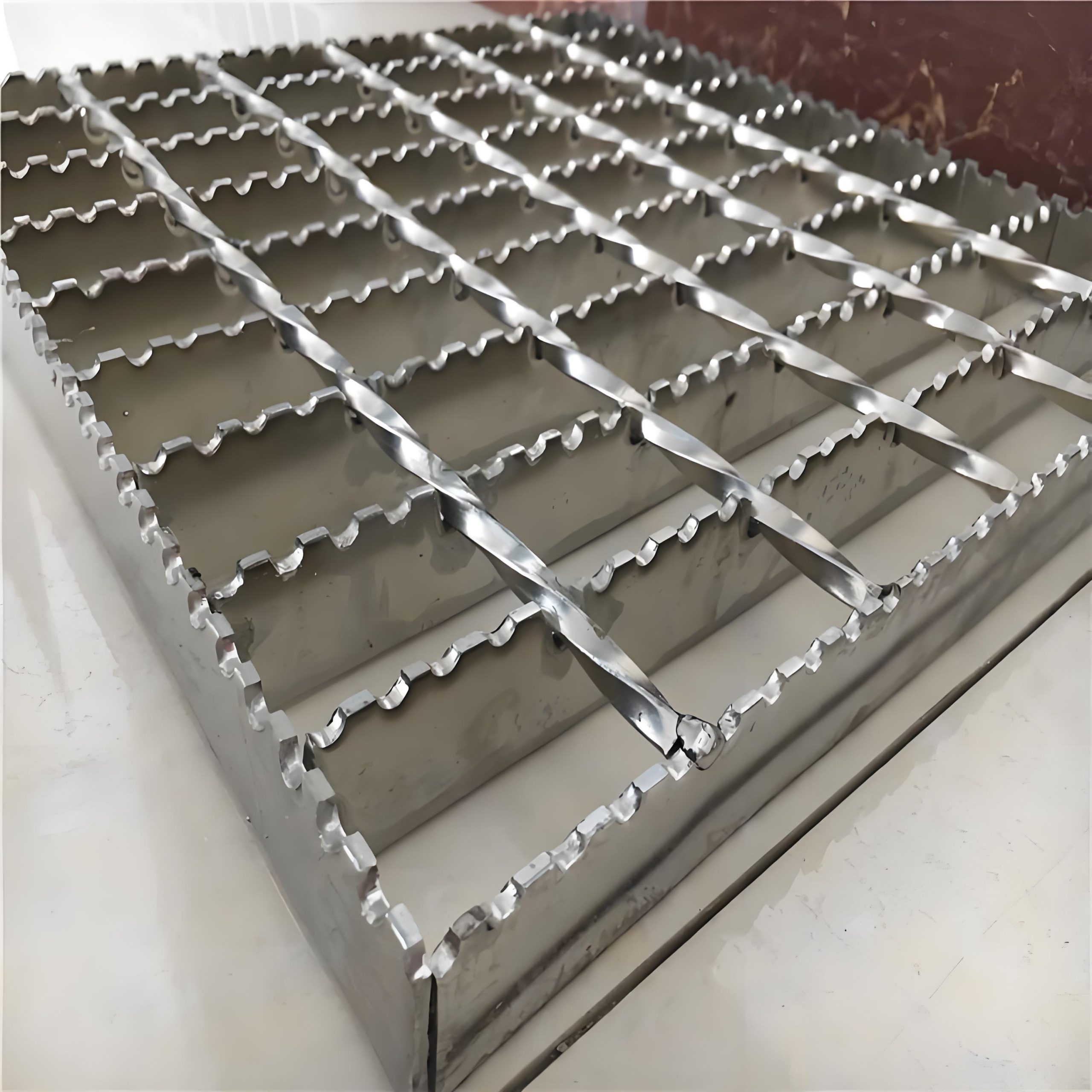
Serrated grating has notches along the top of the bearing bars to improve footwear engagement. It is commonly specified for offshore decks, production platforms, drilling areas, stair treads, tank farms, loading zones, and outdoor process walkways.
Serrations can reduce slip risk in the presence of water or oil, but they do not make the surface completely slip-proof. Grease, mud, ice, wax, chemical deposits, and poor housekeeping can still create unsafe conditions.
Plain grating has flat bearing bar tops and may be suitable for dry indoor areas, clean equipment rooms, and locations where smooth movement of carts or tools is more important than maximum traction.
Slip resistance should be designed together with slope, footwear, lighting, handrails, drainage, spill response, and cleaning. A serrated deck with blocked drains can still become dangerous when oil and water remain on the surface.
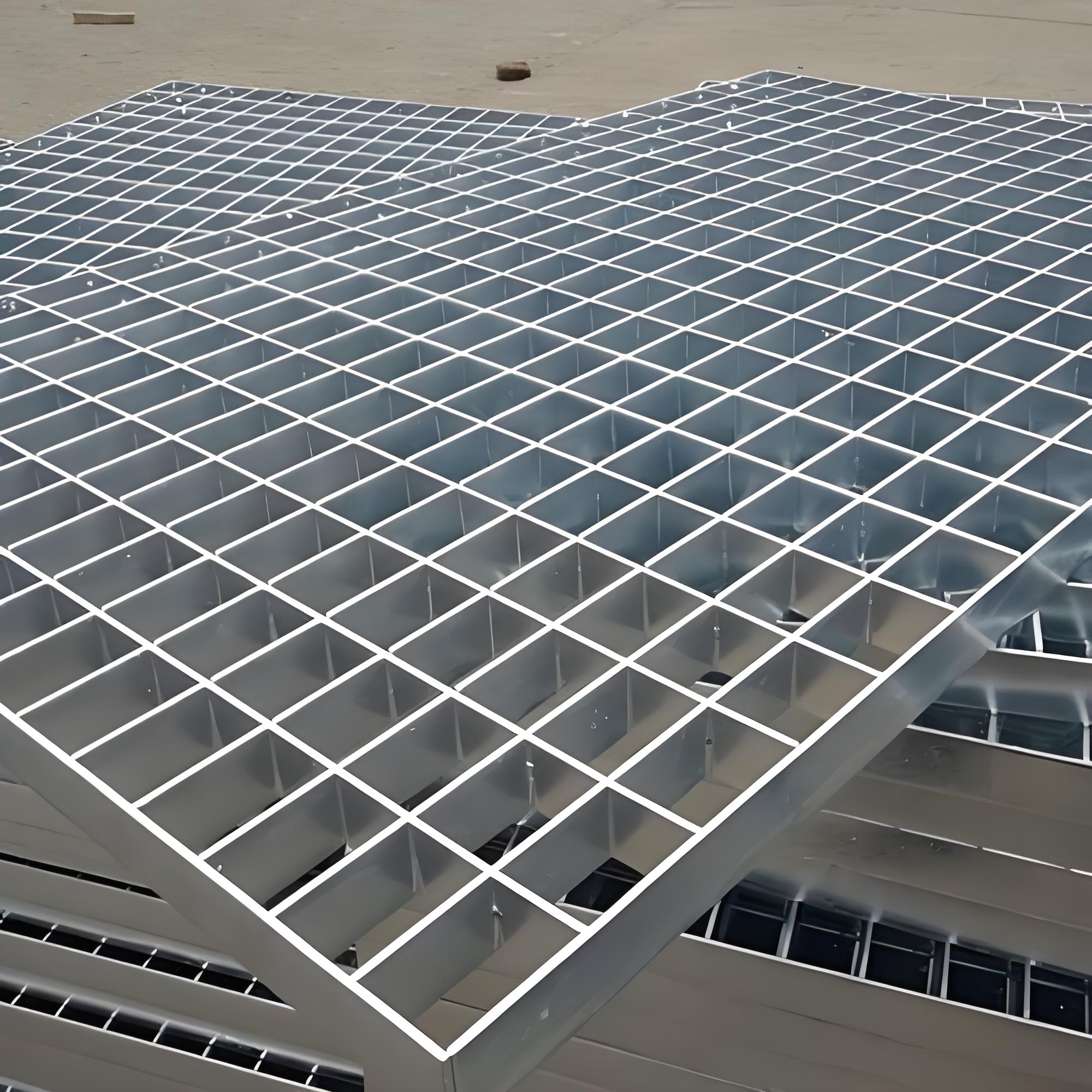
Grating on escape routes must remain stable, walkable, and free from unexpected movement. Panels should be securely fixed, edges should be flush, and removable sections should not be located where an emergency evacuation could be interrupted.
Open grating allows firewater and spilled liquids to move into drainage systems, which can help reduce surface accumulation. However, drainage paths must be designed to prevent hydrocarbon spread, uncontrolled discharge, or firewater contamination.
Steel grating is noncombustible, but its strength decreases as temperature rises. The supporting steel, clips, welds, and surrounding structure must also be considered during fire engineering.
Emergency hatches may require quick opening, lifting handles, hinges, locks, hold-open devices, and anti-fall protection. An access cover that is difficult to open under emergency conditions should not be treated as a compliant escape feature.
Blast-resistant design is a project-specific engineering discipline. Grating panels can become loose or airborne if they are not adequately restrained during blast or pressure events. Clips, bolts, frames, supports, and panel weight should be reviewed against the project blast philosophy. Standard grating load data does not automatically qualify a panel for blast exposure.
Grating patterns, nosings, handrails, and panel joints should remain visible under normal and emergency lighting. Contrasting nosings or clearly marked stair edges can improve access safety.
Offshore platforms receive continuous salt-laden air, humidity, rain, spray, and wet-dry cycling. Hot-dip galvanized steel may be suitable in selected areas with a qualified coating system and maintenance plan. 316 or 316L stainless steel is often considered for more aggressive chloride exposure.
Seawater splash, stagnant deposits, warm surfaces, and crevices can attack both coatings and stainless steels. A “marine grade” description is not enough. The project should identify the splash zone, immersion condition, temperature, cleaning, and expected maintenance.
Hydrocarbon residues, acids, alkalis, solvents, and treatment chemicals can attack zinc coatings or stainless steel depending on concentration and temperature. Chemical compatibility should be checked for the actual process, not inferred from the facility name.
Galvanized steel often provides a practical solution for onshore refineries, pipe racks, tank farms, and gas facilities exposed to weather. Industrial pollution, sulfur compounds, coastal air, and chemical vapors may reduce coating life and require a more detailed coating specification.
Corrosion often starts at clips, bolt holes, overlapping plates, frame seats, welds, and trapped deposits. Stainless steel connected to galvanized steel, carbon steel, or aluminum may create galvanic effects when moisture or process liquid is present.
Good detailing should minimize liquid traps, provide cleaning access, avoid incompatible fasteners, and isolate dissimilar metals where required.
Hot-dip galvanizing provides a zinc barrier and sacrificial protection for fabricated carbon-steel grating. All cutting, drilling, welding, banding, and grinding should preferably be completed before galvanizing.
Vent and drain holes are important for closed sections, side plates, nosings, and frames. Poorly detailed enclosed spaces can retain solutions or molten zinc and create processing or quality problems.
Painted grating may be used where color coding, project identification, or a specified protective coating system is required. Surface preparation, primer, stripe coats, dry-film thickness, edge treatment, weld treatment, and field repair are more important than color alone.
Offshore coating systems may reference NORSOK M-501 or an owner-approved equivalent. The specification should identify the coating system, surface preparation grade, environmental conditions during application, inspection method, and repair procedure.
Stainless grating may be supplied with a mill, brushed, pickled, passivated, polished, or electropolished finish. Pickling and passivation can remove weld heat tint, iron contamination, and oxidation and help restore a clean passive surface.
Field welding, cutting, drilling, or grinding can damage galvanizing and stainless steel surfaces. The project should define approved repair materials and post-work cleaning. Carbon-steel tools should not be used on stainless steel surfaces because embedded iron can create rust staining.
Walkways should provide a continuous route with adequate width, controlled deflection, safe openings, secure clips, and appropriate slip resistance. Bearing bars should run across the supporting beams.
Production decks may carry operators, hoses, tools, process equipment, pipe supports, and temporary maintenance loads. Panel layout should coordinate with valves, instruments, drains, handrails, and emergency access.
Industrial stair treads generally include a grating panel, side carrier plates, bolt holes, and a front nosing. Serrated surfaces or abrasive nosings are often selected for oily or outdoor stairs.
Platforms around pumps, compressors, separators, drilling equipment, and heat exchangers may require removable panels, hinged hatches, close-mesh sections, lifting handles, or local reinforcement.
| Application | Typical material and surface | Key design issue |
|---|---|---|
| Offshore walkway | Galvanized steel, 316/316L stainless, serrated | Salt spray, slip, uplift, drainage, and secure fixing |
| Pipe rack platform | Galvanized welded grating, plain or serrated | Loads from personnel, pipe supports, and maintenance equipment |
| Drilling platform | Heavy-duty steel or specialty grating | Impact, vibration, equipment loads, and repeated traffic |
| Refinery stair | Galvanized or stainless serrated tread | Slip resistance, nosing visibility, rise, run, and secure attachment |
| Tank farm access | Galvanized or stainless grating | Hydrocarbon exposure, drainage, firewater, and corrosion |
| Maintenance hatch | Framed removable or hinged panel | Opening frequency, lifting force, locks, and hold-open safety |
Pipe rack grating provides access for inspection, valve operation, coating work, and maintenance. Cut-outs around pipes and supports should be fabricated accurately and reinforced where bearing bars are removed.
Drilling areas are exposed to heavy equipment, dropped tools, vibration, mud, oil, and impact. Heavy-duty bearing bars, robust support frames, serrated surfaces, secure fastening, and frequent inspection are important.
Production decks may include separators, pumps, compressors, instruments, and emergency equipment. The grating layout should preserve access to isolation valves, drains, firewater equipment, escape routes, and lifting points.
Maintenance areas may carry temporary equipment, portable lifting systems, hoses, replacement parts, and tools. Concentrated loads should be identified during design rather than assuming that a general platform load is sufficient.
Drainage grates allow rainwater, wash-down water, and process liquids to enter channels and sumps. The open area and mesh size should be coordinated with flow, debris, hydrocarbon drainage, and safe foot placement.
Trench covers protect cable trenches, utility channels, process drains, and equipment pits. The clear opening, bearing direction, support frame, traffic load, and lifting method should be defined.
Removable panels are suitable for occasional inspection, cable access, pump maintenance, and periodic cleaning. They should have manageable weight, clear identification, stable seating, lifting holes or handles, and anti-movement details.
Hinged covers are useful where access is frequent or where a loose panel could be lost, stolen, or left beside an open trench. Hinges, pins, frames, locks, gas struts, hold-open devices, and traffic stops must be engineered for the cover weight and environment.
For trench-cover options and support details, buyers can review the CSSP Grating steel grating trench cover information.
Open grating reduces wind area compared with solid plate, but panels can still lift in exposed offshore locations. Clips, bolts, locating lugs, anti-lift devices, and frames should be selected for the design wind condition.
Lower decks, splash-zone walkways, and marine structures may experience water impact or wave loads. Panels should be securely restrained, and removable covers should not rely only on their weight.
Compressors, pumps, turbines, drilling equipment, and rotating machinery can create repeated vibration. The grating, clips, supports, welds, rivets, and adjacent structure should be checked as one system.
Tools, valves, pipe components, and equipment can fall onto the platform. Local reinforcement, thicker bearing bars, closer supports, or a replaceable wear panel may be required in high-impact locations.
Blast design must follow the project’s safety and structural engineering basis. Standard platform grating load tables do not automatically cover blast pressure, missile hazards, progressive collapse, or emergency egress under abnormal conditions. Panel restraint, support continuity, fastener ductility, and the possibility of loose fragments should be specifically reviewed.
Clips hold panels to support beams and may allow future removal. Offshore clips should resist corrosion, vibration, uplift, and repeated maintenance. Clip quantity and spacing should be shown on the drawing.
Bolted fixing provides positive restraint and is common for removable panels, vehicle areas, vibrating platforms, and security-sensitive locations. Bolt material, grade, washer, nut, hole size, and tightening method should be specified.
Welded attachment provides permanent fixing but makes replacement difficult. Galvanized areas damaged by welding must be repaired, and stainless steel welds may require cleaning and passivation.
Frames may be made from angle, channel, flat bar, or fabricated sections. They must provide adequate bearing width, stiffness, anchor capacity, corrosion protection, and a level seating surface.
Oil and gas platforms require cut-outs around pipes, columns, valves, cable trays, equipment, drains, and handrails. Cut-outs should be shown on fabrication drawings with dimensions, clearances, reinforcement, and banding details.
Trim banding closes exposed bearing bar ends and improves handling. Load-carrying banding may be required where the edge transfers load or where a cut-out removes primary bearing bars.
Toe plates reduce the risk of tools, bolts, and materials falling from elevated platforms. Kick plates may also be required around equipment, stair edges, and open deck boundaries.
Inspection frequency should be based on exposure, traffic, criticality, access difficulty, and past damage. Offshore and process areas normally require more frequent inspection than protected indoor platforms.
Oil, grease, mud, salt, sand, process chemicals, and debris should be removed before they create a slip or corrosion hazard. Drainage openings and trench frames should remain clear. Cleaning agents must be compatible with the galvanized coating, stainless alloy, paint system, or other material.
Good corrosion control includes appropriate material selection, drainage, ventilation, coating inspection, compatible fasteners, isolation of dissimilar metals, sealed or minimized crevices, and timely repair of damaged surfaces.
Separate offshore splash zones, open decks, enclosed modules, pipe racks, chemical areas, tank farms, drilling floors, utility trenches, stairways, and indoor equipment rooms. Each zone may need a different material or finish.
State the clear span, support width, bearing direction, uniform load, concentrated load, wheel load, impact, vibration, fatigue, and allowable deflection. Identify all temporary maintenance loads that may occur.
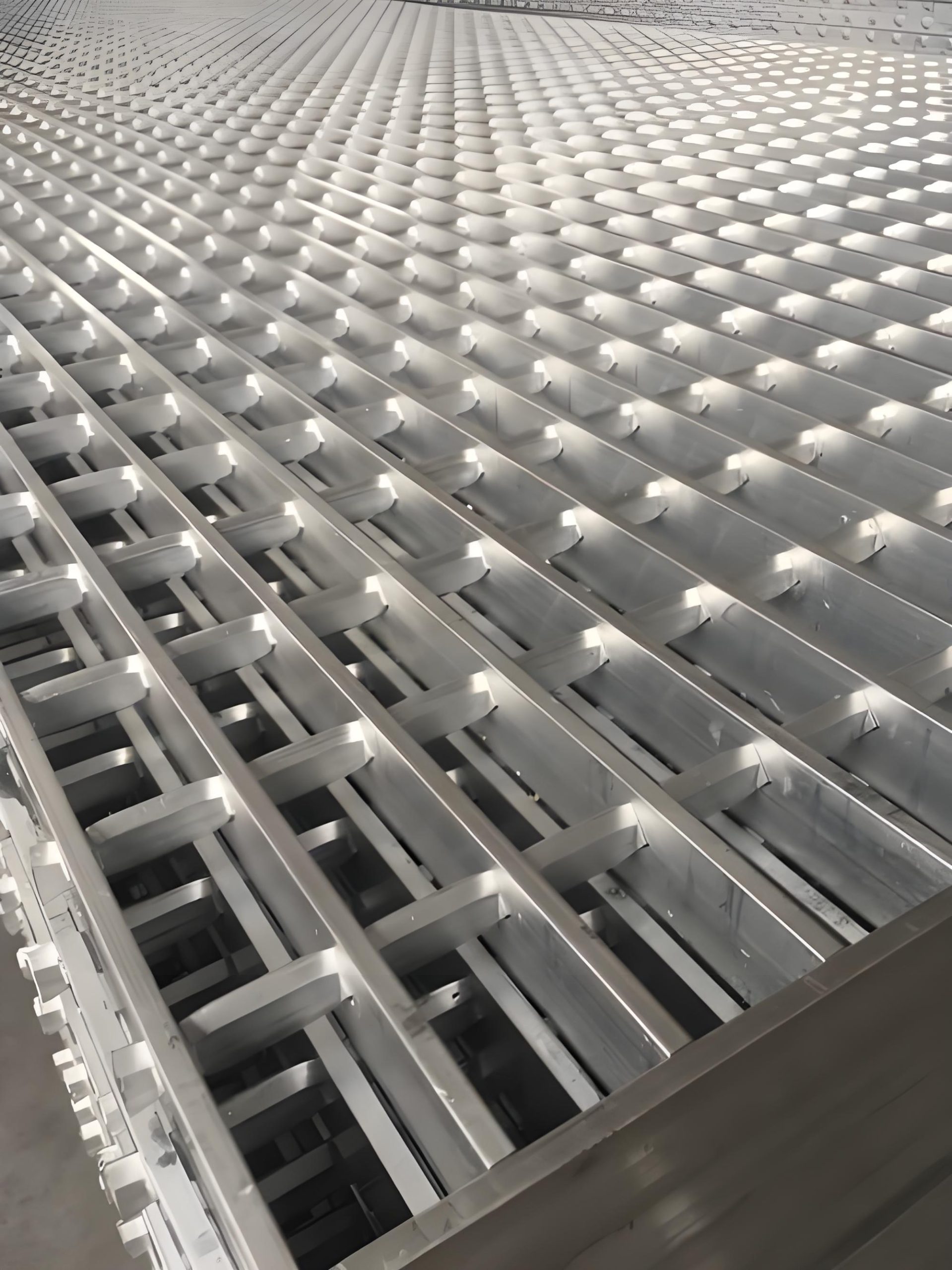
Welded grating is widely used for industrial platforms and custom fabrication. Riveted or other heavy-duty constructions may be considered for repeated rolling, bridge-type, or specialty vehicle loads. Press-locked grating may be suitable for selected architectural or moderate-duty areas.
Choose carbon steel, hot-dip galvanized steel, 304, 316, 316L, duplex, aluminum, or another approved material. Define galvanizing, paint, NORSOK coating, passivation, surface finish, corrosion allowance, and field-repair requirements.
Specify plain or serrated surfaces, anti-slip nosings, mesh opening, fall-through protection, dropped-object control, and drainage requirements.
Provide panel dimensions, cut-outs, banding, toe plates, frames, lifting points, removable sections, hinge positions, locks, clips, fasteners, and panel marks.
| Document | Purpose |
|---|---|
| Fabrication drawings | Show panel dimensions, bearing direction, cut-outs, banding, supports, and fixing |
| Load calculations | Confirm span, uniform load, concentrated load, wheel load, and deflection |
| Material certificates | Verify steel grade, heat number, mechanical properties, and traceability |
| Welding documents | Verify procedures, welder qualifications, inspection, and repairs |
| Galvanizing or coating report | Confirm surface preparation, coating system, thickness, and repair |
| Stainless finishing records | Confirm pickling, passivation, cleaning, or polishing where required |
| Inspection and test plan | Define inspection stages, sampling, witness points, and acceptance criteria |
| Compliance matrix | Show how the product satisfies each project standard and owner requirement |
| Packing and panel schedule | Support identification, lifting, delivery, and installation |
| RFQ category | Information to provide |
|---|---|
| Facility type | Offshore platform, FPSO, refinery, tank farm, drilling site, gas plant, or petrochemical facility |
| Location | Open deck, splash zone, enclosed module, pipe rack, stair, trench, or process area |
| Material | Carbon steel, galvanized steel, 304, 316, 316L, duplex, aluminum, or approved alternative |
| Construction | Welded, riveted, press-locked, heavy-duty, or custom construction |
| Load | Personnel, equipment, uniform, concentrated, wheel, vehicle, impact, and temporary loads |
| Span | Clear opening, support width, frame section, and bearing direction |
| Surface | Plain, serrated, anti-slip, nosing, close mesh, or special profile |
| Open area | Drainage, ventilation, firewater, debris, and dropped-object requirements |
| Finish | Hot-dip galvanizing, paint, NORSOK coating, pickling, passivation, or polished finish |
| Fabrication | Cut-outs, banding, frames, toe plates, kick plates, handles, hatches, and panel marks |
| Fixing | Clips, bolts, welds, anti-lift devices, hinges, locks, and dissimilar-metal isolation |
| Safety | Escape route, handrail, guardrail, toe plate, fire, blast, and hazardous-area requirements |
| Documents | Drawings, calculations, certificates, inspection reports, coating records, and conformity documents |
For oil and gas platform projects, buyers can also review the CSSP Grating offshore grating manufacturer guide and the steel grating product range when comparing galvanized, stainless, serrated, heavy-duty, and custom-fabricated options.
What is the best steel grating for offshore oil platforms? The best choice depends on the deck location, salt exposure, load, fire requirements, and maintenance plan. Hot-dip galvanized steel is commonly used for many structural offshore and onshore areas when the coating system is properly specified. 316 or 316L stainless steel is often considered for severe chloride, splash-zone, chemical, and corrosion-sensitive locations. Heavy-duty welded or riveted grating may be required for drilling floors, vehicle routes, ramps, or repeated rolling loads. The final selection should be confirmed by project calculations and the operator’s material specification.
Why is serrated grating used on oil and gas platforms? Serrated grating improves footwear engagement on surfaces exposed to rain, seawater, oil, mud, chemicals, and wash-down liquid. It is commonly used on offshore decks, production platforms, pipe racks, stairs, ramps, and maintenance walkways. Serrations do not eliminate slip risk by themselves. Drainage, cleaning, lighting, handrails, suitable footwear, spill control, and regular inspection are still required.
What standards should be specified for oil and gas platform grating? The project should identify the applicable grating, material, structural, coating, offshore, fire, and local safety standards. Common references may include ANSI/NAAMM MBG 531 or MBG 532, YB/T 4001.1, ASTM material and galvanizing standards, ISO 1461, API offshore practices, ISO 19901 or ISO 19902, NORSOK coating requirements, and owner specifications. The purchase order should state which document governs the product, load calculation, coating, inspection, installation, and emergency-access requirements.
