

Hot-dip galvanized steel grating for welding installation is widely used in industrial platforms, walkways, stair landings, drainage trench covers, equipment access floors, bridge service areas, and heavy-duty maintenance zones where a strong and permanent fixing method is required. The grating panel is usually fabricated from steel bearing bars and cross bars, then hot-dip galvanized for corrosion protection. During installation, the panel can be welded directly to steel supports, frames, or embedded structures. Welding installation provides strong fixation, but it also damages part of the zinc coating at the weld points, so proper coating repair is necessary after welding. For buyers and contractors, the key is to choose the right grating specification, confirm bearing bar direction, design suitable welding points, and repair the galvanized layer correctly after installation.
Hot-dip galvanized steel grating is a metal grating product made from steel bearing bars and cross bars, then protected by a zinc coating through the hot-dip galvanizing process. It is commonly used as an open-grid flooring or covering material where strength, drainage, ventilation, corrosion resistance, and safe access are required.
The steel grating is usually fabricated first by welding or mechanical assembly. After cutting, edge banding, drilling, shaping, and other fabrication work are completed, the finished panel is dipped into molten zinc. The zinc coating covers the steel surface, including bearing bars, cross bars, welded joints, edges, and many internal contact areas. This helps protect the grating from corrosion in outdoor, humid, industrial, and drainage environments.
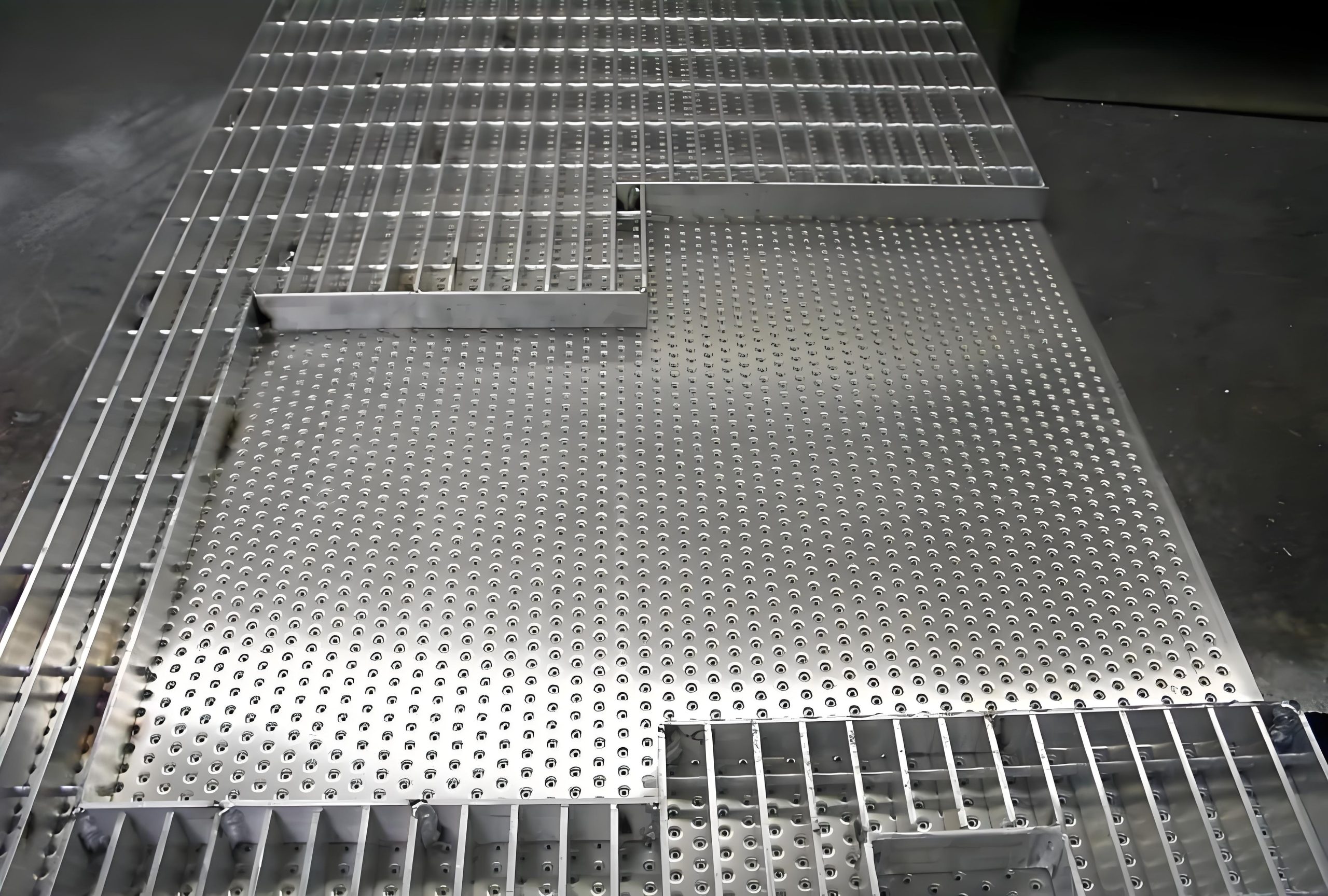
A standard hot-dip galvanized steel grating panel normally includes bearing bars, cross bars, edge banding, and zinc coating. The bearing bars carry the main load. The cross bars keep the bearing bars in position. The open spaces allow water, air, light, dust, snow, oil, and debris to pass through. The galvanized coating protects the steel from rust.
| Part | Function | Why It Matters |
|---|---|---|
| Bearing bars | Carry the main load | Determine load capacity and span performance |
| Cross bars | Connect and stabilize bearing bars | Maintain grid shape and panel rigidity |
| Edge banding | Closes panel edges | Improves handling safety and appearance |
| Open grid | Allows drainage and ventilation | Suitable for platforms, walkways, and trench covers |
| Hot-dip galvanized coating | Protects steel from corrosion | Important for outdoor and wet environments |
Welding installation is common because it provides a strong and permanent connection between steel grating panels and support structures. In many industrial projects, grating panels are installed on steel beams, frames, channels, or embedded supports. Welding helps keep the panels fixed in position and reduces the risk of movement, lifting, vibration, or accidental displacement.
For platforms, walkways, and industrial floors where panels do not need to be removed frequently, welding is a practical fixing method. It can create a strong connection that holds the grating securely during worker traffic, maintenance activity, vibration, and equipment operation.
Many grating projects are installed on steel structures. Welding is familiar to contractors and can be done directly on site when the support frame is made from steel. This makes it useful for industrial plants, power plants, water treatment facilities, steel platforms, and equipment maintenance structures.
Compared with bolt or clip installation, welded fixing does not rely on removable fasteners. In areas with vibration, frequent foot traffic, or long-term exposure, clips and bolts may loosen if not checked. Welding provides a fixed solution when future panel removal is not required.
| Reason Welding Is Used | Practical Benefit |
|---|---|
| Permanent fixing | Prevents panels from shifting, lifting, or moving during service |
| Strong connection | Suitable for industrial platforms and structural steel supports |
| No loose clips | Reduces fastener maintenance in fixed installations |
| Simple site method | Can be performed by qualified welders on steel support frames |
| Useful for long-term flooring | Suitable where grating panels do not need regular removal |
Hot-dip galvanizing protects welded steel grating by forming a zinc coating on the steel surface. This coating works as a barrier between the steel and the environment. It also provides sacrificial protection, meaning the zinc corrodes before the underlying steel in many service conditions.
For steel grating, hot-dip galvanizing is usually done after factory fabrication. This means the grating is welded, cut, banded, drilled, and shaped before galvanizing. As a result, the zinc coating covers welded joints, cut edges, bearing bars, cross bars, and panel edges. This is better than cutting or welding after galvanizing without repair.
Hot-dip galvanized steel grating is commonly used outdoors because it resists rust better than untreated carbon steel. It is suitable for rain-exposed platforms, drainage covers, bridge walkways, water treatment plants, outdoor stairs, industrial walkways, and humid service areas.
Factory-welded joints are protected during hot-dip galvanizing. However, when installation welding is performed on site, the zinc coating near the weld area is burned or removed. These installation weld points need repair after welding to restore corrosion protection.
| Protection Area | How Galvanizing Helps | Important Note for Welding Installation |
|---|---|---|
| Factory welds | Zinc coating covers welded joints after fabrication | Protected if galvanizing is done after fabrication |
| Cut edges | Zinc coating covers exposed edges | Factory cutting before galvanizing is preferred |
| Panel surface | Zinc acts as a corrosion barrier | Useful for outdoor and humid environments |
| Installation weld points | Original coating is damaged during welding | Repair coating after site welding |
The main structure of hot-dip galvanized steel grating includes bearing bars, cross bars, open grid areas, edge banding, and sometimes additional components such as toe plates, fixing clips, stair tread side plates, lifting holes, or support frames. For welding installation, the relationship between the grating panel and the supporting structure is especially important.
Bearing bars are the main load-carrying bars. They must span between supports. During installation, the bearing bar direction should be confirmed before welding. If the panel is welded in the wrong direction, the grating may not carry the required load safely.
Cross bars are welded or locked across the bearing bars to stabilize the panel. They maintain spacing and help keep the panel rigid. Cross bars are not normally designed to carry the main span load, so they should not replace bearing bars in the load direction.
Edge banding closes the panel edges and improves handling safety. In welded installation, banding may also provide a cleaner edge and help installers position the panel correctly. However, welding should normally be applied at suitable bearing bar or support contact points according to project requirements.
Support frames or steel beams must be strong enough to carry the grating and live loads. The grating should have adequate bearing length on supports before welding. Poor support can cause vibration, deformation, or unsafe load transfer.
| Structural Item | Role in Grating | Installation Concern |
|---|---|---|
| Bearing bar | Main load-carrying component | Must span between supports before welding |
| Cross bar | Maintains spacing and panel stability | Should not be treated as the main load span member |
| Banding bar | Closes and reinforces panel edges | Helps handling and edge safety |
| Support beam | Carries the grating panel and load | Must provide proper bearing length and strength |
| Weld point | Fixes panel to support | Requires coating repair after welding |
Welded installation and clip installation are two common methods for fixing hot-dip galvanized steel grating. The right choice depends on whether the panel needs to be removable, the load condition, site safety requirements, maintenance access, and corrosion protection concerns.
Welded installation fixes the grating directly to the steel support structure. It provides strong and permanent fixing. It is commonly used where panels do not need to be removed regularly. It can reduce panel movement and is suitable for fixed industrial platforms, walkways, and structural steel floors.
Clip installation uses saddle clips, bottom clips, bolts, nuts, or special fasteners to hold the grating in position. It is useful when panels need to be removed for maintenance, cleaning, drainage inspection, or equipment access. Clip installation also avoids burning the galvanized coating during site fixing.
Welding is suitable for permanent installations where strong fixing is required and the grating does not need frequent removal. Clip installation is better for removable panels, maintenance covers, trench covers, and areas where coating damage from welding should be avoided.
| Comparison Item | Welded Installation | Clip Installation |
|---|---|---|
| Fixing strength | Strong and permanent | Strong enough when properly selected and tightened |
| Removability | Not easy to remove | Easy to remove for maintenance |
| Coating damage | Damages zinc coating at weld points | Less coating damage during installation |
| Maintenance access | Less suitable for frequent access | Suitable for removable panels and inspection areas |
| Common use | Fixed platforms, walkways, industrial floors | Trench covers, drainage covers, removable platforms |
Welding hot-dip galvanized steel grating has several advantages when the project requires permanent fixing. It is especially useful for industrial floors, walkways, and platforms where panel movement must be minimized.
Welding creates a direct connection between the grating and steel support. This helps prevent panels from shifting during use. In areas with vibration, frequent walking, or equipment maintenance, welded fixing can improve stability.
Loose or unsecured grating can create serious safety risks. Welding helps prevent panels from lifting or being displaced accidentally. This is important on elevated platforms, walkways, and industrial access floors.
Because welded grating does not depend on removable clips or bolts, there are fewer fasteners to inspect and retighten. This can be useful in fixed installations where access for future maintenance is limited.
When the grating is intended to remain in place for many years, welding can be an efficient fixing method. It is commonly used in industrial steel structures, equipment platforms, plant walkways, and permanent access floors.
| Advantage | Practical Value |
|---|---|
| Permanent connection | Panels stay firmly fixed to steel supports |
| Stable walking surface | Reduces movement, rattling, and lifting risks |
| Fewer loose parts | No clips or bolts that may loosen over time |
| Suitable for industrial structures | Works well with steel beams and welded frames |
| Useful for fixed platforms | Good for areas where panels do not need regular removal |
The main disadvantage of welding hot-dip galvanized steel grating is zinc coating damage at and around the weld points. During welding, high heat burns away the zinc coating and exposes the steel. If these areas are not repaired, corrosion may start at the welded points.
Hot-dip galvanized coating is made of zinc. Welding temperature is much higher than the temperature zinc can withstand. When welding is performed, the zinc near the weld area vaporizes, burns, or is removed. This leaves exposed steel around the weld.
If the exposed area is not repaired, moisture and oxygen can attack the steel. In outdoor, humid, or chemical environments, corrosion may develop faster. Weld points are also often located at contact areas where water or dust can accumulate, making repair even more important.
Welding galvanized steel can produce fumes from zinc coating. Qualified welders should use suitable ventilation, personal protection, and safe welding procedures. The work area should be prepared properly before welding.
After welding, the repaired area may not look exactly the same as factory hot-dip galvanizing. This is normal. The main purpose of repair is corrosion protection, not perfect appearance matching.
| Welding Issue | Cause | Required Action |
|---|---|---|
| Zinc coating burns off | High welding heat | Repair exposed steel after welding |
| Corrosion risk | Bare steel near weld points | Apply zinc-rich repair coating or approved repair method |
| Welding fumes | Zinc coating vaporized by heat | Use ventilation and proper welder protection |
| Surface color difference | Repair coating differs from original galvanizing | Acceptable if corrosion protection is restored |
Repairing galvanized coating after welding is necessary when hot-dip galvanized steel grating is welded to support structures. The repair method should cover all exposed steel around the weld points and restore corrosion protection as much as practical.
Before repair, remove welding slag, spatter, burnt zinc residue, dust, oil, and loose material. A clean surface helps the repair coating bond properly. Wire brushing, grinding, or other surface preparation may be needed depending on the condition of the weld.
Zinc-rich paint is commonly used for repairing damaged galvanized coating after welding. It should be applied according to the paint manufacturer’s instructions. Multiple coats may be required to achieve sufficient protection.
Zinc spray can be used for small weld areas or touch-up work. It is convenient for site repair, but the surface preparation and coating thickness should still be controlled.
Some projects require specific repair materials or standards. Buyers and contractors should confirm repair requirements before installation, especially for outdoor, municipal, bridge, industrial, or corrosive environments.
After coating repair, the weld area should be inspected visually. Check whether all exposed steel is covered. In high-corrosion environments, more detailed inspection may be required.
| Repair Step | Recommended Practice | Purpose |
|---|---|---|
| Surface cleaning | Remove slag, spatter, dust, burnt zinc, and oil | Improve coating adhesion |
| Surface preparation | Wire brush or grind exposed steel if needed | Create a clean repair surface |
| Apply zinc-rich coating | Use zinc-rich paint or spray according to project requirement | Restore corrosion protection |
| Check coverage | Confirm all exposed steel is covered | Reduce corrosion risk at weld points |
| Maintenance inspection | Check repaired points during regular maintenance | Ensure long-term protection |
Before welding installation, the grating specification must be selected according to the load requirement and support span. Welding only fixes the panel in place. It does not compensate for an undersized bearing bar, excessive span, wrong bearing direction, or weak support frame.
Bearing bar size is usually described by height and thickness, such as 25 x 3 mm, 30 x 3 mm, 30 x 5 mm, 40 x 5 mm, or 50 x 5 mm. Higher and thicker bearing bars provide stronger load capacity but also increase weight and price.
Bearing bar spacing affects load distribution, weight, opening size, and walking comfort. Closer spacing provides better load distribution and smaller openings, but it increases steel weight. Wider spacing reduces weight and cost but may not be suitable for every walkway, platform, or cover.
The clear span is the unsupported distance between support beams or frames. It is one of the most important values for selecting steel grating. A grating panel suitable for a short span may not be safe on a longer span.
Different projects require different loads. Pedestrian walkways, maintenance platforms, drainage trench covers, carts, forklifts, and vehicle areas all need different grating designs. Before welding the panel in place, load requirements should be confirmed.
| Bearing Bar Size | Relative Load Level | Common Application |
|---|---|---|
| 20 x 3 mm | Light | Short-span pedestrian access and light covers |
| 25 x 3 mm | Light to medium | General walkways and light platforms |
| 30 x 3 mm | Medium | Industrial walkways and standard platform grating |
| 30 x 5 mm | Medium to heavy | Factory platforms, frequent-use walkways, trench covers |
| 40 x 5 mm | Heavy | Heavy platforms, longer spans, stronger covers |
| 50 x 5 mm or larger | Very heavy | Vehicle areas, forklift zones, heavy-duty trench covers |
| Bearing Bar Spacing | Performance Effect | Typical Use |
|---|---|---|
| 25 mm | Smaller openings and better walking comfort | Public access, close-mesh walkways, special platforms |
| 30 mm | Strong load distribution and common industrial use | Platforms, walkways, trench covers |
| 34 mm | Balanced weight, open area, and strength | General galvanized steel grating |
| 40 mm | Larger openings and lower material weight | Drainage areas and light-duty economical panels |
Panel size and layout should be confirmed before welding installation. Once grating is welded to the support structure, adjustment becomes more difficult. A correct layout improves installation speed, reduces site cutting, and prevents panels from being welded in the wrong position.
The bearing bars must span between supports. This direction should be marked on drawings and confirmed on site before welding. If panels are rotated incorrectly, load capacity can be reduced even if the welding points are strong.
Large panels reduce the number of joints, but they are heavier and harder to position. Smaller panels are easier to handle but require more welding points and more installation time. The best panel size depends on the support layout, lifting method, project area, and future maintenance needs.
Steel structures, frames, and grating panels may have small dimensional tolerances. Layout design should allow reasonable gaps for installation. Panels should not be forced into position because this may cause stress, deformation, or poor welding contact.
If the grating needs openings for pipes, columns, machines, drains, valves, or handrails, these cut-outs should be fabricated before hot-dip galvanizing whenever possible. Site cutting after galvanizing exposes steel and requires repair.
| Layout Item | What to Confirm | Why It Matters |
|---|---|---|
| Bearing bar direction | Direction of main load-carrying bars | Critical for load capacity |
| Panel size | Length, width, and quantity | Affects handling and welding work |
| Support position | Beam or frame location | Controls span and bearing length |
| Installation gap | Reasonable tolerance between panels | Prevents forced fitting and site modification |
| Cut-outs | Openings for pipes, columns, equipment, and drains | Better processed before galvanizing |
| Panel numbering | Marks panels according to layout drawings | Improves installation efficiency |
Welding points and support frames must be designed properly for hot-dip galvanized steel grating installation. A grating panel should not be welded randomly. The welding position, weld length, support contact, and coating repair should follow project requirements and practical site conditions.
Welding points are usually placed where the grating panel contacts the support structure. The number and size of welds depend on panel size, load condition, support layout, and project specification. For large panels or high-vibration areas, more fixing points may be required.
The grating should sit flat on the support before welding. If there is poor contact, welding may not fix the panel properly. Uneven supports can create rocking, noise, deformation, or local stress.
Support frames should be strong enough to carry both grating weight and service load. For trench covers or drainage panels, the frame or ledge must provide adequate bearing length. For platforms, beams should match the bearing bar direction.
Welding should be performed by qualified workers using suitable procedures. Poor welds may crack, fail, or leave weak connections. Welds should be inspected visually after installation, and coating damage should be repaired.
Excessive welding can cause unnecessary coating damage, panel distortion, and more repair work. The goal is to provide enough fixing strength without damaging more galvanized surface than necessary.
| Fixing Requirement | Recommended Practice | Risk If Ignored |
|---|---|---|
| Correct weld position | Weld at suitable contact points between grating and support | Weak fixing or unnecessary coating damage |
| Flat support contact | Ensure panel sits properly before welding | Rocking, noise, deformation, poor weld quality |
| Adequate support length | Provide sufficient bearing area on beams or frames | Reduced load safety and edge failure risk |
| Qualified welding | Use trained welders and suitable welding procedure | Cracked or weak welds |
| Coating repair | Repair zinc coating after welding | Corrosion at weld points |
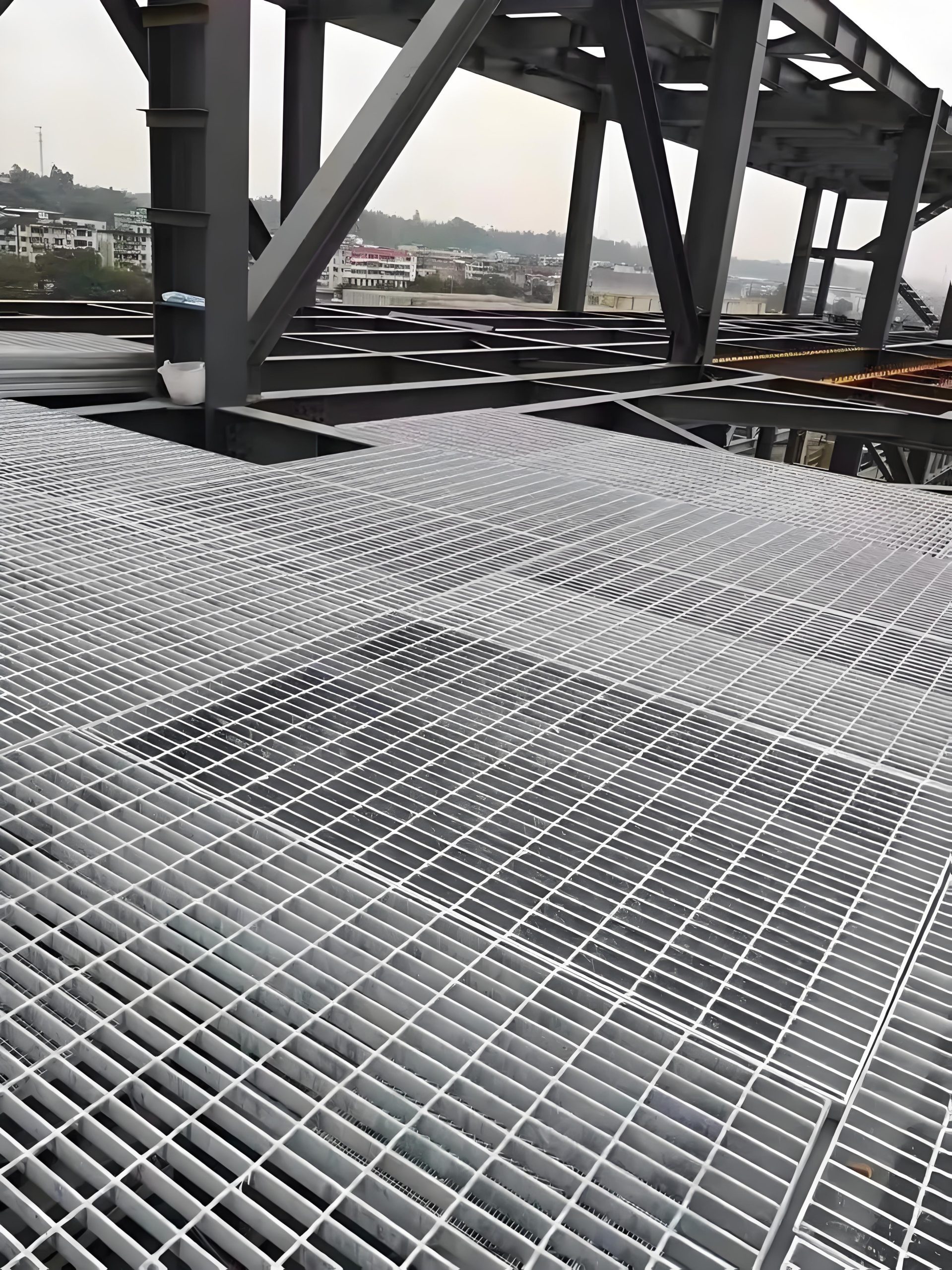
Hot-dip galvanized steel grating for welding installation is often used in areas where safety is important. Walkways, platforms, drainage covers, and industrial access floors must be stable, properly supported, slip resistant when required, and protected against corrosion.
For walkways, the grating should provide comfortable and safe passage. Bearing bar spacing should be suitable for the users. Outdoor or wet walkways may need serrated grating to improve slip resistance. Welded panels should not move, lift, or rattle during use.
Industrial platforms often carry workers, tools, and maintenance parts. The grating must match the required load and span. Toe plates or kick plates may be required around elevated platform edges to prevent objects from falling.
Drainage covers must support the expected load while allowing water flow. If the covers need to be removed regularly, welding installation may not be the best option. For permanent drainage covers or areas where lifting is not required, welding may be acceptable if inspection access is not needed.
Serrated hot-dip galvanized steel grating is recommended for wet, oily, outdoor, or sloped areas. Plain grating may be suitable for dry indoor platforms. Stair treads usually benefit from serrated surface or anti-slip nosing.
If weld points corrode over time, fixing strength and appearance may be affected. Repairing galvanized coating after welding helps maintain long-term safety and service life.
| Safety Area | Important Requirement | Recommended Solution |
|---|---|---|
| Walkways | Stable walking surface and safe openings | Correct spacing, support, and welded fixing |
| Outdoor platforms | Slip resistance and corrosion protection | Serrated galvanized grating and coating repair after welding |
| Elevated platforms | Load safety and object fall prevention | Proper grating size, toe plates, and secure fixing |
| Drainage covers | Load capacity and water flow | Correct bar size, support ledge, and drainage opening |
| Stairs | Foot grip and edge visibility | Serrated stair treads and anti-slip nosing |
Welded hot-dip galvanized steel grating is used in many industrial and outdoor projects. It is selected when the project needs strong fixing, corrosion resistance, open-grid drainage, and long-term flooring performance.
Industrial platforms around machines, tanks, boilers, pipe racks, valves, and conveyors often use welded hot-dip galvanized steel grating. Welding installation helps keep the panels permanently fixed to the steel structure.
Walkways and catwalks require stable walking surfaces. Hot-dip galvanized steel grating provides drainage and corrosion protection, while welded fixing prevents movement in fixed access areas.
Power plants and chemical plants use galvanized steel grating for maintenance platforms, access floors, stairs, trenches, and equipment areas. Site conditions may include humidity, dust, chemical vapor, or outdoor exposure, so coating repair after welding is important.
Water treatment facilities often use grating around tanks, channels, pumps, and filtration systems. Hot-dip galvanizing improves corrosion resistance, and serrated grating may be selected for wet walking areas.
Bridge service walkways and outdoor platforms need drainage and weather resistance. Welded hot-dip galvanized grating is suitable where panels are intended to remain fixed.
For trench covers, welding installation may be used when covers are permanent. If the covers need to be removable for cleaning, clips or bolted fixing may be better. The fixing method should be chosen according to maintenance access requirements.
| Application | Why Welded Hot-Dip Galvanized Grating Is Used |
|---|---|
| Industrial platforms | Strong permanent fixing and corrosion-resistant open flooring |
| Walkways | Stable access surface with drainage and ventilation |
| Equipment access floors | Supports maintenance workers and tools around machines |
| Outdoor service areas | Hot-dip galvanizing protects against weather exposure |
| Drainage covers | Allows water flow while supporting required loads |
| Bridge maintenance areas | Open-grid structure reduces water accumulation |
Choosing a suitable hot-dip galvanized steel grating supplier is important for welding installation projects because the supplier must understand both grating production and installation requirements. The right supplier should help confirm the grating specification, drawing details, panel layout, welding installation concerns, galvanizing quality, packing, and delivery requirements.
A qualified supplier should be able to produce welded steel grating, serrated grating, stair treads, trench covers, heavy-duty panels, cut-to-size panels, and custom fabricated grating. For welding installation, factory-made panels with correct cut-outs and banding reduce site modification and coating damage.
The supplier should help confirm bearing bar size, bearing bar spacing, cross bar spacing, clear span, load requirement, surface type, and bearing bar direction. These details are necessary before panels are welded to the structure.
Good hot-dip galvanizing quality includes full coating coverage, clean surface, proper drainage, controlled zinc buildup, and limited sharp points. The supplier should inspect galvanized panels before shipment.
A practical supplier should remind buyers that welding damages galvanized coating and that weld areas need repair. For some projects, the supplier may recommend clip installation instead of welding if the panels need to be removable.
For platforms, stairs, and trench covers, drawings are important. The supplier should be able to read CAD drawings, prepare panel lists, mark panel numbers, and process holes or cut-outs before galvanizing.
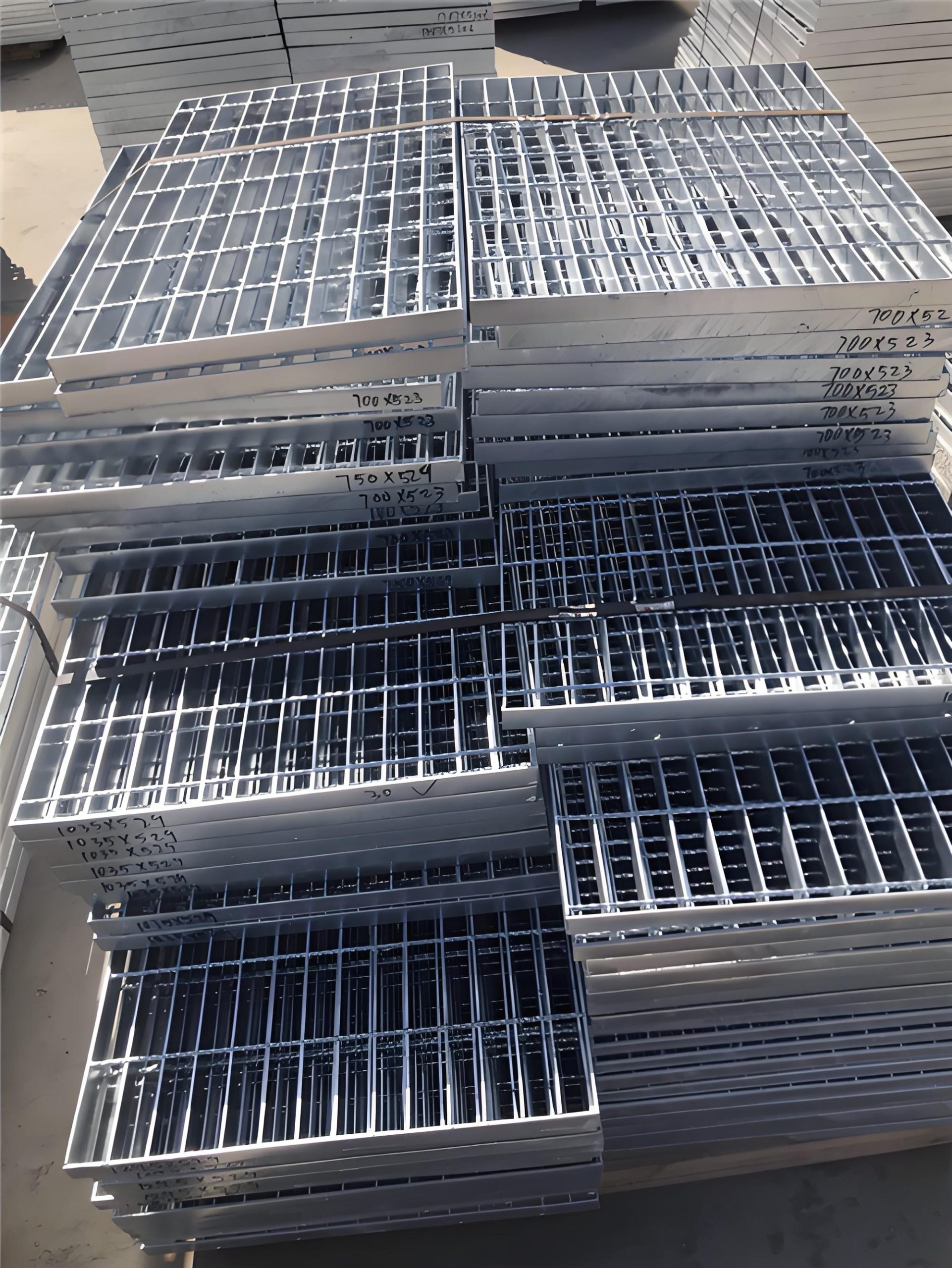
Hot-dip galvanized steel grating is heavy and can be scratched or bent if poorly packed. Export orders should use strong bundling, labels, packing lists, and loading plans. Panel numbering should be protected and easy to read on site.
For buyers evaluating factory-based steel grating supply, Anping County Chuansen Silk Screen Products Co., Ltd. can be considered for hot-dip galvanized steel grating, walkway grating, trench covers, stair treads, and custom welded grating panels. Before ordering, buyers should confirm drawings, load requirements, bearing bar direction, surface type, welding installation method, galvanizing requirements, and coating repair plan.
| Supplier Selection Point | What to Confirm | Why It Matters |
|---|---|---|
| Production ability | Welded grating, serrated grating, stair treads, trench covers, custom panels | Ensures product can match project requirements |
| Technical knowledge | Load, span, bearing bar direction, spacing, surface type | Reduces risk of wrong specification |
| Drawing support | CAD reading, panel numbering, cut-outs, holes, banding | Improves installation accuracy |
| Galvanizing control | Coating coverage, zinc buildup, bare spots, sharp edges | Affects corrosion resistance and handling safety |
| Installation understanding | Welding points, coating repair, removable panel requirements | Helps buyers choose welding or clip installation correctly |
| Packing and export | Strong bundles, labels, packing lists, loading photos | Reduces transport damage and site confusion |
Can hot-dip galvanized steel grating be welded during installation?
Yes, hot-dip galvanized steel grating can be welded during installation when permanent fixing is required. However, welding burns or removes the zinc coating around the weld points. After welding, the exposed steel should be cleaned and repaired with zinc-rich coating or another approved galvanizing repair method to reduce corrosion risk.
Is welding better than using grating clips?
Welding is better for permanent installations where panels do not need to be removed and strong fixing is required. Grating clips are better when panels need to be removable for cleaning, inspection, drainage maintenance, or equipment access. Welding provides a fixed connection, while clips reduce coating damage and allow easier future removal.
How do you protect galvanized grating after welding?
After welding galvanized grating, remove slag, spatter, burnt zinc, dust, and oil from the weld area. Then apply zinc-rich repair paint, zinc spray, or another approved repair coating to cover exposed steel. The repaired area should be inspected to ensure the bare steel is fully protected, especially for outdoor, wet, or industrial environments.