

Serrated grating is an open-grid metal flooring product in which the upper edges of the load-carrying bearing bars are formed with notches, teeth, or scalloped profiles. These raised edges create additional contact points between the grating and footwear, making serrated grating particularly useful on industrial platforms, walkways, stair treads, ramps, access routes, and maintenance areas exposed to water, oil, mud, process residue, snow, or other contaminants. Its main benefits include improved underfoot traction, rapid drainage, ventilation, light transmission, a high strength-to-weight ratio, removable panel construction, and compatibility with carbon steel, galvanized steel, stainless steel, and aluminum systems. The correct product, however, must still be selected according to the supported span, intended load, bearing bar size, mesh opening, corrosion environment, fabrication method, fastening system, and maintenance conditions.
Metal bar grating is formed by placing parallel bearing bars at regular intervals and connecting them with perpendicular cross bars. The bearing bars carry loads between structural supports, while the cross bars maintain spacing, provide lateral stability, and help distribute local loads across adjacent bearing bars.
On plain grating, the upper edges of the bearing bars are flat. On serrated grating, a repeated tooth or notch pattern is formed along those edges. The serrations may be rolled, punched, cut, or formed during production, depending on the material, bearing bar profile, and manufacturing process.
The term “serrated grating” normally refers to bar grating with serrated bearing bars. It should not automatically be treated as identical to one-piece safety grating, perforated planks, expanded metal, or grating with an applied abrasive coating. These products may all be used to improve walking-surface safety, but their structural behavior, drainage pattern, load tables, installation details, and cleaning requirements are different.
| Grating Component | Primary Function | Effect on Selection |
|---|---|---|
| Bearing bars | Carry loads in the direction of the span | Depth, thickness, profile, spacing, and material determine most of the structural capacity |
| Serrated upper edge | Creates additional mechanical engagement with footwear | Useful where moisture, oil, mud, or other contaminants may reduce traction |
| Cross bars | Hold bearing bars in position and provide lateral stability | Type and spacing affect panel rigidity, appearance, opening size, and fabrication method |
| Banding bars | Close cut bearing bar ends and reinforce selected edges | Required around many openings, cut edges, and unsupported panel boundaries |
| Fixing clips or anchors | Secure panels to supporting steel | Prevent movement, uplift, vibration, and accidental panel displacement |
| Nosing | Defines and reinforces the leading edge of a stair tread | May provide additional visibility and slip-resistant performance at the stair edge |
A serrated panel remains directional. The bearing bars must span between supports, while the cross bars normally run perpendicular to the span. Rotating a panel by 90 degrees can place the weaker cross-bar direction over the support opening and create an unsafe condition, even when the panel dimensions appear correct.
A smooth metal surface depends mainly on friction between the footwear sole and the top of the bar. Water, oil, grease, fine powder, algae, ice, or process residue can form a separating layer that reduces direct contact. Serrations interrupt the flat surface and introduce multiple edges that can engage the texture of a footwear sole.
Instead of presenting one continuous flat edge, serrated bearing bars provide a sequence of raised contact points. These edges can penetrate thin contaminant films and create additional mechanical resistance to sliding. The benefit is particularly noticeable when ordinary smooth steel would otherwise become difficult to walk on.
Workers frequently change direction, step across panel joints, climb stairways, or move between dry and contaminated sections of a plant. The tooth pattern provides more defined surface engagement during these transitions. This is one reason serrated grating is commonly specified for stair treads, access platforms, outdoor walkways, sloped approaches, and maintenance routes.
The open-grid structure allows water and many process liquids to pass through instead of remaining across a continuous floor. Serrations and drainage openings address different parts of the same problem: the open area removes liquid, while the serrated edges improve contact with the walking surface that remains.
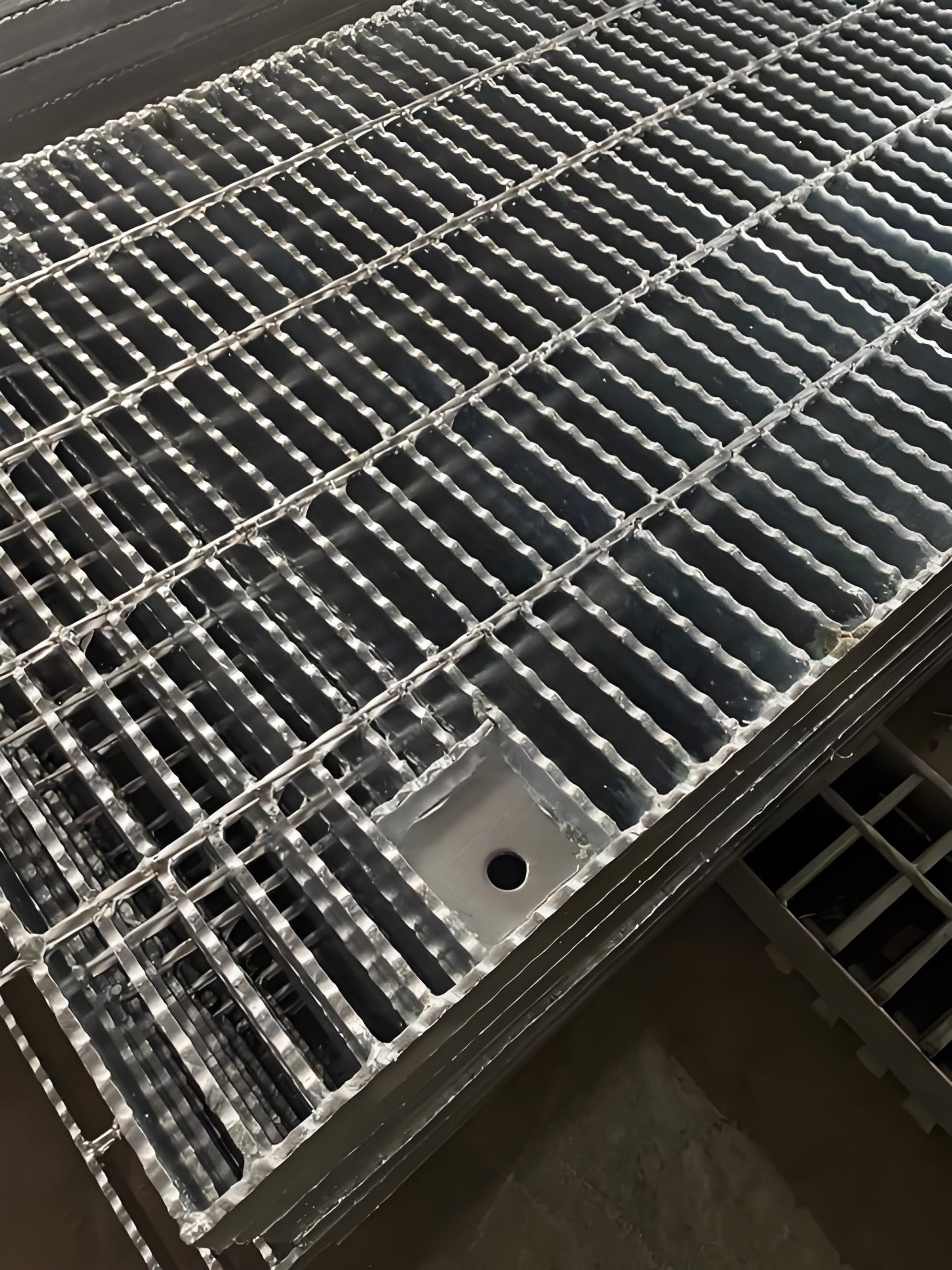
Serrated grating should be described as slip resistant rather than slip-proof. Its performance depends on the serration geometry, material finish, coating, wear, footwear, direction of travel, type and quantity of contamination, slope, temperature, housekeeping, and maintenance.
A deep accumulation of grease can fill the tooth pattern. Packed mud, sticky product residue, scale, ice, or fibrous waste can also cover the serrations and restrict drainage. In these conditions, the surface must be cleaned and the source of contamination controlled. Selecting serrated grating does not remove the need for drainage design, spill management, suitable footwear, lighting, guardrails, inspections, and safe operating procedures.
The most important benefit is improved underfoot engagement in environments that may become wet, oily, muddy, or exposed to weather. This makes serrated grating suitable for process plants, outdoor access routes, loading areas, marine facilities, wastewater plants, mining equipment, and other locations where smooth metal surfaces may become slippery.
The spaces between bearing bars and cross bars allow rainwater, wash water, and many process liquids to drain through the panel. This helps limit surface ponding and reduces the amount of liquid that must travel across the walkway before reaching a drain.
The structure below the grating must still be designed to collect or safely discharge the liquid. Open grating placed above electrical equipment, hot surfaces, occupied levels, sensitive machinery, or incompatible chemical systems may require drip pans, splash protection, curbs, or controlled drainage.
Open grating permits air movement through platforms and equipment decks. This can be useful around machinery, cooling systems, boilers, turbines, pumps, compressors, and processing equipment where a solid floor could restrict air circulation or trap heat.
Natural or artificial light can pass between floor levels. Better light transmission may improve visibility beneath platforms and reduce the shadowed areas commonly created by solid flooring. Lighting design still needs to account for structural members, equipment, piping, and the possibility of glare.
Bar grating concentrates material in parallel load-carrying members rather than using a continuous solid plate. A correctly selected panel can therefore support industrial pedestrian loads while remaining lighter than many solid floor systems. Lower panel weight can simplify lifting, installation, removal, and maintenance access.
Panels can be designed for removal above valves, pumps, cable routes, sumps, trenches, and maintenance areas. Removable construction provides access without cutting a permanent floor. Panels must be clearly marked, properly supported, and securely fastened when returned to service.
Grating can be cut and banded around columns, pipes, equipment bases, handrail posts, structural braces, and access hatches. Factory fabrication from approved drawings generally produces cleaner edges, better fit, more reliable banding, and improved coating coverage compared with uncontrolled site cutting.
Openings allow some dirt, snow, small particles, and loose debris to pass through the floor rather than remaining on the walking surface. The actual self-cleaning effect depends on the mesh size and the nature of the material. Sticky, fibrous, wet, or oversized debris may still collect between bars.
| Benefit | How It Is Achieved | Project Value |
|---|---|---|
| Improved traction | Serrated edges increase mechanical engagement with footwear | Useful in wet, oily, muddy, icy, or weather-exposed areas |
| Drainage | Open mesh allows liquid to pass through | Reduces ponding when drainage below is properly designed |
| Ventilation | Open area permits air circulation | Suitable around heat-producing and process equipment |
| Light transmission | Openings allow light between levels | Can improve visibility beneath elevated platforms |
| Lower installed weight | Material is concentrated in structural bearing bars | May reduce handling effort and supporting dead load |
| Maintenance access | Individual panels can be removable | Provides access to equipment, trenches, valves, and services |
| Layout flexibility | Panels can be cut, notched, banded, and marked | Adapts to complicated industrial floor arrangements |
The primary difference is the shape of the upper bearing bar edge. Plain grating has a smooth, flat edge, while serrated grating has repeated teeth or notches. This apparently simple difference affects traction, cleaning, fabrication cost, structural calculations, and the applications for which each surface is normally selected.
| Comparison Item | Serrated Grating | Plain Grating |
|---|---|---|
| Upper surface | Notched, toothed, or scalloped bearing bar edges | Flat bearing bar edges |
| Typical environment | Wet, oily, muddy, outdoor, marine, or weather-exposed areas | Dry indoor areas and general industrial flooring |
| Traction | Provides additional mechanical engagement | Relies more heavily on surface friction |
| Cleaning | May require more attention where sticky residue fills the serrations | Flat edges may be easier to wipe or wash in some processes |
| Fabrication cost | Usually higher because the bearing bars require an additional forming operation | Normally the more economical surface option |
| Load calculation | Must use data applicable to the serrated bearing bar profile | Uses load data for the full smooth bearing bar section |
| Footwear interaction | More aggressive contact profile | Smoother contact and sometimes more comfortable in clean areas |
| Common use | Stair treads, exterior walkways, ramps, process platforms, and wash-down areas | Indoor platforms, mezzanines, dry access areas, and general flooring |
Serrated grating is not automatically the best product for every location. Plain grating may be entirely suitable in a dry, clean, well-controlled indoor area. It can be less expensive, easier to clean in certain hygiene-sensitive processes, and more comfortable for continuous foot traffic.
Conversely, choosing plain grating solely to reduce purchase cost can be a poor decision where water, oil, condensation, weather, or process residue is expected. Surface selection should reflect the actual operating condition rather than the condition on the day the equipment is commissioned.
The serrations remove or displace material from the upper portion of the bearing bar. Depending on the profile and manufacturing method, this can reduce the effective section depth and section properties compared with a smooth bar of the same nominal dimensions.
For this reason, designers should not assume that plain and serrated panels with identical nominal bearing bar sizes have identical allowable loads. A manufacturer’s serrated load table, engineering calculation, or project-specific verification should be used. In some situations, a deeper or thicker serrated bearing bar may be required to provide performance comparable with a smaller smooth bar.
Welded grating is one of the most common constructions for carbon steel industrial flooring. Parallel bearing bars are joined to perpendicular cross bars by resistance welding under heat and pressure. The process creates repetitive, rigid connections and is efficient for standard mesh patterns and larger production quantities.
Welded serrated grating is widely used for industrial platforms, catwalks, maintenance floors, stair treads, drainage covers, conveyor access, and equipment walkways. It can be supplied as untreated carbon steel, shop painted steel, or hot-dip galvanized steel.
The main advantages of welded construction are broad availability, economical production, structural rigidity, and compatibility with common industrial bearing bar sizes. Stainless steel welded grating is also available, although material cost, welding procedures, cleaning, pickling, and passivation requirements may make it more expensive than carbon steel.
Press-locked or pressure-locked grating is produced by forcing cross bars into accurately prepared slots in the bearing bars. The bars are mechanically interlocked under pressure rather than joined by the conventional resistance-welding process used for standard welded grating.
This construction creates a regular, uniform appearance and can provide good dimensional consistency. It is frequently selected for architectural walkways, public areas, façade screens, sunshades, platforms, bridges, and industrial projects where appearance and alignment are important.
Press-locked serrated grating may be manufactured from carbon steel, stainless steel, or aluminum. The availability of specific serrated profiles, bar depths, mesh openings, and panel sizes depends on the manufacturer’s tooling and production system.
Swage-locked grating is commonly associated with aluminum. Cross bars are inserted through openings in the bearing bars and mechanically deformed or swaged so that they cannot rotate or move freely. Rectangular bearing bars, I-bars, and other shaped profiles may be used.
Aluminum swage-locked serrated grating offers low weight and natural corrosion resistance. It is used on offshore structures, water-treatment equipment, rooftop access systems, architectural walkways, transportation facilities, and equipment platforms where reducing dead load or handling weight is important.
Aluminum should not be selected only because it does not rust like carbon steel. Its strength, stiffness, wear behavior, compatibility with chemicals, galvanic interaction with other metals, fire exposure, and operating temperature must also be reviewed.
Riveted grating uses rivets to connect bearing bars with bent or reticulated connecting bars. It is a traditional grating construction that remains useful in selected heavy-duty, transportation, bridge, industrial, and vibration-related applications.
The connection pattern can provide a rigid walking surface and good distribution of repeated loads. However, riveted grating is less commonly stocked than standard welded grating, and its price, availability, panel dimensions, and serrated surface options should be confirmed early in the design process.
| Construction Type | Connection Method | Common Materials | Typical Selection Reason |
|---|---|---|---|
| Welded | Resistance-welded cross bars | Carbon steel and stainless steel | Economical industrial flooring and broad availability |
| Press-locked | Cross bars pressed into prepared bearing bar slots | Carbon steel, stainless steel, and aluminum | Uniform appearance, alignment, and architectural flexibility |
| Swage-locked | Cross bars mechanically locked by swaging | Primarily aluminum, with selected other materials | Low weight and a high strength-to-weight ratio |
| Riveted | Connecting bars attached with rivets | Steel and aluminum | Specialized heavy-duty, repeated-load, or vibration applications |
Carbon steel is normally the most economical material for serrated industrial grating. It offers good strength, wide availability, straightforward fabrication, and compatibility with welding, banding, notching, toe plates, stair nosings, and common fastening systems.
Untreated carbon steel is suitable only where corrosion is controlled or where a separate coating system will be applied. Mill scale and surface rust may be present, and exposed steel can deteriorate quickly in outdoor, humid, wash-down, chemical, or coastal environments.
A shop-applied primer provides temporary or limited protection rather than a universal long-term corrosion system. The coating specification should identify surface preparation, primer type, total coating system, dry-film thickness, application method, color, repair procedure, and environmental exposure.
Hot-dip galvanized serrated grating combines the structural economy of carbon steel with a zinc coating applied after fabrication. Galvanizing after cutting, welding, banding, and notching allows exposed surfaces and fabricated edges to receive coating during immersion.
Galvanized serrated grating is widely used for outdoor platforms, power stations, water-treatment plants, industrial walkways, cooling towers, mining facilities, conveyor access, loading areas, and general infrastructure.
The coating provides sacrificial protection to carbon steel, but galvanized grating is not immune to corrosion. Service life depends on coating thickness, atmospheric category, chemical exposure, moisture retention, abrasion, damaged areas, drainage, storage, and maintenance.
Strong acids, strong alkalis, continuous immersion, high chloride exposure, elevated temperatures, or severe abrasion may require a different material or a specially designed coating system. The compatibility of zinc with the actual process environment should be checked rather than assumed.
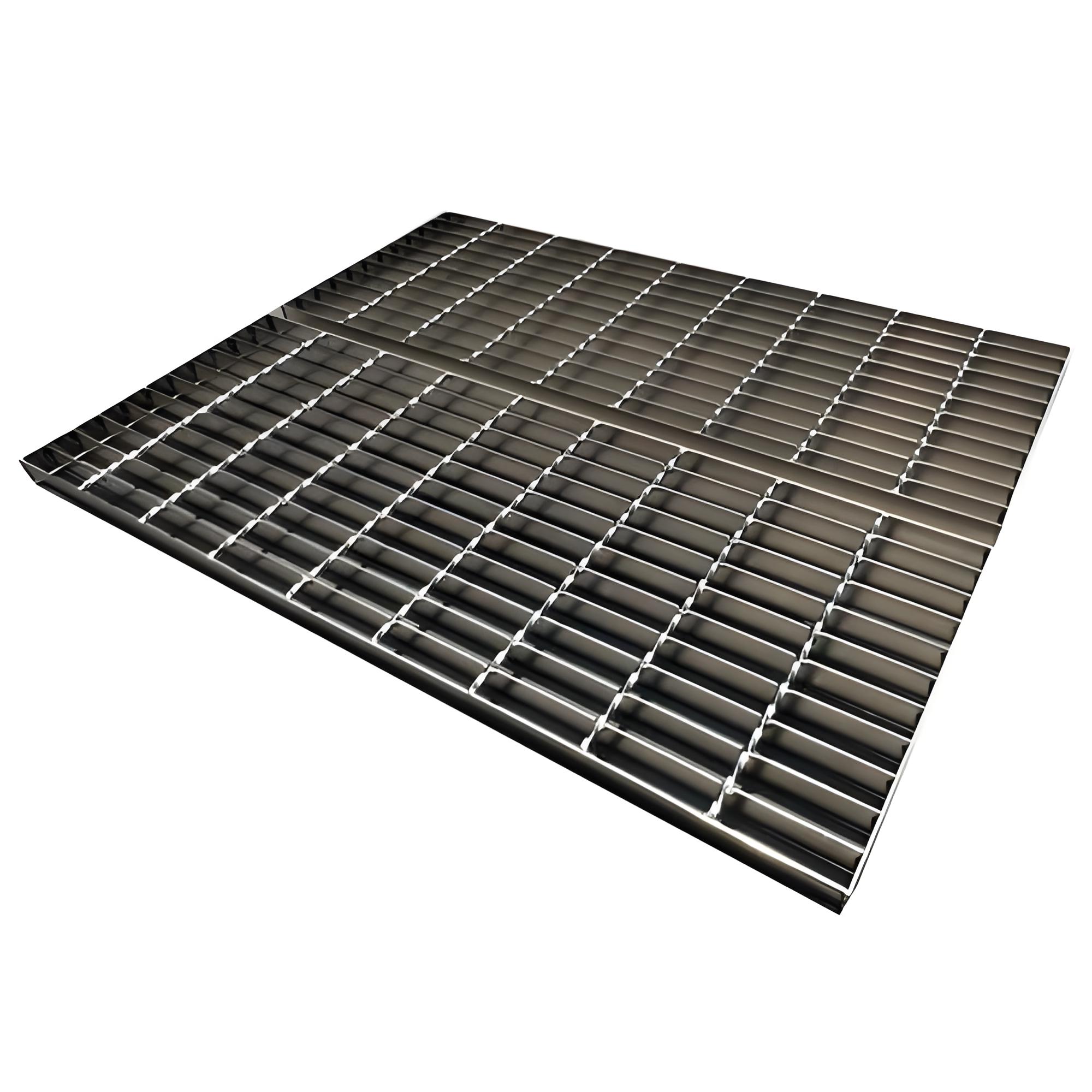
Stainless steel serrated grating is used where corrosion resistance, hygiene, temperature capability, or reduced coating maintenance justifies the higher initial cost. Common grades include 304, 304L, 316, and 316L, although other grades may be available for specialized conditions.
Grade 304 is commonly used in food-processing areas, indoor wash-down locations, architectural projects, and general industrial environments. Grade 316 or 316L is often considered where chlorides, salt water, coastal air, or more aggressive chemicals are present.
Stainless steel grade selection must be based on the actual chemical concentration, temperature, cleaning agent, exposure duration, deposit formation, crevices, weld condition, and possibility of galvanic contact. The word “stainless” does not mean that the material cannot pit, stain, crack, or corrode.
Fabricated stainless steel grating may require pickling, passivation, bead blasting, electropolishing, or another specified finish. Carbon steel contamination from shared tools, worktables, grinding dust, lifting equipment, or storage racks should be controlled where surface cleanliness is important.
Aluminum grating is substantially lighter than comparable steel grating and has natural resistance to atmospheric corrosion. It is commonly supplied in press-locked, swage-locked, or extruded forms and may use rectangular, I-shaped, or T-shaped bearing bars.
Typical applications include offshore access, rooftop walkways, water-treatment structures, marine equipment, architectural platforms, transportation facilities, and movable maintenance panels.
Aluminum has a lower elastic modulus than steel, so deflection may control the design even when material strength appears adequate. The manufacturer’s aluminum load table should be used rather than converting a steel specification directly.
Galvanic corrosion can occur when aluminum is connected to dissimilar metals in the presence of an electrolyte. Isolation materials, compatible fasteners, drainage, coating, and connection detailing may be required.
| Material | Relative Initial Cost | Main Advantages | Important Limitations |
|---|---|---|---|
| Untreated carbon steel | Lowest | Strong, economical, and easy to fabricate | Requires corrosion control in exposed environments |
| Hot-dip galvanized steel | Moderate | Good general outdoor protection and broad industrial use | Zinc may be unsuitable for some chemicals and severe abrasion |
| 304 stainless steel | High | Good general corrosion resistance and clean appearance | Can be vulnerable in aggressive chloride conditions |
| 316 or 316L stainless steel | Higher | Improved resistance in many chloride and process environments | Higher cost and not resistant to every chemical condition |
| Aluminum | Medium to high | Low weight and natural atmospheric corrosion resistance | Lower stiffness and possible galvanic corrosion concerns |
The serrated surface does not determine whether a panel can support the intended load. Structural performance primarily depends on the bearing bar depth, thickness, profile, spacing, material, supported span, connection system, and load condition.
Deeper bearing bars generally provide greater resistance to bending. Common metric depths include 20, 25, 30, 32, 35, 40, 45, 50, 60, and 65 mm. Common imperial depths range from approximately 3/4 inch to 2-1/2 inches for standard industrial grating, with heavier products available for specialized work.
Increasing depth can be more structurally efficient than increasing thickness, but the selected section must fit available clearances, support details, stair geometry, adjoining floors, and fabrication requirements.
Common metric thicknesses include 3, 4, 4.5, 5, 6, and 8 mm. A thicker bar adds material, improves local durability, and can support higher loads, but it also increases panel weight and cost.
Heavy pedestrian traffic, small hard wheels, concentrated equipment loads, impact, corrosion allowance, and repeated removal may justify a thicker bearing bar even where a thinner bar satisfies a basic uniform-load calculation.
Closer bearing bar spacing places more load-carrying bars within each unit of width. This normally increases panel weight and capacity while reducing the clear opening between bars.
Common arrangements include approximately 30 mm center-to-center spacing and imperial patterns such as 19-W-4, where the bearing bars are spaced at about 1-3/16 inches and the cross bars at about 4 inches. Close-mesh arrangements are available where small wheels, restricted openings, accessibility requirements, or dropped-object control must be considered.
Cross bars are commonly spaced at approximately 50 or 100 mm in metric products and 2 or 4 inches in many imperial systems. Closer cross-bar spacing can improve lateral restraint and reduce the size of the rectangular opening, but it does not replace the need to select adequate bearing bars.
The supported span is measured in the direction of the bearing bars between structural supports. Load capacity decreases as the clear span increases. Even a small change in support spacing can alter the required bearing bar depth or thickness.
The panel length is not always the same as the supported span. A grating panel may extend over several supports, include bearing overlap, or contain cutouts that interrupt bars. Drawings should clearly distinguish overall panel dimensions from structural span.
Pedestrian occupancy is often represented by a uniform load together with a concentrated load requirement. Industrial applications may also include maintenance carts, pallet trucks, mobile equipment, pipe loads, storage loads, wheel loads, or impact.
A narrow wheel can load only one or two bearing bars and may govern the design even when the total equipment weight appears moderate. Wheel width, contact area, spacing, direction of travel, impact, braking, and repeated fatigue cycles should be considered.
| Design Parameter | Effect of Increasing the Parameter | Engineering Check Required |
|---|---|---|
| Bearing bar depth | Usually increases bending resistance | Load table, span, clearance, and deflection |
| Bearing bar thickness | Increases weight, local strength, and cost | Concentrated load, durability, and fabrication |
| Number of bearing bars | Increases as spacing becomes closer | Opening restriction, wheel support, and panel weight |
| Cross bar frequency | Improves lateral restraint and reduces opening length | Construction type and project opening limits |
| Supported span | Longer span reduces allowable load and increases deflection | Actual support-to-support dimension |
| Serration depth | May reduce the effective structural section | Product-specific serrated load data |
The open area of serrated grating provides several secondary performance benefits, but mesh size should be selected carefully. A very open panel drains quickly and allows substantial air and light movement, while a close-mesh panel provides smaller openings for wheels, footwear, and dropped-object control.
Water can pass directly through open grating, reducing the distance it travels across the walking surface. For effective drainage, the supporting structure and area below the grating should not create dams, blocked outlets, inaccessible sediment traps, or uncontrolled discharge.
Where hazardous chemicals are involved, unrestricted drainage may be undesirable. The project may require curbs, collection trays, sumps, segregated drains, neutralization systems, or containment beneath the walkway.
Open grating is useful where air must circulate around machinery or between floor levels. However, designers should consider whether the openings could spread smoke, flame, hot gases, dust, odors, or hazardous vapors. Fire and process-safety requirements may call for solid sections, fire-rated barriers, or controlled ventilation zones.
Light passing through an elevated platform can improve the working environment below it. The actual benefit depends on the percentage of open area, bar depth, support framing, equipment density, and location of light fixtures.
Wide openings allow more dirt and loose material to pass through, but they also allow tools, fasteners, product, and personal items to fall to lower levels. Close mesh reduces the clear opening, but it may retain more mud, leaves, scale, or fibrous waste.
Where people work below an elevated platform, toe plates, debris screens, secondary mesh, solid protection, exclusion zones, or tool-control procedures may be required. Standard serrated grating alone should not be treated as dropped-object protection.
Industrial platforms provide access to equipment, valves, instruments, tanks, conveyors, filters, cooling systems, piping, and maintenance points. Serrated grating is useful where these platforms are outdoors, regularly washed, affected by condensation, or exposed to process contamination.
A complete platform system includes more than floor panels. The design must account for structural supports, bearing direction, panel joints, fastening clips, guardrails, toe plates, access gates, openings, removable sections, clearances, and safe movement around equipment.
Panels should be arranged so that bearing bars span across the shortest practical support distance. Cutouts around pipes and columns should be factory banded where possible. Unsupported bearing bar ends and large openings may require load-carrying banding or additional structural framing.
Walkway width should reflect the expected number of users, tools carried, emergency access, equipment maintenance, and local regulatory requirements. Narrow access routes may become difficult to use when workers wear protective clothing or carry components.
Serrated grating is frequently used beside conveyors, crushers, screens, packaging lines, and material-handling systems. The open construction allows spilled particles to fall away from the immediate walking surface, while serrations help maintain footing where dust or moisture is present.
The material falling through the grating must still be managed. Workers, motors, belts, electrical systems, or occupied areas below may require guarding, catch trays, secondary flooring, or exclusion zones.
Pumps, compressors, heat exchangers, filters, and process vessels often require removable floor sections. Panel marks and layout drawings help maintenance personnel return each panel to its correct position. Fasteners should be selected so that repeated removal does not damage the grating or supporting steel.
Stair treads are among the most common serrated grating applications because users place substantial force near the leading edge while ascending or descending. A complete tread normally includes a grating section, front nosing, end plates or carrier plates, and bolted or welded connections to the stair stringers.
The nosing helps define the leading edge and may be supplied as checkered plate, abrasive material, grooved aluminum, or another specified profile. Visibility, contrast, corrosion resistance, tread depth, riser consistency, and attachment details are all important.
A serrated tread surface does not correct poor stair geometry. Unequal risers, inadequate tread depth, loose connections, excessive deflection, blocked access, insufficient handrails, or poor lighting can remain serious hazards.
Inclined surfaces place greater demand on available traction because part of the user’s weight acts parallel to the slope. Serrated grating can improve footing, but ramp slope, landing arrangement, drainage, handrails, wheelchair or trolley use, wheel size, and local accessibility requirements must also be reviewed.
Standard industrial bar grating is not automatically suitable for every accessible route. Opening dimensions, orientation, surface level changes, wheel passage, and heel entrapment requirements vary by jurisdiction and project type.
Workers stepping from a ladder onto a platform need a stable, unobstructed landing with correctly positioned guardrails and gates. Serrated grating may improve footing at the transition, but the landing must also be adequately sized, supported, fastened, and kept free from hoses, cables, tools, and process residue.
Oil, gas, refining, and petrochemical facilities contain many areas where hydrocarbons, lubricants, cooling water, rain, condensation, and chemical residue can affect walking surfaces. Serrated grating is commonly used around process units, pipe racks, pumps, compressors, vessels, loading areas, tank farms, flare systems, and maintenance platforms.
Hot-dip galvanized carbon steel is widely used for general atmospheric exposure, while stainless steel or specialized materials may be required where chemicals attack zinc or carbon steel. Material selection should consider both normal operation and credible leaks, cleaning chemicals, emergency releases, temperature, and fire exposure.
Open grating can reduce liquid accumulation, but it may also allow a spill to reach equipment or lower levels. Drainage and containment should therefore be coordinated with process-safety requirements. In some locations, solid plate, curbing, drip trays, or sealed collection systems may be more appropriate.
Serrations can improve walking-surface traction, but a heavy oil film can still cover the teeth. Leak prevention, prompt cleanup, inspection, suitable footwear, and controlled access remain necessary.
Power-generation facilities use serrated grating around boilers, turbines, cooling systems, scrubbers, coal-handling equipment, transformers, cable routes, pumps, and maintenance platforms.
Outdoor and wash-down locations commonly use galvanized steel. Stainless steel may be selected in flue-gas treatment, chemical dosing, demineralization, coastal cooling-water, or other corrosive sections. Aluminum may be considered where low panel weight is important and the temperature and chemical environment are suitable.
Open flooring assists ventilation and provides access to equipment beneath the platform. It can also allow hot particles, liquids, tools, or maintenance debris to fall. Floor layout must therefore be coordinated with equipment protection and worker occupancy below.
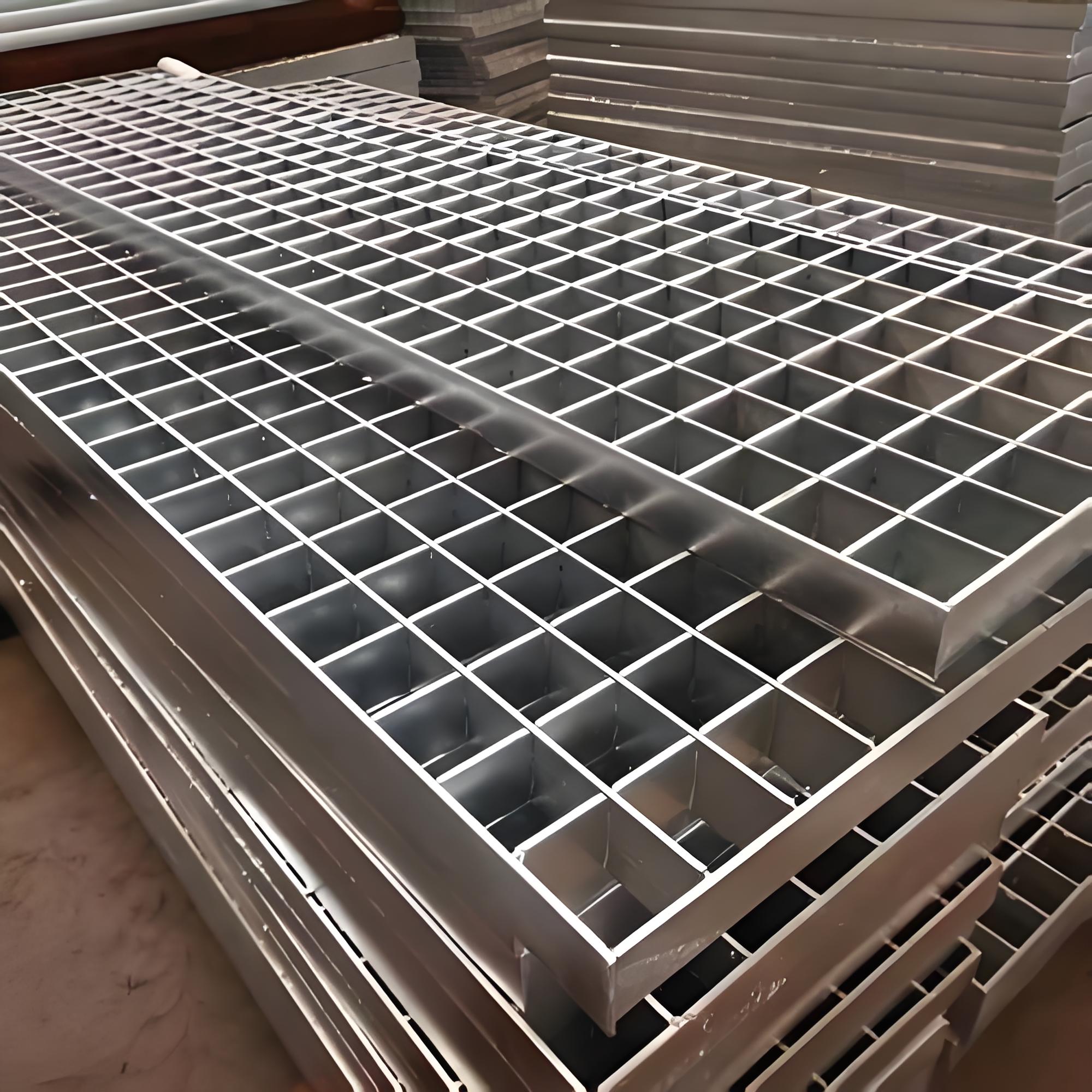
Manufacturing plants use serrated grating for machinery platforms, production-line access, robotic cells, painting systems, presses, heat-treatment equipment, material-handling systems, loading areas, and maintenance mezzanines.
The source of contamination varies widely. Metalworking operations may produce coolant and chips; food plants may produce water, grease, and organic residue; paper mills may produce pulp and moisture; chemical plants may create corrosive deposits; and automotive plants may expose flooring to oils and process fluids.
The mesh should be selected so that waste can be managed without creating hazards below. Fine metal chips can lodge between serrations, while long turnings may wrap around bars. Sticky food residue may require a stainless steel surface and a cleaning procedure that reaches both the teeth and bar intersections.
Mining facilities expose walkways to mud, water, abrasive dust, ore particles, vibration, impact, and heavy maintenance activity. Serrated grating is used around crushers, screens, conveyors, transfer towers, thickeners, flotation equipment, mills, and loading systems.
Aggressive serration can help in wet or muddy conditions, but abrasion may gradually round the tooth edges. Panels should be inspected for wear, corrosion, loose fasteners, cracked connections, bent bearing bars, and loss of support.
Heavy-duty bearing bars may be required where equipment components, hoses, tools, or wheeled maintenance loads are moved across the floor. A pedestrian grating specification should not be extended to vehicle or equipment loading without verification.
Marine terminals, ships, offshore platforms, coastal plants, and port infrastructure frequently experience salt spray, standing water, wind-driven rain, and continuous wetting and drying. Serrated surfaces are valuable for exposed walkways, stairs, gangways, equipment decks, and maintenance platforms.
Material selection is particularly important. Galvanized steel may provide suitable service in many atmospheric conditions, while stainless steel, aluminum, coated steel, or nonmetallic alternatives may be required in more severe zones.
Stainless steel is not automatically immune to seawater corrosion, and aluminum connections must be designed to limit galvanic attack. Fasteners, clips, support steel, isolation pads, welds, crevices, and drainage details should be treated as part of the material system.
Wastewater plants contain continuously damp areas, wash-down water, treatment chemicals, biological residue, hydrogen sulfide exposure, and outdoor weather. Serrated grating is commonly used around clarifiers, screens, aeration tanks, pumps, channels, filters, digesters, and chemical-dosing systems.
Hot-dip galvanized steel is economical for many general areas, but severe hydrogen sulfide, chloride, or chemical exposure may require stainless steel, aluminum, coated systems, or fiber-reinforced plastic. The selection should be based on the exact process zone rather than one material for the entire plant.
Close-mesh grating may be useful around smaller wheels or public access, while wider mesh may be easier to clean where fibrous material is present. The plant’s cleaning method, pressure-washing practice, chemical use, and access for removing trapped material should be considered.
| Industrial Sector | Typical Hazard | Common Serrated Grating Application | Important Selection Issue |
|---|---|---|---|
| Oil and gas | Hydrocarbons, rain, and chemical leaks | Process platforms and pipe-rack access | Spill containment and material compatibility |
| Power generation | Water, heat, dust, and maintenance loads | Boiler, turbine, and cooling-system platforms | Temperature, dropped objects, and equipment protection |
| Manufacturing | Oil, coolant, chips, and wash water | Production and machine-access platforms | Debris size, cleaning, and wheel loads |
| Mining | Mud, abrasive particles, impact, and vibration | Crusher, screen, and conveyor walkways | Abrasion, heavy loads, and wear inspection |
| Marine and offshore | Salt spray, rain, and continuous moisture | Decks, stairs, gangways, and access routes | Corrosion system and galvanic compatibility |
| Wastewater | Moisture, chemicals, biological residue, and gases | Tank, channel, pump, and clarifier access | Localized corrosion conditions and cleanability |
| Food processing | Water, fats, cleaning chemicals, and organic residue | Wash-down platforms and processing access | Hygiene, stainless grade, and cleaning access |
The service life of serrated grating depends on the complete exposure system. Material grade and coating are important, but drainage, crevices, deposits, damaged areas, chemical concentration, temperature, abrasion, and maintenance can have equal influence.
Bare carbon steel is generally reserved for dry indoor service, temporary work, or applications where the purchaser will apply a separate coating system. Surface rust can develop during transport or storage, especially when panels are wet or bundled without ventilation.
A basic shop primer may provide temporary protection during transport and construction. A long-term industrial paint system requires defined surface preparation, compatible primer and topcoats, specified thickness, stripe coating around edges and welds where necessary, and a repair procedure.
Hot-dip galvanizing is normally performed after fabrication so that welded joints, banding, and cut edges are coated. ASTM A123/A123M or another applicable regional standard may be specified for fabricated iron and steel products.
Drainage and venting must be considered during fabrication. Large panels may distort during galvanizing if their geometry, residual stress, welding sequence, and handling are not properly controlled. Finished panels should be inspected for coating coverage, excess zinc that interferes with fit, distortion, sharp projections, and damaged areas.
A duplex system combines galvanizing with paint or powder coating. It may be selected for longer corrosion protection, color identification, architectural appearance, or particularly demanding atmospheric exposure.
Surface preparation between the zinc coating and the organic coating is critical. Applying paint or powder directly to an improperly prepared galvanized surface can lead to poor adhesion and early peeling.
Stainless grating may be supplied in an as-fabricated condition or treated by pickling and passivation. Pickling removes heat tint and surface scale, while passivation supports the formation of a clean protective oxide surface. Electropolishing may be specified where a smoother, cleaner, or more corrosion-resistant finish is required.
Aluminum may be supplied in a mill finish, anodized condition, or coated system. The selected finish should be compatible with the operating environment, desired appearance, wear level, and connections to other metals.
| Material or Finish | Suitable General Environment | Maintenance Consideration |
|---|---|---|
| Bare carbon steel | Controlled dry indoor service | Inspect frequently for rust and apply protection where required |
| Painted carbon steel | Moderate industrial exposure with a defined coating system | Repair scratches, worn edges, and damaged weld areas |
| Hot-dip galvanized steel | General outdoor and humid industrial service | Inspect cut edges, damaged zinc, deposits, and wet storage staining |
| Duplex-coated galvanized steel | Severe atmospheric exposure or color-sensitive projects | Maintain both the organic coating and underlying zinc system |
| 304 stainless steel | General processing and many wash-down environments | Remove deposits and avoid carbon steel contamination |
| 316 or 316L stainless steel | Many coastal, chloride, and chemical environments | Inspect crevices and deposits; verify chemical compatibility |
| Aluminum | Atmospheric and lightweight applications | Control galvanic contact, wear, and aggressive chemical exposure |
Bearing bars must run from support to support. Panel marks, shop drawings, and installation plans should make the bearing direction unmistakable.
Each panel requires sufficient support at its ends. The required bearing length depends on the material, bar depth, load, support type, project standard, and manufacturer’s recommendation.
Clips, bolts, welded lugs, countersunk fasteners, or other anchoring systems prevent movement and uplift. Fasteners should be accessible for inspection and compatible with the grating and support materials.
Loose panels can rock, rattle, shift, or lift under traffic and vibration. Serrations cannot compensate for an unstable or poorly anchored panel.
Appropriate clearance is needed between adjacent panels and around fixed structures to allow fabrication tolerance, coating thickness, thermal movement, installation, and removal. Excessive gaps can create trip, heel, wheel, or dropped-object hazards.
Cut bearing bars around pipes, columns, and equipment openings may require banding. Where multiple bearing bars are interrupted or an edge is not supported, load-carrying banding or additional structural steel may be required.
Site cutting should be minimized. Cutting galvanized panels exposes bare steel and requires an approved repair method. Cutting structural bars without reviewing the load path can also reduce capacity or create unsupported edges.
Regular inspection is necessary because grating is frequently installed in areas exposed to corrosion, vibration, impact, contamination, and repeated maintenance activity.
Inspect the serrations for oil, mud, ice, scale, product residue, paint buildup, or wear. Cleaning methods should remove contamination without creating a new hazard or damaging the protective finish.
Pay particular attention to bearing at supports, cut edges, welds, banding, crevices, areas beneath deposits, and locations exposed to leaking chemicals. Rust staining alone does not quantify structural loss, but significant thinning requires engineering review and panel replacement.
Check for loose or missing clips, rocking panels, enlarged fastener holes, damaged supports, excessive clearances, and displaced removable sections.
Bent bearing bars, broken cross bars, cracked welds, damaged rivets, or permanent deflection can indicate overload, impact, fatigue, corrosion, or improper support. The affected area should be controlled until it is evaluated.
A platform originally designed for pedestrian access may later be used for storage, mobile equipment, piping, or maintenance carts. The existing grating should be rechecked whenever the maximum intended load, support arrangement, chemical environment, or traffic pattern changes.
| Inspection Item | Possible Problem | Required Response |
|---|---|---|
| Blocked serrations | Reduced traction | Clean the surface and control the contamination source |
| Missing clips | Panel movement or uplift | Replace with compatible fasteners |
| Corroded bearing bars | Reduced effective section | Measure, assess, and replace where required |
| Bent panel | Impact or overload | Restrict access and obtain structural evaluation |
| Damaged galvanizing | Localized carbon steel exposure | Prepare and repair according to the specified procedure |
| Excessive gap | Trip, wheel, heel, or dropped-object hazard | Correct panel dimensions, support, or edge detailing |
| Worn serrations | Reduced mechanical engagement | Review traffic, abrasion, and replacement needs |
Identify whether the area is dry, wet, oily, muddy, icy, dusty, corrosive, abrasive, hygienic, outdoor, marine, or exposed to chemicals. Record both routine conditions and foreseeable leaks, cleaning cycles, shutdown work, and weather events.
Include personnel, tools, stored materials, removable equipment, maintenance carts, wheels, piping, impact, and any temporary construction loads. Do not size the panel from a generic pedestrian load when equipment may cross it.
Measure the clear distance in the bearing bar direction. Check whether cutouts, removable sections, support interruptions, or unusual framing change the effective span.
Choose depth, thickness, material, and profile from an applicable serrated load table. Check both strength and deflection. Excessive deflection can make a structurally adequate floor uncomfortable or unstable underfoot.
Consider pedestrian use, wheel dimensions, drainage, ventilation, debris passage, dropped objects, accessibility, footwear, and opening restrictions. Close mesh is not automatically better; it changes weight, cost, drainage, and cleaning behavior.
Welded grating is generally economical for carbon steel industrial flooring. Press-locked grating offers a regular appearance and broad design flexibility. Swage-locked construction is common for lightweight aluminum systems, while riveted grating serves selected specialized applications.
Compare untreated steel, painted steel, hot-dip galvanized steel, stainless steel, aluminum, and alternative materials against the actual exposure. Consider both purchase cost and the cost of inspection, coating repair, shutdown, removal, and replacement.
Use repeated panel sizes where practical, minimize unsupported cutouts, place joints over supports, show bearing direction, identify removable panels, and coordinate openings with equipment and structural steel.
Define trim banding, load-carrying banding, toe plates, stair nosings, fixing clips, bolts, welded lugs, hinges, handles, and lifting points. Leaving these items undefined can produce quotations that appear comparable but cover different scopes.
Depending on the project, documentation may include material certificates, dimensional inspection, welding procedures, load data, coating reports, galvanizing inspection, stainless steel treatment records, panel drawings, packing lists, and installation instructions.
| Information for Selection or Quotation | Example |
|---|---|
| Application | Outdoor petrochemical maintenance walkway |
| Material | Carbon steel with hot-dip galvanizing after fabrication |
| Construction | Welded serrated grating |
| Bearing bar size | 40 × 5 mm |
| Bearing bar spacing | 30 mm center to center |
| Cross bar spacing | 100 mm center to center |
| Supported span | 1,200 mm |
| Loads | Uniform pedestrian load plus specified concentrated maintenance load |
| Panel dimensions | According to the approved layout drawing |
| Fabrication | Banding, pipe cutouts, toe plates, and panel marks |
| Fasteners | Galvanized saddle clips and bolts |
| Inspection | Material certificate, dimensional report, and coating inspection |
The tooth pattern improves surface engagement but does not establish structural capacity. Load tables, supported span, deflection, bearing bar direction, and concentrated loads must still be checked.
Tooth depth, shape, pitch, orientation, and manufacturing method vary. Where slip-resistance performance is critical, the project specification should define the required surface and any test method rather than using the word “serrated” alone.
Narrow wheels can drop between bars, overload individual bearing bars, or become difficult to move. Wheel width, diameter, contact patch, direction, and load should be compared with the actual opening.
Low-cost untreated carbon steel can become expensive when coating, maintenance, shutdown, and replacement are included. At the same time, specifying stainless steel in every location can add unnecessary cost where galvanized steel would provide adequate service.
Open floors permit liquids, dirt, tools, sparks, and process material to fall through. Personnel and equipment below may require protection even when the walking surface itself is correctly selected.
No tooth profile remains effective when it is buried under grease, mud, ice, or hardened process residue. Inspection, cleaning, drainage, and leak control remain part of the safety system.
Is serrated grating better than plain grating?
Serrated grating is generally the better option where a walkway may be exposed to water, oil, mud, snow, condensation, or other materials that reduce traction. Its toothed bearing bar edges create additional mechanical engagement with footwear. Plain grating can still be more suitable in dry indoor areas where contamination is controlled, cleaning is important, and the extra serrated surface is unnecessary. The correct choice depends on the operating environment rather than one surface being universally better.
What is serrated grating used for?
Serrated grating is used for industrial platforms, catwalks, stair treads, ramps, equipment-access floors, drainage covers, conveyor walkways, marine decks, mining facilities, wastewater plants, power stations, manufacturing lines, and oil and gas installations. It is most valuable in locations where moisture, oil, weather, mud, or process residue may make a smooth metal surface difficult to walk on.
Does serrated grating have less load capacity than plain grating?
Serrations can reduce the effective section of a bearing bar because material is removed or displaced near its upper edge. A serrated panel may therefore have different allowable loads and deflection values from a plain panel with the same nominal bearing bar dimensions. Designers should use the manufacturer’s serrated grating load table or a project-specific calculation instead of assuming that plain and serrated products have identical structural capacity.