

Steel grating is widely used for industrial floors, walkways, platforms, stair treads, trench covers, drainage channels, bridges, equipment access areas, loading zones, and maintenance structures. Its price, size, and load capacity are closely connected. A light grating panel may be economical for a short-span pedestrian walkway, while a heavy-duty panel with deeper bearing bars, closer spacing, banded edges, and galvanizing may be required for forklifts, vehicle traffic, or long industrial spans. The best steel grating selection is based on the full specification: material, bearing bar size, mesh pattern, panel dimensions, clear span, design load, deflection limit, surface treatment, fabrication, quantity, and delivery terms.
Steel grating factory price is normally calculated from the finished product weight, steel material cost, manufacturing method, fabrication time, surface treatment, packaging, and commercial terms. A price per square meter is useful for early budgeting, but it is only meaningful when it is linked to a defined bearing bar size, thickness, spacing, cross-bar pattern, and finish.
Two grating panels can have the same outside dimensions but very different prices. A panel made from 25 mm × 3 mm bearing bars at wider spacing contains much less steel than one made from 40 mm × 5 mm bars at close spacing. The heavier panel may cost more, but it may also be necessary to meet a longer span, lower deflection limit, or higher concentrated load.
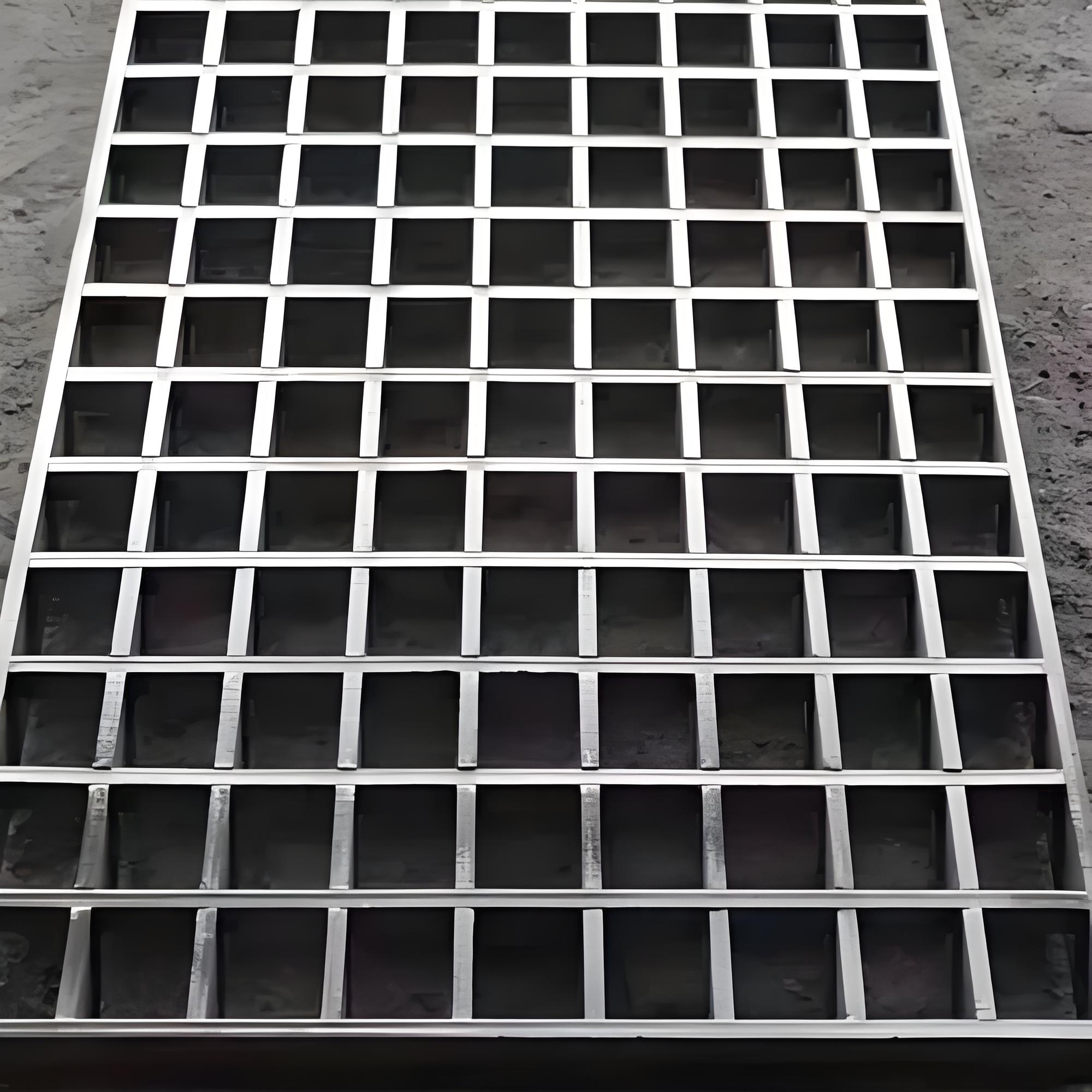
For general price background and a comparison of material, weight, fabrication, and delivery factors, see our steel grating prices and manufacturers guide.
Steel grating can be quoted in several ways. Each pricing method is useful for a different stage of purchasing and project planning.
Price per square meter is the most common method for comparing standard grating panels. It is useful for large platform layouts, walkways, floor grating, and repeated panel sizes. However, a square-meter price should always identify the exact bearing bar size, spacing, cross-bar spacing, surface type, and coating.
For broad factory budgeting, basic untreated carbon steel grating may be approximately US$15 to US$45 per m². Standard hot-dip galvanized steel grating may be approximately US$25 to US$80 per m². Fabricated galvanized panels, close-mesh panels, serrated panels, and heavy-duty grating normally cost more because of additional material weight, processing, and fabrication.
| Steel Grating Type | Broad Factory Budget Range | Typical Description |
|---|---|---|
| Basic Untreated Carbon Steel Grating | US$15–45 per m² | Standard mesh, plain surface, limited fabrication, no permanent corrosion protection |
| Painted Carbon Steel Grating | US$20–65 per m² | Primer or industrial paint system for controlled environments |
| Standard Hot-Dip Galvanized Steel Grating | US$25–80 per m² | Outdoor walkways, platforms, stair treads, and drainage covers |
| Fabricated Galvanized Steel Grating | US$40–140 per m² | Cut-to-size panels with banding, notches, holes, or identification marks |
| Close-Mesh Galvanized Grating | US$50–170 per m² | Closer bearing bar spacing, reduced openings, and higher steel weight |
| Heavy-Duty Galvanized Steel Grating | US$90–300 per m² | Deep and thick bars for heavy industrial or concentrated loads |
| 304 Stainless Steel Grating | US$55–150 per m² | General wet, food-processing, architectural, and industrial environments |
| 316 or 316L Stainless Steel Grating | US$70–220 per m² | Marine, coastal, chemical, wastewater, and chloride-exposed areas |
These figures are planning references only. Steel, zinc, stainless steel, labor, energy, freight, exchange rates, order quantity, and project requirements can all change the final quotation.
Price per panel is useful when the project includes defined panel dimensions. The panel price includes the grating area plus the added cost of cutting, banding, holes, notches, frames, clips, coating, and packing.
Panel Price = Panel Area × Base Grating Price + Fabrication + Surface Treatment + Accessories + Packing + Freight
For example, a 1000 mm × 6000 mm grating panel has an area of 6 m². If standard galvanized grating is budgeted at US$50 per m², the basic grating value is US$300 before adding cutouts, banding, clips, special coating, packaging, and delivery.
Factories often calculate steel grating prices from theoretical or actual finished weight. Price per ton can be useful for comparing large orders with similar material, mesh pattern, and fabrication requirements.
However, price per ton should not be the only comparison method. Two panels with the same weight can have very different fabrication costs. A simple rectangular panel may require only basic cutting, while a lighter irregular panel with multiple cutouts, reinforced edges, and custom frames may cost more per kilogram because of the extra labor.
Material selection is one of the largest price factors for steel grating. It affects initial cost, corrosion resistance, maintenance requirements, surface appearance, fabrication process, and expected service life.
Carbon steel is generally the most economical grating material. It is strong, easy to weld, and suitable for dry indoor industrial areas, temporary structures, controlled factory environments, or projects with a separate paint system.
Untreated carbon steel has the lowest initial cost, but it will rust when exposed to water, humidity, outdoor weather, or corrosive chemicals. It should not be used as a long-term corrosion-resistant solution in wet or outdoor environments without a suitable coating.
Hot-dip galvanized steel grating is made from carbon steel and coated with zinc after fabrication. The grating is cleaned, fluxed, immersed in molten zinc, cooled, and inspected. This process protects the bearing bars, cross bars, welds, cut edges, banding bars, and many fabricated details.
Galvanized steel is often the best balance of strength, price, and corrosion resistance for outdoor platforms, industrial walkways, stair treads, trench covers, utility structures, power plants, water-treatment facilities, and general factory access systems.
For a detailed explanation of zinc coating, fabrication sequence, and price factors, see our hot-dip galvanized steel grating guide.
304 stainless steel grating has a higher initial cost than galvanized carbon steel, but it offers good corrosion resistance without relying on a zinc coating or paint system. It is commonly used in food processing, commercial kitchens, wet industrial areas, clean production facilities, and architectural applications.
316 and 316L stainless steel contain molybdenum, which improves resistance to chloride exposure compared with 304 stainless steel. They are often selected for marine facilities, coastal projects, chemical plants, wastewater systems, salt-containing production areas, and aggressive washdown environments.
| Material | Relative Initial Price | Corrosion Protection | Typical Use |
|---|---|---|---|
| Bare Carbon Steel | Lowest | No permanent protection | Dry indoor, temporary, or site-coated applications |
| Painted Carbon Steel | Low | Paint or primer system | Factories, warehouses, and controlled industrial areas |
| Hot-Dip Galvanized Steel | Low to moderate | Zinc coating | Outdoor walkways, platforms, stairs, drainage covers |
| 304 Stainless Steel | Moderate to high | Passive stainless steel surface | Food, wet areas, hygienic facilities, general corrosion resistance |
| 316 or 316L Stainless Steel | High | Improved chloride resistance | Marine, coastal, chemical, wastewater, and aggressive washdown areas |
Steel grating is produced in standard panel widths and lengths, then cut and fabricated according to project drawings. Standard panel dimensions depend on the factory’s production equipment, bearing bar direction, transport limits, and grating type.
Common industrial panel widths often include 1000 mm, 1200 mm, and other modular dimensions. Common lengths may range from 1000 mm to 6000 mm or more, depending on material thickness, bar size, handling limitations, and shipping requirements. Large panels can reduce joints and installation time, but smaller panels may be easier to lift, remove, and replace.
| Panel Type | Price Level | Reason |
|---|---|---|
| Standard Rectangular Panel | Lower | Efficient production, limited cutting, easier packing |
| Cut-to-Size Panel | Medium | Additional cutting, edge finishing, and inspection |
| Irregular Custom Panel | Higher | Drawing review, complex cutting, banding, and increased labor |
| Panel with Multiple Cutouts | Higher | Additional cutting, reinforcement, fitting, and inspection work |
| Removable Access Panel | Medium to high | May require special banding, lift handles, clips, frames, or locks |
For platforms and walkways, panel layout should be planned early. A good layout can reduce waste, simplify support locations, improve maintenance access, and lower fabrication cost. The drawing should show support beams, panel joints, columns, pipes, handrails, equipment legs, trench openings, and bearing bar direction.
Bearing bars are the main load-carrying members of steel grating. They run in the span direction between supports. The bearing bar depth, thickness, and spacing are the most important factors affecting load capacity, deflection, panel weight, and price.
Bearing bar depth is measured vertically. Increasing the bar height generally provides a strong increase in bending stiffness, allowing a longer span or higher load. Common bearing bar depths include 20 mm, 25 mm, 30 mm, 32 mm, 35 mm, 40 mm, 45 mm, 50 mm, 60 mm, and deeper sizes for heavy-duty applications.
Common bearing bar thicknesses include 3 mm, 4 mm, 5 mm, and heavier sizes for special applications. A thicker bar increases steel weight, local strength, impact resistance, and resistance to bending. It also increases raw material cost, galvanizing cost, and freight weight.
Bearing bar spacing is measured from the center of one bearing bar to the center of the next. Common spacings include approximately 20 mm, 25 mm, 30 mm, 30.2 mm, 32 mm, 34 mm, 35 mm, and 40 mm. Closer spacing uses more bearing bars per meter of panel width and normally increases both weight and price.
| Bearing Bar Size | Approximate Grating Body Weight | Typical Use |
|---|---|---|
| 20 mm × 3 mm | Approximately 19–23 kg/m² | Light covers and pedestrian access |
| 25 mm × 3 mm | Approximately 23–28 kg/m² | Light platforms, walkways, and shorter spans |
| 30 mm × 3 mm | Approximately 28–34 kg/m² | Common industrial platform and walkway grating |
| 30 mm × 5 mm | Approximately 42–48 kg/m² | Industrial platforms and stronger trench covers |
| 40 mm × 5 mm | Approximately 55–65 kg/m² | Heavy platforms and longer spans |
| 50 mm × 5 mm | Approximately 68–80 kg/m² | Heavy-duty trench covers and vehicle access areas |
These weight values are useful for preliminary comparisons. Actual finished weight can change with cross-bar type, cross-bar spacing, welding pattern, serration, banding, cutouts, galvanizing thickness, and fabrication details.
For more detailed reference values, see our galvanized steel grating weight chart.
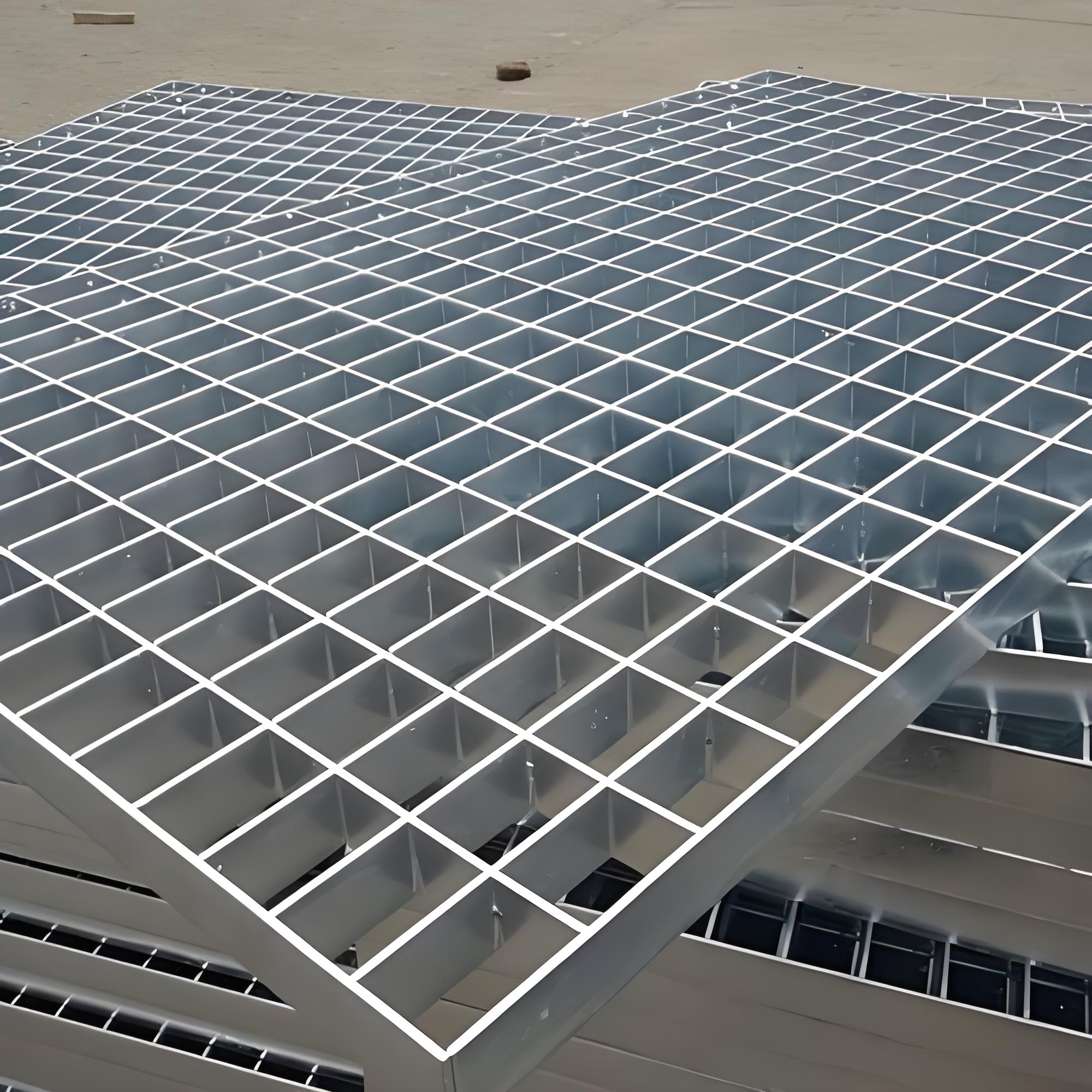
Cross bars connect the bearing bars and create the mesh pattern. They may be twisted square bars, round bars, flat bars, pressed bars, or other profiles. In welded steel grating, twisted square cross bars are common because they provide a rigid connection and a practical walking surface.
Common cross-bar spacing is approximately 100 mm on center. Closer spacing, such as 50 mm or 75 mm, may be used where additional lateral stability, smaller openings, or a particular visual pattern is required.
| Bearing Bar Spacing | Cross Bar Spacing | Typical Application |
|---|---|---|
| 30 mm | 100 mm | Standard industrial walkways, platforms, stair treads |
| 30 mm | 50 mm | Closer cross-bar pattern and improved lateral stability |
| 25 mm | 100 mm | Smaller openings and increased bearing-bar density |
| 20 mm | 100 mm | Close mesh for smaller openings and selected pedestrian areas |
| 40 mm | 100 mm | More open grating for controlled industrial access and drainage |
Mesh selection should balance drainage, open area, small-object retention, foot comfort, load distribution, and cost. Wider spacing reduces steel weight and may reduce price, but it may not satisfy required load, opening, or safety criteria.
Steel grating designations vary between manufacturers, countries, and project specifications. A good designation should identify the grating type, bearing bar size, bearing bar spacing, cross-bar spacing, material, surface, and finish.
A metric specification may be written as:
Welded Serrated Steel Grating, 30 × 3 / 30 / 100, HDG
This may describe welded steel grating with:
A common North American style designation may use a format such as:
19-W-4, 1-1/4 in. × 3/16 in., Serrated, Galvanized
This generally describes a grating with bearing bars near 1-3/16 in. on center, welded construction, cross bars near 4 in. on center, and the stated bearing bar size. Naming systems differ, so the supplier’s technical schedule should always be checked before ordering.
Steel grating weight affects raw material cost, galvanizing cost, structural support requirements, lifting methods, packaging, and freight. It is one of the most useful values for comparing quotations.
When two suppliers quote the same panel dimensions but show very different prices, compare the kg/m² value. A panel weighing 28 kg/m² and another weighing 55 kg/m² should not be expected to have the same price or load capacity.
For preliminary estimating, bearing-bar mass can be calculated using a nominal steel density of 7850 kg/m³:
Bearing Bar Mass per m² = 7.85 × Bearing Bar Height (mm) × Bearing Bar Thickness (mm) ÷ Bearing Bar Spacing (mm)
For example, a 30 mm × 3 mm bearing bar at 30 mm spacing has an approximate bearing-bar mass of:
7.85 × 30 × 3 ÷ 30 = 23.55 kg/m²
Cross bars, welding, banding, cutouts, frames, clips, and coating weight must then be added. This is why a finished panel weight is normally higher than the simple bearing-bar calculation.
Carbon steel and galvanized steel have nearly the same base density, although galvanizing adds zinc coating weight. Stainless steel is slightly heavier than carbon steel for identical geometry. Aluminum grating is much lighter than steel, but its load capacity must be checked using aluminum-specific load tables.
| Material | Typical Density Reference | Weight Note |
|---|---|---|
| Carbon Steel | Approximately 7850 kg/m³ | Common calculation reference for steel grating |
| Hot-Dip Galvanized Steel | Carbon steel plus zinc coating | Finished weight is slightly higher than black steel |
| 304 Stainless Steel | Approximately 7930–8000 kg/m³ | Slightly heavier than carbon steel for identical geometry |
| 316 Stainless Steel | Approximately 7980–8000 kg/m³ | Weight depends on the specified grade and product standard |
Load capacity is determined by bearing bar size, thickness, spacing, material strength, cross-bar construction, clear span, support condition, and allowable deflection. The panel must be installed with bearing bars spanning between supports.
The clear span is the unsupported distance between the structural support faces. It is one of the most important dimensions in grating selection. Increasing the span increases bending stress and deflection. A 30 mm × 3 mm panel that works for a short pedestrian span may not be suitable for a longer platform span or a concentrated equipment load.
A uniform load is distributed across the grating surface, such as workers standing on a platform. A concentrated load is applied over a smaller area, such as a wheel, tool cabinet, equipment foot, ladder foot, maintenance cart, or forklift tire.
Concentrated loads can control grating selection even when the uniform load requirement appears moderate. Vehicle and forklift applications should include the actual wheel load, wheel contact area, tire type, direction of travel, and support arrangement.
Deflection is the amount the grating bends under load. A panel may not fail structurally but may still feel unstable, collect water, damage adjacent finishes, or create a poor walking surface if deflection is excessive.
Common project requirements may define a permitted deflection as a fraction of the span, such as L/200 or L/240. The exact limit should be stated in the inquiry because it affects bearing bar selection and price.
Steel grating should be selected for the actual loading condition. Descriptions such as “walkway,” “industrial,” or “heavy duty” are helpful, but they are not enough for final selection without knowing span and load requirements.
| Application | Typical Selection Focus | Important Design Checks |
|---|---|---|
| Pedestrian Walkway | Comfortable openings, drainage, suitable anti-slip surface | Clear span, pedestrian load, heel safety, deflection |
| Industrial Platform | Strength, drainage, maintenance access, corrosion resistance | Personnel load, equipment load, cutouts, support layout |
| Outdoor Stair Tread | Serrated surface, nosing, end plates, galvanizing | Stringer span, tread connection, slip resistance, coating |
| Trench Cover | Frame fit, opening size, drainage, removable access | Clear trench span, edge banding, wheel or cart load |
| Forklift Area | Heavy-duty grating, reinforced frame, robust support system | Wheel load, contact area, travel direction, fatigue, impact |
| Vehicle Access Area | Engineered heavy-duty grating and frame | Axle load, wheel load, traffic pattern, concrete support detail |
For vehicle or forklift use, the grating panel, frame, supporting beams, and surrounding concrete or steelwork must be designed together. A strong grating panel cannot perform properly if the frame is weak or the support edges are not adequate.
Surface type and grating duty level affect safety, corrosion protection, drainage, weight, and price.
Plain grating has smooth bearing-bar tops. It is economical and easy to clean. It is suitable for dry indoor platforms, equipment rooms, controlled industrial environments, and locations where additional slip resistance is not required.
Serrated grating has notches or teeth along the top of the bearing bars. It provides better grip in wet, oily, muddy, dusty, snowy, or outdoor environments. Serrated grating is commonly selected for stairs, ramps, rooftop access, wastewater plants, process platforms, marine facilities, and loading areas.
Serrated grating usually costs more than plain grating because the bearing bars require additional processing. The extra cost is often justified where slip resistance is important.
Heavy-duty grating uses deeper and thicker bearing bars, closer spacing, reinforced banding, stronger frames, or specialized construction to carry higher concentrated loads. It is used for trench covers, heavy platforms, loading docks, forklifts, vehicle routes, ports, mines, and industrial yards.
Heavy-duty grating should not be priced by simply adding a small percentage to light grating. It may contain two or three times the steel weight of a standard panel and may require special welding, frames, calculations, load testing, and handling equipment.
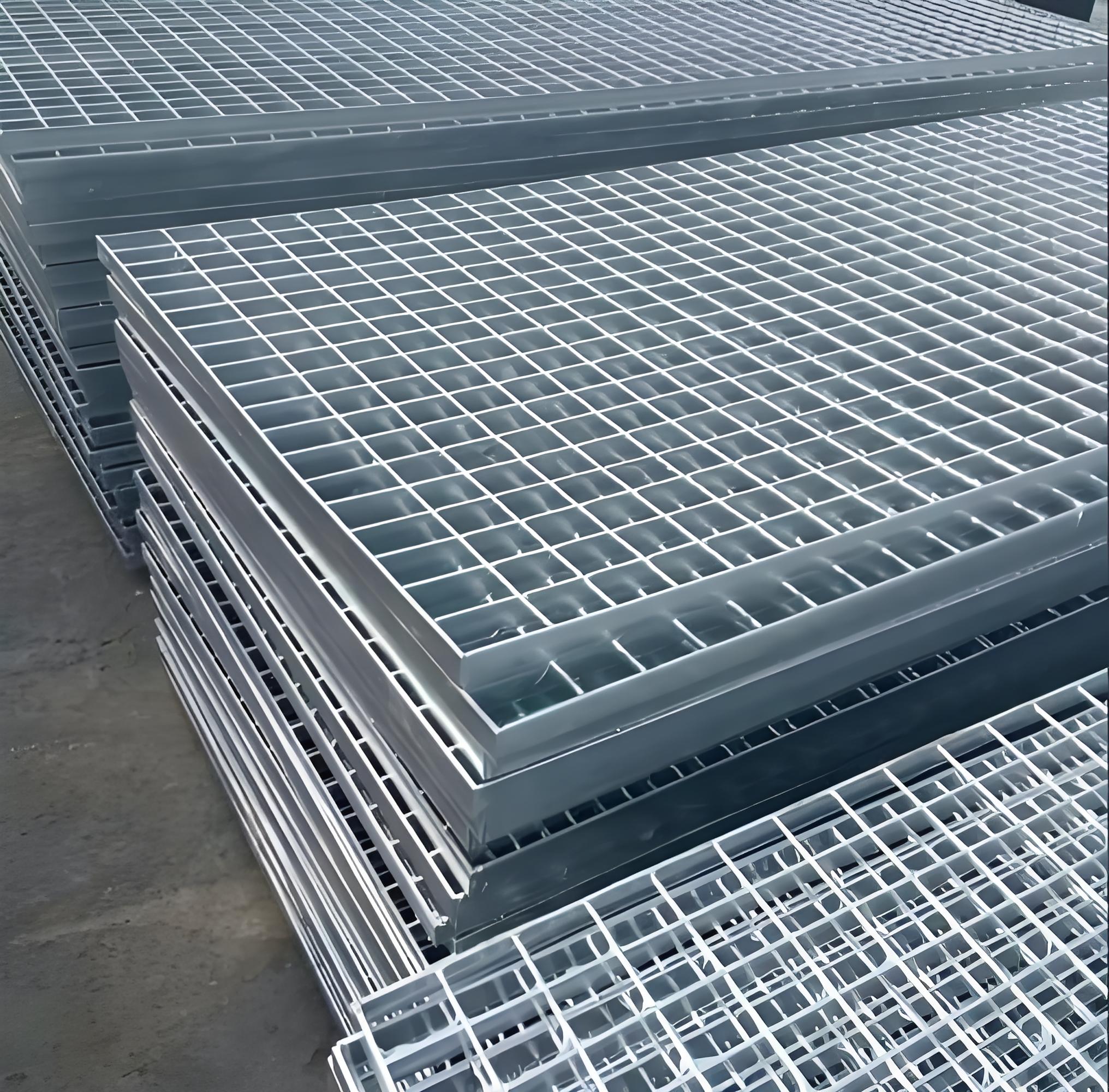
Surface treatment affects both the initial price and the service life of steel grating. The correct finish depends on the environment, corrosion risk, appearance requirement, maintenance plan, and project budget.
| Surface Treatment | Relative Cost | Typical Application |
|---|---|---|
| Bare Carbon Steel | Lowest | Temporary structures, dry indoor use, site-coated products |
| Shop Primer | Low | Temporary protection and controlled indoor applications |
| Painted Finish | Low to moderate | Factories, equipment platforms, color-coded access areas |
| Powder Coating | Moderate | Architectural and decorative grating systems |
| Hot-Dip Galvanizing | Moderate | Outdoor, humid, wet, and general industrial environments |
| Duplex Coating | High | Severe outdoor, coastal, or long-service projects |
| Stainless Pickling and Passivation | Moderate addition | Marine, chemical, hygienic, and wet stainless steel grating |
Hot-dip galvanizing is usually completed after cutting, welding, banding, and fabrication. This protects the steel grating body, cut edges, welds, and added components together. Galvanizing cost is often based on finished steel weight, zinc use, processing, inspection, and minimum batch charges.
For outdoor and wet service, galvanizing often provides better long-term value than bare steel or light paint systems. For more price details, see our steel grating price per square meter guide.
Most industrial projects require fabricated grating panels rather than full stock sheets. Custom fabrication improves fit-up and can reduce site labor, but it adds cost because it requires drawing review, cutting, welding, drilling, edge finishing, inspection, and specialized packing.
Trim banding closes exposed bearing bar ends and provides a neat finished edge. Load banding uses a stronger section and is intended to support concentrated loads or transfer force to adjacent supports. The correct banding type depends on the panel edge condition and support design.
A small irregular panel with several cutouts may weigh less than a large standard panel but cost more per kilogram because it requires more labor. Complex fabrication should be priced from detailed drawings rather than from panel area alone.
For trench and drainage projects, custom frame and panel details can be reviewed together with our steel grating trench cover information.
The best way to compare steel grating quotes is to compare complete technical specifications, not only the lowest advertised price per square meter. A low price may indicate smaller bearing bars, wider spacing, lower steel weight, incomplete galvanizing, missing banding, or excluded fabrication work.
A grating load table normally lists bearing bar size, bearing bar spacing, span, allowable uniform load, concentrated load, and deflection. Use the table for the exact grating type, material, surface, and support condition. Do not use a carbon steel load table to select aluminum grating, or use a plain-bar table without checking the serrated-bar requirement.
When comparing load tables, confirm whether the span is measured as clear span, center-to-center support distance, or another dimension. Also confirm whether the listed load is a uniform load, concentrated load, allowable load, proof load, or ultimate load.
A clear quotation request can read:
Please quote hot-dip galvanized serrated welded steel grating, bearing bars 30 mm × 3 mm at 30 mm spacing, cross bars at 100 mm spacing, panel size 1000 mm × 6000 mm, bearing bars spanning 1000 mm, banded on four sides, suitable for the required pedestrian load and approved deflection limit, including export packing and FOB price.
How much does steel grating cost per square meter?
For broad factory budgeting, basic untreated carbon steel grating may be approximately US$15 to US$45 per m², standard hot-dip galvanized steel grating may be approximately US$25 to US$80 per m², and common stainless steel grating may be approximately US$55 to US$180 per m². Final price depends on weight, bar size, spacing, coating, fabrication, quantity, packing, and delivery terms.
How do I choose the right steel grating load capacity?
Select steel grating by confirming the clear span between supports, bearing bar direction, uniform load, concentrated load, allowable deflection, material, and grating specification. Pedestrian, forklift, and vehicle applications require different load checks. For vehicle or heavy equipment traffic, provide wheel load, wheel contact area, traffic direction, and support-frame details.
What is the most common steel grating size?
A common industrial specification is welded steel grating with 30 mm × 3 mm bearing bars at approximately 30 mm spacing and cross bars at approximately 100 mm spacing. This is widely used for general platforms and walkways, but it is not suitable for every span or load. Heavier or longer-span applications may require deeper and thicker bearing bars such as 30 mm × 5 mm, 40 mm × 5 mm, or larger.