

Steel bar grating stair treads are a practical choice for industrial stairs, access towers, platforms, maintenance routes, warehouses, power plants, water-treatment facilities, mines, loading areas, and outdoor steel structures. They combine structural strength with open drainage, ventilation, and reliable footing. Factory price is usually calculated from the finished tread specification rather than from one fixed price list. Bearing bar size, mesh pattern, tread width, nosing, end plates, surface finish, weight, quantity, and delivery terms can all change the final cost per tread.
A steel bar grating stair tread is a fabricated step made from load-bearing steel bars and cross bars. The bearing bars run between the stair stringers and carry the main load. Cross bars hold the grating together, maintain the opening pattern, and help stabilize the tread.
Most finished steel bar grating stair treads include the grating body, a front nosing, two end plates, and bolt holes or slots for fixing to the stair stringers. The open grid allows rainwater, dirt, dust, and small debris to pass through instead of building up on the tread surface.
Steel bar grating is especially useful where solid plate treads would collect water or become slippery. The correct tread design should still be selected according to the actual stair geometry, load requirement, environmental exposure, and local project requirements.
For a broader explanation of dimensions, weight calculation, end plates, and installation details, see our grating stair treads size, weight, and standard guide.
Steel bar grating stair treads can be manufactured in welded, press-locked, or riveted construction. The best option depends on the required strength, appearance, material, opening pattern, corrosion environment, and project budget.
Welded steel grating is the most common type for industrial stair treads. Cross bars are welded to the bearing bars by resistance welding or another controlled production method. The result is a rigid grating panel that is well suited to industrial stairs, platforms, walkways, trench covers, and access structures.
Welded carbon steel grating is often the most economical option for repeated industrial tread sizes. It can be fabricated with serrated or plain bearing bars, checker plate nosing, end plates, holes, and hot-dip galvanized protection.
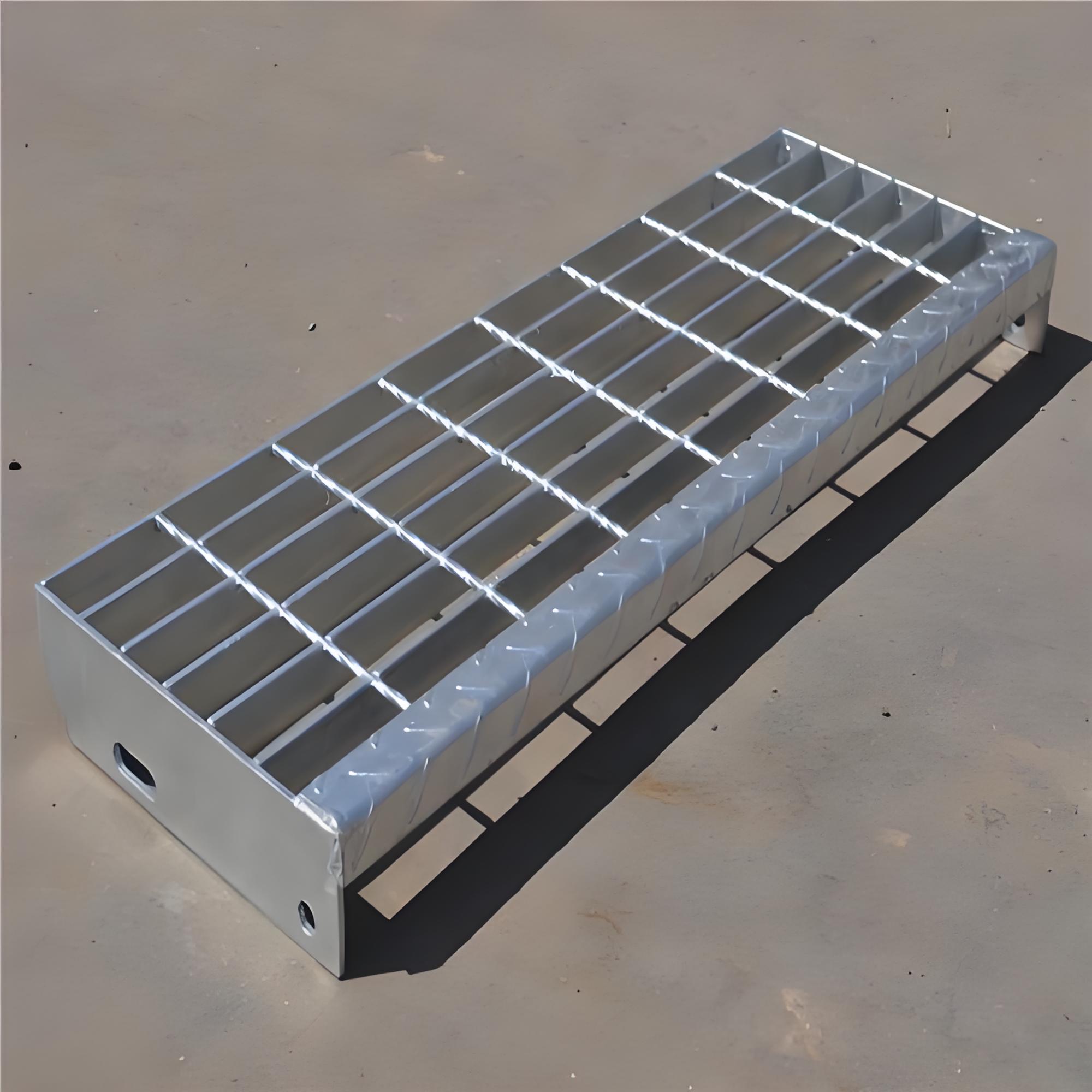
Press-locked stair treads are made by pressing notched cross bars into notched bearing bars. This construction can create a clean and uniform appearance with square or rectangular openings. It is often selected for architectural stairs, public access routes, commercial projects, platforms with close-mesh requirements, and applications where a refined visual finish is important.
Press-locked grating may cost more than standard welded grating because of the additional slotting, alignment, and pressing process. It can still be a cost-effective choice when the project requires a close mesh, a specific visual pattern, or reduced opening size.
Riveted grating is made by mechanically fastening bearing bars and cross bars with rivets. It can provide a strong and durable structure for specialized heavy-duty, vibration-prone, or long-span applications. Riveted stair treads are less common than welded grating treads for general factory stairs, but they can be appropriate for demanding industrial and infrastructure projects.
| Tread Type | Construction Method | Typical Strengths | Common Applications |
|---|---|---|---|
| Welded Bar Grating | Bearing bars and cross bars joined by controlled welding | Economical, rigid, widely available, suitable for industrial use | Factories, towers, platforms, outdoor stairs |
| Press-Locked Grating | Notched bars mechanically pressed together | Clean appearance, close openings, custom mesh patterns | Commercial stairs, architectural platforms, public access areas |
| Riveted Grating | Bars mechanically connected by rivets | Strong, durable, suitable for selected heavy-duty or special designs | Infrastructure, special industrial systems, vibration-prone service |
Bearing bars are the primary structural members of a steel bar grating stair tread. Their depth, thickness, spacing, and span direction determine much of the tread’s load capacity, deflection, finished weight, and factory price.
Increasing bearing bar depth usually provides a significant increase in bending stiffness. Increasing bar thickness increases material weight, local strength, impact resistance, and durability. Closer bearing-bar spacing increases the number of bars per tread, reduces opening size, and raises the steel weight per square meter.
| Bearing Bar Size | Typical Use | Relative Weight and Price |
|---|---|---|
| 25 mm × 3 mm | Short-span maintenance stairs and light-duty access | Lower |
| 30 mm × 3 mm | Common general industrial stair treads | Moderate |
| 32 mm × 3 mm | Standard metric industrial access systems | Moderate |
| 40 mm × 3 mm | Longer spans or lower deflection requirements | Moderate to high |
| 30 mm × 5 mm | High-traffic or more demanding industrial stairs | High |
| 40 mm × 5 mm | Heavy-duty and longer-span tread applications | High |
| 50 mm × 5 mm or larger | Special engineered stair systems | Very high |
Standard industrial stair treads often use bearing bars at approximately 30 mm on center. Other spacings, such as 25 mm, 32 mm, 34 mm, 35 mm, or 40 mm on center, may be selected depending on required opening size, heel safety, load distribution, drainage, and manufacturing preference.
Closer bar spacing increases the number of bearing bars across the tread depth. This can improve walking support and reduce the size of the openings, but it also increases steel weight, welding work, galvanizing weight, and final price.
Cross bars connect the bearing bars and form the grating mesh. They can be twisted square bars, round bars, flat bars, or other profiles depending on the manufacturing method and required appearance.
Common cross-bar spacing for welded steel grating is approximately 100 mm on center. A closer spacing, such as 50 mm or 75 mm, can improve appearance and lateral stability but may increase production cost and reduce open area.
Open area is important because it affects drainage, visibility, ventilation, debris fall-through, foot comfort, and small-object retention. A more open grating tread drains water quickly and is useful for wet outdoor stairs. A closer mesh may be preferred where small tools, high heels, narrow wheels, or debris retention are concerns.
| Mesh Choice | Advantages | Points to Consider |
|---|---|---|
| Standard Open Grating | Good drainage, lower weight, efficient industrial option | May not be suitable for heel-sensitive or small-object-retention areas |
| Close-Mesh Grating | Smaller openings, improved foot support, reduced fall-through risk | Higher steel weight, higher price, less open drainage area |
| Press-Locked Close Mesh | Clean appearance and controlled opening pattern | Often higher fabrication cost than standard welded grating |
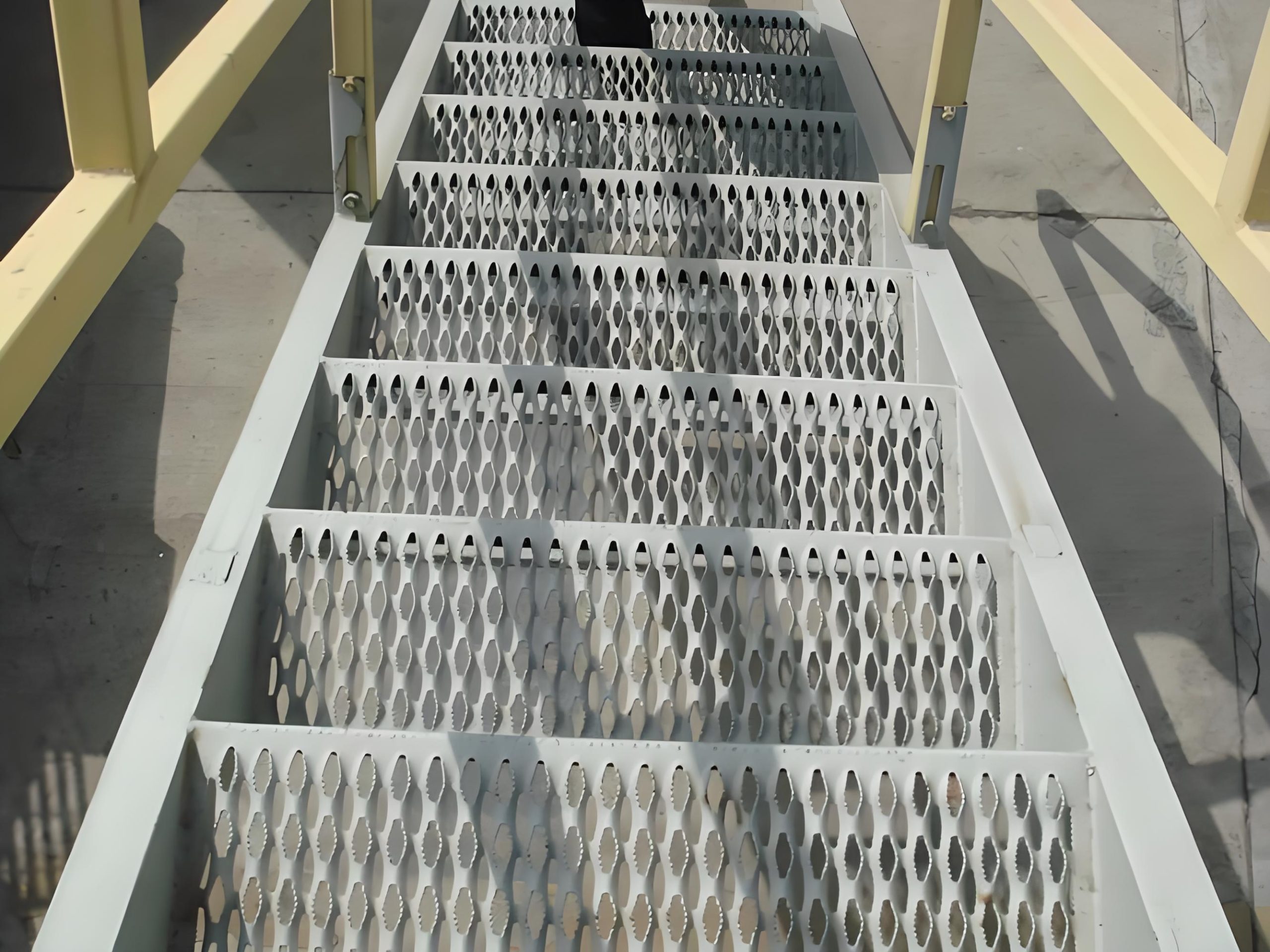
| Safety-Plank Pattern | Aggressive traction and formed drainage openings | Different load and fabrication rules from bar grating |
The ideal stair tread should provide enough drainage for the environment without creating unnecessary safety concerns. For ordinary industrial access stairs, standard bar grating is often suitable. For public-facing, high-heel, close-mesh, or small-object-sensitive applications, the opening pattern should be checked against the project requirements.
Steel bar grating stair treads are commonly supplied in standard and custom dimensions. “Standard” usually means frequently manufactured sizes rather than one universal size required for every project.
Typical metric stair tread lengths include 600 mm, 700 mm, 750 mm, 800 mm, 900 mm, 1000 mm, 1100 mm, and 1200 mm. Typical depths include 240 mm, 250 mm, 270 mm, 280 mm, 300 mm, and 305 mm. The actual size should match the stair design, clear stringer span, tread run, nosing arrangement, and local project requirements.
| Common Tread Size | Typical Application | Selection Note |
|---|---|---|
| 600 mm × 240 mm | Compact maintenance stairs | Check required clear stair width before use |
| 800 mm × 240 mm | General industrial access stairs | Practical compact factory size |
| 900 mm × 270 mm | Factories, warehouses, processing facilities | Common industrial configuration |
| 1000 mm × 270 mm | Regular personnel access stairs | Confirm bearing bar capacity for the full span |
| 1200 mm × 270 mm | Wide industrial stairways | May require deeper or thicker bearing bars |
| 1000 mm × 300 mm | Comfortable access stairs with a larger walking surface | Confirm whether stated depth includes the nosing |
| 1200 mm × 300 mm | Wide personnel access and high-use stairs | Engineering review is recommended for load and deflection |
The front nosing reinforces the tread edge, improves step visibility, and provides a defined foot-contact line. Common configurations include checker plate angle nosings, serrated flat-bar nosings, perforated safety-plank nosings, and solid angle nosings.
Industrial drawings often show front nosing projections in the approximate 25 mm to 50 mm range, but the final dimension should always follow the approved stair drawing. Nosing design should be coordinated with the tread depth, riser height, handrail system, and applicable stair requirements.
Plain steel bar grating uses smooth bearing-bar tops. Serrated steel bar grating uses notched or toothed bearing-bar tops. Both can carry industrial loads when correctly selected, but they are suited to different service conditions.
Plain grating is economical, easy to clean, and suitable for dry indoor areas where additional slip resistance is not required. It may be selected for equipment rooms, dry platforms, enclosed industrial stairs, and controlled environments.
Serrated treads provide more gripping edges under footwear and are commonly selected for wet, oily, dusty, muddy, icy, outdoor, and industrial environments. They are widely used for access towers, outdoor stairs, wastewater facilities, loading platforms, process plants, and maintenance routes.
| Surface Type | Best Use | Price Position |
|---|---|---|
| Plain Top | Dry indoor areas and general equipment access | Usually lower |
| Serrated Top | Outdoor, wet, oily, dusty, and slip-prone stairs | Usually moderately higher due to serration processing |
| Special Anti-Slip Nosing | High-risk stairs and special safety applications | Project-specific |
Serrations should be selected based on actual exposure conditions. They provide better traction, but they may also retain more dirt than plain bars in some applications. Regular cleaning is still important for stairs exposed to mud, leaves, ice, or heavy process residue.
For more detail on surface selection, read our serrated carbon steel bar grating article.
End plates are welded to the ends of the tread and allow the grating to be fixed to stair stringers. They are important for safe installation because they transfer load from the tread into the supporting stair structure.
A standard tread may use two side plates with round holes or slotted holes. The plate size, plate thickness, hole diameter, and hole centers should match the stair stringer drawing exactly.
For replacement treads, measure the actual hole spacing and end-plate dimensions before ordering. A small difference in hole center can make installation difficult and may force field drilling, which can damage the galvanized coating or create poor alignment.
All drilling, cutting, end-plate welding, and nosing fabrication should preferably be completed before hot-dip galvanizing. This allows the zinc coating to protect the welds, cut edges, and fabricated details.
The load capacity of a steel bar grating stair tread depends on bearing bar size, bar thickness, bar spacing, tread span, material grade, cross-bar design, and connection details. The bearing bars should run between the stair stringers because they are the primary load-carrying members.
Installing the tread in the wrong direction can significantly reduce load capacity. The cross bars are not normally intended to carry the same bending load as the bearing bars.
Deflection is the amount a tread bends under load. A tread may remain structurally intact but still feel unstable or uncomfortable if deflection is excessive. The project drawing or engineer may specify a maximum deflection limit, such as a fraction of the clear span.
Longer treads often require deeper or thicker bearing bars. In some cases, adding an intermediate support may be more economical than increasing the bearing bar size for every tread. The best solution should be selected using a load table or project-specific calculation.
Carbon steel is commonly used for steel bar grating stair treads because it is strong, weldable, widely available, and economical. Typical material specifications may refer to applicable steel standards and project grade requirements.
Steel tread price is strongly linked to finished weight. Two treads with the same outside dimensions can have very different weights when they use different bearing bar sizes, spacing, nosings, end plates, and finishes.
Finished Tread Weight = Grating Body Weight + Nosing Weight + Two End Plate Weights + Fasteners or Accessories + Coating Allowance
When the grating unit weight is known:
Grating Body Weight = Tread Length × Tread Depth × Grating Weight per Square Meter
For preliminary steel grating estimates, the bearing-bar mass can be calculated using a nominal steel density of 7850 kg/m³:
Bearing Bar Mass per m² = 7.85 × Bearing Bar Height (mm) × Bearing Bar Thickness (mm) ÷ Bearing Bar Pitch (mm)
For example, 30 mm × 3 mm bearing bars at 30 mm pitch have an approximate bearing-bar mass of:
7.85 × 30 × 3 ÷ 30 = 23.55 kg/m²
Cross bars, welding, edge banding, nosing, end plates, and galvanizing must then be added to estimate the finished tread weight. The approved factory drawing and actual product weight should be used for final shipping calculations.
A 40 mm × 5 mm bearing bar contains much more steel than a 25 mm × 3 mm bearing bar. The heavier tread costs more in raw material, welding, galvanizing, handling, packaging, and freight. However, the heavier configuration may be necessary to meet the required span or deflection limit.
For an explanation of how steel weight, bar size, spacing, fabrication, and coating affect factory prices, see our steel grating price per square meter guide.
Surface finish is an important part of steel bar grating stair tread selection. The best finish depends on whether the stairs are indoors, outdoors, wet, chemical-exposed, marine, highly visible, or difficult to maintain.
Bare carbon steel is the lowest-cost option. It is suitable for dry indoor applications, temporary access systems, or projects where a site-applied coating will be used. It is not suitable for long-term outdoor exposure without additional protection.
Painted steel treads can be used in enclosed factories, warehouses, equipment rooms, and color-coded industrial areas. Paint systems may include primer, epoxy, polyurethane, alkyd, or another specified coating. The cost depends on surface preparation, number of coats, coating thickness, color, and inspection requirements.
Hot-dip galvanizing is one of the most common finishes for outdoor industrial stair treads. The tread is fabricated first and then immersed in molten zinc, protecting the bearing bars, cross bars, end plates, nosing, welds, and cut edges.
Hot-dip galvanized steel bar grating is widely used for outdoor stairs, platforms, towers, trench covers, drainage areas, factories, power plants, and wastewater facilities. It normally costs more than bare steel, but it can reduce maintenance and extend service life in many wet and outdoor environments.
Read more about coating selection and price factors in our hot-dip galvanized steel grating guide.
A duplex system combines hot-dip galvanizing with paint or powder coating. It provides additional corrosion protection and allows color selection. This finish is useful for severe outdoor, coastal, industrial, or architectural stair systems, but it has a higher initial cost.
Stainless steel stair treads may be supplied with mill finish, pickling, passivation, brushing, bead blasting, or polishing. These finishes can improve appearance and corrosion resistance after cutting and welding. Stainless steel is more expensive than galvanized carbon steel, but it can be a better choice for chemical, marine, food-processing, hygienic, and chloride-exposed environments.
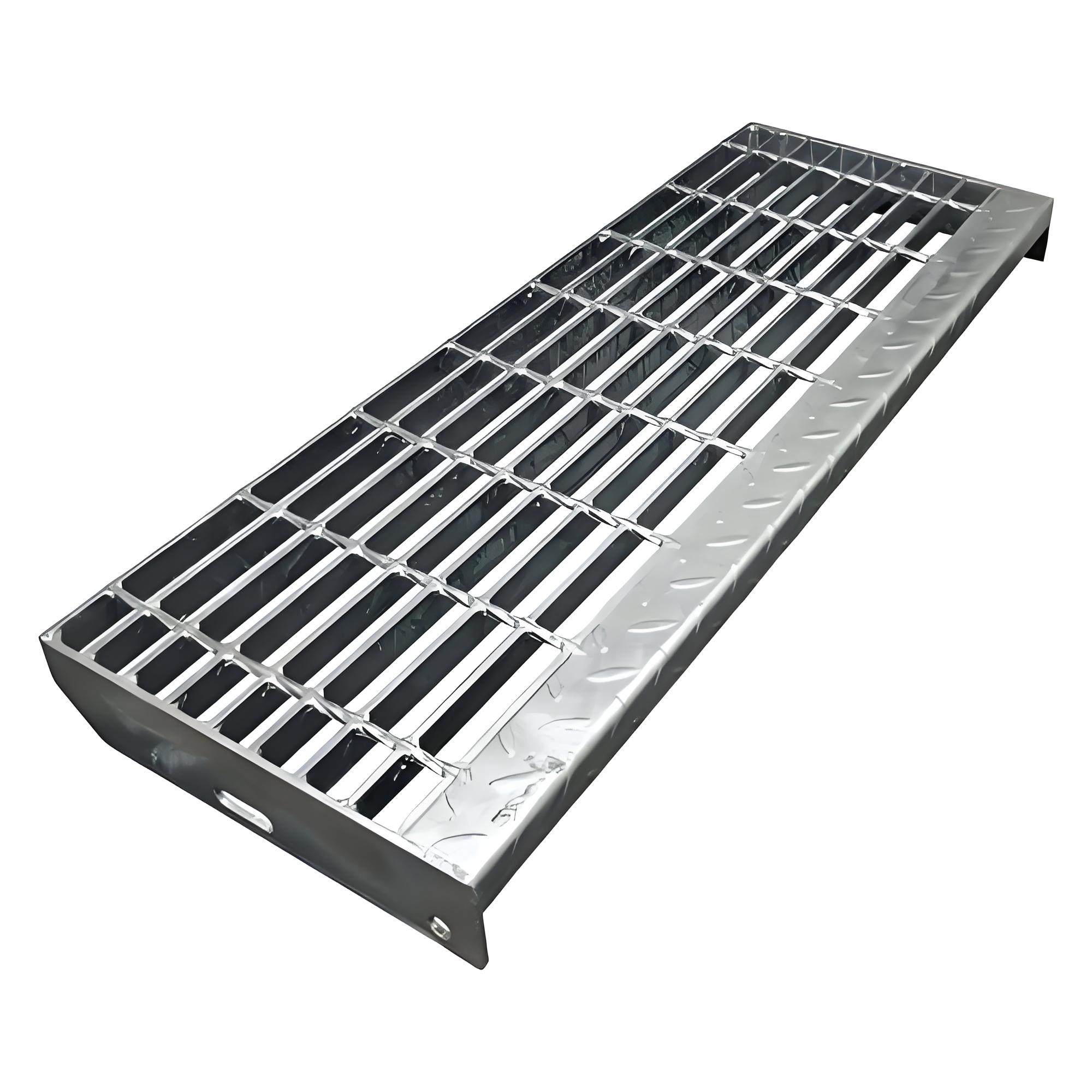
Industrial stairs are often not made from only standard rectangular treads. Factory fabrication can provide custom dimensions and details that reduce site cutting and make installation faster.
Custom fabrication increases the price because each tread may need drawing review, cutting, welding, drilling, grinding, inspection, and special packing. However, factory-prepared treads can reduce labor on site and help avoid incorrect field modifications.
For large stair projects, supply a tread schedule showing every tread mark, size, end-plate detail, nosing type, material, finish, and quantity. This allows the factory to optimize production and provide a more accurate quotation.
Steel bar grating stair tread production normally begins with bearing bars and cross bars prepared to the required size. The bars are assembled into welded, press-locked, or riveted grating panels. The panels are then cut into tread sizes and fitted with nosings, end plates, holes, edge banding, and other custom details.
A good factory quotation should state whether it includes drawings, material certificates, coating reports, load checks, inspection records, export packing, and freight documentation.
Steel bar grating stair treads can be priced per piece, per square meter, per kilogram, or per tonne. Each method has a different purpose.
Price per tread is the most useful method for finished stair products because it includes the specific tread size, nosing, end plates, bolt holes, coating, and fabrication. This is the preferred quote format for projects that have a detailed tread schedule.
Price per square meter is useful for preliminary budgeting and for comparing grating body cost. It should not be treated as the final installed tread price because each tread includes extra fabrication that is not proportional to its area.
For general factory budgeting, basic untreated carbon steel grating may be approximately US$15 to US$45 per m², while standard hot-dip galvanized grating may be approximately US$25 to US$80 per m². Fabricated galvanized grating, close mesh, serrated grating, heavy-duty grating, and custom stair treads can cost more because of added weight and labor. See our industrial metal grating factory price guide.
Price per ton or kilogram is useful when comparing large orders with similar specifications. It reflects the major effect of steel weight on raw material, welding, galvanizing, and shipping. However, it does not show the full cost of small custom treads with many holes, plates, notches, and individual fabrication steps.
A 900 mm × 270 mm tread has an area of approximately 0.243 m². If fabricated galvanized grating is budgeted at approximately US$35 to US$110 per m², the basic area-based value is approximately US$8.50 to US$26.75 before adding individual end plates, bolt holes, nosing, minimum galvanizing charges, special packing, and freight.
This is why a short finished tread often has a higher price per square meter than a large standard floor grating panel. Stair tread price should be based on the full fabrication drawing, not only on the visible walking area.
The most important factory price factor is usually finished steel weight. Larger bearing bars, thicker bars, closer spacing, heavy nosings, large end plates, and reinforced edges all add weight. More weight increases raw material cost, welding time, galvanizing cost, handling, packing, and freight.
| Cost Factor | Effect on Factory Price |
|---|---|
| Steel Weight | Heavier bearing bars, closer spacing, and thicker end plates increase cost. |
| Serrated Surface | Serration adds processing compared with plain grating. |
| Hot-Dip Galvanizing | Adds zinc, processing, cleaning, handling, and inspection cost. |
| Custom Fabrication | Cutouts, angled ends, special nosings, and unusual holes add labor. |
| Order Quantity | Repeated standard sizes generally reduce unit cost. |
| Small Order Charges | Minimum fabrication and galvanizing charges increase the price per tread. |
| Inspection and Documentation | Material certificates, reports, and project records add cost when required. |
| Packaging | Export pallets, steel frames, labels, and corrosion protection affect total cost. |
| Delivery Terms | Freight, destination port, customs, tax, and Incoterm change the delivered price. |
For the best price, standardize tread sizes where possible, use repeated hole patterns, provide complete drawings early, and group similar fabrication requirements in the same order. This allows the factory to reduce setup time, material waste, and packing complexity.
For projects using galvanized stair treads, our steel bar grating stair treads factory price article explains why raw steel, galvanizing, end plates, and custom fabrication should be compared as part of one complete quote.
What is the standard size of a steel grating stair tread?
Common industrial steel grating stair treads are often 600 mm to 1200 mm long and approximately 240 mm to 305 mm deep. A frequently used factory size is 900 mm × 270 mm, but the final size should match the clear distance between stringers, stair geometry, load requirement, and nosing detail.
Are serrated steel grating stair treads better than plain treads?
Serrated steel grating stair treads are usually better for wet, oily, dusty, muddy, outdoor, and industrial environments because the notched bearing bars provide more traction under footwear. Plain grating may be suitable for dry indoor stairs where cleaning and a smoother surface are more important than maximum slip resistance.
How much do steel bar grating stair treads cost?
Steel bar grating stair treads are normally quoted per piece because the finished cost depends on size, bearing bar weight, surface type, end plates, bolt holes, nosing, galvanizing, quantity, packing, and freight. A 900 mm × 270 mm fabricated galvanized tread may have an area-based grating value of approximately US$8.50 to US$26.75 before stair-specific fabrication and delivery costs are added. A formal quote should be based on the approved tread drawing and total quantity.