
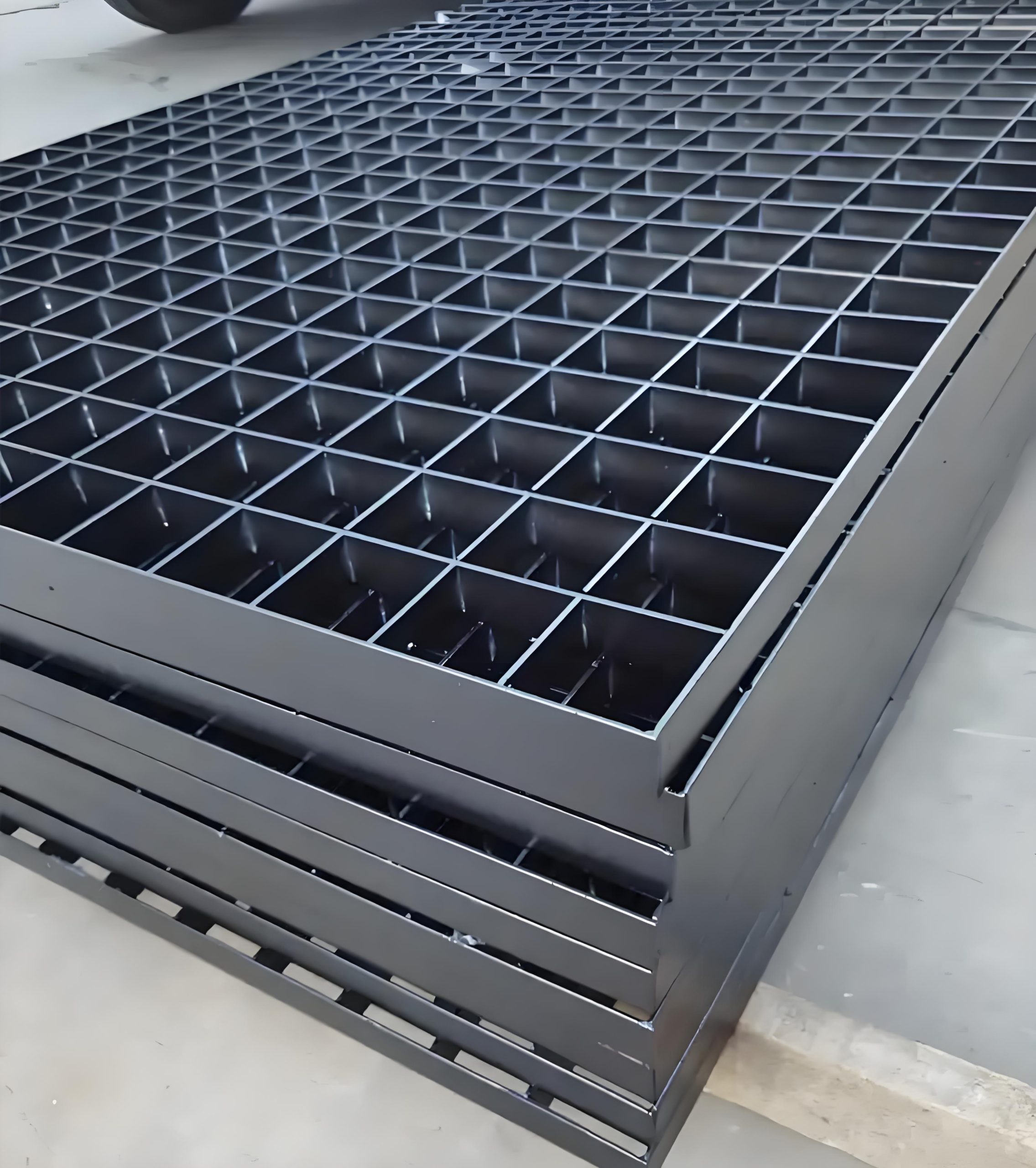
Welded painted steel grating is an open metal flooring system manufactured by resistance-welding cross bars to parallel bearing bars and then applying a specified protective paint system. It is widely used for indoor platforms, factory floors, catwalks, mezzanines, equipment access areas, stairs, trench covers, drainage platforms, and industrial structures where a colored finish and moderate corrosion protection are required. Factory price depends on the steel grade, bearing bar size, mesh spacing, panel weight, paint system, surface preparation, custom fabrication, order quantity, inspection, packing, and delivery terms. A proper quotation should state the complete grating construction and coating specification instead of giving only a price per square meter.
Welded painted steel grating consists of load-bearing flat bars arranged in one direction and cross bars welded across them. The bearing bars span between structural supports and carry most of the applied load. The cross bars keep the bearing bars at a consistent pitch, add lateral stability, and form the open grid pattern.
After fabrication, the carbon steel grating is cleaned and coated with one or more layers of paint. Depending on the project, the finish may be a temporary shop primer, a primer and topcoat system, a high-build epoxy system, a polyurethane finish, or a more specialized industrial coating.
| Component | Function | Typical Specification |
|---|---|---|
| Bearing Bar | Primary load-carrying member spanning between supports | Height, thickness, pitch, plain or serrated top |
| Cross Bar | Maintains bearing bar spacing and panel rigidity | Twisted square, round, flat, reticulated, pitch |
| Edge Banding | Closes exposed bar ends and reinforces the panel perimeter | Flat bar size, weld detail, perimeter length |
| Toe Plate | Reduces the chance of tools and materials falling from an edge | Height, thickness, folded or flat construction |
| Support Frame | Provides a bearing seat and transfers loads to the structure | Angle, channel, frame dimensions, anchor details |
| Paint System | Protects carbon steel and provides the requested color and finish | Primer, intermediate coat, topcoat, dry film thickness, gloss |
Resistance welding creates a rigid, one-piece panel that can be produced efficiently in standard and custom dimensions. The process is suitable for a wide range of bearing bar heights, thicknesses, mesh patterns, and panel formats. Welded grating also allows the factory to produce serrated surfaces, banded edges, stair treads, frames, cutouts, and other fabricated details before painting.
Painted welded grating is particularly useful when the project needs a specific color for identification, a lower initial cost than stainless steel, or a coating system matched to an indoor or moderately corrosive environment. It is not automatically the best choice for continuous immersion, severe chloride exposure, or aggressive chemical service. Those conditions may require hot-dip galvanizing, a duplex coating system, stainless steel, FRP, or a project-specific protective system.
The open grid permits water, air, light, dust, and process liquids to pass through the floor. This helps prevent standing water and improves ventilation around equipment. The actual drainage performance depends on the clear opening, slope, debris, liquid flow, and drainage structure below the panel. A nominal mesh designation alone does not establish the hydraulic capacity.
In a welded steel grating panel, the bearing bars are placed in a welding machine and cross bars are fused at each intersection. Resistance welding uses controlled electrical current, pressure, and heat to create a permanent connection. The welding schedule must match the bar size, steel grade, cross bar profile, and production equipment.
Bearing bars should run from one support to the opposite support. Their height and thickness determine most of the bending stiffness, load capacity, and panel weight. The bearing bar direction should be shown on the shop drawing and, for square or removable panels, marked clearly on the finished panel.
A common specification may read 40 x 5 mm bearing bars at 30 x 100 mm mesh. The first two dimensions describe the bearing bar height and thickness, while the mesh describes the center-to-center spacing of the bearing bars and cross bars. A quote that lists only “30 x 100 grating” is incomplete because it does not identify the structural bar size.
Cross bars are installed perpendicular to the bearing bars. They prevent the bearing bars from moving sideways, maintain the specified mesh, and help distribute local forces between adjacent bars. Common cross bar options include twisted square bars, round bars, flat bars, and formed reticulated bars.
Cross bars contribute to panel stability, but they do not normally replace the bearing bars as the primary span members. Increasing the cross bar size or reducing the cross bar spacing can improve local support and surface stability, but it cannot compensate for an undersized bearing bar over a long span.
Welded grating should have consistent welds at the required intersections, without missing joints, excessive spatter, undercut, severe distortion, or loose cross bars. The welds must remain sound during handling, painting, installation, and service. Poor welding can create rattling, bar movement, coating damage, and premature failure at heavily loaded intersections.
For industrial projects, the factory should be able to explain its welding procedure, equipment control, operator qualification, inspection method, and repair process. If a project references a particular welding code or inspection level, that requirement should be stated before production.
| Construction | Connection Method | Typical Advantage | Common Selection |
|---|---|---|---|
| Welded | Cross bars are resistance welded to bearing bars | Rigid panel, efficient factory production, broad industrial availability | Platforms, walkways, floors, stairs, trench covers |
| Press-Locked | Cross bars are pressed into pre-notched bearing bars | Flush appearance and flexible architectural mesh patterns | Decorative floors, close mesh, interior and specialty applications |
| Riveted | Formed cross bars are mechanically connected with rivets | Useful for selected rolling-load and specialty applications | Bridge decks, ramps, heavy-duty industrial areas |
Paint and hot-dip galvanizing both protect carbon steel, but they work in different ways. Paint creates a barrier between the steel and the environment. Galvanizing provides a zinc coating that acts as a barrier and can also offer sacrificial protection when the steel is exposed at a small scratch or cut edge.
| Comparison Point | Painted Steel Grating | Hot-Dip Galvanized Steel Grating |
|---|---|---|
| Initial Cost | Usually lower for a basic shop-primer system | Usually higher because of zinc, dipping, handling, and inspection |
| Color Choice | Wide choice of industrial colors and identification schemes | Normally zinc-gray unless a duplex paint system is added |
| Scratch Protection | A scratch can expose bare carbon steel and needs repair | Zinc can provide limited sacrificial protection at small damaged areas |
| Field Repair | Touch-up paint is relatively simple if the surface is prepared correctly | Repair requires a compatible zinc-rich or approved repair system |
| UV Exposure | Topcoat must be selected for exterior color and weather resistance | Zinc weathers naturally; optional paint can improve color and durability |
| Continuous Immersion | Requires a coating system specifically rated for immersion | Also requires an environment-specific assessment; neither option is universal |
| Appearance | Can be smooth, colored, matte, or gloss depending on the topcoat | Metallic zinc appearance with possible variations from dipping |
| Maintenance | Periodic inspection and touch-up may be needed | Often lower routine maintenance in general outdoor exposure |
Painted grating is often selected for dry indoor factories, equipment rooms, mezzanines, warehouses, commercial plants, and areas where color coding is important. It can also be suitable outdoors when the coating system is designed for the actual atmospheric exposure and maintained according to the coating manufacturer’s recommendations.
Paint is particularly convenient when the owner needs safety yellow, walkway identification, process-area colors, or a finish that matches surrounding structures. A painted surface can also be easier to renew during planned maintenance than a panel that must be removed and sent for galvanizing.
Hot-dip galvanizing is commonly preferred for outdoor walkways, cooling towers, drainage platforms, utility facilities, humid industrial structures, and general atmospheric corrosion. It is often more forgiving than a basic paint system when small scratches occur during transport or installation.
For a detailed comparison of zinc coating, fabrication timing, and corrosion protection, buyers can review this hot-dip galvanized steel grating guide.
A duplex system combines hot-dip galvanizing with an additional paint or powder coating. It can provide a colored finish and increase the service life in demanding atmospheric environments. The paint must be compatible with the galvanized surface, and the zinc should be properly cleaned and prepared before coating.
The steel grade affects structural properties, weldability, material certificates, availability, and price. Common project specifications may call for structural carbon steel grades such as ASTM A36, ASTM A1011 structural material, EN S235JR, EN S275JR, or another local equivalent. The correct grade depends on the project design and the manufacturer’s supply range.
| Steel Grade Family | Typical Use | What to Confirm |
|---|---|---|
| ASTM A36-Type Structural Steel | General industrial platforms, walkways, stairs, and fabricated supports | Mill certificate, yield and tensile properties, weldability, project acceptance |
| ASTM A1011 Structural Grades | Cold-formed or hot-rolled components where the project specifies the grade | Grade designation, thickness range, forming and welding requirements |
| EN S235JR | General European industrial grating and structural fabrication | Certificate format, impact requirements, equivalent design basis |
| EN S275JR | Projects requiring a higher nominal yield strength than S235JR | Engineer approval, weld procedure, actual supply condition |
| Project-Specific or Local Grade | Infrastructure, energy, marine, or regulated projects | Applicable standard, certificates, traceability, and substitution approval |
A higher-strength steel grade does not automatically make a panel suitable for a longer span or a heavier load. Bearing bar height, thickness, spacing, support width, and deflection usually have a larger influence on the grating selection. The engineer should verify the entire design rather than choosing a material grade alone.
The steel must be compatible with the selected welding process and paint system. Excessive mill scale, oil, rust, or welding contamination can reduce coating adhesion even when the steel grade itself is correct. Material certificates should be requested when the project requires proof of chemistry, mechanical properties, or heat-number traceability.
Bearing bar dimensions are among the strongest drivers of both structural capacity and factory price. Common illustrative sizes include 25 x 3 mm, 30 x 3 mm, 32 x 5 mm, 40 x 5 mm, 50 x 5 mm, and 60 x 6 mm. Larger sizes are available for heavy-duty floors, vehicle traffic, long spans, and special covers.
| Bearing Bar Size | Typical Design Discussion | Relative Weight and Cost |
|---|---|---|
| 25 x 3 mm | Light industrial floors and short, closely supported spans | Low |
| 30 x 3 mm | General walkways and platforms with moderate loading | Low to moderate |
| 32 x 5 mm | Stronger industrial flooring and medium load conditions | Moderate |
| 40 x 5 mm | Common heavier platform and maintenance-floor geometry | Moderate to high |
| 50 x 5 mm | Longer spans or higher loads after table verification | High |
| 60 x 6 mm | Heavy industrial covers, equipment floors, and demanding access areas | Very high |
Common metric mesh patterns include 30 x 100 mm, 30 x 50 mm, 40 x 100 mm, and 40 x 50 mm. Inch-based patterns such as 19W4 and 19W2 are also widely specified. The first number normally identifies the bearing bar pitch, and the second identifies the cross bar pitch.
| Mesh Pattern | Approximate Meaning | Typical Selection Reason |
|---|---|---|
| 30 x 100 mm | 30 mm bearing bar pitch and 100 mm cross bar pitch | General platforms, walkways, drainage, and industrial floors |
| 30 x 50 mm | 30 mm bearing bar pitch and 50 mm cross bar pitch | Closer openings for carts, tools, and smaller objects |
| 19W4 | Approximately 30.2 mm bearing pitch and 101.6 mm cross bar pitch | Common inch-based welded industrial pattern |
| 19W2 | Approximately 30.2 mm bearing pitch and 50.8 mm cross bar pitch | Closer cross bar spacing for industrial floor use |
| 11W4 | Approximately 17.5 mm bearing pitch and 101.6 mm cross bar pitch | Close-mesh pedestrian and small-object retention applications |
For early budgeting, the bearing bar contribution can be estimated with the following formula:
Approximate bearing bar weight (kg/m2) = 7.85 x bearing bar height (mm) x thickness (mm) / bearing bar pitch (mm)
This estimate uses a carbon steel density of approximately 7,850 kg/m3. It excludes cross bars, banding, frames, clips, paint, and packing.
| Bearing Bar | Pitch | Approximate Bearing Bar Weight Only | Illustrative Finished Panel Range |
|---|---|---|---|
| 25 x 3 mm | 30 mm | About 19.6 kg/m2 | About 25-33 kg/m2 |
| 30 x 3 mm | 30 mm | About 23.6 kg/m2 | About 29-38 kg/m2 |
| 32 x 5 mm | 30 mm | About 41.9 kg/m2 | About 48-60 kg/m2 |
| 40 x 5 mm | 30 mm | About 52.3 kg/m2 | About 60-74 kg/m2 |
| 50 x 5 mm | 30 mm | About 65.4 kg/m2 | About 73-90 kg/m2 |
| 60 x 6 mm | 30 mm | About 94.2 kg/m2 | About 103-122 kg/m2 |
The finished range is only an illustrative planning estimate. Cross bar profile, cross bar pitch, banding, cutouts, frames, reinforcement, and fabrication tolerances can change the actual weight. More dimensional information is available in this steel bar grating dimensions guide.
The paint system should be selected according to the exposure, expected service life, appearance, maintenance plan, and project standard. A single shop primer is not equivalent to a multi-coat industrial system. The coating description should identify the primer chemistry, intermediate coat, topcoat, color, dry film thickness, surface preparation, curing requirements, and repair method.
| Paint System | Typical Use | Advantages | Limitations |
|---|---|---|---|
| Shop Primer | Temporary protection during fabrication, storage, and indoor installation | Low cost and fast application | May not provide long-term outdoor or chemical protection |
| Zinc-Phosphate Primer | General indoor and moderate atmospheric exposure | Improved corrosion inhibition compared with an unprimed panel | Needs a compatible topcoat for demanding service |
| Epoxy Primer and Intermediate Coat | Industrial floors, humid plants, chemical splash, and heavy maintenance areas | Good barrier protection and adhesion when correctly prepared | Can chalk under prolonged sunlight without a suitable topcoat |
| Polyurethane Topcoat | Exterior color, UV exposure, appearance-sensitive industrial structures | Good color and gloss retention | Requires a compatible primer or epoxy base |
| Zinc-Rich Primer System | Selected atmospheric steel protection where the project calls for it | Can provide sacrificial zinc protection in a compatible system | Requires strict surface preparation and application control |
| High-Build Epoxy | Heavy industrial, splash, abrasion, and selected immersion conditions | Thicker barrier film and strong chemical resistance in suitable media | Not automatically suitable for UV exposure or every chemical |
A shop primer is usually intended to protect the steel while the project is being fabricated, transported, stored, and installed. It may be sufficient for a dry indoor application, but it should not be assumed to provide a long service life outdoors. The buyer should confirm whether the primer is compatible with a later site-applied topcoat.
Epoxy coatings provide a strong barrier and are widely used for industrial floors, humid plants, chemical splash areas, and equipment platforms. The coating must be applied to a properly prepared surface, at the specified thickness, and within the recoat window. Excessively thick film can crack or trap solvent, while insufficient film can leave porous or weakly protected areas.
Polyurethane is often used as a final coat where color stability, gloss, and weather resistance are important. It is commonly applied over an epoxy primer or intermediate coat. A topcoat alone is not a substitute for proper corrosion protection because it depends on the adhesion and integrity of the underlying layers.
Typical project requirements may specify a shop primer around 20-40 micrometers, an epoxy primer around 50-75 micrometers, a high-build epoxy layer around 100-200 micrometers, or a polyurethane topcoat around 40-60 micrometers. These figures are examples only. The coating manufacturer and project specification should determine the actual dry film thickness.
Open grating is difficult to coat uniformly because it has narrow bar edges, weld intersections, undersides, and inaccessible corners. The factory should explain how it measures film thickness and how it handles areas where a gauge cannot sit flat.
Surface preparation is often more important than the brand name of the paint. Oil, grease, moisture, mill scale, rust, welding residue, dust, salts, and sharp edges can all reduce adhesion and shorten coating life.
High-performance industrial systems often require abrasive blast cleaning to remove mill scale and create a suitable anchor profile. Specifications may reference preparation grades such as Sa 2.5 or SSPC/NACE equivalents. The actual preparation standard should be stated in the coating specification rather than assumed from the word “painted.”
Abrasive blasting must reach the sides, undersides, weld zones, and bar intersections as far as practical. A panel that is clean only on the top surface can still develop corrosion from unprepared areas beneath the floor.
Power-tool cleaning may be practical for small orders, repair work, or indoor service where full blasting is not available. It normally provides less uniform preparation than abrasive blasting and may not be acceptable for a high-performance exterior or chemical coating system.
Sharp edges hold less coating than flat surfaces and are vulnerable to early breakdown. The factory should remove burrs and, where required, slightly round exposed edges before painting. Cutouts, banding, stair nosings, bolt holes, and frame corners require special attention because they are common locations for thin film and mechanical damage.
Painting should not proceed when the steel is too cold, damp, dirty, or close to the dew point. Humidity, condensation, dust, airflow, and curing temperature affect the final film. In a factory quotation, ask whether the supplier controls these conditions and records the coating batch and application date.
For additional guidance on custom painted fabrication, see this custom painted steel grating fabrication guide.
Welds, cut edges, banded perimeters, and holes often require more attention than the flat areas of the grating. These locations may have heat tint, roughness, sharp corners, weld spatter, or a geometry that is difficult for spray equipment to reach.
Weld spatter should be removed before painting. Welds should be checked for undercut, porosity, sharp projections, and contamination. A stripe coat may be applied to welds and edges before the full spray coat so that the coating reaches the required thickness.
Cutouts and notches expose fresh carbon steel and can have a thin or uneven paint film if they are not prepared separately. The factory should clean, smooth, and stripe-coat the cut edge. If the panel is cut in the field, the repair procedure should identify the required preparation, primer, topcoat, and drying time.
Edge banding closes the open ends of bearing bars and reinforces the panel. The banded perimeter can create a narrow recess at the weld line, so it should be cleaned and coated before the panel is stacked. Banded edges are also vulnerable to impact from forks, slings, and adjacent panels during handling.
Bolt holes should be free of sharp burrs and excessive paint buildup. If the fastener must make electrical or structural contact, the specification should state whether the hole or contact surface is to remain unpainted. Paint thickness around a clip or bolt can otherwise affect fit and torque.
The underside of a panel is often exposed to condensation, process liquids, road salt, and cleaning water. It should not be omitted from the coating scope unless the project explicitly allows it. Hidden surfaces around frames and supports should also be accessible for inspection and maintenance.
A complete paint specification should describe more than “painted black” or “painted gray.” The factory needs to know the color standard, gloss, coating type, film thickness, visual acceptance, repair allowance, and whether the finish applies to all panel surfaces.
| Specification Item | Example Information | Why It Matters |
|---|---|---|
| Color | RAL reference, owner color code, or approved sample | Controls pigment selection and identification of production areas |
| Gloss | Matte, semi-gloss, or gloss range | Affects appearance, glare, and maintenance expectations |
| Coating Chemistry | Shop primer, epoxy, polyurethane, zinc-rich, or specified brand system | Determines compatibility, application, and service environment |
| Total DFT | Project-defined micrometer range | Controls corrosion protection and material consumption |
| Surface Preparation | Blast-cleaning or power-tool preparation standard | Directly affects adhesion and coating life |
| Coverage Scope | Top, underside, edges, welds, holes, banding, frame | Prevents unprotected or disputed surfaces |
| Repair Standard | Touch-up method for scratches, cut edges, and handling marks | Defines responsibility before delivery and installation |
Safety yellow, gray, black, green, blue, and other industrial colors may be selected for equipment identification or visual coordination. The color should be specified by a recognized color reference or physical sample. Digital screen colors are not reliable enough for final acceptance.
Dry film thickness should be measured after the coating has cured according to the coating manufacturer’s instructions. A single reading on a flat bearing bar does not prove that the undersides, edges, welds, and intersections meet the requirement. The inspection plan should define the sampling locations and how inaccessible surfaces are assessed.
Minor variations in gloss, spray pattern, and film thickness can occur on open grating because of its geometry. The buyer should define acceptable appearance, runs, sags, pinholes, overspray, roughness, and handling marks. Touch-up paint should be compatible with the original system and supplied with clear application instructions.
Plain grating has a smooth bearing bar top. Serrated grating has notches or teeth along the top edge to improve traction. Both can be painted, but the surface choice should reflect the operating environment, footwear, wheels, drainage, cleaning method, and maintenance traffic.
| Surface | Typical Use | Advantages | Points to Check |
|---|---|---|---|
| Plain | Dry indoor platforms, cart routes, clean areas, architectural floors | Smoother rolling and easier cleaning | Less traction when wet, oily, icy, or contaminated |
| Serrated | Outdoor walkways, stairs, ramps, wastewater and oily industrial areas | Improved grip for footwear in slippery conditions | Can retain debris and requires careful coating of the serrations |
Serrations must remain open and clearly defined after painting. Excessive coating buildup can blunt the teeth, fill the notches, and reduce the intended traction. The factory should control spray angle, stripe coating, and film thickness so that the anti-slip profile remains functional.
Plain grating may be preferable for carts, pallet jacks, and wheeled equipment because the top surface is more uniform. It is often easier to sweep and wash in indoor facilities. If plain grating is used outdoors, the project should evaluate rain, snow, ice, oil, algae, and other contamination over the expected service life.
Paint color and coating type do not by themselves determine slip resistance. Surface profile, contamination, footwear, slope, drainage, and maintenance all matter. A project requiring tested slip performance should specify the relevant test method and acceptance value.
Painted steel grating must be matched to the exposure category. A primer suitable for a dry equipment room may fail quickly in a coastal plant, chemical washdown area, or continuously wet trench.
| Environment | Typical Coating Direction | Important Considerations |
|---|---|---|
| Dry Indoor Area | Shop primer or simple primer and topcoat | Color, abrasion, handling marks, cleaning chemicals, ventilation |
| Humid Indoor Plant | Epoxy primer with compatible topcoat | Condensation, washdown, hidden undersides, drainage, maintenance access |
| Normal Outdoor Exposure | Multi-coat epoxy and UV-resistant polyurethane, or galvanizing | Rain, sunlight, temperature cycles, edge damage, joint corrosion |
| Coastal or Salt Exposure | Engineered high-performance coating, duplex system, or stainless steel | Chlorides, crevices, salt deposits, frequent inspection, coating repair |
| Chemical Splash | Media-specific epoxy or another chemically compatible system | Chemical name, concentration, temperature, immersion and cleaning exposure |
| Continuous Immersion | Special immersion-rated coating or alternate material | Water chemistry, pH, biological activity, cathodic effects, maintenance |
| Food or Hygienic Area | System approved for the process and sanitation chemicals | Cleanability, flaking risk, chemical compatibility, surface roughness |
Indoor platforms, mezzanines, machine access floors, and warehouse walkways often need only moderate corrosion protection. The main concerns may be abrasion, forklift contact, cleaning chemicals, and the ability to match the surrounding safety-color scheme.
Outdoor grating experiences rain, ultraviolet light, temperature cycling, condensation, and mechanical damage during maintenance. A UV-resistant topcoat is important when color and gloss must remain stable. Drainage design is equally important because standing water can attack cut edges and support frames even when the top surface is well painted.
Painted carbon steel can be suitable for selected chemical or marine exposures only when the full coating system is designed for the actual medium. Chlorides, solvents, acids, alkalis, hot washdown, and immersion can require different primers, intermediate coats, stripe coats, or alternate materials. Repainting a repeatedly failed coating may cost more than selecting galvanized or stainless steel at the beginning.
Standard rectangular panels are normally the most economical because they use common bar lengths and efficient factory production. Industrial projects often require cutouts around pipes, columns, valves, cable trays, ladders, handrail posts, machines, and drainage channels.
| Panel Format | Illustrative Size | Typical Use | Handling Consideration |
|---|---|---|---|
| Small Maintenance Panel | 600 x 1,000 mm | Access openings and removable covers | Usually easier to lift, depending on bar size |
| Narrow Walkway Panel | 750 x 3,000 mm | Catwalks and service routes | Weight should be checked before manual handling |
| Common Industrial Panel | 1,000 x 3,000 mm | Platforms, floors, and equipment access | Heavy specifications may require mechanical lifting |
| Long Stock Panel | 1,000 x 6,000 mm | Long platforms and repeated walkway runs | Requires lifting, transport, and joint planning |
| Wide Panel | 1,200 x 3,000 mm | Wide floors and drainage covers | More weight and greater frame-seat requirements |
Cutouts around pipes, columns, valves, and equipment can interrupt bearing bars. The factory may add trimming bars, banding, angles, or local reinforcement to restore the load path. The drawing should show the cutout shape, dimensions, center location, clearance, and required edge finish.
Edge banding closes exposed bearing bar ends and creates a finished perimeter. It can improve edge safety, provide a fastening surface, and strengthen the panel near a cutout or traffic edge. Banding should be welded and painted as part of the complete panel rather than added after coating whenever possible.
Toe plates reduce the chance of tools and materials falling from elevated platform edges. They should be coordinated with handrails, gates, ladders, stairs, and drainage. The required height and thickness depend on the project safety standard and should be stated in the drawing.
Welded painted grating can be fabricated into stair treads with serrated or plain surfaces, nosing, end plates, bolt holes, and stringer connections. Serrated treads are commonly used outdoors and in wet industrial areas. A stair tread coating must cover the nosing, underside, end plates, welds, and cut edges without filling the anti-slip profile.
Custom frames can be supplied for trench covers, pits, drains, and removable access panels. The frame should be priced with the grating because its dimensions and stiffness affect the panel support and final installation. Small access covers may cost more per square meter than large standard panels because the frame, hinges, locks, and fabrication labor dominate the total.
Factory price is normally calculated from the amount of steel, the welding and fabrication labor, surface preparation, paint consumption, inspection, packing, and delivery terms. A price per square meter is useful only when the bearing bar size, mesh, panel weight, paint system, and custom scope are identical.
Factory price per m2 = steel material cost + welding and fabrication + surface preparation + paint system + custom work + inspection + packing + delivery-related charges
The following figures are broad planning references in US dollars for carbon steel welded grating. They are not fixed market offers. Raw steel prices, paint brand, coating thickness, order quantity, panel weight, production schedule, custom details, packing, freight, taxes, and Incoterms can change the final quotation.
| Typical Painted Grating Scope | Indicative Factory Budget per m2 | Typical Assumption |
|---|---|---|
| Standard welded panel with shop primer | About US$20-45 | Regular rectangular panels, moderate bar size, larger production quantity |
| Primer and single industrial topcoat | About US$30-65 | Standard panels with defined color and moderate film thickness |
| Epoxy primer plus polyurethane topcoat | About US$45-95 | Prepared surface, multi-coat system, normal industrial exposure |
| Heavy-duty bars with multi-coat industrial finish | About US$70-140 | Higher steel weight, thicker coating, serration or reinforced edges |
| Custom framed or heavily fabricated painted grating | About US$90-220+ equivalent | Cutouts, frames, stairs, toe plates, notches, hinges, or small batch quantity |
These prices are intended for early budgeting only. A one-off panel can have a much higher unit price than a repeated order because programming, setup, cutting, welding, inspection, and packing are spread over fewer square meters.
A 1,000 x 3,000 mm panel covers 3 m2. If the quoted base price is US$55 per m2, the basic panel value is approximately US$165 before custom cutouts, edge banding, frames, special inspection, packing, and freight.
If the same panel uses a much heavier bearing bar, a serrated surface, a three-coat epoxy and polyurethane system, and two reinforced pipe openings, the price should be calculated as a fabricated assembly rather than by multiplying the area by a simple stock-panel rate.
Large orders may be quoted by ton because the steel weight is substantial. Price per ton can help compare material and fabrication efficiency, but it does not show the complete project cost. Paint, frames, cutouts, inspection, packing, and shipping may be calculated separately.
When comparing a per-ton quote with a per-square-meter quote, ask for the estimated finished weight per square meter, including cross bars and banding but excluding or clearly identifying frames and accessories.
| Cost Factor | Effect on Factory Price |
|---|---|
| Steel Grade | Higher grade, certified material, or special sourcing can increase material cost. |
| Bearing Bar Size | Deeper and thicker bars increase steel consumption and handling weight. |
| Mesh Spacing | Closer pitch increases the number of bars and fabrication time. |
| Surface Type | Serration adds machining or forming work and requires careful coating. |
| Surface Preparation | Abrasive blasting and extensive cleaning cost more than basic mechanical preparation. |
| Paint System | More coats, higher DFT, specialty resins, and color requirements increase material and labor. |
| Cutouts and Notches | Irregular cutting, edge dressing, reinforcement, and material waste add cost. |
| Banding and Frames | Add steel, welding, fitting, coating area, and dimensional inspection. |
| Stair Treads | Nosing, end plates, bolt holes, and individual handling increase the per-piece price. |
| Inspection Documents | Material certificates, coating records, drawings, and inspection reports require additional work. |
| Quantity | Repeated panels normally reduce setup and programming cost per square meter. |
| Packing and Shipping | Heavy painted panels need separators and protection against rubbing, moisture, and impact. |
A factory quality plan should cover both the grating structure and the paint system. A visually attractive panel is not necessarily dimensionally correct, and a strong panel is not adequately protected if the coating has poor adhesion or thin edges.
| Inspection Area | Typical Check | Reason |
|---|---|---|
| Raw Material | Grade, thickness, heat number, certificates | Confirms the material matches the approved specification |
| Bearing Bars | Height, thickness, pitch, straightness, serration | Controls structural performance and mesh accuracy |
| Cross Bars | Profile, pitch, alignment, connection quality | Controls panel stability and opening pattern |
| Welds | Missing welds, spatter, distortion, loose bars, visible defects | Supports joint strength and service durability |
| Panel Dimensions | Length, width, diagonals, flatness, cutouts, banding | Ensures the panel fits the frame and adjacent panels |
| Surface Preparation | Cleanliness, rust removal, profile, dust, salts, flash rust | Directly affects coating adhesion |
| Paint Application | Primer, recoat interval, color, coverage, runs, sags, pinholes | Confirms the specified coating system was applied correctly |
| Dry Film Thickness | Readings on bars, edges, welds, underside, and representative areas | Confirms protection without excessive or insufficient film |
| Adhesion | Project-specified adhesion test or inspection method | Checks whether the coating is bonded to the prepared steel |
| Packing | Separators, moisture protection, bundles, labels, lifting points | Prevents paint damage during transport and unloading |
Depending on the project, the specification may refer to structural steel standards, grating standards, welding requirements, surface-preparation standards, coating-performance standards, or inspection methods. Examples may include ANSI/NAAMM bar-grating guidance, BS or EN grating requirements, ISO 8501 surface preparation, ISO 12944 corrosion-protection categories, and ASTM methods for dry film thickness or adhesion.
These references should be treated as project requirements rather than automatic claims of compliance. The factory should identify the exact edition, acceptance criteria, test frequency, and documentation required by the buyer.
Painted panels should be fully cured before stacking. Separators should prevent bearing bars from rubbing against one another. Bundles should be protected from rain, condensation, dirt, and forklift impact. If panels are shipped in a container, the packing plan should include lifting access and a method for unloading without dragging the painted edges across the floor.
A complete enquiry allows the factory to calculate steel consumption, coating area, production time, and shipping weight accurately.
| Information to Provide | Example |
|---|---|
| Product Type | Welded floor grating, walkway panel, stair tread, or trench cover |
| Material Grade | ASTM A36, S235JR, S275JR, or project-approved equivalent |
| Bearing Bar | 40 x 5 mm, 50 x 5 mm, or factory-recommended size |
| Mesh | 30 x 100 mm, 30 x 50 mm, 19W4, or another pattern |
| Surface | Plain or serrated |
| Panel Dimensions | Length, width, quantity, and panel numbering |
| Clear Span and Load | Support spacing, uniform load, point load, wheel load, and deflection limit |
| Custom Fabrication | Cutouts, notches, banding, frames, toe plates, stair nosing, bolt holes |
| Surface Preparation | Mechanical cleaning, abrasive blast, or project-defined preparation grade |
| Paint System | Shop primer, epoxy primer, intermediate coat, polyurethane topcoat |
| Color and DFT | Color reference, gloss, total dry film thickness, repair requirements |
| Inspection Documents | Material certificates, coating records, dimensional report, drawings |
| Packing and Delivery | Destination, Incoterm, container requirements, lifting and unloading conditions |
A dimensioned PDF or CAD drawing should show the overall panel outline, bearing bar direction, support lines, cutouts, frame dimensions, panel joints, banding, toe plates, stair connections, bolt holes, lifting points, and coating notes. A rough hand sketch can be useful for an initial discussion, but production should be based on an approved drawing.
Compare the complete scope instead of comparing only the quoted price per square meter. Check whether each supplier has included surface preparation, all coating layers, underside coverage, cut-edge treatment, banding, frames, inspection documents, protective packing, and delivery to the requested location.
Also compare the estimated finished weight. A low price may simply reflect a lighter bearing bar that does not meet the required span or load. The quote should identify the structural specification and paint system clearly enough that another supplier can offer an equivalent product.
For a wider comparison of standard and custom steel grating supply, buyers can review this steel grating factory supply guide.
What is welded painted steel grating used for?
Welded painted steel grating is used for indoor and moderately protected industrial platforms, factory floors, catwalks, mezzanines, equipment access areas, stairs, drainage platforms, trench covers, and maintenance walkways. It provides a rigid open floor while allowing water, air, and light to pass through. The paint system should be selected for the actual humidity, chemical, abrasion, and outdoor exposure.
Is painted steel grating better than hot-dip galvanized grating?
Neither is better for every project. Painted grating is often more economical and offers flexible colors, while hot-dip galvanized grating generally provides more forgiving atmospheric corrosion protection and lower routine maintenance outdoors. For severe chloride, chemical, immersion, or marine service, compare an engineered coating or duplex system with stainless steel or another corrosion-resistant material.
How much does welded painted steel grating cost per m2?
Broad factory planning ranges are about US$20-45 per m2 for standard panels with shop primer, US$45-95 per m2 for a multi-coat epoxy and polyurethane system, and US$70-140 or more per m2 for heavy-duty bars and industrial finishes. Custom cutouts, frames, stair treads, banding, inspection documents, packing, and shipping can increase the final price substantially.
